




About this worksheet
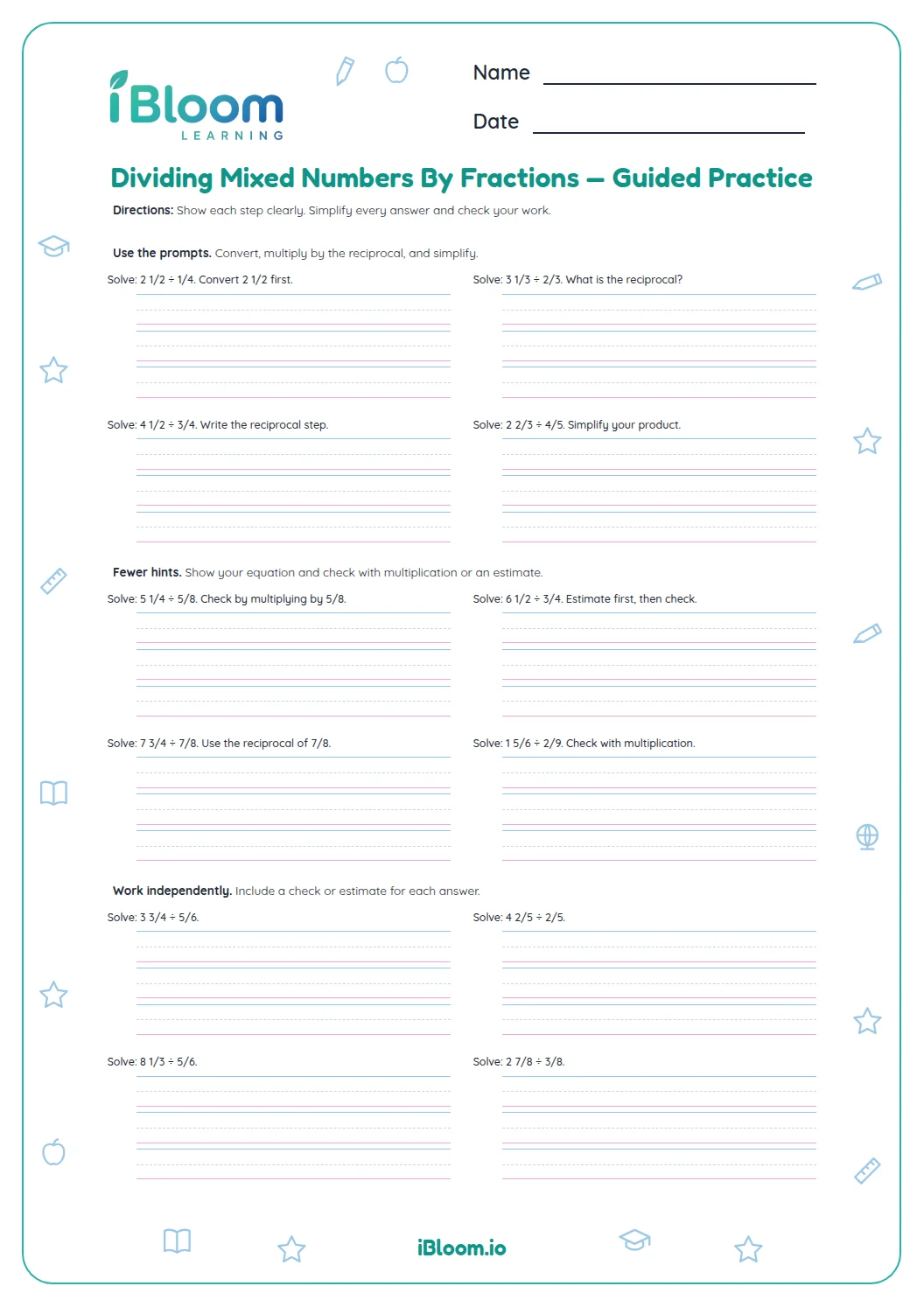
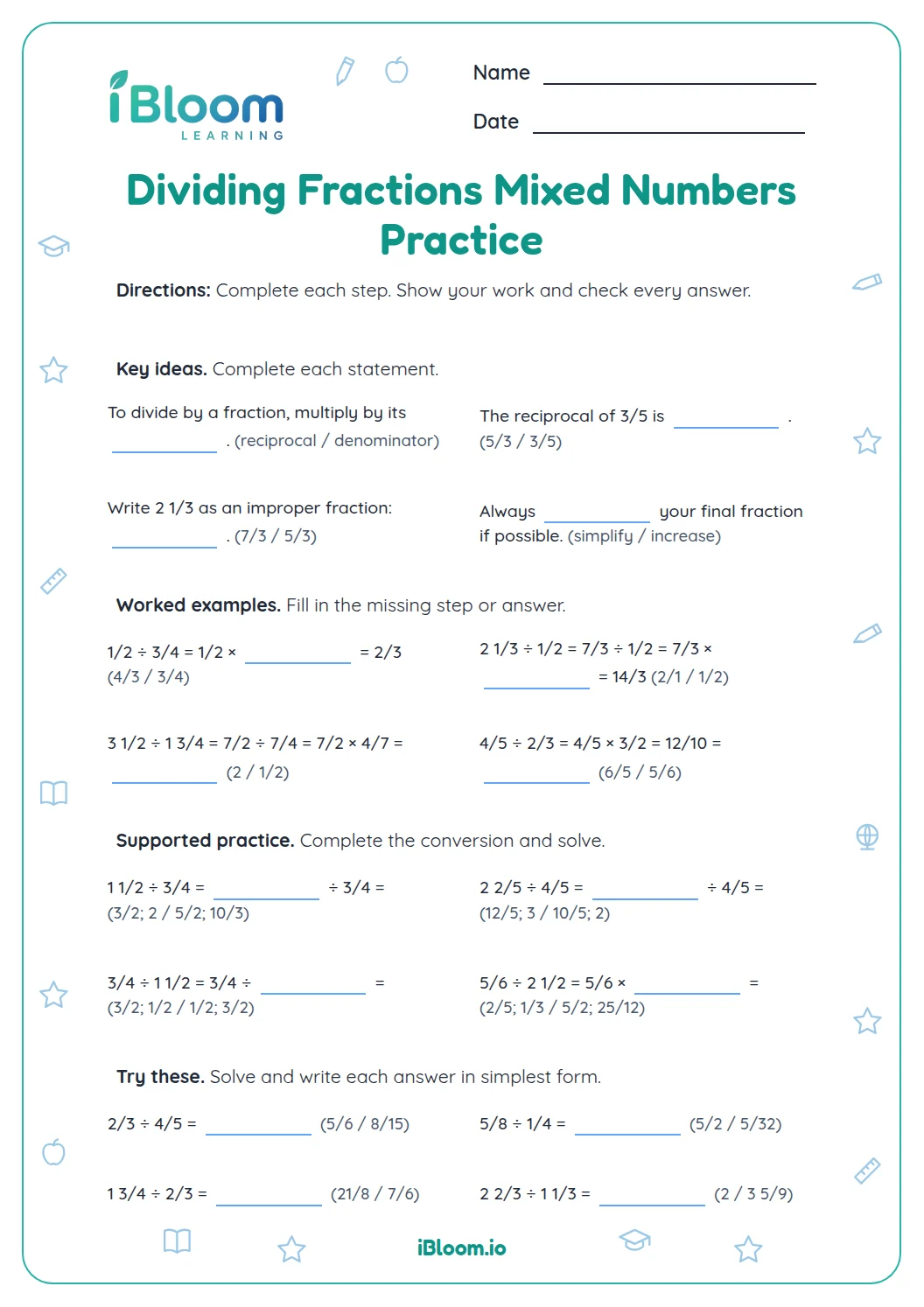
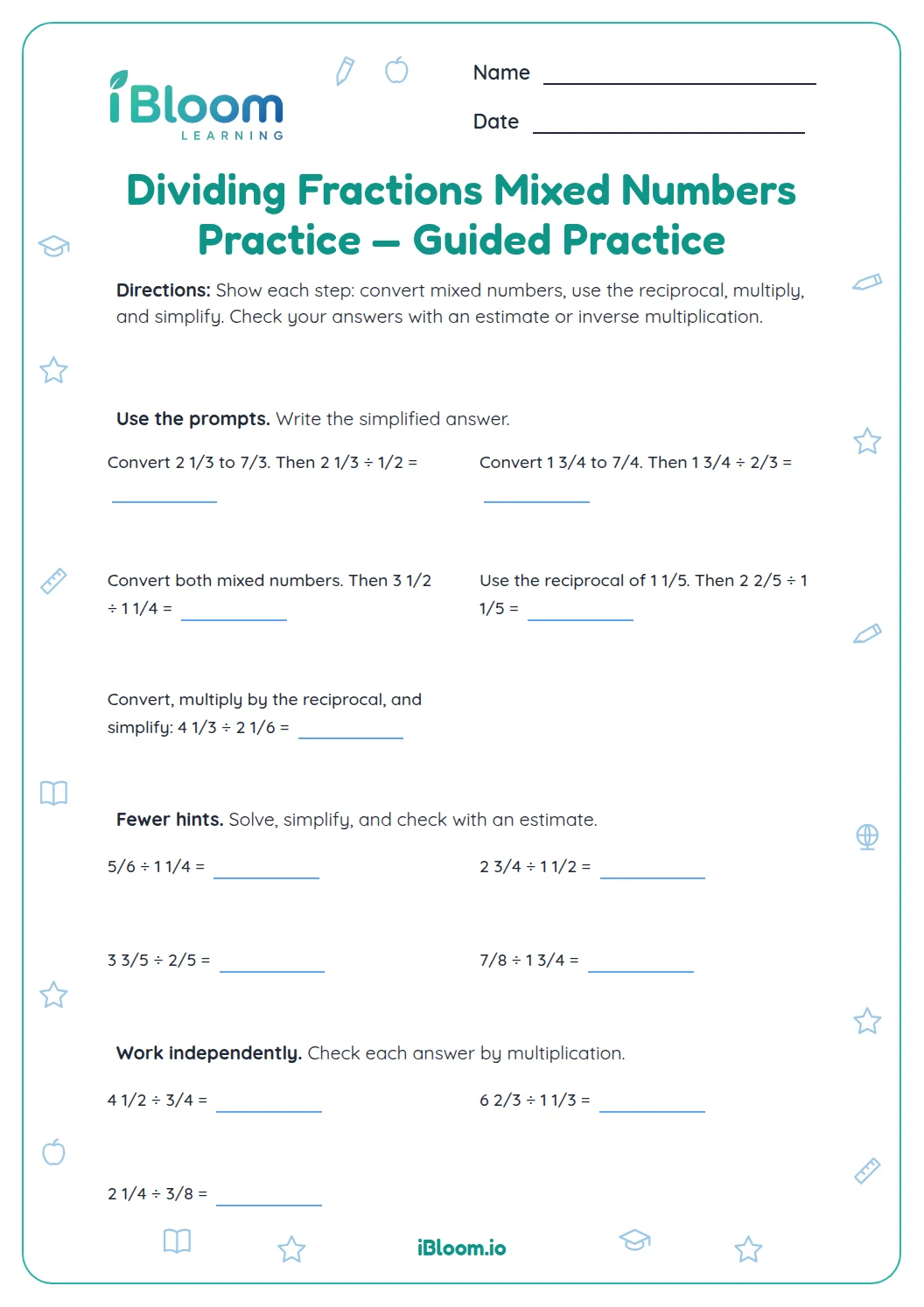
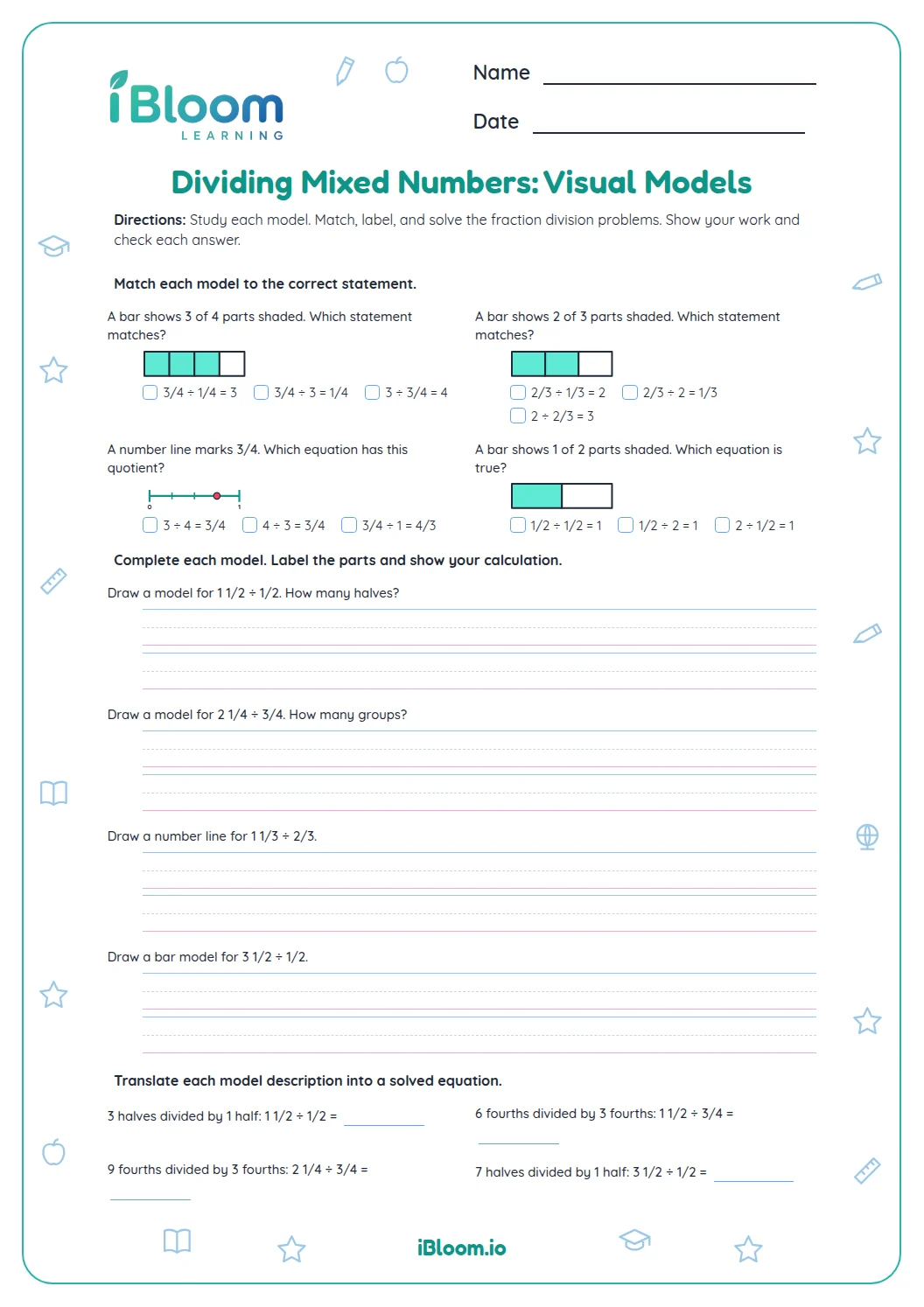
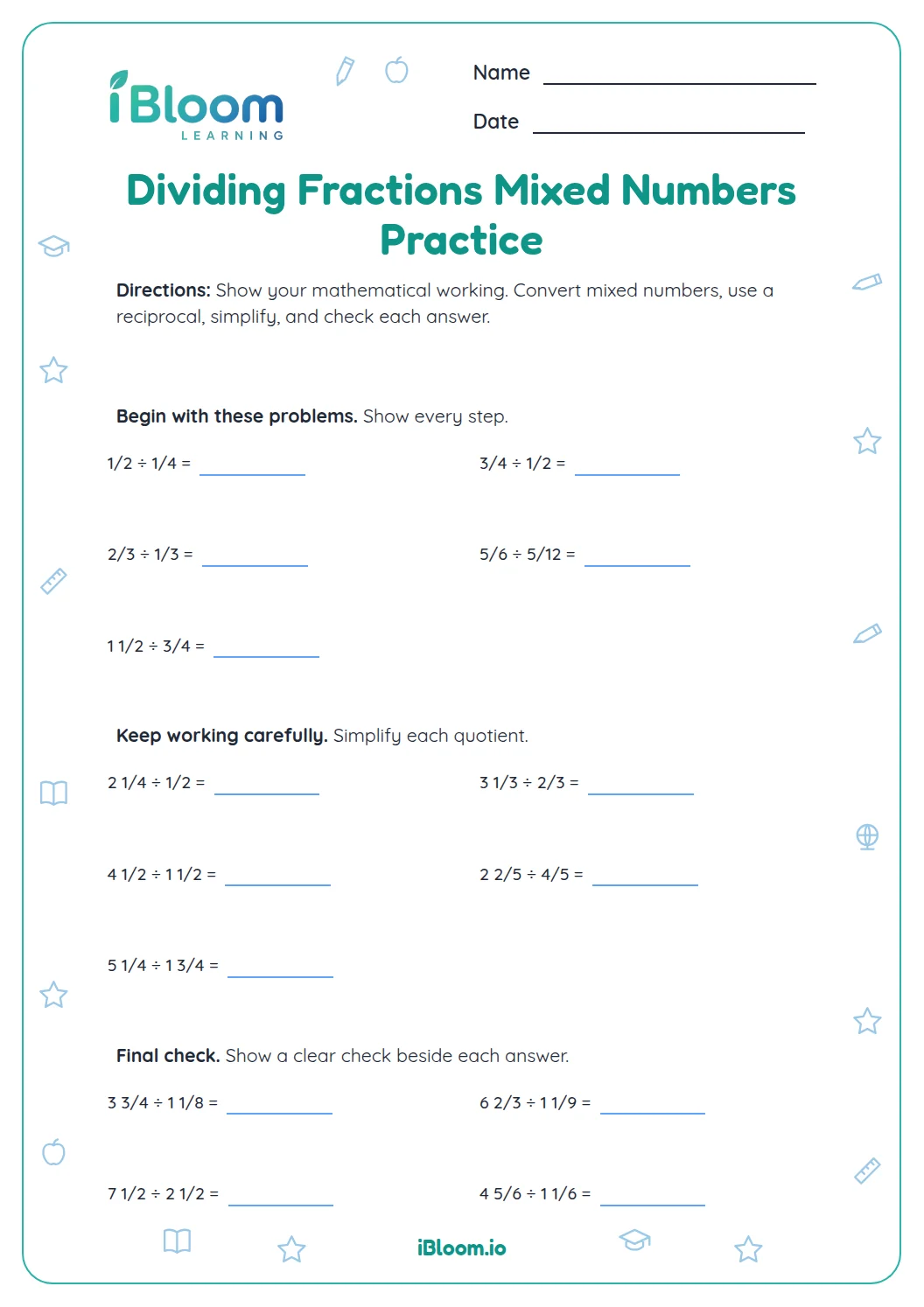
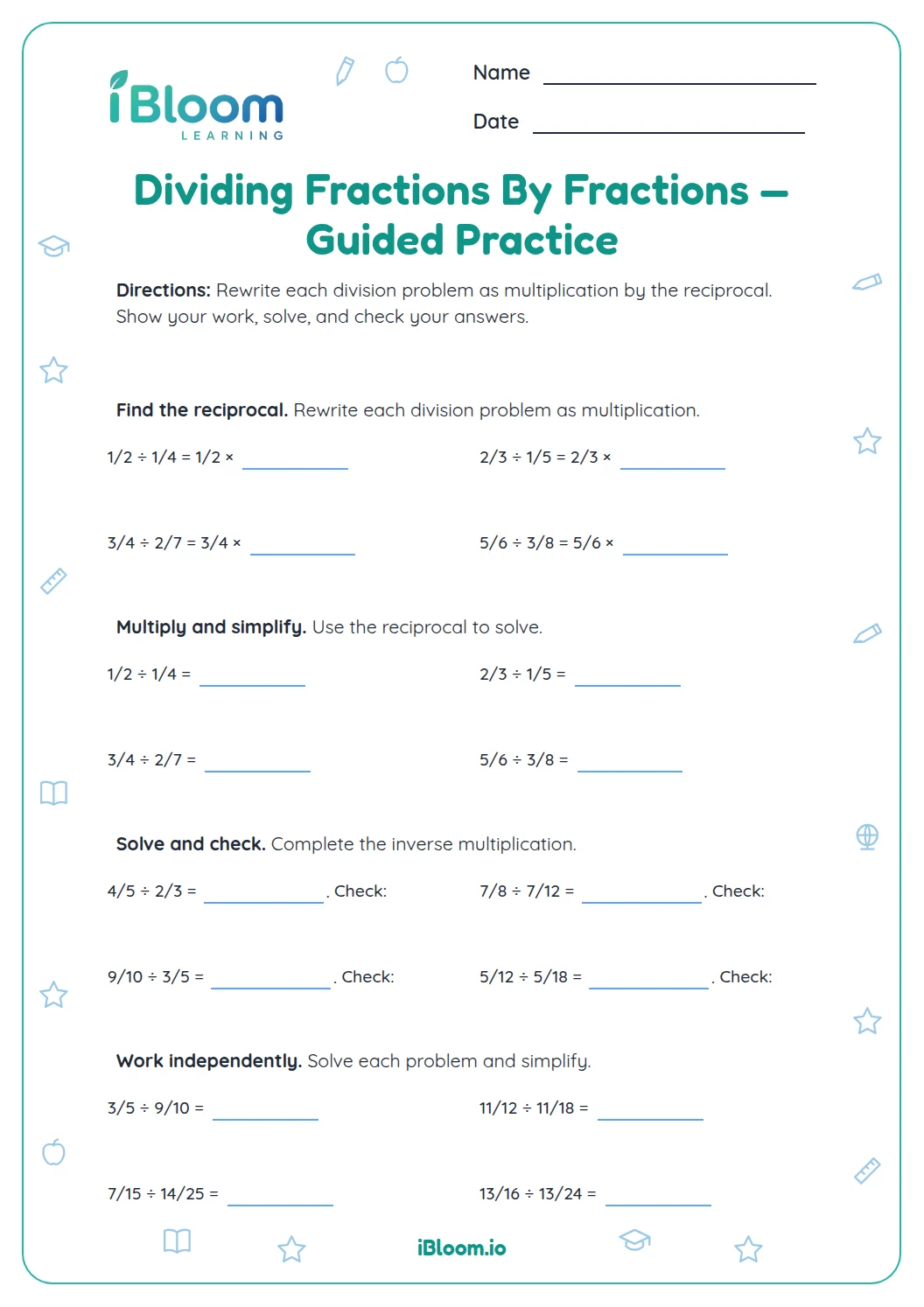
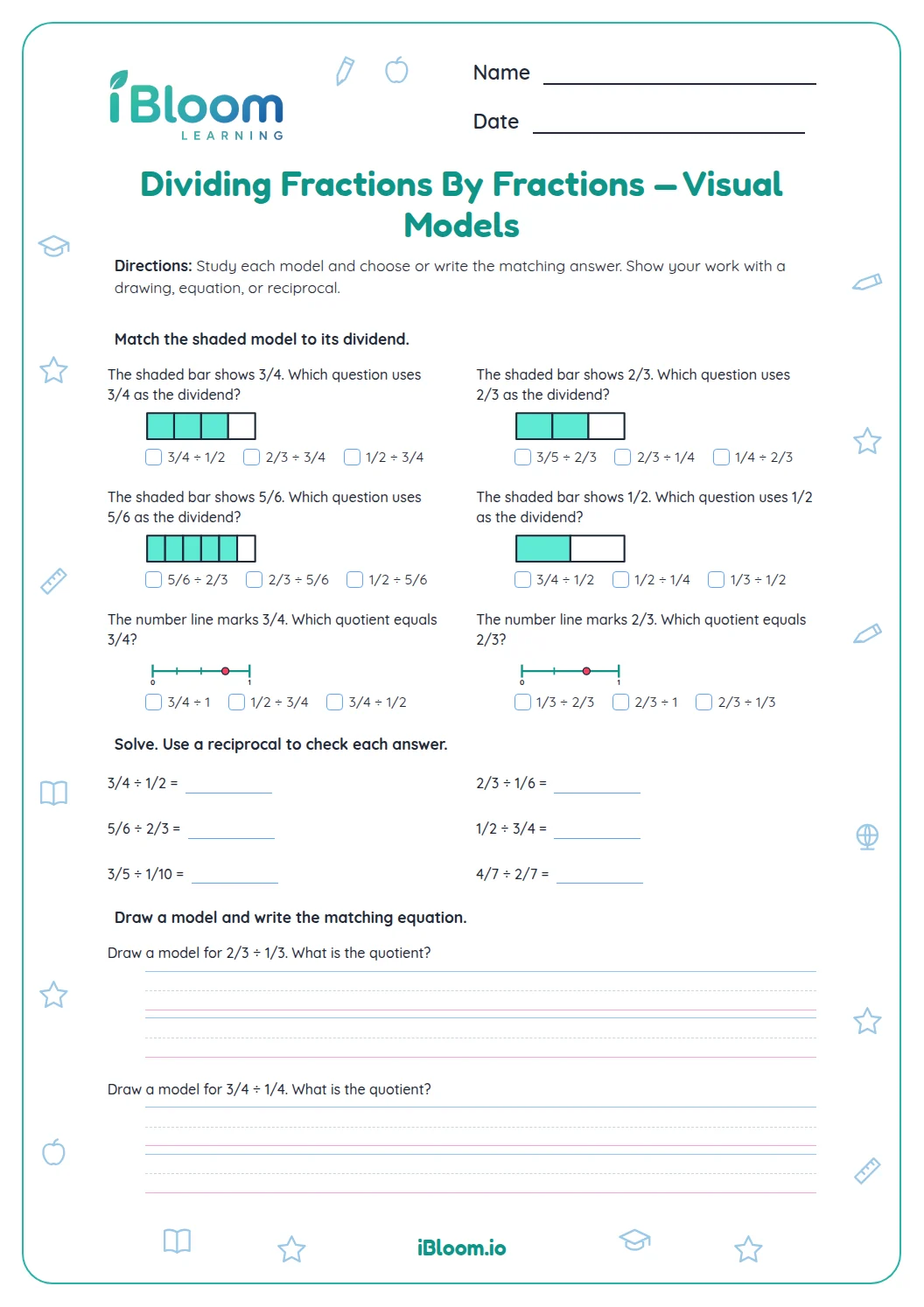
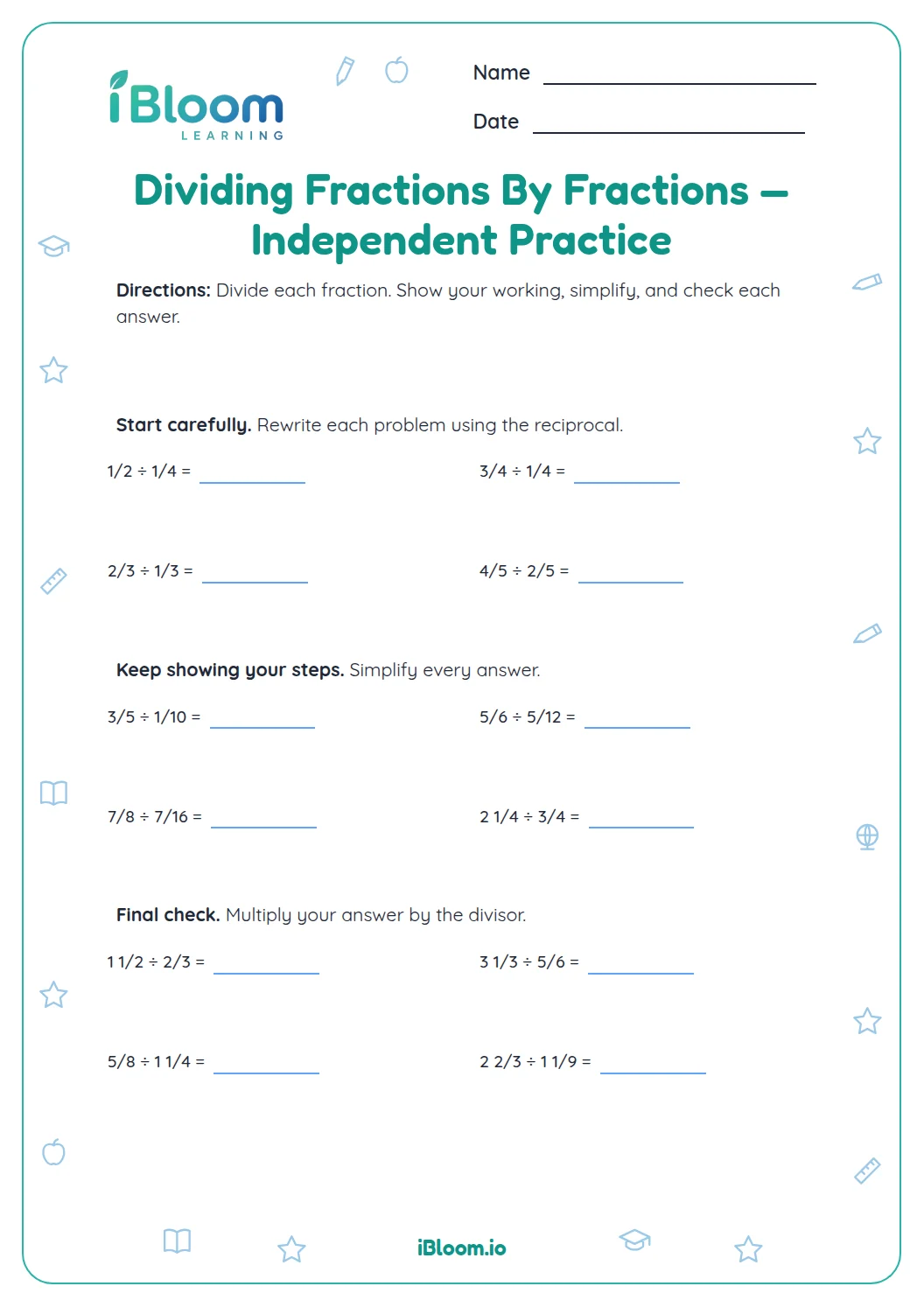
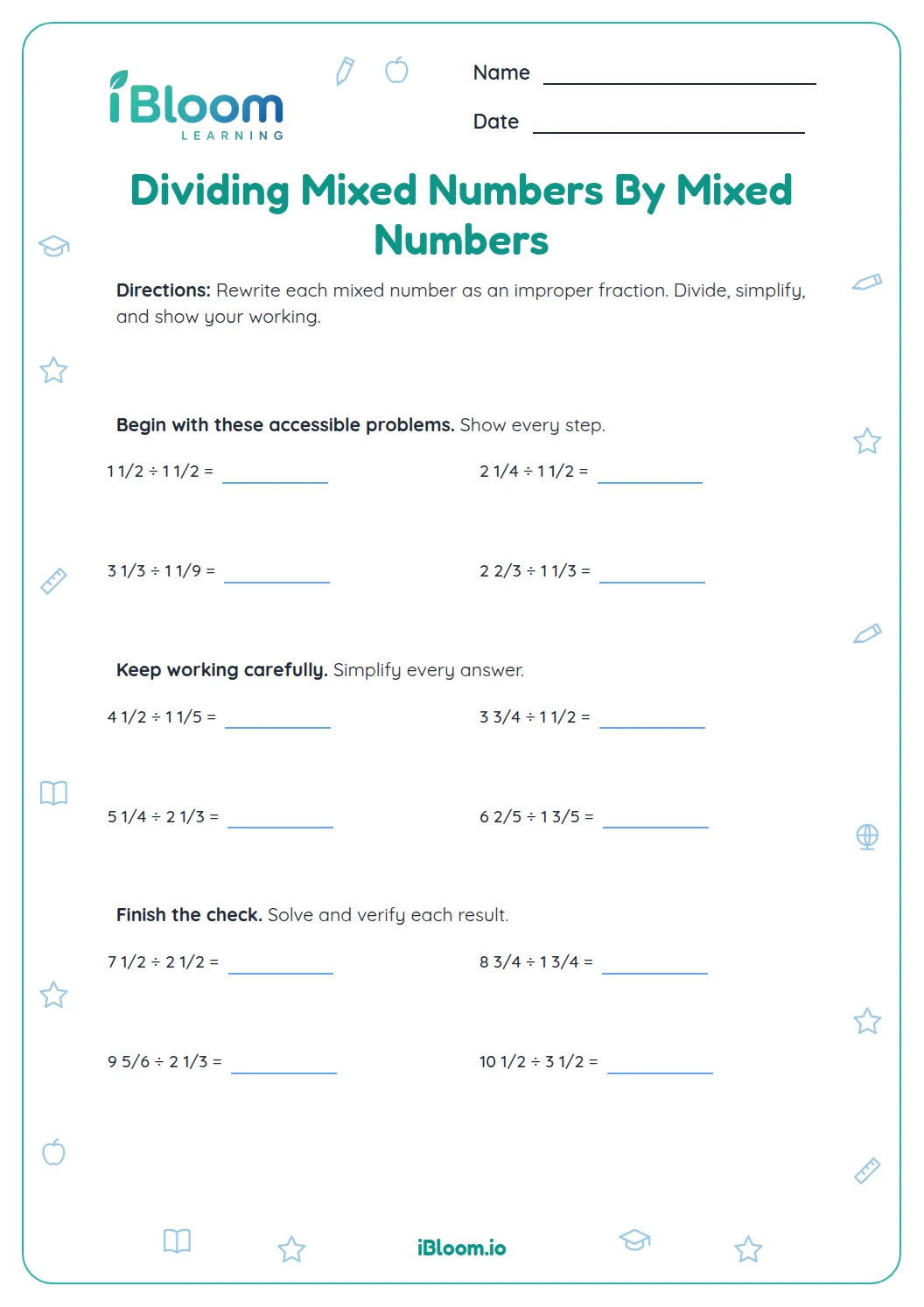
This free printable Grade 5 worksheet practices dividing mixed numbers by fractions through 18 questions in 5 parts. It includes direct practice, reasoning or checking, and application items, followed by a separate answer key.
Aligned to 5.NF.B.7
How do you divide a mixed number by a fraction?
First rewrite the mixed number as an improper fraction. Then keep the first fraction, change division to multiplication, and use the reciprocal of the divisor. Reduce the product and convert it to a mixed number if needed.
Question 1 is 10 5/6 ÷ 11/12. Convert to 65/6 × 12/11; the quotient is 130/11, or 11 9/11.
- 110 5/6 ÷ 11/12
- 265/6 × 12/11
- 3130/11 = 11 9/11
Why use the reciprocal?
Division asks how many divisor-sized groups fit in the starting value. Multiplying by the reciprocal is the equivalent fraction operation; multiplying by the original divisor is a common error.
What does independent practice include?
18 questions include direct quotients, a multiple-choice rewrite, an error correction, and four portioning contexts. The key simplifies each quotient, including the 11 9/11 result in question 1.
How can you use this worksheet?
- 1Convert each mixed number to an improper fraction.
- 2Change division to multiplication by the reciprocal.
- 3Cancel common factors before multiplying when possible.
- 4Reduce the quotient and convert to a mixed number.
- 5For a context question, label the number of groups or portions.
What mistakes should students check?
The mistake
Keeping the divisor instead of using its reciprocal.
The fix
Change ÷ a/b into × b/a after converting the first value to an improper fraction.
The mistake
Dividing the whole number and fraction parts separately.
The fix
Convert the entire mixed number to one improper fraction before dividing.
The mistake
Stopping at an unsimplified or improper result.
The fix
Reduce the fraction, then write a mixed number when the quotient is greater than one.
Common Core alignment
Interpret and solve division involving fractions in real-world contexts.
On this sheet: Use division to determine how many fraction-sized groups fit in a quantity.
Show the official wordingHide the official wording
Apply and extend previous understandings of division to divide unit fractions by whole numbers and whole numbers by unit fractions.
What to practice next
Make more practice
Further reading
Questions parents and teachers ask
What is 10 5/6 ÷ 11/12?
The quotient is 11 9/11. Convert 10 5/6 to 65/6, then multiply by 12/11. Cancel 12 and 6 to get 130/11, which is 11 9/11 as a mixed number. Reducing before multiplying can make the arithmetic shorter and easier to check.
Why do you convert a mixed number first?
Convert the whole mixed number to an improper fraction before applying the fraction division rule. This preserves the starting value and gives one fraction to multiply by the reciprocal of the divisor. Converting back to a mixed number helps communicate quotients greater than one.
How do you find the reciprocal of 5/6?
Swap the numerator and denominator: the reciprocal of 5/6 is 6/5. In question 17, dividing 2 3/4 by 5/6 becomes multiplying 11/4 by 6/5. The reciprocal keeps the quotient equivalent to the original division. Writing the divisor upside down changes division into the equivalent multiplication step.
Can the quotient be larger than the starting mixed number?
Yes. When the divisor is less than one, the quotient counts how many small groups fit into the starting amount and may be larger. For instance, dividing a length by 1/4 yard asks for the number of quarter-yard pieces.
What should the word-problem answers represent?
They represent how many equal portions fit in the starting quantity. Each story names both the total amount and the portion size, and the key reports the number of portions that can be made. Students can use multiplication to confirm each quotient.