





About this worksheet
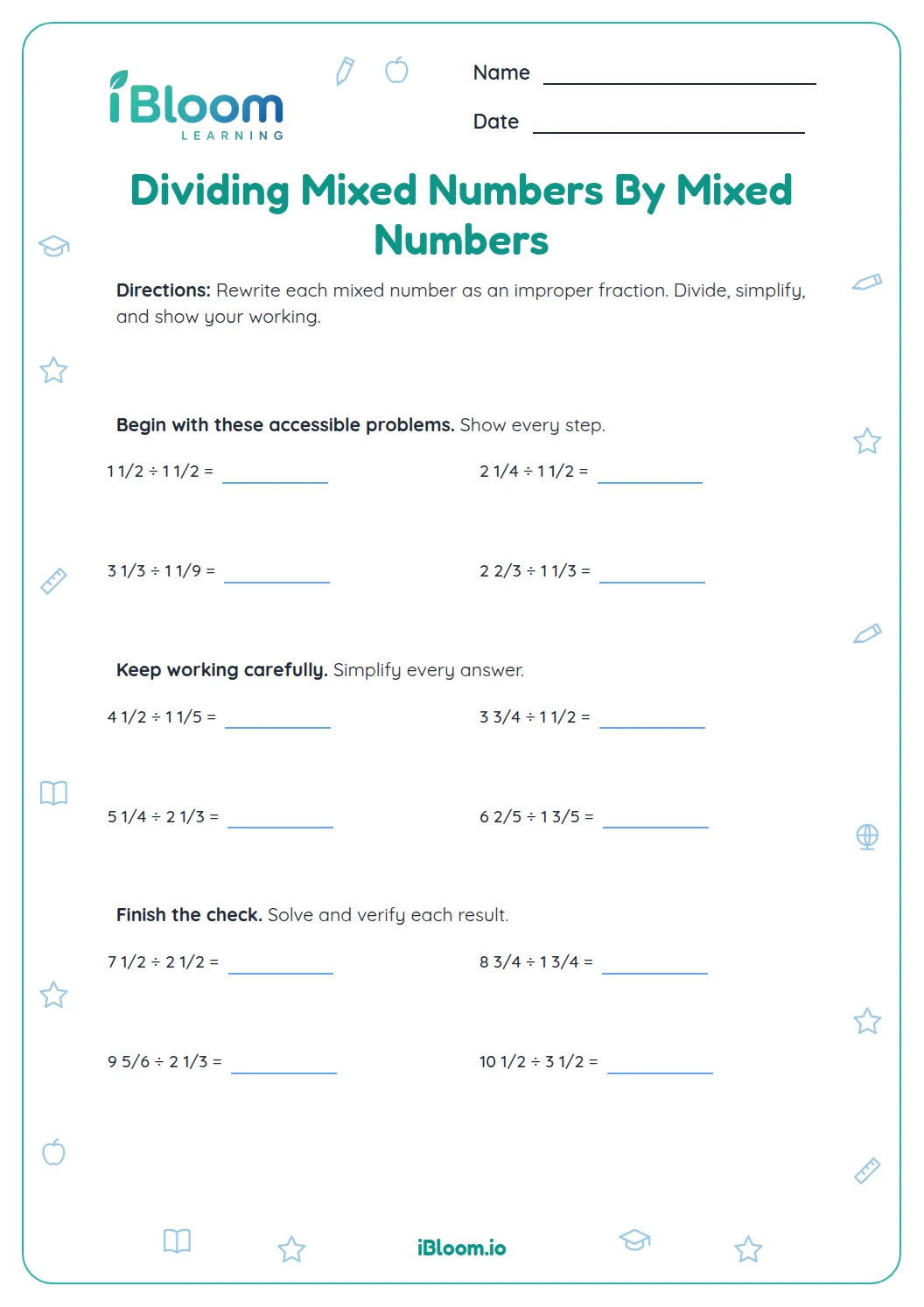
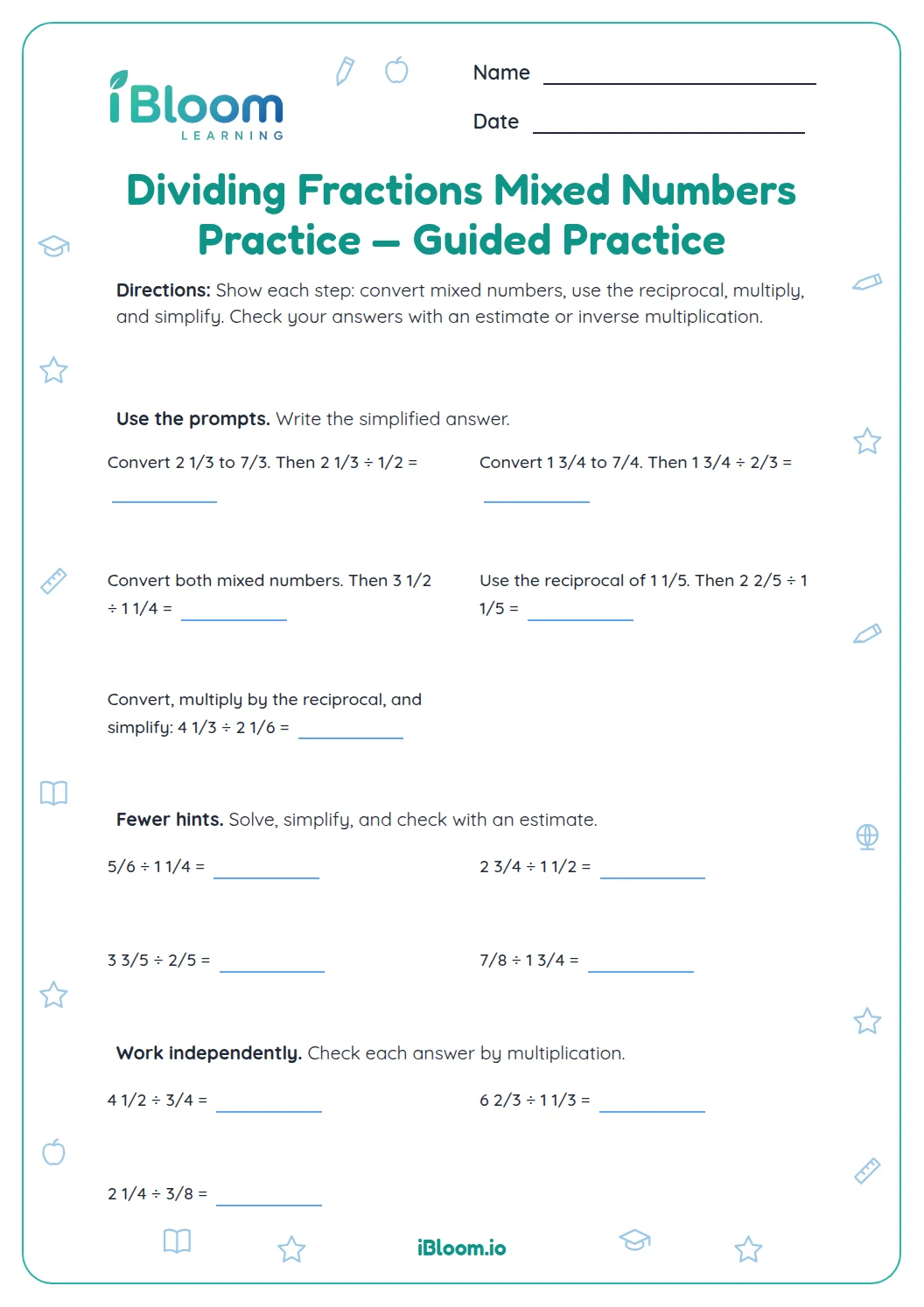
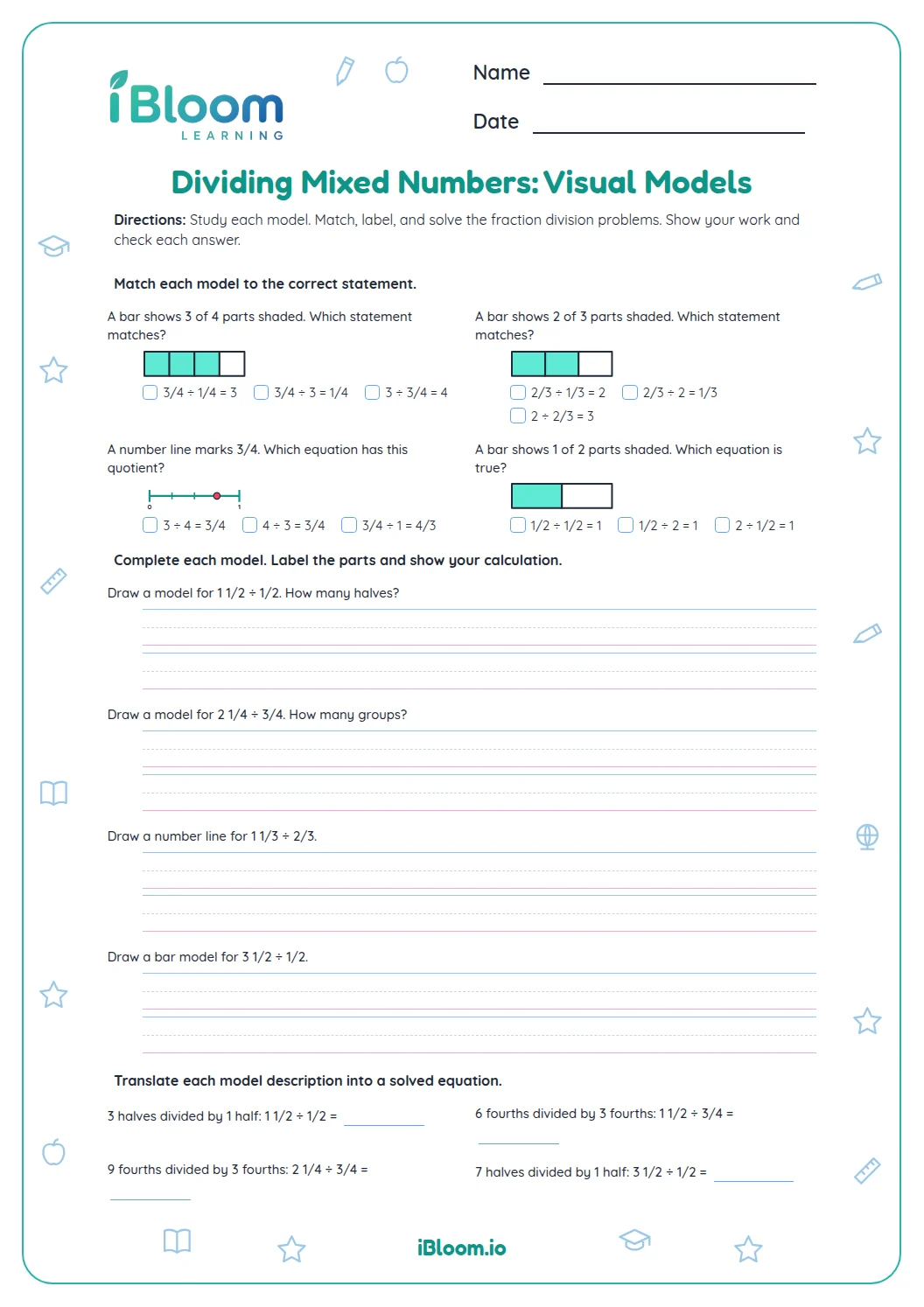
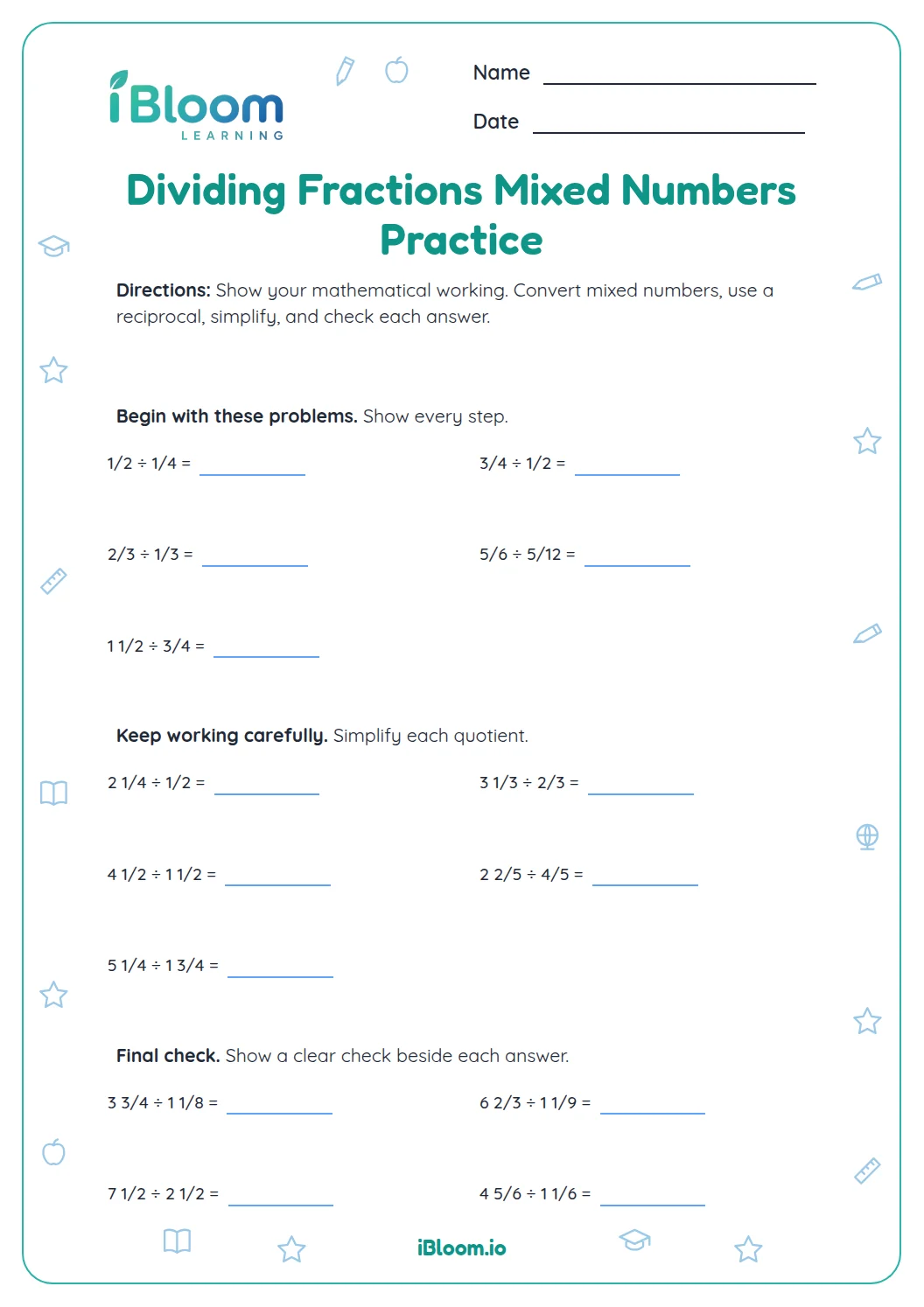
This Grade 5 printable gives students focused practice dividing one mixed number by another. Students convert to improper fractions, multiply by the reciprocal, simplify, and check quotients across 14 problems on two worksheet pages. The answer key corrects 2 7/8 ÷ 1 3/4 to 23/14, or 1 9/14.
Aligned to 6.NS.A.1
How do you divide two mixed numbers?
Rename both mixed numbers as improper fractions, then multiply by the reciprocal of the divisor. For 2 7/8 ÷ 1 3/4, calculate 23/8 × 4/7 = 23/14, or 1 9/14.
This worked example uses the first problem on the sheet. Convert each mixed number before taking the reciprocal, then simplify the product.
- 1Rename both mixed numbers as improper fractions, then multiply by the reciprocal of the divisor. For 2 7/8 ÷ 1 3/4, calculate 23/8 × 4/7 = 23/14, or 1 9/14.
What will students practice?
The first seven problems build a steady routine with mixed-number quotients. The second set continues with more quotients and asks students to show an equation or check by multiplying the quotient by the divisor.
How can students check a quotient?
Multiply the quotient by the original divisor. The product should equal the dividend. Also simplify the quotient and check that its size makes sense before moving on.
A simple practice routine
- 1Identify the dividend and divisor.
- 2Convert mixed numbers to improper fractions.
- 3Write the reciprocal of the divisor.
- 4Multiply and simplify the quotient.
- 5Multiply quotient by divisor to check.
Common mistakes and quick fixes
The mistake
Flipping the dividend instead of the divisor.
The fix
Keep the dividend in place and write the reciprocal of the divisor.
The mistake
Leaving an improper fraction when a mixed number is expected.
The fix
Divide the numerator by the denominator and write the remainder over the denominator.
The mistake
Skipping the check.
The fix
Multiply the quotient by the original divisor; the product should be the dividend.
Common Core alignment
These problems give students practice applying the standard with mixed numbers.
Compute quotients of fractions and solve fraction-division problems.
On this sheet: The questions directly practice dividing mixed numbers by mixed numbers with the stated numbers.
Show the official wordingHide the official wording
Interpret and compute quotients of fractions, and solve word problems involving division of fractions by fractions, e.g., by using visual fraction models and equations to represent the problem.
What to practice next
Make more practice
Further reading
Questions parents and teachers ask
Does the worksheet include an answer key?
Yes. The printable includes a separate key for all 14 quotient problems. Students can compare simplified answers after finishing the work, then use a mismatch to review the conversion, reciprocal, or multiplication step. The key includes each item in the same order as the worksheet, so students can locate the corresponding work quickly.
What method does this sheet practice?
Students rename mixed numbers as improper fractions, take the reciprocal of the divisor, multiply, and simplify. The later problems also prompt students to estimate or check by multiplying the quotient by the original divisor. Students can write the conversion and reciprocal beside the problem before multiplying, leaving a visible record of the method.
How can I help without solving a problem for my child?
Ask which number is the divisor and what it becomes when written as an improper fraction. Then ask which fraction should be flipped. These prompts keep the student responsible for choosing and carrying out each step. A small group can solve the first example together, then compare which step changed as the divisor changed.
Why does the quotient sometimes include a fraction?
The dividend may not contain an exact whole-number number of divisor-sized groups. A fractional part records the remaining portion; for example, 23/14 is 1 9/14. Encourage the student to do the conversion aloud and ask them to verify the product independently.
How long should students spend on the worksheet?
Plan for about 20 minutes, allowing time to show the reciprocal and multiplication for each problem. Students can check selected answers by multiplying each quotient by its divisor. The suggested time is an estimate; careful written work and checking may take longer for some students.