



About this worksheet
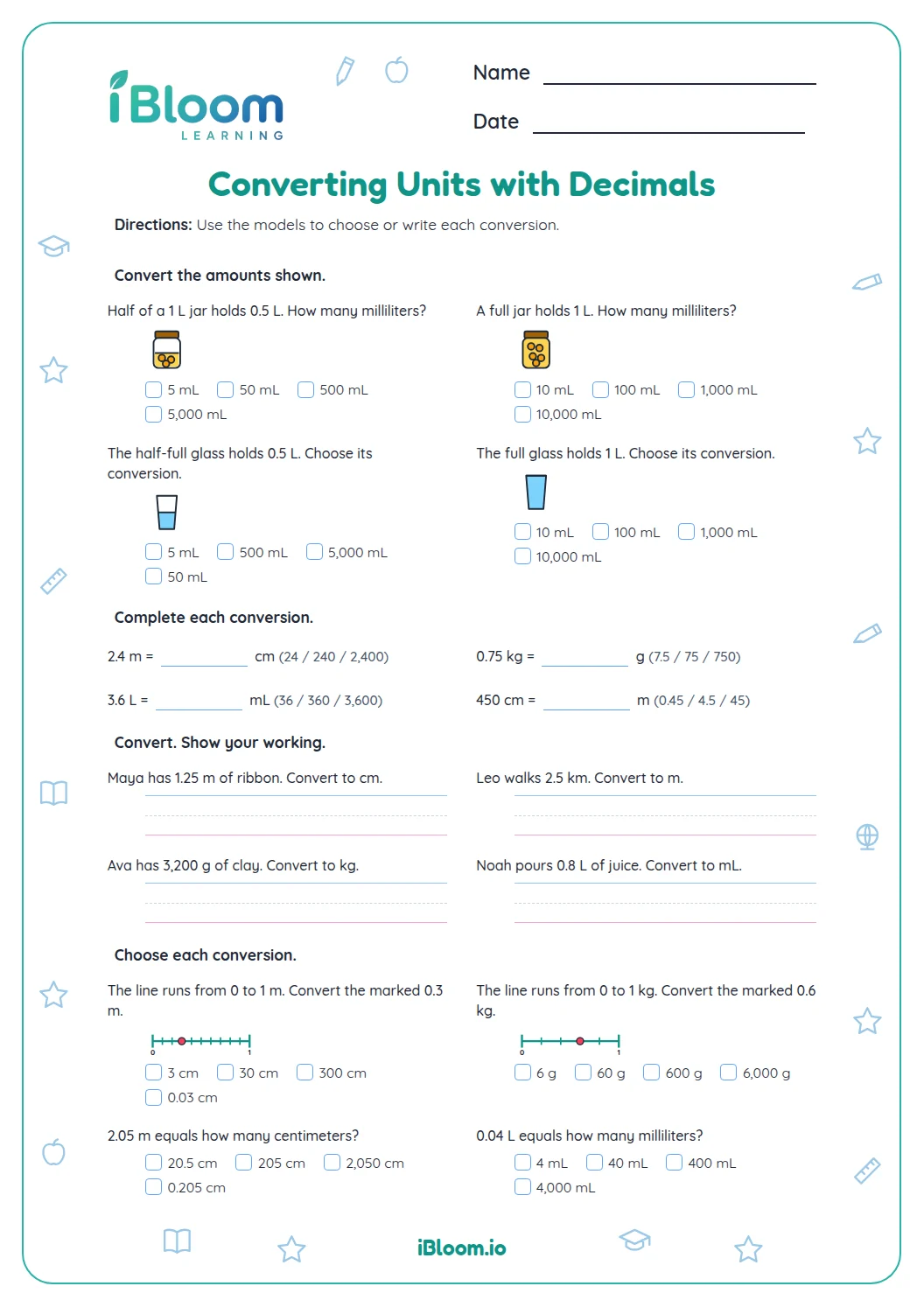
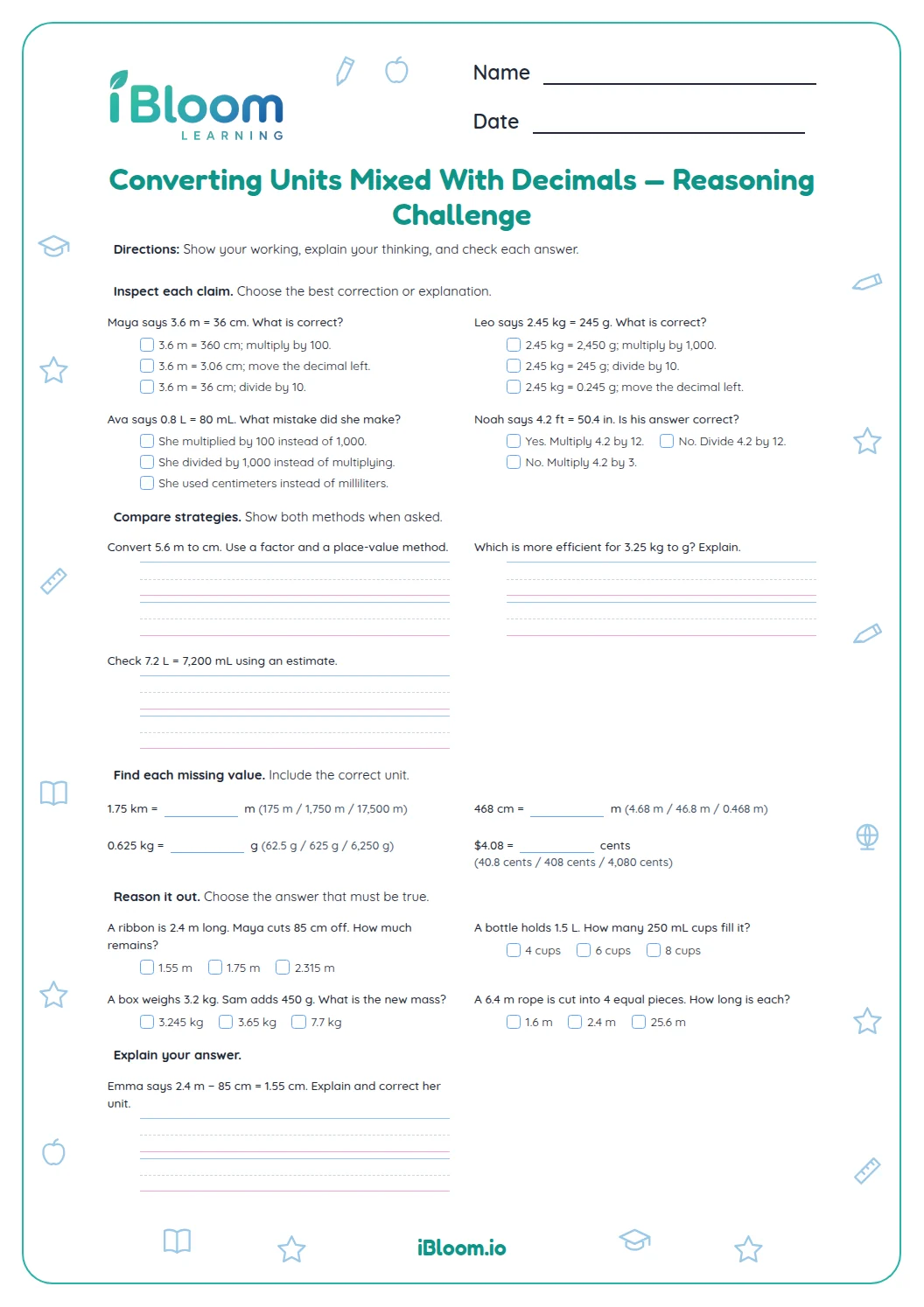
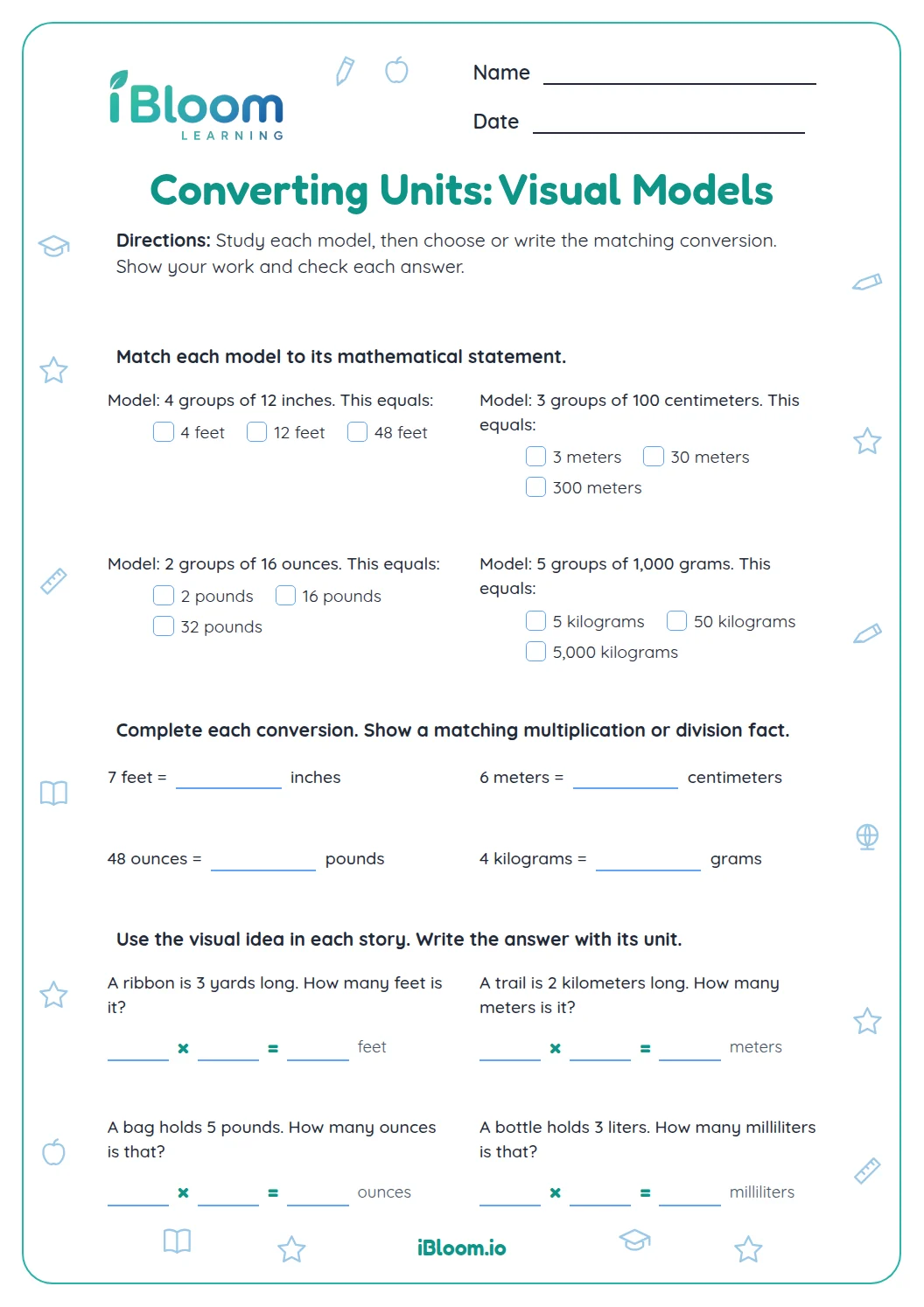
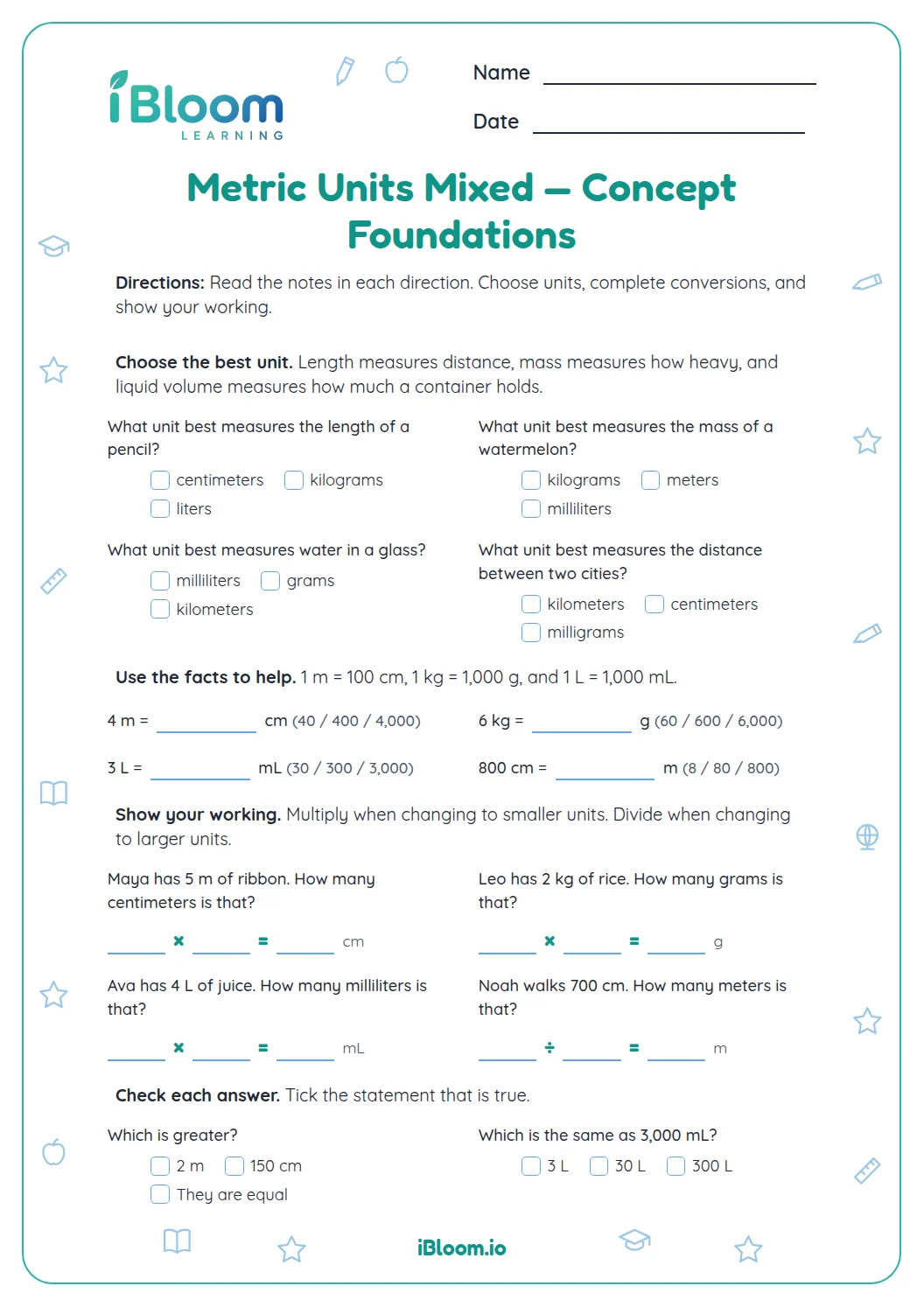
This free Grade 5 printable practices metric unit conversions with decimal measurements and short real-world problems. Students convert length, mass, and liquid volume using powers-of-ten relationships, then use conversions in short addition and subtraction stories. The page includes 16 questions in three parts, answer space for working, and a separate key. It supports CCSS 5.MD.A.1.
Aligned to 5.MD.A.1
Which metric relationships help with these conversions?
The worksheet uses meters and centimeters, kilometers and meters, grams and kilograms, and liters and milliliters. Each change uses a factor of 10, 100, or 1,000.
For question 1, 1 kilometer = 1,000 meters, so 2.4 × 1,000 = 2,400 meters. Question 12 reverses the direction: 940 millimeters ÷ 1,000 = 0.94 meters.
- 12.4 km × 1,000 = 2,400 m
- 2A smaller unit needs a larger number.
When do you multiply or divide?
When the answer uses smaller units, the number grows: meters become centimeters by multiplying by 100. When it uses larger units, the number shrinks: centimeters become meters by dividing by 100.
Keep the unit with each intermediate value. In question 13, convert 1.2 kilometers to 1,200 meters before adding 850 meters.
What does each part ask students to do?
Part A changes metric measurements to smaller units. Part B changes them to larger units. Part C uses conversions inside short stories. Every item has room to show a calculation, and the answer key is separate.
How to work through the sheet
- 1Write the units beside each value before calculating.
- 2Mark whether the target unit is smaller or larger.
- 3Choose the conversion factor and multiply or divide.
- 4For a story, convert all measurements to one unit before adding or subtracting.
- 5Check that the number grows for smaller units and shrinks for larger units.
Common mistakes and quick fixes
The mistake
Multiplying in both directions.
The fix
Ask whether the target unit is smaller; if it is larger, divide.
The mistake
Moving the decimal the wrong way.
The fix
Estimate the size first: 3 meters must be more than 3 centimeters.
The mistake
Adding different units directly.
The fix
Convert both measurements to the same unit before combining them.
Common Core alignment
This worksheet gives children practice applying the measurement and number skills described below.
Use decimal metric conversions to solve grade-level problems.
On this sheet: The questions ask students to decimal metric conversions in several contexts.
Show the official wordingHide the official wording
Convert among different-sized standard measurement units within a given measurement system (e.g., convert 5 cm to 0.05 m), and use these conversions in solving multi-step, real world problems.
What to practice next
Make more practice
Further reading
Questions parents and teachers ask
Which metric facts are used?
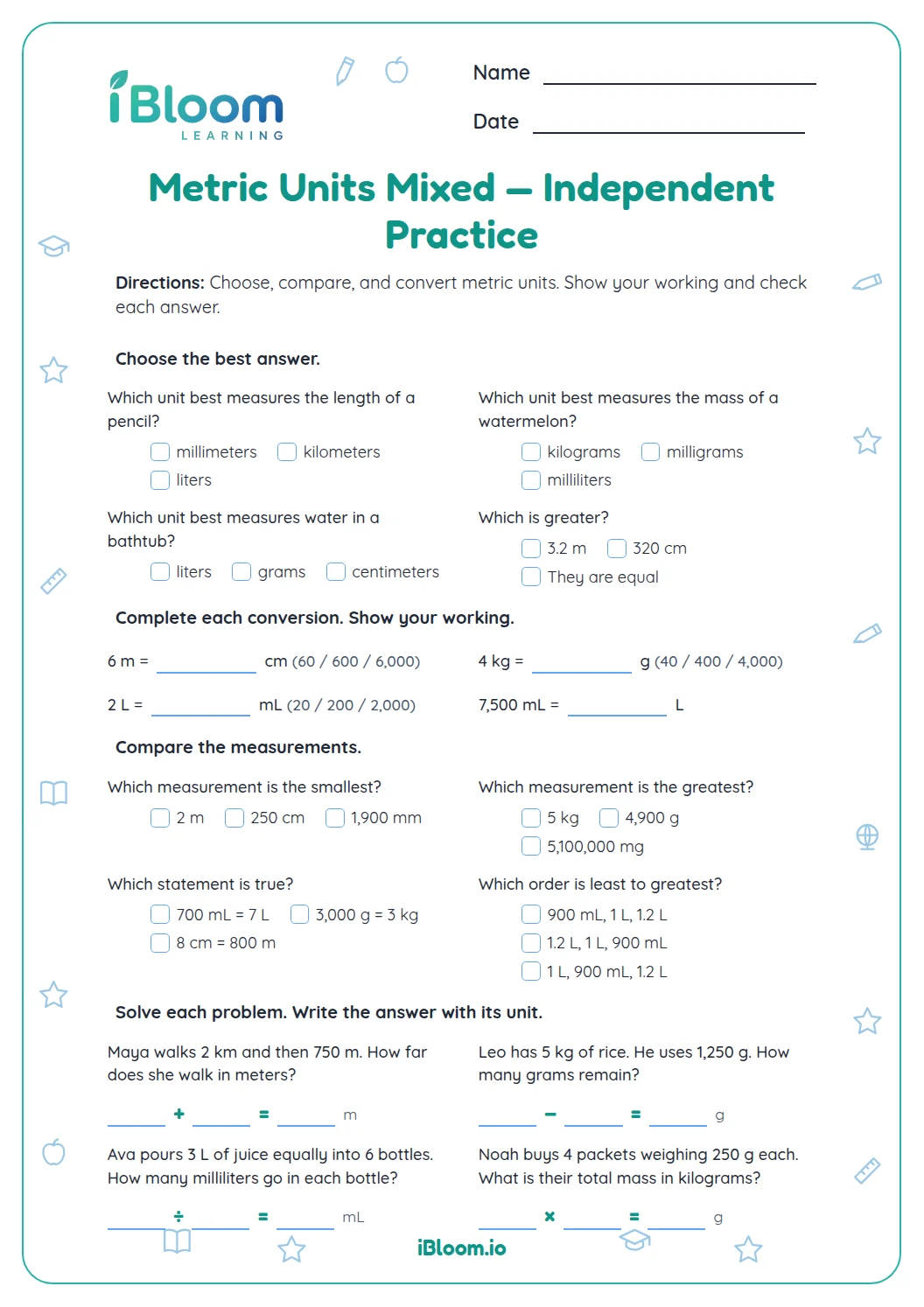
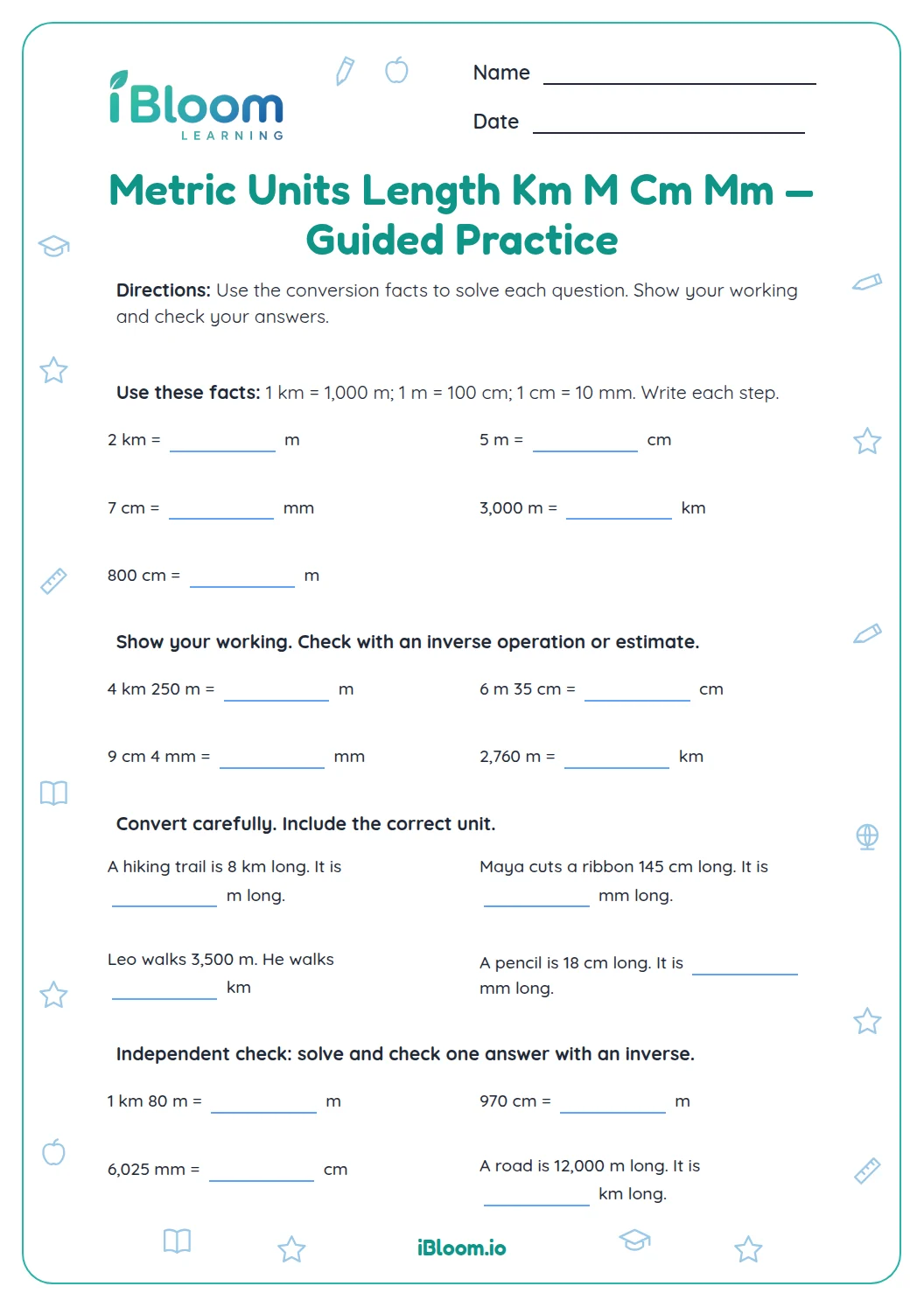
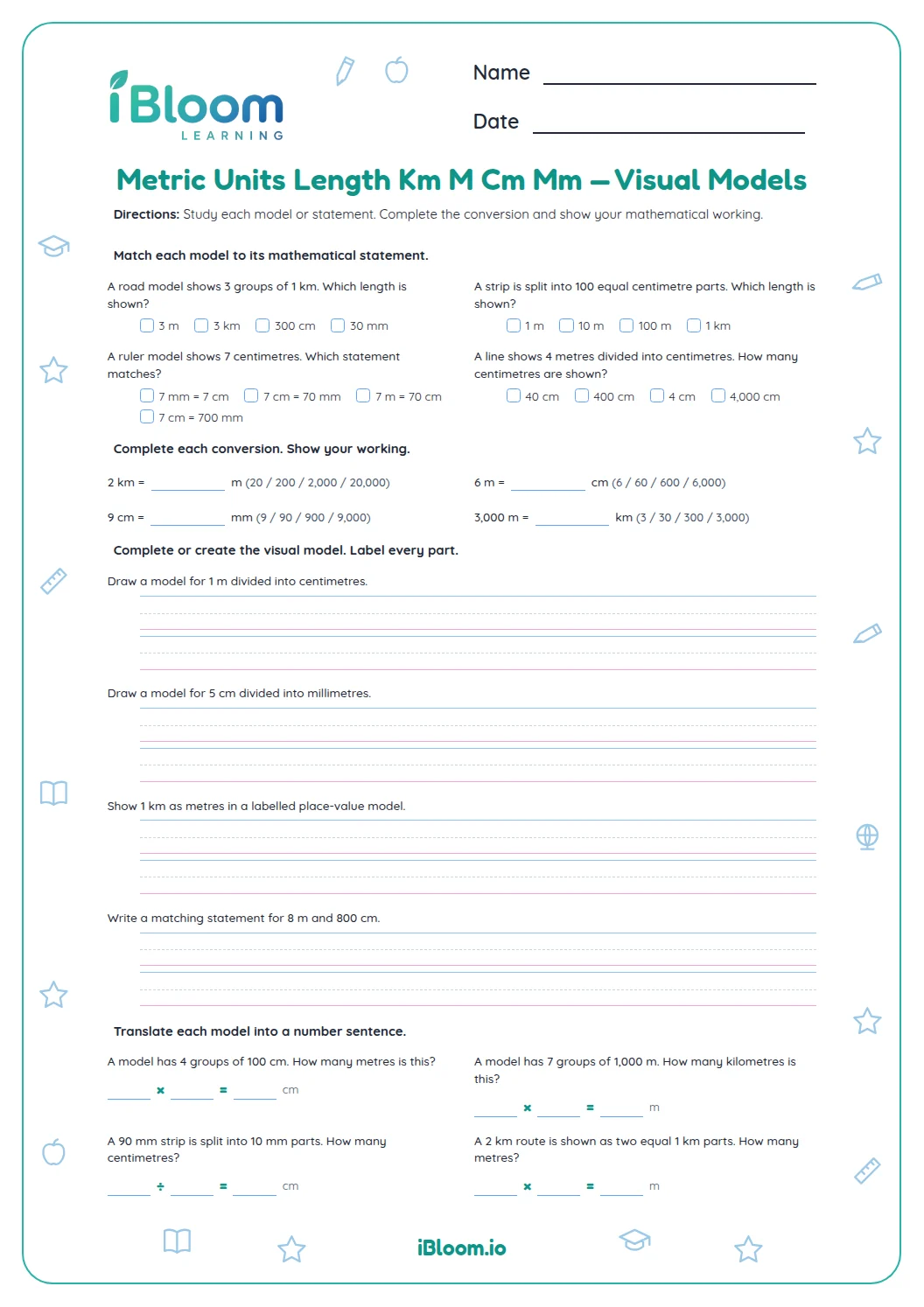
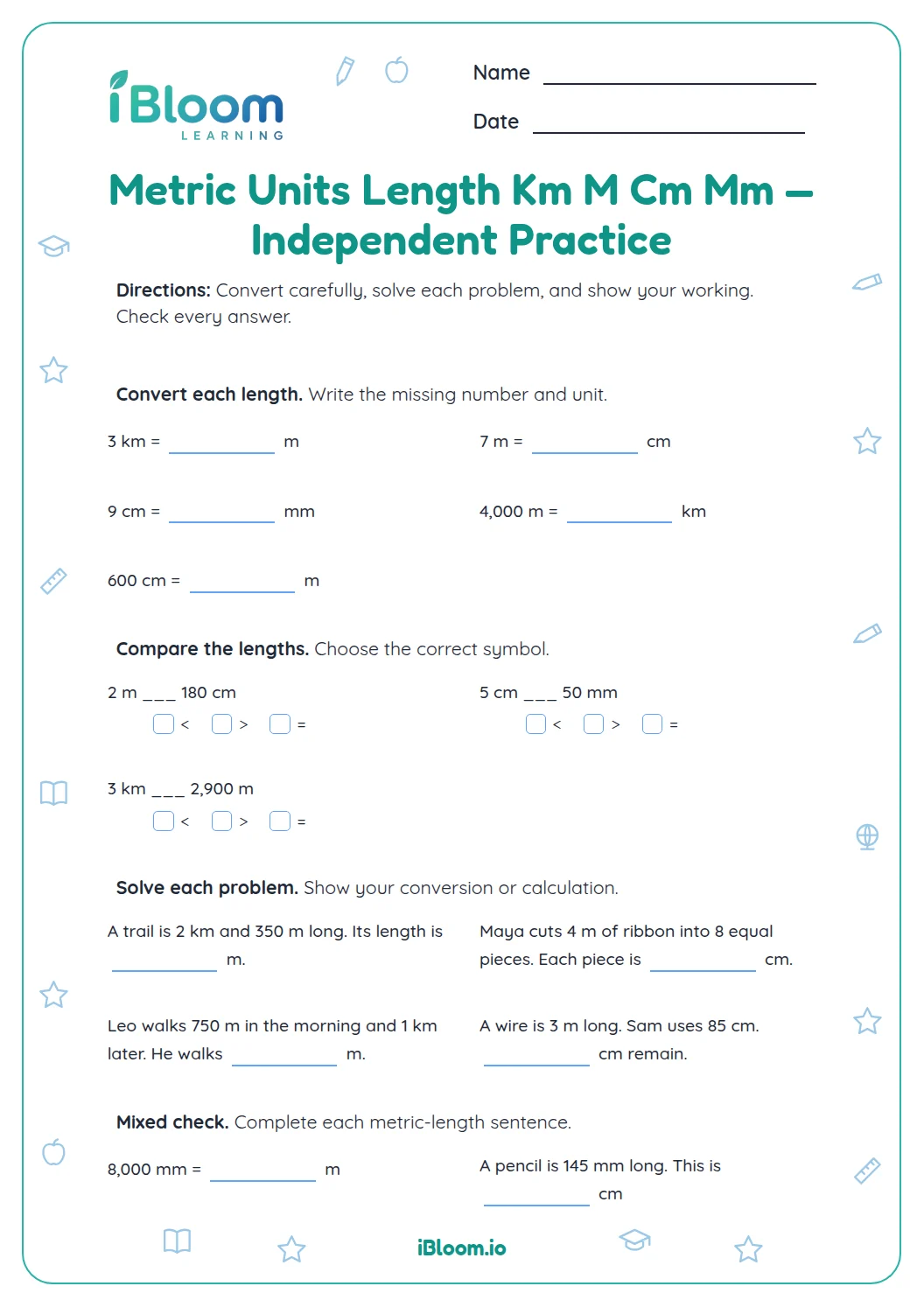
The questions use 1 km = 1,000 m, 1 m = 100 cm, 1 m = 1,000 mm, 1 kg = 1,000 g, and 1 L = 1,000 mL. These relationships let students shift between units by multiplying or dividing by powers of ten. The conversion facts are stated in the instructions for reference.
Why does the number change when the unit changes?
A smaller unit takes more units to measure the same amount, so the number gets larger. A larger unit takes fewer units, so the number gets smaller. For instance, 2.4 kilometers is 2,400 meters because each kilometer contains 1,000 meters.
How should students solve the hiking problem?
Convert 1.2 kilometers to 1,200 meters, then add the additional 850 meters. The total is 2,050 meters. Keeping both distances in meters makes the addition straightforward and gives a clear unit for the answer. Converting first also keeps the units consistent throughout the calculation.
What is a useful way to check a conversion?
Estimate before calculating. Since a meter is much smaller than a kilometer, the meter count should be larger than the kilometer count. For a conversion to larger units, the numerical value should decrease. The unit label should also match the question.
Is an answer key included?
Yes. The printable includes a separate answer key with the converted values and word-problem totals. Students can use the worksheet pages for practice, then an adult or student can check each answer against the key after completing the work.