

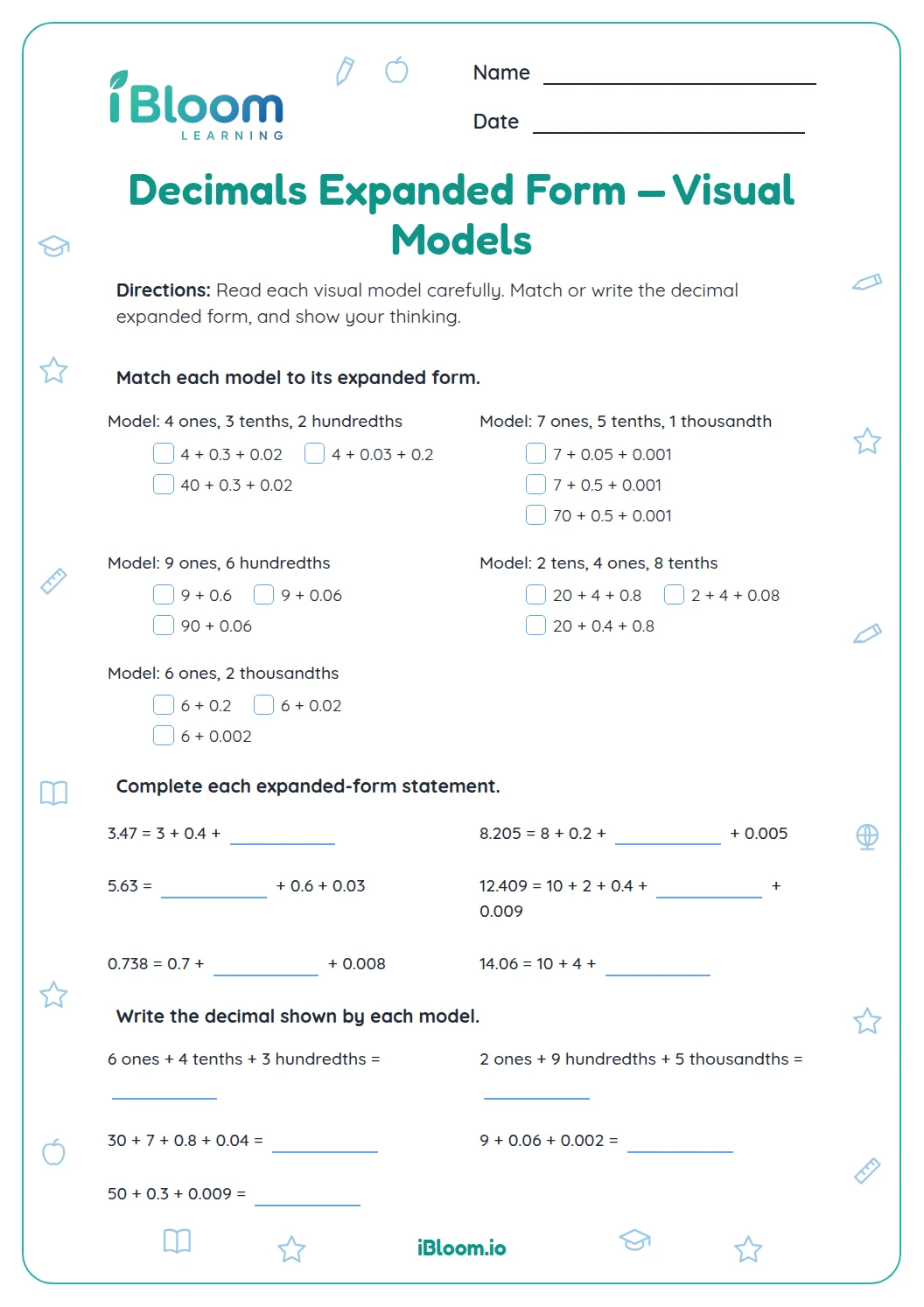
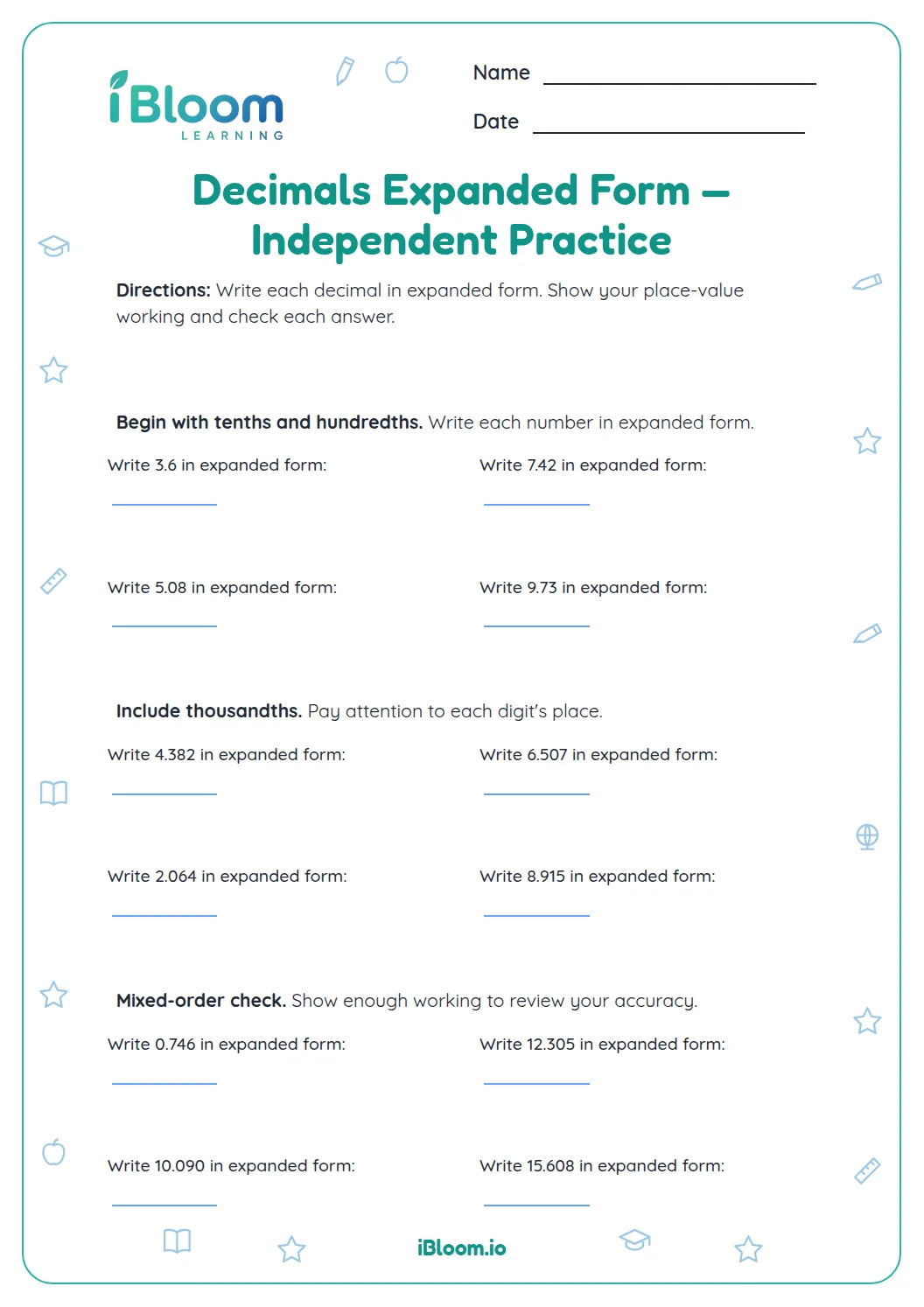
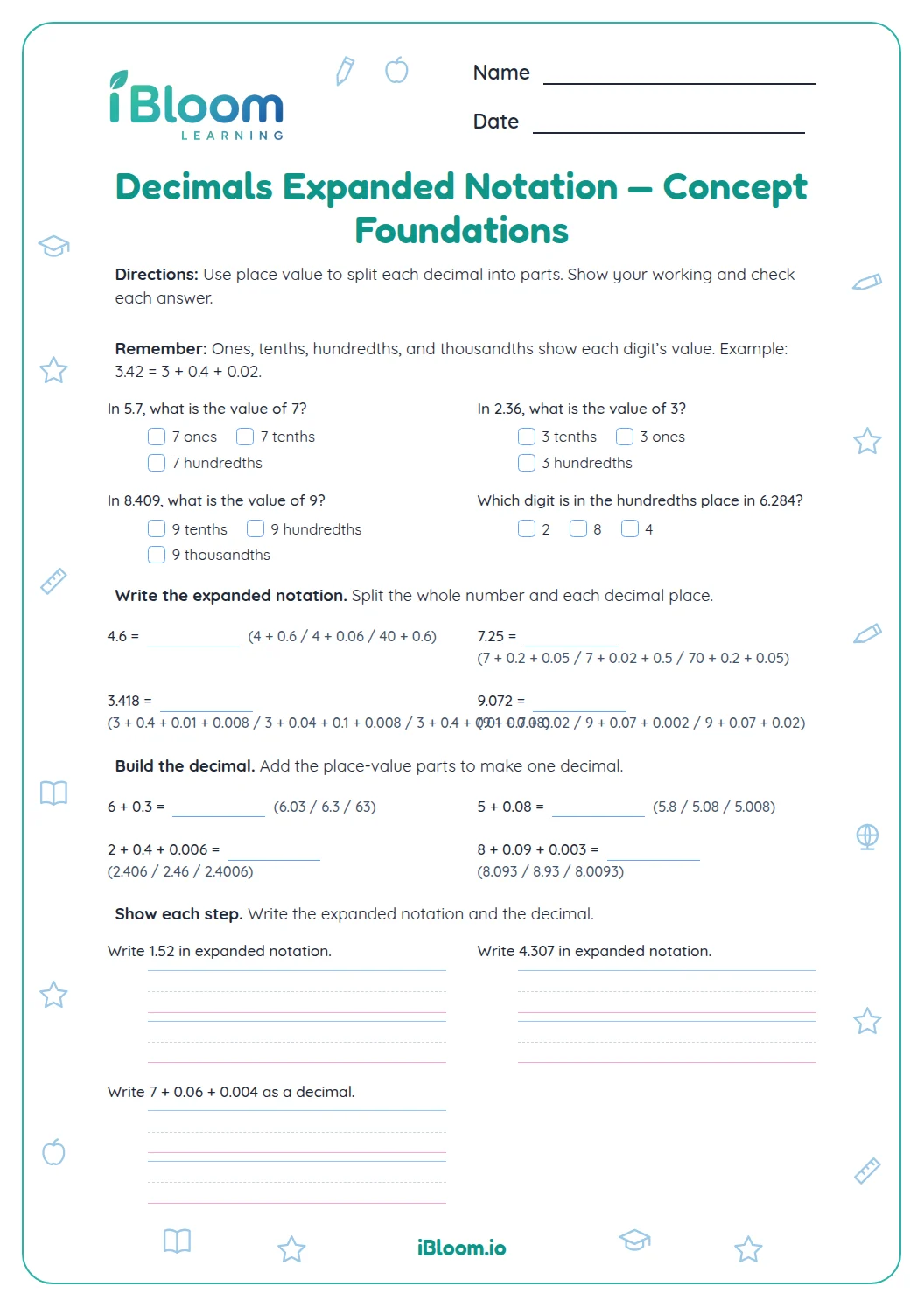
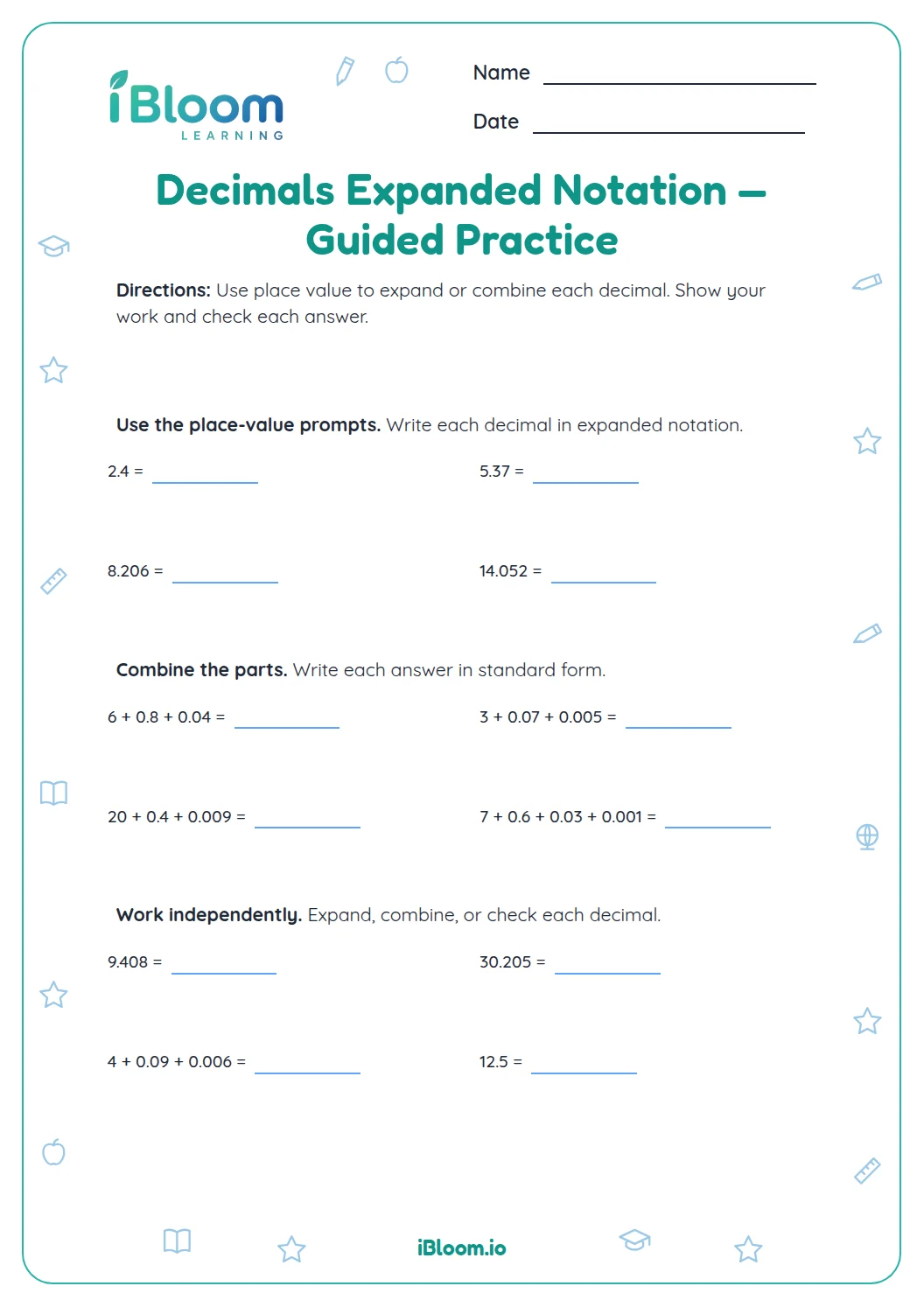
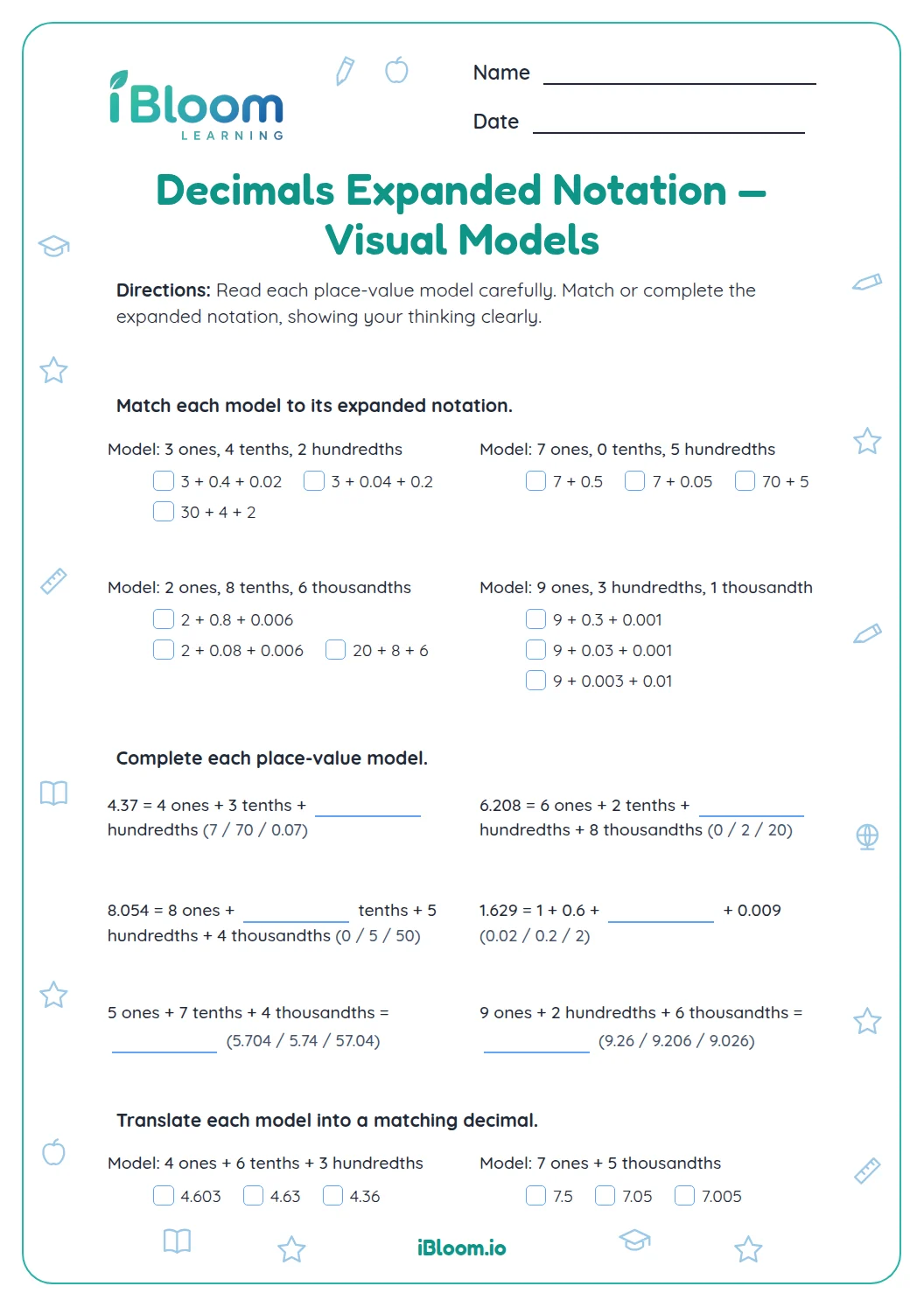
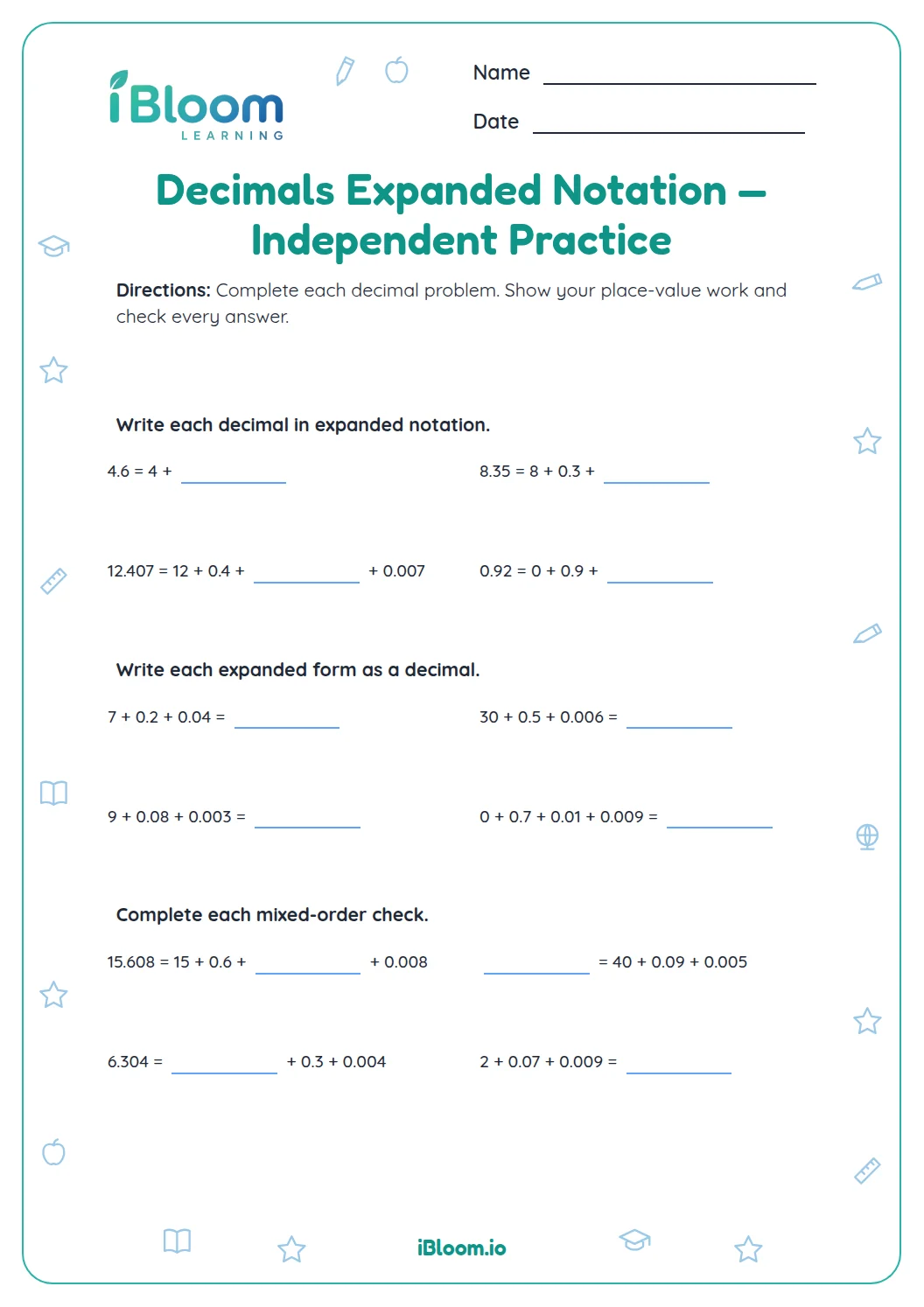
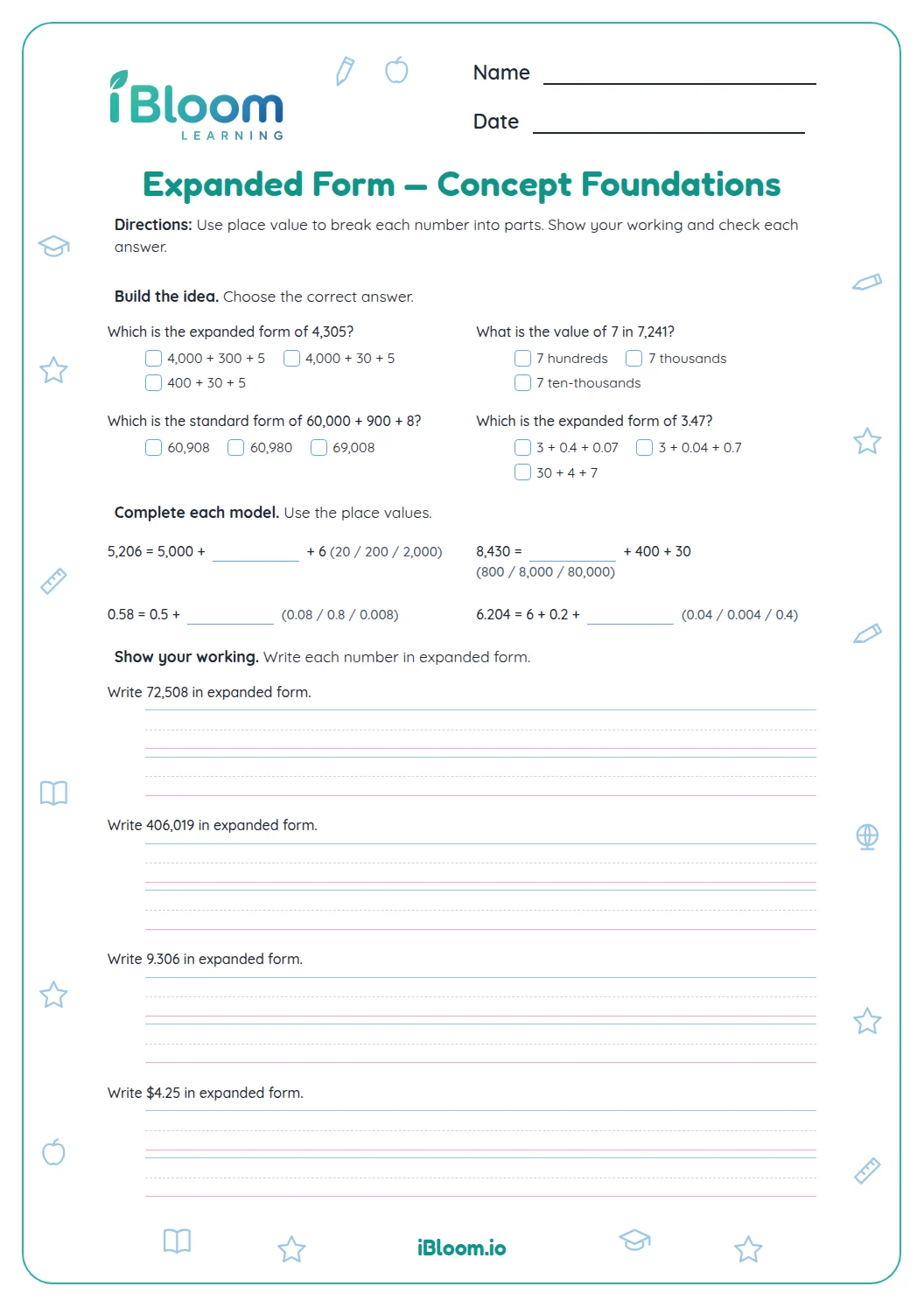
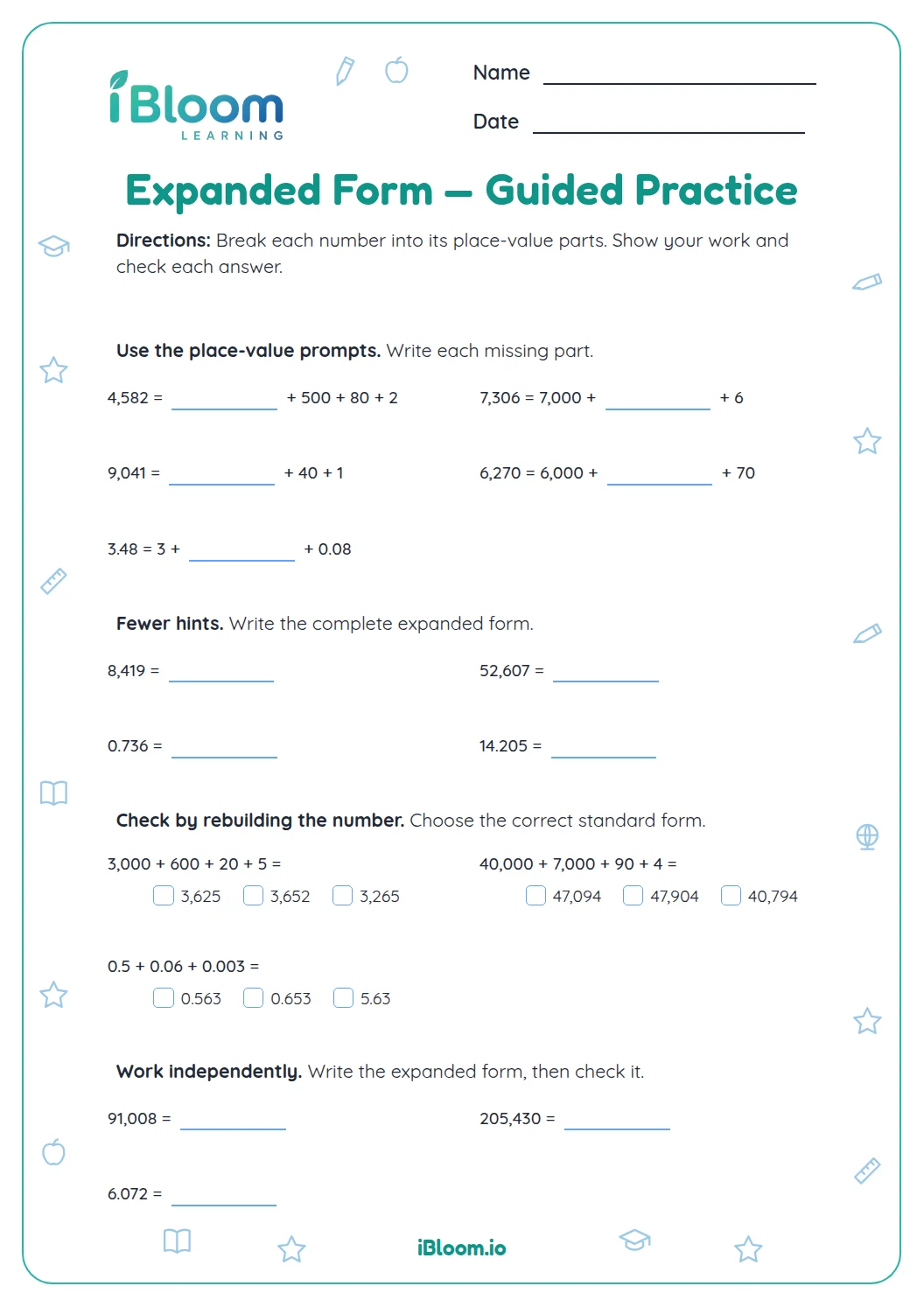
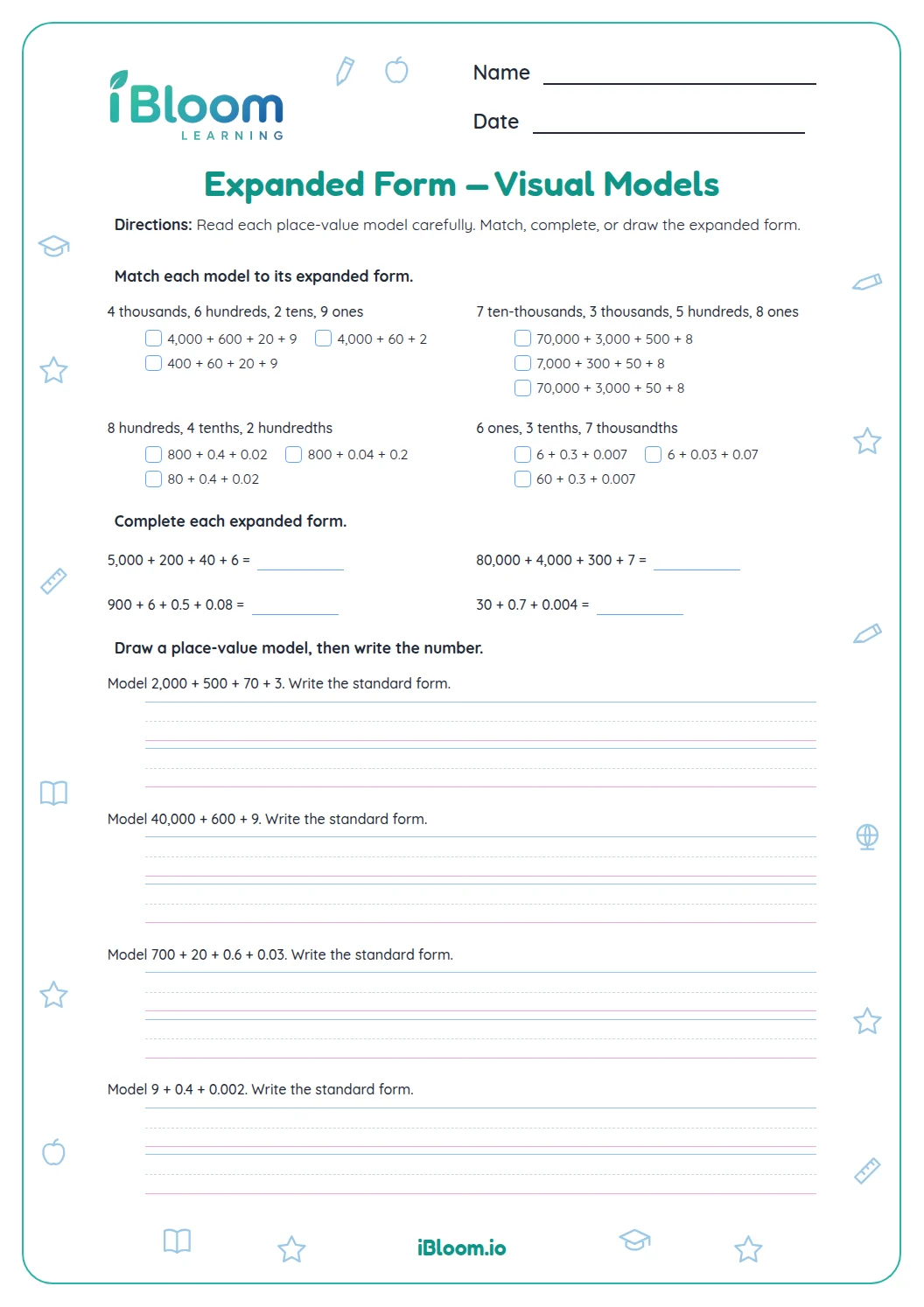
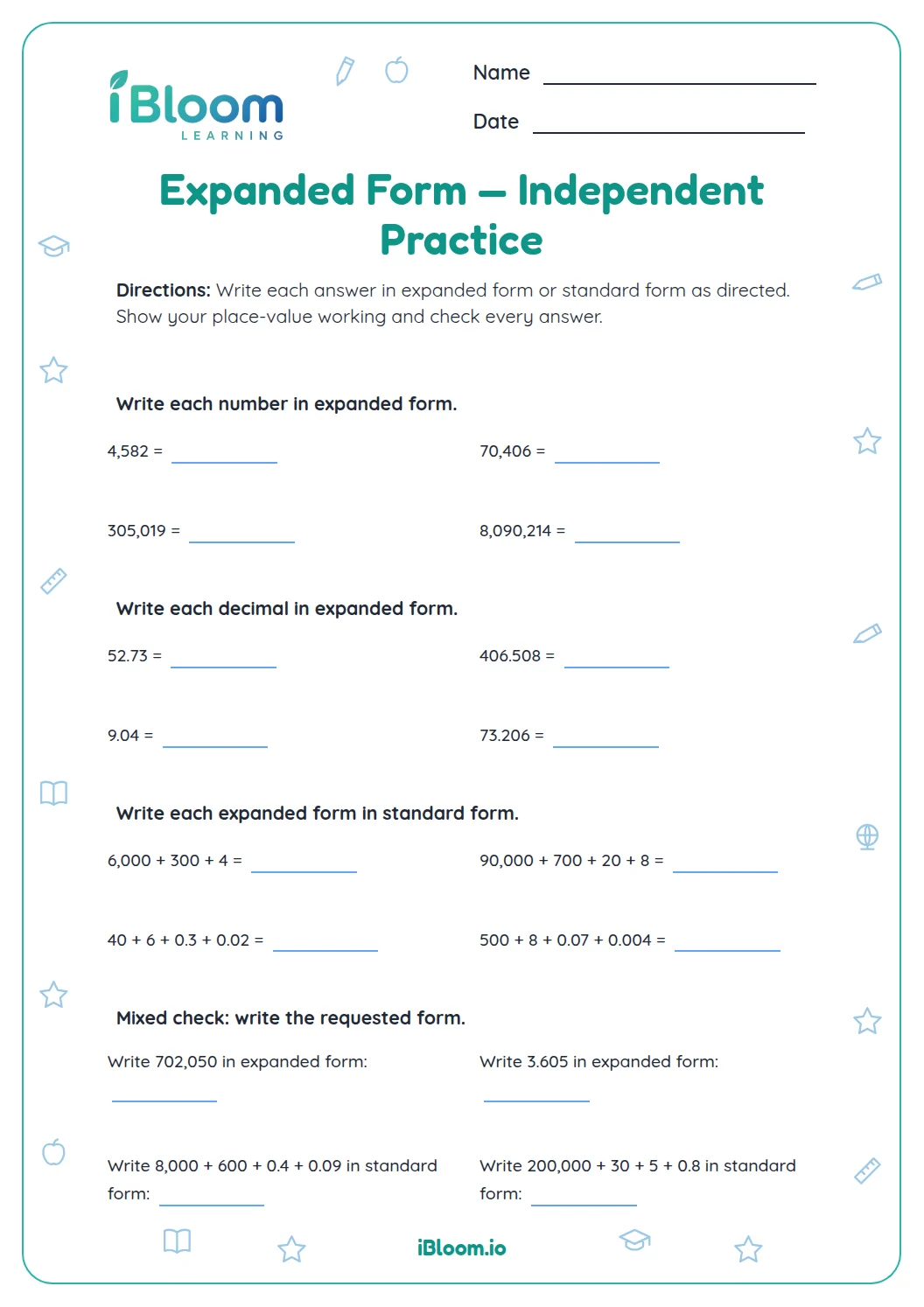
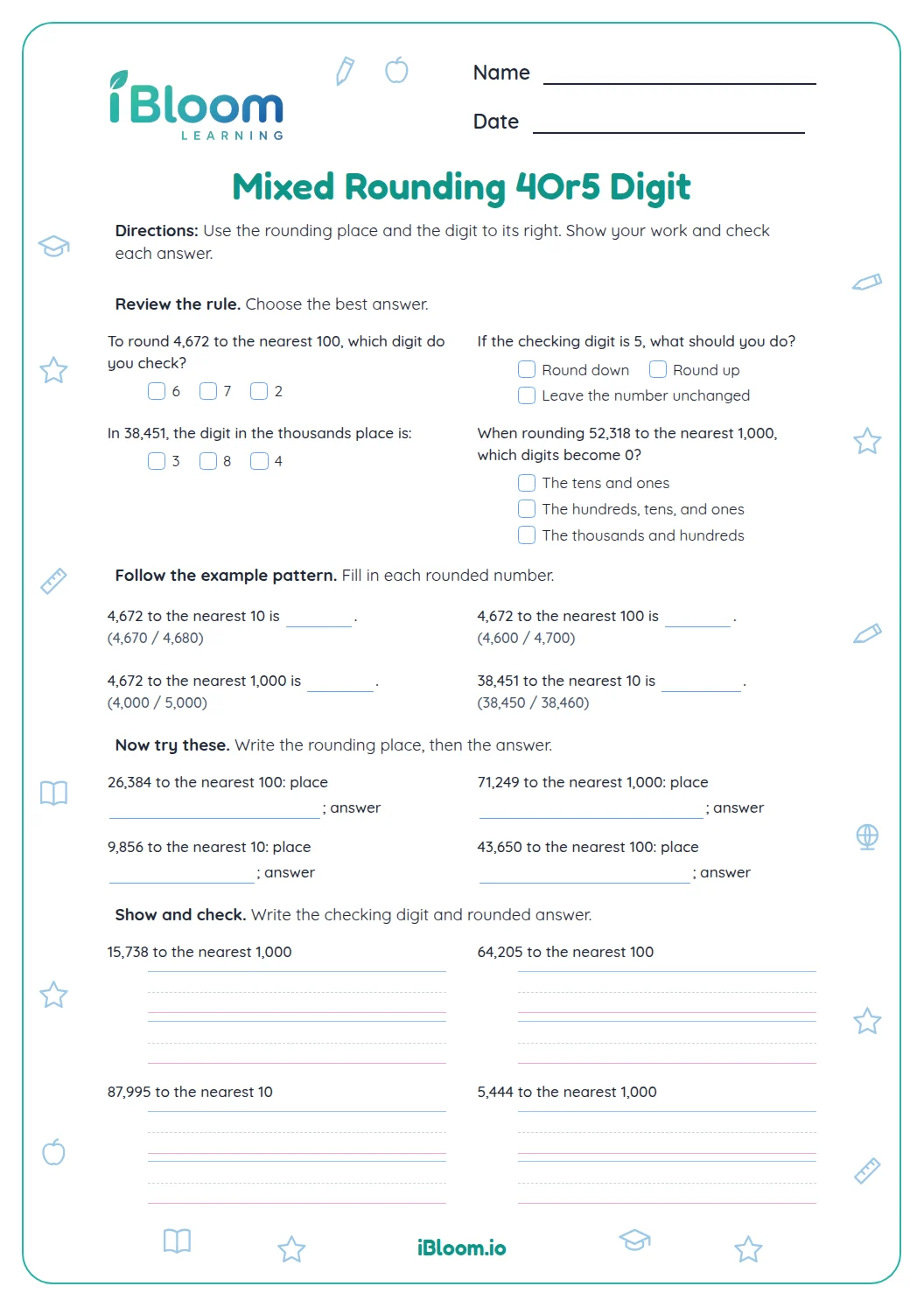
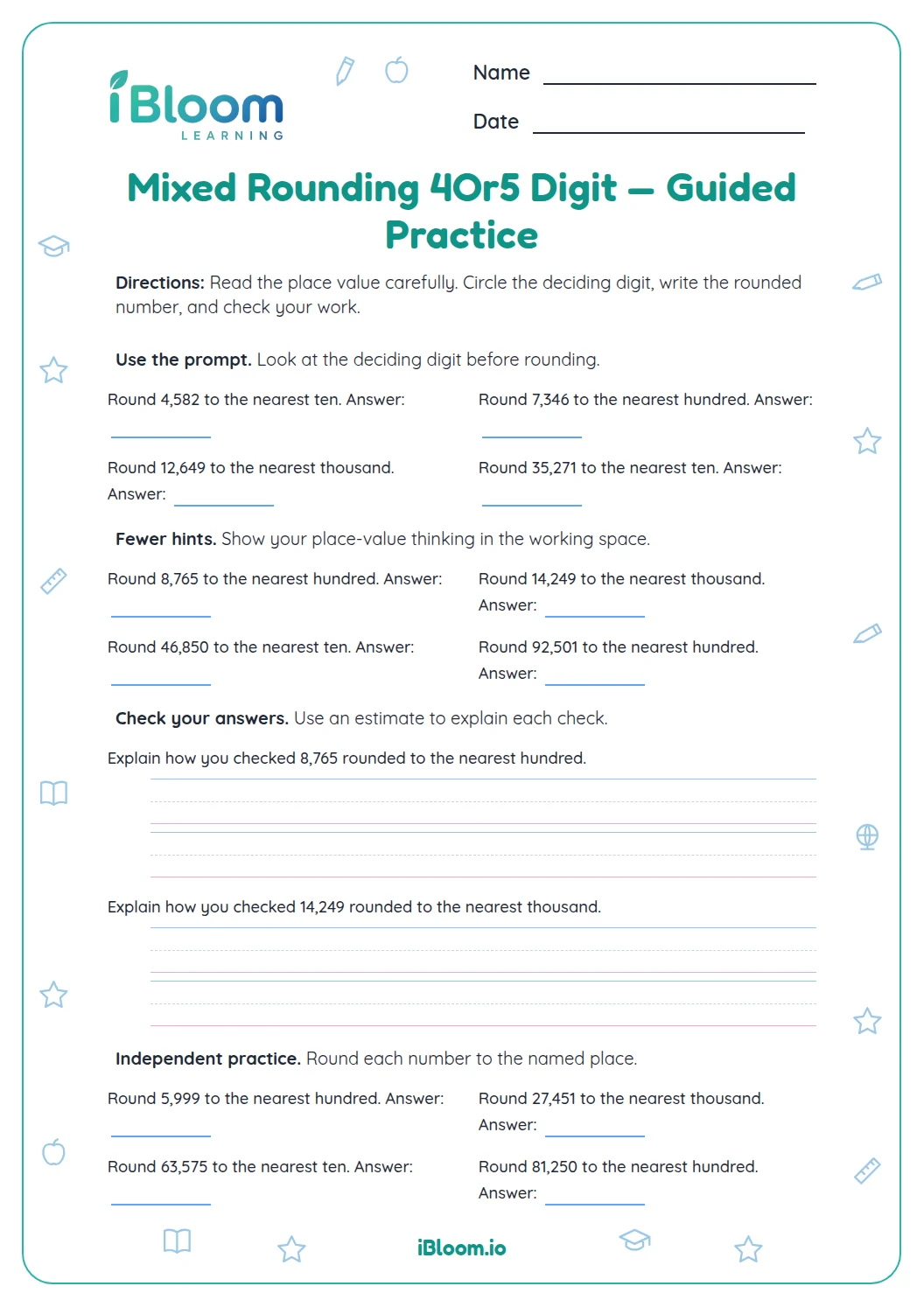
About this worksheet
This Grade 5 printable connects expanded notation and place value with school, community, and visitor totals. Students interpret digit values, write five- and six-digit numbers in expanded form, add quantities, and judge a reasonable estimate. The 14 questions use visible numbers throughout; the park visitor total is 21,105.
Aligned to 5.NBT.A.1
How does expanded notation show place value?
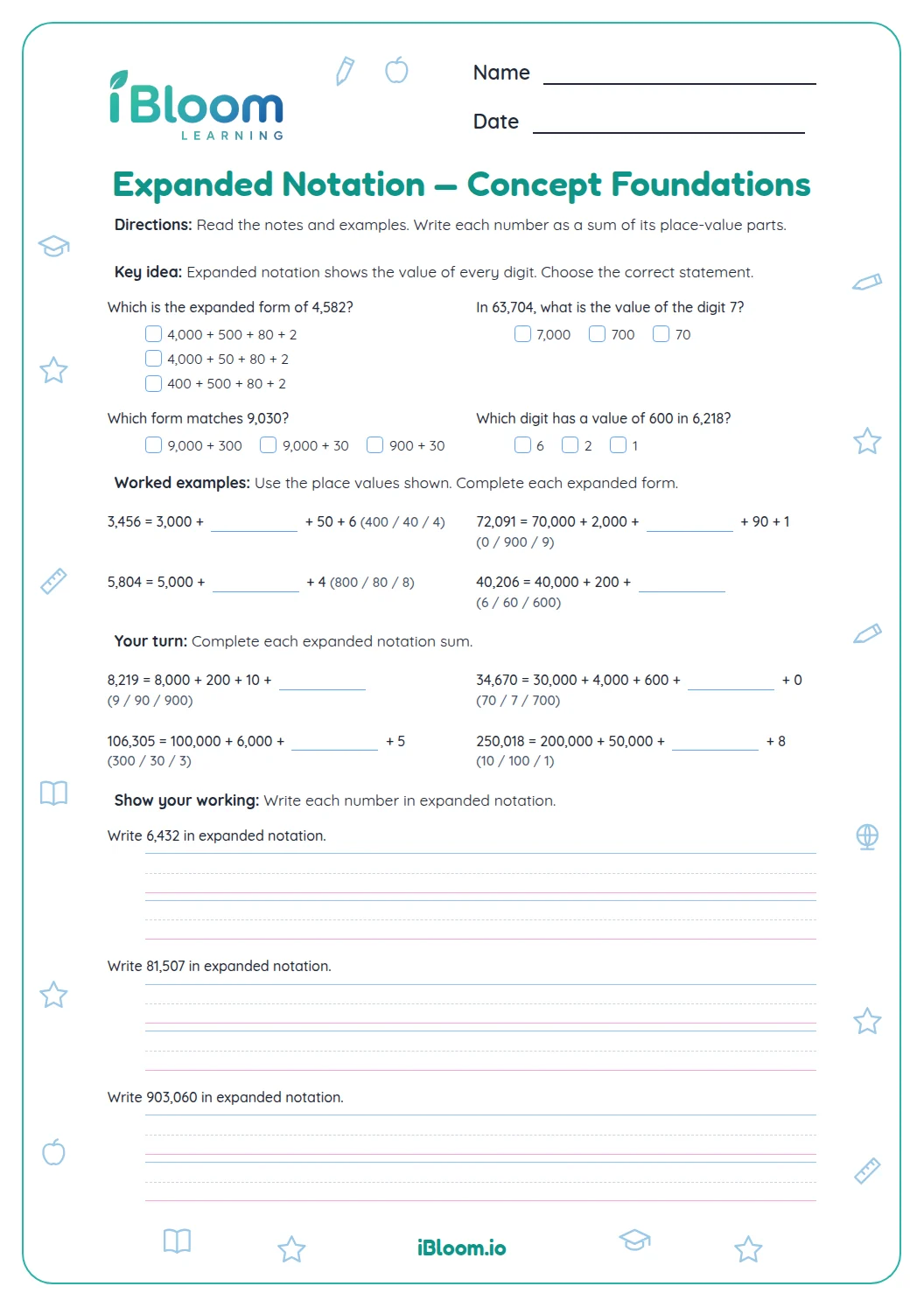
Write a number as the sum of the value of each nonzero digit. For example, 48,306 = 40,000 + 8,000 + 300 + 6.
- 1Write a number as the sum of the value of each nonzero digit. For example, 48,306 = 40,000 + 8,000 + 300 + 6.
What will students do with the numbers?
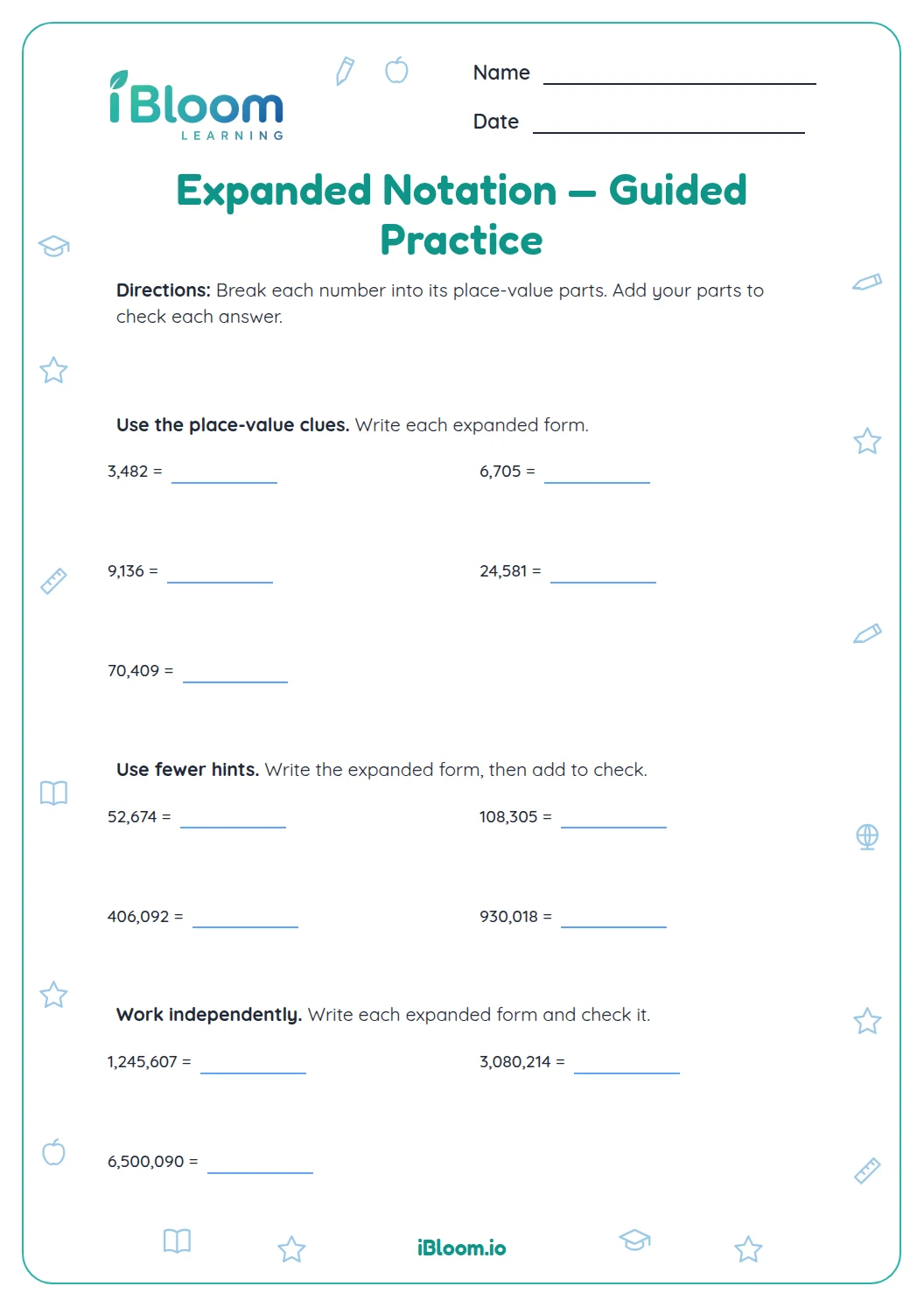
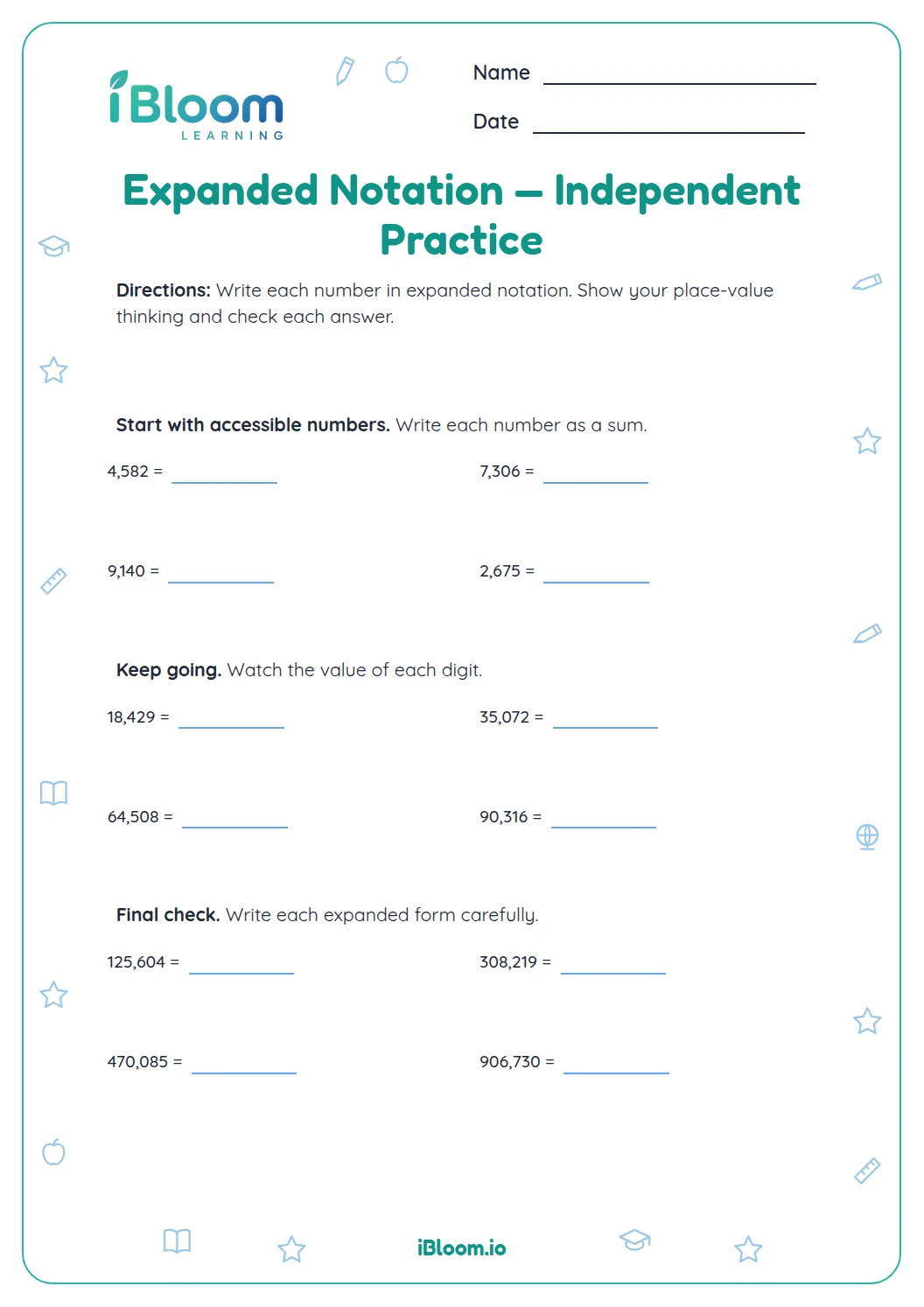
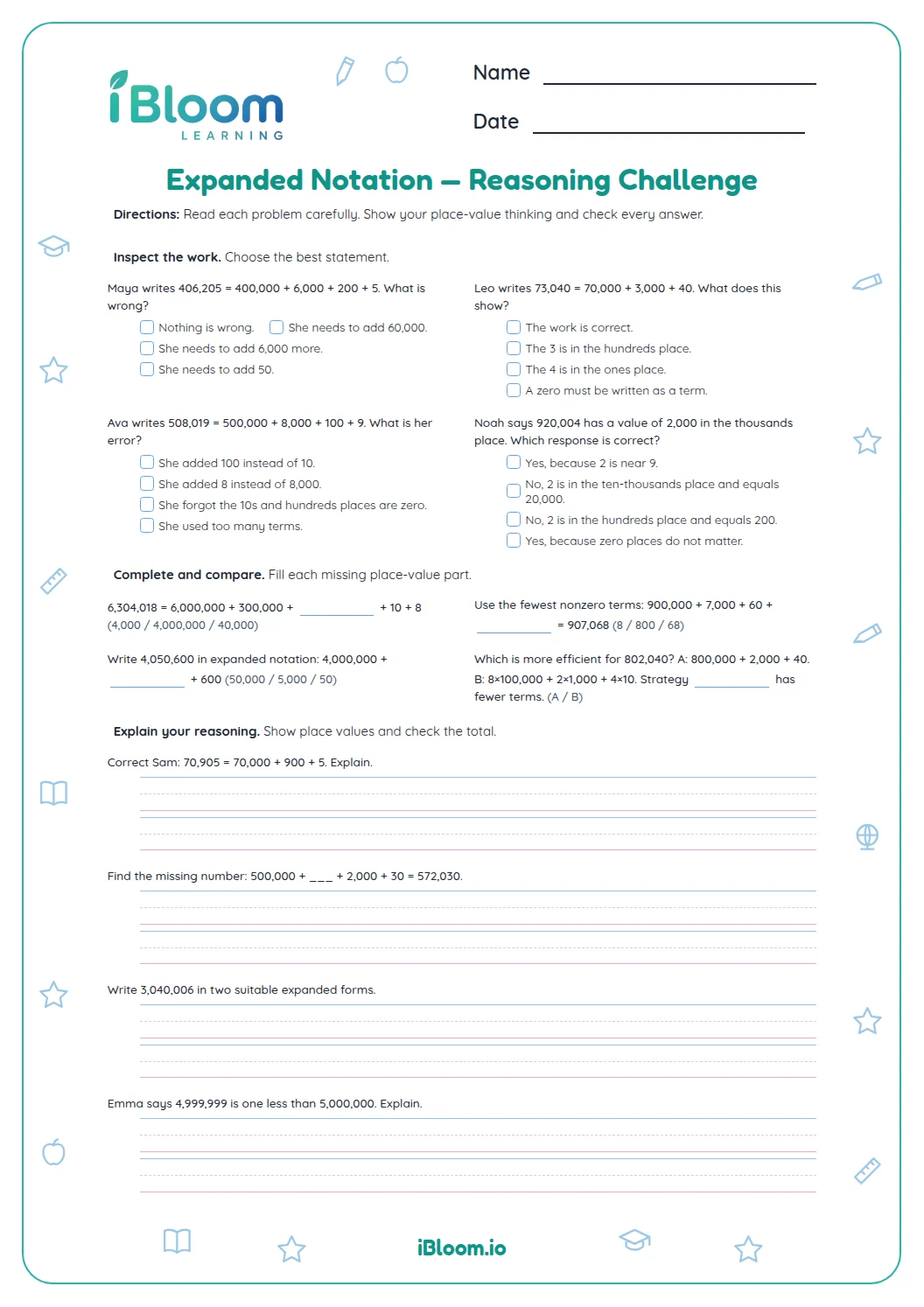
Students identify a digit’s value, write numbers in expanded notation, and add or estimate quantities in short situations about visits, reading, fundraising, and teams. The values needed are printed in each question.
How can students check an expanded form or total?
Add the expanded parts to see whether they rebuild the original number. For a total, estimate first, add carefully by place value, and compare the sum with the estimate.
A simple practice routine
- 1Read each digit’s place before writing its value.
- 2Write nonzero place values in expanded form.
- 3Add expanded addends or story quantities by place.
- 4Estimate visitor and fundraiser totals.
- 5Check that the digits remain in their correct places.
Common mistakes and quick fixes
The mistake
Writing 3,000 for the 3 in the ten-thousands place.
The fix
Name the digit’s position first; in 84,725, the 4 is worth 4,000.
The mistake
Leaving out a zero place and shifting a later digit.
The fix
Keep each nonzero digit attached to its place value.
The mistake
Adding visitor counts but copying one addend as the total.
The fix
Estimate, add by place value, and compare the result with the estimate.
Common Core alignment
These problems give students practice applying the standard with mixed numbers.
Explain how each place is ten times the place to its right.
On this sheet: The questions directly practice expanded notation and place value in real-world problems with the stated numbers.
Show the official wordingHide the official wording
Recognize that in a multi-digit number, a digit in one place represents 10 times as much as it represents in the place to its right and 1/10 of what it represents in the place to its left.
What to practice next
Make more practice
Further reading
Questions parents and teachers ask
Does the worksheet include an answer key?
Yes. A separate answer key gives answers to all 14 questions, including expanded forms, digit value, sums, and a reasonable estimate. The park total is keyed as 21,105. Students can use the key after completing the sheet and compare each written form or total with the matching problem.
What is expanded notation?
Expanded notation writes a number as the sum of its nonzero place values. For example, 48,306 is 40,000 + 8,000 + 300 + 6. The questions include five- and six-digit whole numbers and practice identifying the value represented by a digit.
What place-value range appears on the sheet?
The worksheet uses five- and six-digit whole numbers. Students work with values through the hundred-thousands place and use zero places to keep later digits in the correct positions. A zero means that place contributes no addend, but it still holds the correct position for the digits around it.
How can a student avoid shifting digits?
Name each digit’s place before writing its value. Keep zero places in mind even when they do not appear as addends in expanded notation. For example, estimate the combined counts before adding, then check that the exact sum is close to the estimate.
How can families use the real-world questions?
Have the student point to every quantity in the story, estimate a reasonable result, and then calculate. The answer key can be used afterward to check the exact total. The stories provide the quantities directly so students can focus on place value, addition, and estimation.