




About this worksheet
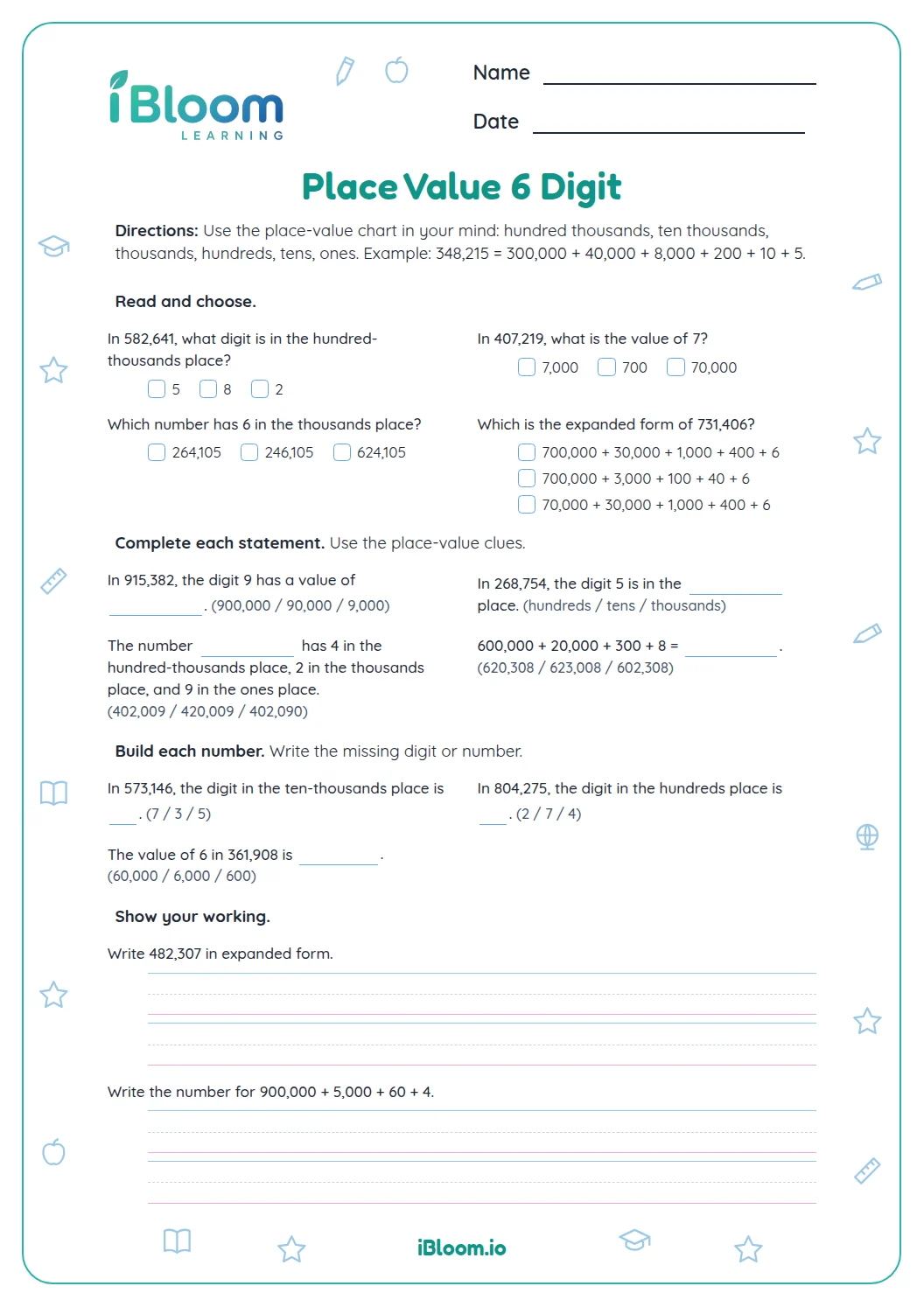
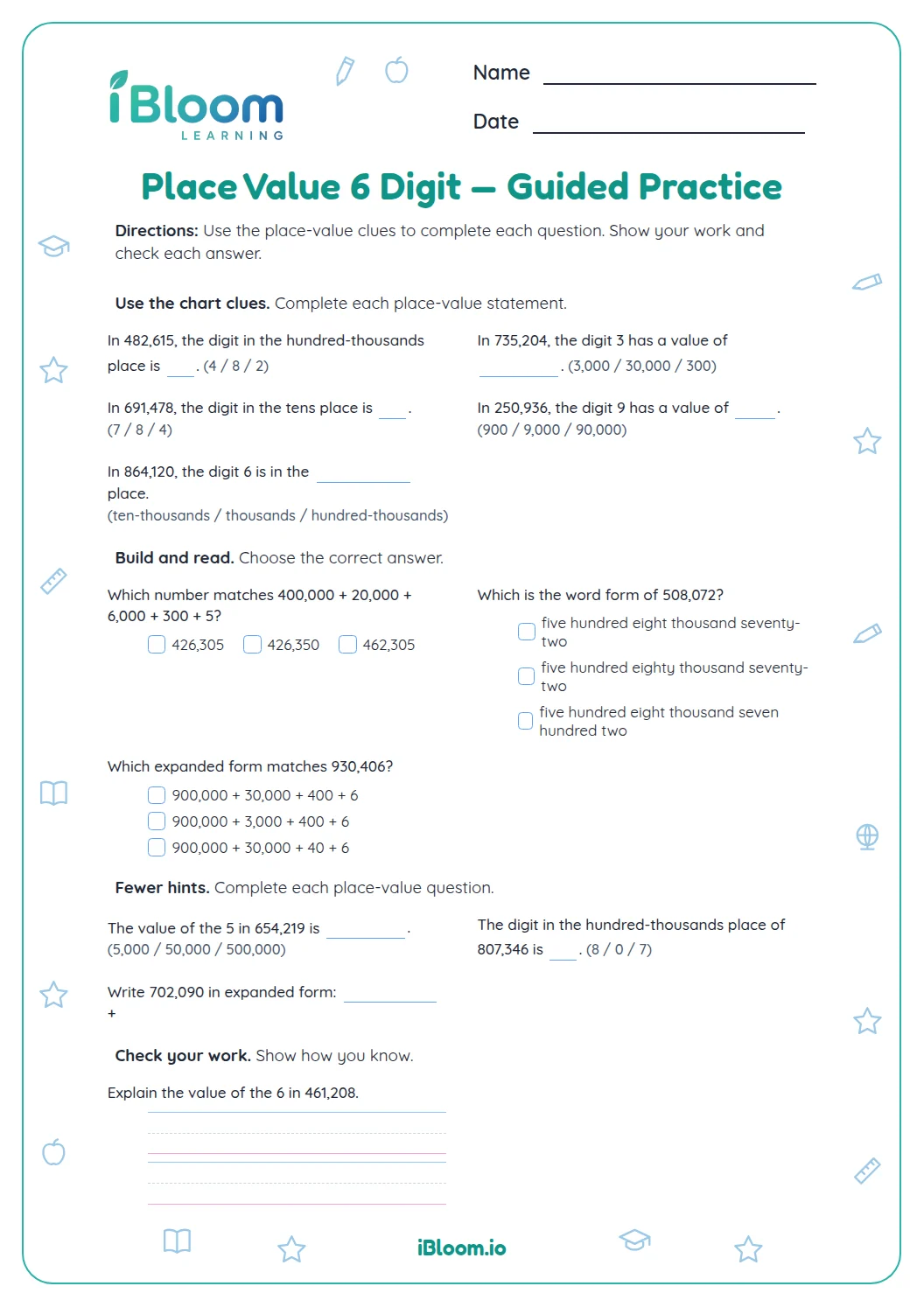
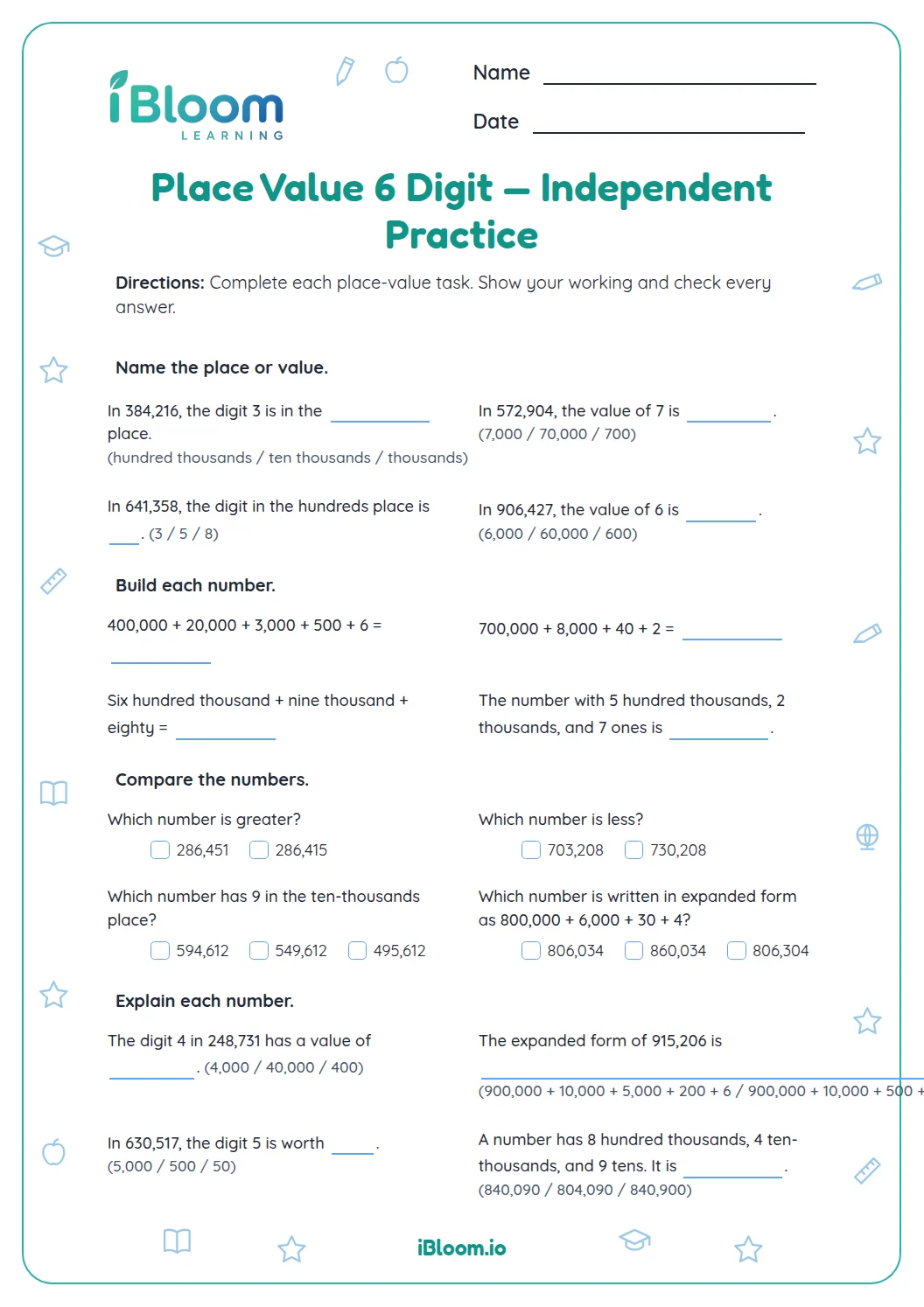
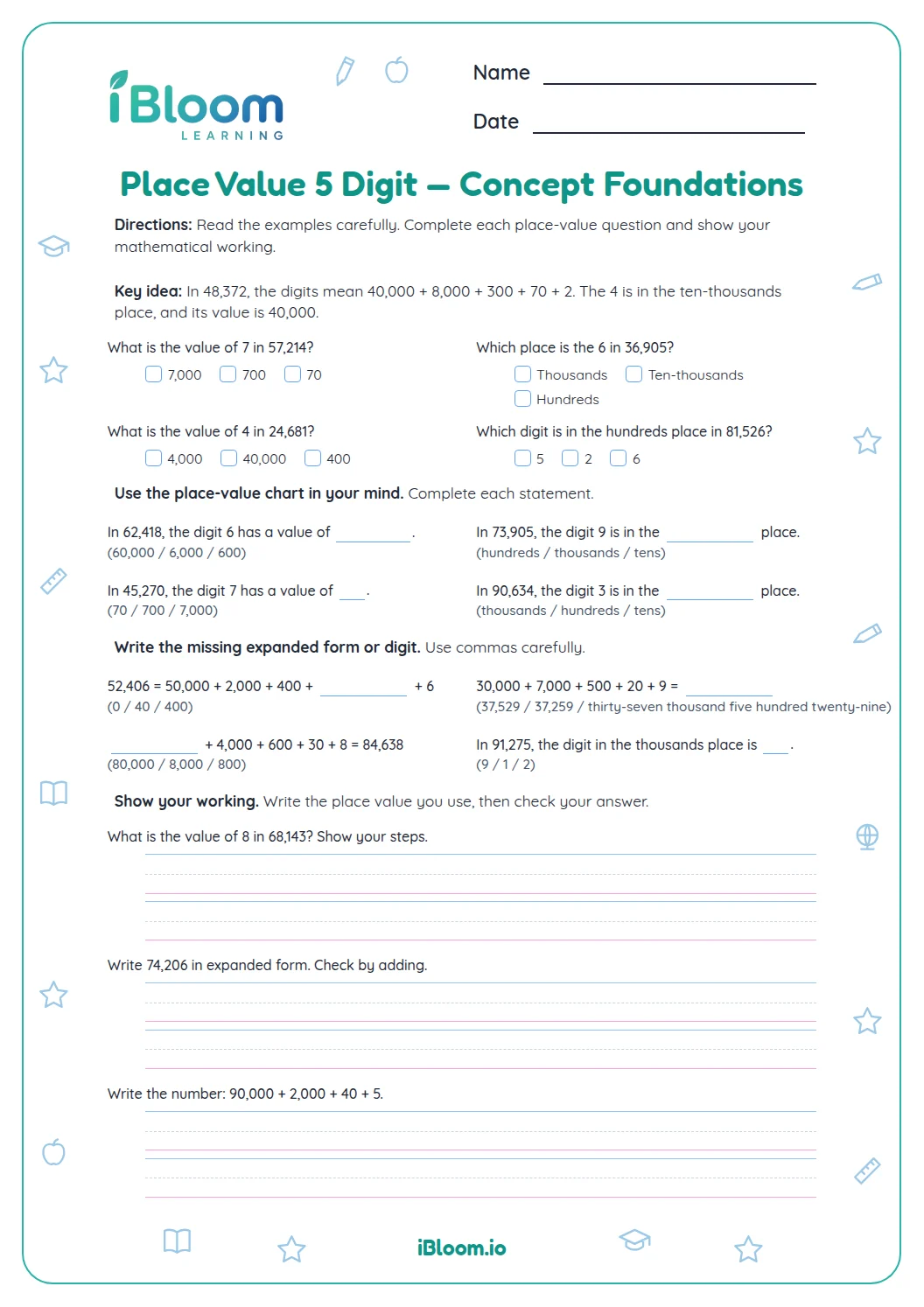
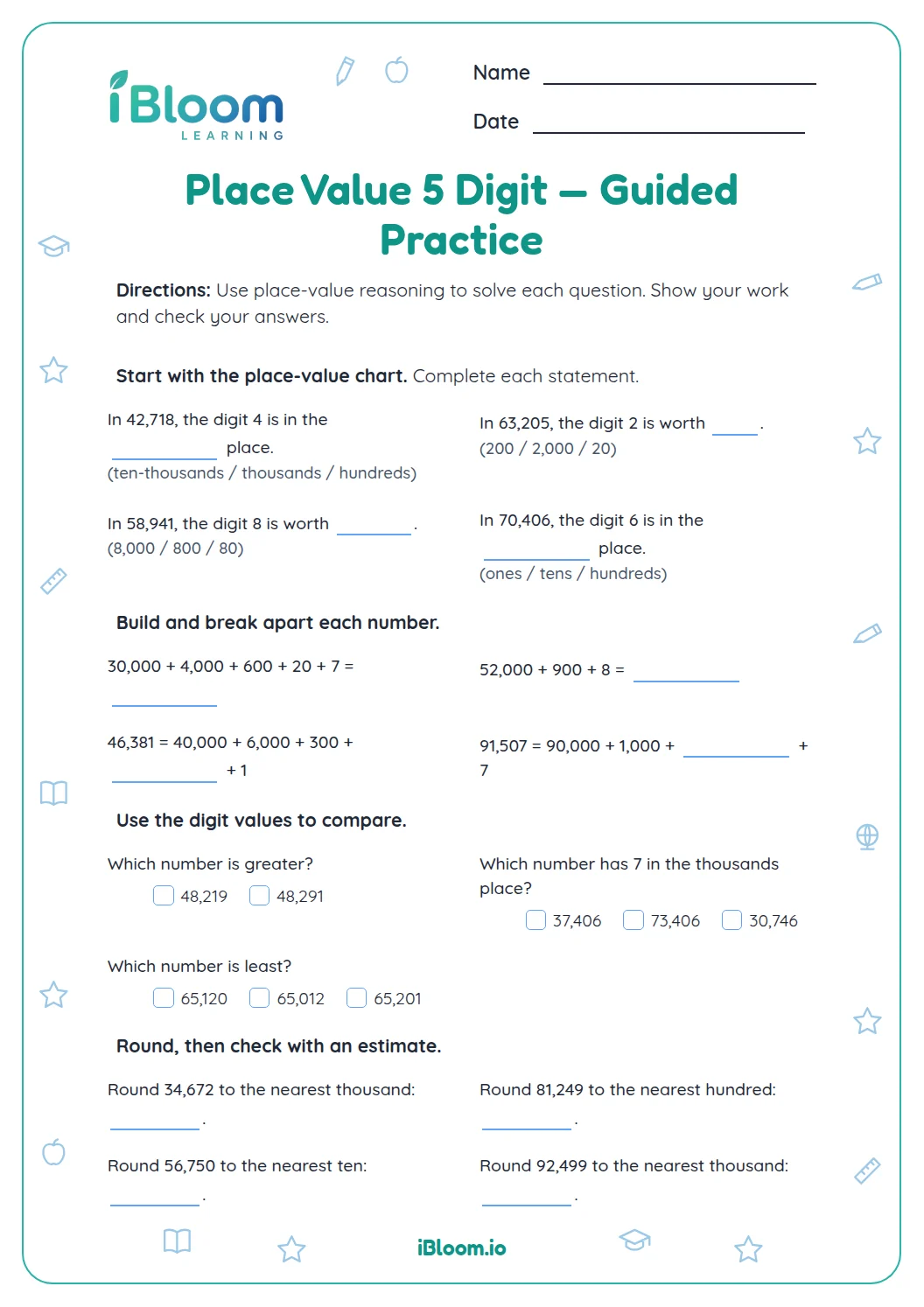
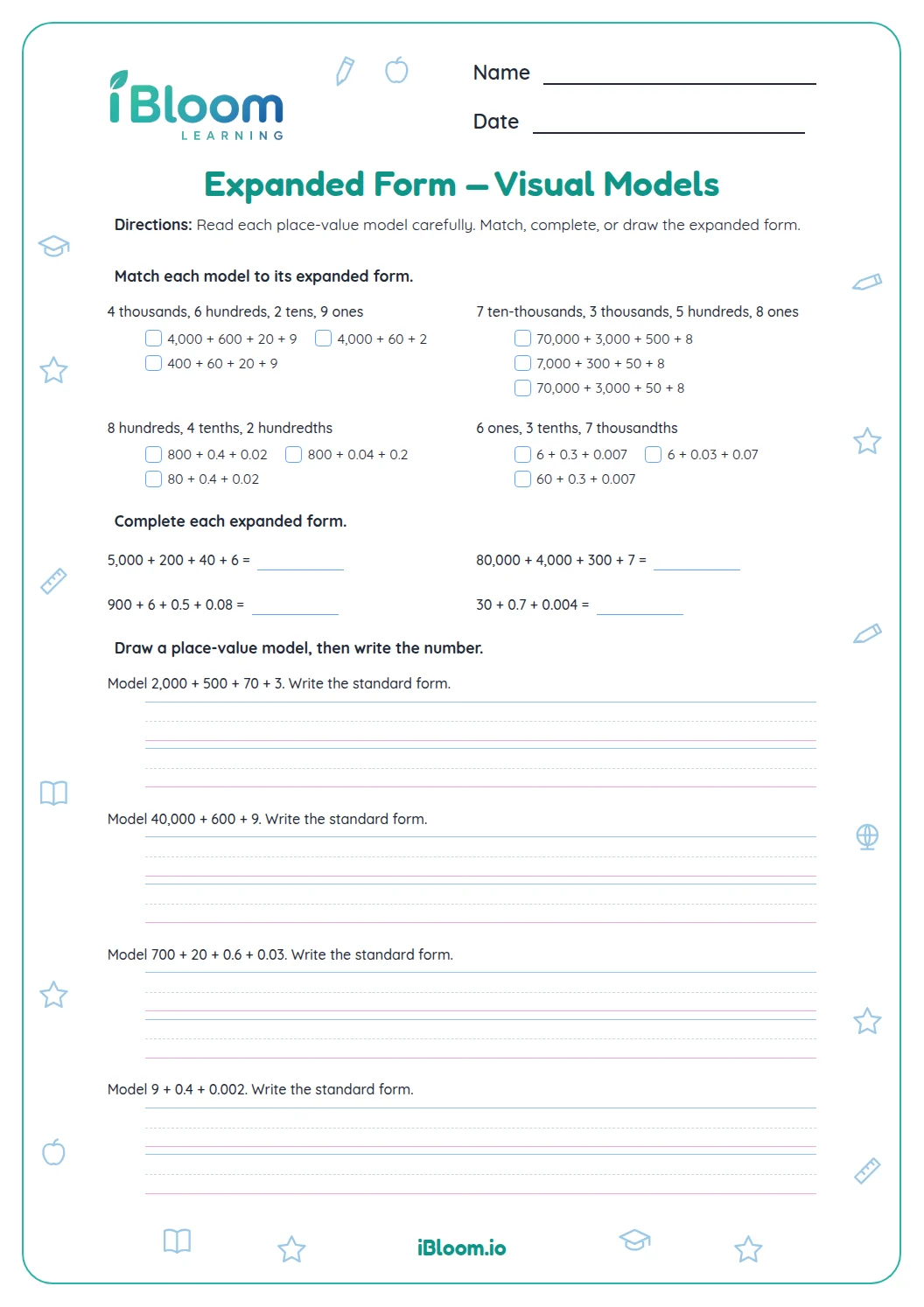
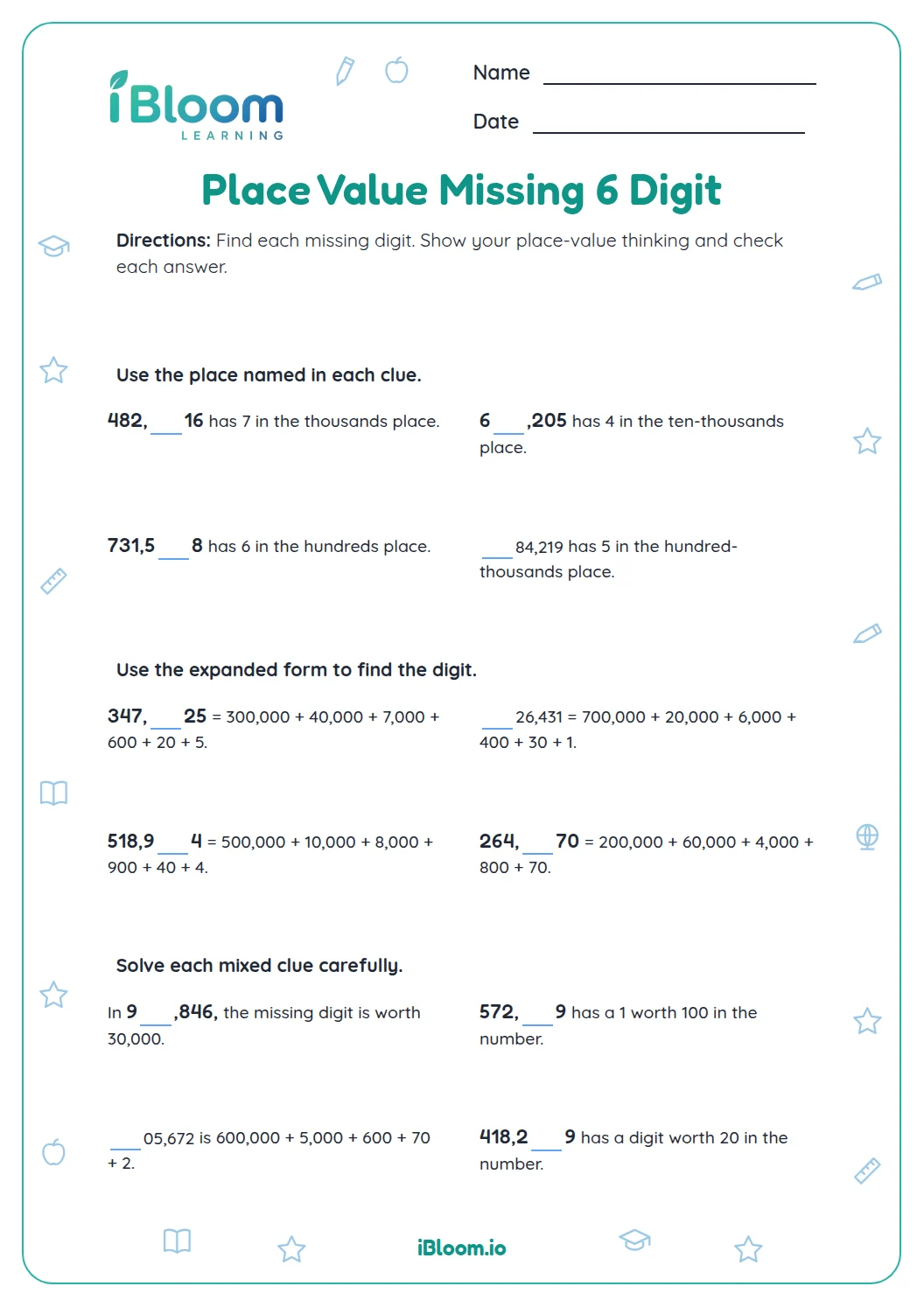
This Grade 5 visual-model worksheet uses compact place-value charts that pair adjacent places while keeping all six digits visible to make each digit’s position visible. Students read numbers, identify digit values, move between standard and expanded forms, and reason about how a digit’s value changes by place. It contains 16 model-based questions and a separate answer key. The charts replace block drawings that cannot show all six places, while preserving the focus on visual place-value reasoning in CCSS 5.NBT.A.1.
Aligned to 5.NBT.A.1
How does each place change a digit’s value?
A digit’s value is its face value multiplied by the value of its place. In 482,716, the 8 is in the ten-thousands place, so it represents 80,000. Moving one place left makes a digit worth ten times as much; moving right makes it one tenth as much.
Question 2 uses 263,491. The digit 6 is in the thousands place, so its value is 6,000.
- 1263,491
- 26 is in the thousands place
- 3Its value is 6,000
How do standard and expanded forms connect?
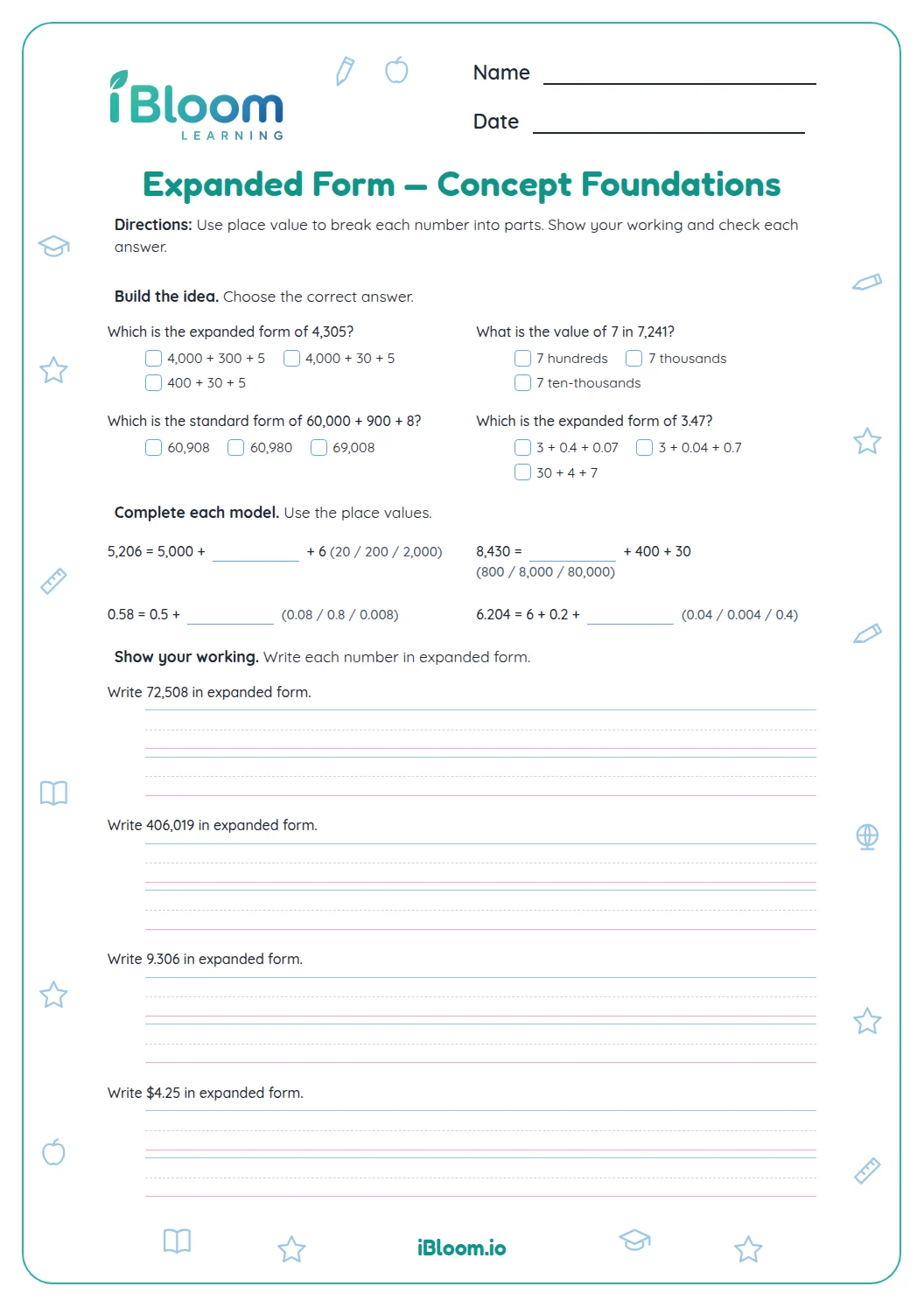
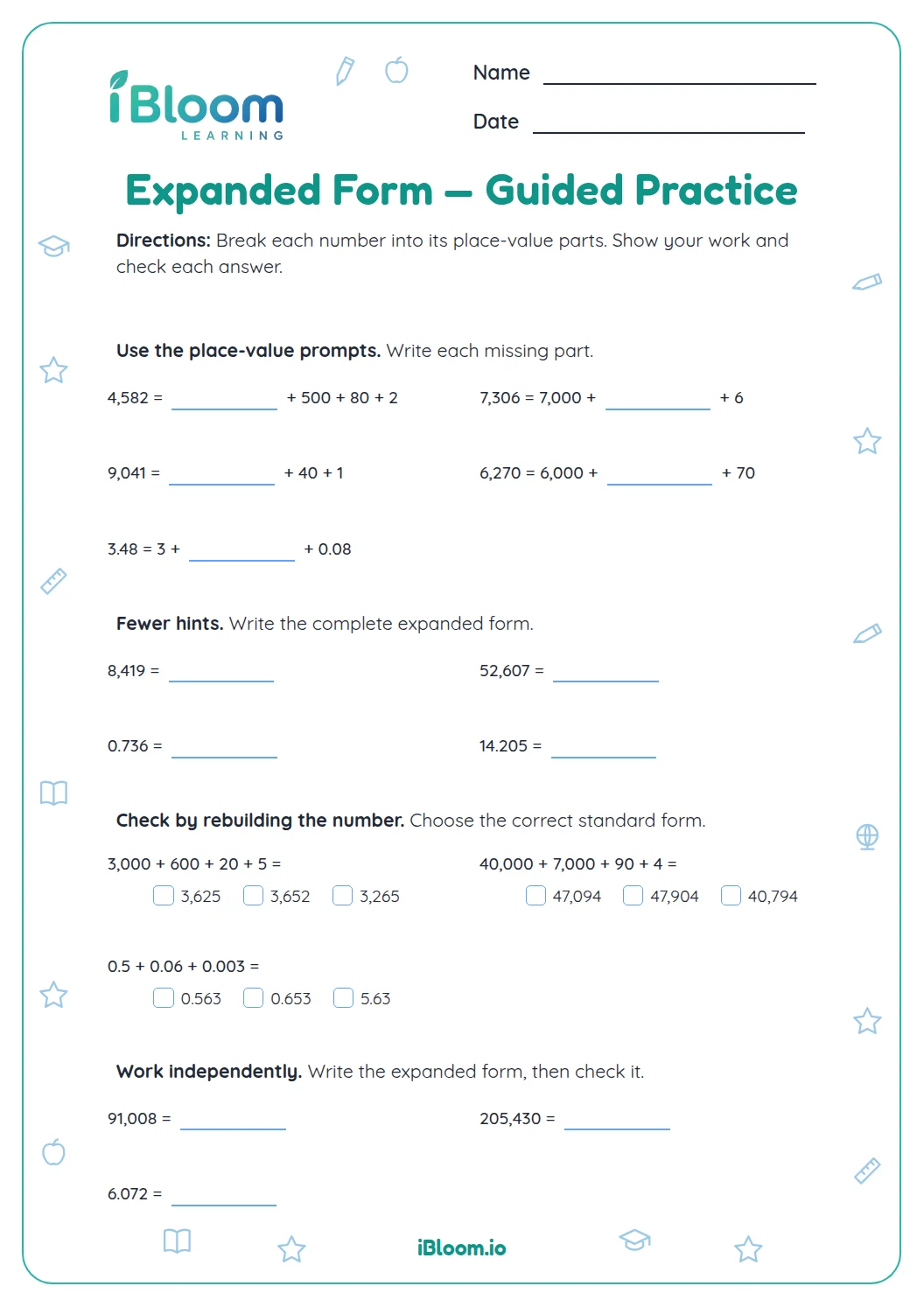
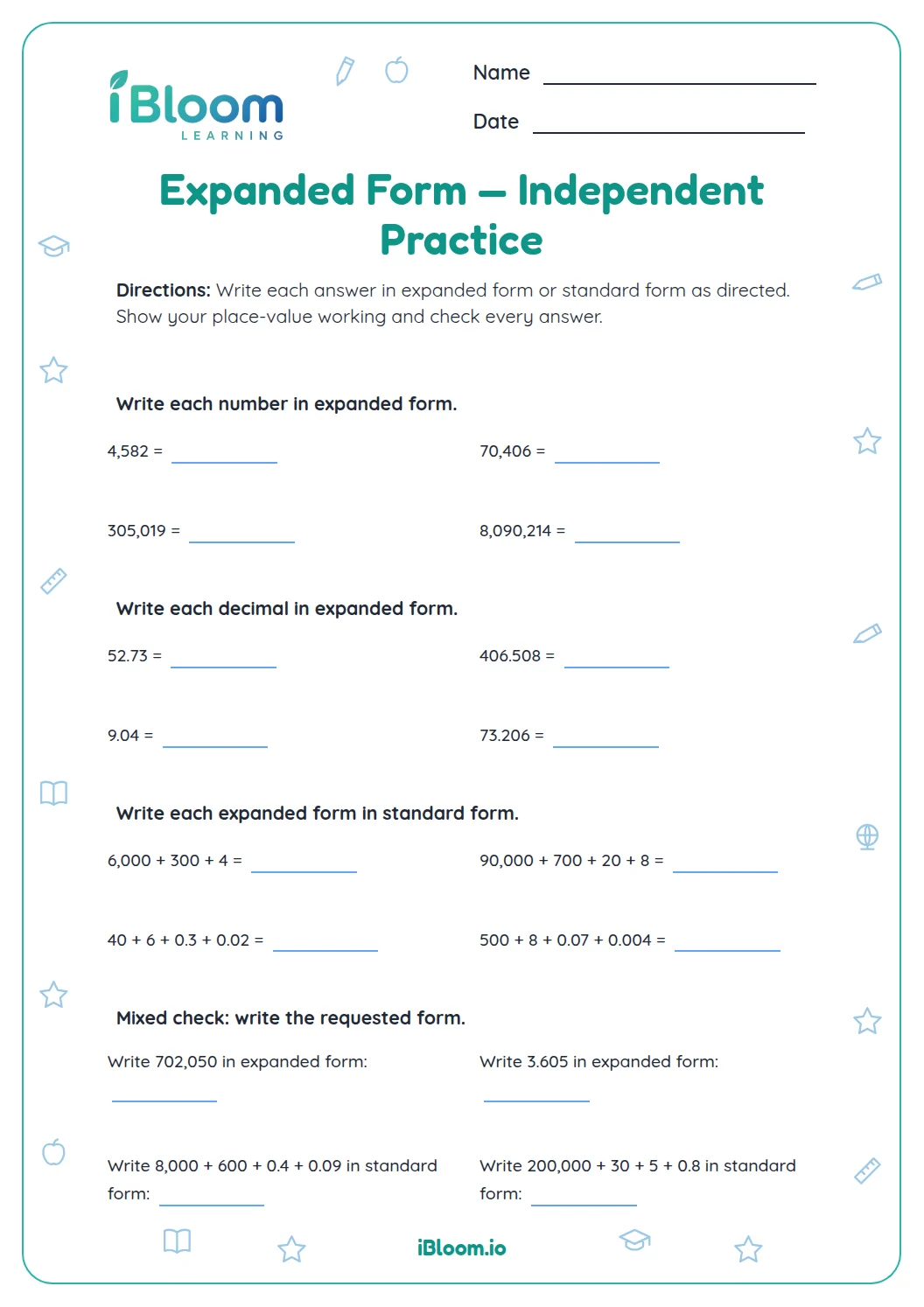
Standard form uses digits in a single number. Expanded form writes the value represented by each nonzero digit as a sum. For 532,418, the expanded form is 500,000 + 30,000 + 2,000 + 400 + 10 + 8.
The questions include standard-form numbers and place-value descriptions, so students can connect digit positions to number form.
What visual models appear on the worksheet?
Each item includes a compact chart that groups two adjacent places in each labeled column, or asks students to interpret a number or place-value description. This keeps every number visible while practicing all six places.
How to work through the sheet
- 1Scan the place-value headings from left to right.
- 2Name the digit in the requested column.
- 3Multiply the digit by its place value to find its value.
- 4For expanded values, match each addend to its digit position.
- 5Check that the addends reconstruct the original number.
Common mistakes and quick fixes
The mistake
Naming the digit instead of its value.
The fix
For a digit in the thousands place, write the digit multiplied by 1,000.
The mistake
Losing a zero when writing standard form.
The fix
Keep every column in place, including zero-valued places.
The mistake
Treating adjacent places as a change of one.
The fix
Each move left is 10 times the value; each move right is one tenth.
Common Core alignment
This worksheet gives children practice applying the measurement and number skills described below.
Use read and represent six-digit numbers to solve grade-level problems.
On this sheet: The questions ask students to read and represent six-digit numbers in several contexts.
Show the official wordingHide the official wording
Recognize that in a multi-digit number, a digit in one place represents 10 times as much as it represents in the place to its right and 1/10 of what it represents in the place to its left.
What to practice next
Make more practice
Further reading
Questions parents and teachers ask
What are the six places in each model?
The charts group adjacent places in labeled pairs, from hundred-thousands and ten-thousands through tens and ones. Each pair keeps the six-digit number visible while showing the place sequence. Students use the headings to read the number and identify individual digit values.
How do I find the value of a digit?
Identify its place, then multiply the digit by that place value. In 263,491, the 6 is in the thousands place, so its value is 6,000. The number chart makes the position clear before students write the value. Multiplying by 1,000 gives the digit’s value in that place.
What is expanded form?
Expanded form expresses a number as the sum of its place values. For example, 532,418 can be written as 500,000 + 30,000 + 2,000 + 400 + 10 + 8. Zero-valued places may be omitted from the sum.
Why use place-value charts instead of blocks?
A standard base-ten block model represents hundreds, tens, and ones. The six-column tables on this sheet show all six digits and their actual positions, so they can represent numbers into the hundred-thousands place clearly. This chart model preserves all six places in the number.
Does the sheet include rounding?
The questions focus on six-digit place value, digit values, and number forms. Students use visual place-value models to read and reason about numbers, with a separate answer key for checking the 16 responses. Each response can be checked against its matching chart or number description.