

About this worksheet
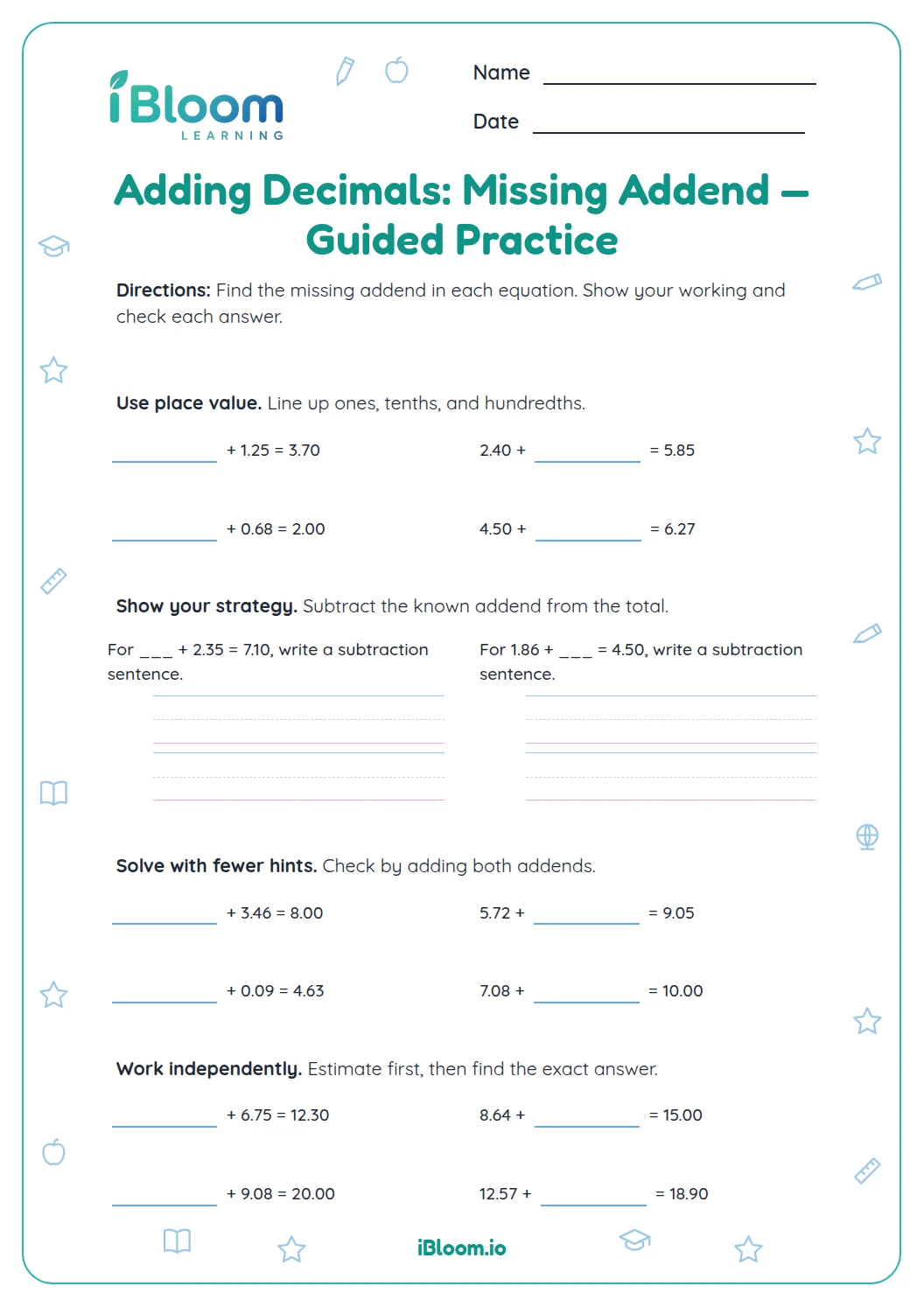
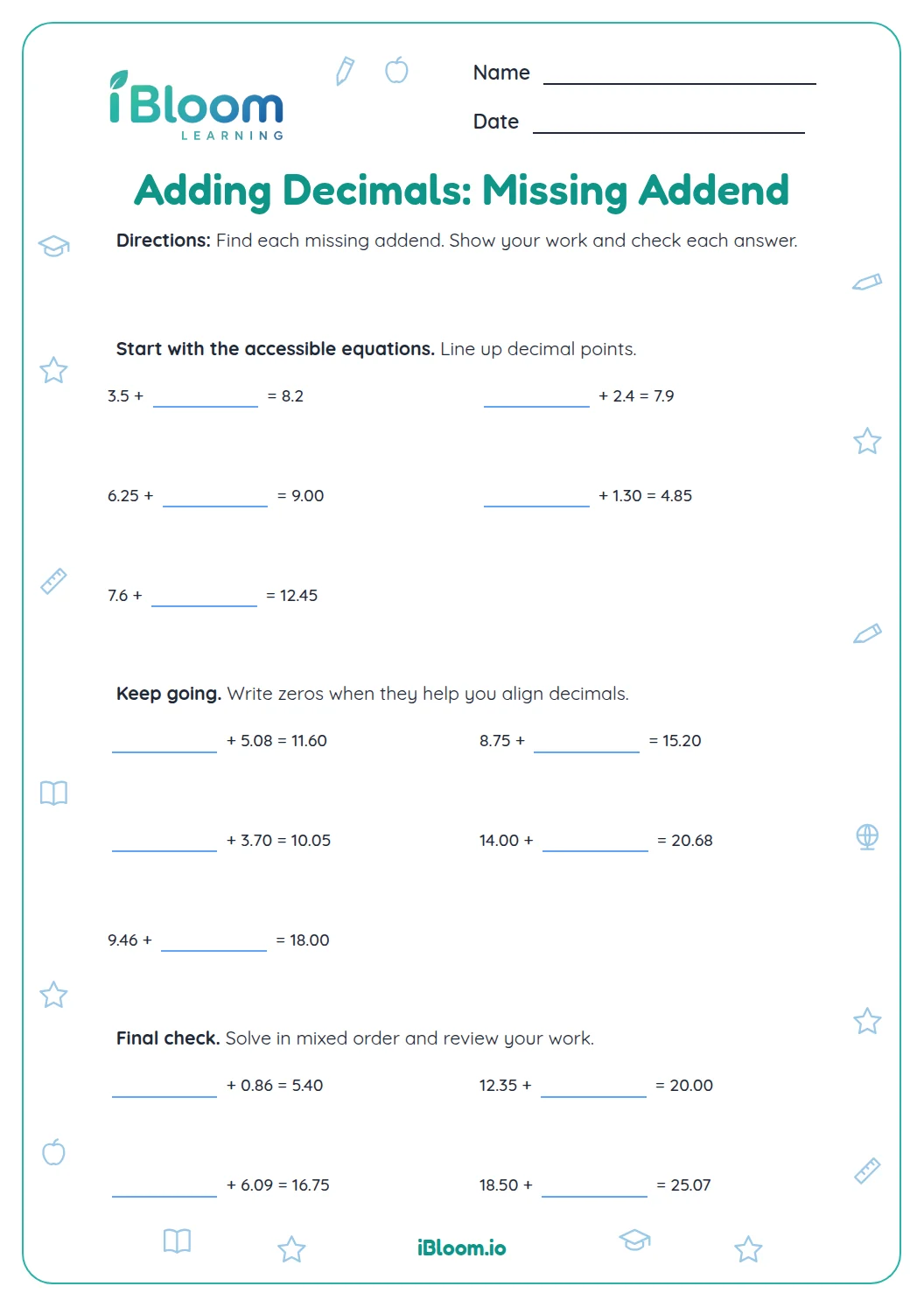
This free printable worksheet gives Grade 6 students 20 problems in adding decimals with missing addends. Students show each step, check the result, and use the separate answer key to review their work. Find the unknown addend by subtracting the known addend from the sum. Then add your answer back to check it.
Aligned to 6.NS.B.3
Subtract the known addend from the total.
Line up decimal points and add zeros when needed so tenths, hundredths and thousandths stay in their proper places.
- 17.50 + ___ = 10.08
- 210.08 − 7.50 = 2.58
- 37.50 + 2.58 = 10.08
What is on this worksheet?
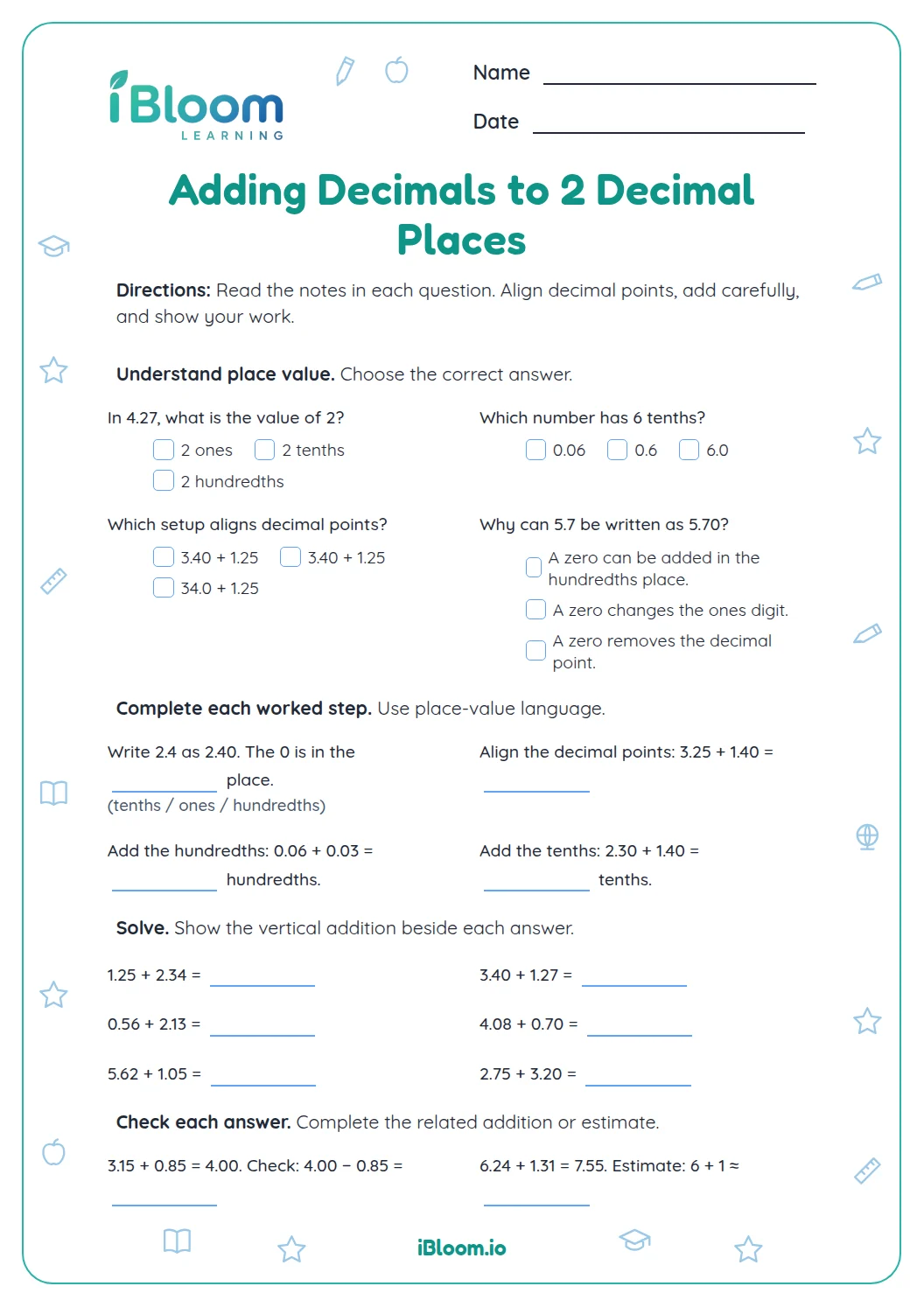
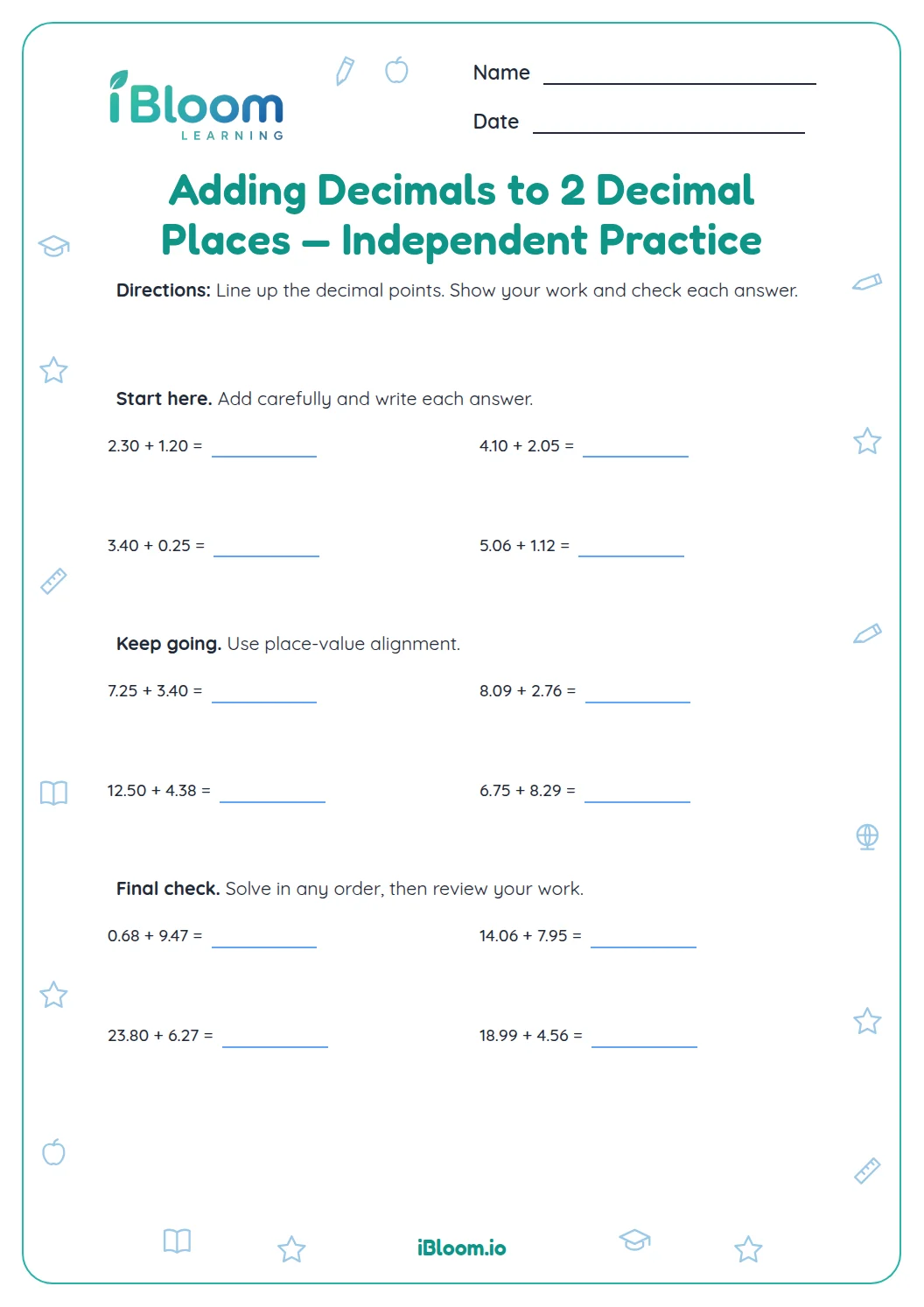
The four guided parts move from missing-addend equations to checking sums and solving short contexts. Add the missing addend back to the known addend to verify each result.
- 20 problems across four guided parts
- Room to record the calculation and simplified answer
- A separate key gives a result for every problem
How to use this worksheet at home or in class
- 1Name the total and the addend already shown.
- 2Subtract the known addend from the total, aligning decimal points.
- 3Add the missing addend back to the known addend to check the sum.
Common mistakes and quick fixes
The mistake
Subtracting the digits without aligning decimal points, such as treating 10.08 − 7.5 like 10.08 − 7.05.
The fix
Rewrite 7.5 as 7.50 so tenths and hundredths line up.
The mistake
Copying a claimed answer without testing it. For 7.50 + 3.58, the sum is 11.08.
The fix
Add the proposed addend to the known addend. If it misses the total, subtract the known addend from the total.
Common Core alignment
This Grade 6 practice sheet builds fluency with rational-number computation and supports the fraction skills developed in earlier grades.
Fluently add, subtract, multiply, and divide multi-digit decimals using the standard algorithm.
On this sheet: Each item gives students practice with adding decimals with missing addends using the exact operation named in the prompt.
Show the official wordingHide the official wording
Fluently add, subtract, multiply, and divide multi-digit decimals using the standard algorithm.
What to practice next
Make more practice
Further reading
Questions parents and teachers ask
What should students write for each problem?
Students should write the calculation with each step needed for the operation: align decimal places for decimal work, or rename fractions with a common denominator. For subtraction, show a regrouping step when needed. The separate key gives a final result for all 20 questions.
How can I help without solving it for my child?
Ask the student to align decimal points before calculating. Then ask whether the result is reasonable and how addition can check it. Have the student explain the check aloud and point to the digits or fraction parts being compared. That makes the reasoning visible without giving away the next calculation.
Is an answer key included?
Yes. The printable has two student worksheet pages followed by a separate two-page answer key. It lists a checked result for each of the 20 questions, so students can compare their final values after completing the work. The key is printed after the two student pages for quick reference.
How long does the worksheet take?
Plan for about 20 to 25 minutes for the 20 problems, with more time if students write every intermediate step. Pause after each printed part so students can check their work before moving to the next set. Encourage careful work rather than speed, especially when regrouping.