


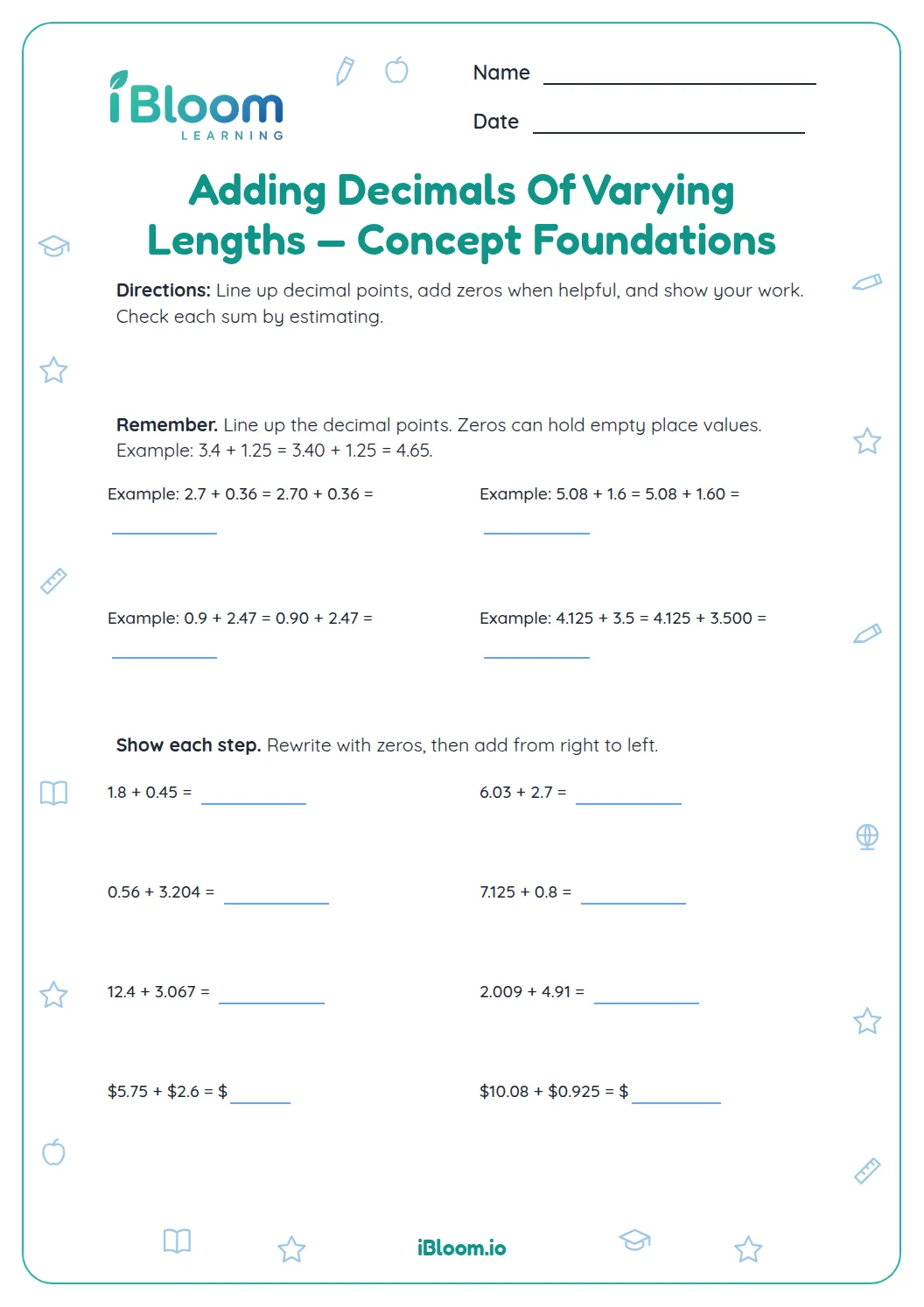
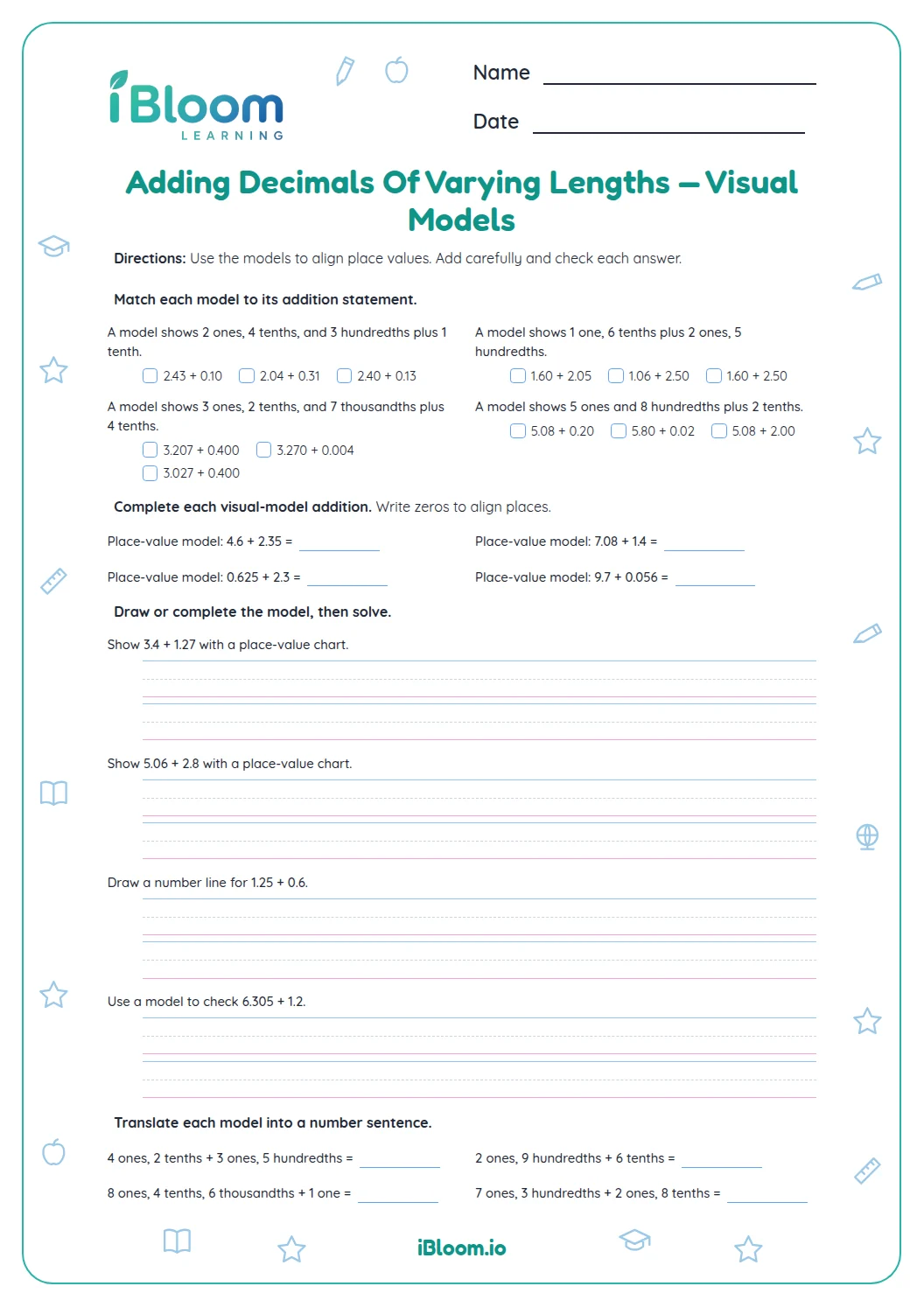
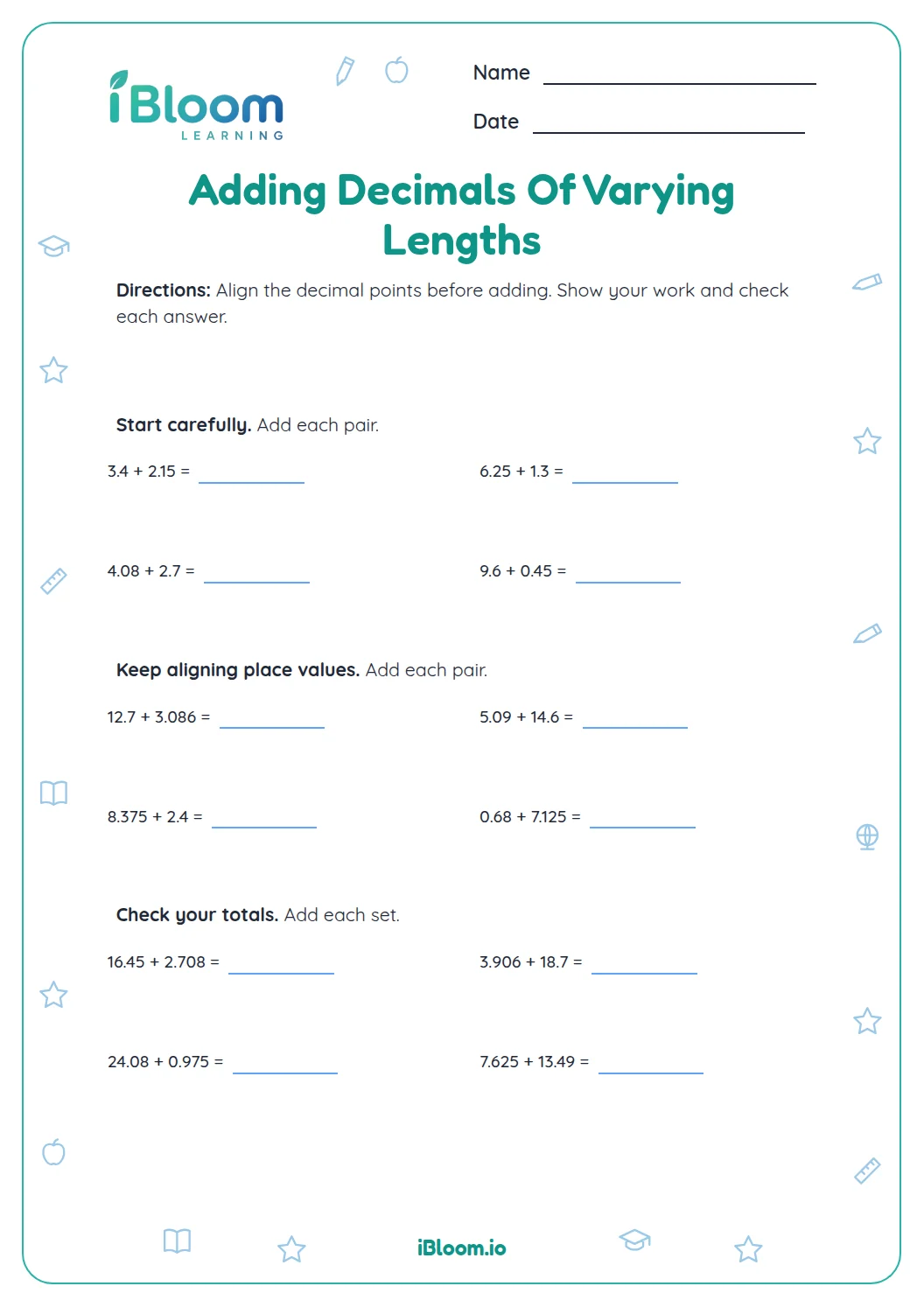
About this worksheet
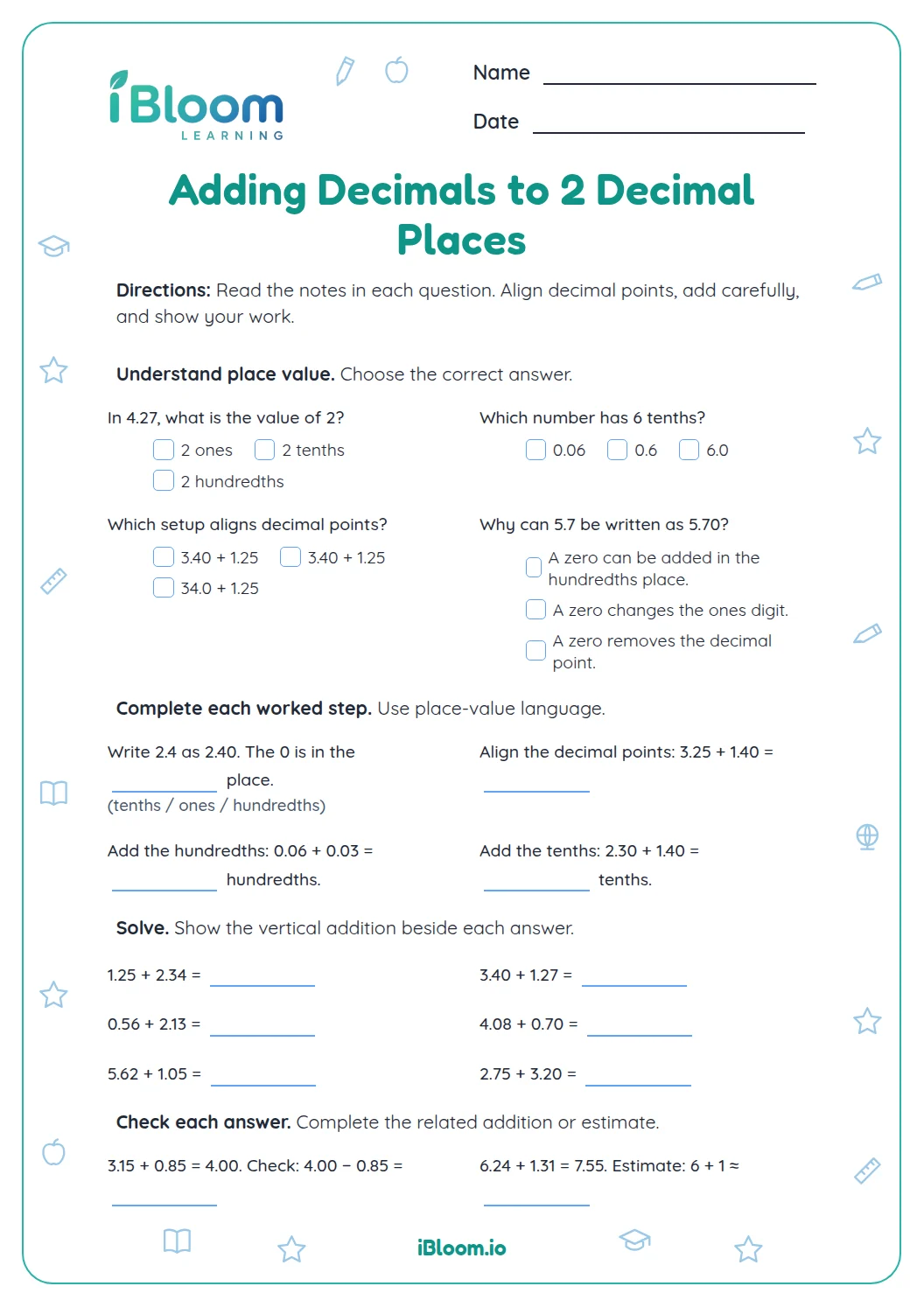
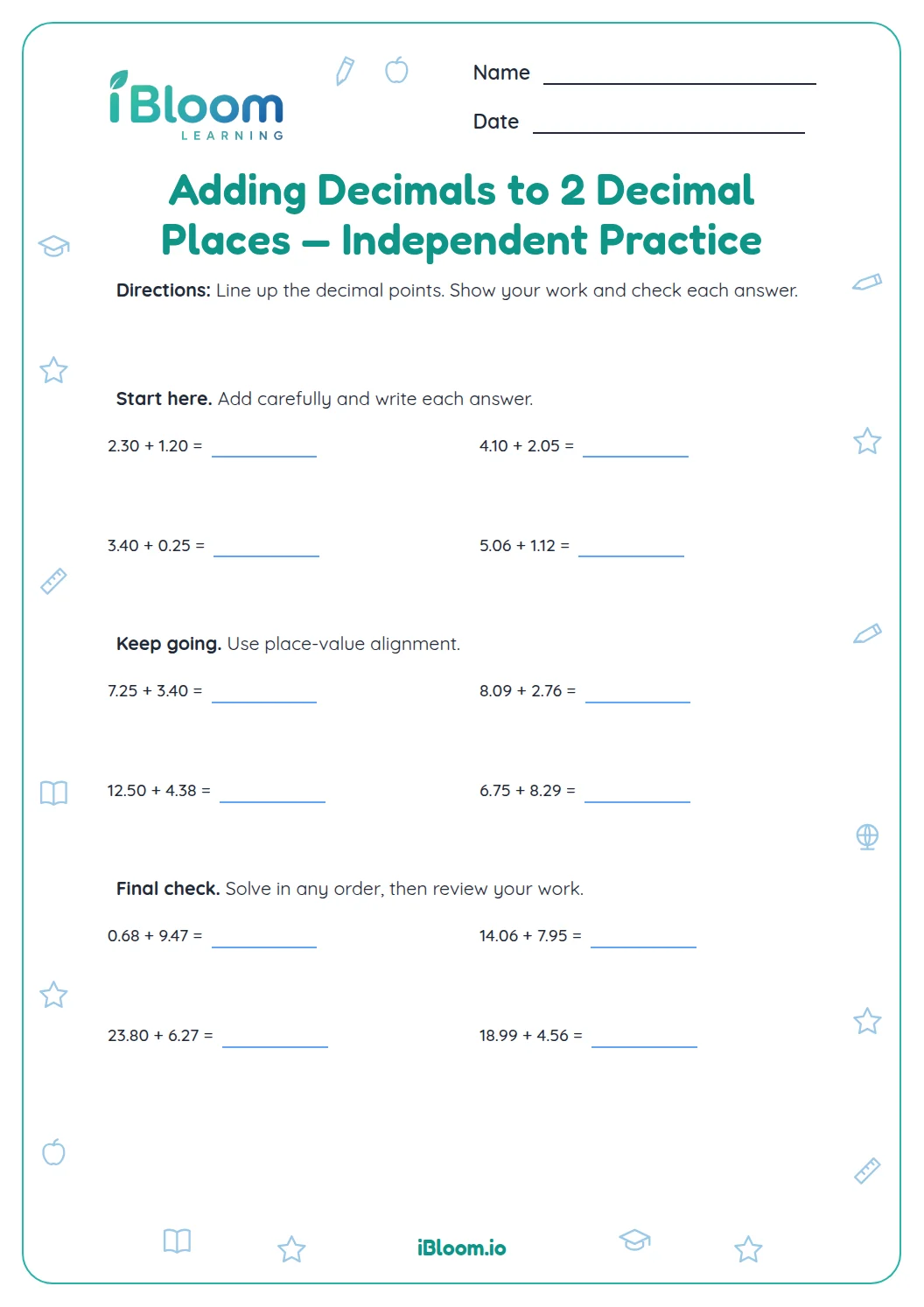
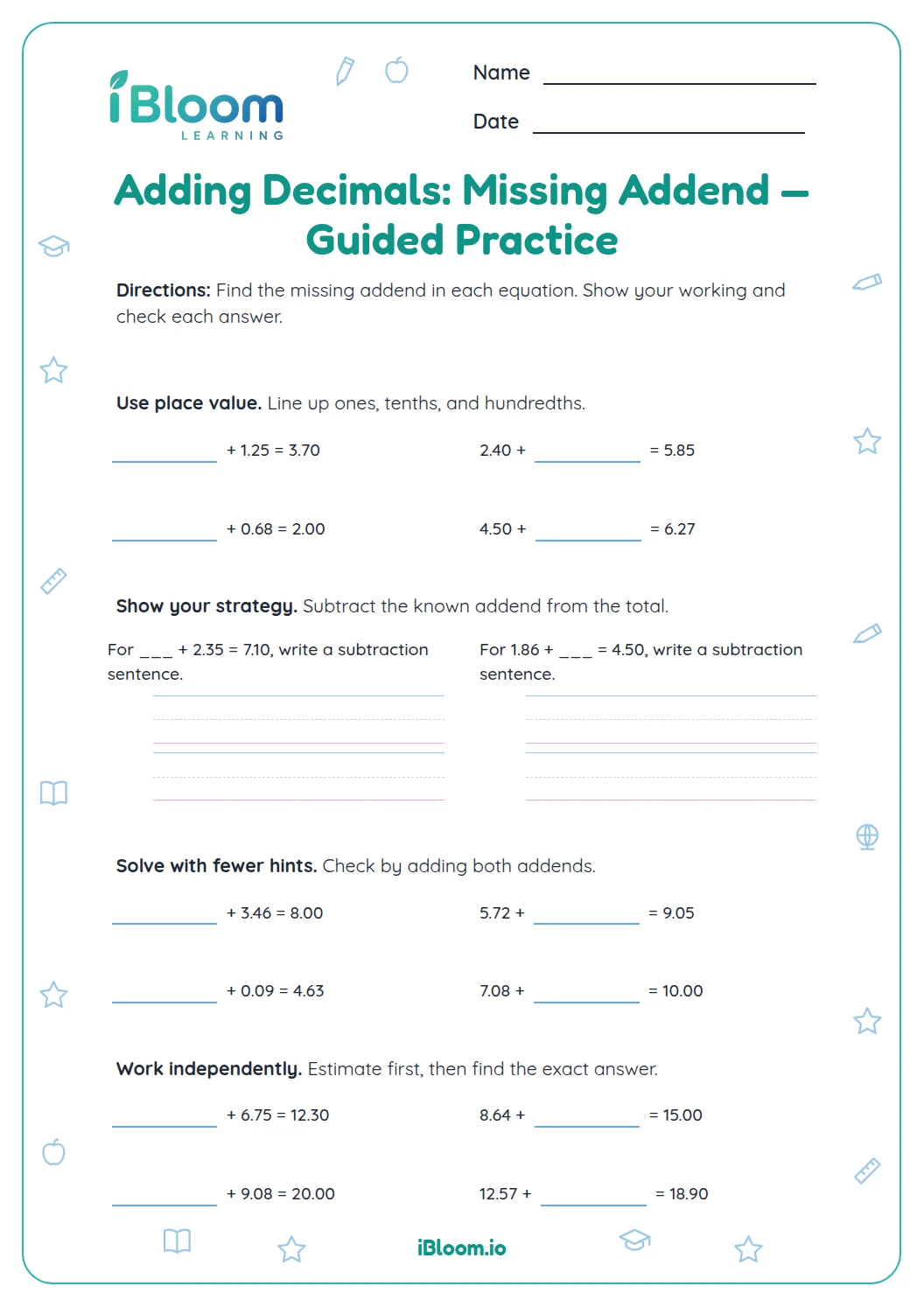
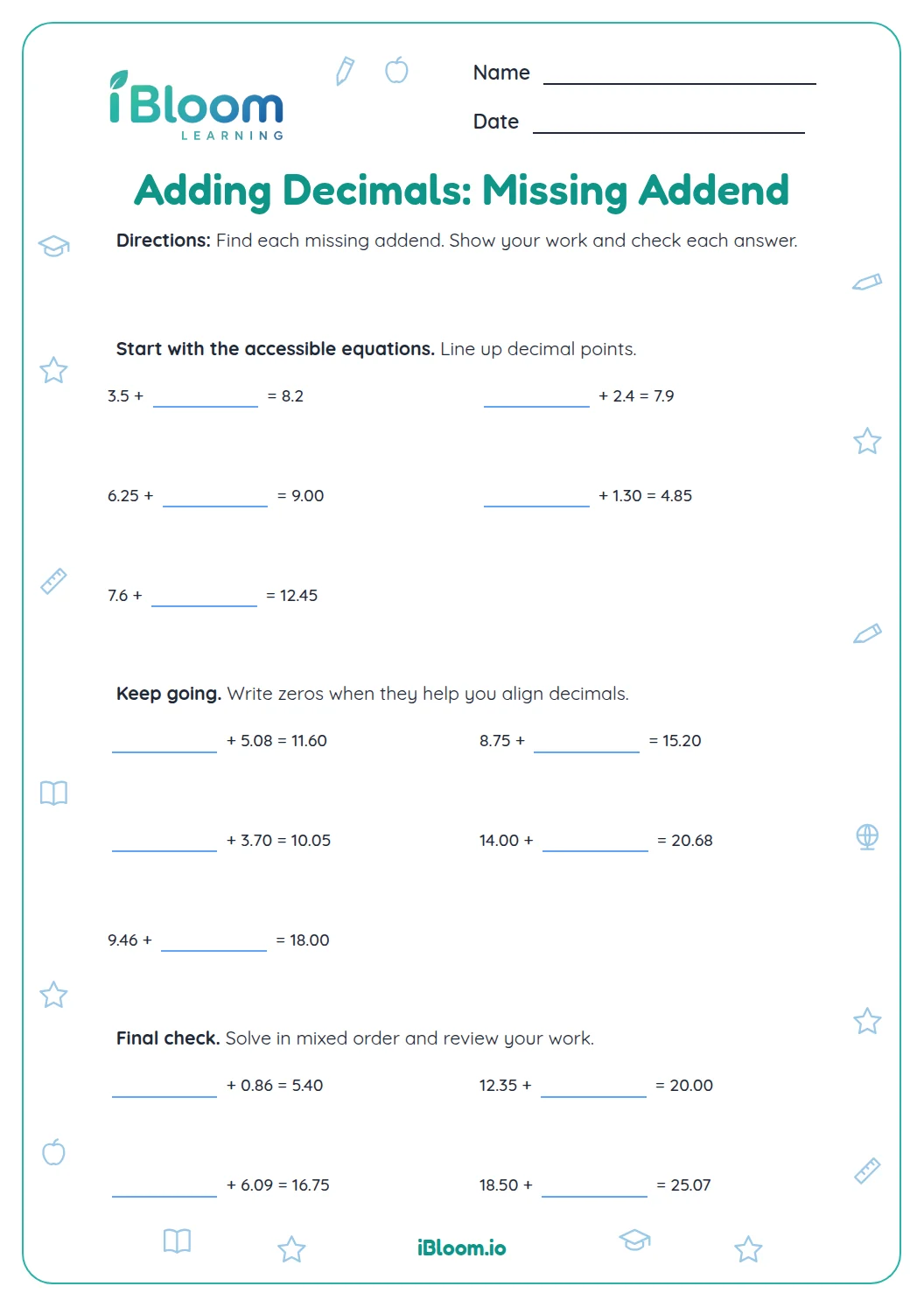
This free printable worksheet gives Grade 6 students structured practice with adding decimals to two decimal places. It includes 16 questions across 3 parts, with clear prompts and a separate answer key. The activities build accuracy by asking students to organize their work and check whether each result makes sense. It practices 6.NS.B.3.
Aligned to 6.NS.B.3
How can students solve adding decimals to two decimal places?
Line up the decimal points so tenths are added to tenths and hundredths to hundredths. Add zeros when a place is empty. Estimate separately to catch an answer that is far too large or small.
In question 1, 6.72 + 2.15 has 2 hundredths plus 5 hundredths, then 7 tenths plus 1 tenth, then 6 plus 2 ones. The sum is 8.87.
- 1 6.72
- 2+ 2.15
- 3 8.87
What practice is on the sheet?
The worksheet has 16 questions in 3 short parts. Each part changes the way students practice, while keeping the same central skill.
How can students check an answer?
Estimate or reason about the size of the result before comparing it with the exact answer. For a model, first read the represented amount, then check that the equation matches it.
How to use the worksheet
- 1Complete Part A by lining up decimal points.
- 2For each Part B item, round both numbers before adding.
- 3Write only the estimate in the estimate item’s answer space.
- 4Translate each Part C story into an addition sentence.
- 5Check each exact sum against its size estimate.
Mistakes to watch for
The mistake
Putting tenths under hundredths.
The fix
Line up decimal points before adding.
The mistake
Forgetting to regroup when a column totals ten or more.
The fix
Write the ones digit and carry the next place value.
The mistake
Writing the rounded estimate as the exact sum.
The fix
Keep the estimate and exact answer in their separate questions.
Common Core alignment
Fluently add, subtract, multiply, and divide multi-digit decimals.
On this sheet: The sheet builds accurate addition of decimals by aligning place values.
Show the official wordingHide the official wording
Fluently add, subtract, multiply, and divide multi-digit decimals using the standard algorithm for each operation.
What to practice next
Make more practice
Further reading
Questions parents and teachers ask
How do I add decimals with two places?
Line up the decimal points so tenths and hundredths share columns, then add from right to left. Regroup when a column totals ten or more, and keep the decimal point in the same position in the sum. For example, 6.72 + 2.15 = 8.87.
Why is the estimate a separate answer?
An estimate checks whether the exact sum is reasonable. In 6.72 + 2.15, rounding each addend gives 7 + 2, or 9; the exact sum, 8.87, is close. Writing the estimate in its own space keeps it distinct from the precise answer.
Should I include two decimal places in every sum?
The number sentences use hundredths, so two decimal places make the place values clear. In the word problems, include the unit from the situation, such as meters, liters, miles, or feet. A trailing zero is acceptable when it represents the same value.
How can I check regrouping?
Add the columns again and confirm that every carried ten went to the next place. Then compare the exact sum with the estimate. If the result is far from the rounded total, check decimal alignment and regrouping. This two-step check separates place-value errors from regrouping errors.
What if one addend has an empty place?
Write a zero in the empty place to keep the columns aligned. For instance, 2.6 can be written as 2.60 before adding hundredths. The zero does not change the value, but it helps keep tenths and hundredths in their proper columns.