
About this worksheet
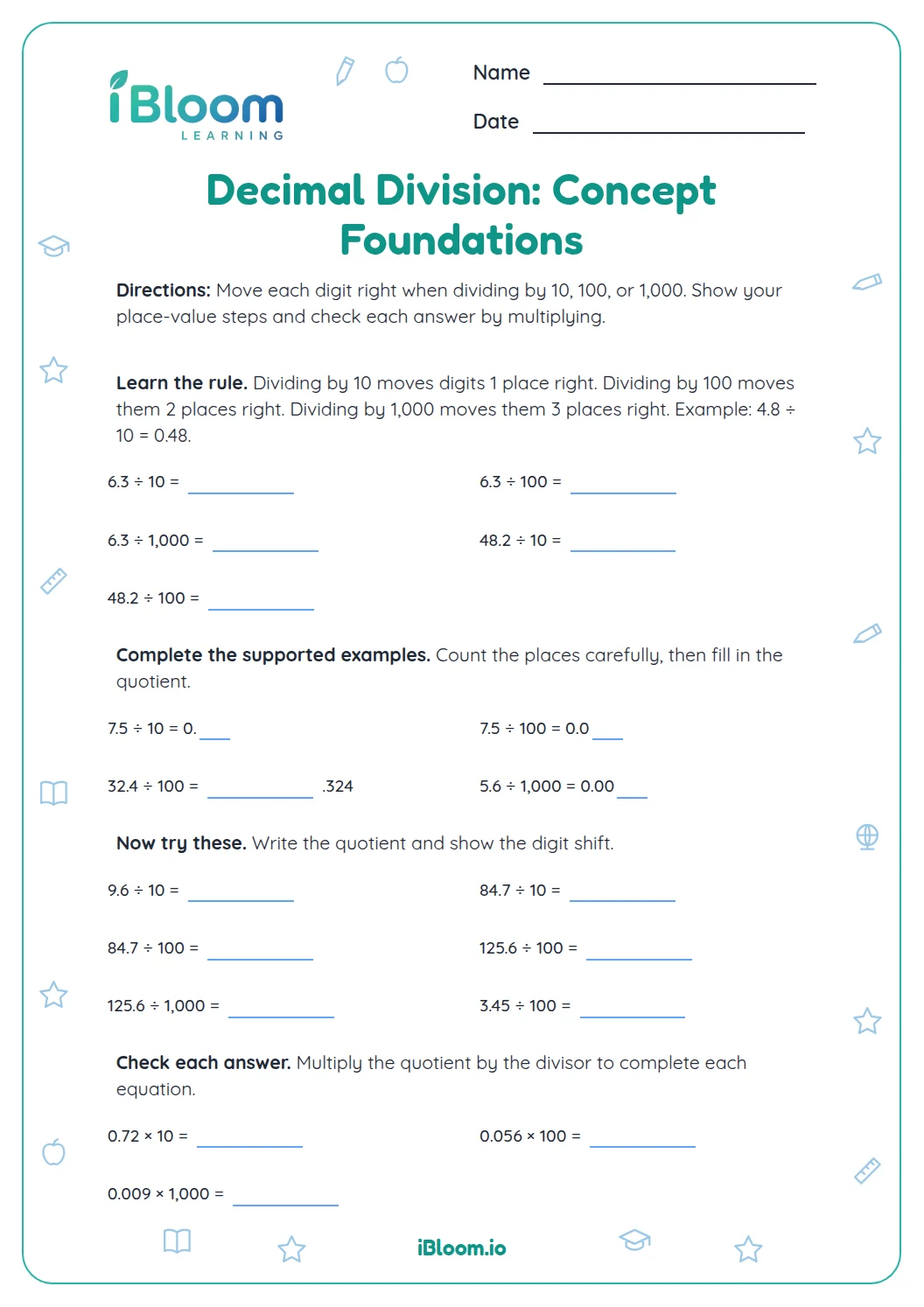
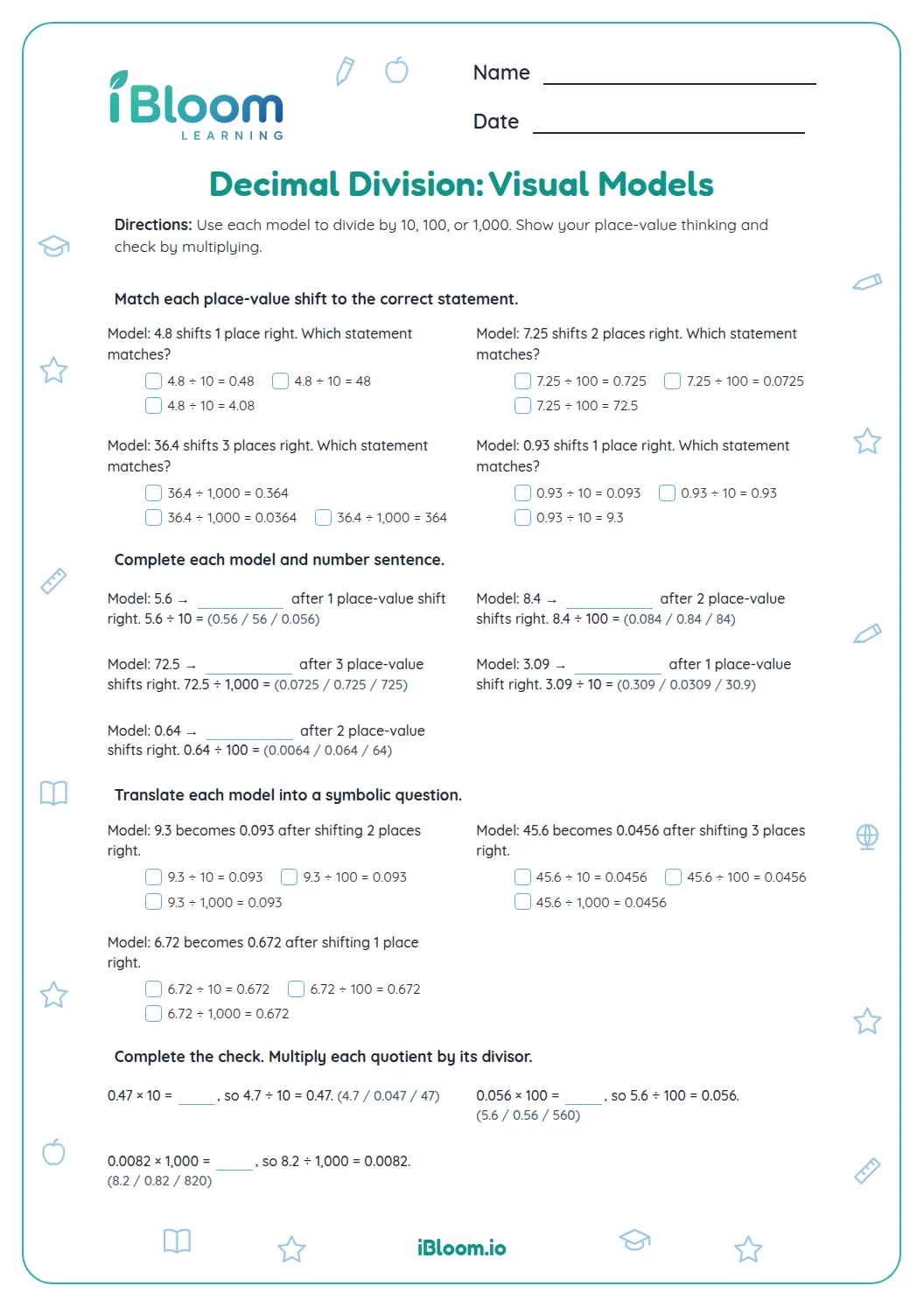
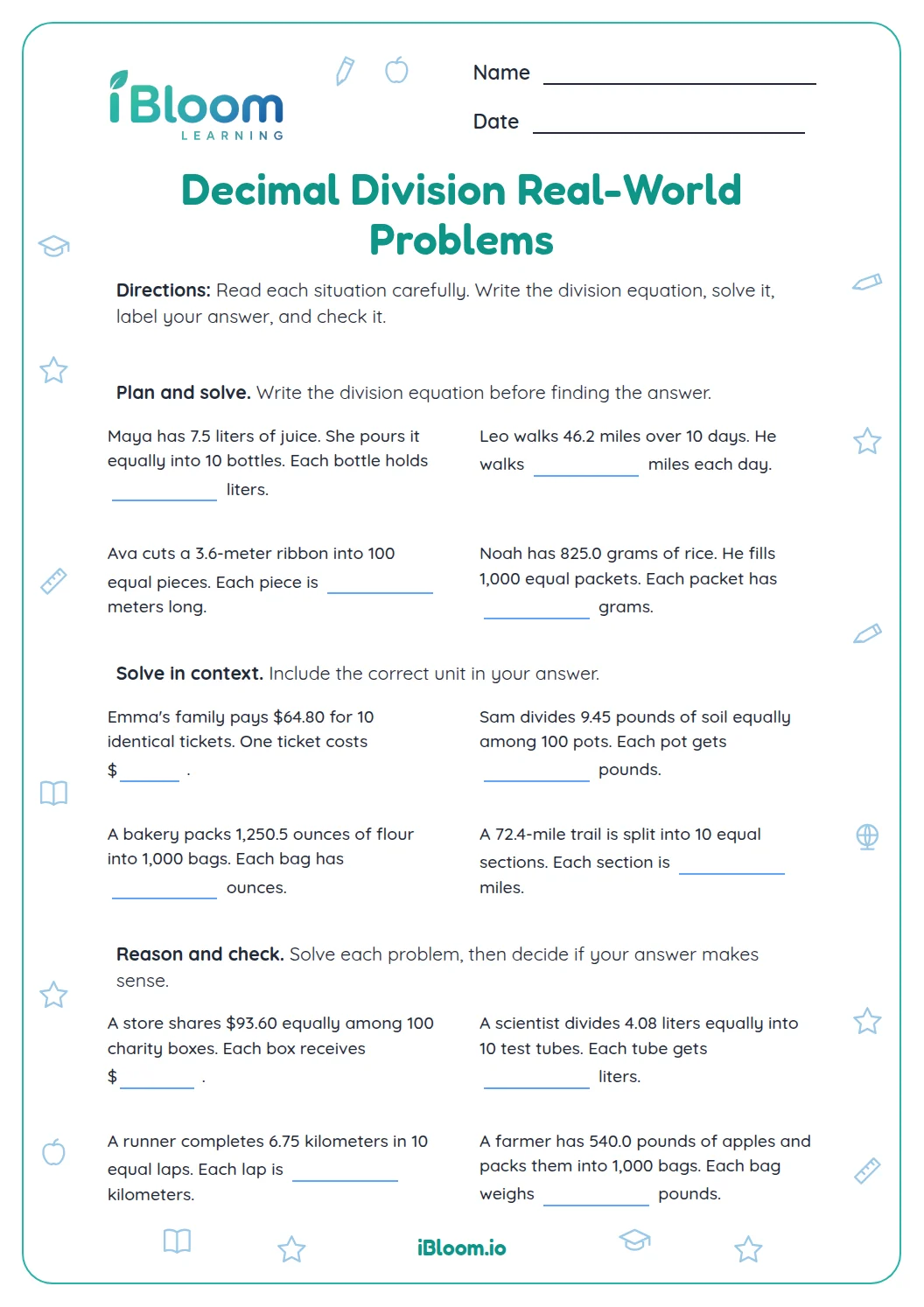
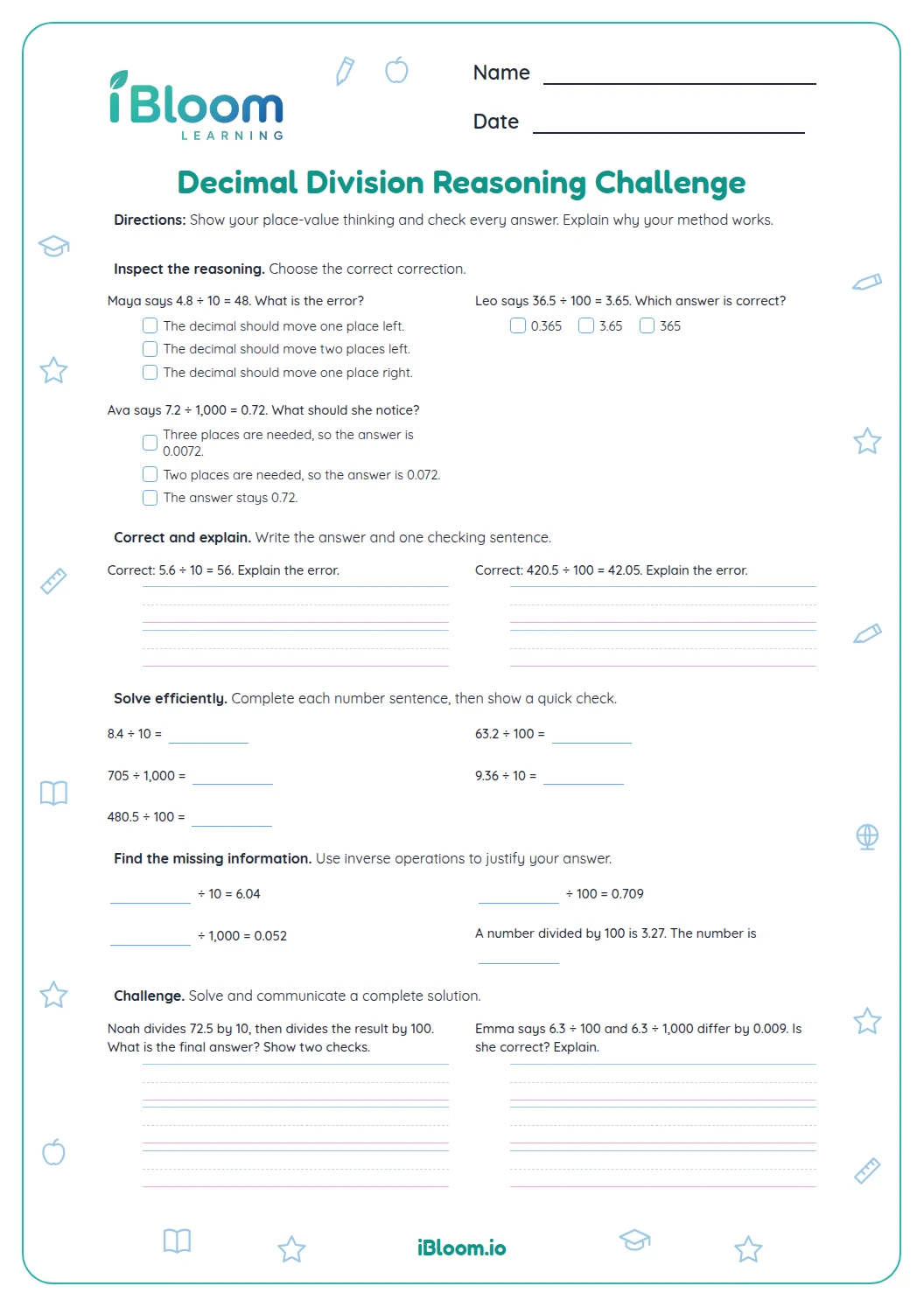
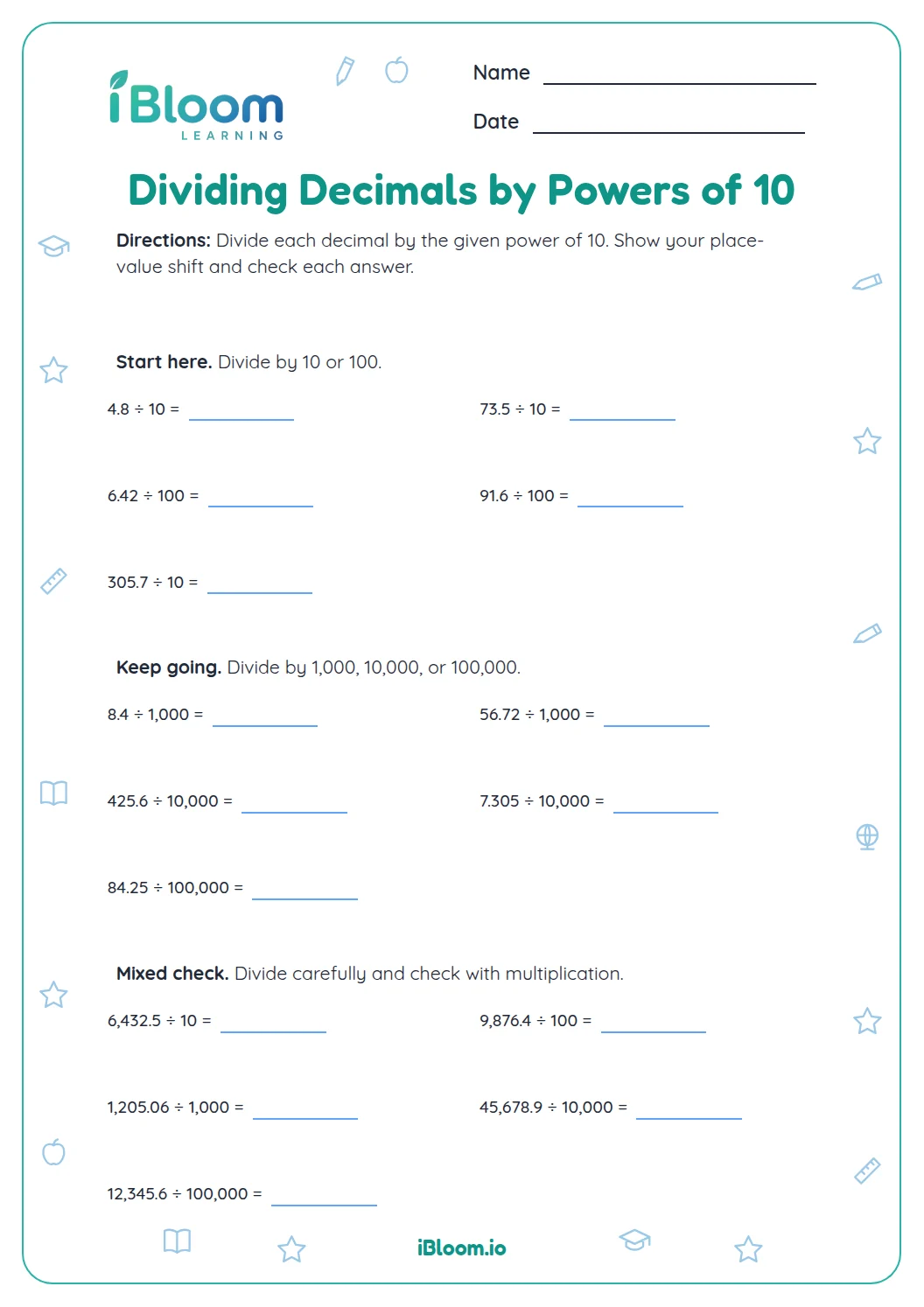
This Grade 6 printable worksheet practices dividing decimals by 10, 100, and 1,000. Students begin with six quotient problems, then solve eight more and write a multiplication check in its own answer space. The separate key lists each quotient and check equation. The page practices CCSS 6.NS.B.3 through decimal division and place-value reasoning.
Aligned to 6.NS.B.3
What does divide by 10, 100, or 1,000 mean?
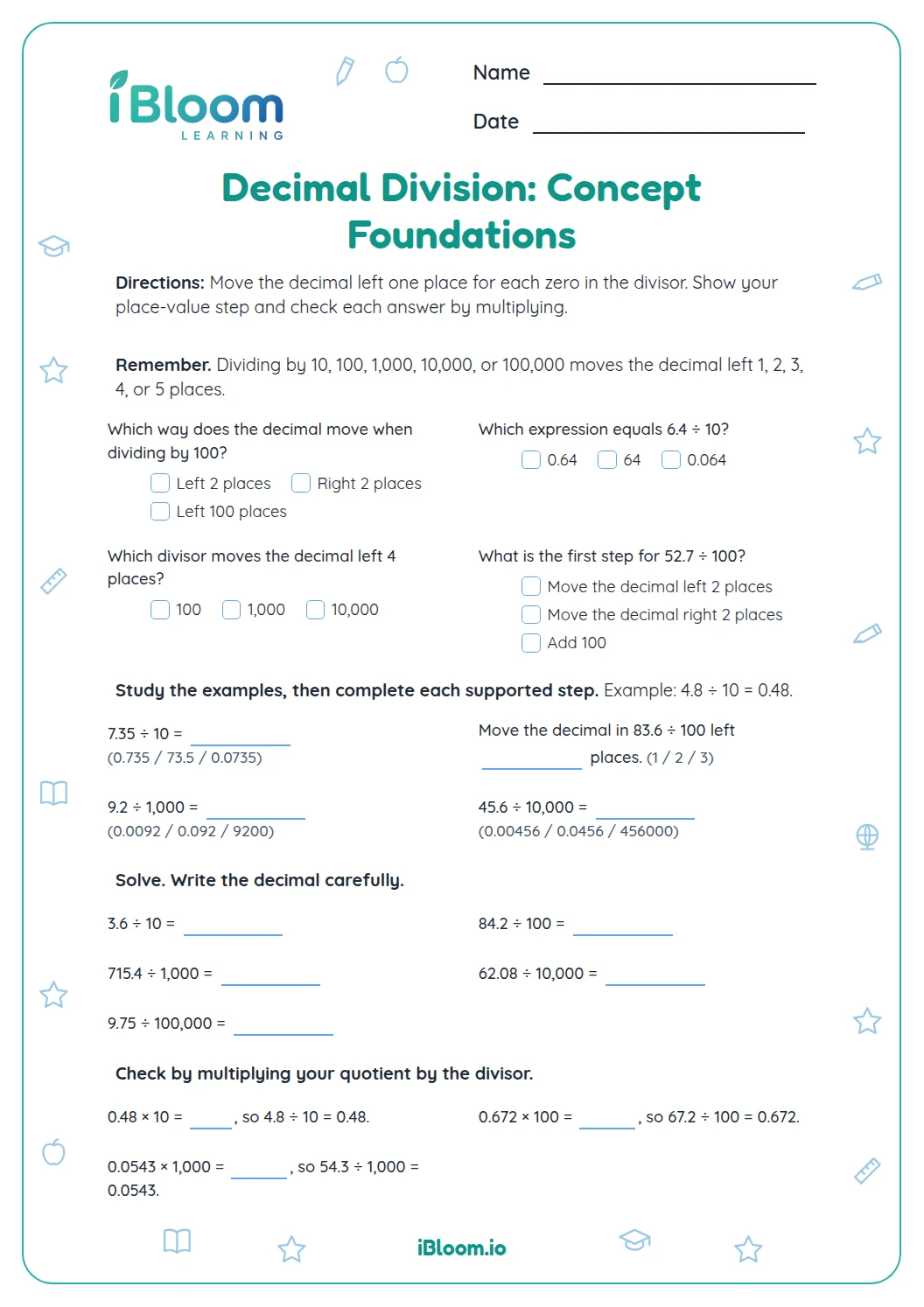
Dividing by 10, 100, or 1,000 changes the place value of every digit. The divisor tells how many places the quotient is smaller: one place for 10, two for 100, and three for 1,000.
How should students check a quotient?
For question 7, 3.75 ÷ 10 = 0.375. Check the result by multiplying: 0.375 × 10 = 3.75, which returns the original dividend.
- 13.75 ÷ 10 = ___
- 2Answer: 0.375
- 3Check: 0.375 × 10 = 3.75
What will students practice on this page?
There are 14 questions in two parts. The first six ask for quotients; the next eight ask for a quotient and a separate multiplication check.
- Part 1: six divisions by 10, 100, or 1,000.
- Part 2: eight quotient and check pairs.
- The answer key has two pages.
How to use this worksheet
- 1Read the divisor and count how many places its zeros represent.
- 2Estimate whether the quotient should be larger or smaller than the dividend.
- 3Write the quotient in the first blank.
- 4For check items, multiply the quotient by the original divisor.
- 5Compare the product with the original dividend and use the key to review.
Common mistakes and quick fixes
The mistake
Moving the decimal the wrong number of places.
The fix
Count one place for 10, two for 100, and three for 1,000.
The mistake
Making the quotient larger when dividing by 100.
The fix
Estimate first: dividing a positive number by 100 makes it smaller.
The mistake
Putting the check equation in the quotient blank.
The fix
Record the quotient first, then write the multiplication check in its own blank.
Common Core alignment
This worksheet practices Grade 6 decimal division and place-value reasoning.
Use place value and the standard algorithm to divide multi-digit decimals.
On this sheet: Students solve decimal division problems using place value, equations, and checks.
Show the official wordingHide the official wording
Fluently add, subtract, multiply, and divide multi-digit decimals using the standard algorithm for each operation.
What to practice next
Make more practice
Further reading
Questions parents and teachers ask
What does this worksheet ask students to divide?
Students divide decimal numbers by 10, 100, or 1,000. The first six items focus on finding the quotient, and the next eight pair each quotient with a multiplication check so the student can verify the place-value shift. This makes the calculation easier to discuss and check together.
Why does dividing by 100 move each digit two places?
One hundred is 10 × 10, so dividing by it makes each place-value unit one hundred times smaller. For example, 84.6 ÷ 100 = 0.846. The decimal point is a shortcut for tracking the value of the digits, not a number that physically moves.
How can a student check a quotient?
Multiply the quotient by the divisor and compare the product with the original dividend. For 3.75 ÷ 10 = 0.375, the check is 0.375 × 10 = 3.75. The worksheet gives a separate space for that product equation on its check items.
Does the answer key include the checks?
Yes. For the second part, the key lists the quotient first and the multiplication equation second, matching the two answer spaces. Students can check both the decimal placement and whether multiplication returns the dividend. This makes the calculation easier to discuss and check together.
How long might this practice take?
Plan for about 20 minutes, depending on whether students write out each multiplication check. The page begins with direct quotient practice, then asks for a complete check equation on eight items, so it can be split across two short sessions if needed.