



About this worksheet
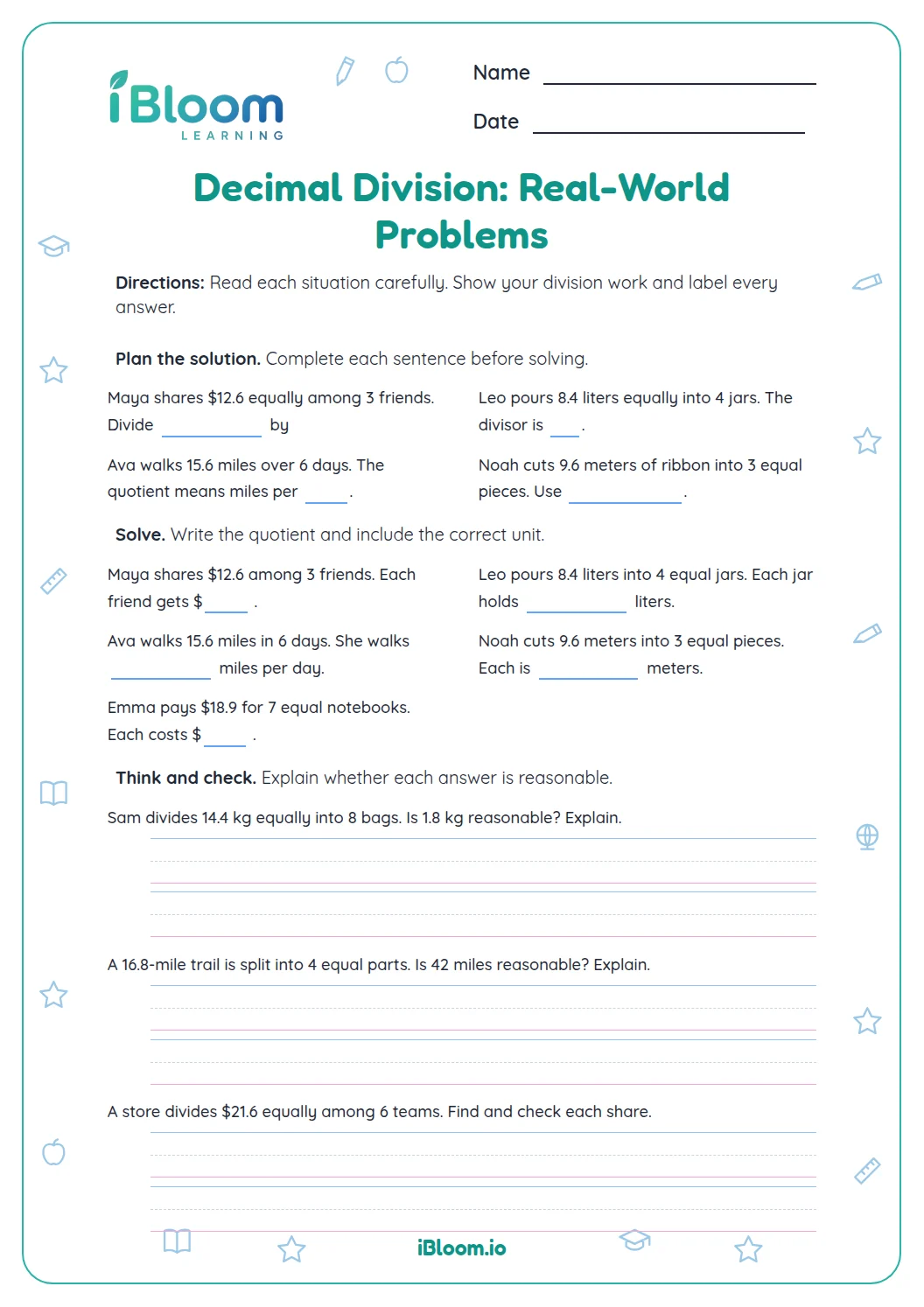
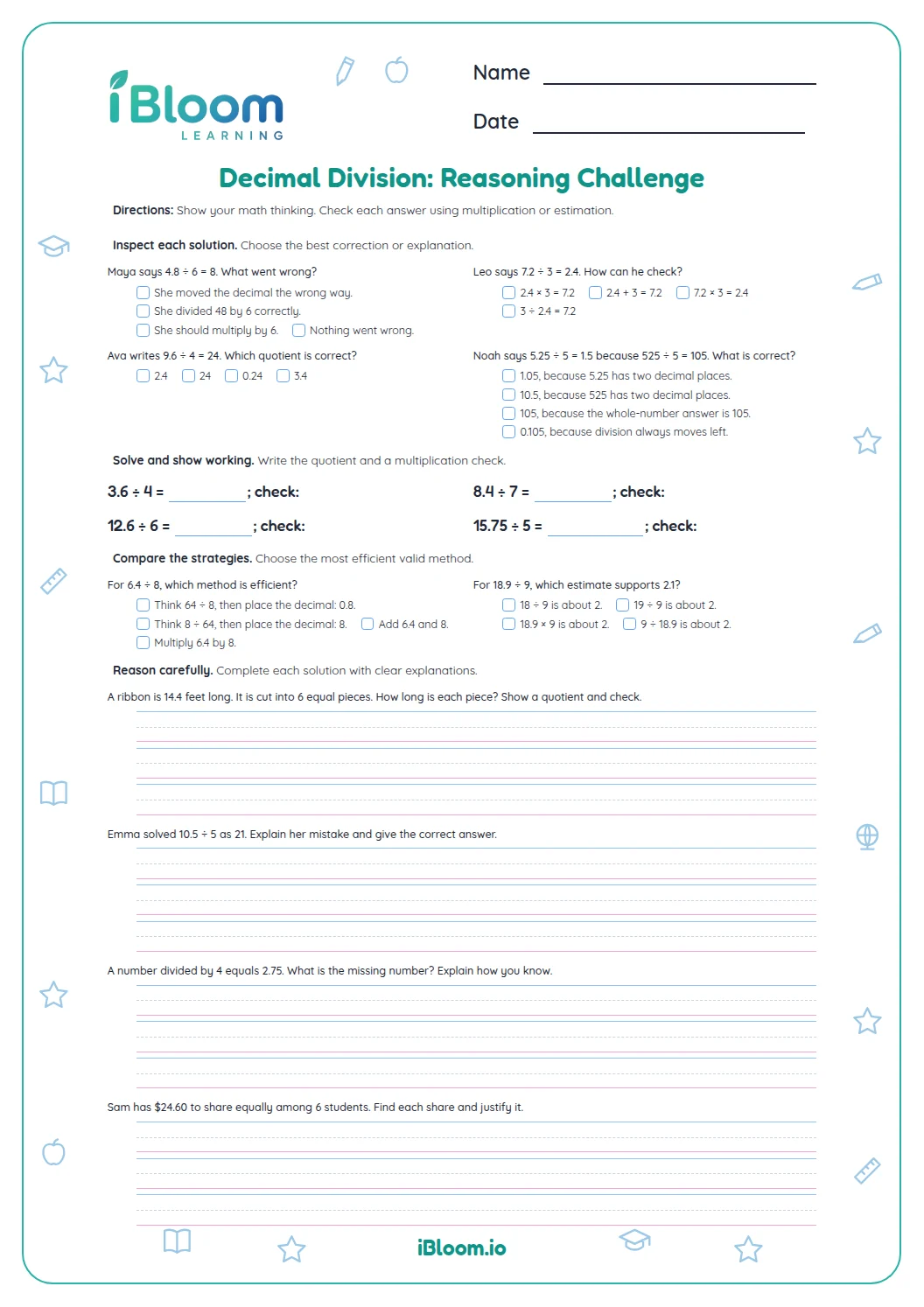
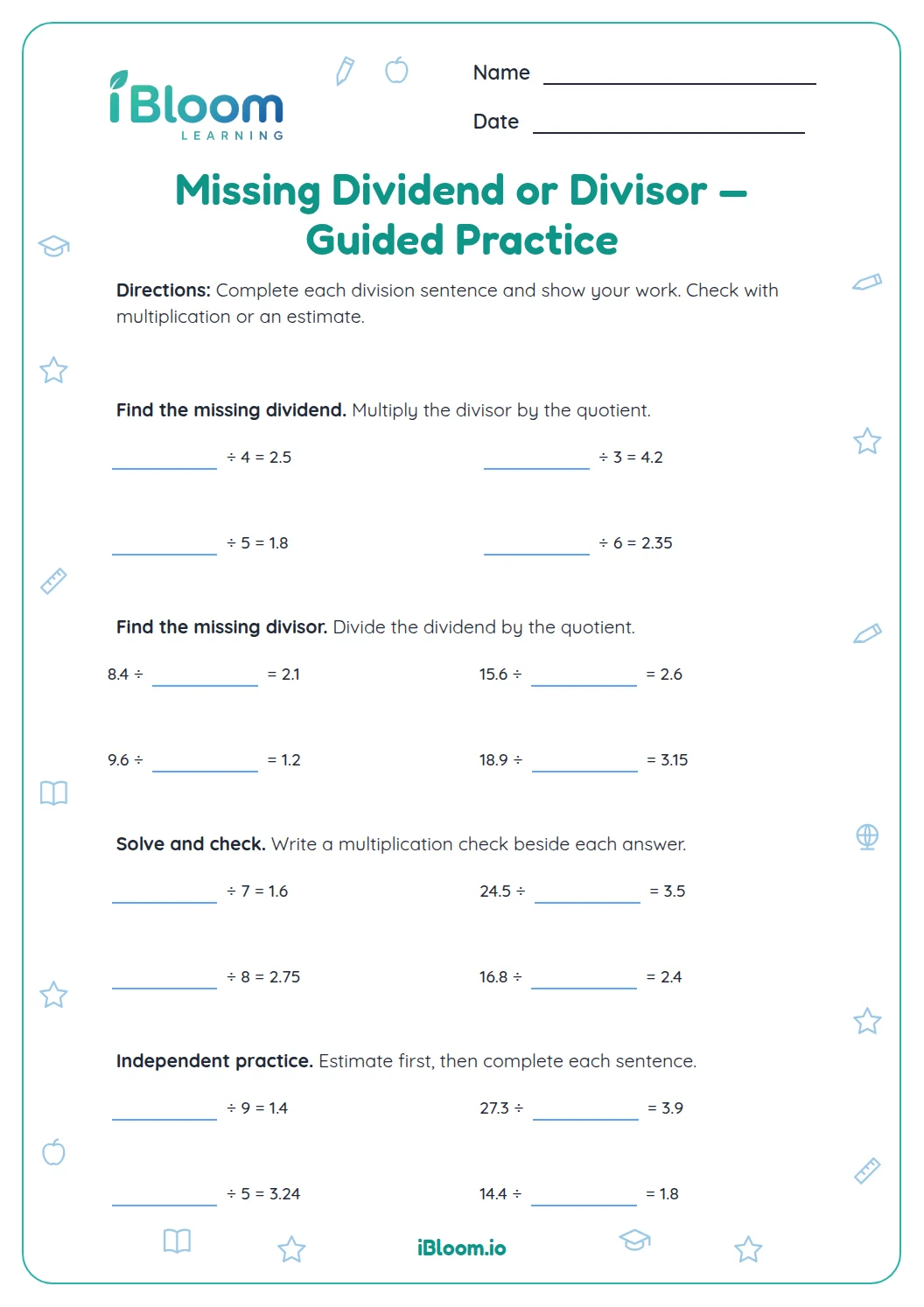
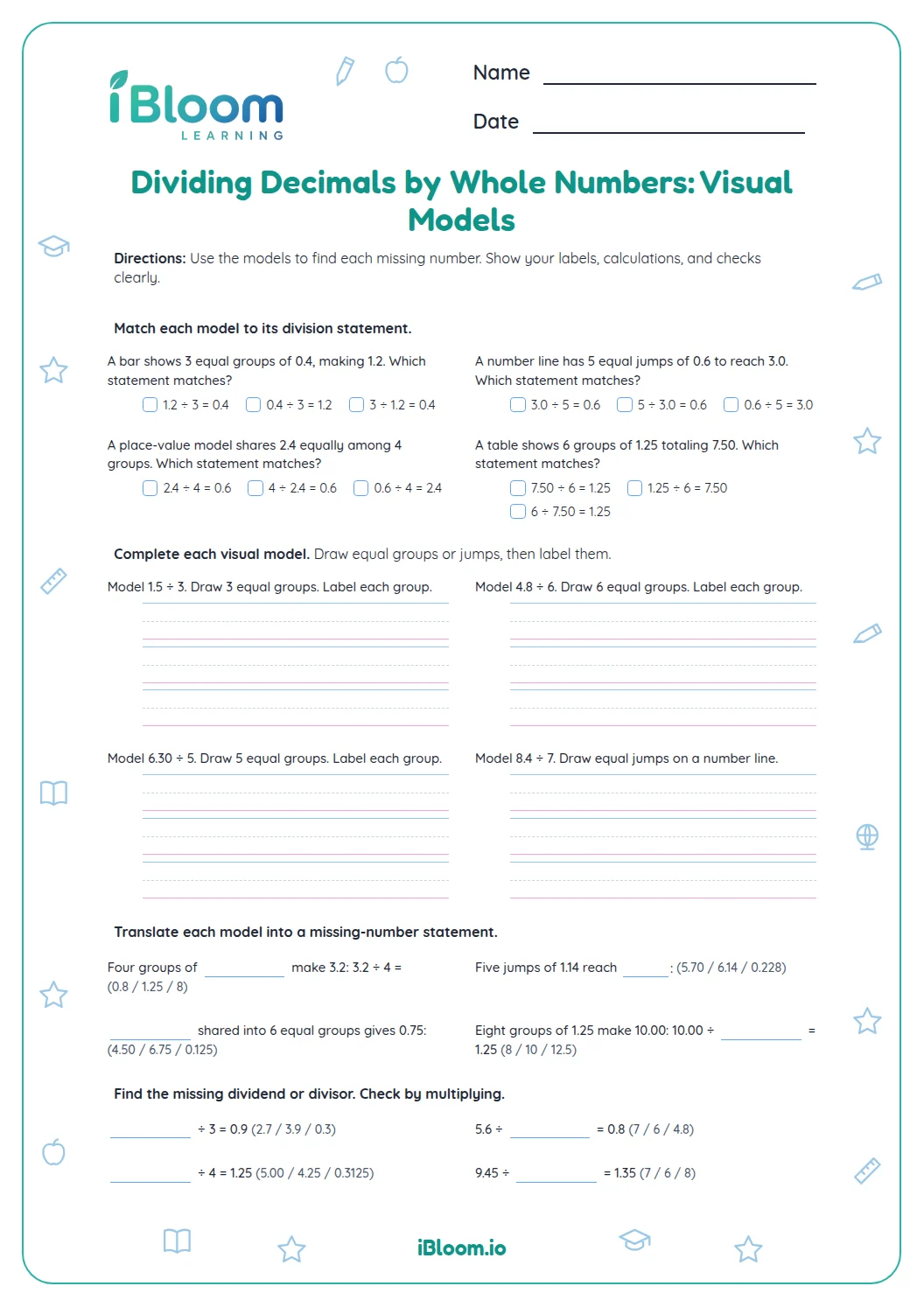
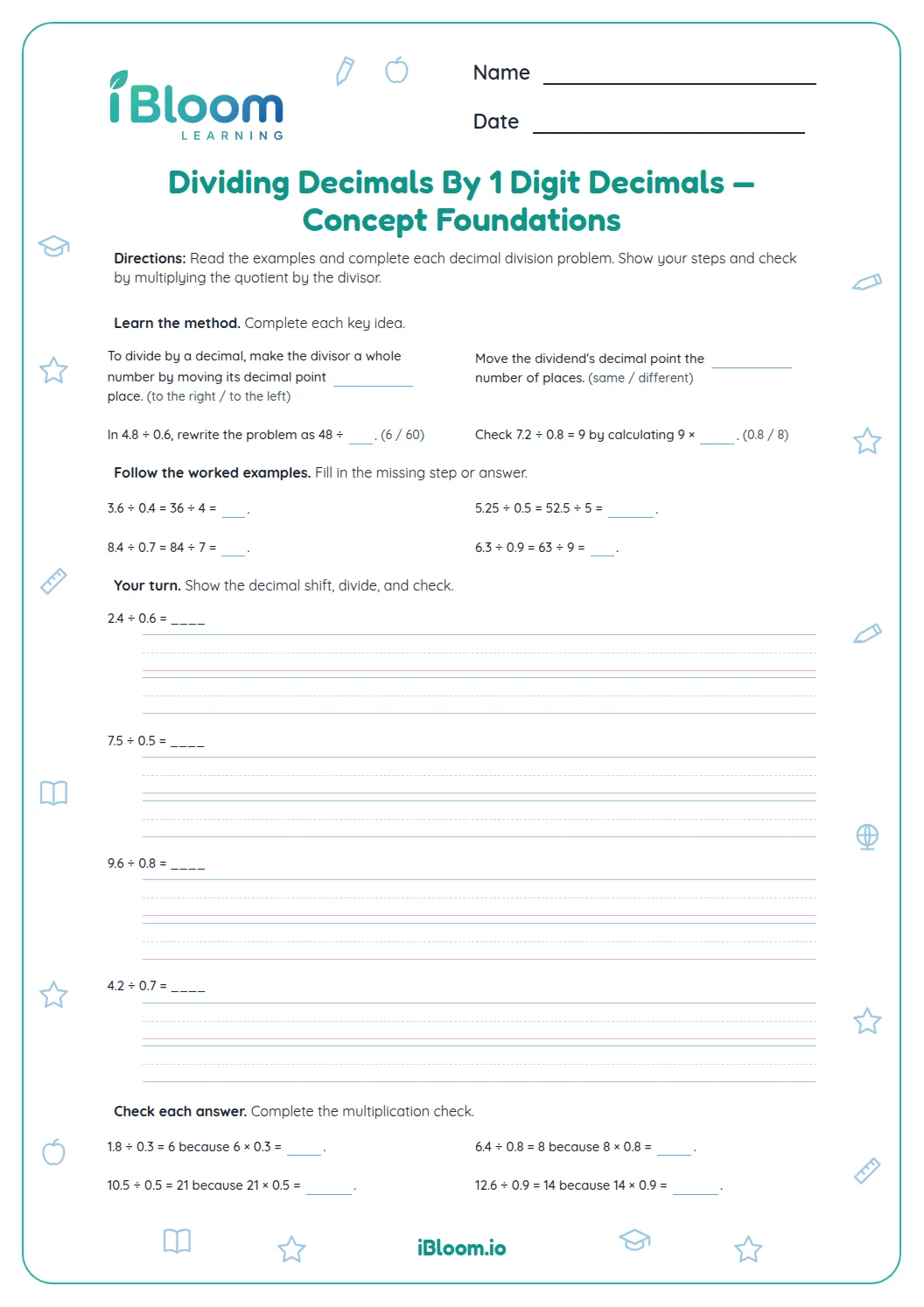
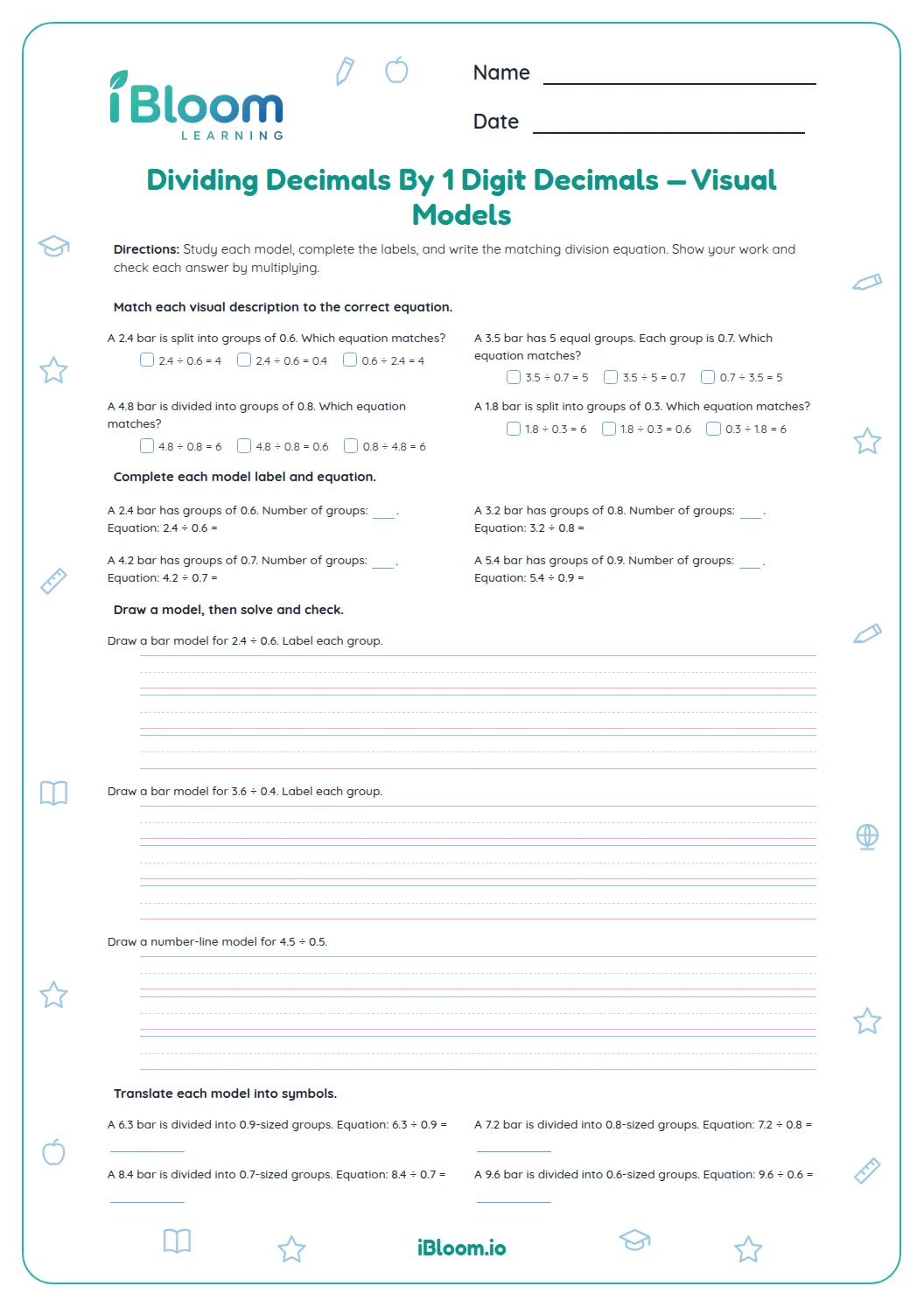
This free printable Grade 6 worksheet gives students 22 decimal-division questions with whole-number divisors. It begins with quotient practice, then asks students to complete separate multiplication checks and estimates. The page practices CCSS 6.NS.B.3, which includes fluently dividing multi-digit decimals with the standard algorithm. A separate key is included.
Aligned to 6.NS.B.3
How do you solve decimal division by whole numbers problems?
Keep the place values visible and work one operation at a time. For 25.2 ÷ 9, the quotient is 2.8 because 2.8 × 9 = 25.2.
- 125.2 ÷ 9
- 2252 tenths ÷ 9 = 28 tenths
- 3The quotient is 2.8
- 4Check: 2.8 × 9 = 25.2
What does each part ask students to do?
The practice moves from quotient calculations to independent division, nearby whole-number estimates, and multiplication checks.
- Part A: Find each quotient (4 questions)
- Part B: Solve and check (6 questions)
- Part C: Work independently (4 questions)
- Part D: Estimate then solve (6 questions)
- Part E: Finish with a check (2 questions)
How can students check a decimal answer?
Use the inverse operation and estimate the size before accepting a result. The estimate is a nearby whole-number value, not a second quotient.
A steady way to work through the sheet
- 1Read the dividend and whole-number divisor.
- 2Divide using place value and keep the decimal point in the quotient aligned.
- 3For a check, multiply the quotient by the divisor.
- 4For an estimate, round to nearby whole numbers.
- 5Compare each result with the answer key.
Common decimal mistakes and fixes
The mistake
Moving a decimal point in only one number during division.
The fix
If the divisor is decimal, multiply both dividend and divisor by the same power of ten.
The mistake
Treating a trailing zero as a change in value.
The fix
Use a zero as a place-value holder: 0.7 and 0.70 name the same amount.
The mistake
Writing a correct quotient in the check space as well, or leaving the check blank.
The fix
Write the quotient in its own blank, then put the multiplication check in the separate check blank.
Common Core alignment
This worksheet practices Grade 6 decimal operations and the related place-value reasoning.
Fluently add, subtract, multiply, and divide multi-digit decimals using standard algorithms.
On this sheet: The questions practice decimal division with whole-number divisors and decimal quotients.
Show the official wordingHide the official wording
Fluently add, subtract, multiply, and divide multi-digit decimals using the standard algorithm for each operation.
What to practice next
Make more practice
Further reading
Questions parents and teachers ask
How many questions are on this worksheet?
This worksheet contains 22 questions arranged in 5 parts, plus a separate answer key. Each prompt has its own response space. Students can finish a part, check the matching key entries, and correct any decimal-place or operation errors before moving on.
What strategy does this worksheet practice?
Students use the inverse relationship between division and multiplication throughout this worksheet. Divide using place value and keep the decimal point in the quotient aligned. For a check, multiply the quotient by the divisor. The separate answer key lets an adult check the reasoning after each part.
Why does the worksheet include checking?
A check helps catch a misplaced decimal point or an arithmetic slip. Multiplying a quotient by its divisor should return the dividend, and an estimate helps show whether the result is a sensible size. Students can use both habits on the practice page.
Can students use zeros at the end of a decimal?
Yes. A zero at the end of a decimal can make place value easier to see without changing the amount, as in 0.7 = 0.70. This is useful when lining up decimal places for subtraction and when comparing equivalent amounts. The value stays unchanged.
How should the answer key be used?
Students can finish a part before checking it, then revisit any missed calculation and explain the correction. The key is on its own pages so it can be printed separately from the student worksheet. Its entries follow the same order as the practice problems.