




About this worksheet
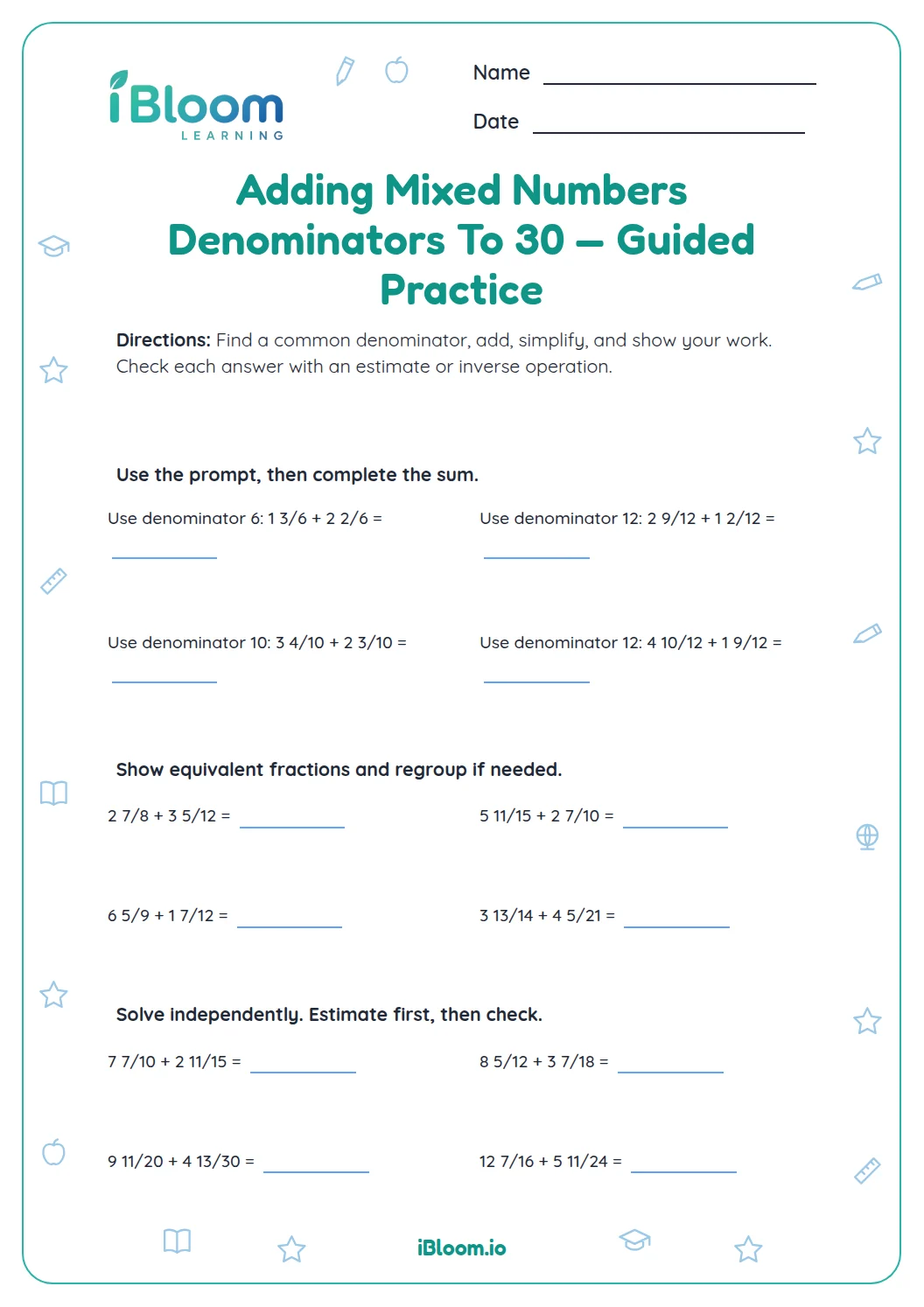
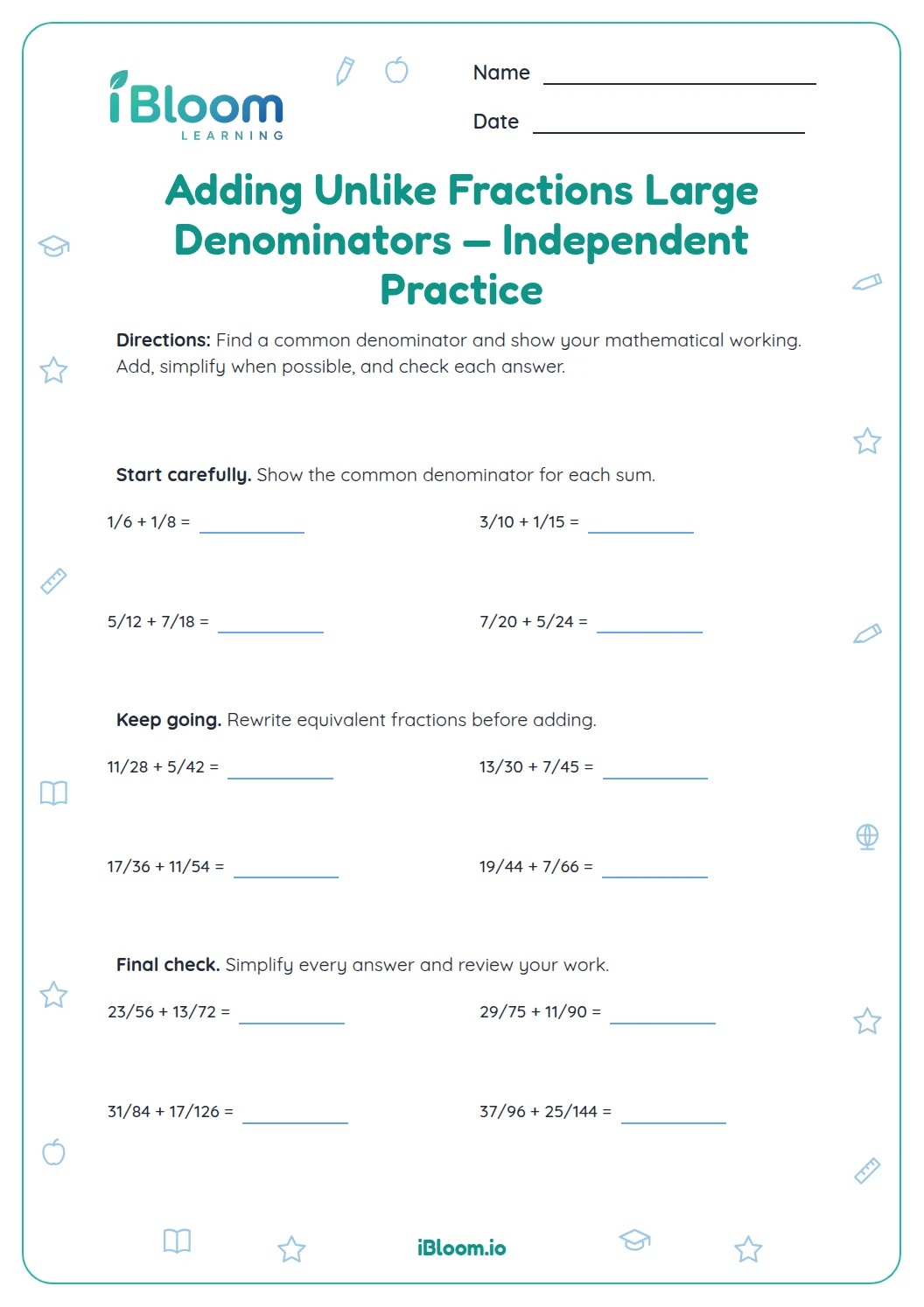
This Grade 6 concept-foundations worksheet practices adding mixed numbers with unlike denominators up to 30. Students make equivalent fractions, add whole and fractional parts, and regroup sums greater than one. The 14 problems include the corrected results 6 19/24 and 6 11/18 for two regrouping examples.
Aligned to 5.NF.A.1
How do you add mixed numbers with unlike denominators?
Rewrite the fractions with a common denominator, add the whole and fractional parts, and regroup when the fraction is at least one. For 5 3/8 + 1 5/12, use twenty-fourths: 5 9/24 + 1 10/24 = 6 19/24.
- 1Rewrite the fractions with a common denominator, add the whole and fractional parts, and regroup when the fraction is at least one. For 5 3/8 + 1 5/12, use twenty-fourths: 5 9/24 + 1 10/24 = 6 19/24.
When does regrouping matter?
Regroup when the fractional sum is an improper fraction. In 2 5/6 + 3 7/9, write fifteenths as eighteenth parts: 2 15/18 + 3 14/18 = 5 + 29/18 = 6 11/18.
How can students check a sum?
Check that the equivalent fractions have the same denominator, add their numerators, and regroup any whole from the fractional sum. A quick estimate can confirm the total is in a sensible range.
A simple practice routine
- 1Find a common denominator for the fractional parts.
- 2Rewrite each fraction as an equivalent fraction.
- 3Add whole-number parts and fractional numerators.
- 4Regroup a fraction sum greater than one.
- 5Simplify the fractional part of the result.
Common mistakes and quick fixes
The mistake
Adding denominators instead of finding equivalent fractions.
The fix
Keep the common denominator and add only the numerators.
The mistake
Forgetting to regroup 29/18 as 1 11/18.
The fix
Separate one whole from the improper fraction and add it to the whole-number sum.
The mistake
Leaving an unsimplified final fraction.
The fix
Reduce the fractional part after regrouping, as with 12/24 = 1/2.
Common Core alignment
These problems give students practice applying the standard with mixed numbers.
Add fractions with unlike denominators by using equivalent fractions.
On this sheet: The questions directly practice adding mixed numbers with unlike denominators and regrouping with the stated numbers.
Show the official wordingHide the official wording
Add and subtract fractions with unlike denominators (including mixed numbers) by replacing given fractions with equivalent fractions in such a way as to produce an equivalent sum or difference of fractions with like denominators.
What to practice next
Make more practice
Further reading
Questions parents and teachers ask
Does the worksheet include an answer key?
Yes. A separate key gives a result for each of the 14 mixed-number sums. It accepts equivalent forms while requiring correct common-denominator work and regrouping. The answer key follows the worksheet numbering and gives simplified mixed-number results for all 14 sums.
What denominator range is practiced?
The fractions use denominators up to 30, including pairs that can be rewritten with a common denominator. Students need to make equivalent fractions before adding. Students make equivalent fractions with a common denominator, add, and simplify. Several sums require regrouping a whole.
When should a student regroup?
Regroup when the fractional parts add to one whole or more. For example, 15/18 + 14/18 = 29/18 = 1 11/18, so add that extra whole to the whole-number sum. The extra whole from 29/18 is added to the sum of the whole-number parts, giving 6 11/18.
Why can’t students add the denominators?
The denominator names the size of each part. Once both fractions use equal-sized parts, add the number of parts and keep the common denominator. Equal denominators let students count same-sized fractional parts; adding denominators would change the part size.
How can I support without giving away the sum?
Ask which common denominator the student chose and whether both fractions name that many equal parts. After adding, ask if the fractional result contains another whole to regroup. These questions direct attention to the denominator choice, equivalent fractions, and whether the fractional sum makes a whole.