





About this worksheet
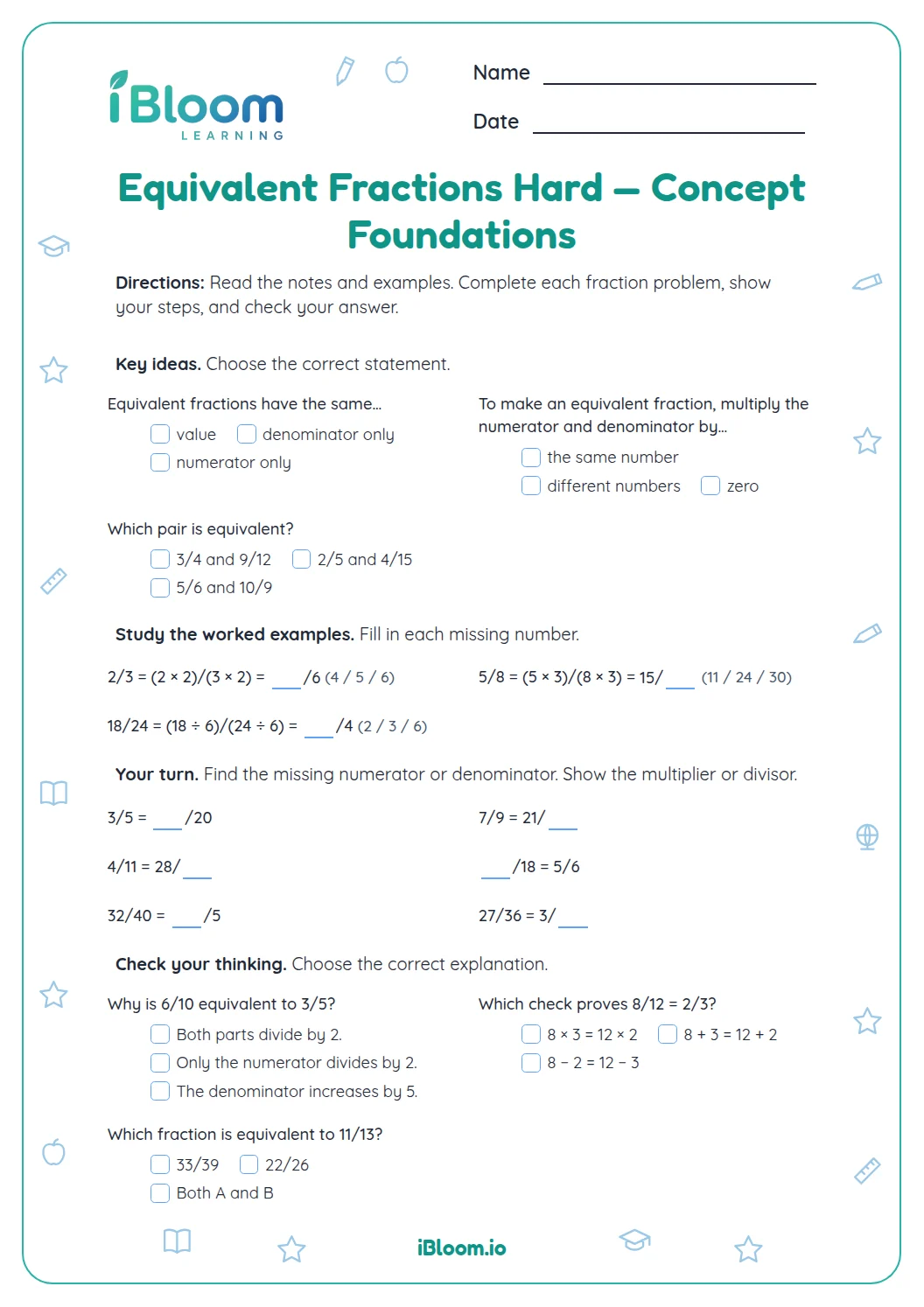
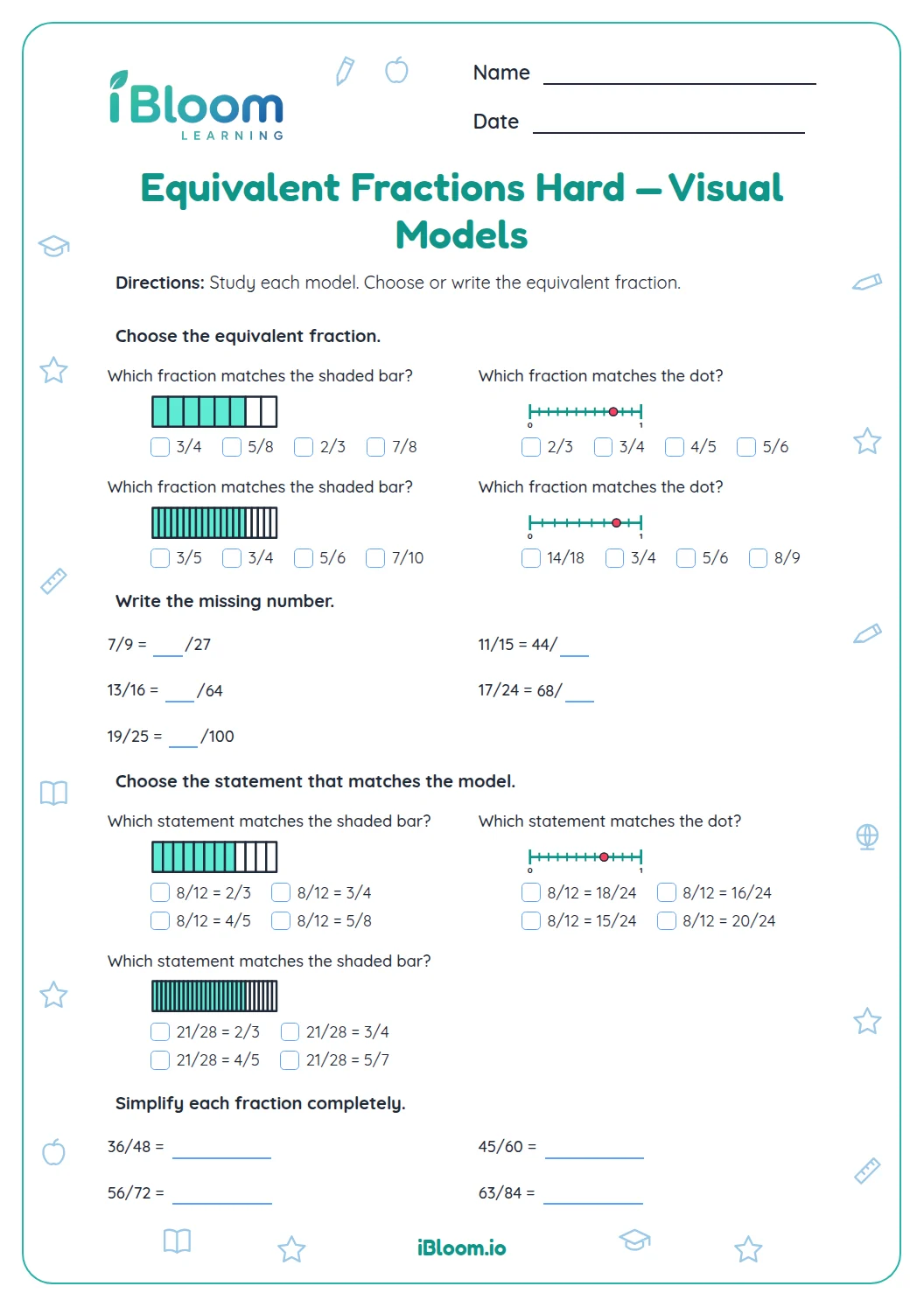
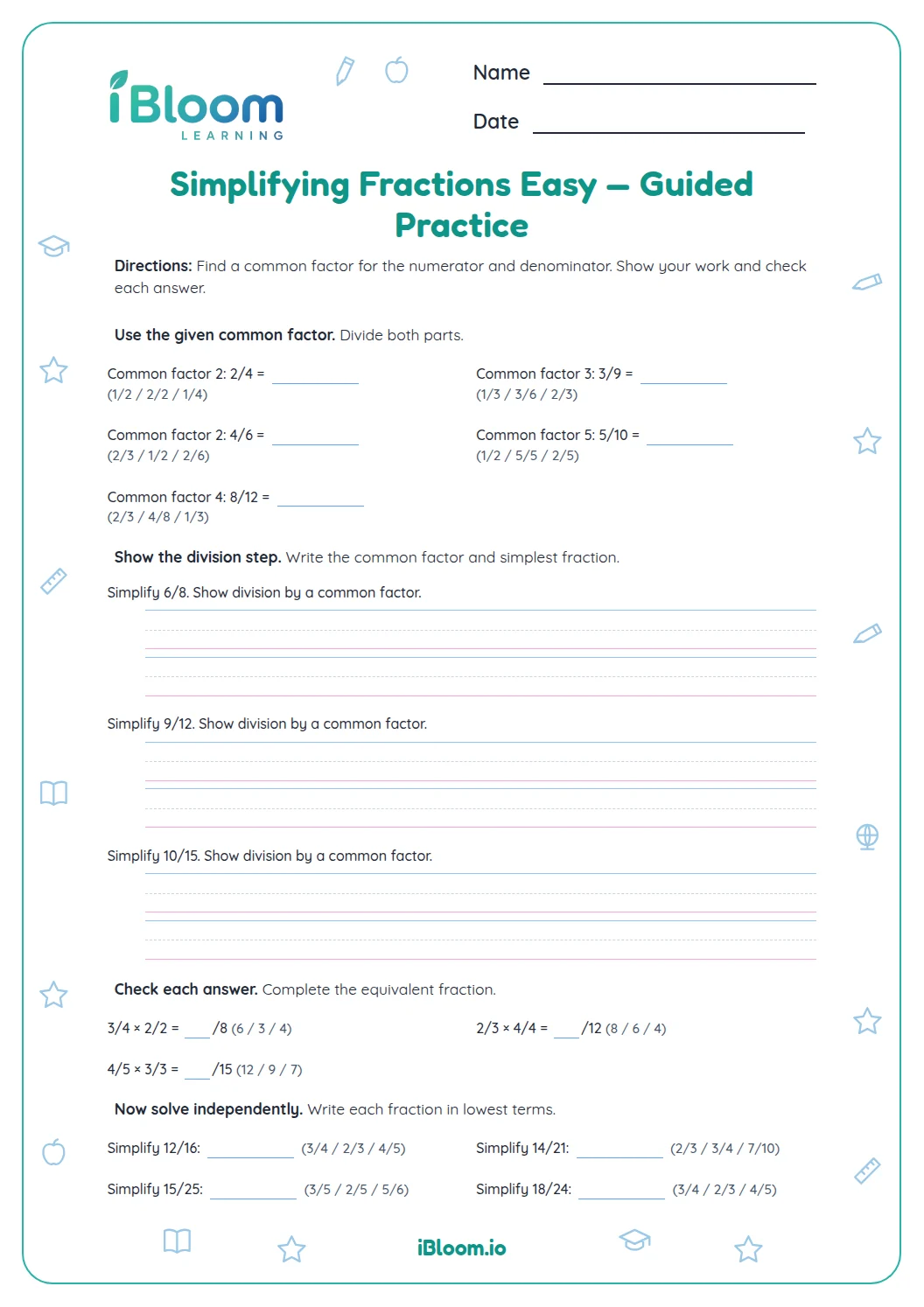
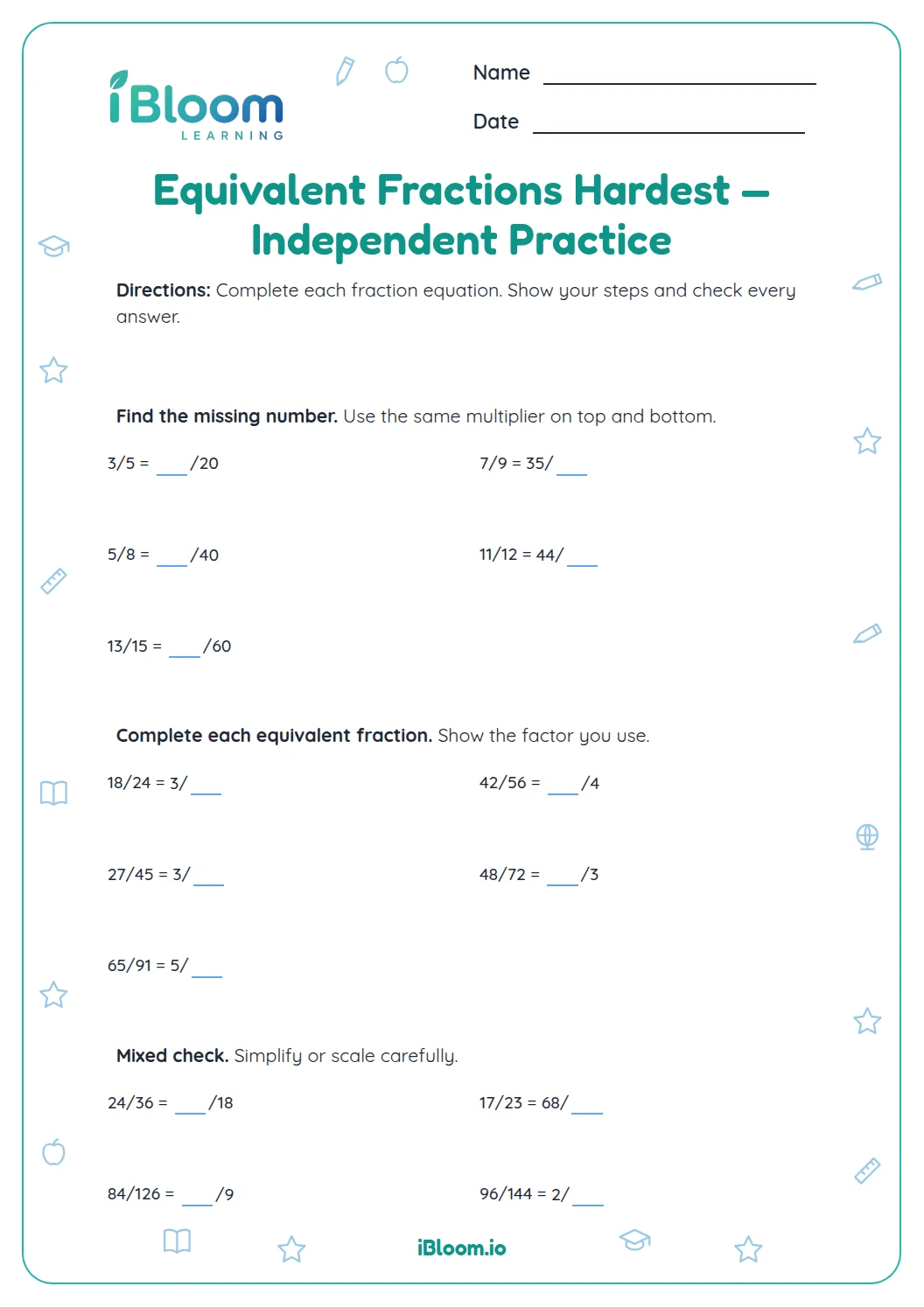
This Grade 6 worksheet connects equivalent shaded models to fraction simplification. Students reduce fractions, record a shared divisor and result in separate blanks, check equivalent forms by multiplying back, and find greatest common factors. The models use valid equal-part drawings and match the written fraction values.
Aligned to 6.NS.B.4
How do you simplify a fraction?
Divide the numerator and denominator by the same greatest common factor. In question 1, 8 and 12 both divide by 4, so the model’s 8/12 is equivalent to 2/3.
- 18 ÷ 4 = 2
- 212 ÷ 4 = 3
- 38/12 = 2/3
How does multiplying back check the result?
Multiply the simplified numerator and denominator by the same factor. In question 9, 2 × 6 gives 12 and 3 × 6 gives 18, rebuilding 12/18.
How to use this worksheet
- 1Read the shaded fraction in each model.
- 2Find a factor that divides both terms evenly.
- 3Divide both numerator and denominator by that factor.
- 4For two-blank items, enter the divisor first and the simplified fraction second.
- 5Multiply both simplified terms by the divisor to check the original fraction.
Common mistakes and fixes
The mistake
Dividing the numerator and denominator by different numbers.
The fix
Use one shared factor so the value stays equivalent.
The mistake
Putting the simplified fraction in the divisor blank.
The fix
The first blank is the common divisor; the second is the result.
The mistake
Checking only one term by multiplication.
The fix
Multiply both numerator and denominator by the factor.
Common Core alignment
This worksheet gives students practice with the fraction skills described below.
Use the greatest common factor to simplify fractions.
On this sheet: Students use greatest common factors to simplify fractions and verify that the resulting terms have no common factor above 1.
Show the official wordingHide the official wording
Find the greatest common factor of two whole numbers less than or equal to 100 and the least common multiple of two whole numbers less than or equal to 12. Use the distributive property to express a sum of two whole numbers 1–100 with a common factor as a multiple of a sum of two whole numbers with no common factor.
What to practice next
Make more practice
Further reading
Questions parents and teachers ask
What does the first blank mean in questions 5–8?
It is the common divisor used on both numerator and denominator. The second blank holds the simplified fraction. For example, 24/36 divided in both parts by 12 becomes 2/3. Students can check that the calculation matches the values and directions printed in this worksheet before using the separate key to review the result.
Why do some models show a simpler equivalent fraction?
A drawing can show an equivalent value using fewer equal parts. Three shaded fourths represent the same amount as 15 shaded twentieths, while keeping the model readable. Students can check that the calculation matches the values and directions printed in this worksheet before using the separate key to review the result.
How can students verify an equivalent fraction?
Multiply the simplified numerator and denominator by the same factor. If the products return the original numerator and denominator, the equivalent fraction is correct. Students can check that the calculation matches the values and directions printed in this worksheet before using the separate key to review the result.
What is the greatest common factor of 54 and 72?
It is 18. Dividing 54 by 18 gives 3, and dividing 72 by 18 gives 4, so the simplest form is 3/4. Students can check that the calculation matches the values and directions printed in this worksheet before using the separate key to review the result.
Does each model show a valid shaded fraction?
Yes. Each bar, square, or circle is split into equal parts, and the shaded count matches the written fraction or an equivalent value. Students can check that the calculation matches the values and directions printed in this worksheet before using the separate key to review the result.