


About this worksheet
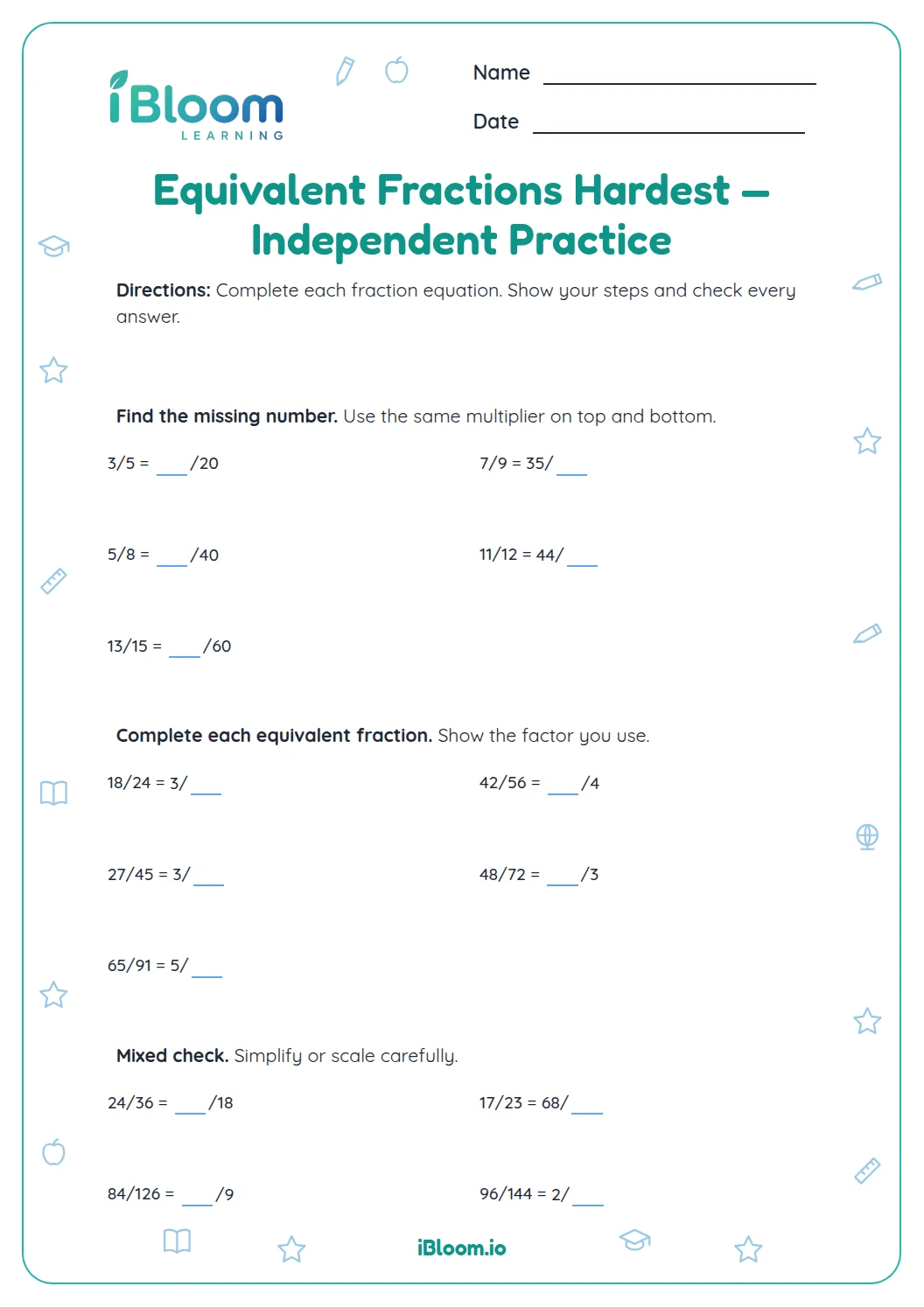
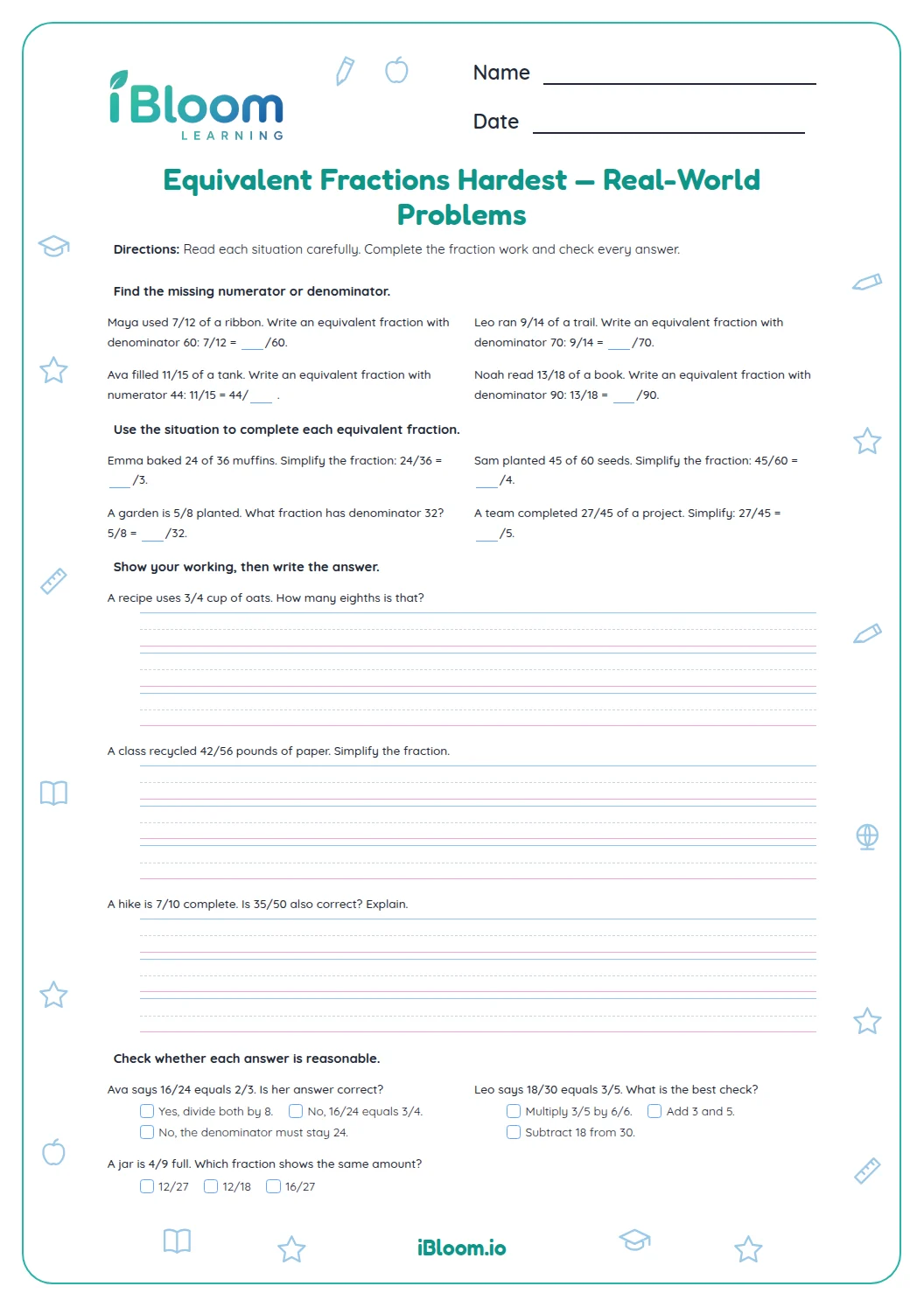
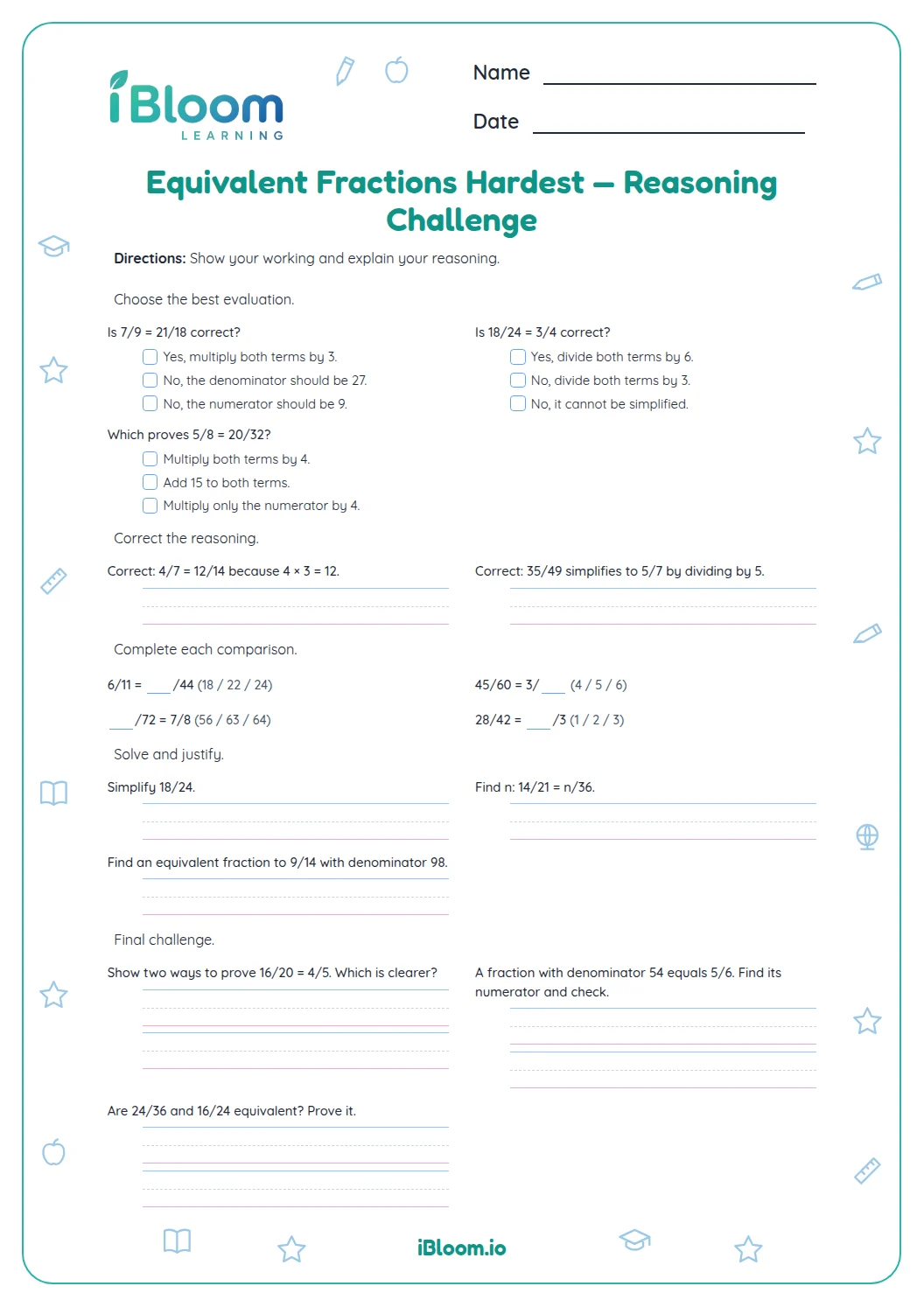
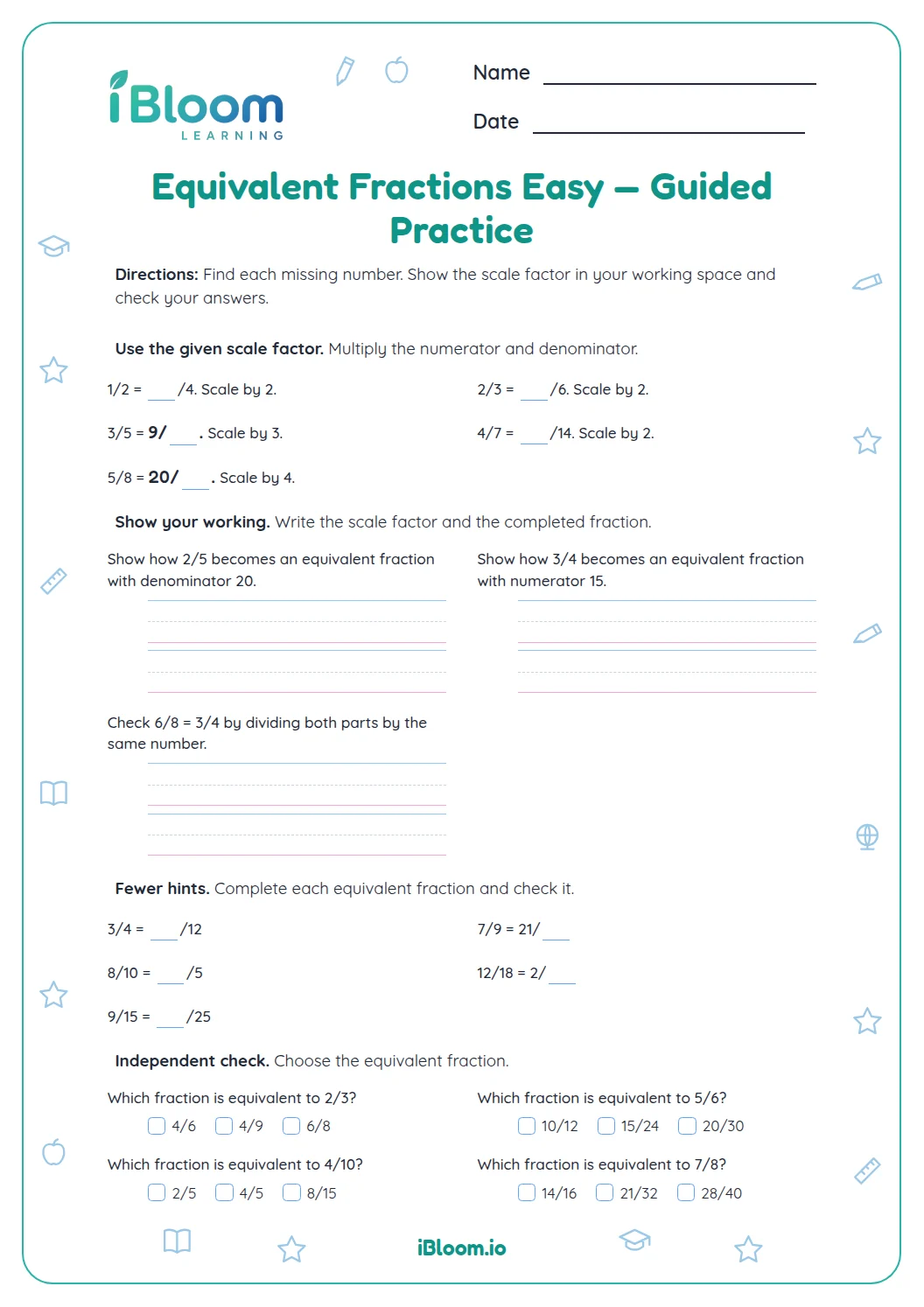
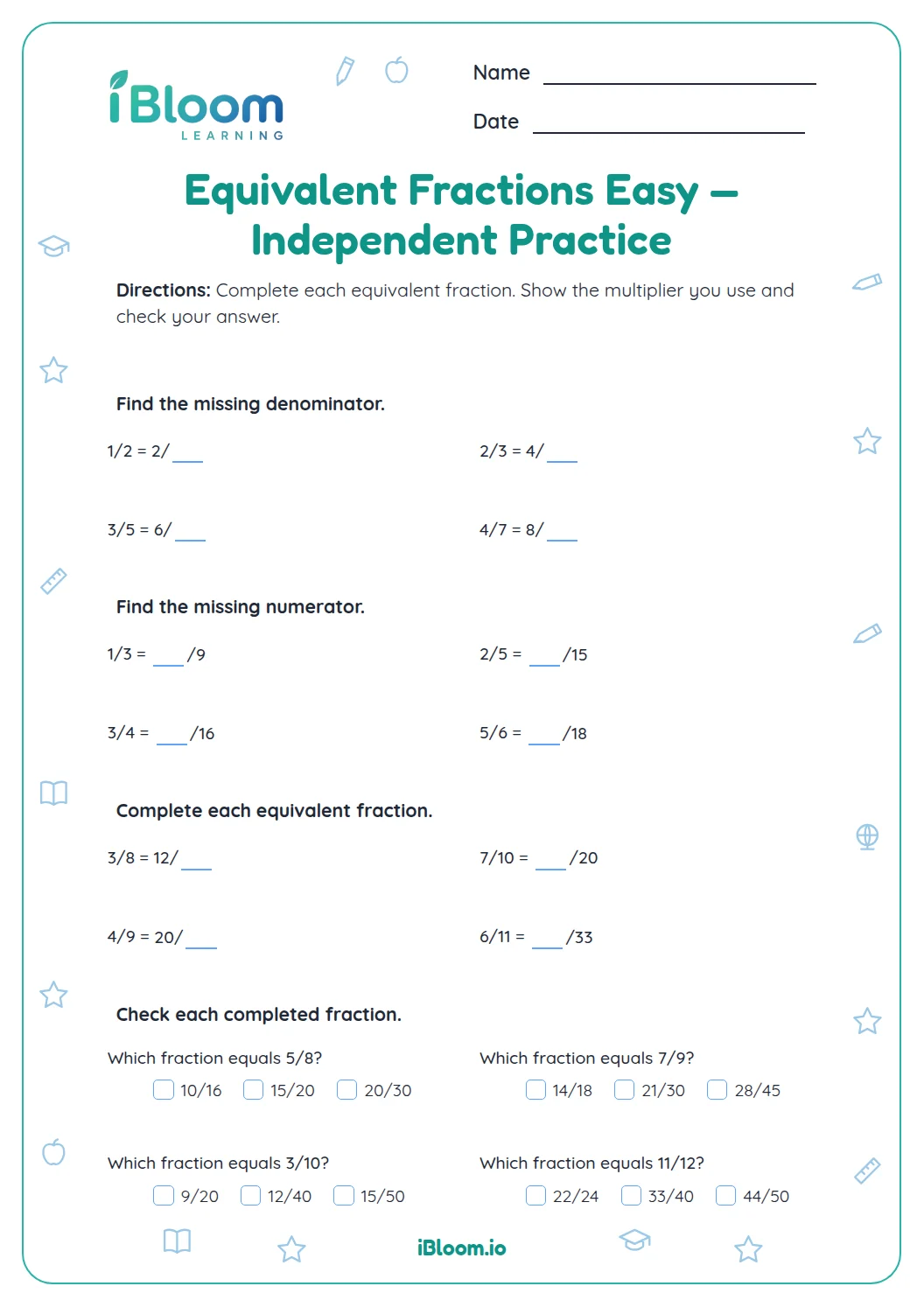
This guided Grade 6 printable gives students 15 equivalent-fraction problems in three parts. Students apply scale factors, find missing numerator or denominator values, and decide whether pairs are equivalent. A separate answer key lists each requested value. The work practices recognizing and generating equivalent fractions, described by Common Core standard 4.NF.A.1.
Aligned to 4.NF.A.1
How do you make equivalent fractions?
This guided Grade 6 printable gives students 15 equivalent-fraction problems in three parts. Students apply scale factors, find missing numerator or denominator values, and decide whether pairs are equivalent. A separate answer key lists each requested value. The work practices recognizing and generating equivalent fractions, described by Common Core standard 4.NF.A.1.
Follow the part directions and keep each response in its matching blank. Use the answer key after completing the questions.
- 13/5 = 15/25 (scale factor 5)
- 23 × 5 = 15 and 5 × 5 = 25
What will students practice?
The 15 questions are grouped into three parts that move from the opening task to independent practice.
- Part A: 5 scale-factor problems
- Part B: 5 missing-term problems
- Part C: 5 equivalence checks
How can a student check the work?
Check that the numerator and denominator were scaled by the same factor. For a yes-or-no item, reduce both fractions or compare cross-products.
How to use this worksheet
- 1Read the direction for each part: use each scale factor, find the missing term, then check equivalence.
- 2Write each requested value in its own answer space.
- 3Apply the same scale factor to the numerator and denominator.
- 4Simplify when needed, then check your response with the answer key.
Common fraction mistakes and quick fixes
The mistake
Changing only one term when scaling a fraction.
The fix
Multiply both numerator and denominator by the same factor.
The mistake
Treating a larger denominator as a larger fraction.
The fix
Compare the value of the whole shaded amount.
The mistake
Filling the wrong fraction blank.
The fix
Check whether the blank is the numerator or denominator before solving.
Common Core alignment
This worksheet practices the fraction skills described in the standards below.
Use fraction models to show why equivalent fractions have the same value.
On this sheet: Shaded bars show equivalent fractions and students generate equivalent fractions by scaling both terms.
Show the official wordingHide the official wording
Explain why a fraction a/b is equivalent to a fraction (n × a)/(n × b) by using visual fraction models, with attention to how the number and size of the parts differ even though the two fractions themselves are the same size. Use this principle to recognize and generate equivalent fractions.
What to practice next
Make more practice
Further reading
Questions parents and teachers ask
How many questions are included?
There are 15 questions in three parts, plus a separate key. Students apply given scale factors, solve missing-term fraction equations, and check whether fraction pairs have the same value. The worksheet changes task type after each group of five, so students can focus on one method at a time.
What does the scale factor tell students to do?
A scale factor is applied to both terms. Multiplying the numerator and denominator by the same number creates a fraction with the same value, as in 3/5 becoming 15/25 when both terms are multiplied by 5. For example, multiplying both terms of 3/5 by 5 gives 15/25.
How can I find a missing fraction term?
Use the known numerator or denominator to determine the scale factor between the fractions. Apply that factor to the other term, or simplify both fractions to compare them. Use the known term to find the scale factor, then apply it to the missing term.
Is an answer key included?
Yes. A separate answer key lists the missing terms and the yes-or-no equivalence decisions in order. Students can check their work after finishing each section or after all 15 items. Students can check their work after finishing each section or after all 15 items, using the values in the same order.
How can I test whether fractions are equivalent?
Simplify both fractions or compare cross-products. If the values match, the fractions are equivalent; if they differ, they are not. Cross-products offer a direct check when the fractions are not already in simplest form. Cross-products offer a direct check when the fractions are not already in simplest form. Equal products confirm equal values.