



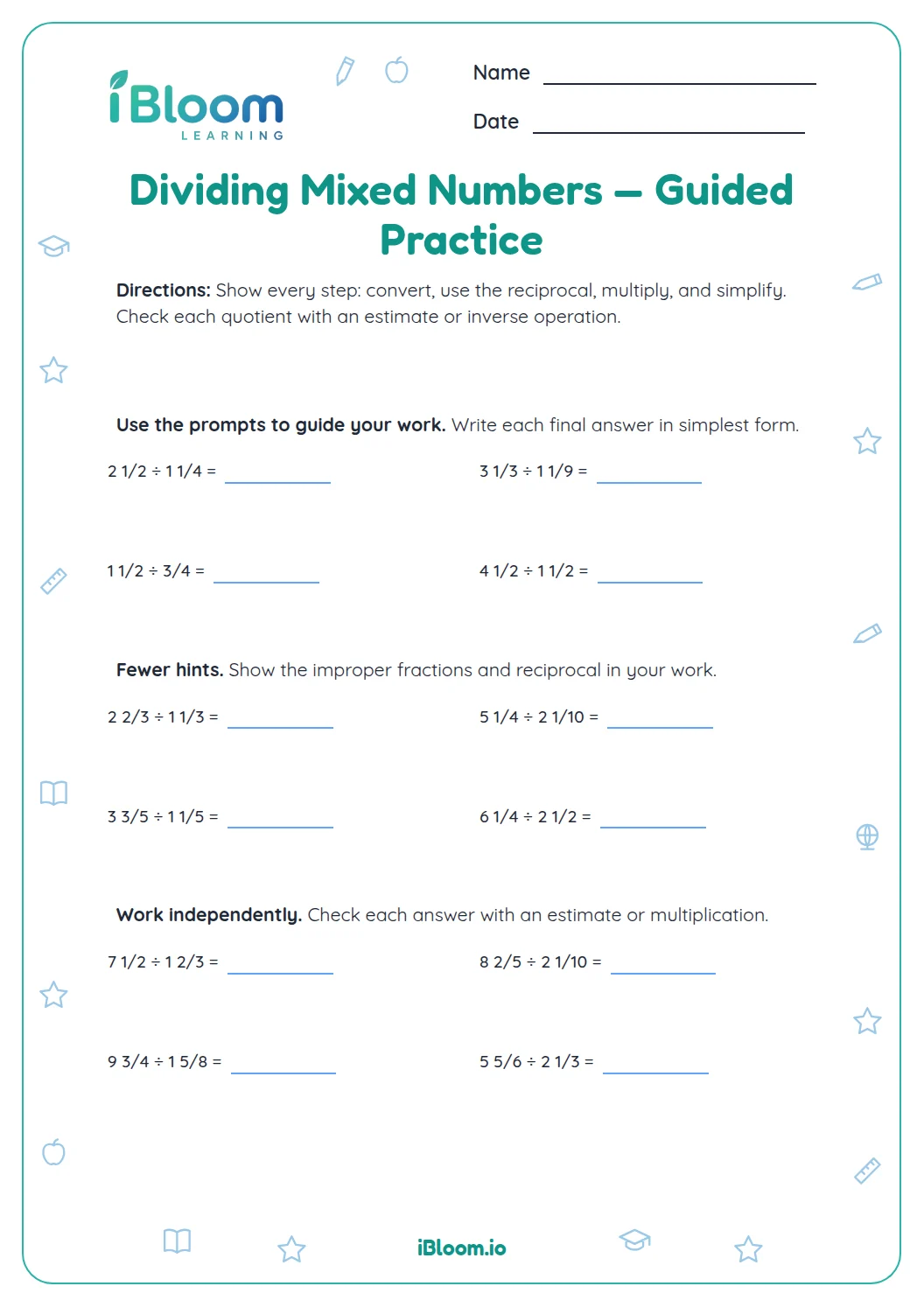


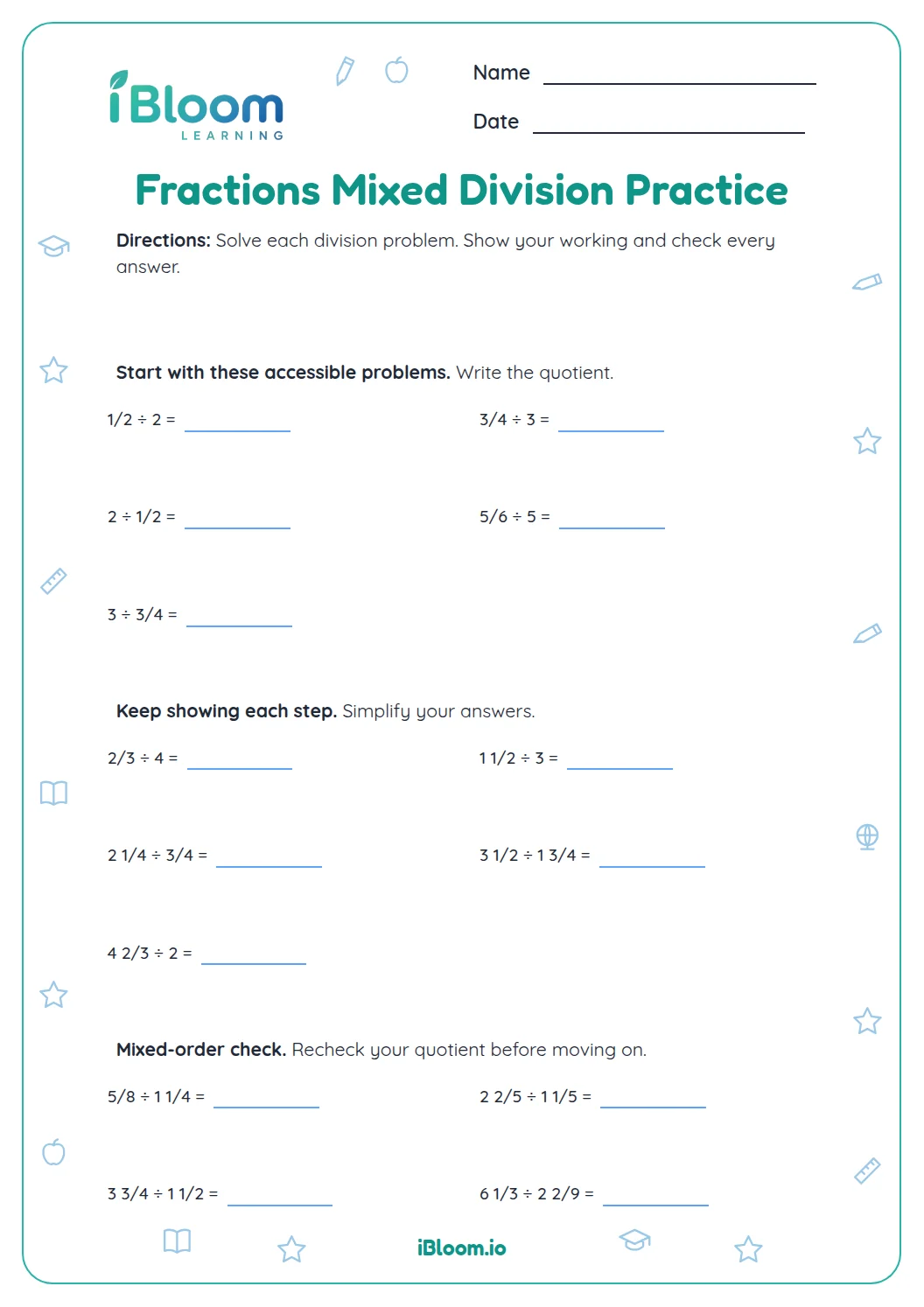
About this worksheet
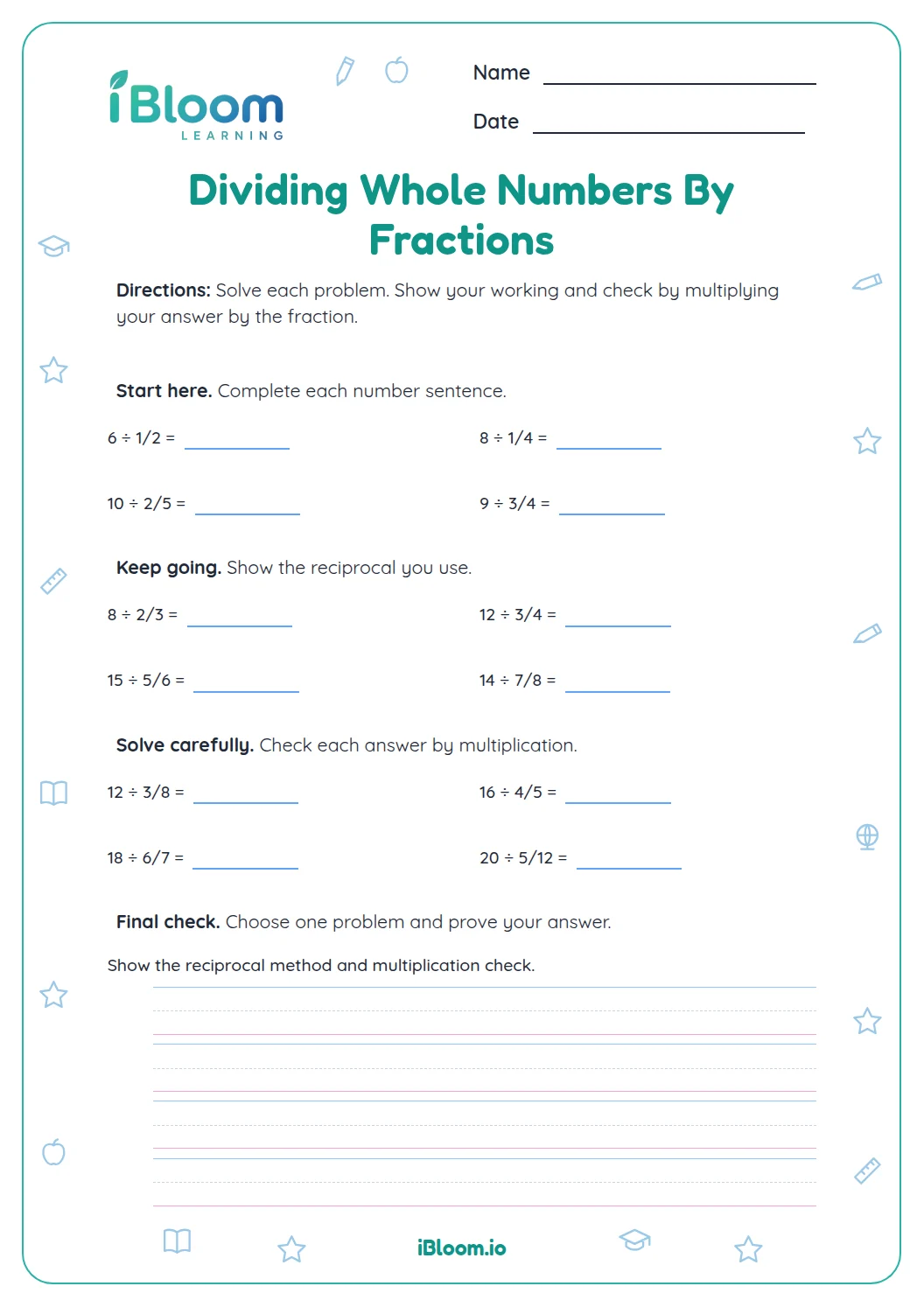
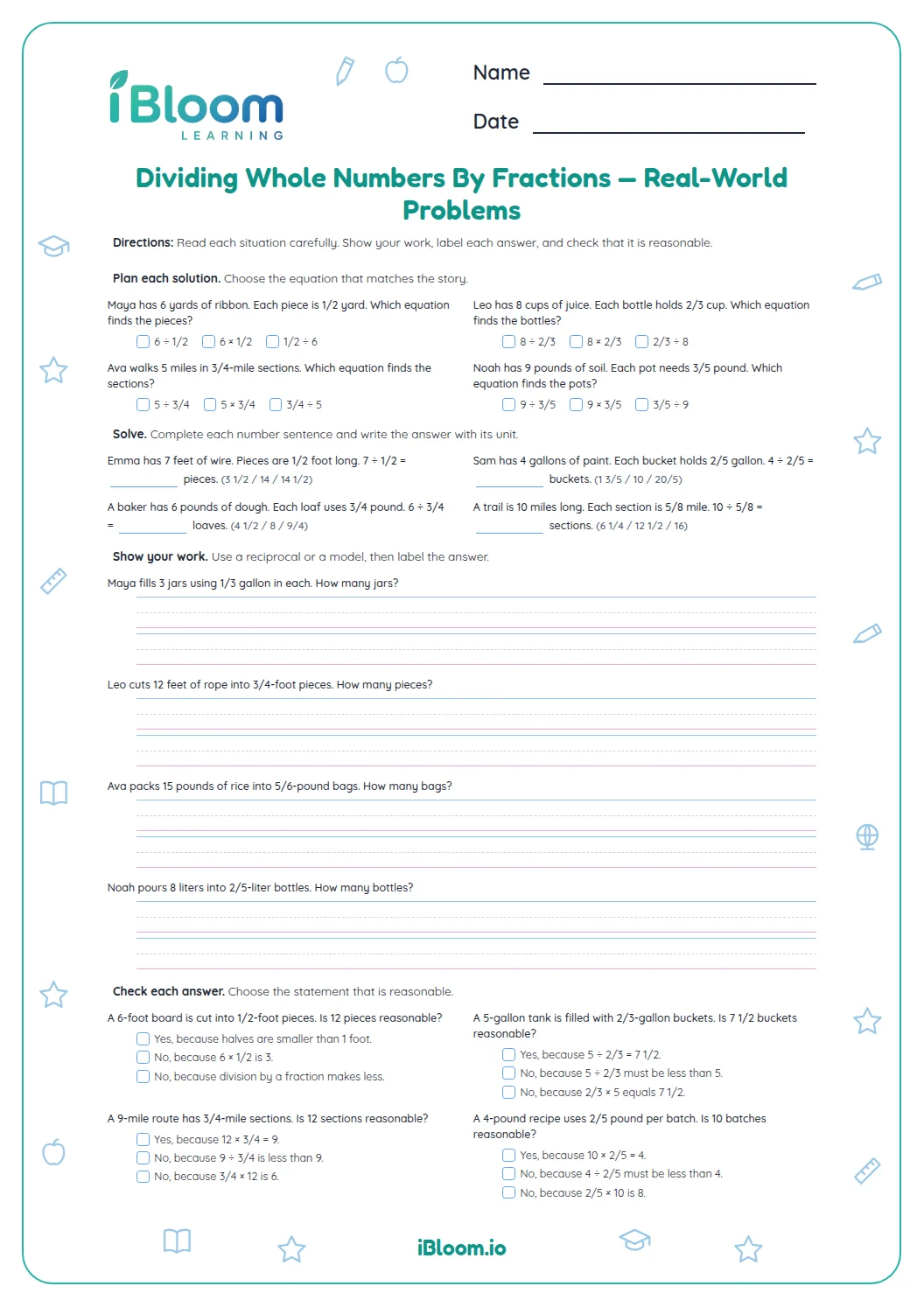
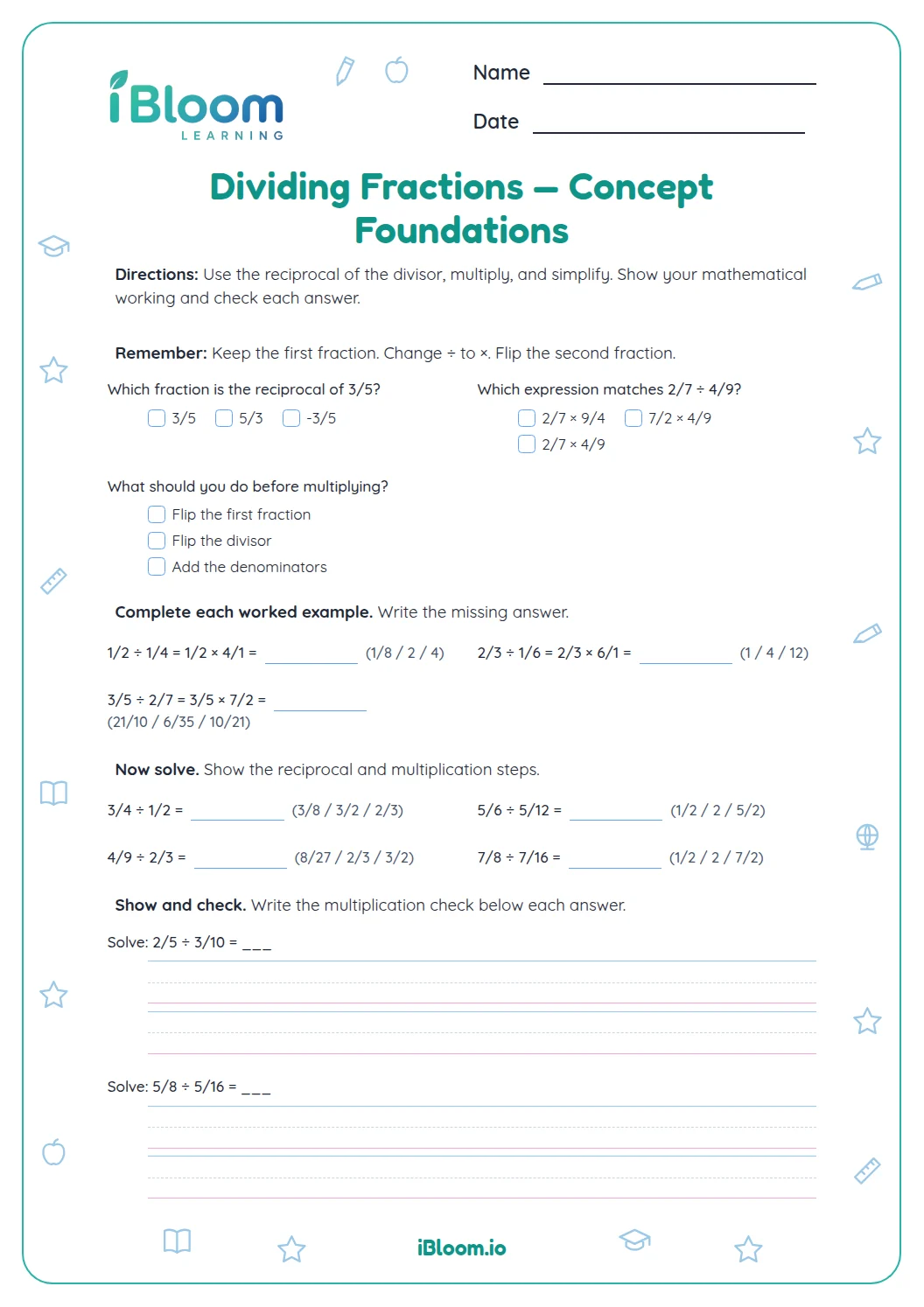
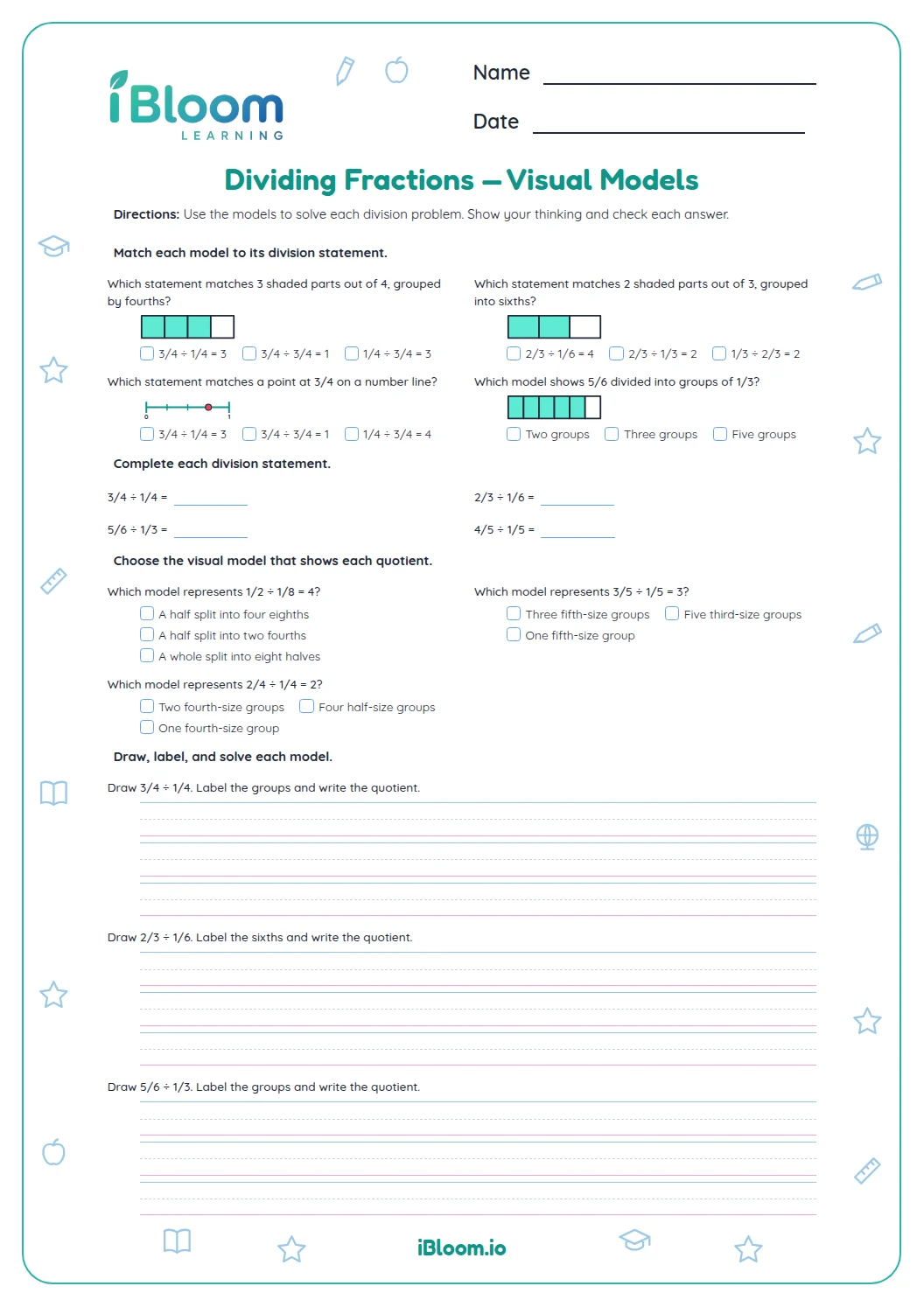
This Grade 6 worksheet builds the meaning of dividing a whole number by a fraction. Students count fractional parts in whole amounts, use multiplication to check quotients, and apply the idea to lengths and capacity. Sixteen questions move from unit fractions to other fractional divisors, with a separate answer key. The work connects to Common Core fraction division and multiplication standards.
Aligned to 6.NS.A.1
How many fraction pieces fit in a whole amount?
Division asks how many groups of a chosen size fit. To find 2 ÷ 1/4, count fourths in two wholes: each whole contains four fourths, so the quotient is eight. Question 1 pairs that question with a bar model.
The divisor is the size of each group. A smaller divisor can fit more times into the same dividend.
- 12 ÷ 1/4 = 8
- 2Check: 8 × 1/4 = 2
How does multiplication check a division answer?
Division and multiplication undo one another. Multiply the quotient by the divisor; the result should be the original dividend. Questions 1–4 give distinct blanks for each quotient and its multiplication check.
How does the idea work with other fractions?
Later questions include divisors such as 2/3 and 4/5. The quotient answers how many groups of that size fit, and multiplying the quotient by the divisor returns the starting whole number. The final two items place the same reasoning in ribbon and jug situations.
What will students practice on the pages?
The worksheet has 16 questions in four parts, followed by its answer key. Students begin with unit-fraction groups, use inverse multiplication, explain why the quotient can grow, and then solve applications.
How to work through the questions
- 1Read the divisor as the size of one group.
- 2For unit fractions, count equal parts in each whole.
- 3Write the quotient in its blank, then complete the multiplication check in its own blank.
- 4For 2/3 or 4/5, ask how many groups of that size fit into the dividend.
- 5In the two word problems, label the quotient with the requested unit.
Common fraction-division mistakes
The mistake
Treating 1/4 as four groups instead of a group size of one fourth.
The fix
Ask what is being counted: fourth-size groups in the whole amount.
The mistake
Writing a quotient without checking it.
The fix
Multiply the proposed quotient by the divisor and see whether it returns the dividend.
The mistake
Using the numerator alone as the number of groups for a non-unit fraction.
The fix
Estimate the size of each group first, then verify the quotient by multiplication.
Common Core alignment
These questions connect equal-group reasoning to fraction division and its inverse operation.
Interpret and compute quotients involving fractions.
On this sheet: The questions connect fractional divisors to multiplication checks and practical situations.
Show the official wordingHide the official wording
Interpret and compute quotients of fractions, and solve word problems involving division of fractions by fractions, e.g., by using visual fraction models and equations to represent the problem.
What to practice next
Make more practice
Further reading
Questions parents and teachers ask
What does 2 ÷ 1/4 mean?
It asks how many one-fourth-size pieces fit in 2 wholes. Each whole contains four fourths, so two wholes contain eight fourths. Question 1 shows that relationship with a bar model and asks students to complete a separate multiplication check. In each case, focus on the size of one group before counting.
Why can the quotient be larger than the dividend?
The quotient counts groups, and a fraction divisor can be smaller than one whole. Several small groups can fit inside one whole. For example, four one-fourth pieces fit in each whole, so dividing 2 by 1/4 gives eight groups. This meaning helps students make sense of a quotient beyond a memorized rule.
How can students check a fraction division answer?
Multiply the quotient by the divisor. The product should equal the original dividend. If 3 ÷ 1/2 is 6, then 6 × 1/2 returns 3. The first part gives students separate spaces for the quotient and the check. Multiplication is a useful check because it reverses the division relationship.
What does the worksheet include?
It has 16 questions in four parts: counting unit-fraction groups, using multiplication checks, explaining the quotient pattern, and solving ribbon and jug problems. A separate answer key gives answers for every item, including each check blank. The sequence moves from simple unit fractions to divisors with non-unit numerators.
What should students do with the word problems?
Write a division sentence using the amount available and the size of one group. Then calculate how many groups fit and include the unit. For the ribbon question, the answer counts pieces; for the jug question, it counts filled cups.