

About this worksheet
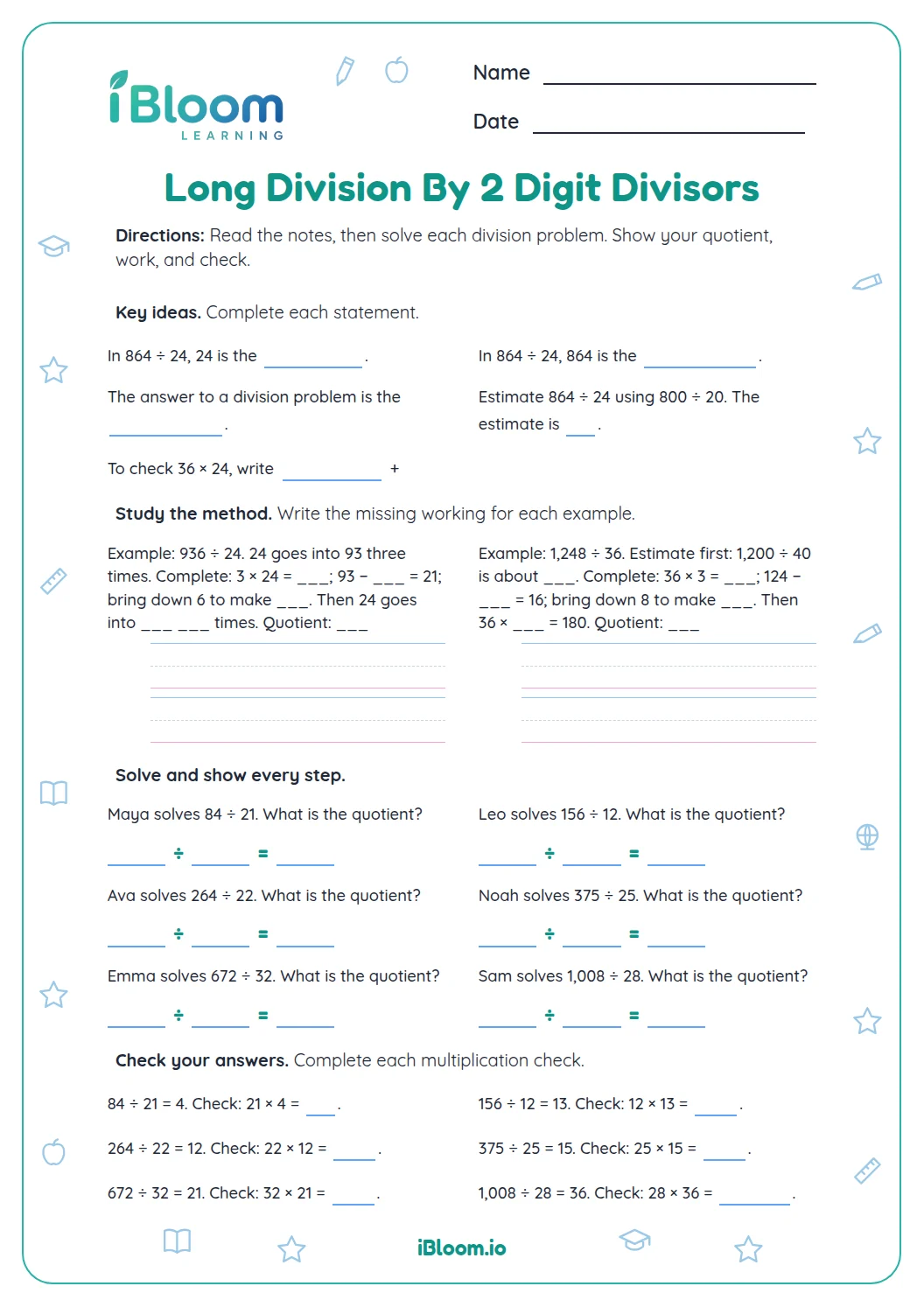
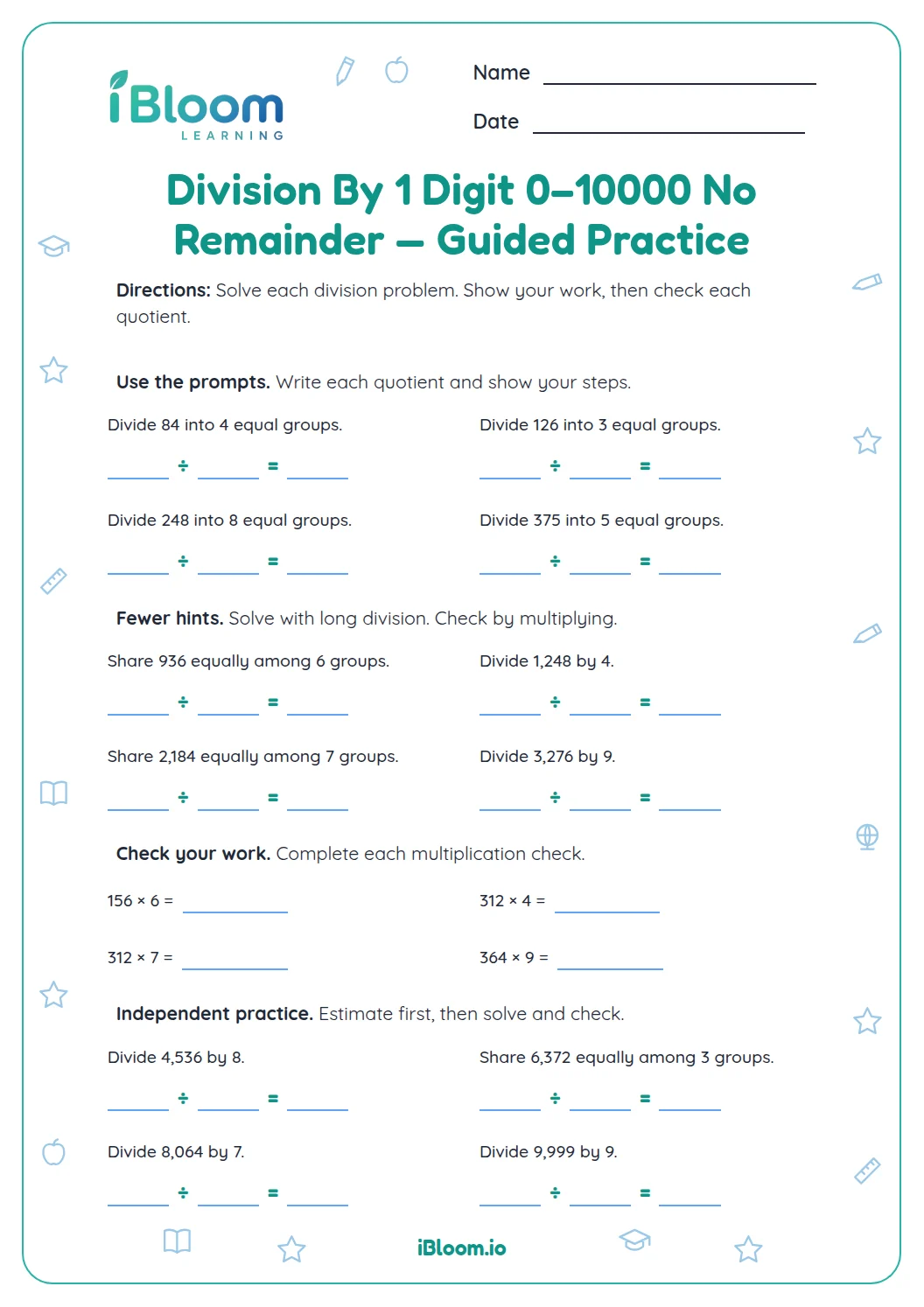
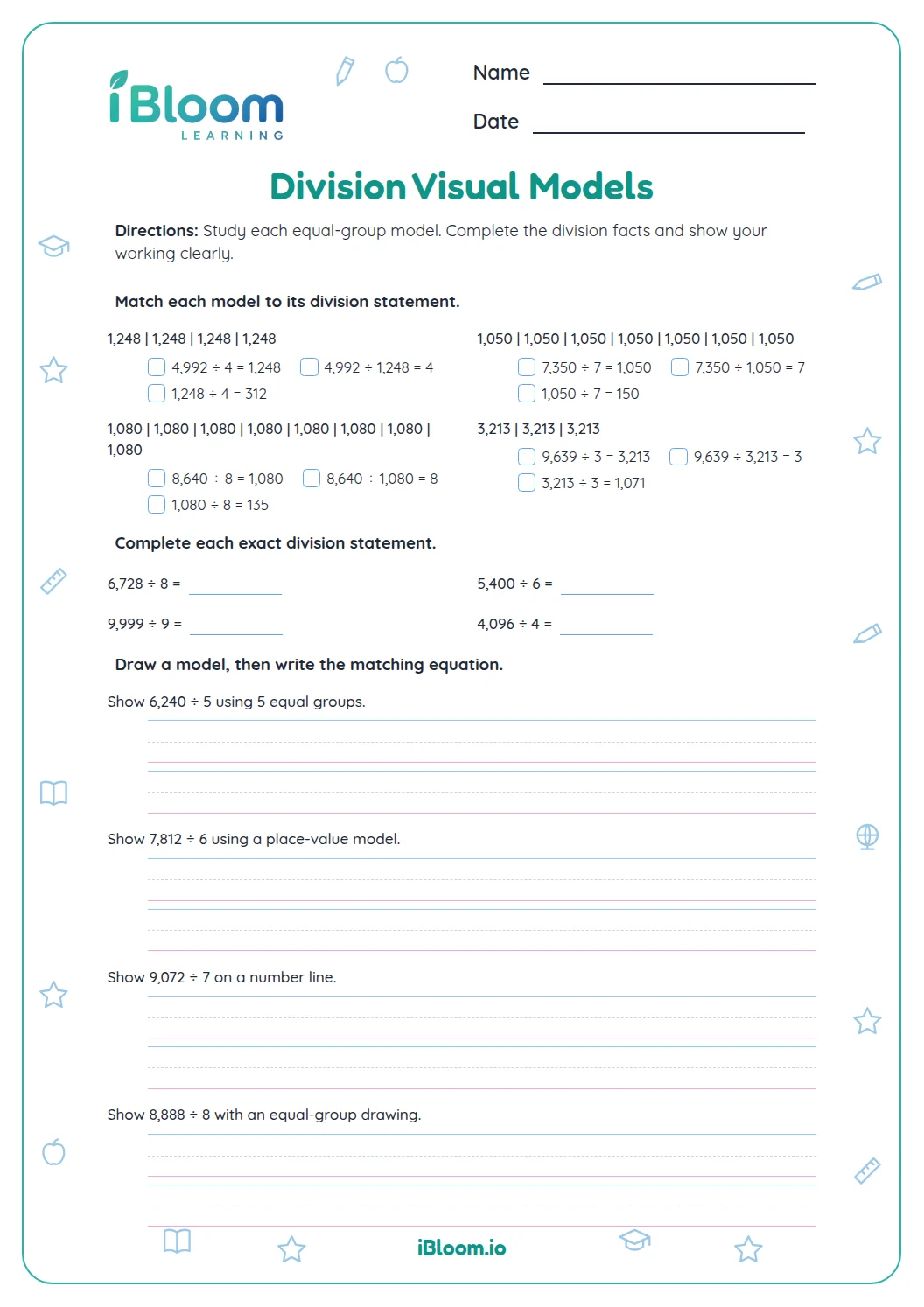
This printable gives Grade 6 students 20 long-division problems with two-digit divisors. Each dividend is shown in the equation, and each answer has distinct spaces for quotient and remainder. Use the usual division steps on scratch paper, then check by multiplying the divisor by the quotient and adding the remainder. The answer key lists each pair. The practice aligns with CCSS 6.NS.B.2.
Aligned to 6.NS.B.2
What are the steps in long division?
For 847 ÷ 23, 23 goes into 84 three times, leaving 15. Bring down 7 to make 157; 23 goes into 157 six times, leaving 19. The quotient is 36 R 19.
How can you verify the example?
Multiply 23 by 36 and add 19: 828 + 19 = 847. Since 19 is less than 23, the quotient and remainder are consistent.
What stays consistent across the problems?
All 20 divisors have two digits. Some divisions are exact and others leave a remainder; the answer format keeps the quotient and remainder in separate places.
How to use this worksheet
- 1Estimate the first quotient digit using the leading digits.
- 2Multiply the divisor by that digit and subtract.
- 3Bring down the next dividend digit and repeat.
- 4Write the quotient before R and the remainder after it.
- 5Check divisor × quotient + remainder = dividend.
Common mistakes and how to fix them
The mistake
Writing the remainder in the quotient blank.
The fix
Put only quotient digits before R; write the amount left after R.
The mistake
Using a three-digit divisor by mistake.
The fix
Read the divisor carefully; every divisor here has two digits.
The mistake
Leaving a remainder at least as large as the divisor.
The fix
Continue the division until the remaining amount is smaller than the divisor.
Common Core alignment
The problems build fluency with multi-digit whole-number division.
Divide multi-digit whole numbers with the standard algorithm.
On this sheet: Students use long-division steps on multi-digit dividends and two-digit divisors.
Show the official wordingHide the official wording
Fluently divide multi-digit numbers using the standard algorithm.
What to practice next
Make more practice
Further reading
Questions parents and teachers ask
What does R stand for?
R marks the remainder, the amount left after complete groups have been made. Write the quotient in the first blank and the remainder after R. For an exact division, write 0 as the remainder. The key uses this same order.
How do I check a long-division answer?
Multiply the divisor by the quotient and add the remainder. That sum should equal the original dividend. The remainder should also be smaller than the divisor; otherwise another full group fits. This check works for every item. Use it after computing.
Do all problems have a remainder?
No. Some divide evenly and have remainder 0. Other problems leave an amount smaller than the divisor. The key shows both values, including zeros, so each answer uses the same format. Write the zero in its blank and verify the product.
Why use two-digit divisors?
A two-digit divisor asks students to estimate how many groups fit, multiply, subtract, and bring down the next digit. Repeating those steps builds long-division practice with larger group sizes and supports a written multiplication check. Every divisor here has two digits.
Should students show their work?
Yes. Work through the quotient steps on scratch paper or a separate workspace, then enter the final quotient and remainder in the printed blanks. Use the answer key after completing the problems. Showing steps helps locate an arithmetic slip.