



About this worksheet
This printable Grade 1 math sheet gives children 18 fully written addition problems to solve, so every number appears on the student page. It focuses on show what you know about doubles plus two, with three parts that move from direct practice to applying the pattern. The questions use addition facts within 20 and connect with Common Core standard 1.OA.C.6. A separate answer key makes it easy to check each response.
Aligned to 1.OA.C.6
What does this doubles + 2 check sheet include?
Part A checks doubles-plus-two sums.
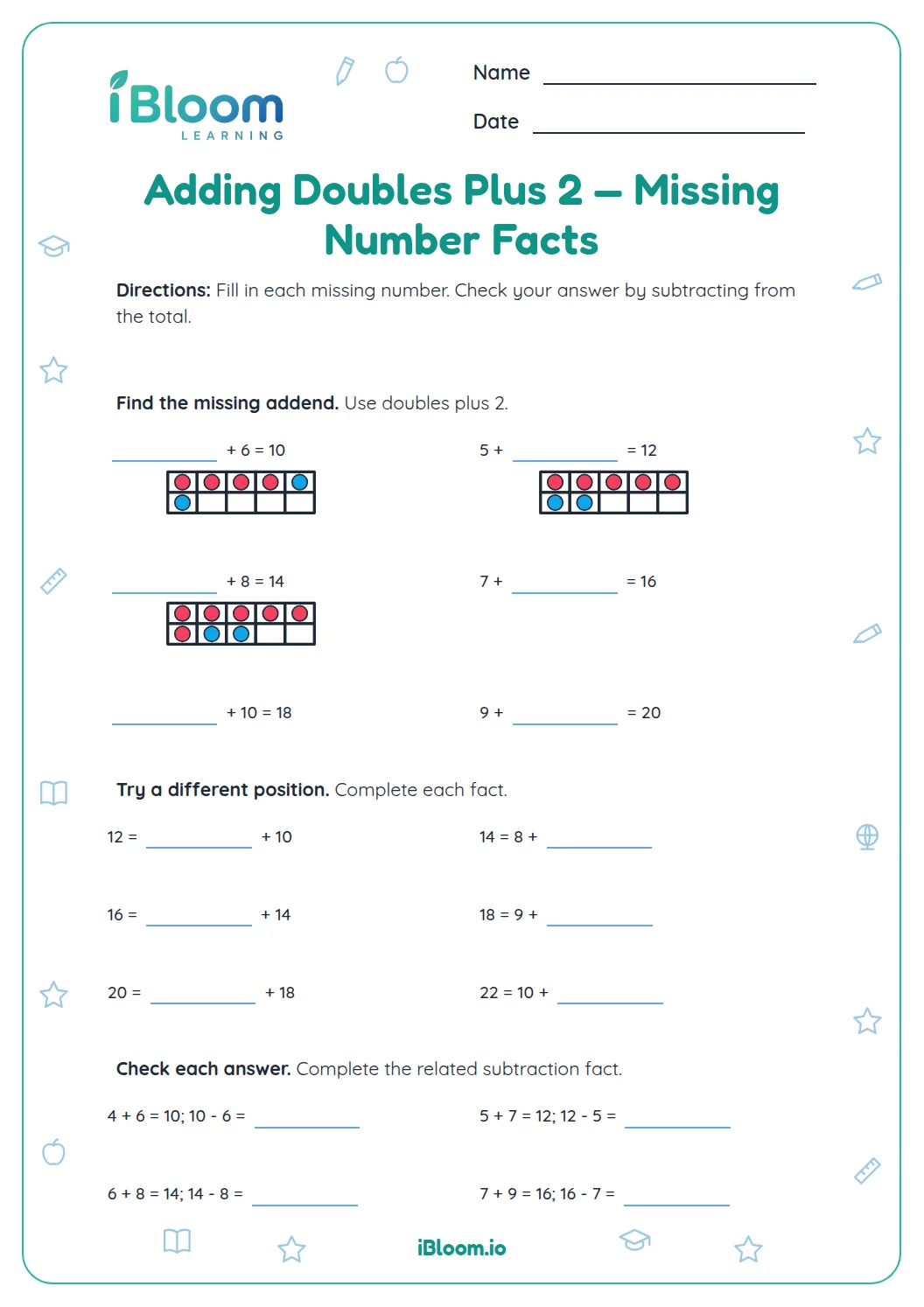
Part B asks for a missing addend or sum, and Part C applies the same relationship in short addition situations. The student page prints every number needed to solve each item.
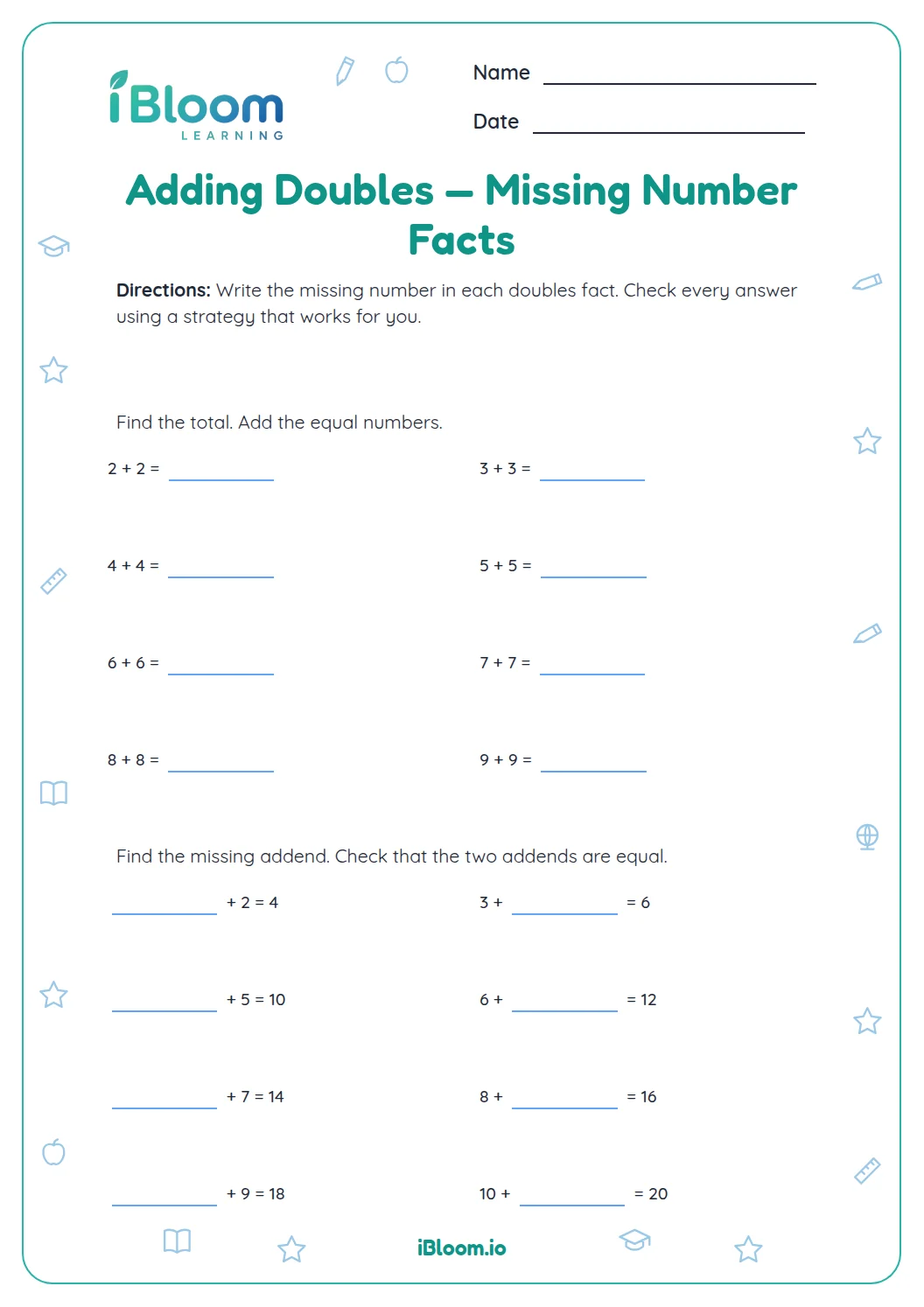
- Part A: 6 doubles-plus-two sums
- Part B: 6 missing-number facts
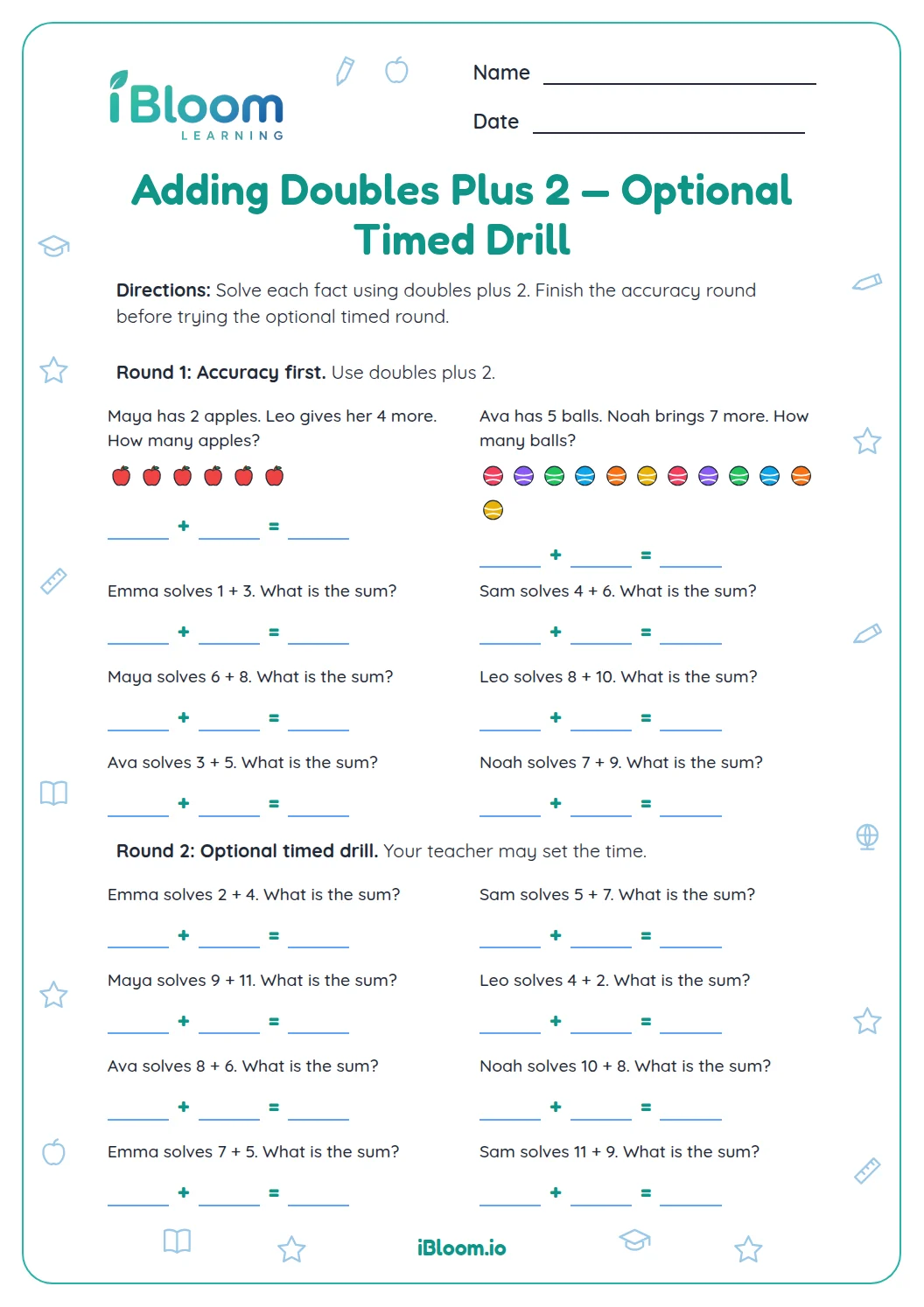
- Part C: 6 short application problems
How can a child use doubles + 2 check?
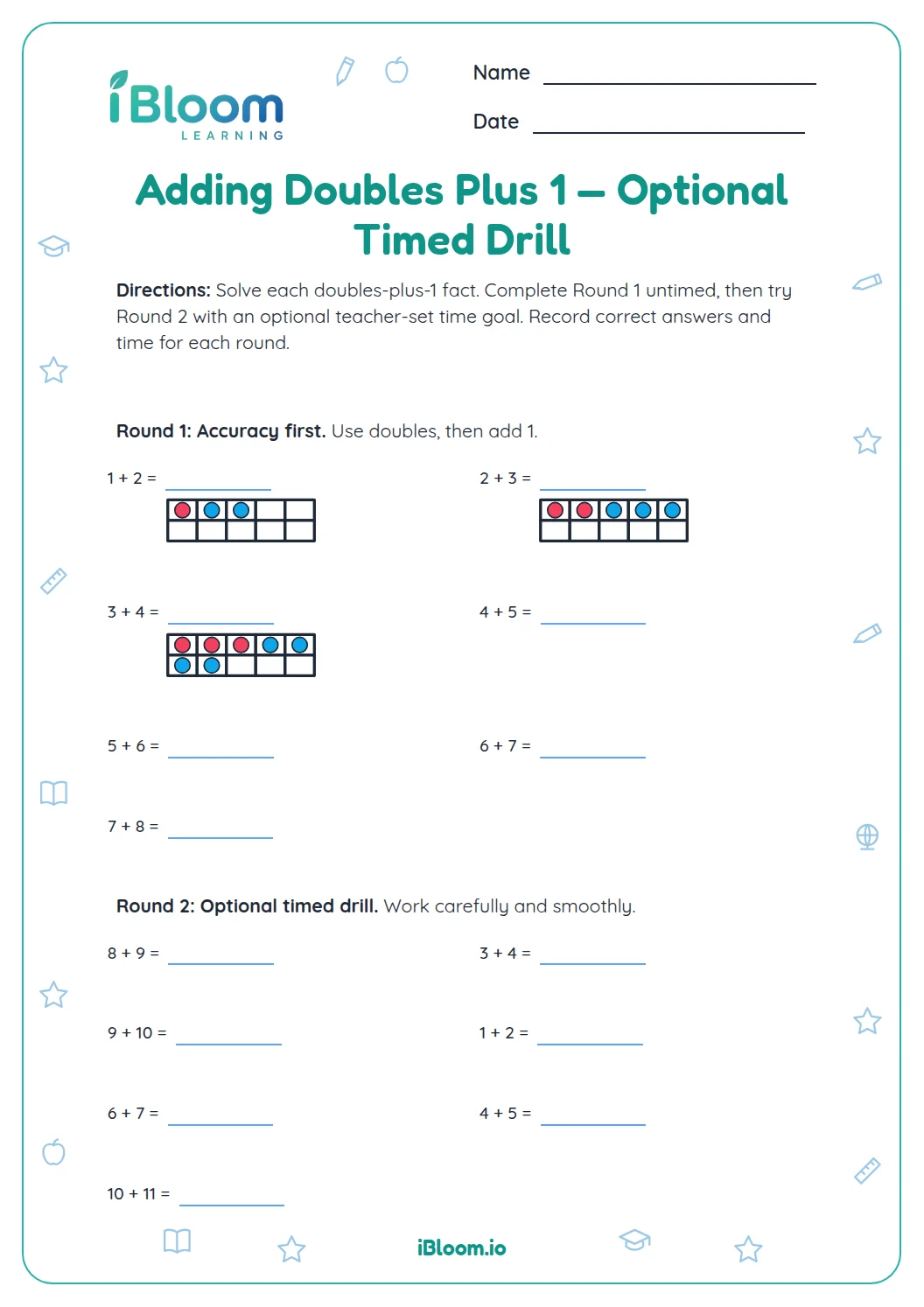
Look at both addends before solving. In Part A, 2 + 4 = ___ gives a concrete example of the target relationship.
Use a known double or make ten when it helps, then check that the answer is the total of both addends.
- 12 + 4 = ___
- 2The sum is 6.
How should students check each addition fact?
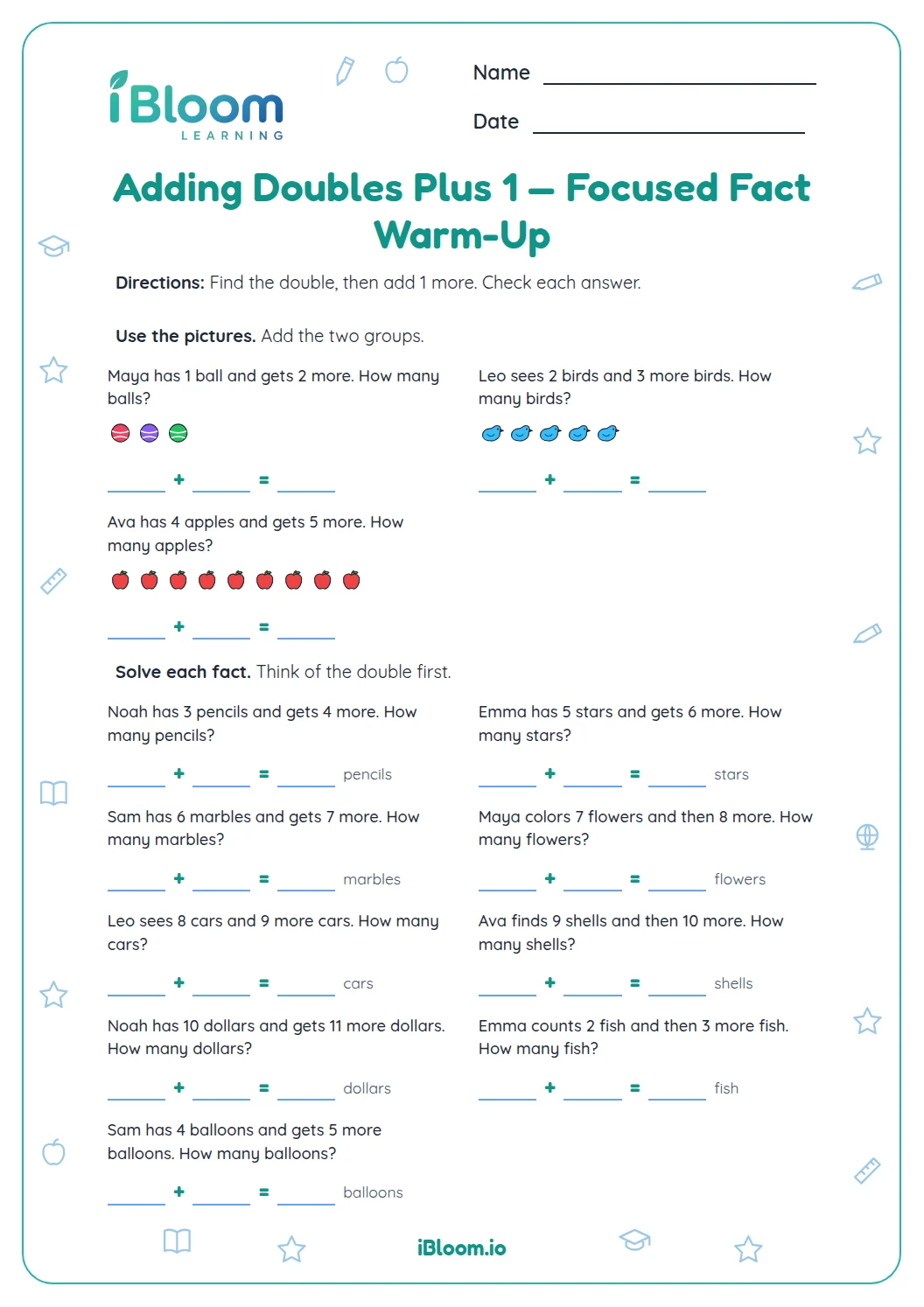
Part C applies the doubles-plus-two pattern in short, fully stated situations. Students identify the two amounts, add them, and write the total.
- 1Mia has 5 red beads and 7 blue beads. How many beads does she have?
- 2Add 5 + 7 to get 12 beads.
How to use this worksheet
- 1Read the directions and solve the printed equation in each row.
- 2Work through Part A, then use the pattern named in Part B.
- 3In Part C, read the whole equation before writing a number.
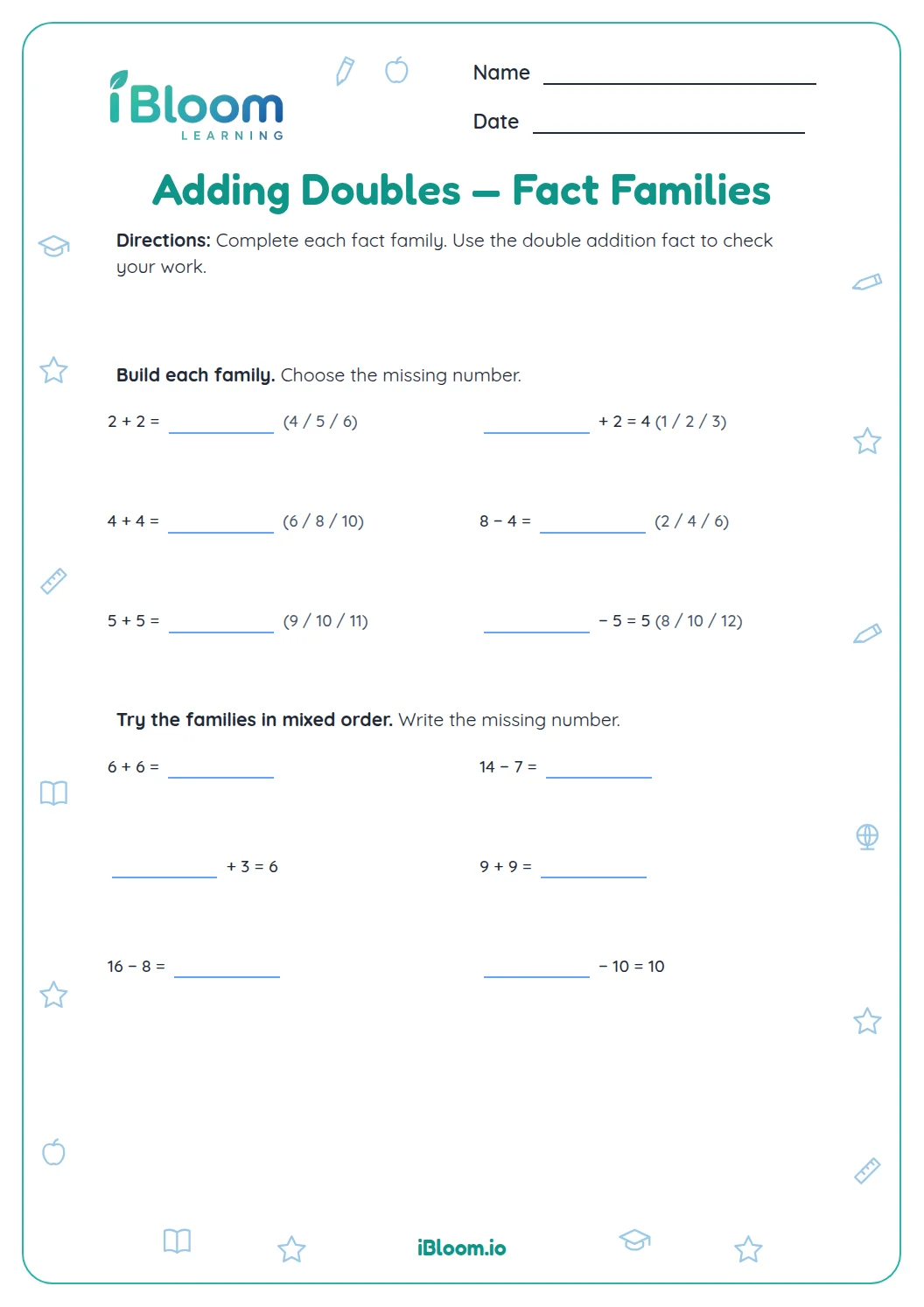
- 4Check each sum by adding the two addends in the other order.
- 5Use the separate answer key to review answers and revisit any missed fact.
Common addition slips and fixes
The mistake
Adding only one addend to itself when the numbers are close.
The fix
Say both addends aloud and count on from the larger one.
The mistake
Writing one less or one more than the total.
The fix
Check by separating the second addend into a helpful part and the rest.
The mistake
Putting the total into a missing-addend blank.
The fix
Use the known addend and ask what amount completes the total.
Common Core alignment
This sheet practices a Grade 1 addition strategy named in the Common Core State Standards.
Use addition strategies such as making ten and known sums to add within 20.
On this sheet:
Show the official wordingHide the official wording
Add and subtract within 20, demonstrating fluency for addition and subtraction within 10. Use strategies such as counting on; making ten (e.g., 8 + 6 = 8 + 2 + 4 = 10 + 4 = 14); decomposing a number leading to a ten (e.g., 13 - 4 = 13 - 3 - 1 = 10 - 1 = 9); using the relationship between addition and subtraction (e.g., knowing that 8 + 4 = 12, one knows 12 - 8 = 4); and creating equivalent but easier or known sums (e.g., adding 6 + 7 by creating the known equivalent 6 + 6 + 1 = 12 + 1 = 13).
What to practice next
Make more practice
Further reading
Questions parents and teachers ask
How many problems are on the doubles + 2 check worksheet?
The mastery check has 18 questions in three parts: six sums, six missing-number facts, and six short addition situations. Students can complete the printed questions first, then use the separate answer key to check their answers and review any fact that needs another try.
Are the numbers printed on the student worksheet?
Yes. The student sheet prints every addend, total, or missing-number equation beside its answer blank. Students can read each problem from the worksheet itself, complete the page without copying from another source, and use the separate answer key only when they are ready to check their responses.
Does the printable include an answer key?
Yes. A separate answer key gives the correct answer for all 18 questions. It follows the same order as the student page, which makes it simple to find a missed fact, talk through the addition strategy, and revisit just the problems that need another look.
How can a child solve a doubles-plus fact?
Start with the nearby double, then adjust it by one or two to match the other addend. For example, 5 + 7 is two more than 5 + 5, so 10 becomes 12; addition in either order gives the same total.
Should students use a timer?
No timer is needed for this practice. Students can work at a steady, comfortable pace and focus on accurate sums and the relationship between the addends; the answer key helps families review any fact that needs another look.