



About this worksheet
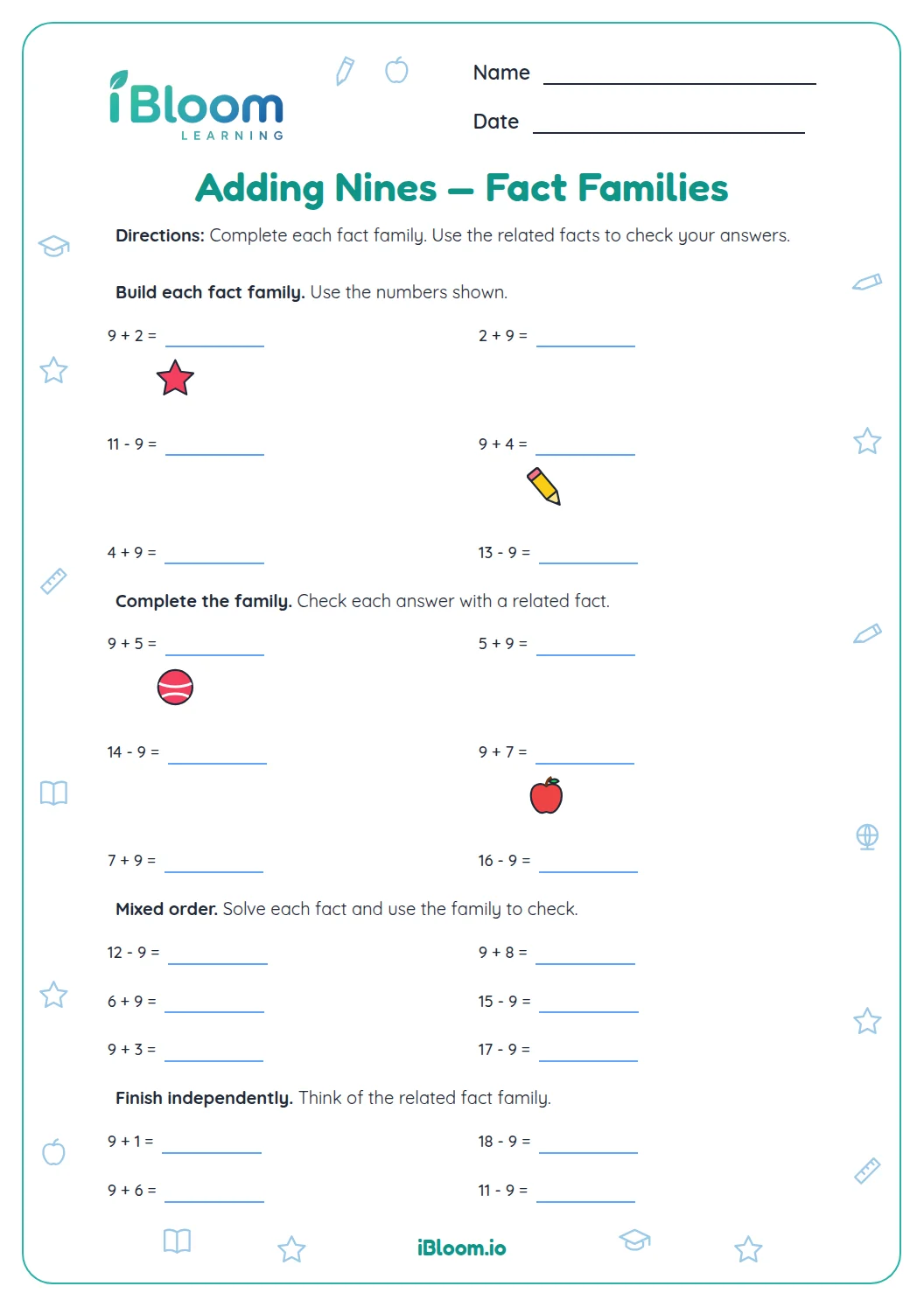
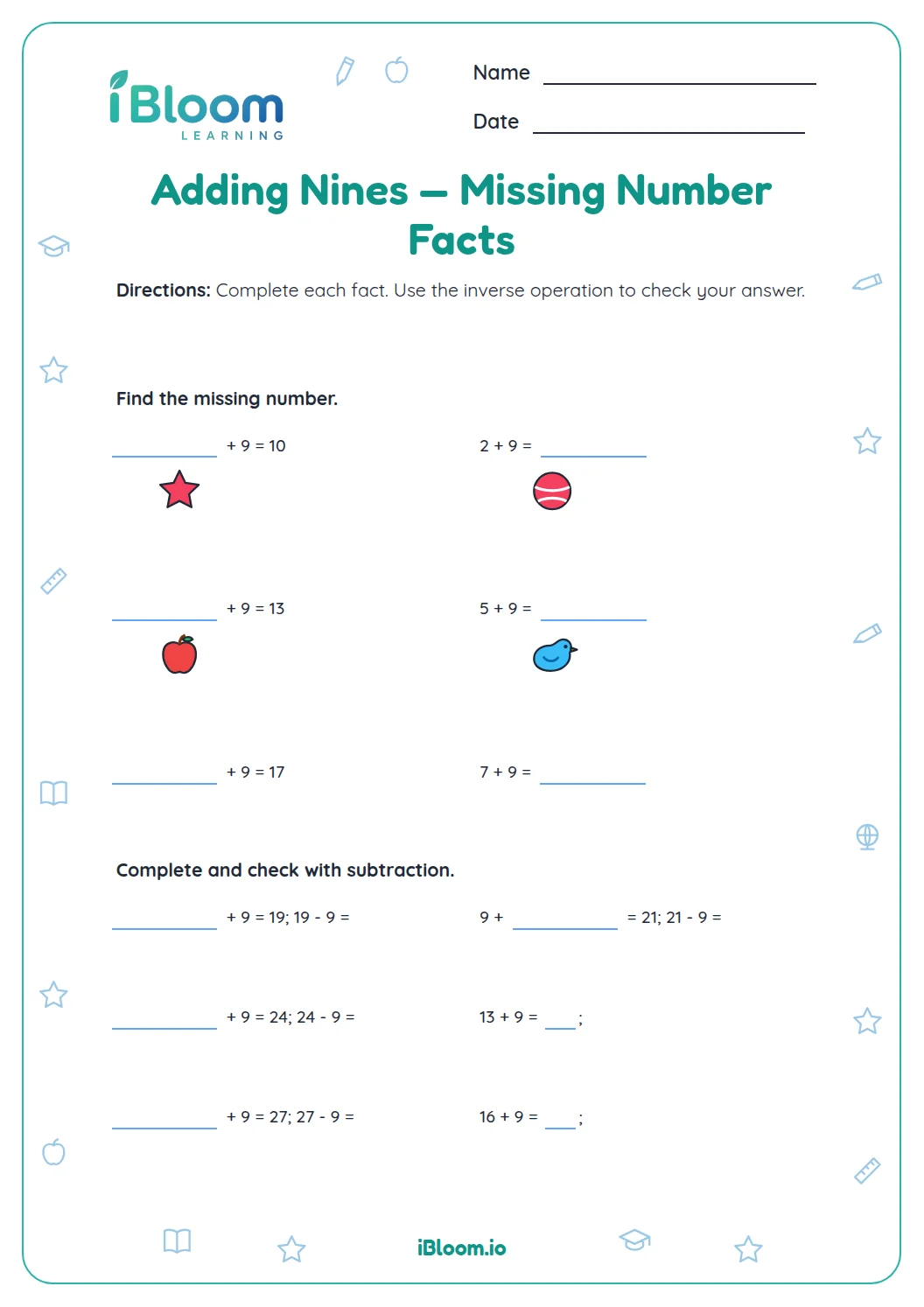
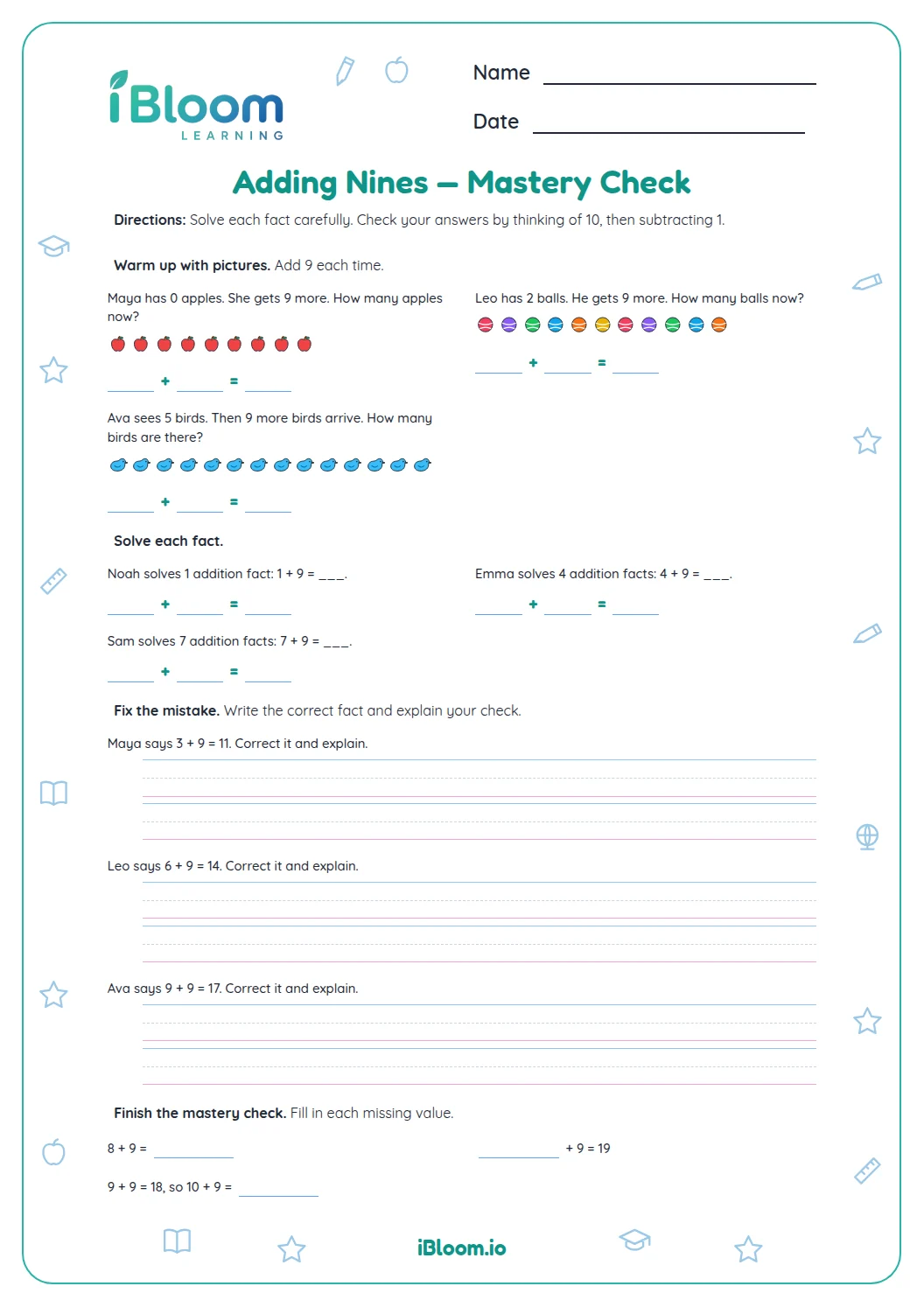
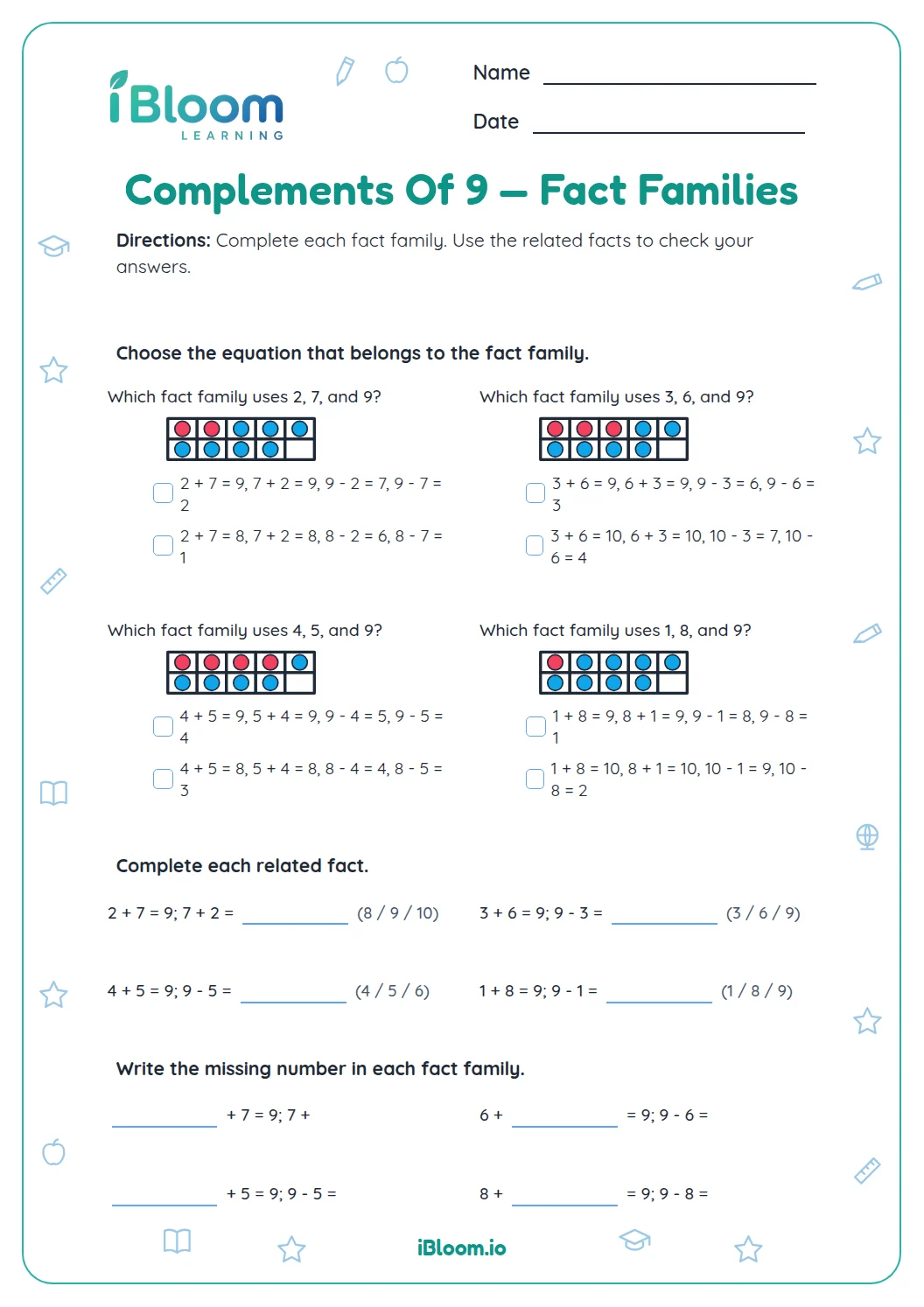
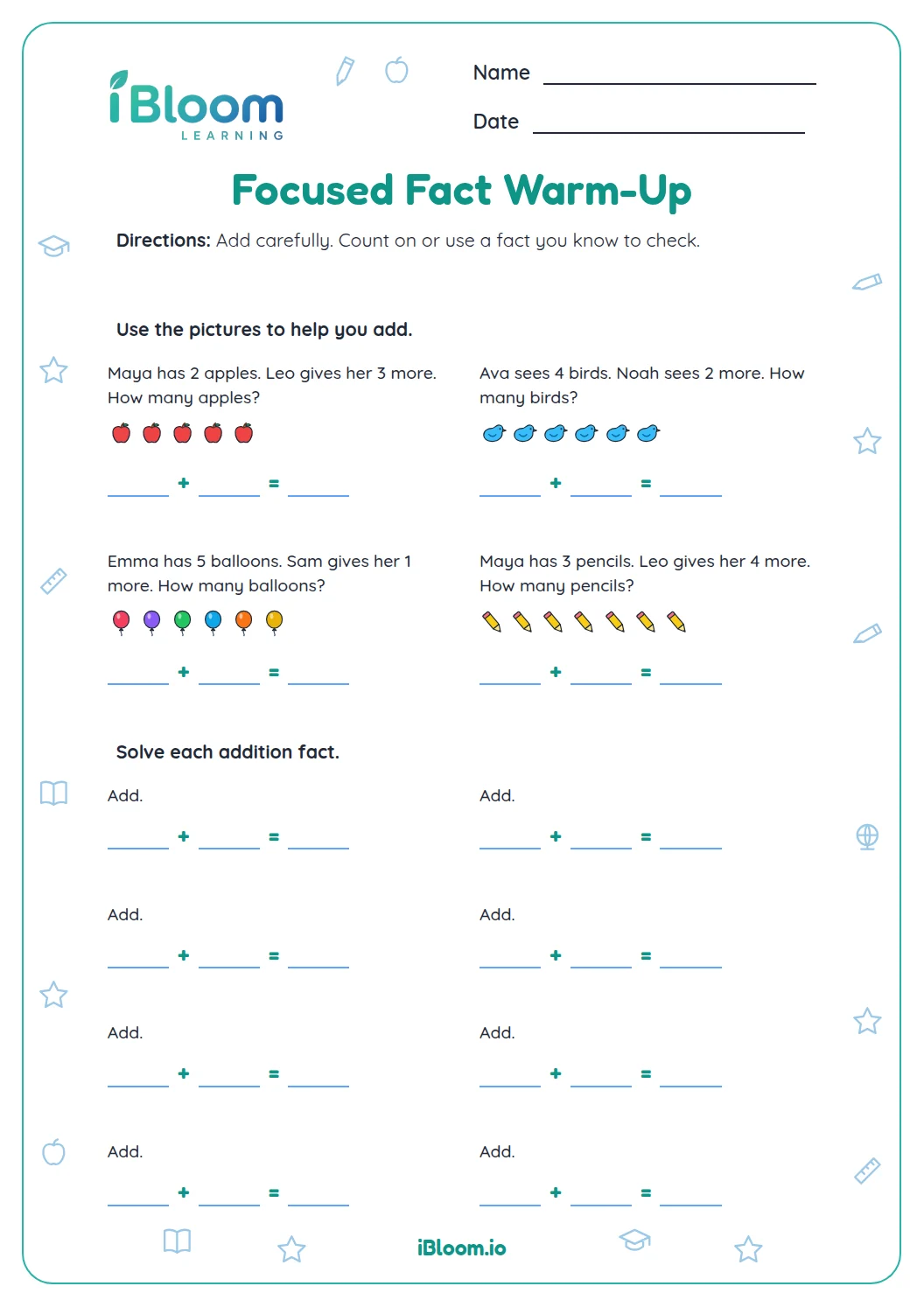
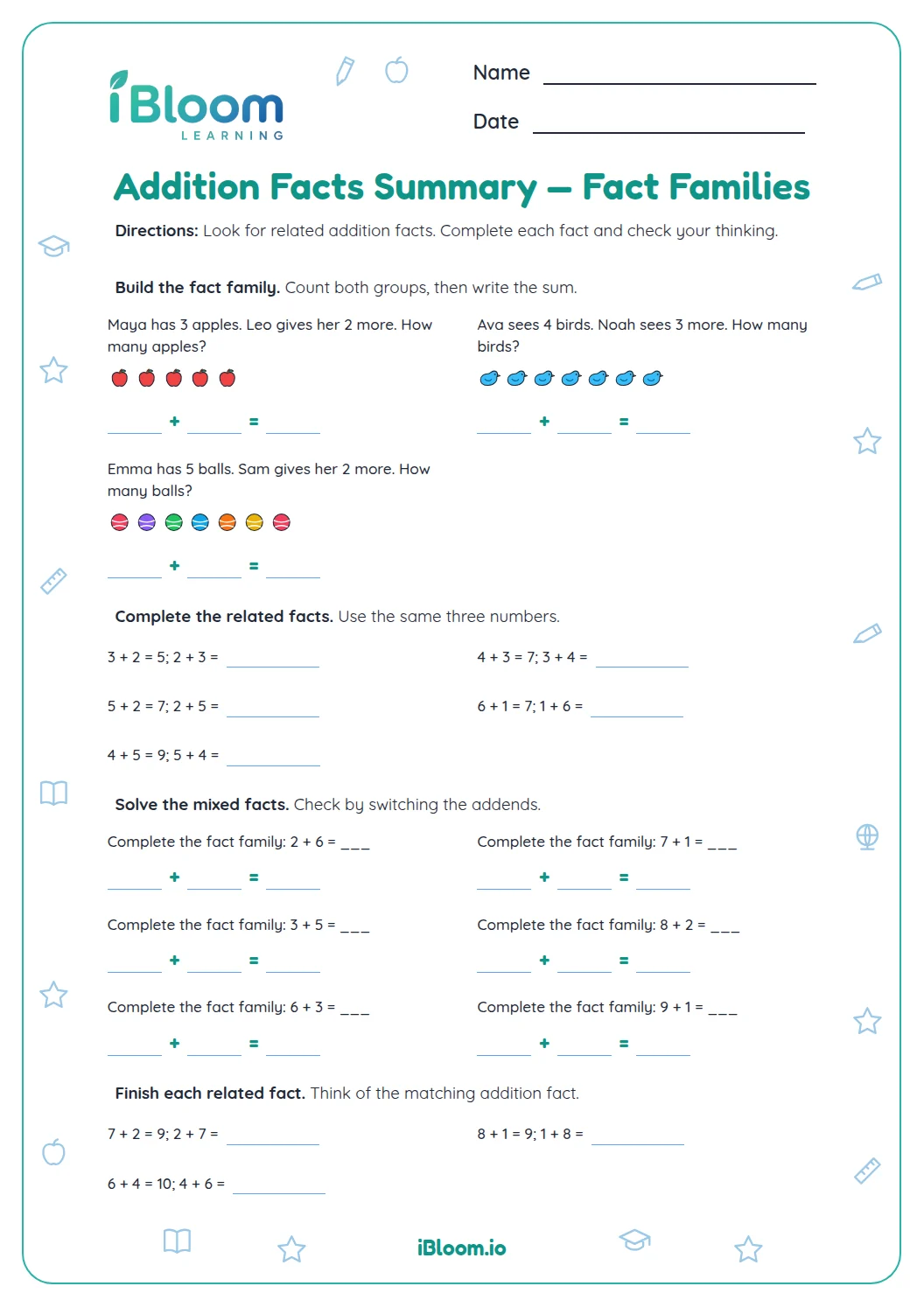
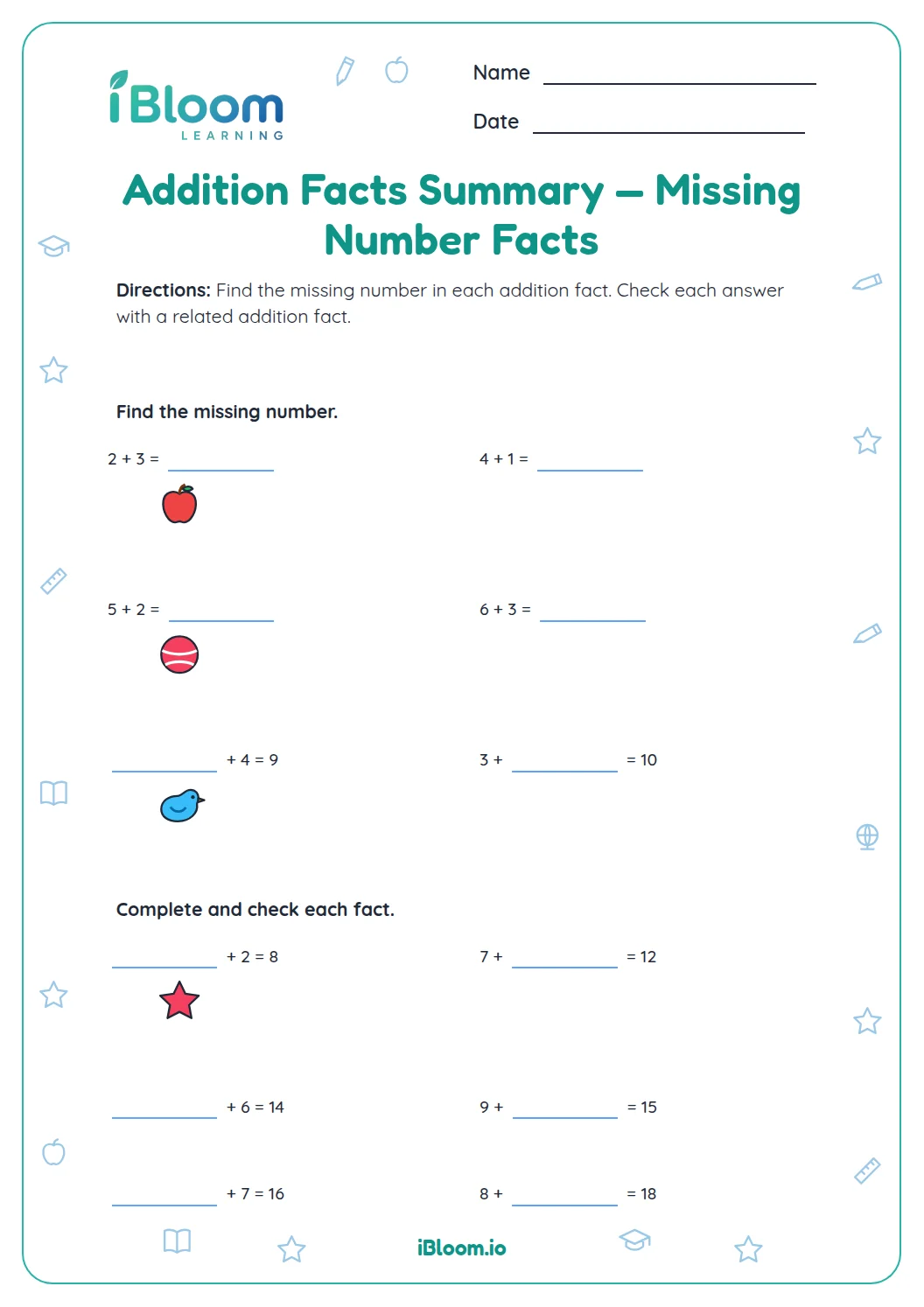
This free printable gives Grade 1 students focused practice with adding nines. It practices Common Core 1.OA.C.6 through addition facts within 20 and the named fact strategy. The 19 questions include four picture stories; the remaining problems print both addends and leave the sum for the student. A separate key supports checking after practice.
Aligned to 1.OA.C.6
How do the picture stories introduce the facts?
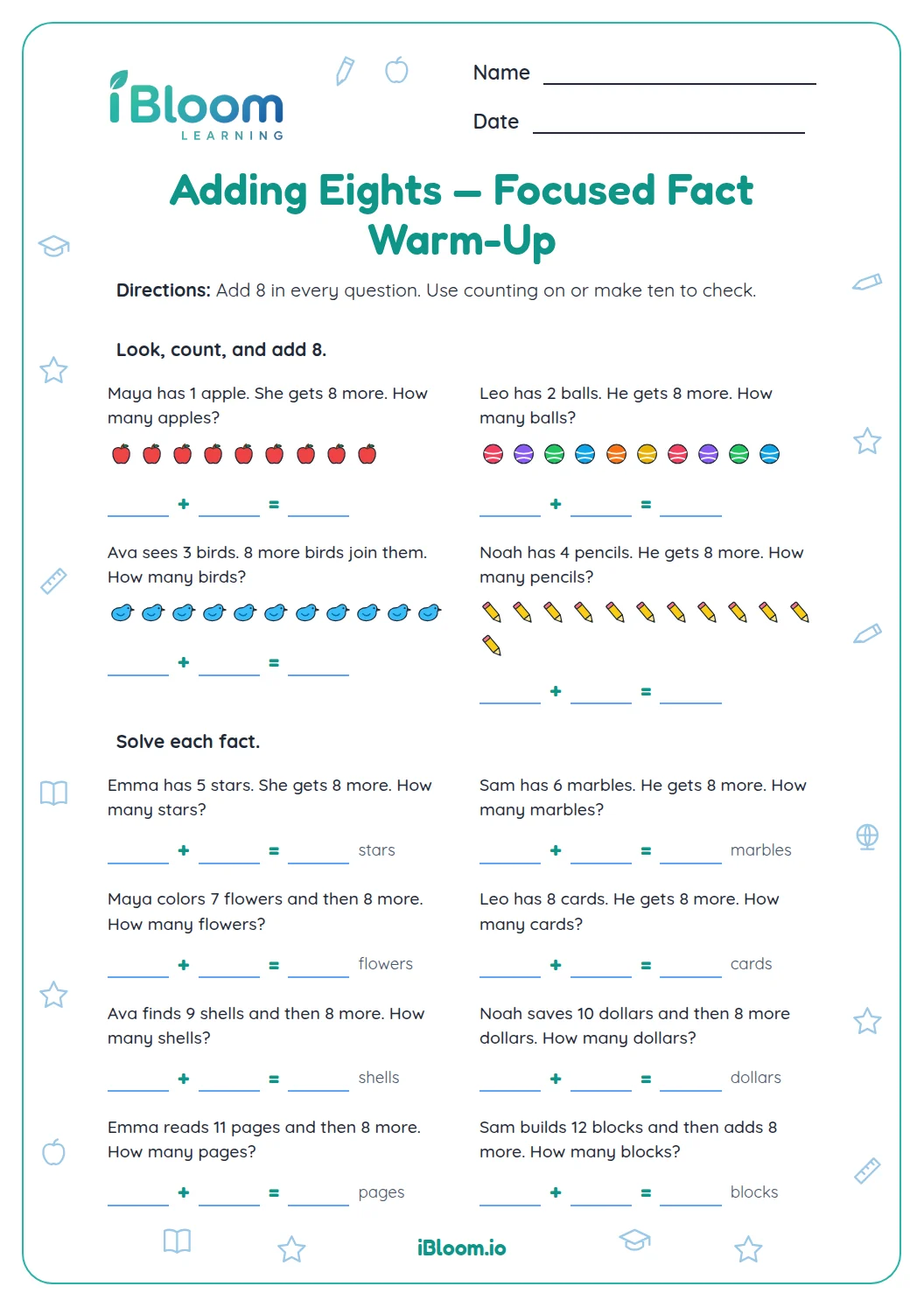
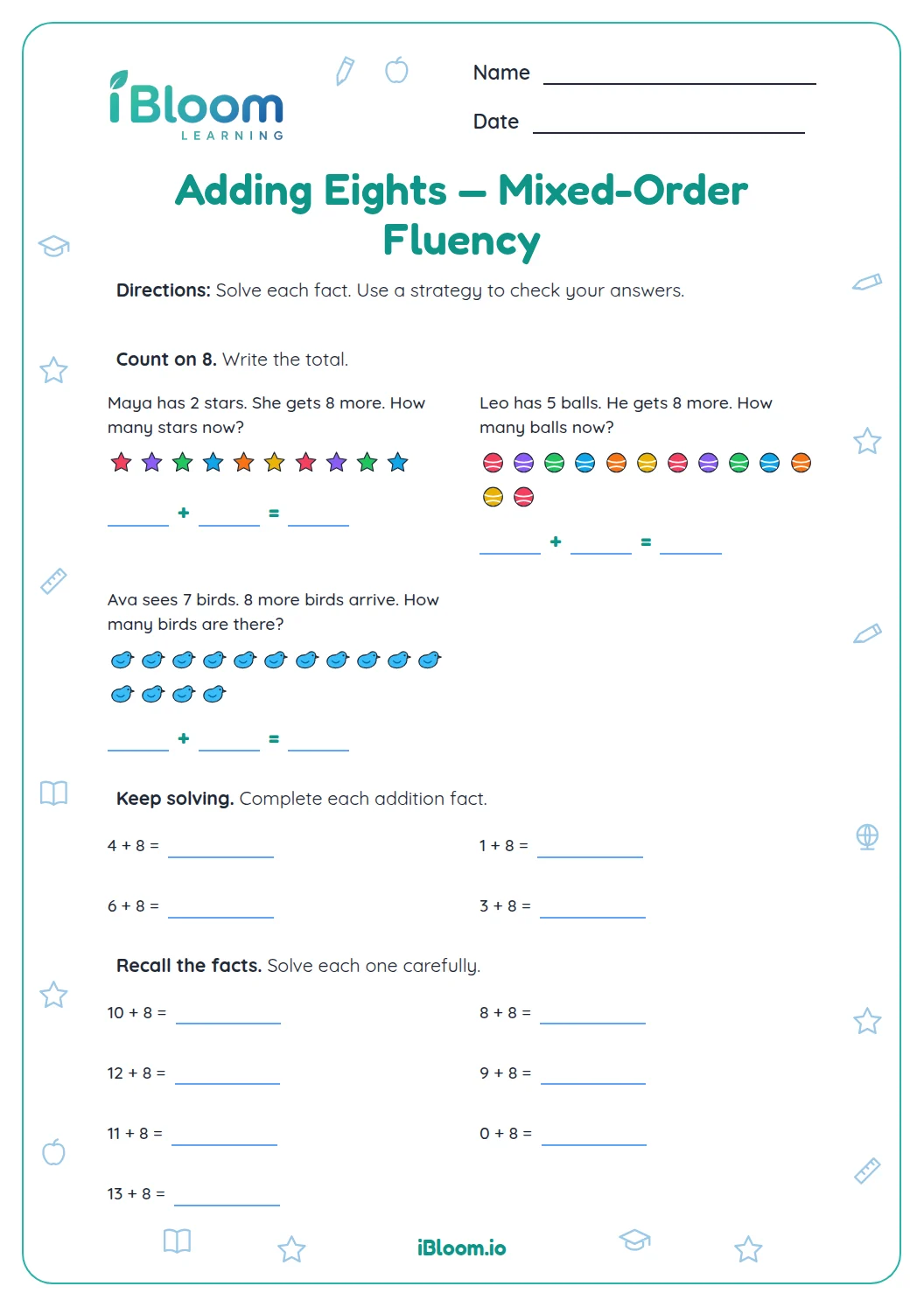
Part A shows the starting group and tells how many more are added. Read both amounts, then find the total. For example, 1 star and 9 more make 10.
What strategy helps with adding nines?
Make a ten when it helps, then add the rest. In Part B, read both addends before writing the sum. For example, 6 + 9 = 15.
How can students check a sum?
Count on from one addend or use a known fact, then compare the result with the answer key. If the result is off by one, reread both addends and check that the plus sign was used.
How to use this worksheet
- 1Read the story or number sentence all the way through.
- 2For a picture story, count the pictured starting group.
- 3Find how many are added and combine the groups.
- 4For a number sentence, use the named fact strategy.
- 5Check each sum with the separate answer key.
Common mistakes and quick fixes
The mistake
Counting the starting group again after adding.
The fix
Say the starting number first, then count on only the new objects.
The mistake
Using the wrong number of added objects.
The fix
Point to the number in the story or second addend before solving.
The mistake
Reading a plus sign as a minus sign.
The fix
Name the operation before finding the sum.
Curriculum alignment
Students add facts within 20 and use the named fact strategy to find each sum.
On this sheet:
Show the official wordingHide the official wording
Add and subtract within 20, demonstrating fluency for addition and subtraction within 10. Use strategies such as counting on; making ten (e.g., 8 + 6 = 8 + 2 + 4 = 10 + 4 = 14); decomposing a number leading to a ten (e.g., 13 - 4 = 13 - 3 - 1 = 10 - 1 = 9); using the relationship between addition and subtraction (e.g., knowing that 8 + 4 = 12, one knows 12 - 8 = 4); and creating equivalent but easier or known sums (e.g., adding 6 + 7 by creating the known equivalent 6 + 6 + 1 = 12 + 1 = 13).
What to practice next
Make more practice
Further reading
Questions parents and teachers ask
What is on this worksheet?
This sheet has 19 questions for adding nines. The opening section uses four picture stories, followed by printed addition facts, so a student can connect a story to a number sentence and then practice the facts directly. Each question leaves the sum blank.
Are all numbers printed for students?
Yes. Each story states both addends in words and shows the pictured starting group. Every number sentence prints both addends and the plus sign, leaving only the sum for the student to find. The stories name the starting group and how many more are added. Students fill in each sum.
How can a student use the pictures?
Count the pictured starting group, read the number added, then find the total. The story gives context without printing the answer; the later number sentences build practice with adding nines. A student can count on or use a known fact to check each result.
What grade is this practice for?
The worksheet is labeled Grade 1 and keeps every sum within 20. An adult can read a story aloud or model one fact, then let the student solve the remaining items and check the separate answer key afterward. This makes the facts a useful brief warm-up.
Is an answer key included?
Yes. A separate answer key lists the correct result for every question in the same order as the student sheet. Have the student finish first, then use the key to find any fact worth solving again with a counting or known-fact strategy.