



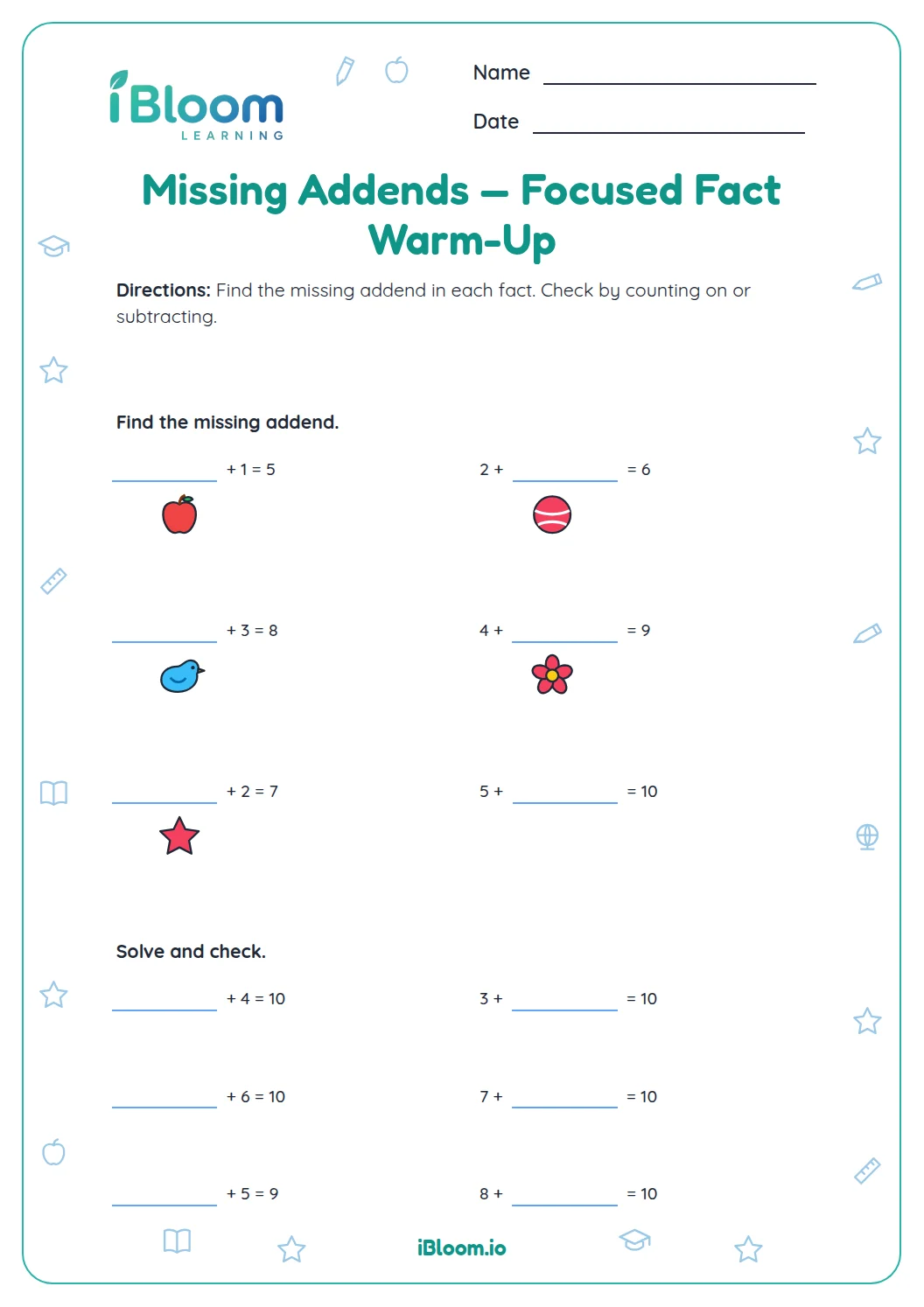
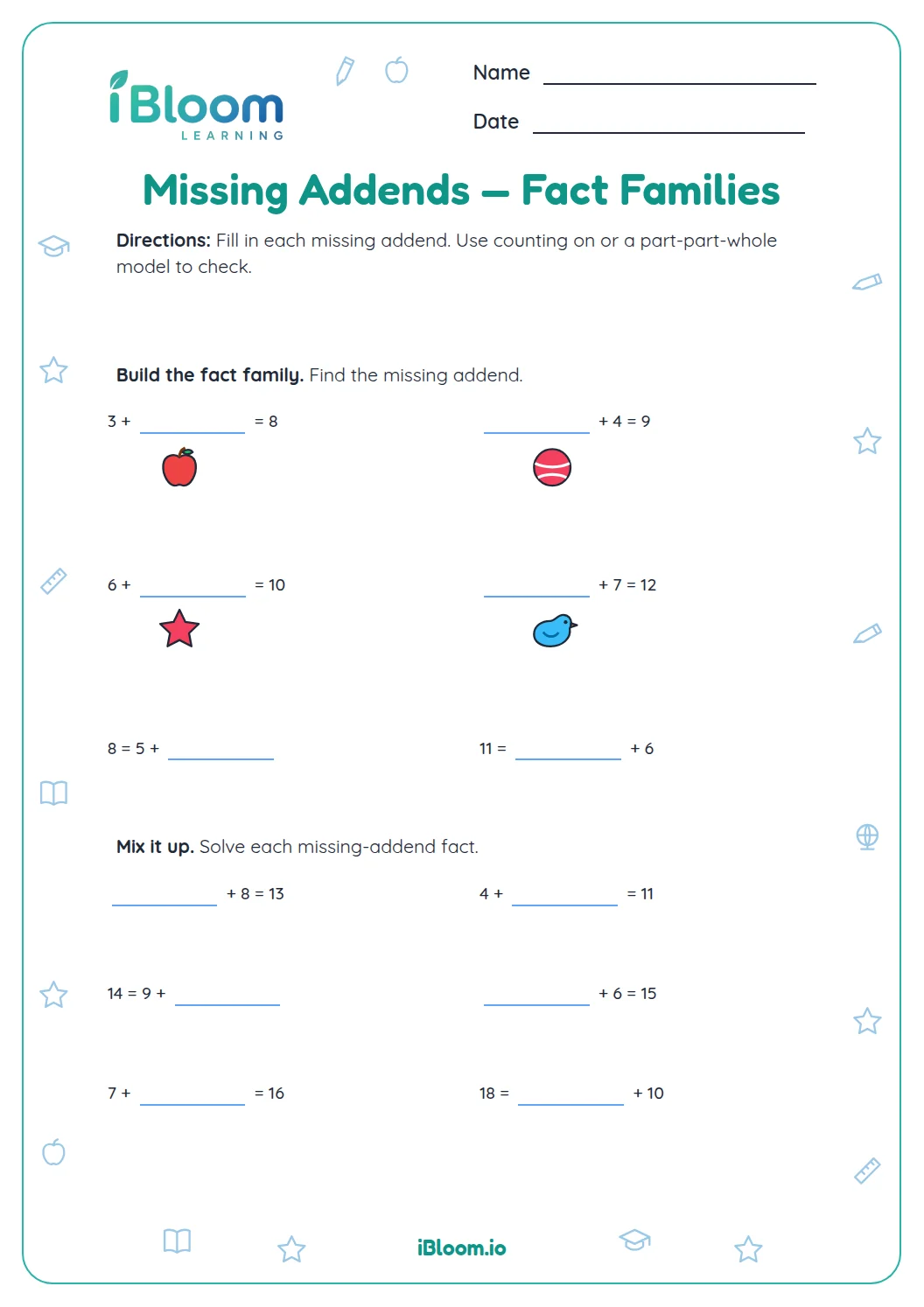
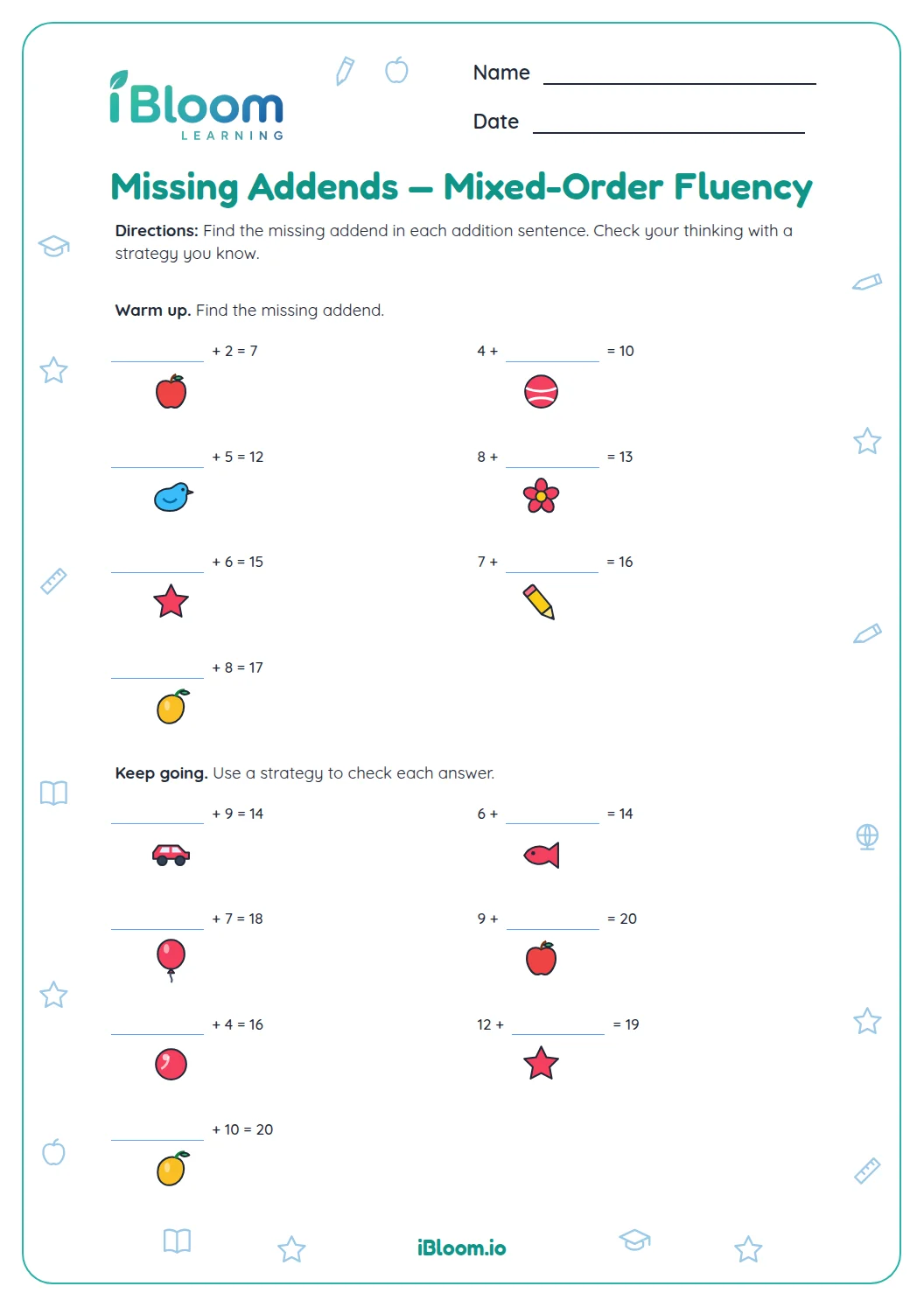
About this worksheet
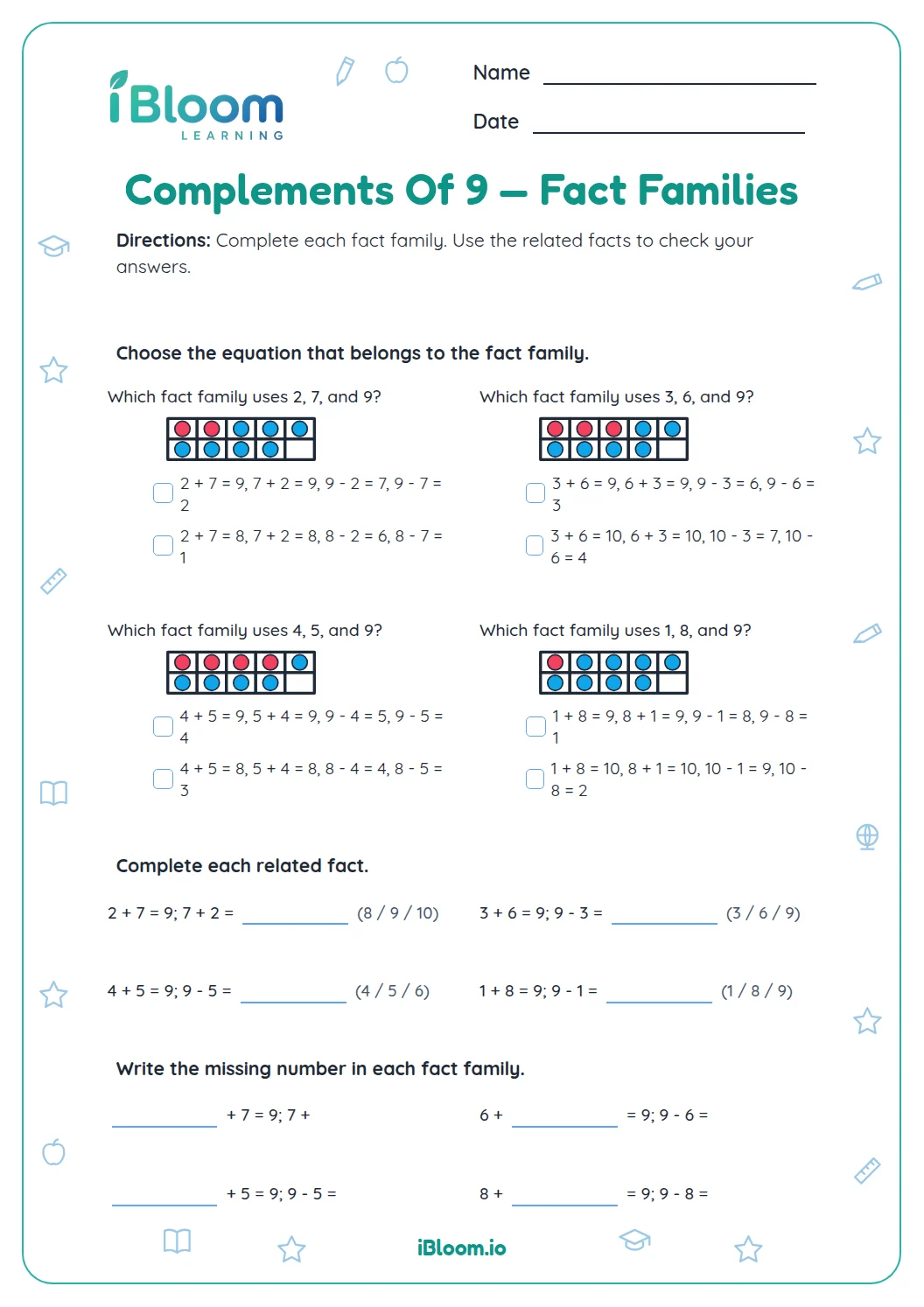
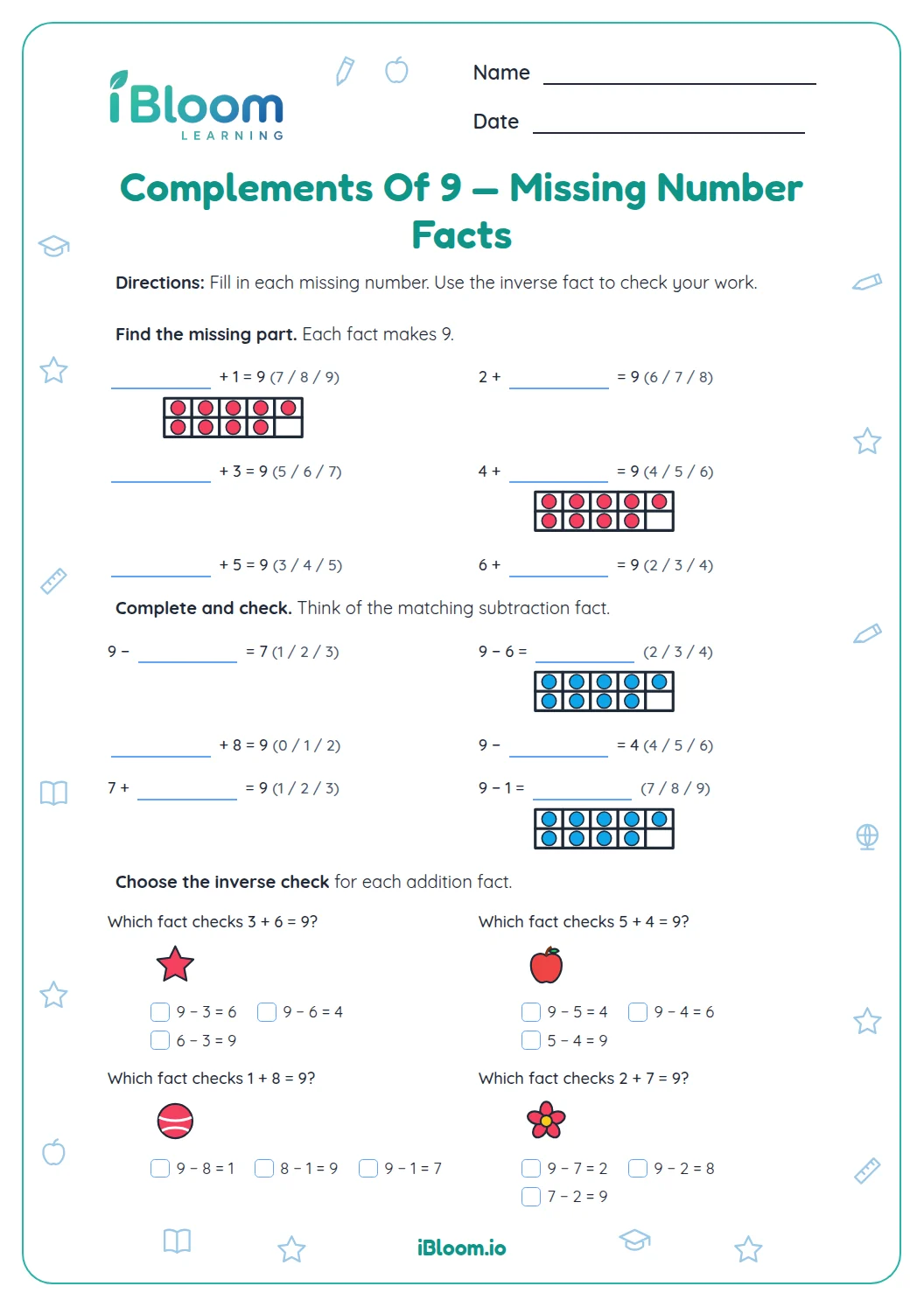
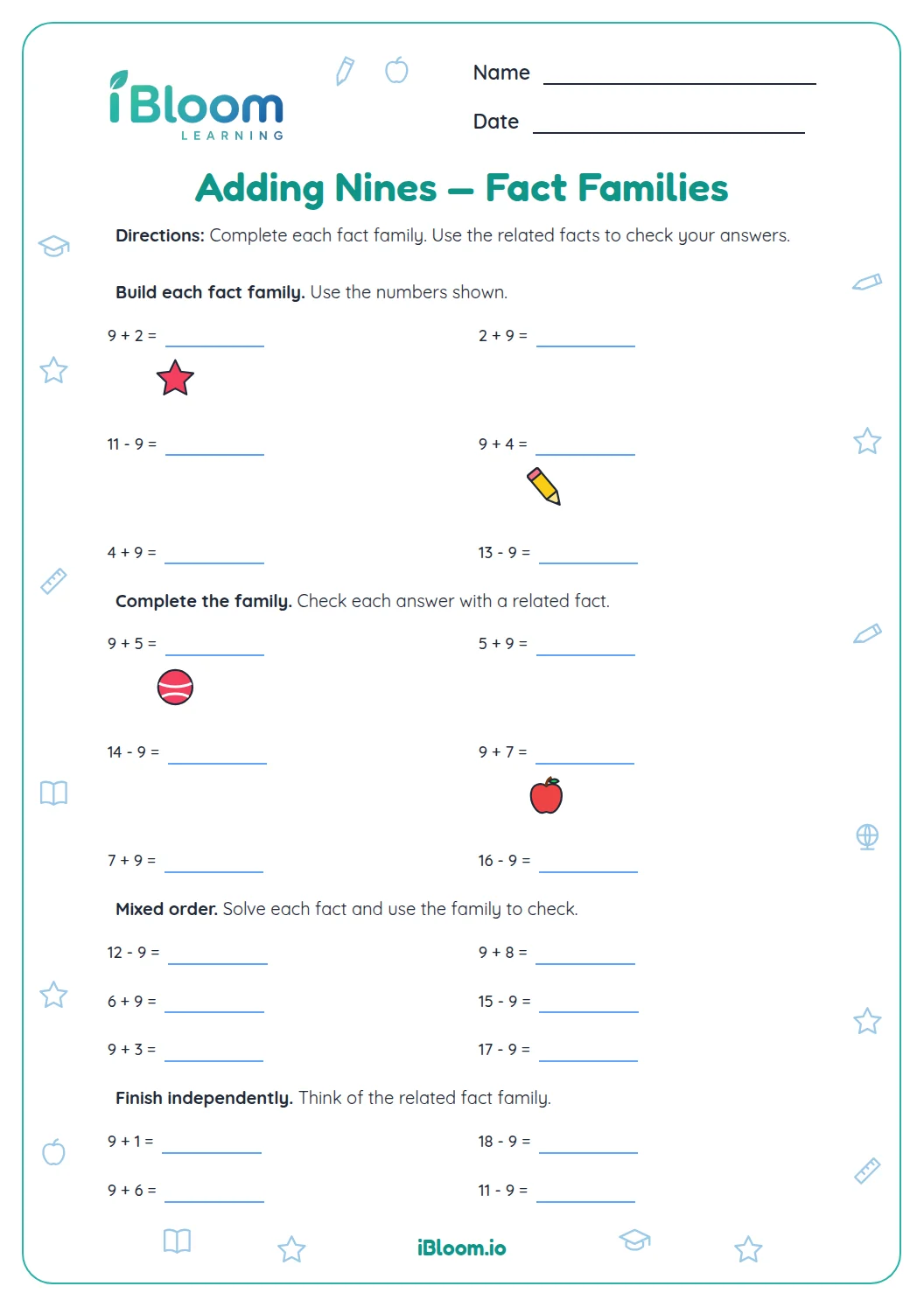
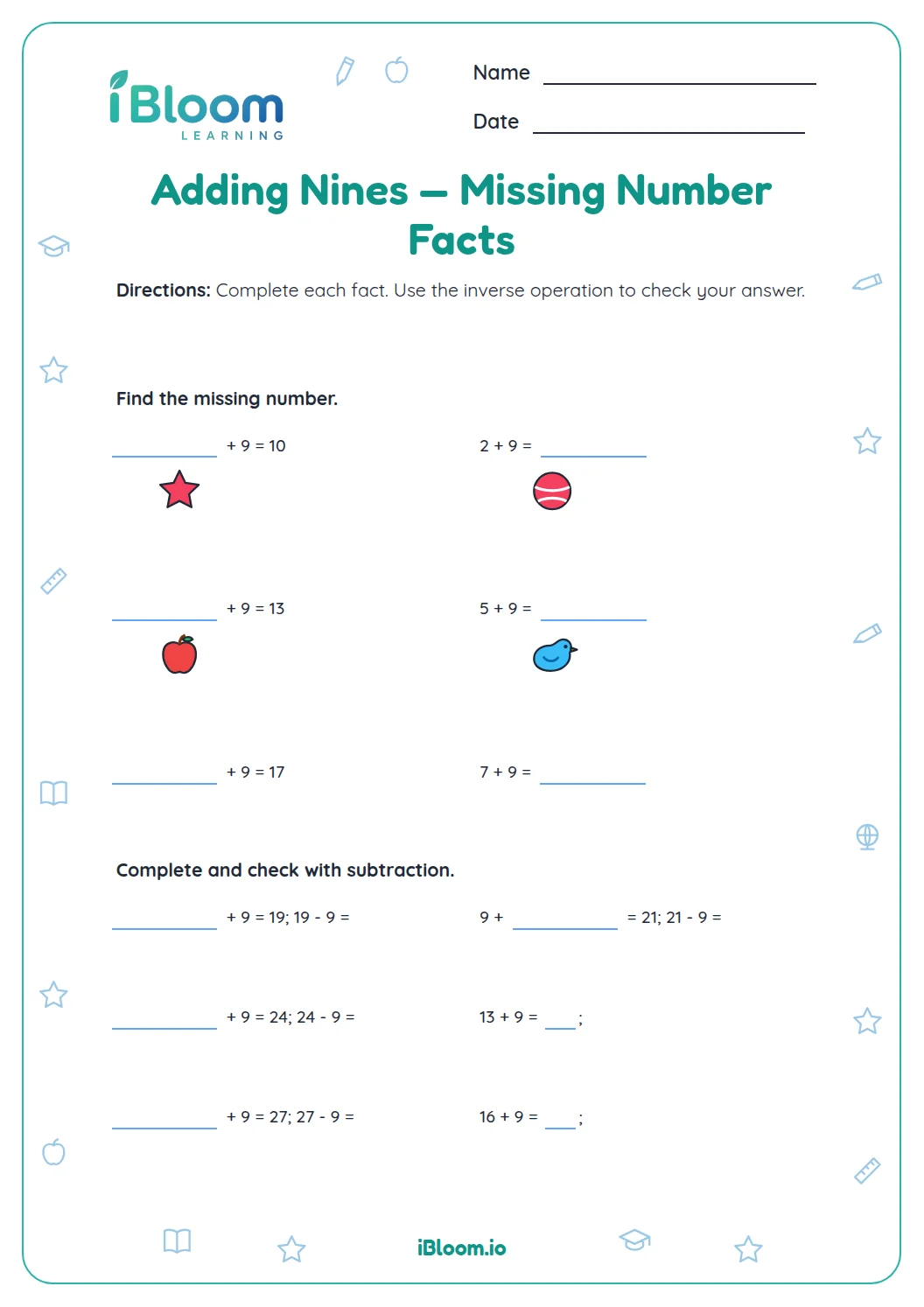
This free printable complements of 9 worksheet gives Grade 1 and Grade 2 learners 16 clearly printed problems to solve, with every number visible on the student pages. Part A builds a steady start with add 0 through 9 to 9; Part B mixes the facts for a fresh recall check, including mixed facts with 9 in either position. The practice supports Common Core standard 1.OA.C.6: adding within 20 and building fluency with addition facts within 10. The separate answer key makes it easy to check each response and revisit any fact that needs another try.
Aligned to 1.OA.C.6
What is on this complements of 9 worksheet?
Part A gives learners a focused first round: add 0 through 9 to 9. Part B changes the order and mixes the numbers, so children have to read each expression instead of relying on a memorized row.
The student sheet prints the complete addition fact before each response. The key lists the matching answers in order, so a child can correct a missed fact and try it again.
- Part A: add 0 through 9 to 9
- Part B: mixed facts with 9 in either position
- 16 student problems with matching key answers
- One worksheet page and one answer key page
How can a child solve a fact efficiently?
Read both addends and the plus sign before answering. For a fact near ten, make ten in your head, then add what remains; for other facts, recall the matching sum and check it once.
- 19 + 4 = 13
- 2Think 9 + 1 makes 10, then add 3 more.
- 3So 9 + 4 = 13.
How should we use the answer key?
Try the worksheet without the key first, then compare answers one part at a time. For any missed item, say the entire addition fact aloud and solve it again; this keeps the operation sign and both addends connected.
A short second attempt later can focus on only the items that were difficult. The aim is accurate recall, with comfortable pacing.
How to use this worksheet
- 1Complete the first round by adding each number to 9.
- 2For sums above 10, first find how many reach 10.
- 3Add any leftover amount after reaching 10.
- 4In the mixed round, read the position of 9 but keep both addends.
- 5Check with the key and retry the facts that need another look.
Common addition fact slips and fixes
The mistake
Writing the other addend as the answer.
The fix
The sum is the total: for 9 + 4, make ten and add the remaining 3 to get 13.
The mistake
Thinking that 9 + 4 stops at 10.
The fix
The 4 adds one to reach 10 and leaves 3 more, so the total is 13.
The mistake
Changing the answer when 9 moves to the right.
The fix
The order of addends does not change the sum; use both numbers in the equation.
Common Core alignment
This practice supports Grade 1 addition fluency and work with sums within 20.
Practice addition within 20 and build fluency with addition facts within 10.
On this sheet: All 16 items practice the addition fact facts named in this worksheet.
Show the official wordingHide the official wording
Add and subtract within 20, demonstrating fluency for addition and subtraction within 10. Use strategies such as counting on; making ten (e.g., 8 + 6 = 8 + 2 + 4 = 10 + 4 = 14); decomposing a number leading to a ten (e.g., 13 - 4 = 13 - 3 - 1 = 10 - 1 = 9); using the relationship between addition and subtraction (e.g., knowing that 8 + 4 = 12, one knows 12 - 8 = 4); and creating equivalent but easier or known sums (e.g., adding 6 + 7 by creating the known equivalent 6 + 6 + 1 = 12 + 1 = 13).
What to practice next
Make more practice
Further reading
Questions parents and teachers ask
What grade is this complements of 9 worksheet for?
This worksheet is designed for Grades 1 and 2. It gives children 16 printed addition problems focused on addition facts, with the numbers printed on the student page and a separate key for checking. An adult can read directions aloud, while the learner completes each fact at a comfortable pace.
Are the numbers printed on the student worksheet?
Yes. Each student problem includes the addends and operation sign, so learners can solve the facts directly on the worksheet. The answer key repeats the answers for checking; it is not the only place where the numbers appear.
How can my child check an addition answer?
Read the original equation again and combine the two addends. For example, 6 + 3 makes 9. If the answer seems off, count on from the larger addend or use a familiar ten-frame strategy, then check the key after completing the part.
Should this worksheet be timed?
Timing is optional. A child can first focus on reading each sign and solving accurately, then repeat the page later to notice whether familiar facts come to mind more quickly. Stop if the pace causes rushed answers; the practice is useful without a timer.
How many problems and pages are included?
There are 16 questions arranged in two parts on one worksheet page. A separate one-page answer key follows. The parts change the arrangement of the facts so learners practice carefully and then revisit them in mixed order at a comfortable pace.
What should we do after a missed fact?
Have the learner read the whole equation aloud, solve it again, and compare with the key. For a fact close to ten, think about how many more reach ten and then add the remaining amount. Revisit only the missed facts for a brief second round.