


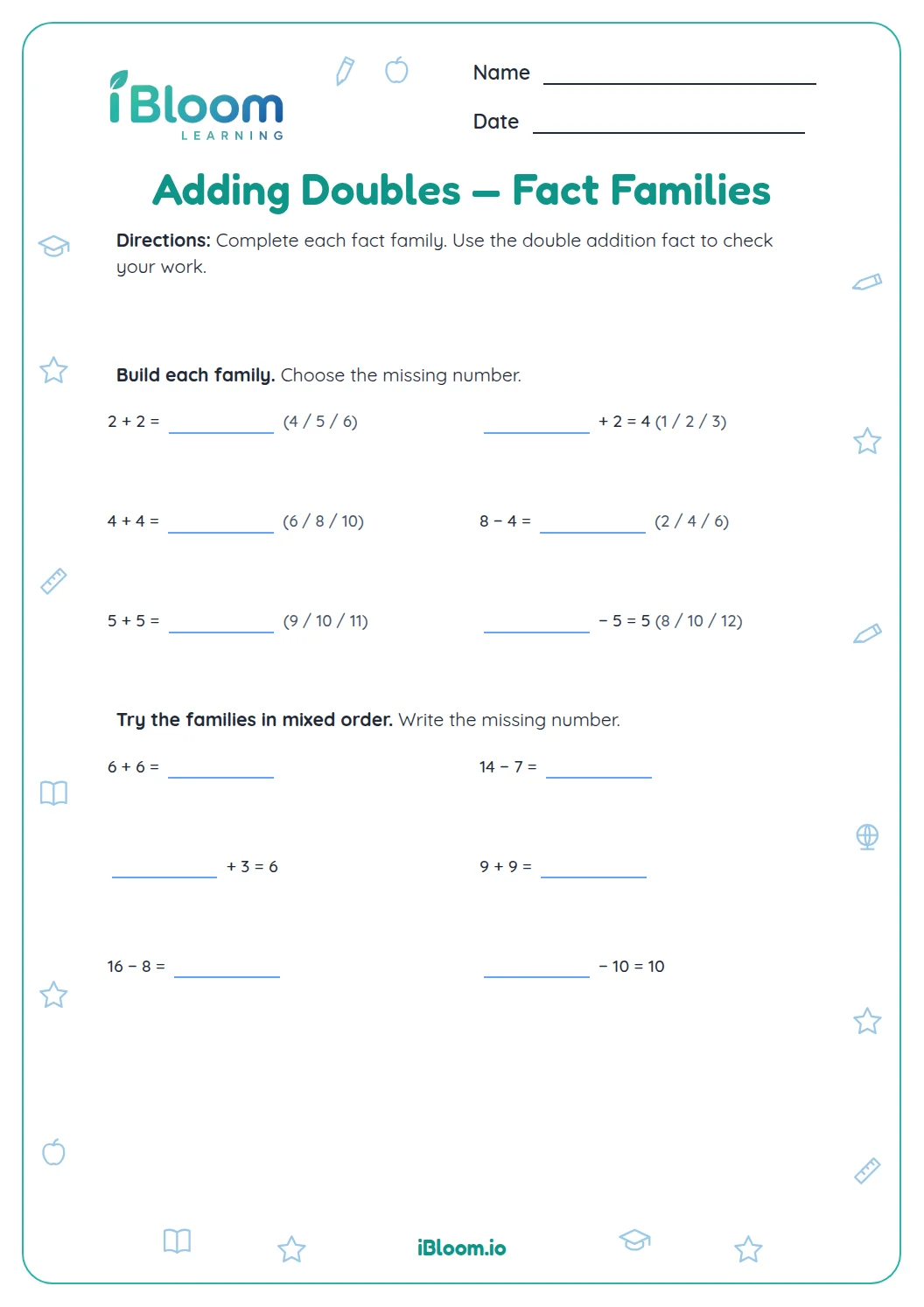
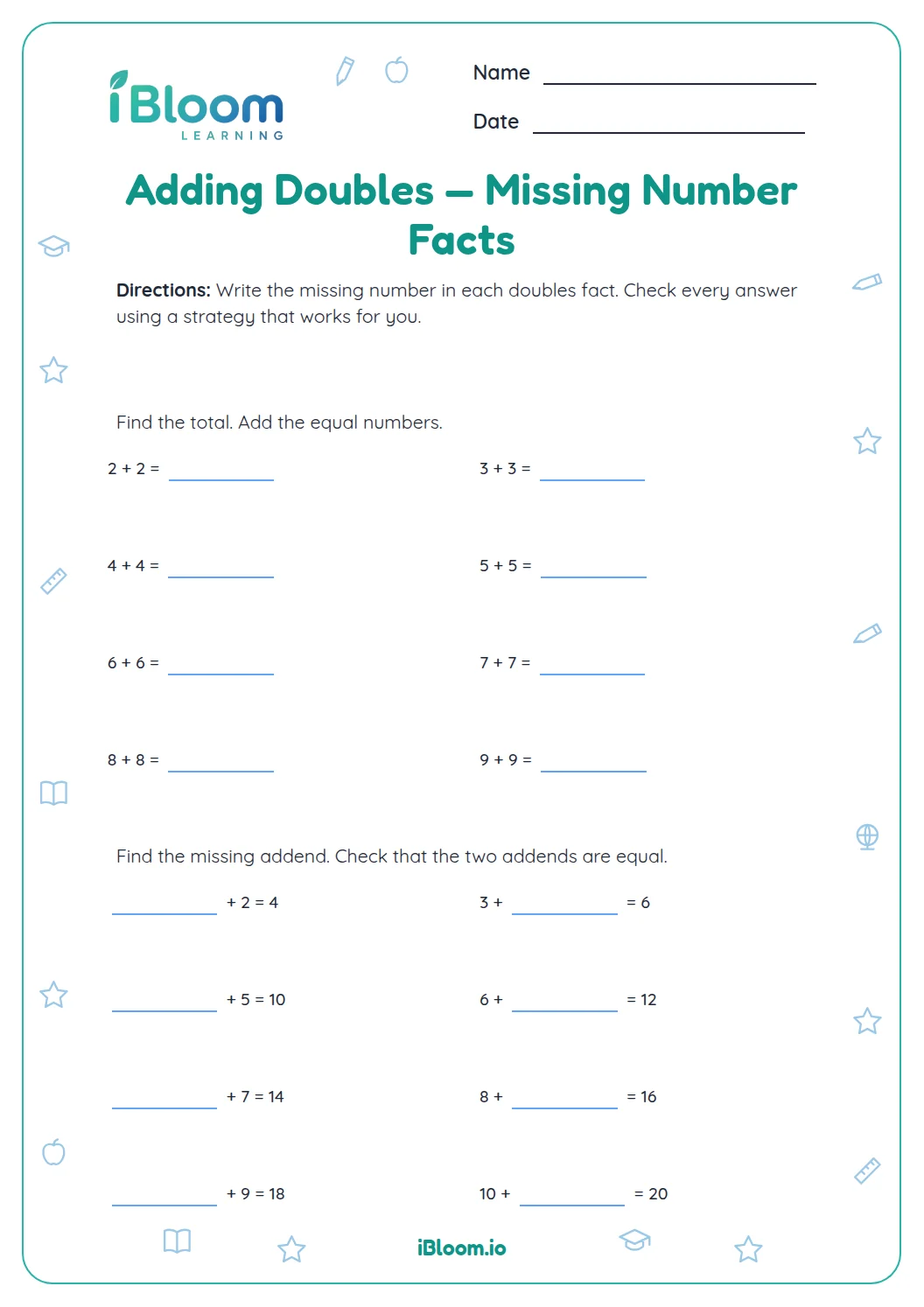

About this worksheet
This printable gives students 24 horizontal addition facts within 20 in mixed order. Each prompt shows both addends and the plus sign. The final set adds another short round for fluency; on the optional timed version, students can skip timing and focus on accuracy. A separate answer key is included.
Aligned to 1.OA.C.6
Ways to work out an addition fact
Start with the larger addend and count on by the smaller addend. For 8 + 5, say “8” and count five steps: 9, 10, 11, 12, 13. The sum is 13.
Some facts connect to doubles or ten. For 6 + 7, think 6 + 6 + 1. For 9 + 4, make ten by moving one from 4: 10 + 3 = 13. With practice, students recognize facts without recounting each time.
- 18 + 5
- 2Start at 8
- 3Count on 5: 9, 10, 11, 12, 13
- 48 + 5 = 13
What is different about this optional timed drill?
Part A begins with ten mixed facts. Part B gives ten more. Part C adds 4 final facts in another order. Students read each complete expression rather than relying on a sequence.
- Part A: 10 horizontal facts
- Part B: 10 more facts within 20
- Part C: 4 final facts
- Separate answer key lists every sum
How to use this worksheet
- 1Read both addends and the plus sign before solving.
- 2Use count-on, doubles, or make-ten strategies when needed.
- 3Record one sum in each blank.
- 4Check each answer by adding in the opposite order or counting on again.
Common mistakes and quick fixes
The mistake
Starting to count on from the smaller addend.
The fix
Start with the larger addend so fewer counting steps are needed.
The mistake
Skipping a number while counting on.
The fix
Touch or point once for each count.
The mistake
Treating optional timing as more important than accuracy.
The fix
First solve carefully; use a timer only if it feels helpful.
Common Core alignment
The facts stay within 20, supporting addition fluency in the primary grades.
Add and subtract within 20, demonstrating fluency for addition within 10.
On this sheet: Students solve horizontal addition facts, using strategies and building recall.
Show the official wordingHide the official wording
Add and subtract within 20, demonstrating fluency for addition and subtraction within 10. Use strategies such as counting on; making ten (e.g., 8 + 6 = 8 + 2 + 4 = 10 + 4 = 14); decomposing a number leading to a ten (e.g., 13 - 4 = 13 - 3 - 1 = 10 - 1 = 9); using the relationship between addition and subtraction (e.g., knowing that 8 + 4 = 12, one knows 12 - 8 = 4); and creating equivalent but easier or known sums (e.g., adding 6 + 7 by creating the known equivalent 6 + 6 + 1 = 12 + 1 = 13).
What to practice next
Make more practice
Further reading
Questions parents and teachers ask
What addition facts are on this page?
There are 24 horizontal addition facts in three varied sets. Each number sentence shows both addends and a plus sign, and students write one sum in each blank. The facts stay within 20 and can be solved with counting on, doubles, or making ten.
Should children use fingers or count on?
Students can use a strategy that helps them reason accurately and build recall. Counting on, using doubles, and making ten are all useful approaches. A child may use fingers at first, then gradually rely on known facts and connections between sums.
Does the optional timed drill require a time limit?
No. Students can complete all of the facts carefully without setting a timer. If a teacher or family chooses to time a round, use it as a personal pacing check and keep accurate sums as the main goal.
Is there an answer key?
Yes. A separate answer-key page lists all 24 sums in question order. After finishing the page, students can finish the three practice sets, match each expression with its answer, and review any missed fact before giving it another try. They can use a missed item to choose a fact family for another short practice round.