



About this worksheet
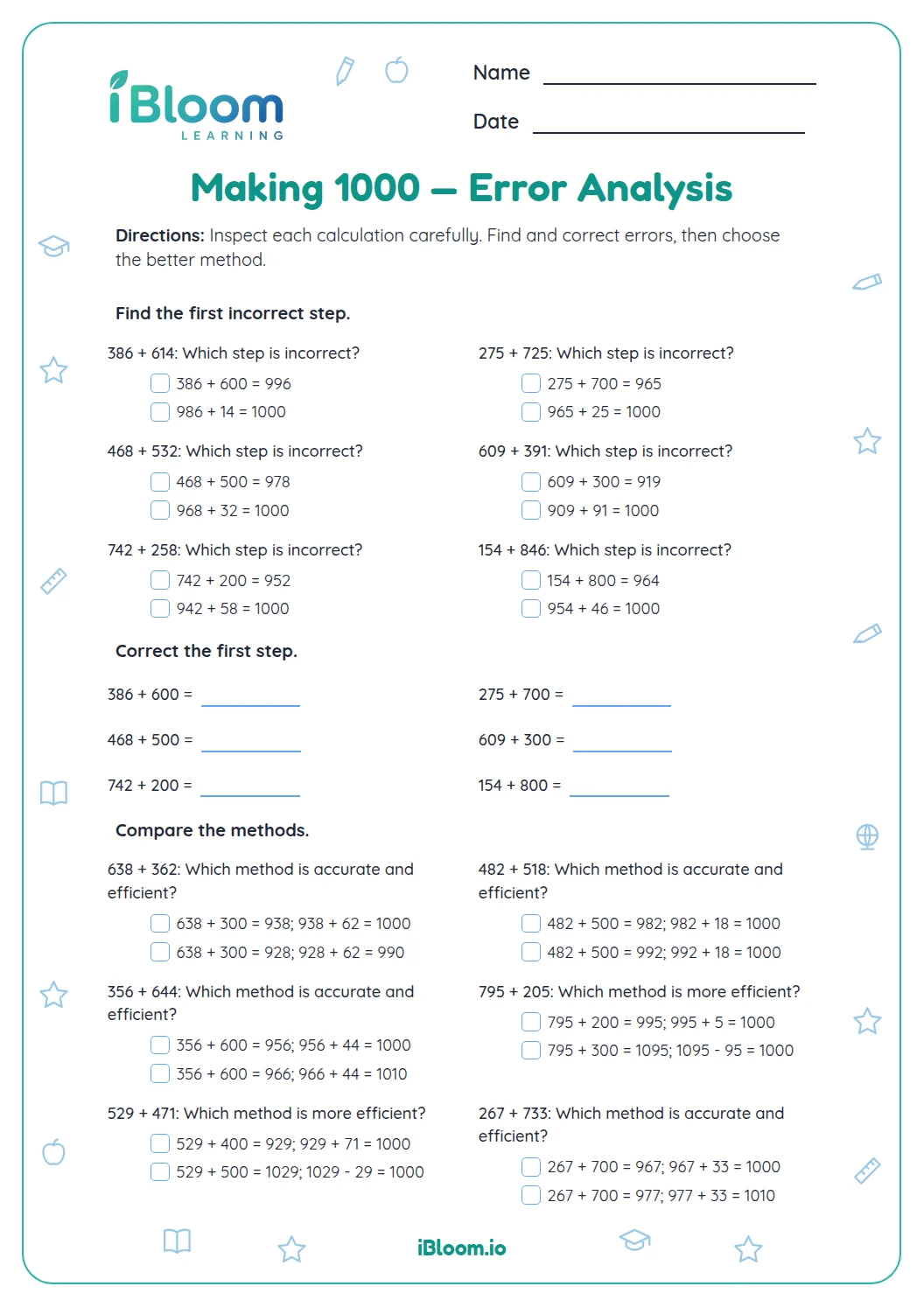
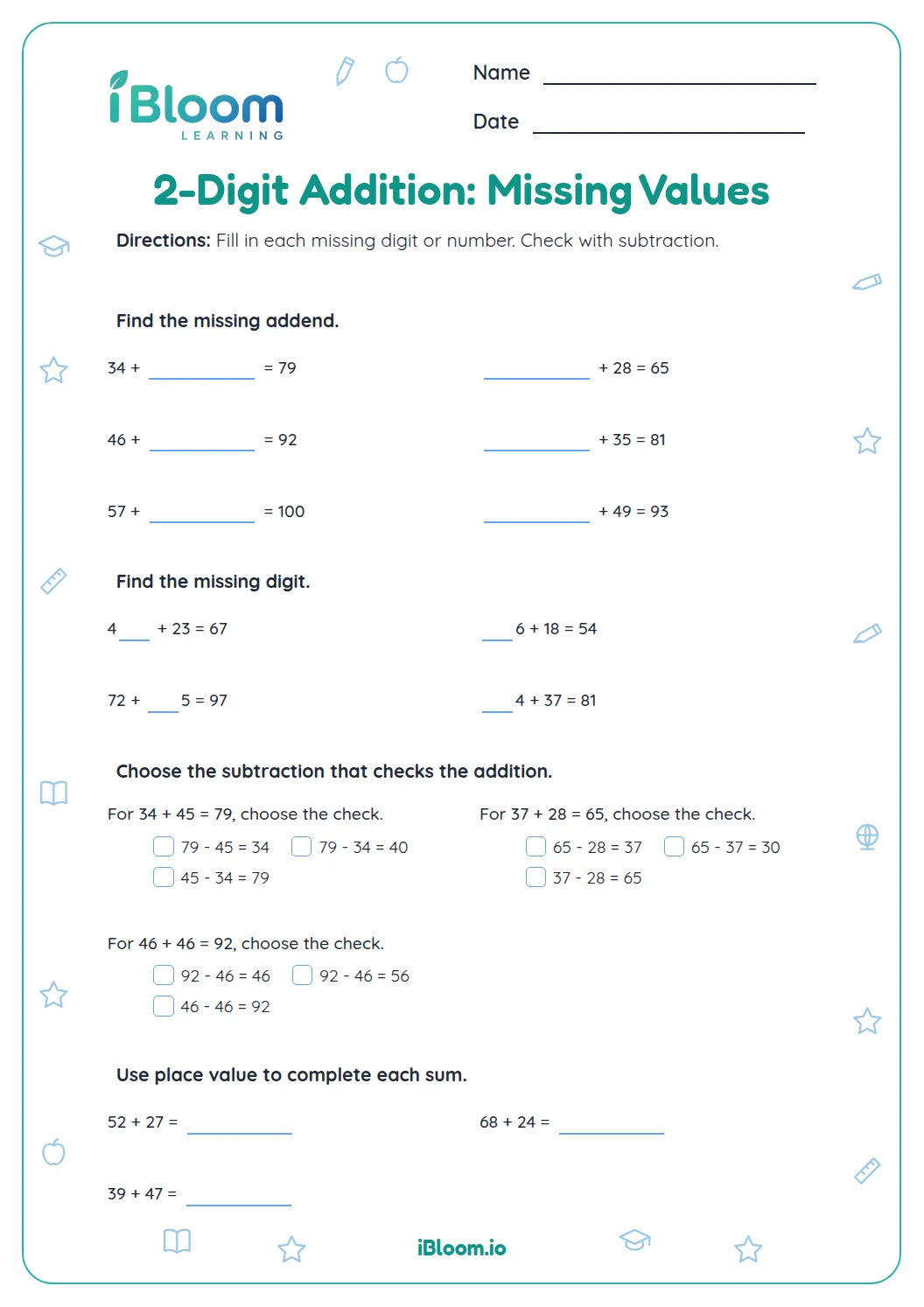
This Grade 3 printable practices making 1,000 with 18 addition and subtraction equations. Students find missing addends in two sets, then subtract from 1,000 to check six of those relationships. The problems use three-digit values and require place-value regrouping; a separate key includes every answer, including all six check differences. It aligns with CCSS 3.NBT.A.2.
Aligned to 3.NBT.A.2
How is the making-1,000 practice organized?
Part A asks for the second addend in sums that equal 1,000. Part B reverses the addend order and asks for the missing first addend. Part C subtracts six of the known addends from 1,000 so students can check the relationship.
Use column addition or subtraction on scratch paper by lining up ones, tens and hundreds. The number sentences stay visible on the page, and the answer key shows every missing value and check difference.
- Part A, questions 1–6: find the addend that completes 1,000
- Part B, questions 7–12: find a missing first addend
- Part C, questions 13–18: subtract from 1,000 to check
- The key includes all six check answers
How can subtraction find a missing addend?
For 164 + ___ = 1,000, subtract 164 from the target: 1,000 − 164 = 836. Check by adding: 164 + 836 = 1,000.
- 1164 + ___ = 1,000
- 21,000 − 164 = 836; 164 + 836 = 1,000.
How can regrouping help with 1,000?
When subtracting from 1,000, regroup across the zeros. For 1,000 − 275, trade one thousand for 10 hundreds, then regroup a hundred as 10 tens to get 725.
How to use this worksheet
- 1Read which addend is missing and keep the target sum at 1,000.
- 2Subtract the known addend from 1,000 to find the missing part.
- 3Line up digits by place value when using a column method.
- 4Use Part C to subtract the same six values from 1,000.
- 5Add each missing addend back to check that the total is 1,000.
Common mistakes and quick fixes
The mistake
Subtracting the target from the known addend.
The fix
Start with 1,000, then subtract the addend that is printed.
The mistake
Stopping after borrowing from the thousands place in 1,000 − 275.
The fix
Regroup across the zeros until each column has enough to subtract.
The mistake
Leaving a check difference blank or copying the original addend as the answer.
The fix
Compute each Part C subtraction; for example, 1,000 − 164 = 836.
Common Core alignment
The worksheet practices number operations and place-value reasoning in the Common Core State Standards for Mathematics.
Fluently add and subtract within 1,000 using strategies and algorithms based on place value.
On this sheet: The page builds sums of 1,000 and practices subtraction checks within 1,000.
Show the official wordingHide the official wording
Fluently add and subtract within 1000 using strategies and algorithms based on place value, properties of operations, and/or the relationship between addition and subtraction.
What to practice next
Make more practice
Further reading
Questions parents and teachers ask
How do you find the missing number in 164 + ___ = 1,000?
Subtract the known addend from the total: 1,000 − 164 = 836. Then check by adding 164 + 836 to confirm the result is 1,000. This subtraction strategy works for each missing addend in Parts A and B. to check the target sum.
Why does the subtraction check use 1,000?
The first two parts ask students to make a total of 1,000. Subtracting one addend from 1,000 gives the other addend, so the difference checks the addition relationship. Regroup as needed, then check the difference with addition. Then add the two parts to check the result.
What are the six check answers in Part C?
The differences are 836, 725, 654, 582, 473 and 217, in order. Each comes from subtracting the printed three-digit number from 1,000, and all six appear in the answer key. The check confirms the two addends make the target total.
What grade is this worksheet for?
It is designed for Grade 3 practice adding and subtracting within 1,000. Students find missing addends, regroup across place values when needed and use subtraction to check sums. Use the exact printed minuend and subtract the full addend. for the target number.
Can students solve the problems in columns?
Yes. Line up the ones, tens and hundreds on scratch paper and regroup as needed. The page prints the number sentences and answer spaces; the key gives the missing addends and the subtraction checks. Line up each place value before subtracting.