




About this worksheet
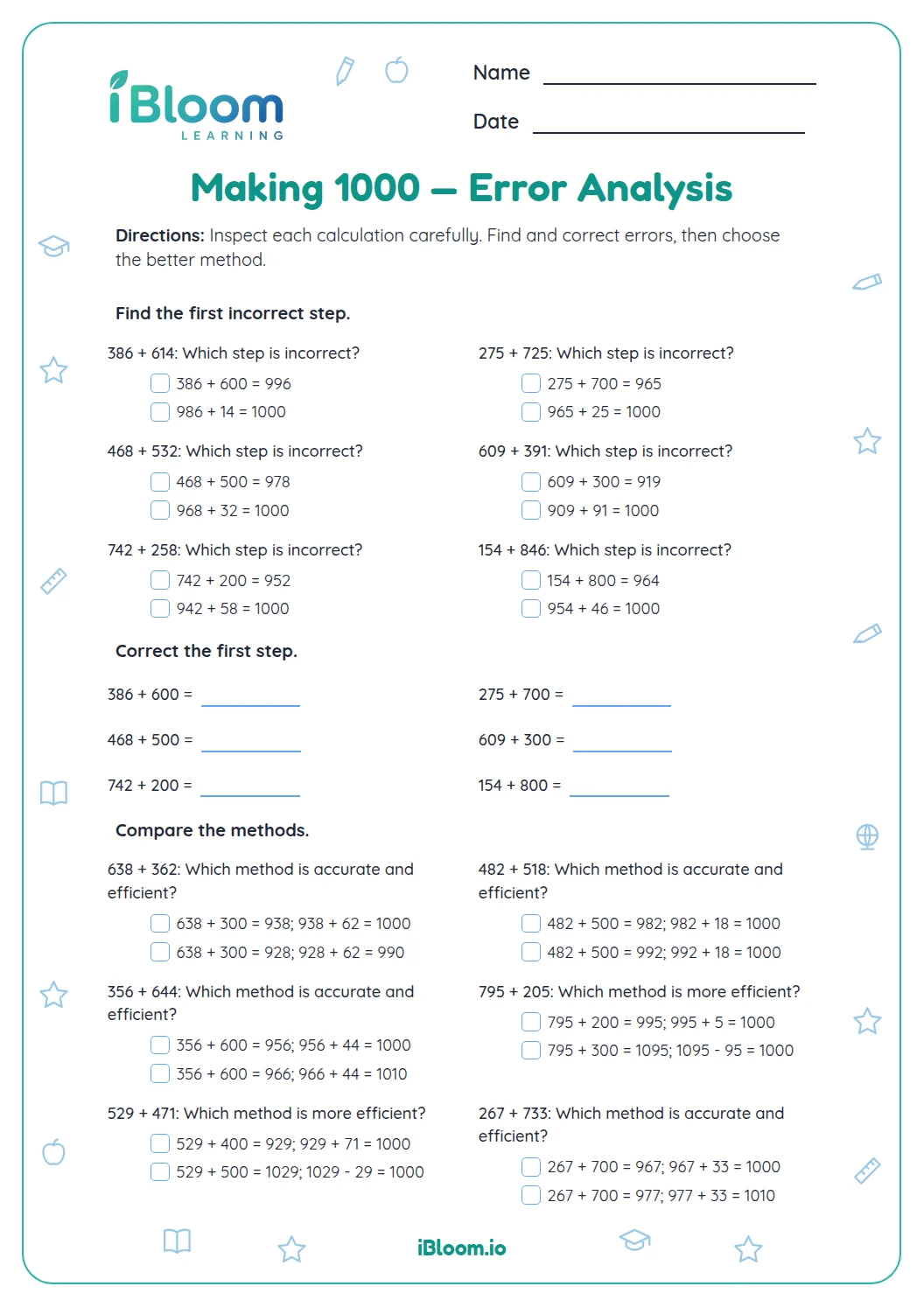
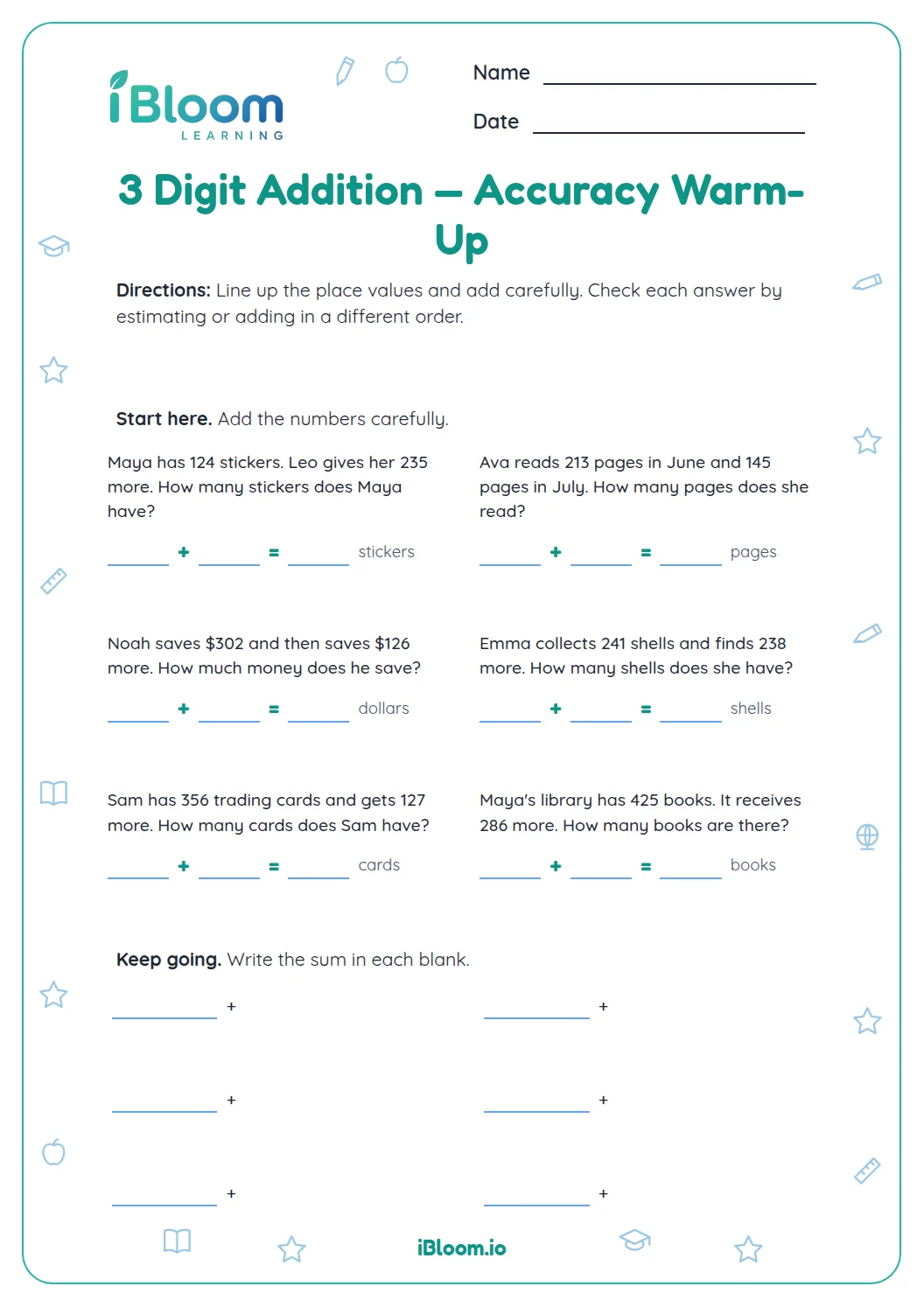
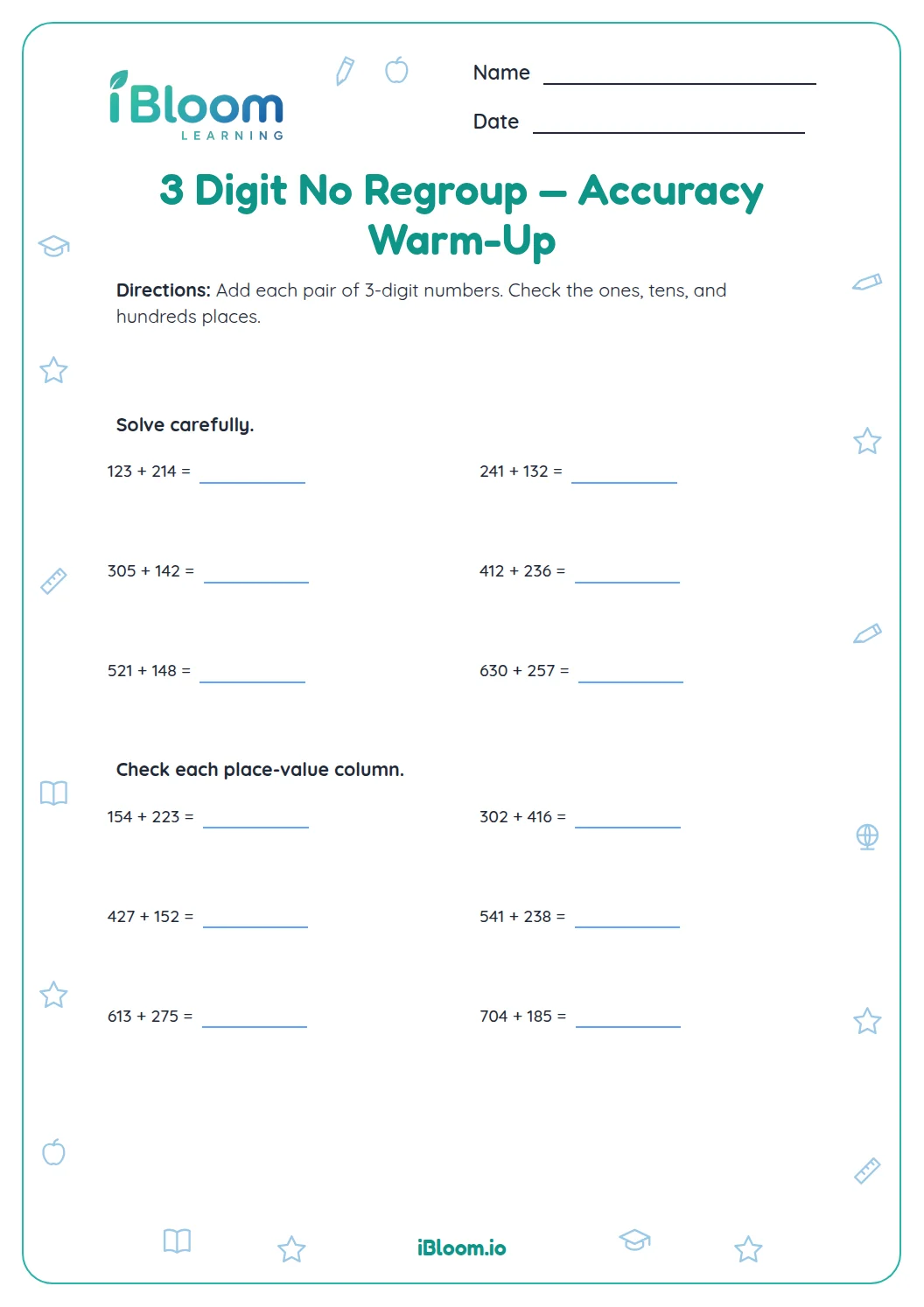
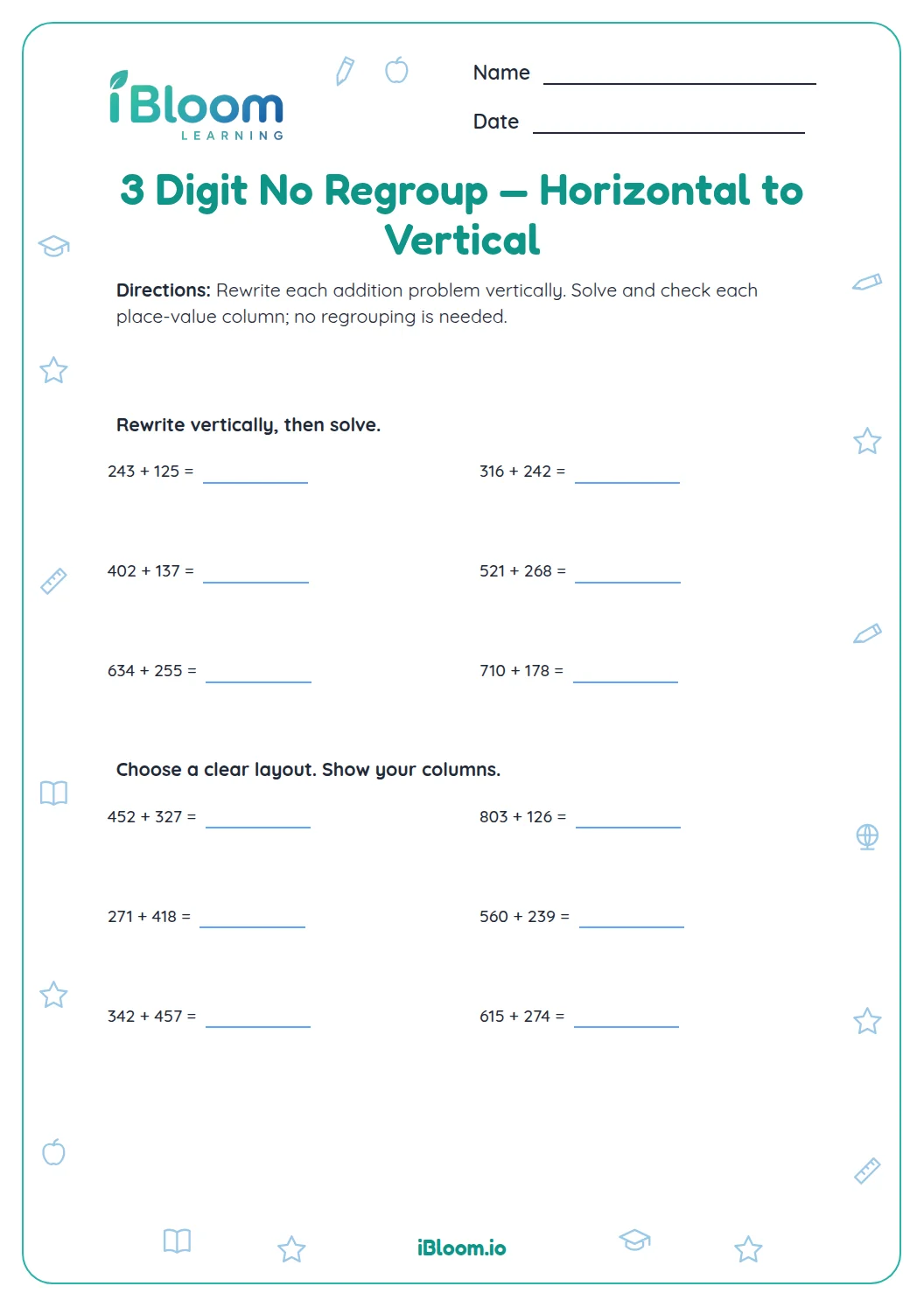
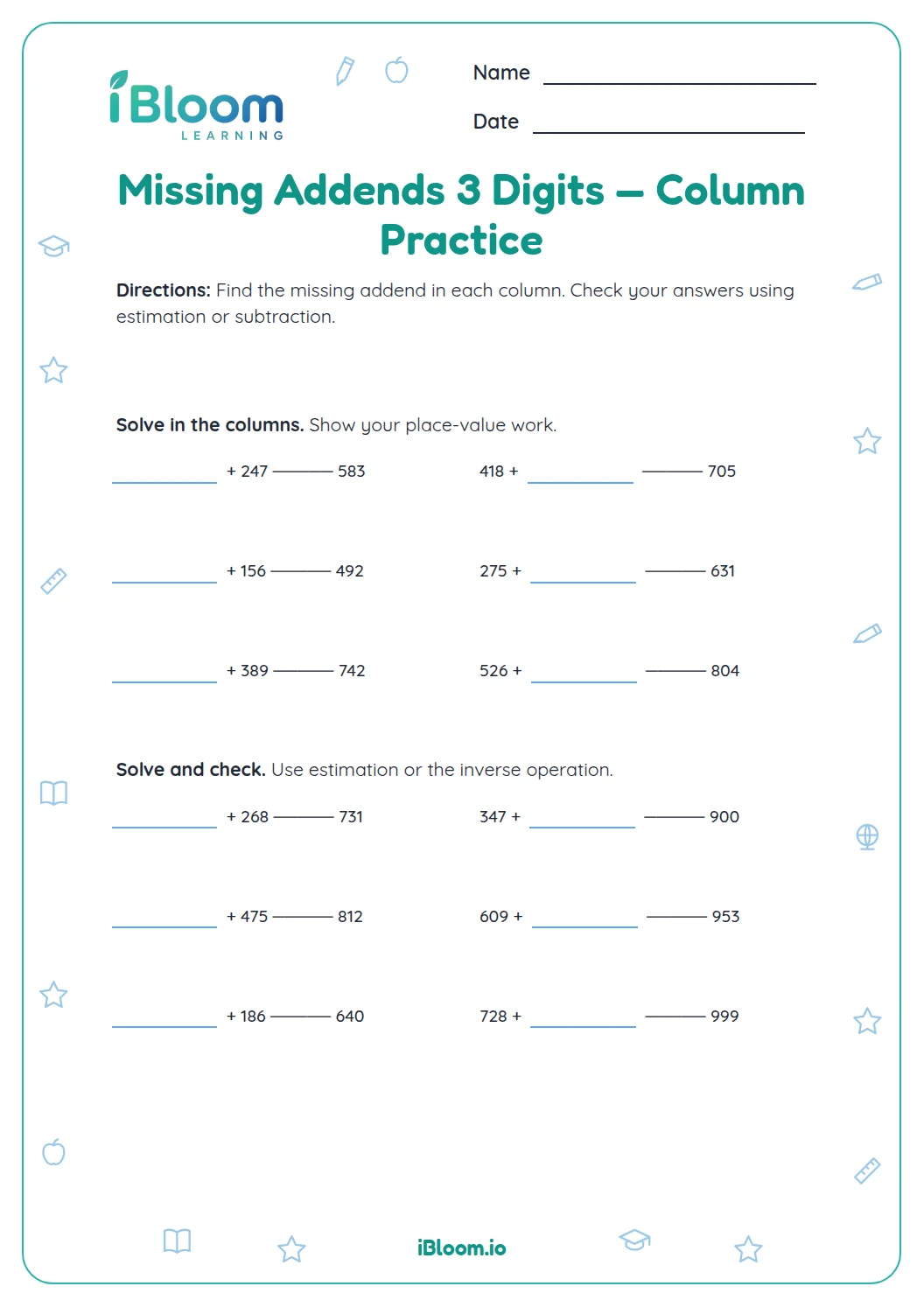
This Grade 3 printable practices making 1,000 with three-digit addends. Students set up six sums vertically, find six missing addends, and explain two place-value checks. The separate key lists the totals and gives sample explanations. It supports CCSS 3.NBT.A.2.
Aligned to 3.NBT.A.2
How should addends line up in vertical addition?
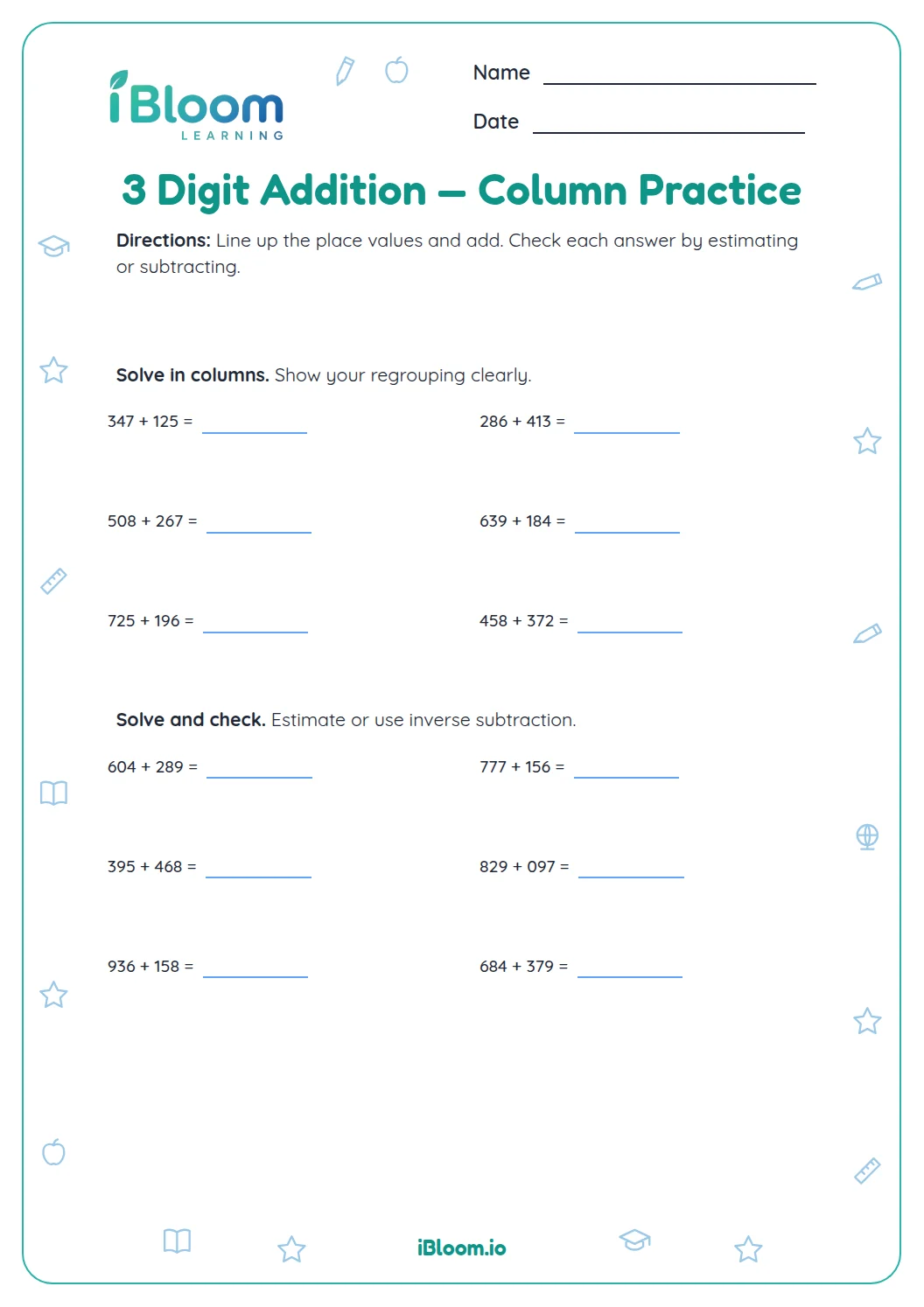
Start by placing ones under ones, tens under tens, and hundreds under hundreds. For question 1, the digits in 245 and 755 line up in three columns; the total is 1,000.
- 1245 + 755
- 2245
- 3+755
- 41,000
How can a missing addend be found?
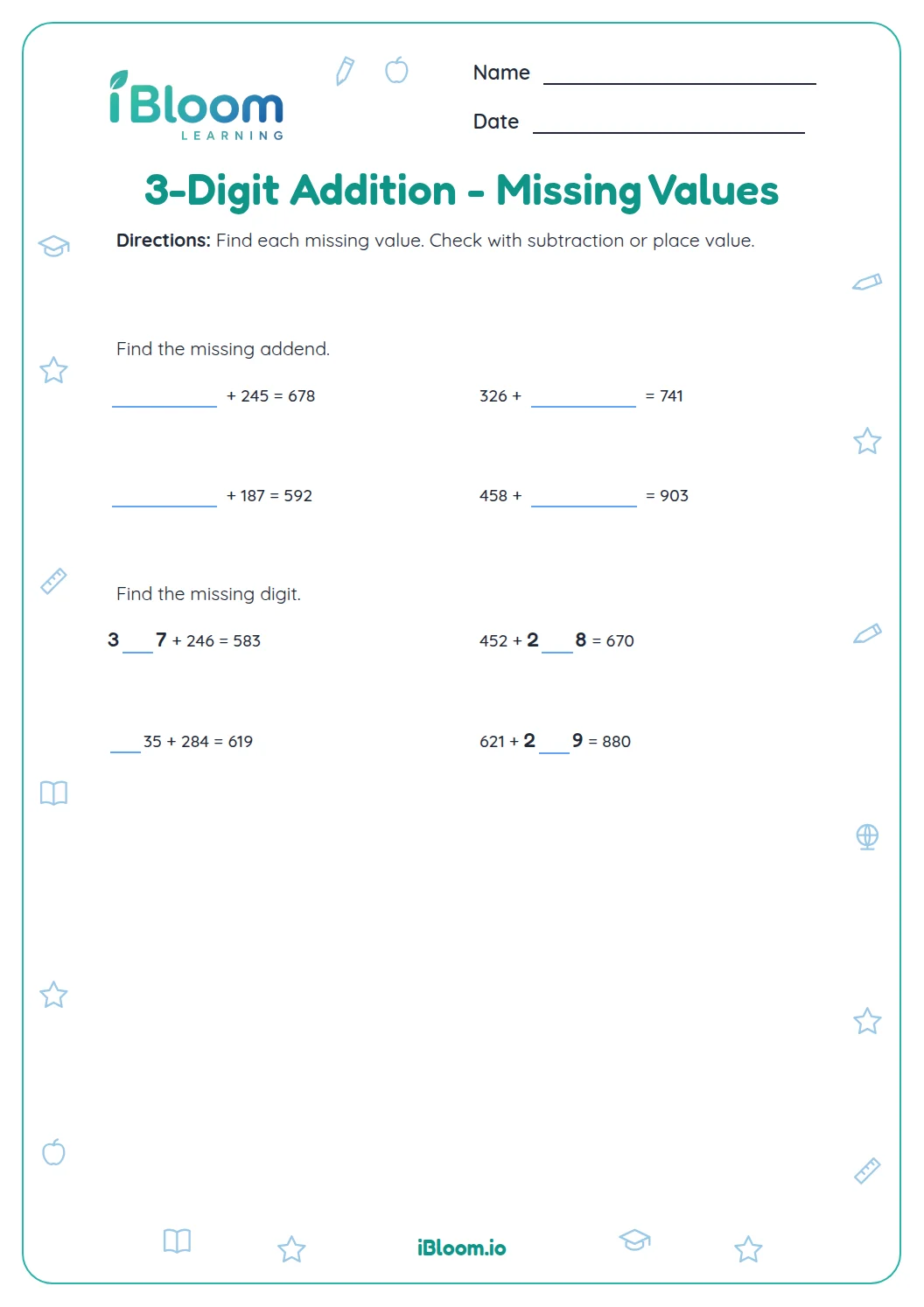
Subtract the known addend from the target sum. In question 7, 1,000 − 635 = 365, so 635 + 365 = 1,000.
How can place value help check a sum?
For the last two questions, explain how the place values combine to make 1,000. In question 13, 6 ones plus 4 ones make 10 ones, while the tens regroup as needed to form 10 hundreds overall.
- 1406 + 594
- 2406
- 3+ 594
- 41,000
How to work through this sheet
- 1Align the ones digits before adding.
- 2Add the ones, tens, and hundreds, regrouping when a column reaches ten.
- 3For a missing addend, subtract the known number from 1,000.
- 4Check that the result is exactly 1,000.
Common mistakes and quick fixes
The mistake
Lining up hundreds instead of ones
The fix
Start at the right edge so ones, tens, and hundreds share matching columns.
The mistake
Forgetting to carry a regrouped ten
The fix
Record the new ten above the next column before adding it.
The mistake
Subtracting the known addend from the wrong number
The fix
Compute 1,000 minus the known addend to find its partner.
Common Core alignment
This worksheet practices the number skills named in these standards.
Use place value to add within 1,000.
On this sheet: Students add three-digit numbers with place-value alignment and regrouping.
Show the official wordingHide the official wording
Fluently add and subtract within 1000 using strategies and algorithms based on place value, properties of operations, and/or the relationship between addition and subtraction.
What to practice next
Make more practice
Further reading
Questions parents and teachers ask
How does vertical addition help with making 1,000?
It keeps ones, tens, and hundreds in matching columns. Students rewrite six horizontal sums, then add each column and regroup as needed. The answer key displays the addends on separate rows so the alignment can be checked. Students can compare the column totals after solving.
How do I find the missing addend in 622 + ___ = 1,000?
Subtract 622 from 1,000 to get 378. Adding 378 to 622 returns to 1,000. Students can use subtraction for each blank, then verify the pair with addition. This inverse-operation check helps catch an arithmetic slip. This check is useful for every missing-addend equation on the page.
What does the place-value check ask students to do?
Students write a vertical sum and explain how the columns combine to make 1,000. For 318 + 682, the ones and tens regroup, and the hundreds total 10 hundreds. The key gives a sample explanation; other clear explanations are also correct.
How many questions and pages are included?
There are 14 questions in three parts: six vertical setups, six missing addends, and two place-value checks. The printable uses two worksheet pages, followed by a separate answer key with the totals and sample written responses. The count includes every student prompt, not the answer-key entries.
What should students check before adding?
Check that ones digits line up, tens digits line up, and hundreds digits line up. After adding, verify that the sum is exactly 1,000. The first six questions make alignment the main task, and the last two ask students to explain their check.
Can students use a different method for missing addends?
Yes. Subtraction is a direct way to find the partner to 1,000, but place-value reasoning also works. For 478, add 2 to reach 480, 20 to reach 500, and 500 more to reach 1,000; the total added is 522. Students can check each example with addition.