

About this worksheet
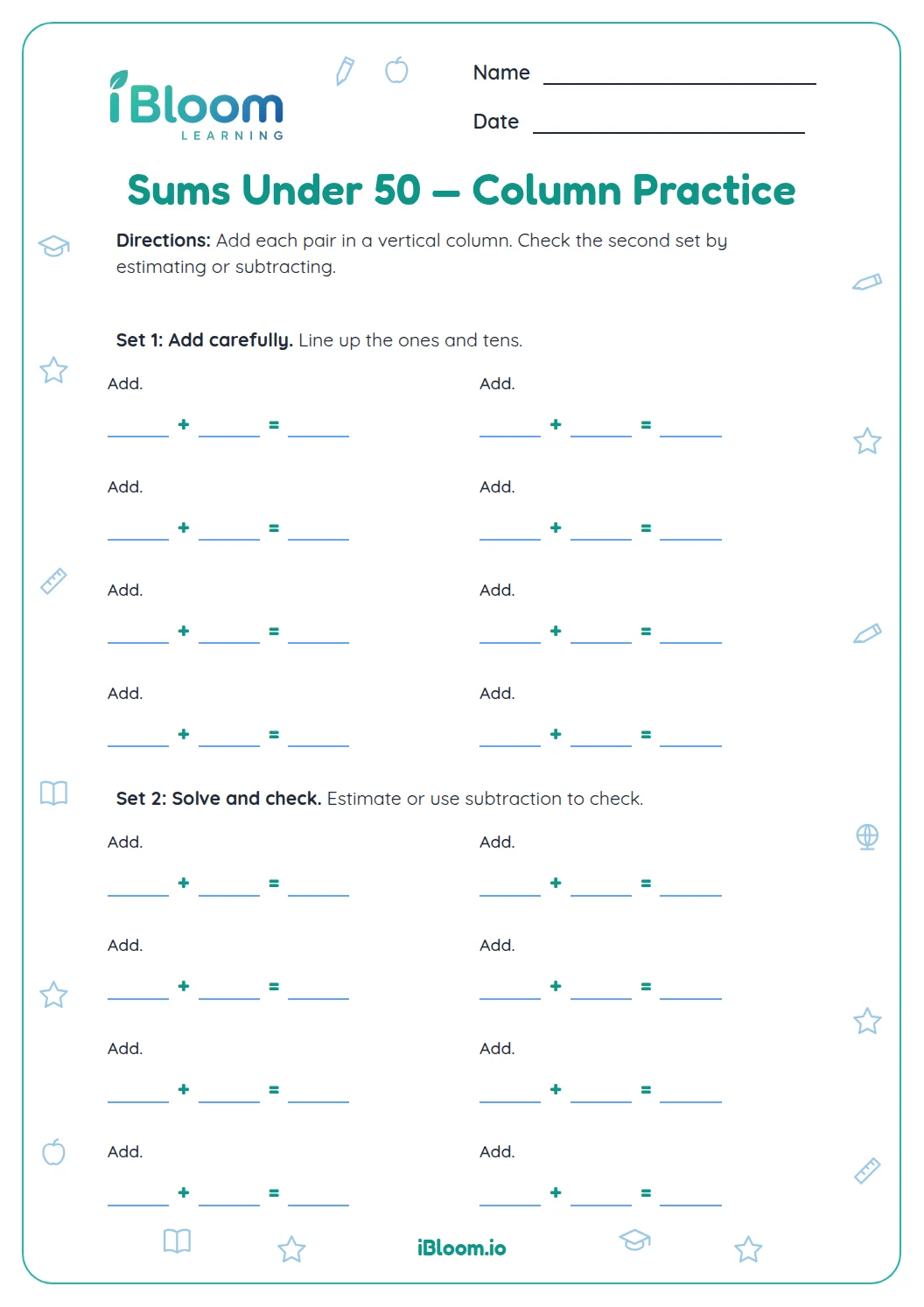
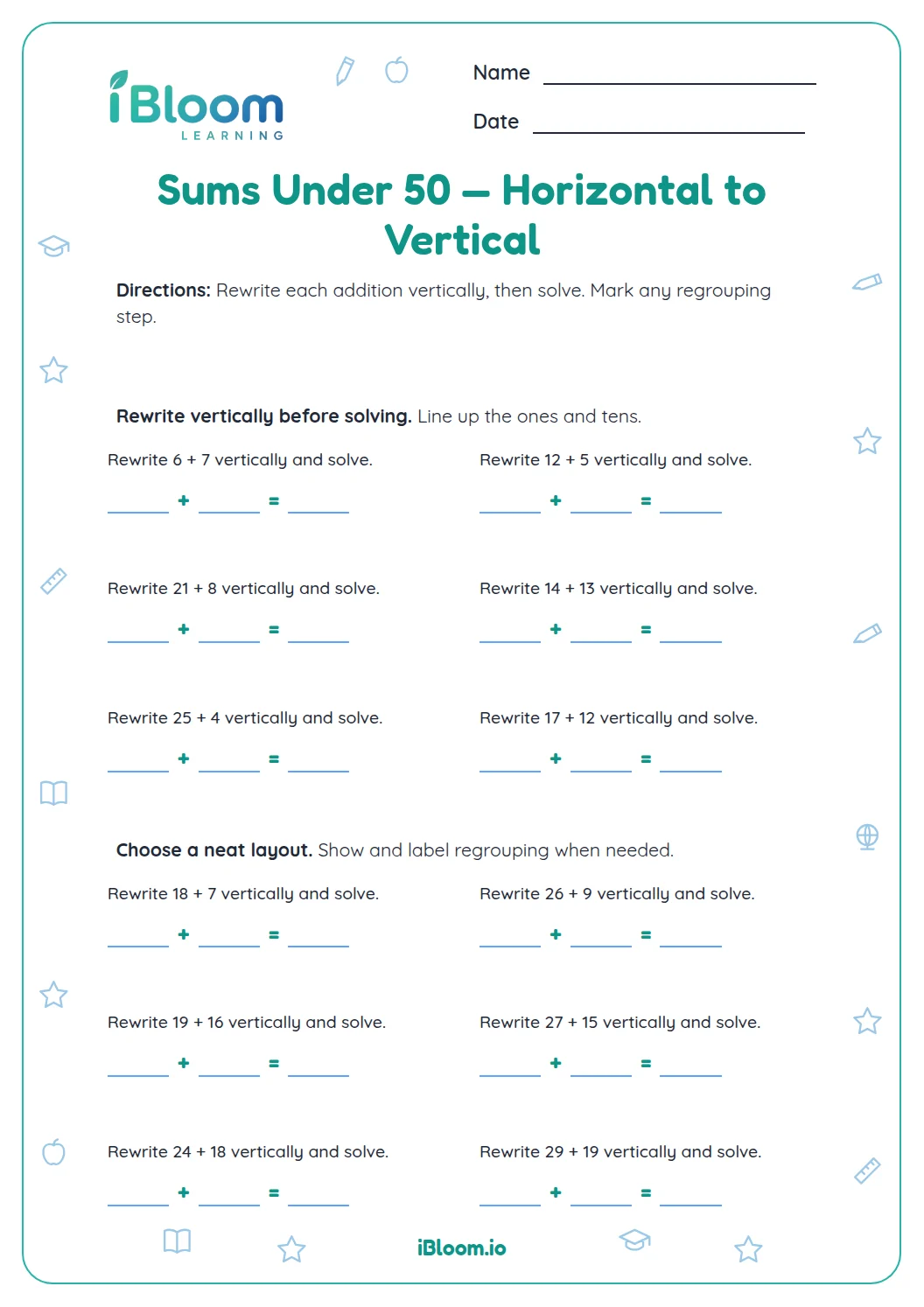
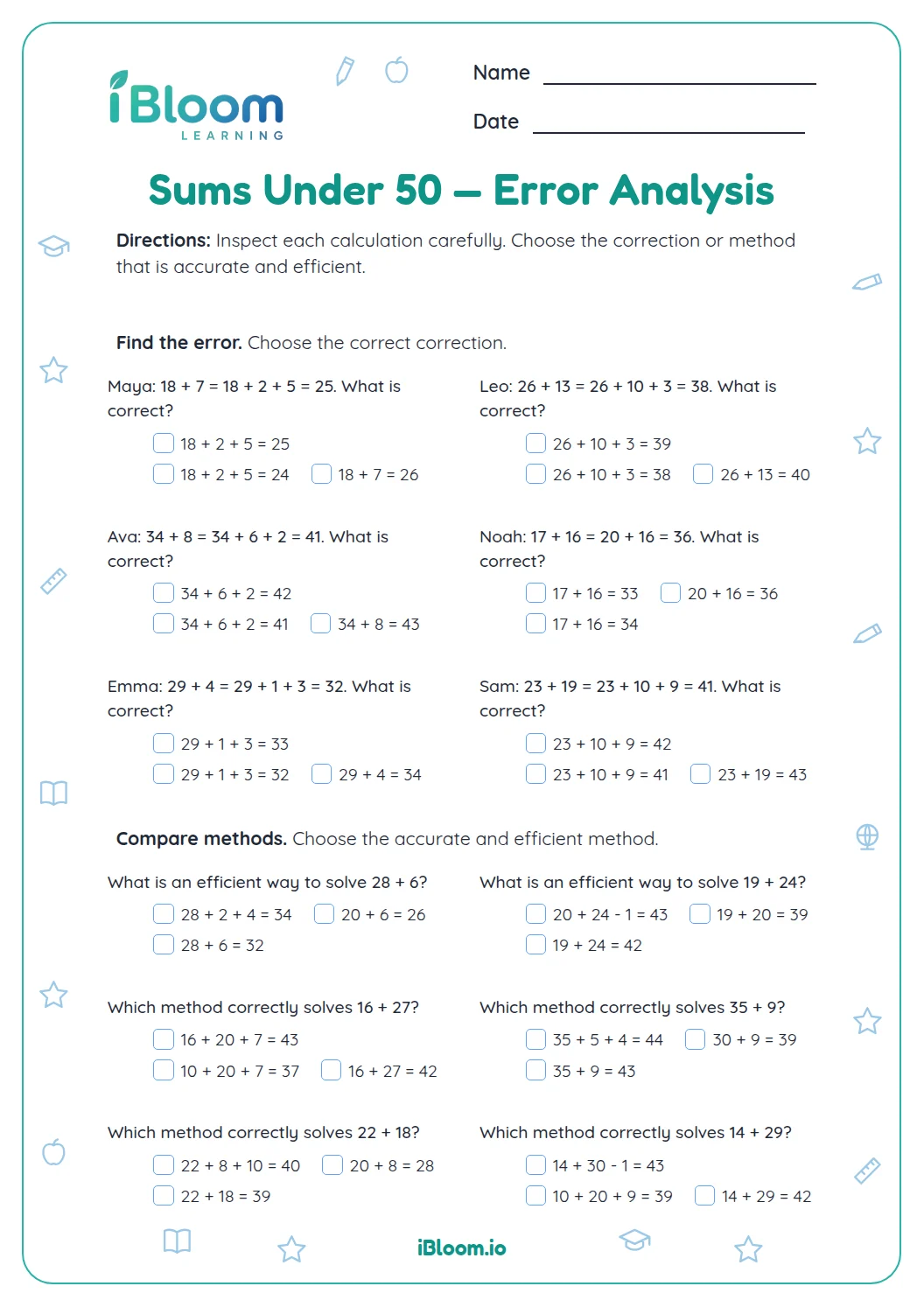
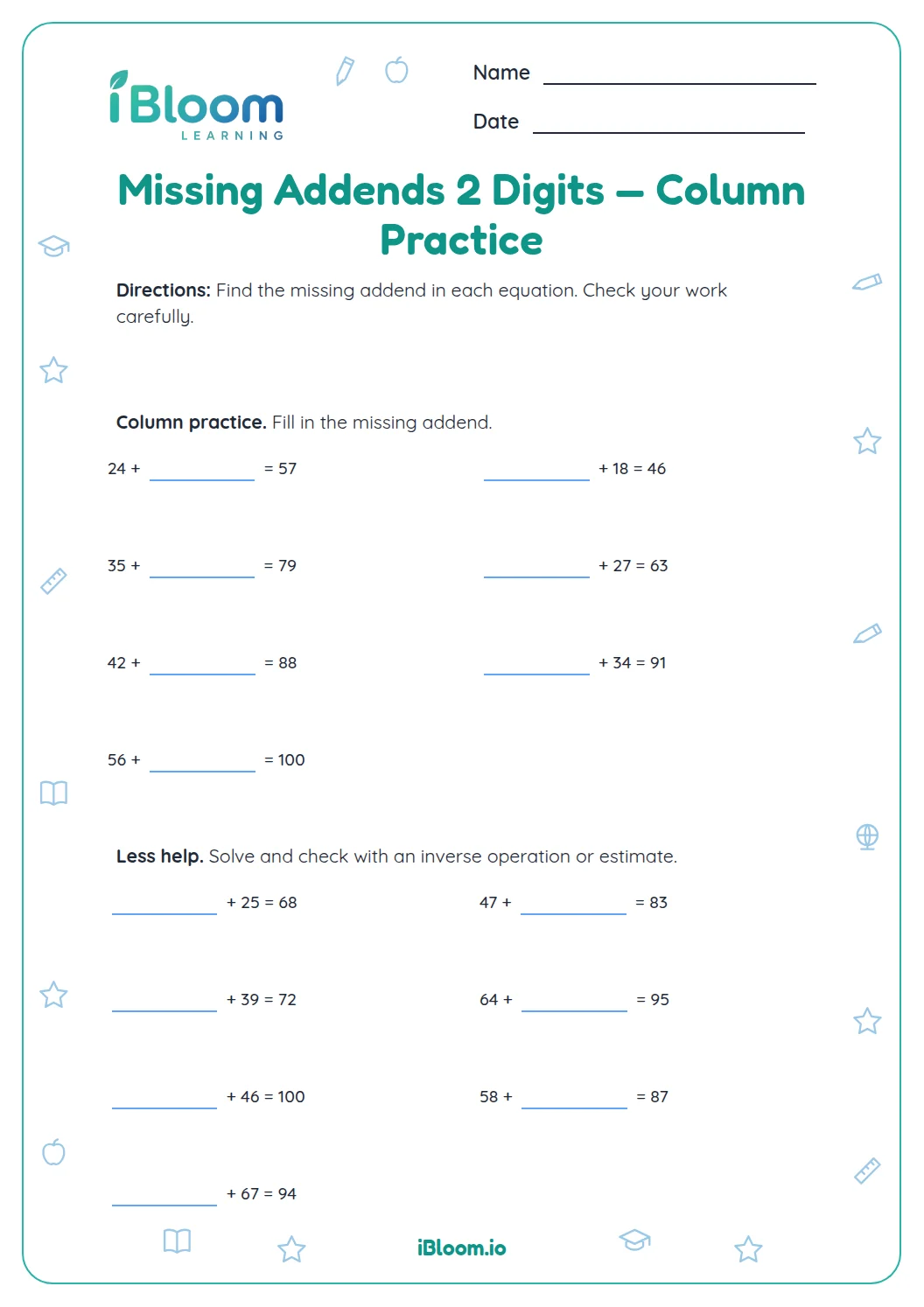
This printable gives Grade 2 students 18 addition equations with sums under 50. The blanks move through three forms: a missing addend, an equation with both sides to balance, and a mixed review of missing addends and totals. One item hides only the ones digit in 2_ + 7 = 29, so students must attend to place value as well as addition. The answer key is included.
Aligned to 2.OA.B.2
What kinds of blanks appear on the sheet?
Part A asks for a missing addend or total, including a tens-and-ones number with its ones digit hidden. Part B balances both sides of an equation. Part C mixes the forms so students must read each sentence before choosing a strategy.
For 2_ + 7 = 29, 29 − 7 = 22, so the missing digit is 2. The complete number is 22, and 22 + 7 does equal 29.
- Part A: 6 equations
- Part B: 6 balanced equations
- Part C: 6 mixed equations
How can a student solve an unknown addend?
A child can subtract the known addend from the total, or count on from the known addend to the total. For 18 + ___ = 31, subtracting gives 31 − 18 = 13. Counting on from 18 to 31 also gives 13.
- 118 + ___ = 31
- 231 − 18 = 13
- 3So the missing addend is 13
- 4Check: 18 + 13 = 31
How do students check a balanced equation?
Work out the visible side first, then see what value makes the other side equal. For 8 + 7 = ___ + 5, the left side is 15, so the blank is 10. Adding 10 and 5 gives the same total.
How to use this worksheet
- 1Read the whole equation and locate the blank.
- 2If an addend is missing, subtract the known addend from the total.
- 3If the total is missing, add the two addends.
- 4For a blank inside a numeral, find the complete number first, then write only its missing digit.
- 5Substitute the answer and check both sides.
Common slips and fixes
The mistake
Writing 9 for the blank digit in 2_ + 7 = 29.
The fix
Find the full missing number: 29 − 7 = 22, so the missing ones digit is 2.
The mistake
Adding the known addend to the total.
The fix
The missing addend and known addend make the total, so subtract the known addend.
The mistake
Making only one side correct in a balanced equation.
The fix
Evaluate both sides after filling the blank and confirm the totals match.
Common Core alignment
Use addition facts and the relationship between addends and totals to solve missing values.
Fluency with addition facts supports solving the sheet’s missing-addend equations.
On this sheet: The equations use addition relationships and sums below 50, with basic facts supporting the missing-part reasoning.
Show the official wordingHide the official wording
Fluently add and subtract within 20 using mental strategies. By end of Grade 2, know from memory all sums of two one-digit numbers.
What to practice next
Make more practice
Further reading
Questions parents and teachers ask
What does 2_ + 7 = 29 ask for?
It asks for the missing ones digit in the number 2_. First find the full number: 29 − 7 = 22. Since the tens digit 2 is already printed, the missing digit is 2. Check by adding 22 + 7 to get 29, then make sure the digit you wrote is only the ones place.
How many questions are included?
There are 18 questions in three parts: six missing-value equations, six equations that balance both sides, and six mixed review items. They include missing addends and missing totals, all with sums under 50. The layouts move from straightforward blanks to equations that require comparing both sides, so students practice reading carefully as well as calculating.
What is a missing addend?
A missing addend is one of the numbers being added. In 18 + ___ = 31, the two addends must make 31, so subtract 18 from 31 to find 13. Students can also count on from 18 until they reach 31.
What grade is this worksheet for?
It is aimed at Grade 2 addition practice. The sums stay under 50, while the blanks appear in different places so children practice reading an equation and using the relationship among its numbers. The last part mixes familiar and less familiar blank positions.
How can students check their answers?
Put each answer back into the equation and add. In a balanced equation, calculate both sides and make sure the totals match. For a missing addend, the two addends should combine to the printed total. Have students read the completed sentence aloud as a final check.