

About this worksheet
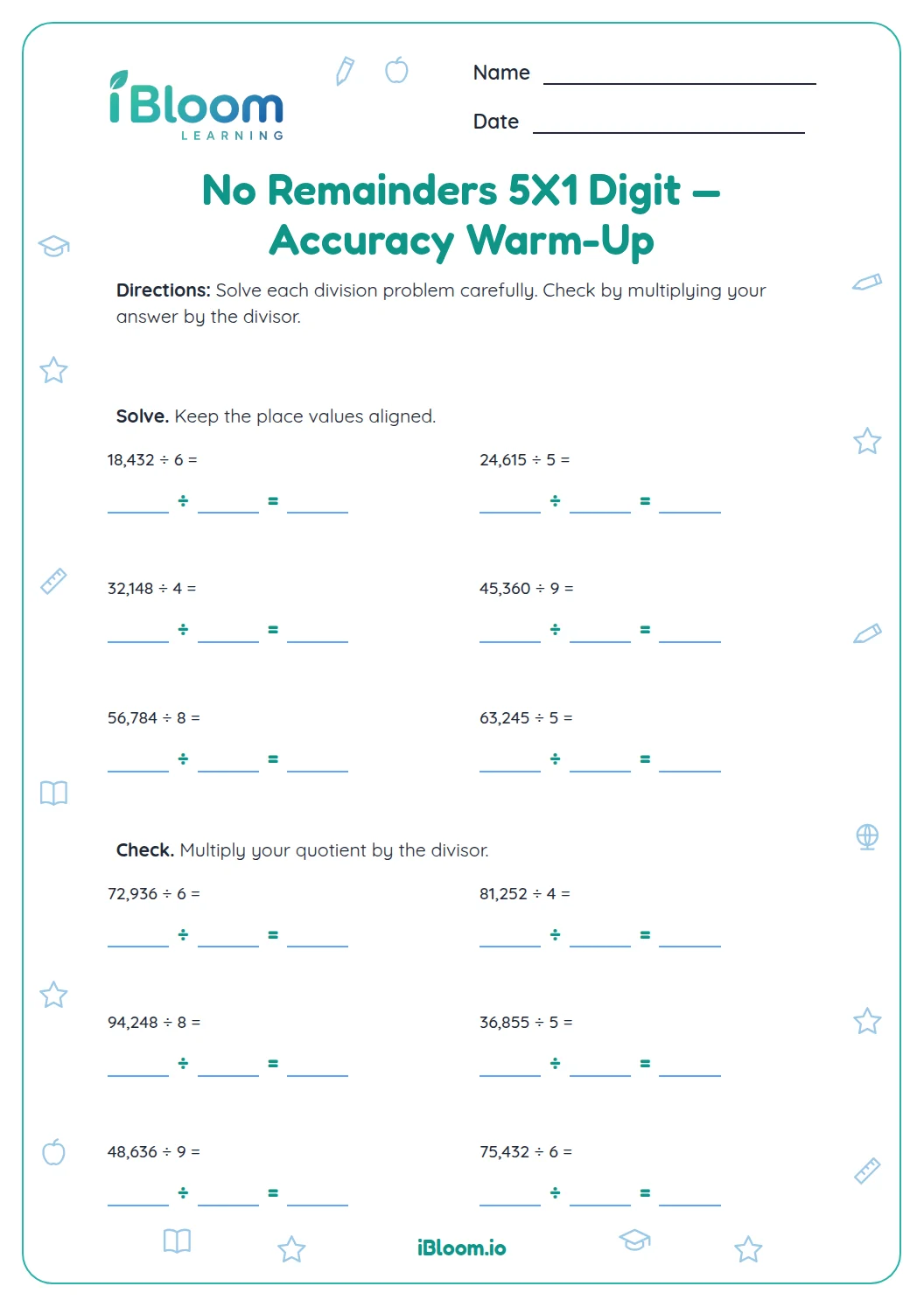
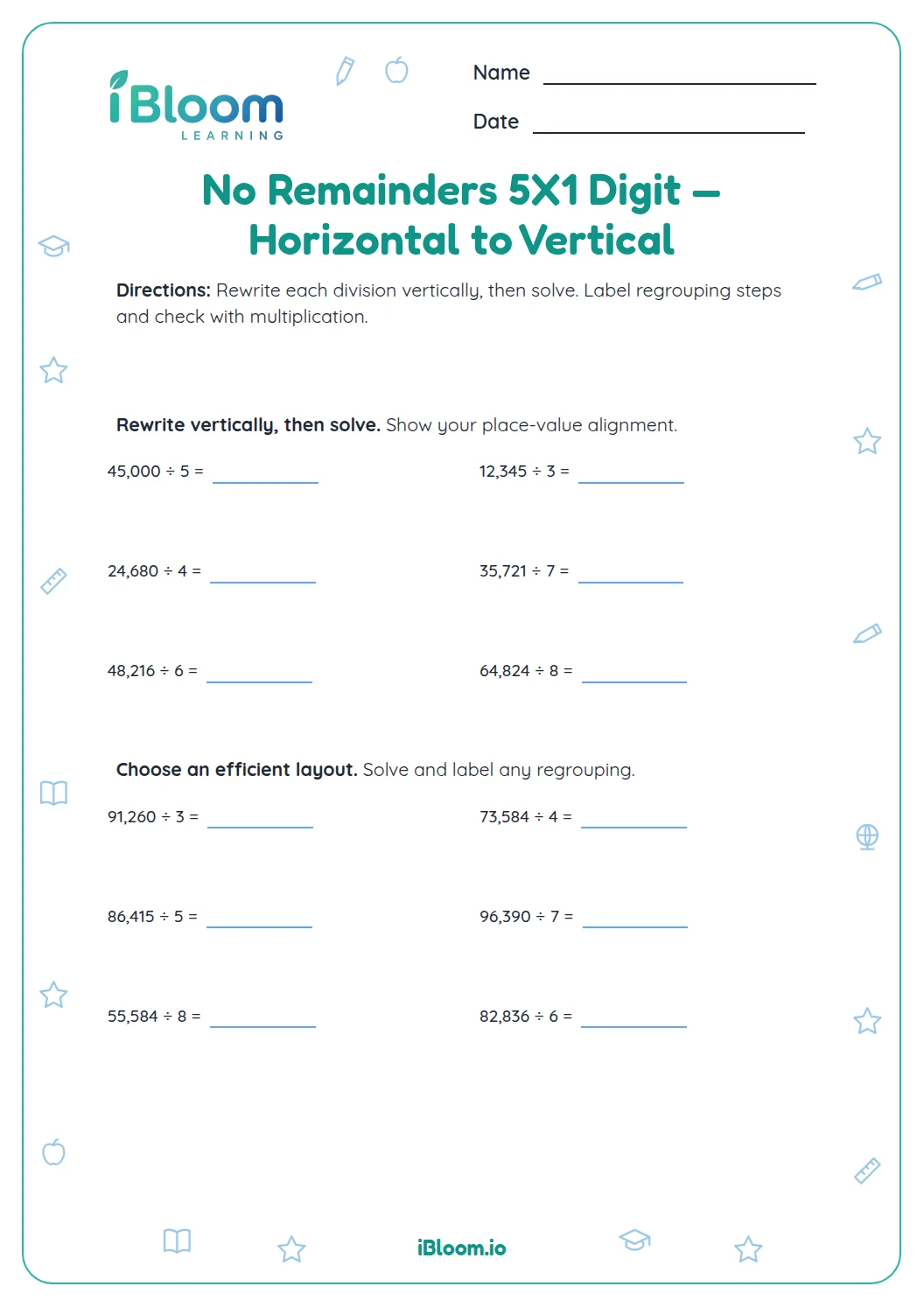
This worksheet gives Grades 4–6 practice checking five-digit dividends divided by one-digit divisors. In Part A, students locate a genuine error in written long-division steps or recognize work with no error. Part B asks them to choose a reliable method for finding and checking exact quotients. The questions practice the standard division algorithm in CCSS 6.NS.B.2; a separate answer key is included.
Aligned to 6.NS.B.2
What will students practice?
This worksheet gives Grades 4–6 practice checking five-digit dividends divided by one-digit divisors. In Part A, students locate a genuine error in written long-division steps or recognize work with no error. Part B asks them to choose a reliable method for finding and checking exact quotients. The questions practice the standard division algorithm in CCSS 6.NS.B.2; a separate answer key is included.
Fourteen questions in two parts: six step checks and eight method choices.
How does one problem work?
For 86,472 ÷ 4, the first step 8 ÷ 4 = 2 is correct. After bringing down 6, the partial dividend is 6, and its quotient digit is 1 with remainder 2. The printed 2 r2 is the first error, so choose “Quotient step.”
How can families use the answer key?
Have the student finish a part before checking it. For any missed answer, compare the place-value work with the key and redo the calculation. The key makes it easier to find the step that needs attention.
How to work through the sheet
- 1Read each written step from left to right.
- 2Check the current partial dividend and divisor.
- 3Choose the earliest incorrect step, or “No error.”
- 4For a completed quotient, multiply it by the divisor.
- 5Use estimation as a reasonableness check, not an exact check.
Common slips to watch for
The mistake
Treating the brought-down digit as a new dividend
The fix
Join it to the remainder to make the next partial dividend.
The mistake
Choosing a quotient digit that is too large
The fix
Multiply the divisor by the digit and compare with the partial dividend.
The mistake
Calling a correct step an error
The fix
Check every shown line before selecting an answer.
The problems build accurate multi-digit computation with the standard algorithm.
Check each partial dividend before deciding a quotient digit is wrong.
On this sheet:
Show the official wordingHide the official wording
Fluently divide multi-digit numbers using the standard algorithm.
What to practice next
Make more practice
Further reading
Questions parents and teachers ask
What does “first error” mean?
It is the earliest step that no longer follows the division process. Check each line in order, including the remainder and the next digit brought down. Several questions include correct work, so choose “No error” when every step shown is valid.
Why can a remainder appear before the final answer?
A remainder can be carried into the next place during long division. Bring down the next digit to make a new partial dividend, then continue dividing. These problems have exact final quotients even though intermediate steps may show remainders. Write the inverse equation beside the original and confirm that both calculations return the same value.
How do I check a quotient exactly?
Multiply the quotient by its divisor and compare the product with the dividend. For example, 21,618 × 4 = 86,472, so that quotient checks exactly. Estimation can help judge whether an answer is reasonable, but it does not prove the exact value.
How many problems are included?
The worksheet has 14 questions in two parts. Part A contains six checks of written division steps, including correct examples. Part B contains eight choices about methods for finding and checking quotients. A separate answer key follows the worksheet pages.
Can students use estimation on this sheet?
Yes. Estimation is useful for judging whether a quotient is in a sensible range. For an exact check, students still need to multiply the quotient by the divisor and compare the result with the dividend. Part B asks them to distinguish these purposes.