


About this worksheet
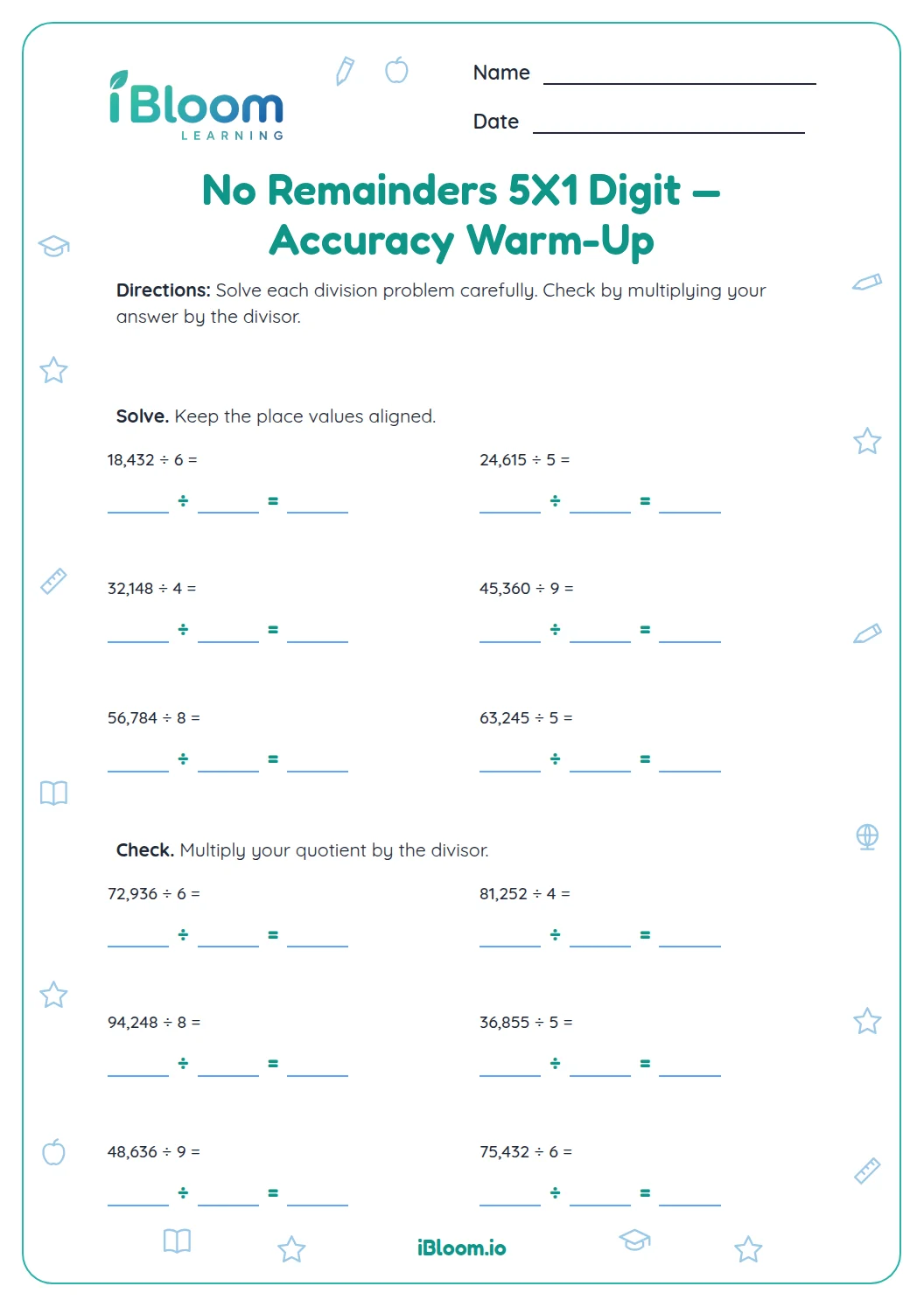
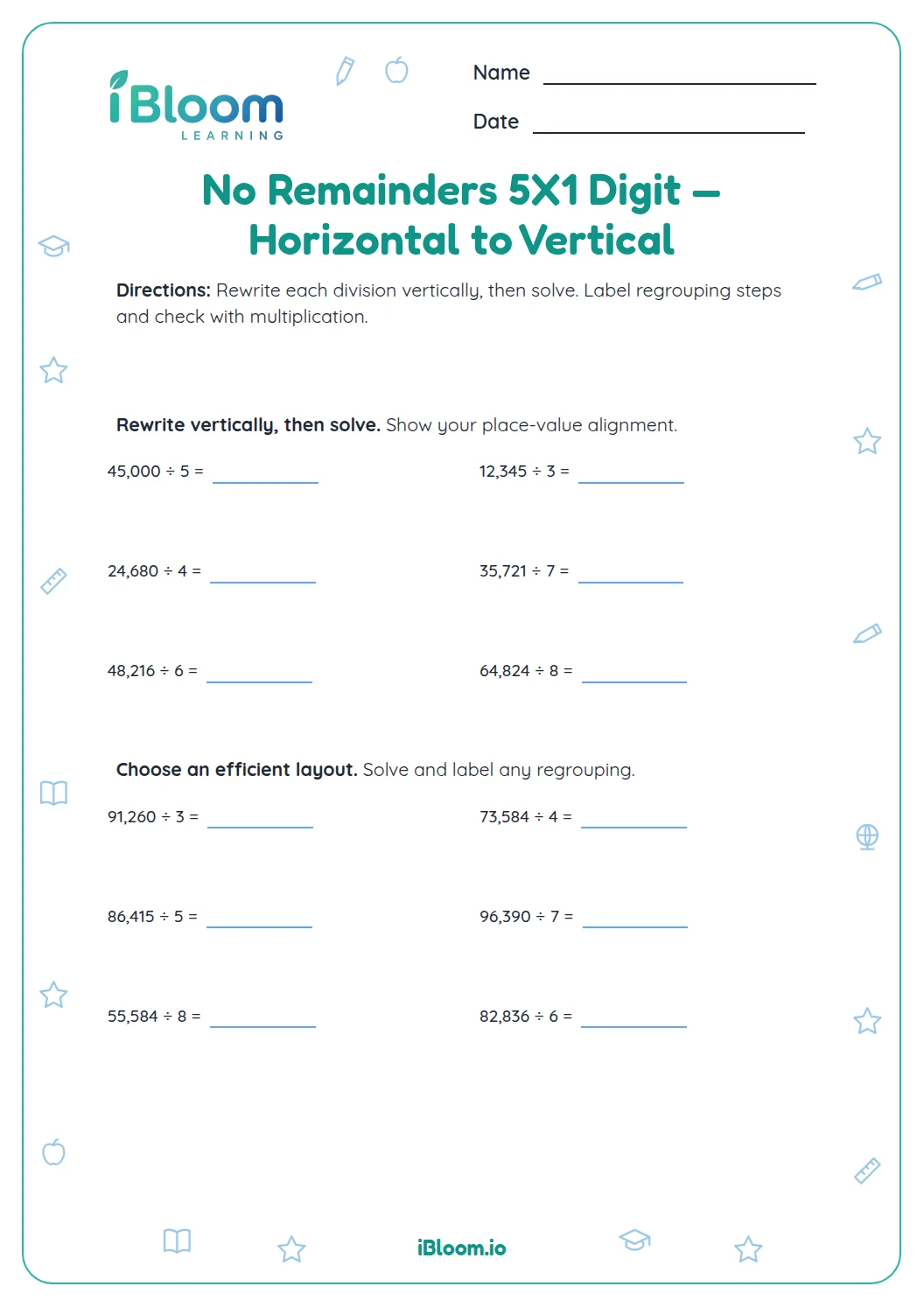
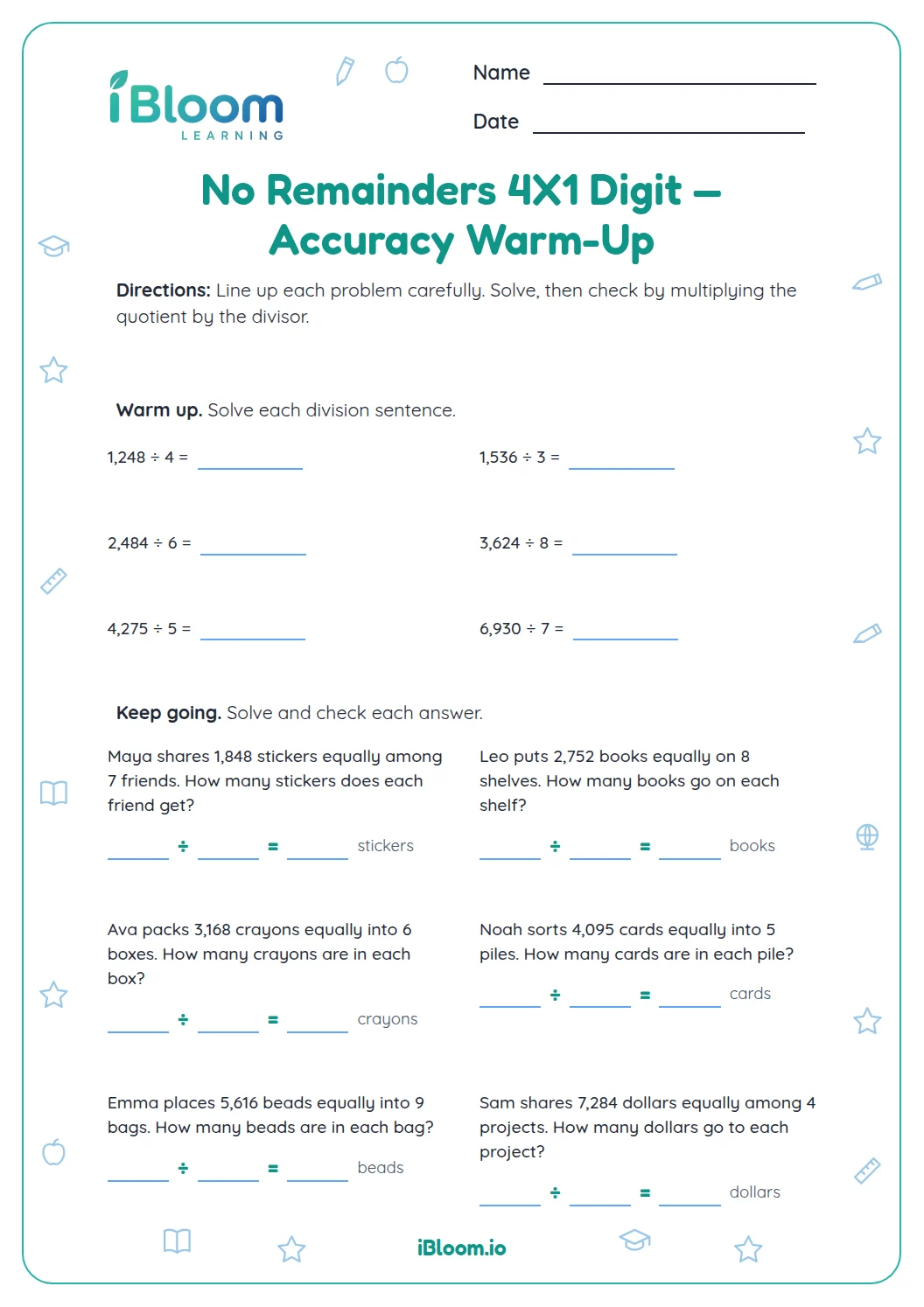
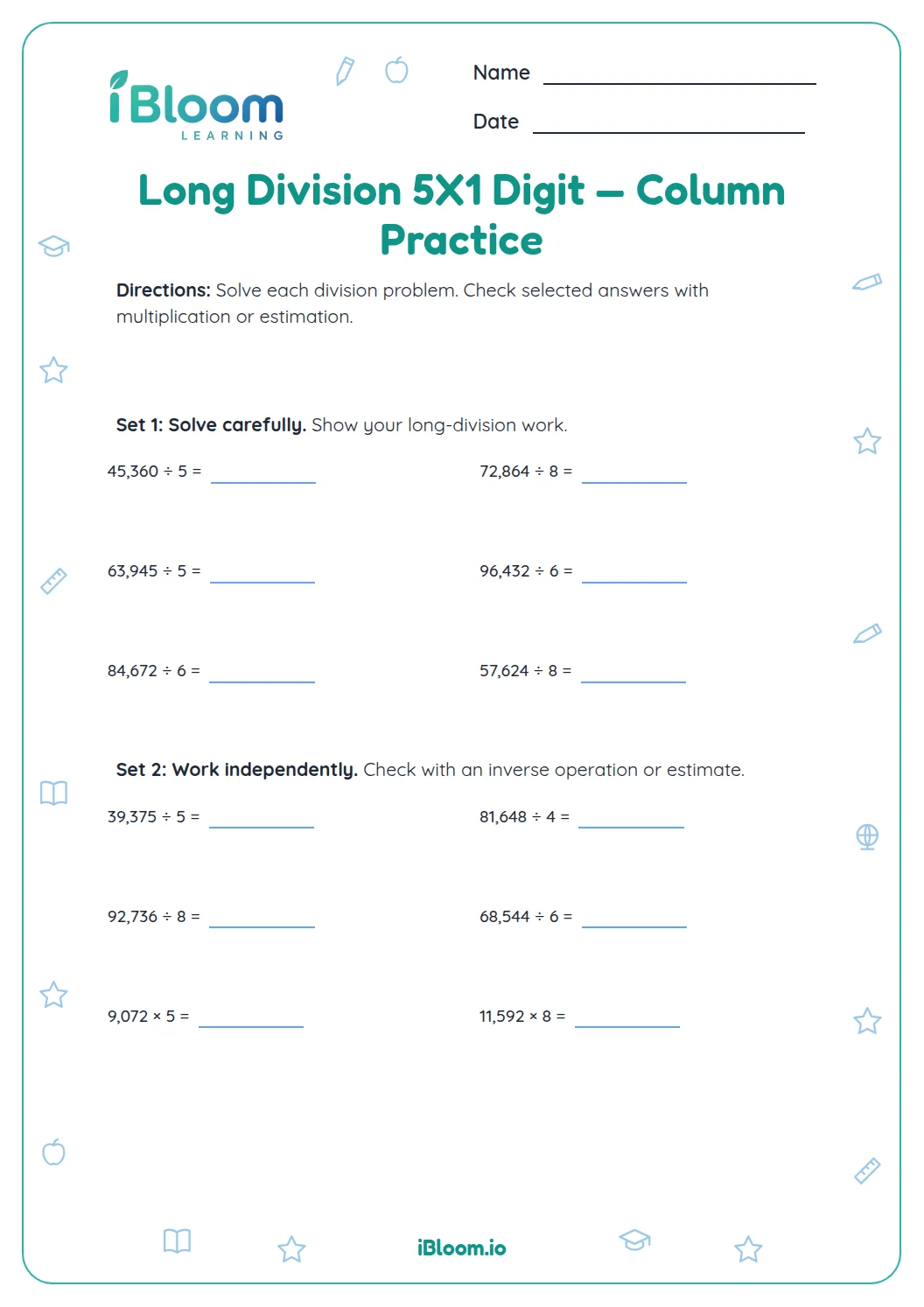
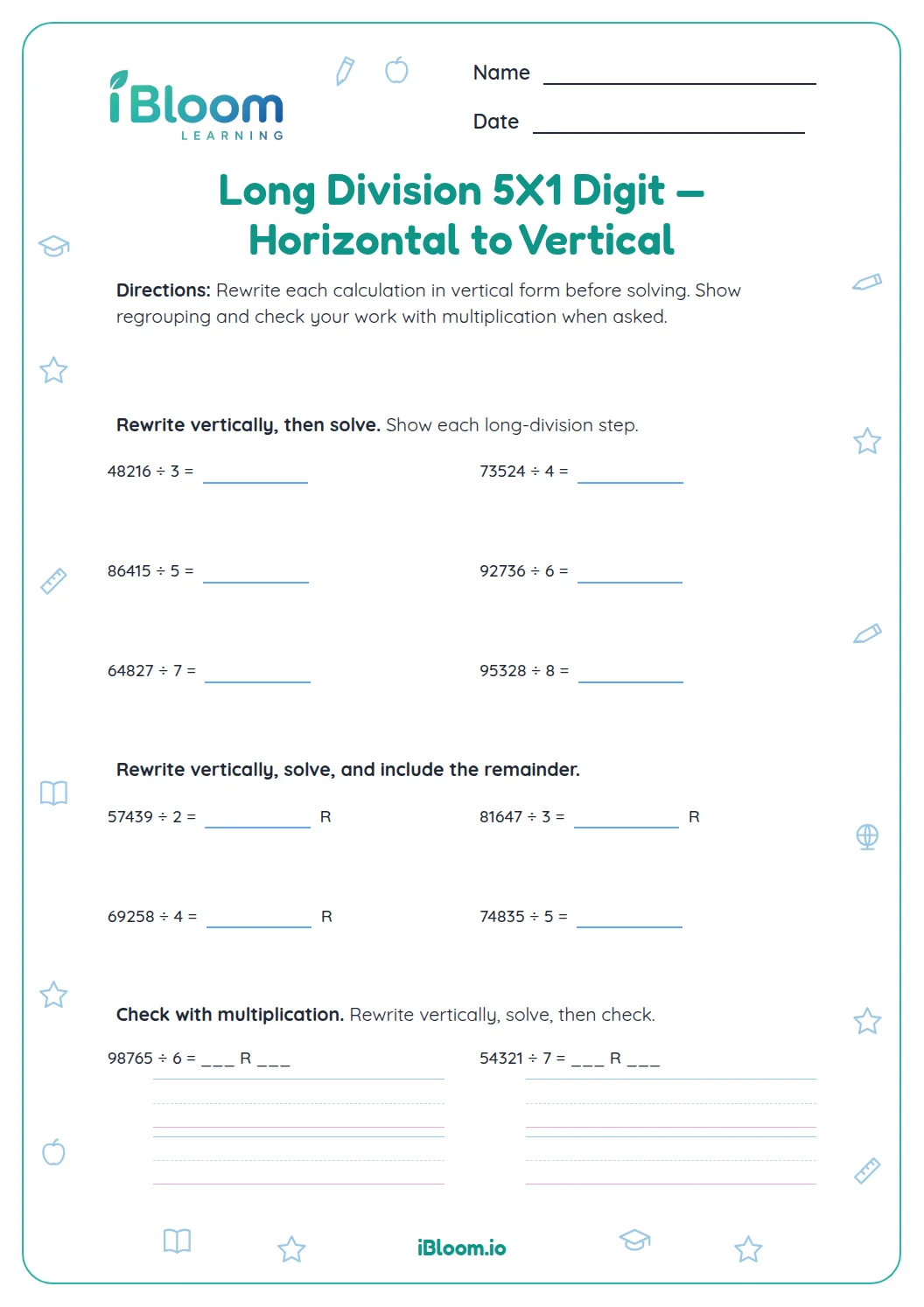
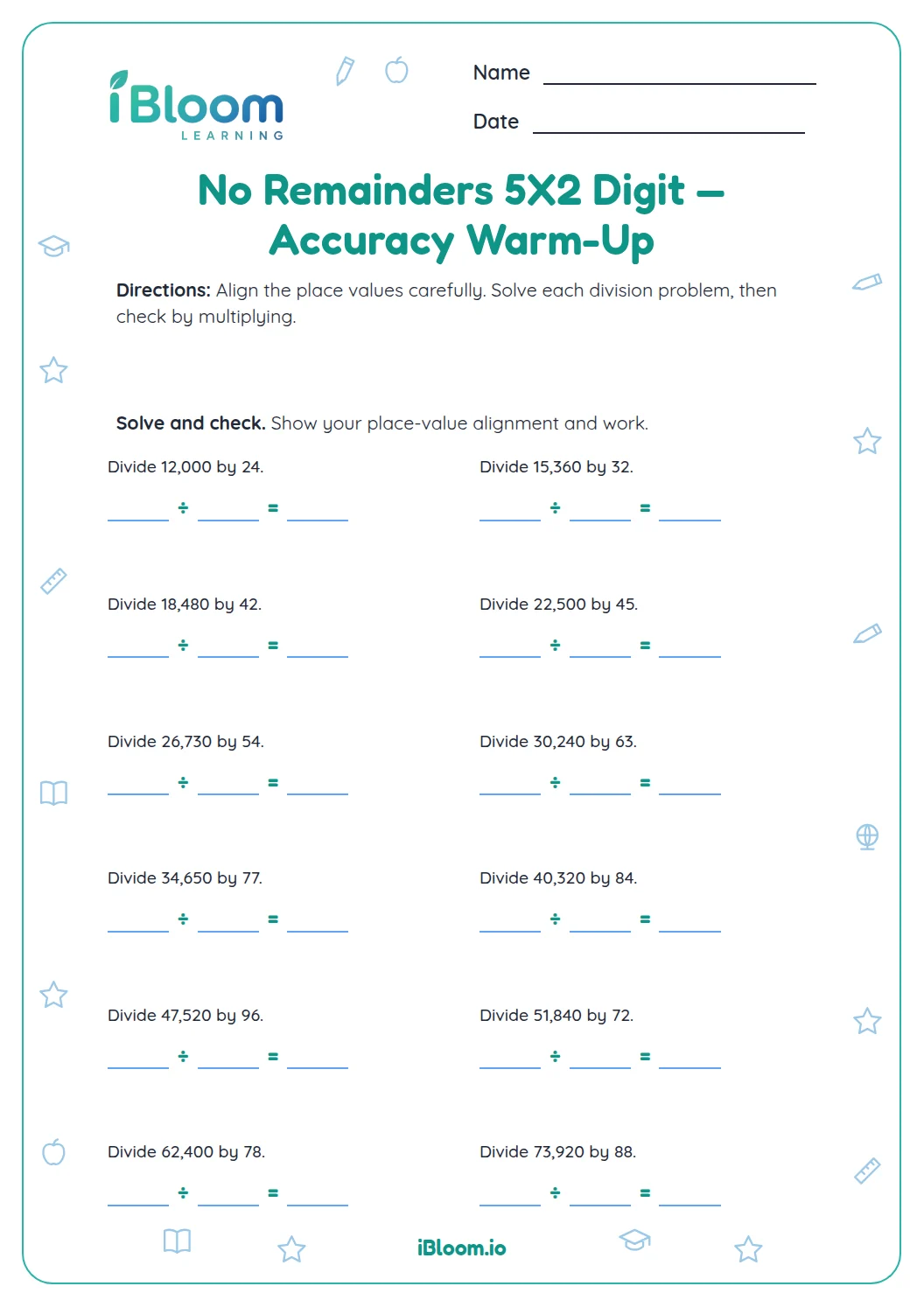
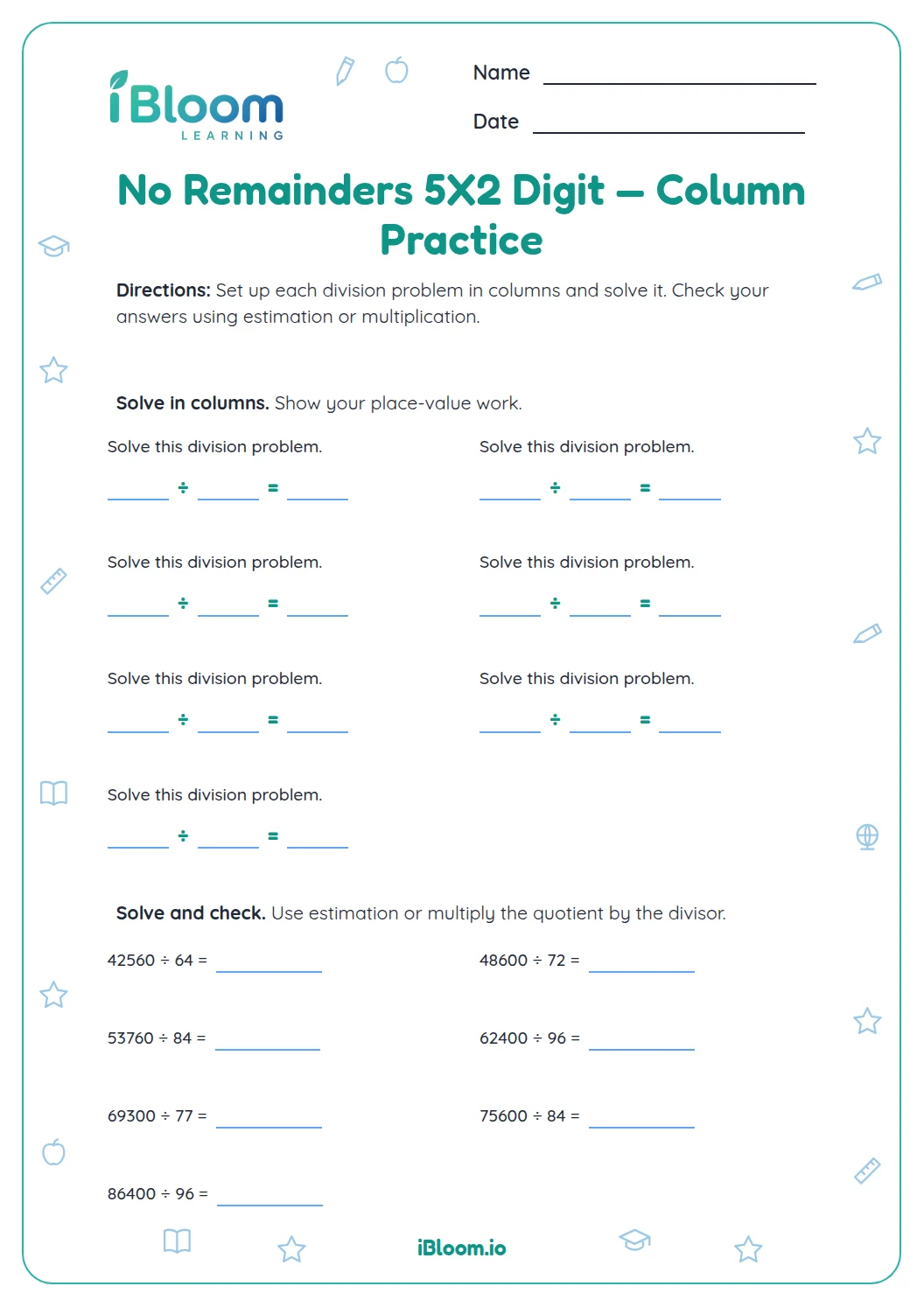
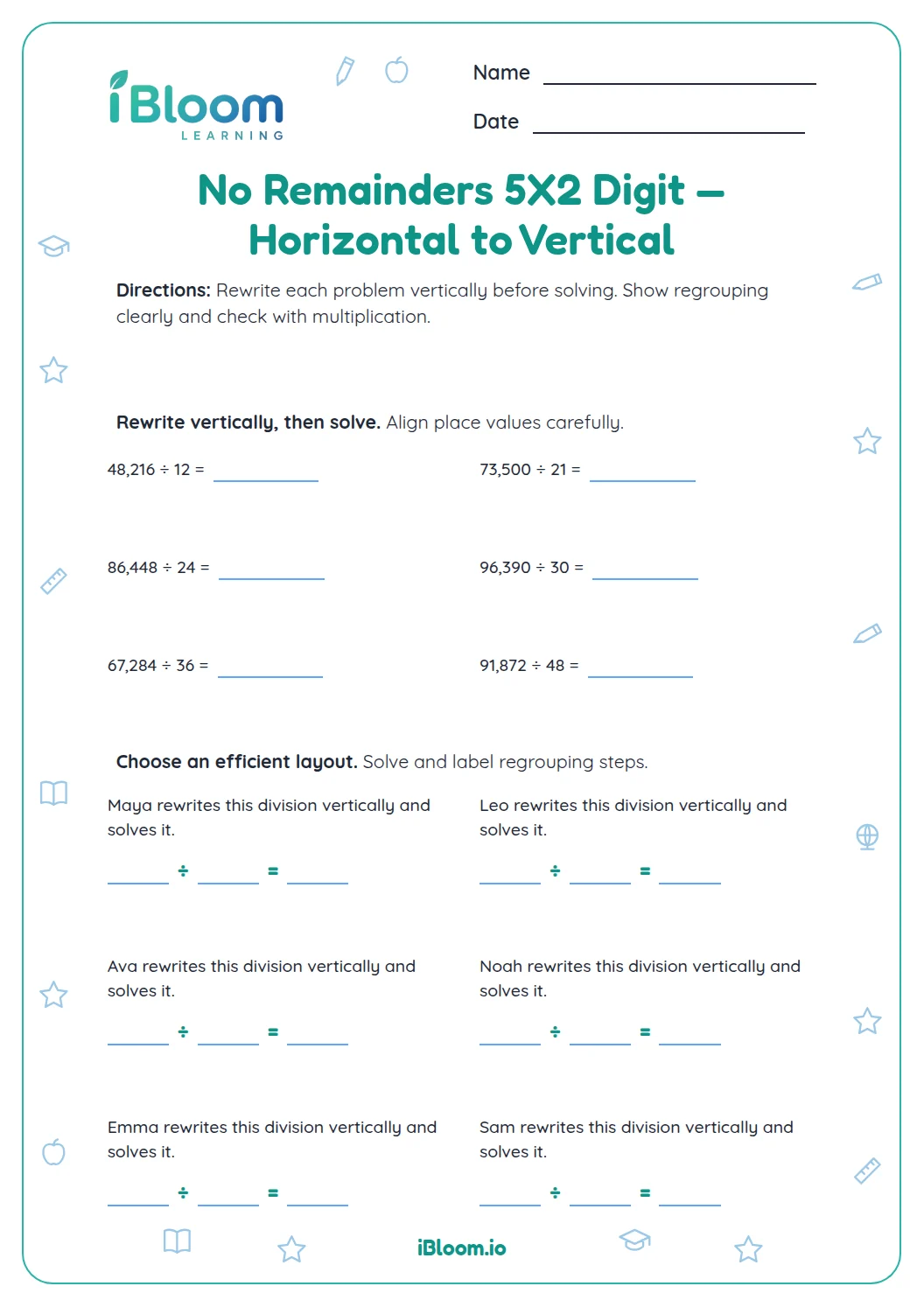
This Grade 5 printable practices exact division with five-digit dividends and one-digit divisors. Students find missing dividends, divisors, or quotients, then complete multiplication checks that confirm the division. All 20 problems have whole-number answers. The answer key gives each missing value and check product.
How do you find the unknown in a division equation?
Use the inverse relationship between division and multiplication. For 35,784 ÷ ___ = 5,112, divide 35,784 by 5,112 to find 7.
- 135,784 ÷ 7 = 5,112
- 25,112 × 7 = 35,784
How can multiplication verify a quotient?
Multiply the quotient by the divisor and compare the product with the dividend. In question 9, 812 × 6 = 4,872, so the division statement is exact.
How to work through this sheet
- 1Identify which value is missing: dividend, divisor, or quotient.
- 2Use multiplication and division as inverse operations.
- 3Estimate the quotient’s size before writing all digits.
- 4Multiply divisor × quotient to check the original dividend.
Common mistakes and quick fixes
The mistake
Treating the quotient as the divisor
The fix
Locate the divisor next to ÷, then use multiplication to solve for a missing divisor.
The mistake
Losing a place in the five-digit dividend
The fix
Estimate the quotient and check that its place value makes sense before multiplying.
The mistake
Leaving the check product blank
The fix
Multiply the quotient by the divisor and write the full dividend as the product.
What to practice next
Make more practice
Further reading
Questions parents and teachers ask
What does “no remainders” mean on this sheet?
Each dividend divides evenly by its one-digit divisor, so every quotient is a whole number. For example, 4,872 ÷ 6 = 812 because 812 × 6 returns 4,872. The answer key shows the product used to check each division. on every problem.
How do I solve ___ ÷ 4 = 2,316?
Multiply the quotient by the divisor: 2,316 × 4 = 9,264. The missing dividend is 9,264. This is one of several formats on the sheet; other questions hide the divisor or the quotient, so read the location of the blank carefully.
How can I find a missing divisor?
Divide the dividend by the known quotient. In 35,784 ÷ ___ = 5,112, 35,784 ÷ 5,112 = 7, so 7 is the missing divisor. Multiplication confirms the result because 5,112 × 7 equals 35,784. This approach works for each equation with a hidden divisor.
Why does the worksheet include multiplication checks?
Multiplication checks whether a quotient and divisor reproduce the dividend. The final twelve questions include a check equation as part of the problem, so students practice the inverse relationship alongside each division answer and can confirm that no remainder is left.
How many problems and pages are included?
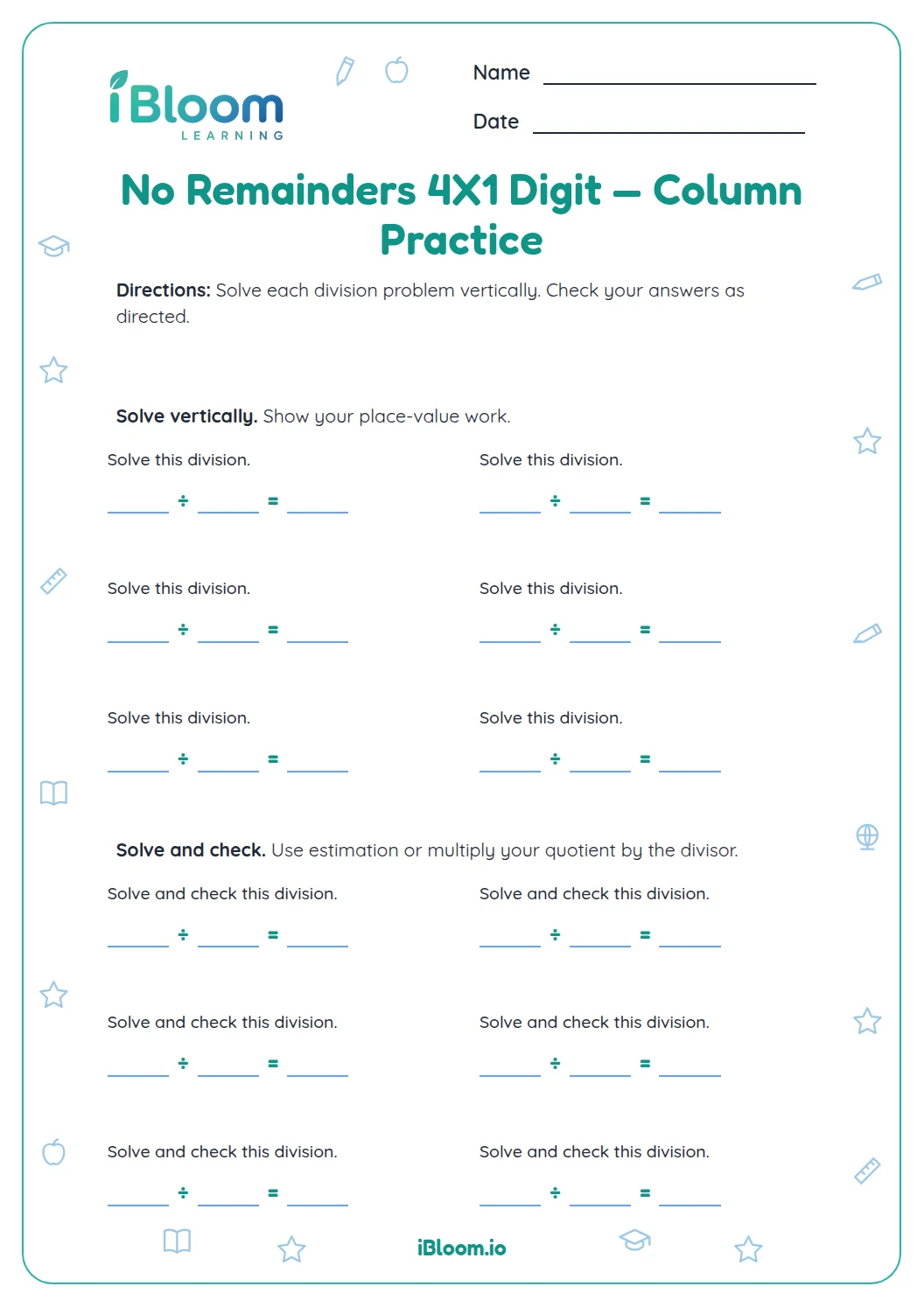
There are 20 problems: eight equations with a missing dividend, divisor, or quotient, followed by twelve division problems with multiplication checks. The practice spans two worksheet pages, and a separate key gives every missing value and check product. across the two practice pages.
What should a student do if a quotient seems unreasonable?
Estimate with the leading digits, then check the place value of the full quotient. A five-digit dividend divided by a one-digit number should produce a quotient in the thousands or tens of thousands. Multiplying that quotient by the divisor gives a final check.