




About this worksheet
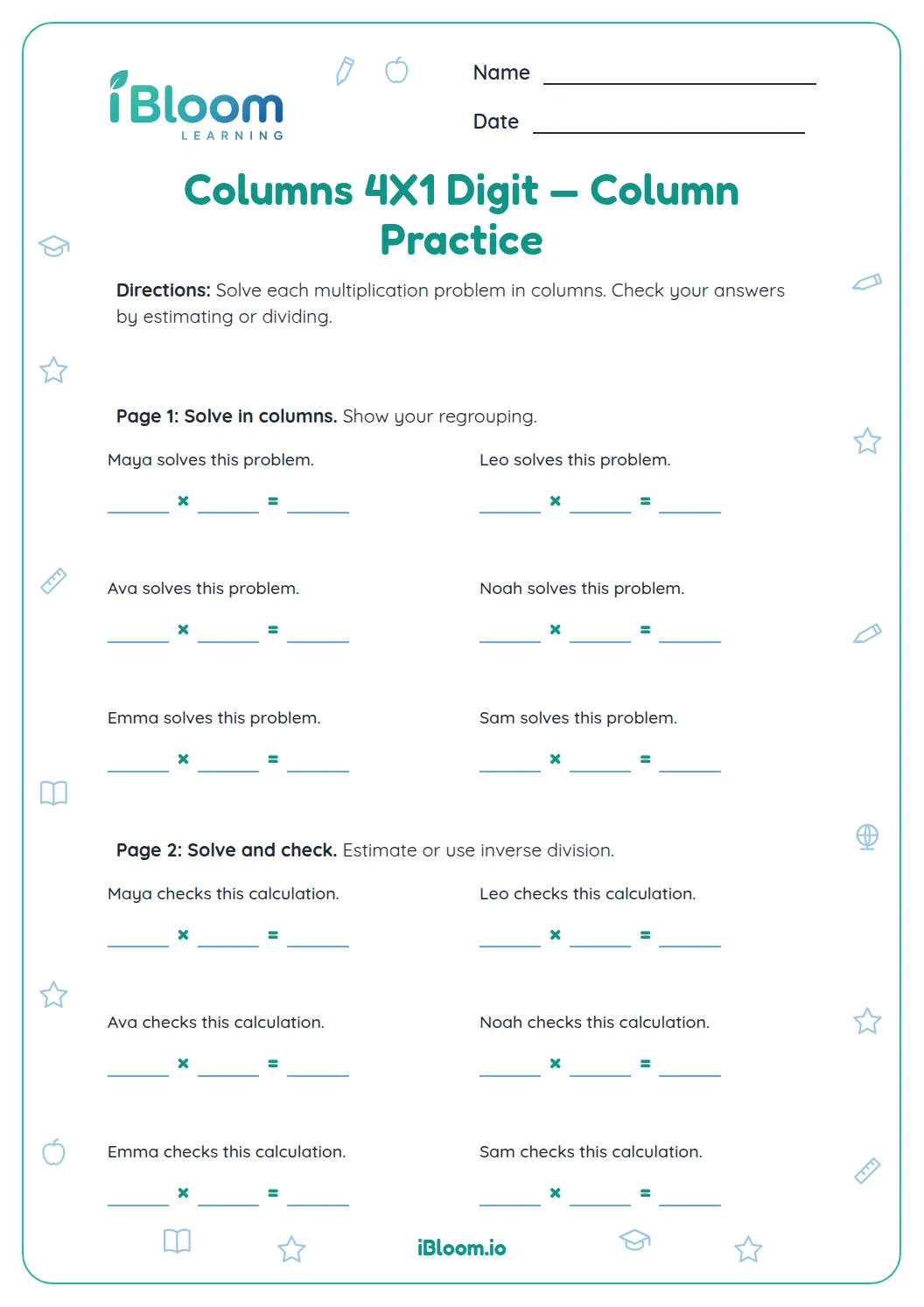
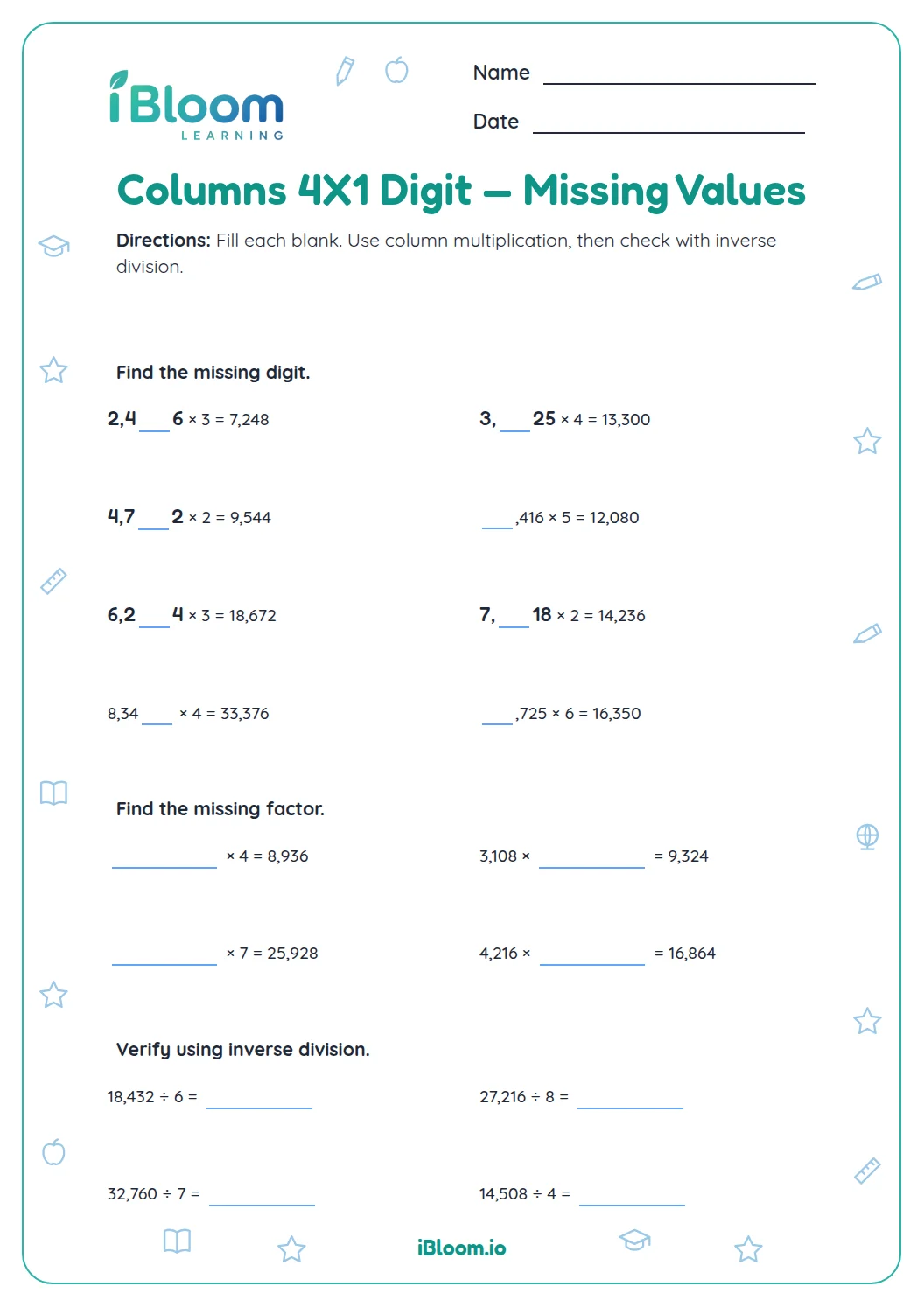
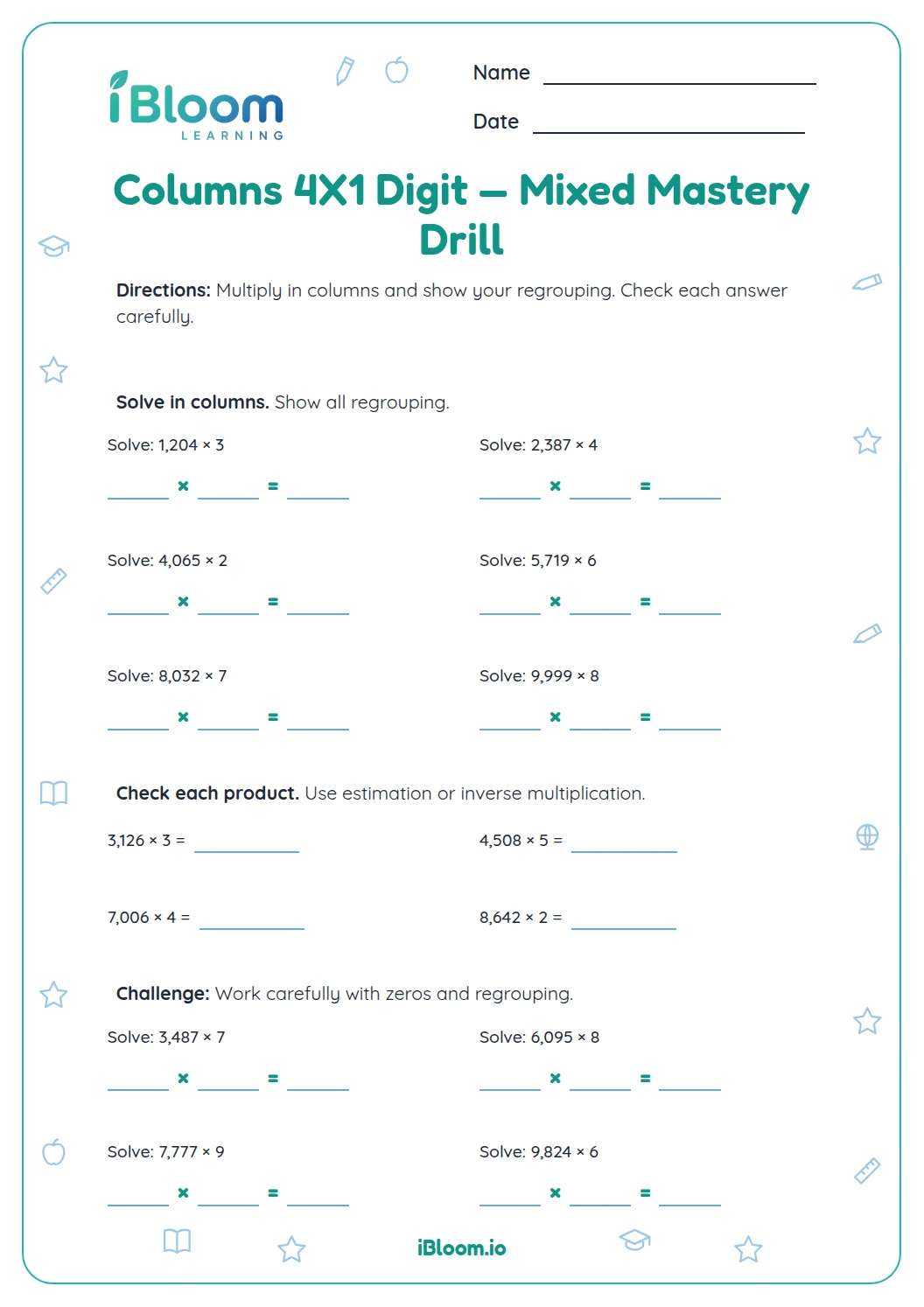
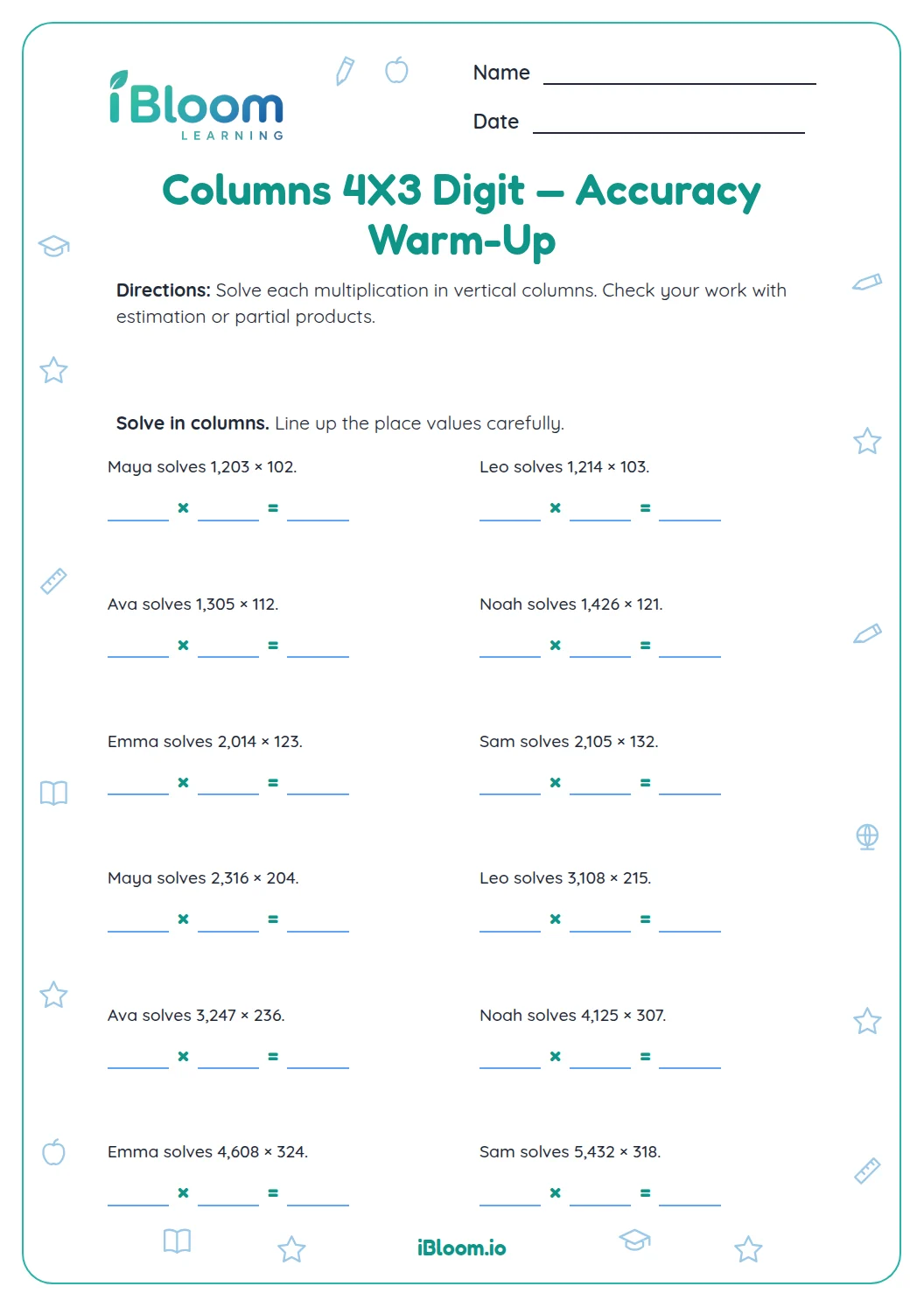
This worksheet helps students in Grades 3–5 inspect four-digit by one-digit multiplication. Part A asks for the first incorrect step or “No error”; several examples contain correct tens calculations with a carried digit. Part B distinguishes an exact multiplication check from an estimate. The work practices multi-digit multiplication under CCSS 4.NBT.B.5 and includes a separate answer key.
Aligned to 4.NBT.B.5
What will students practice?
This worksheet helps students in Grades 3–5 inspect four-digit by one-digit multiplication. Part A asks for the first incorrect step or “No error”; several examples contain correct tens calculations with a carried digit. Part B distinguishes an exact multiplication check from an estimate. The work practices multi-digit multiplication under CCSS 4.NBT.B.5 and includes a separate answer key.
Six step checks and eight product-check choices across two parts.
How does one problem work?
In 2,314 × 3, the ones step gives 12, so write 2 and carry 1. The tens calculation is 1 × 3 + 1 = 4, which is correct. The hundreds step should be 3 × 3 = 9, so the printed 10 is the first error.
How can families use the answer key?
Have the student finish a part before checking it. For any missed answer, compare the place-value work with the key and redo the calculation. The key makes it easier to find the step that needs attention.
How to work through the sheet
- 1Start with the ones place and check the product.
- 2Carry the remaining tens to the next place.
- 3Check each later place in order.
- 4Choose “No error” when every shown step is correct.
- 5Multiply the factors for an exact product check.
Common slips to watch for
The mistake
Forgetting to add the carry
The fix
Include the carried value in the next place calculation.
The mistake
Marking a correct carried tens step wrong
The fix
Multiply the digit, then add the carry shown.
The mistake
Treating an estimate as an exact check
The fix
Multiply the factors to verify the full product.
The problems build accurate multi-digit computation with the standard algorithm.
Follow the carry from one place to the next, and do not mark a correct tens step as the error.
On this sheet:
Show the official wordingHide the official wording
Multiply a whole number of up to four digits by a one-digit whole number.
What to practice next
Make more practice
Further reading
Questions parents and teachers ask
How should I check a carried digit?
After multiplying the ones digit, write the ones digit of the product and carry the tens. Add that carry to the next digit’s product. For example, 1 × 3 + 1 = 4 is correct when the carried value is 1.
What does “first error” ask me to find?
It asks for the earliest incorrect place-value calculation in the sequence. Begin with the ones step, then check the tens, hundreds, and thousands steps in order. If each shown calculation is valid, select “No error.” Write the inverse equation beside the original and confirm that both calculations return the same value.
Why are there correct examples in Part A?
A careful check includes confirming that written work is valid, not only searching for mistakes. Some questions have a later error and some have no error. Checking in order helps distinguish a genuine slip from a correct carry calculation. Write the inverse equation beside the original and confirm that both calculations return the same value.
How can I verify a completed product exactly?
Multiply the two factors and compare the result with the written product. Estimating can show whether a product is reasonable, but it cannot confirm each digit. Part B asks students to identify the exact check. Write the inverse equation beside the original and confirm that both calculations return the same value.
How many questions are on the worksheet?
There are 14 multiple-choice questions in two parts. Part A has six checks of shown multiplication steps. Part B has eight choices about checking products. The answer key identifies the first incorrect step or the exact checking method. Write the inverse equation beside the original and confirm that both calculations return the same value.