


About this worksheet
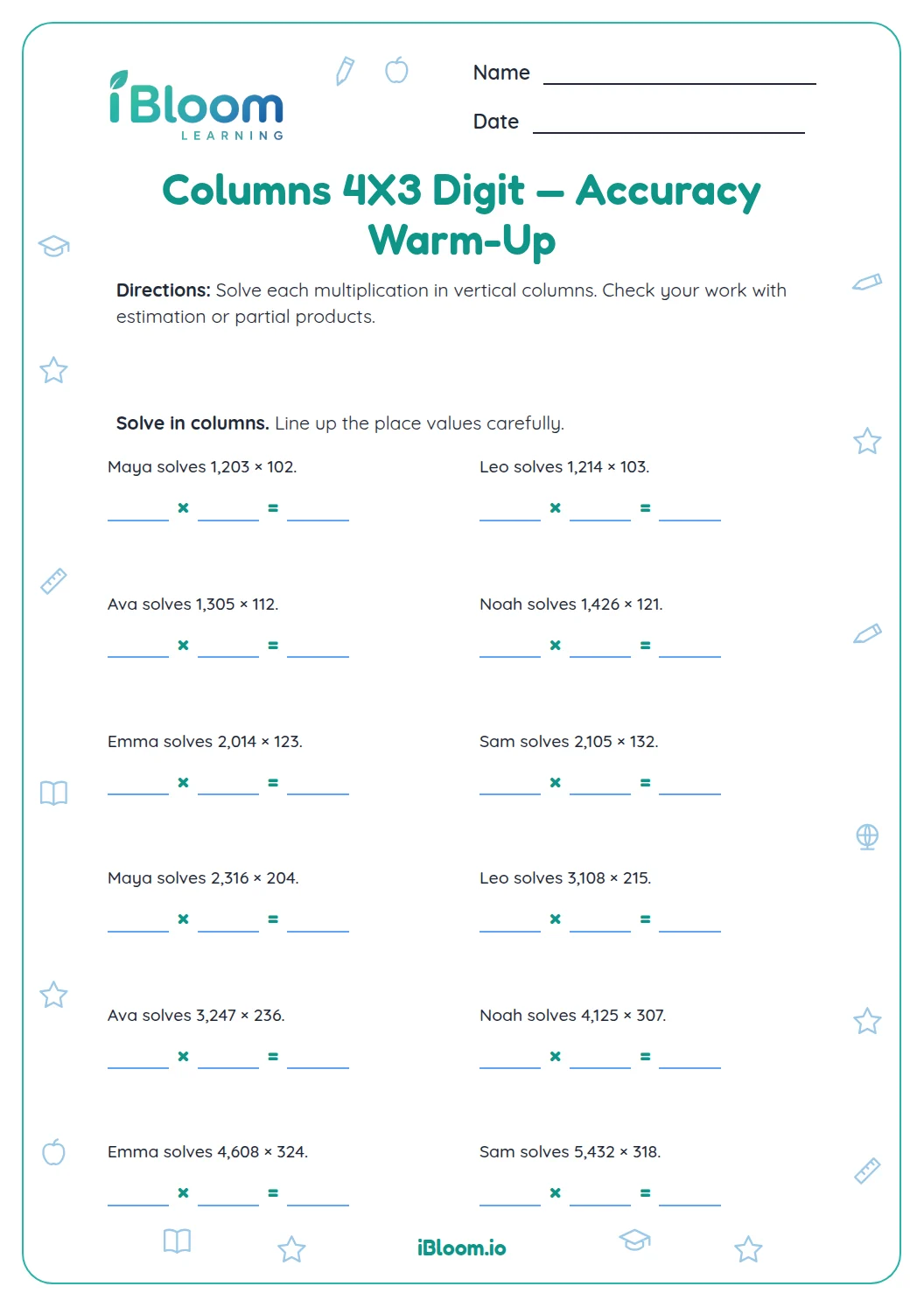
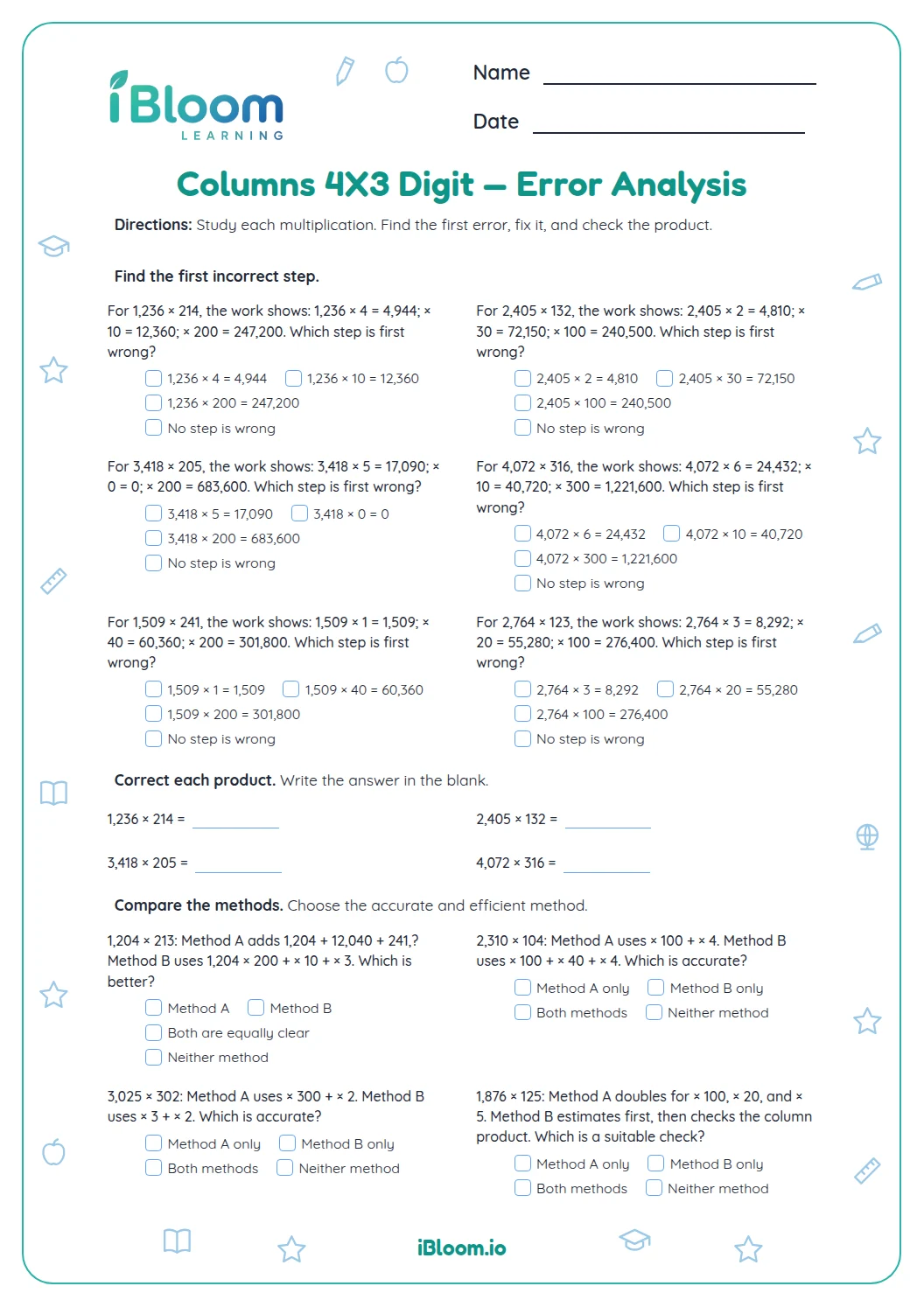
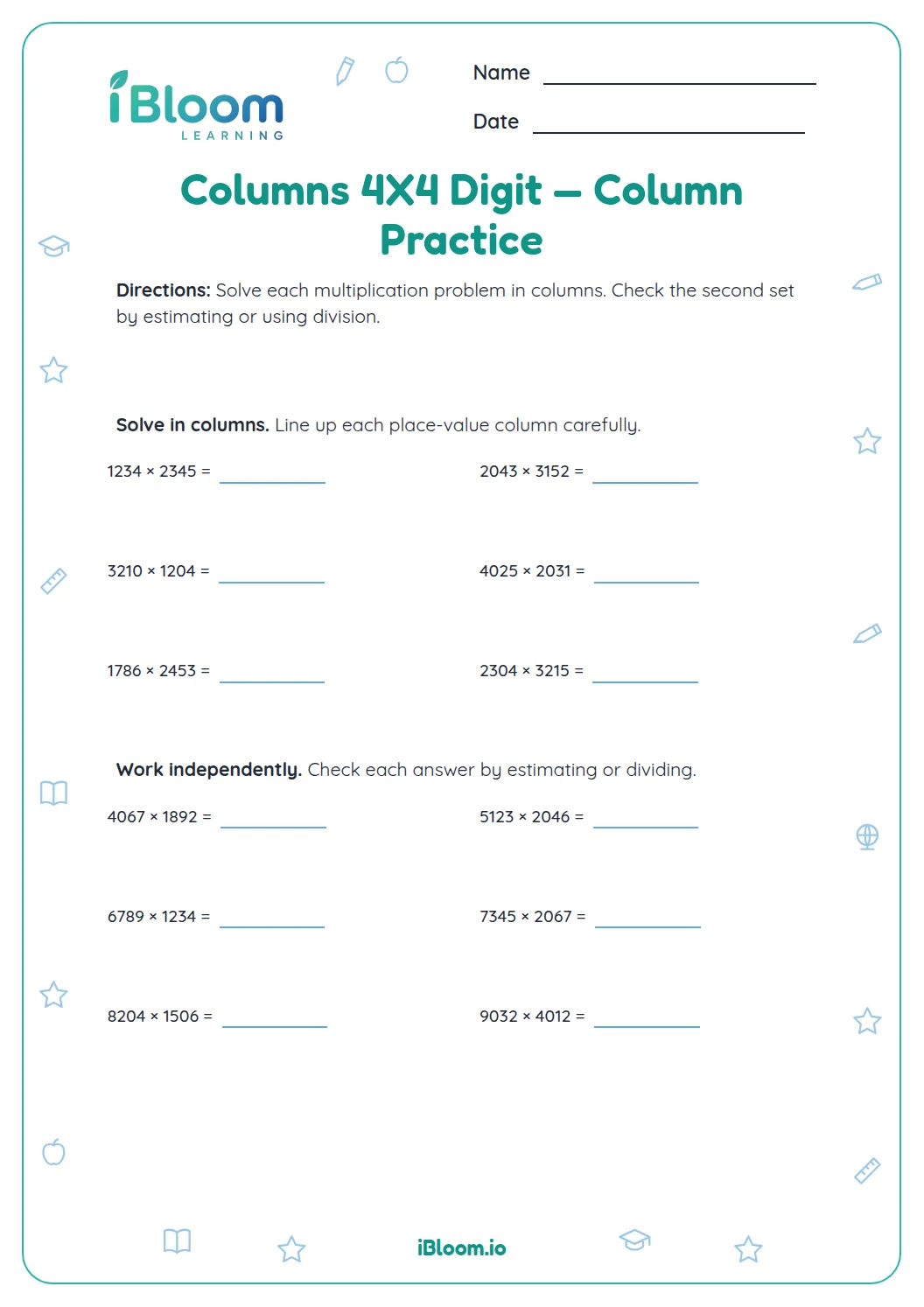
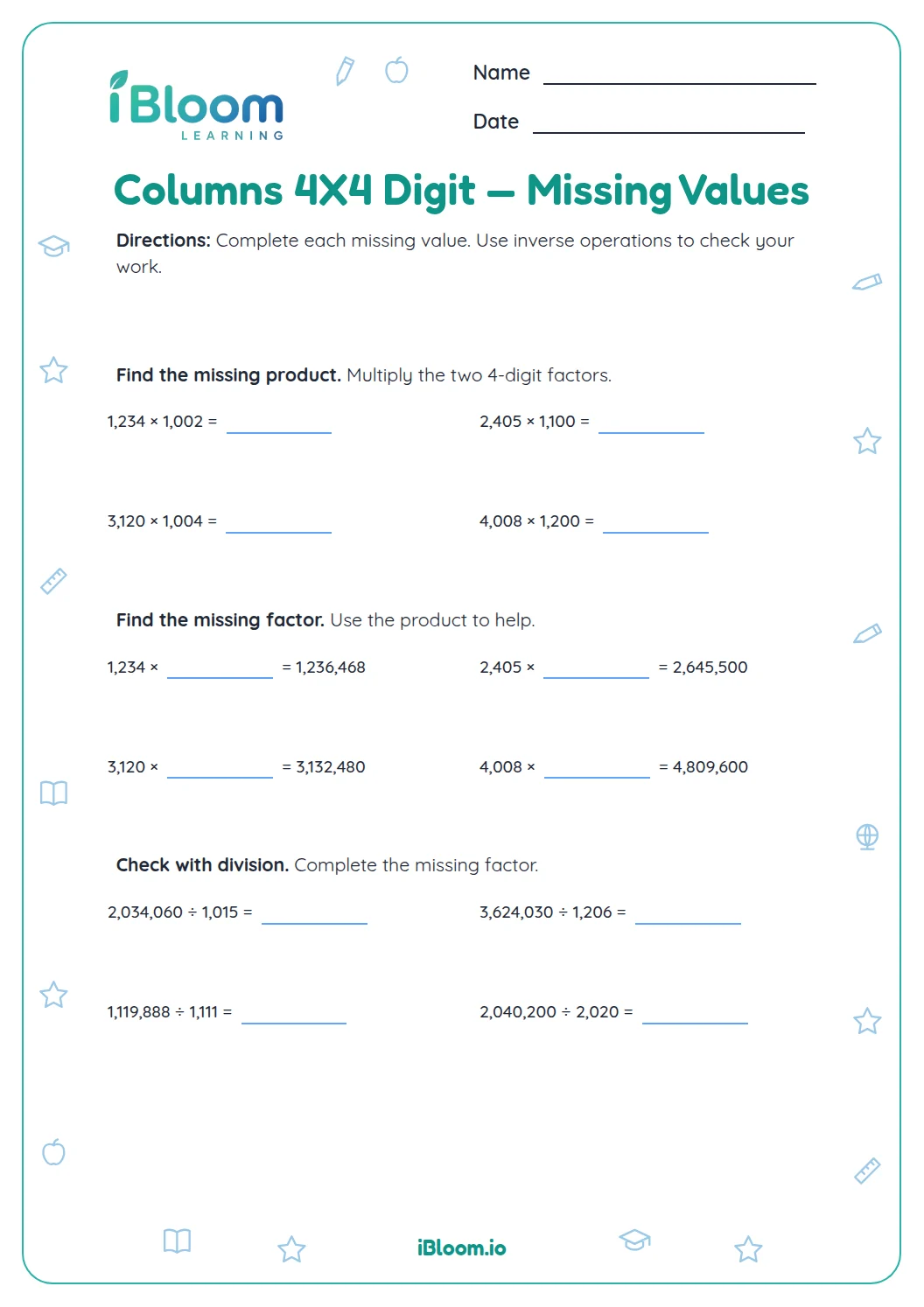
This worksheet gives Grades 4–6 practice with four-digit factors and three-digit multipliers. Students complete missing products, solve for missing factors, and use inverse division to check products. The numbers include the two corrected products from the prior sheet: 5,093 × 214 = 1,089,902 and 2,784 × 132 = 367,488. The practice connects multi-digit multiplication with CCSS 5.NBT.B.5.
Aligned to 5.NBT.B.5
What will students practice?
This worksheet gives Grades 4–6 practice with four-digit factors and three-digit multipliers. Students complete missing products, solve for missing factors, and use inverse division to check products. The numbers include the two corrected products from the prior sheet: 5,093 × 214 = 1,089,902 and 2,784 × 132 = 367,488. The practice connects multi-digit multiplication with CCSS 5.NBT.B.5.
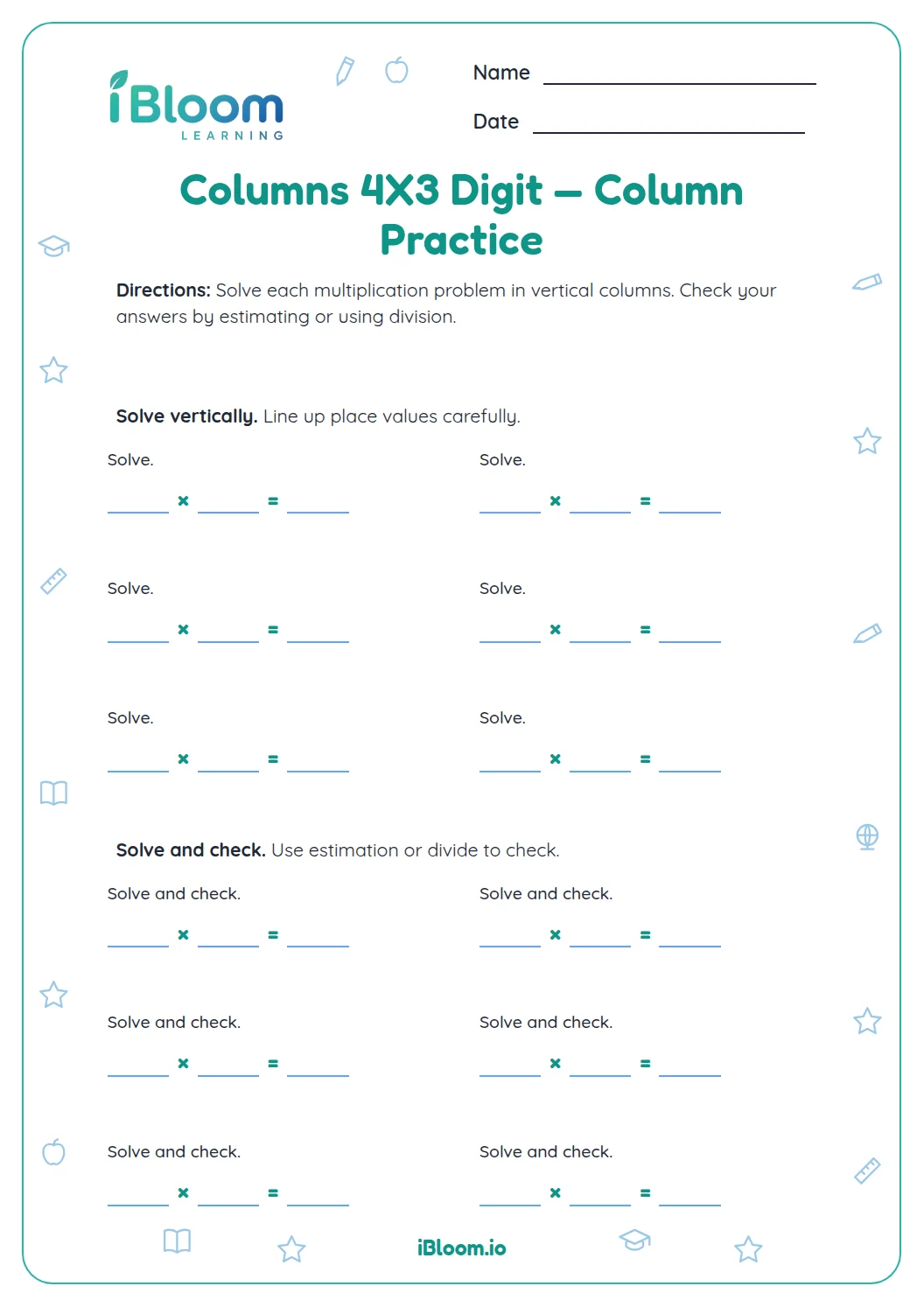
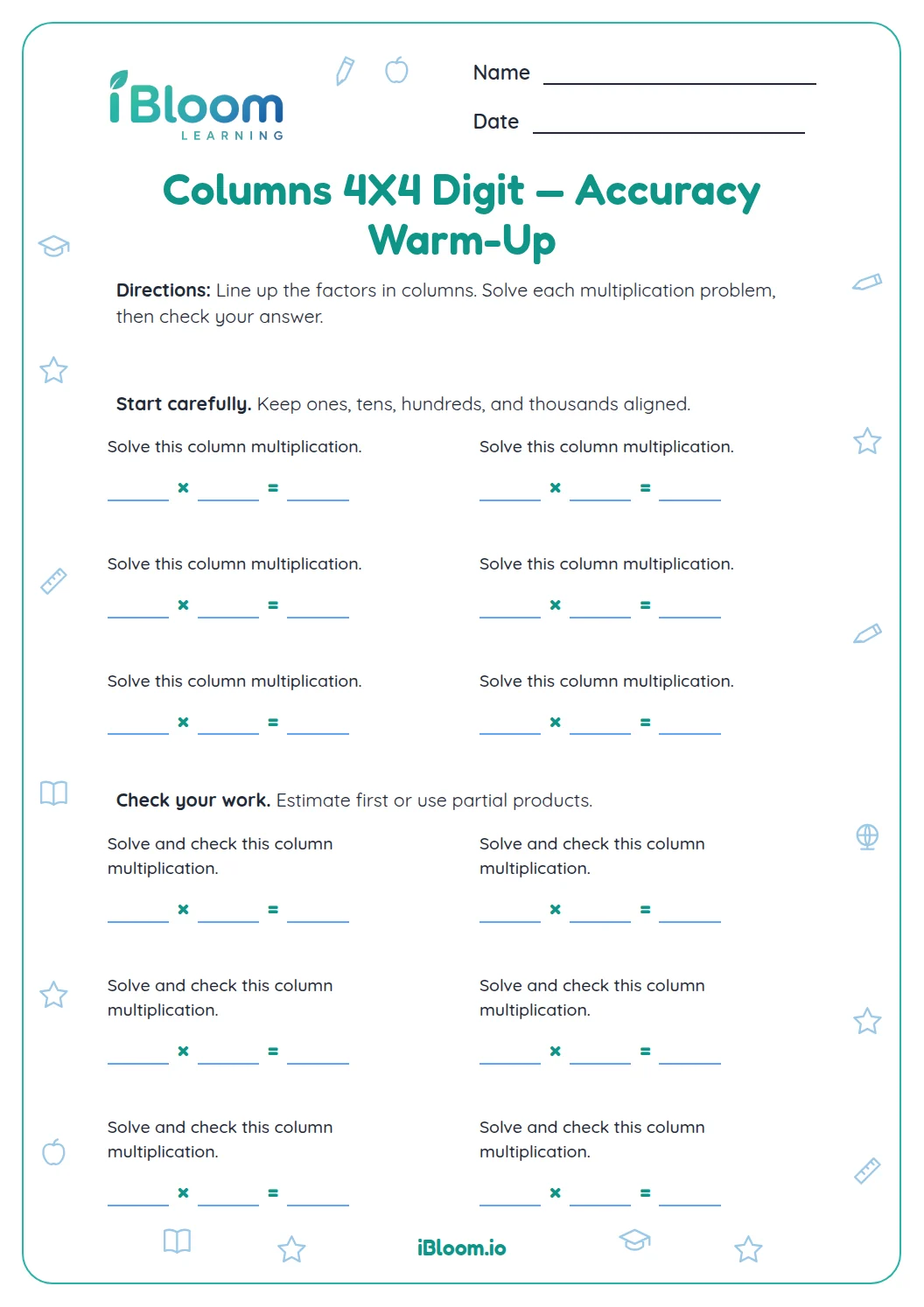
Sixteen multiplication and inverse-division equations in two parts.
How does one problem work?
For 5,093 × 214, split 214 into 200, 10, and 4. The partial products are 1,018,600, 50,930, and 20,372; their sum is 1,089,902. For a missing factor, divide the product by the known factor and check by multiplication.
How can families use the answer key?
Have the student finish a part before checking it. For any missed answer, compare the place-value work with the key and redo the calculation. The key makes it easier to find the step that needs attention.
How to work through the sheet
- 1Estimate the product to check its size.
- 2Multiply by each place value in the three-digit factor.
- 3Add the partial products carefully.
- 4For a missing factor, divide the product by the known factor.
- 5Check by multiplying the completed factors.
Common slips to watch for
The mistake
Forgetting a factor’s place value
The fix
Use the hundreds, tens, and ones values of the multiplier.
The mistake
Dropping a zero in a partial product
The fix
Keep each partial product in its correct place.
The mistake
Using division without checking
The fix
Multiply the factor you found by the known factor.
The problems build accurate multi-digit computation with the standard algorithm.
Use place value to multiply, or divide the product by the known factor when a factor is missing.
On this sheet:
Show the official wordingHide the official wording
Fluently multiply multi-digit whole numbers using the standard algorithm.
What to practice next
Make more practice
Further reading
Questions parents and teachers ask
What kinds of blanks are on this worksheet?
The first part asks students to find missing products or factors in multiplication equations. The second part uses inverse division to recover a factor from a product. Read the operation and locate the blank before choosing whether to multiply or divide.
How can I check a missing product?
Multiply the two factors and compare the result with the product in the equation. For example, 2,784 × 132 = 367,488. A place-value estimate can help catch a product that is far too large or small before checking each partial product.
How do I solve for an unknown factor?
Divide the product by the known factor. For 3,412 × ___ = 580,040, calculate 580,040 ÷ 3,412 = 170. Multiply 3,412 × 170 to verify the original product. Write the inverse equation beside the original and confirm that both calculations return the same value.
Why use inverse division?
Multiplication and division undo one another. When the product and one factor are known, division isolates the missing factor. A final multiplication check confirms that the number you found belongs in the original equation. Write the inverse equation beside the original and confirm that both calculations return the same value.
How many questions are included?
There are 16 questions in two parts. Students complete product equations, find missing factors, and use inverse division to check multiplication relationships. The key lists each completed value on separate answer-key pages. Write the inverse equation beside the original and confirm that both calculations return the same value.