





About this worksheet
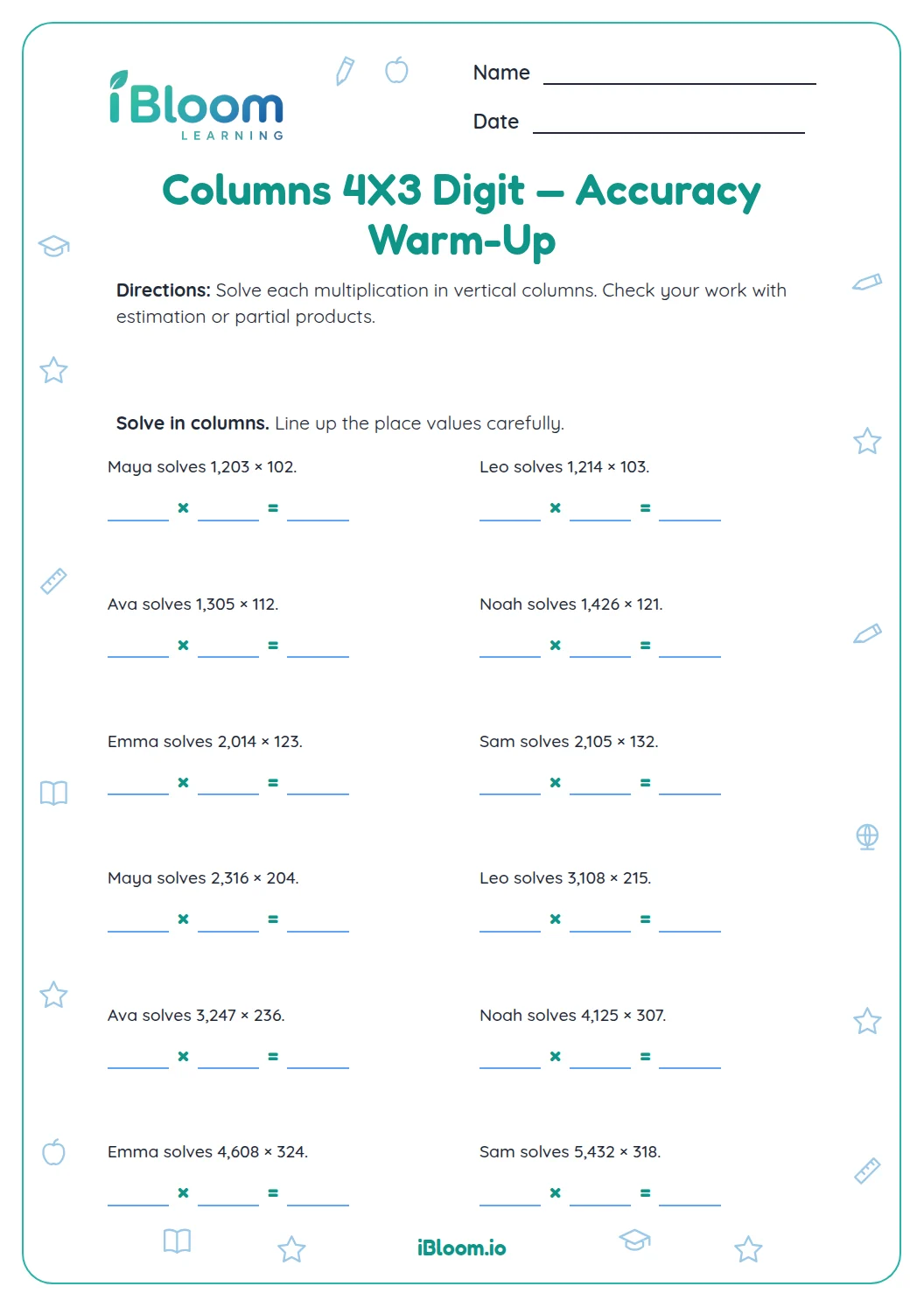
This Grade 5 worksheet gives students 16 four-digit by three-digit multiplication problems on one student page. Each prompt prints both factors, and students can use nearby space for column work. Multiply by place value, record partial products and combine them for an exact product. A separate one-page answer key lists the checked products.
How do the column steps work?
In question 1, multiply 1,234 by 3, then by 20, then by 100. The partial products are 3,702, 24,680 and 123,400; their sum is 151,782.
- 11,234 × 123
- 23,702 + 24,680 + 123,400 = 151,782
What problems are on the page?
All 16 problems use a four-digit number times a three-digit number. The student page supplies the factors, and column-work space supports the multi-step calculation.
- Questions 1–8: exact products
- Questions 9–16: exact products
How can the key support checking?
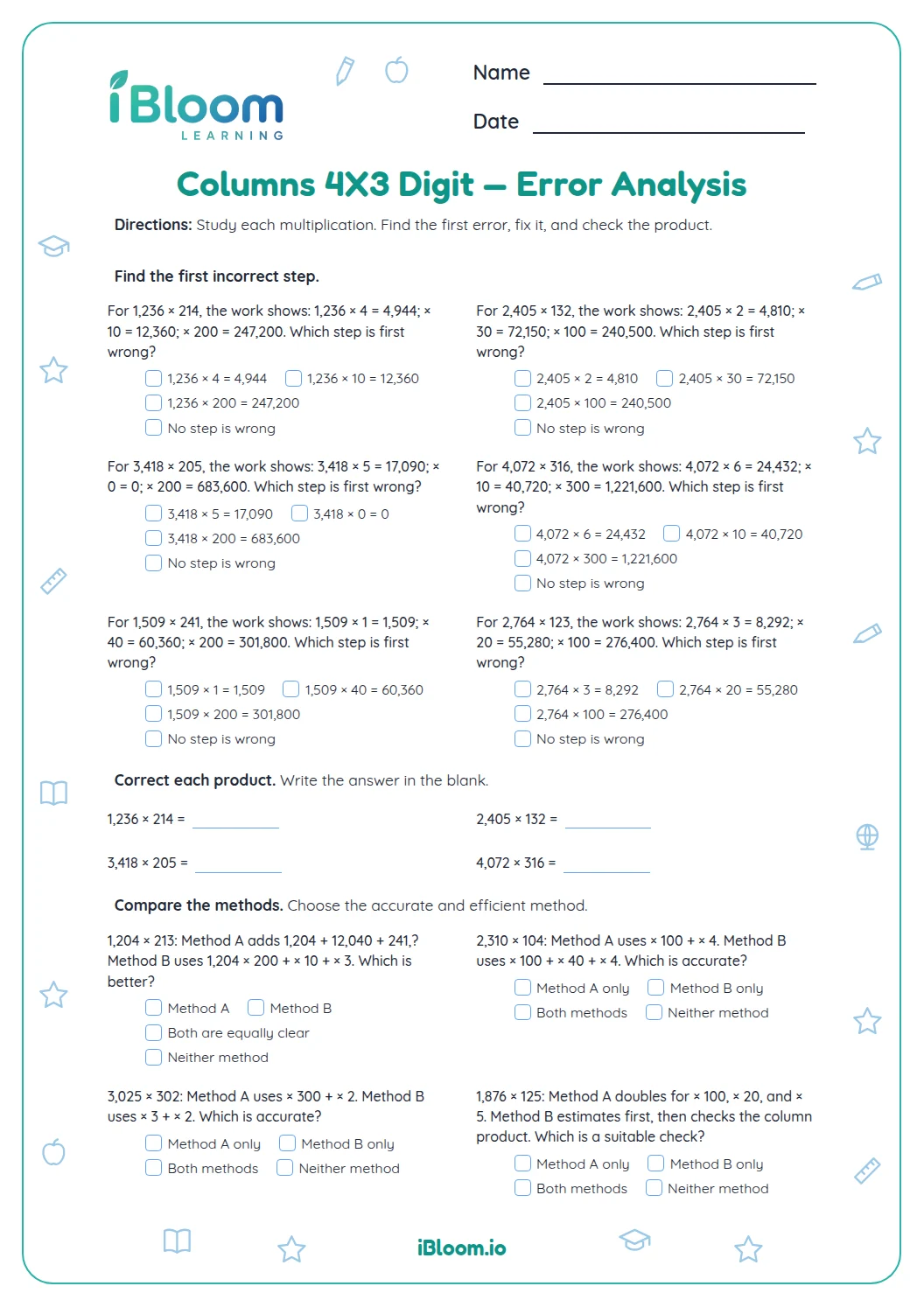
Compare the final product, then review each partial product if it differs. Check the place value of each multiplier digit and make sure the partial products are aligned before adding.
How to multiply in columns
- 1Write the factors with ones digits aligned.
- 2Multiply the four-digit number by the ones digit.
- 3Multiply by the tens digit and shift that partial product one place.
- 4Multiply by the hundreds digit and shift two places.
- 5Add partial products and check the final product in the key.
Common column-multiplication slips
The mistake
Treating a tens digit as ones.
The fix
Use its place value: a 2 in the tens place means 20.
The mistake
Writing partial products without place shifts.
The fix
Start each partial product under its correct place value.
The mistake
Adding partial products before checking them.
The fix
Verify each multiplication row, then add carefully.
What to practice next
Make more practice
Questions parents and teachers ask
What is on the 4-digit by 3-digit worksheet?
The one-page worksheet has 16 equations, each multiplying a four-digit number by a three-digit number. The factors are printed, with nearby space for column work. A separate one-page answer key gives the exact product for every question so students can check their calculations.
How do you multiply a three-digit factor in columns?
Multiply by its ones digit, then its tens digit, then its hundreds digit. Shift the tens and hundreds partial products left to match their place values, and add the rows. Question 1 provides a worked example on this page.
Why do partial products shift?
A digit in the tens place represents ten times its face value, and a digit in the hundreds place represents one hundred times its face value. Shifting the partial product keeps those values aligned. For example, multiplying by the 2 in 123 means multiplying by 20.
Is estimation part of this worksheet?
The printed problems ask for exact products and do not include separate estimation prompts. Students may estimate informally to check whether an answer is reasonable, then use the answer key to compare exact results and review any calculation that differs.
What should I check if the product differs from the key?
Review each partial product and its place value before redoing the addition. Check whether the tens row shifted one place and the hundreds row shifted two places. Then compare the new sum with the numbered answer in the key.