


About this worksheet
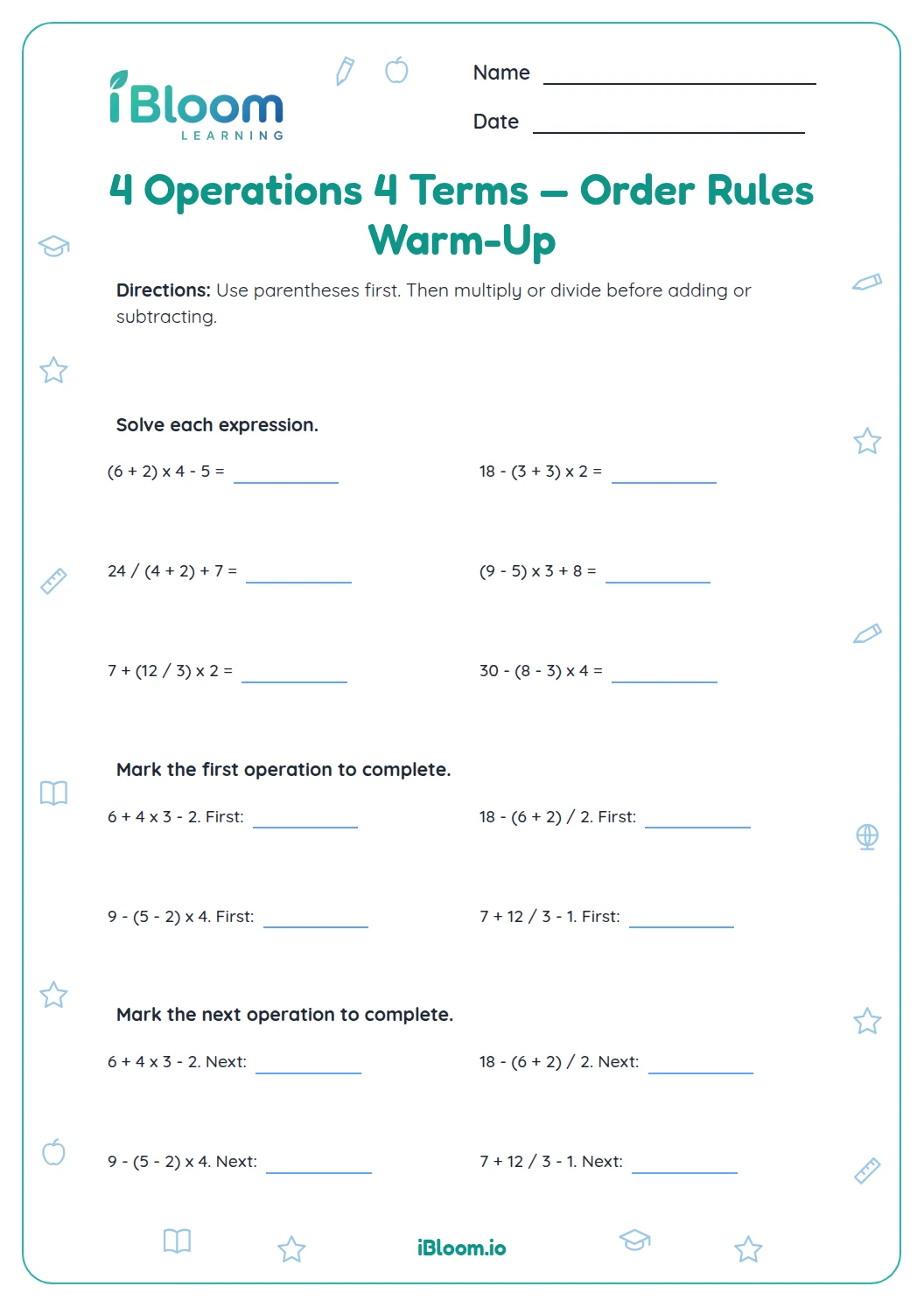
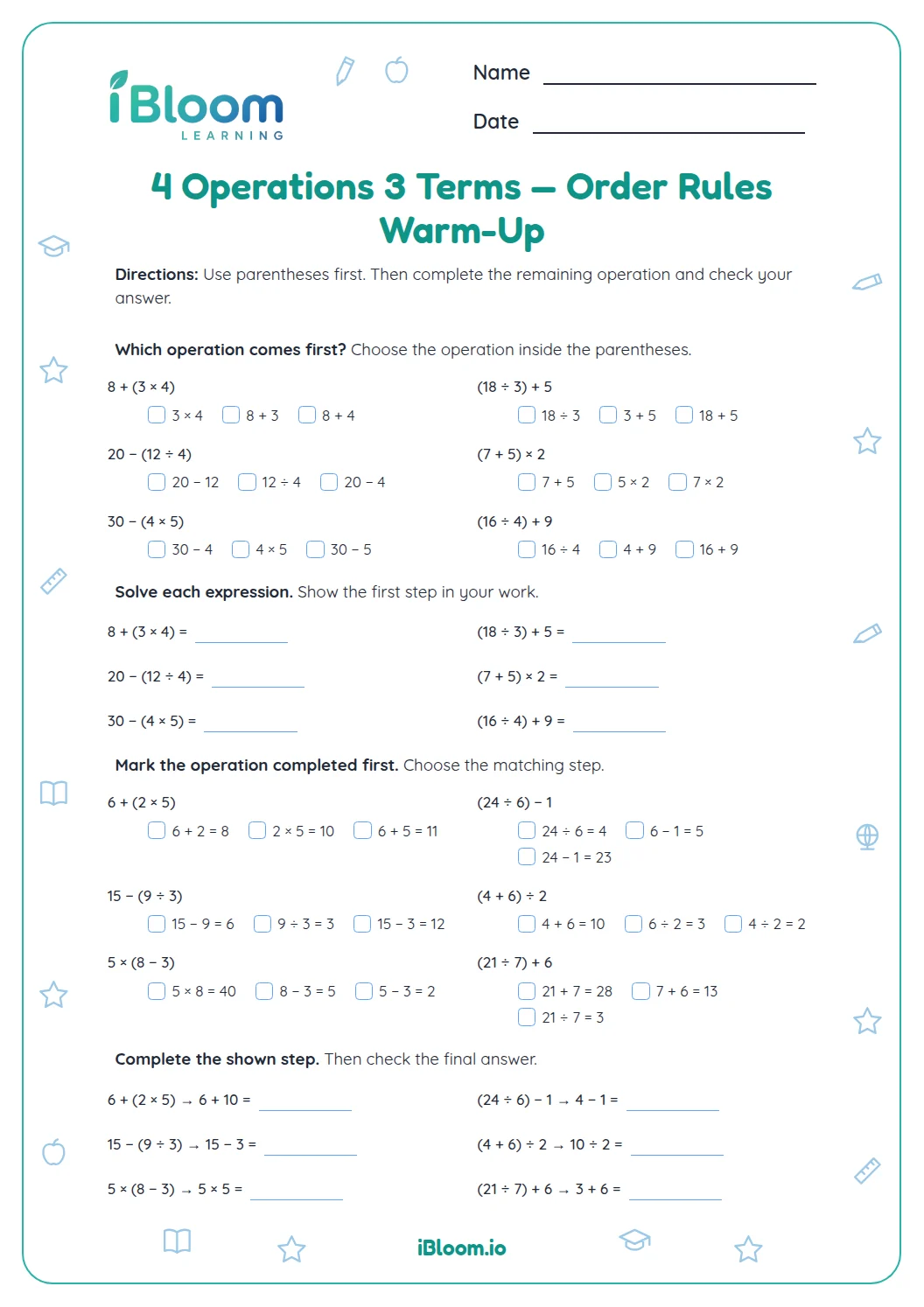
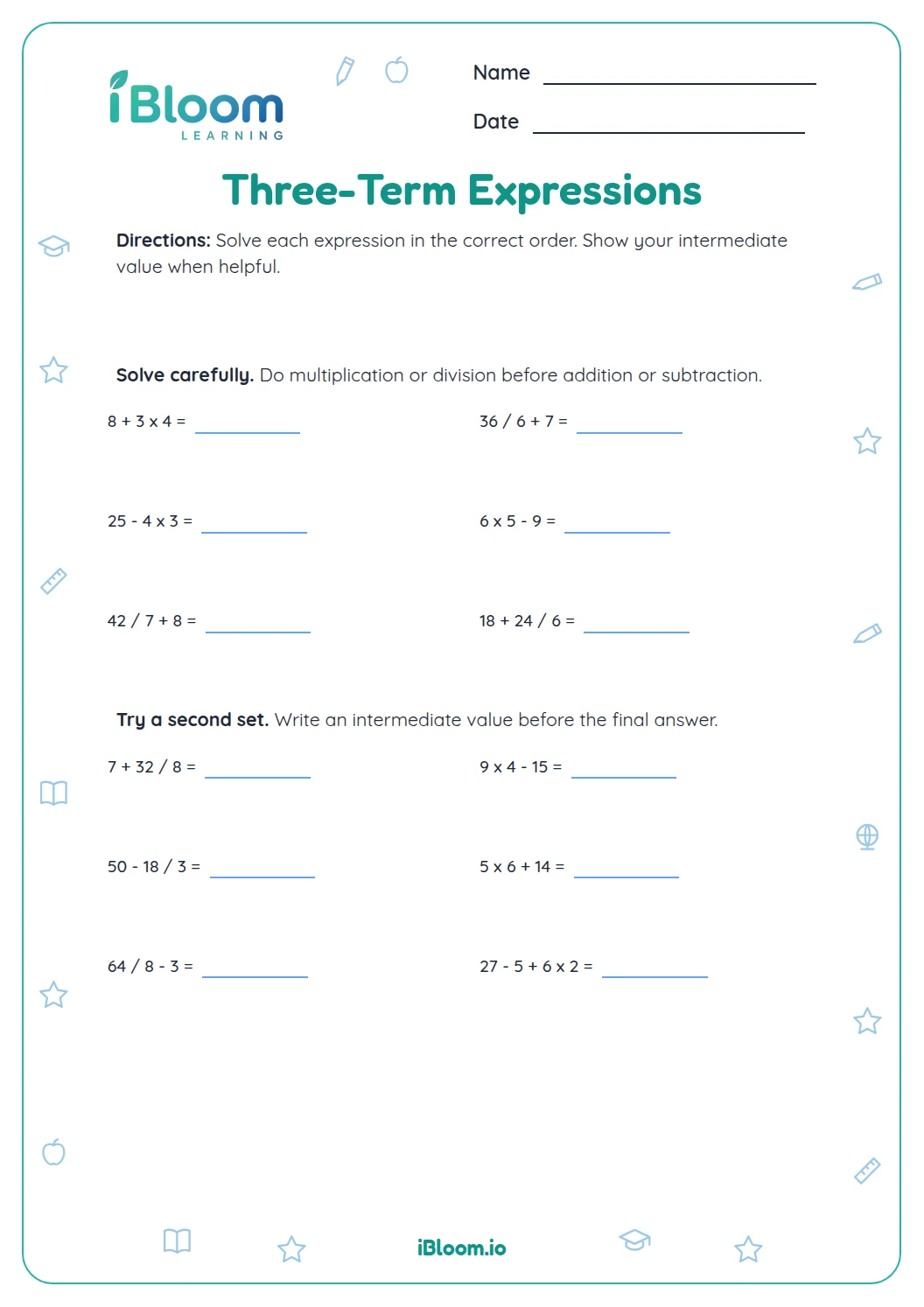
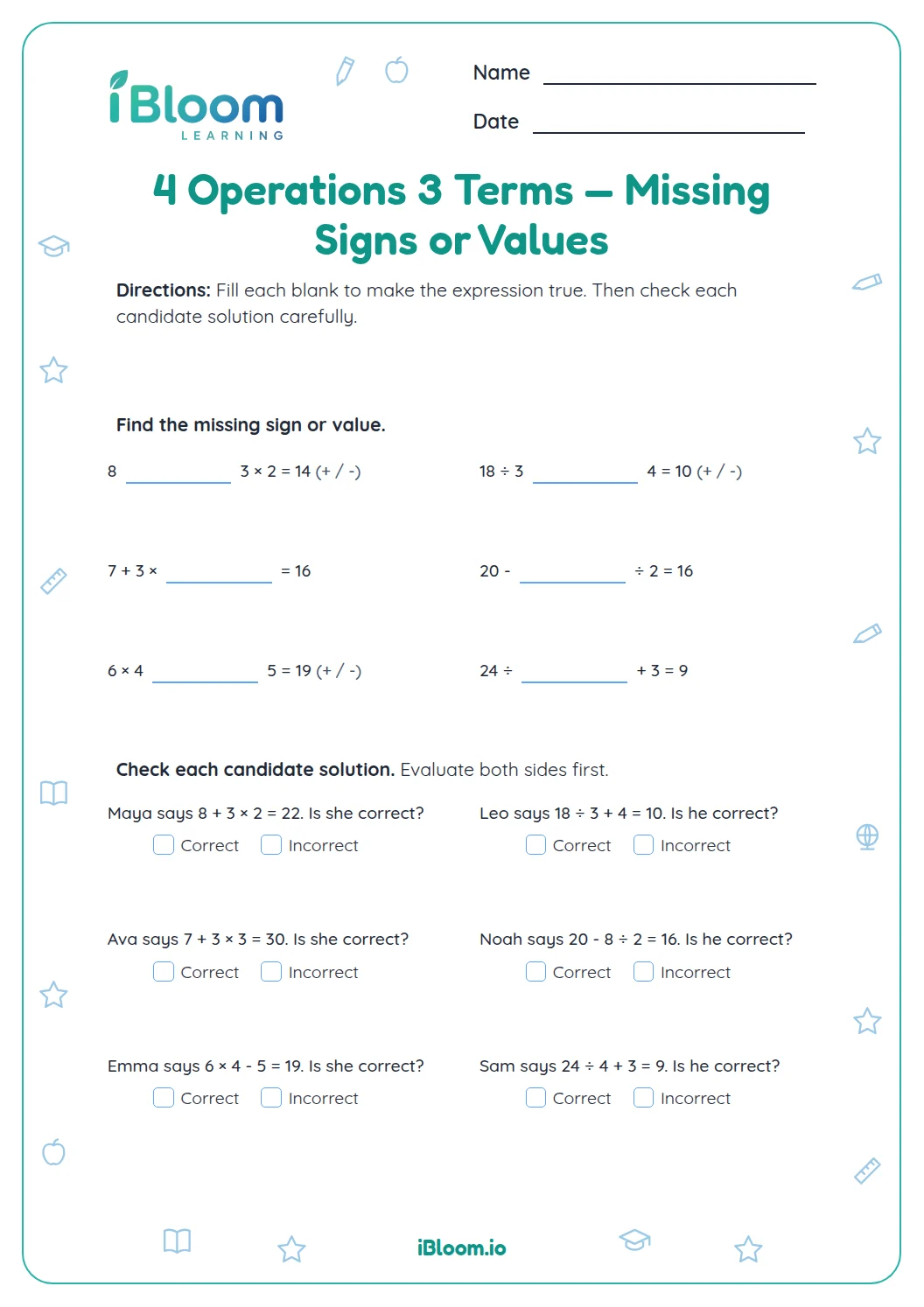
This Grades 5–6 worksheet has 14 multiple-choice questions in two parts. Students first decide whether seven four-operation equations are true. They then identify the first operation-order error in seven short descriptions of student work. Expressions use multiplication and division before addition and subtraction, with equal-rank operations evaluated left to right. A separate key gives the correct choice for each question.
What order should students check?
Complete multiplication and division before addition and subtraction. When operations share a rank, move from left to right. In 20 − 12 ÷ 3 + 2, divide first: 12 ÷ 3 = 4, then calculate 20 − 4 + 2 = 18.
How are the questions divided?
Part A has seven true-or-false equation checks. Part B has seven descriptions of a student’s first operation-order error. In each error item, use the stated work to identify the first incorrect step.
How do students identify the first error?
Follow the work that is described, then compare its first step with the operation rules. In Question 8, the division is correct, but adding 4 + 2 before subtracting is not.
- 1The correct sequence is 12 ÷ 3 = 4, then 20 − 4 + 2 = 18. The first error is adding 4 + 2 before subtracting; that mistaken grouping produces 14.
How should students explain a choice?
Name the operation that should happen first and the operation the student used instead. This connects the selected answer to the actual expression rather than relying on a memorized phrase.
How to use this worksheet
- 1Scan the expression for multiplication or division.
- 2Complete those operations from left to right.
- 3Then complete addition and subtraction from left to right.
- 4For an error item, locate the first step the student is said to take.
- 5Compare that step with the operation order and select its error.
Common mistakes and quick fixes
The mistake
Subtracting before division.
The fix
Complete division before addition or subtraction.
The mistake
Multiplying before division when they appear together.
The fix
Treat multiplication and division equally and work left to right.
The mistake
Naming a later error instead of the first one.
The fix
Follow the described work in order and identify its earliest incorrect step.
What to practice next
Make more practice
Questions parents and teachers ask
How many questions are on this worksheet?
There are 14 numbered questions on the student pages. They are grouped into 2 sections, and the answer key uses the same question numbers. The practice moves from equation checks to first-error diagnoses, so an adult can check progress without searching through a separate list.
How should students work through the questions?
For each equation, calculate multiplication and division from left to right, then addition and subtraction from left to right. For an error item, follow the student’s described first step and find the earliest place it breaks that order. It helps to name which operation should have happened first before judging the student’s choice.
What does the answer key include?
The key marks each equation as true or false and names the first error described in Part B. For Question 8, it explains that 12 ÷ 3 is correct, while adding 4 + 2 before subtracting creates the result 14.
How long should this practice take?
Plan for about 20 minutes, with more time if students write every step. The order of operations error analysis worksheet questions are short enough to pause after each section, compare one result with the key, and then return to any item that needs another calculation.
Can I use this for homework?
Yes. Print the student pages separately from the key if students should work independently. Ask them to keep the operation order and the described first step visible; that gives you a useful way to discuss a missed answer and lets students correct their own work after checking the key.