

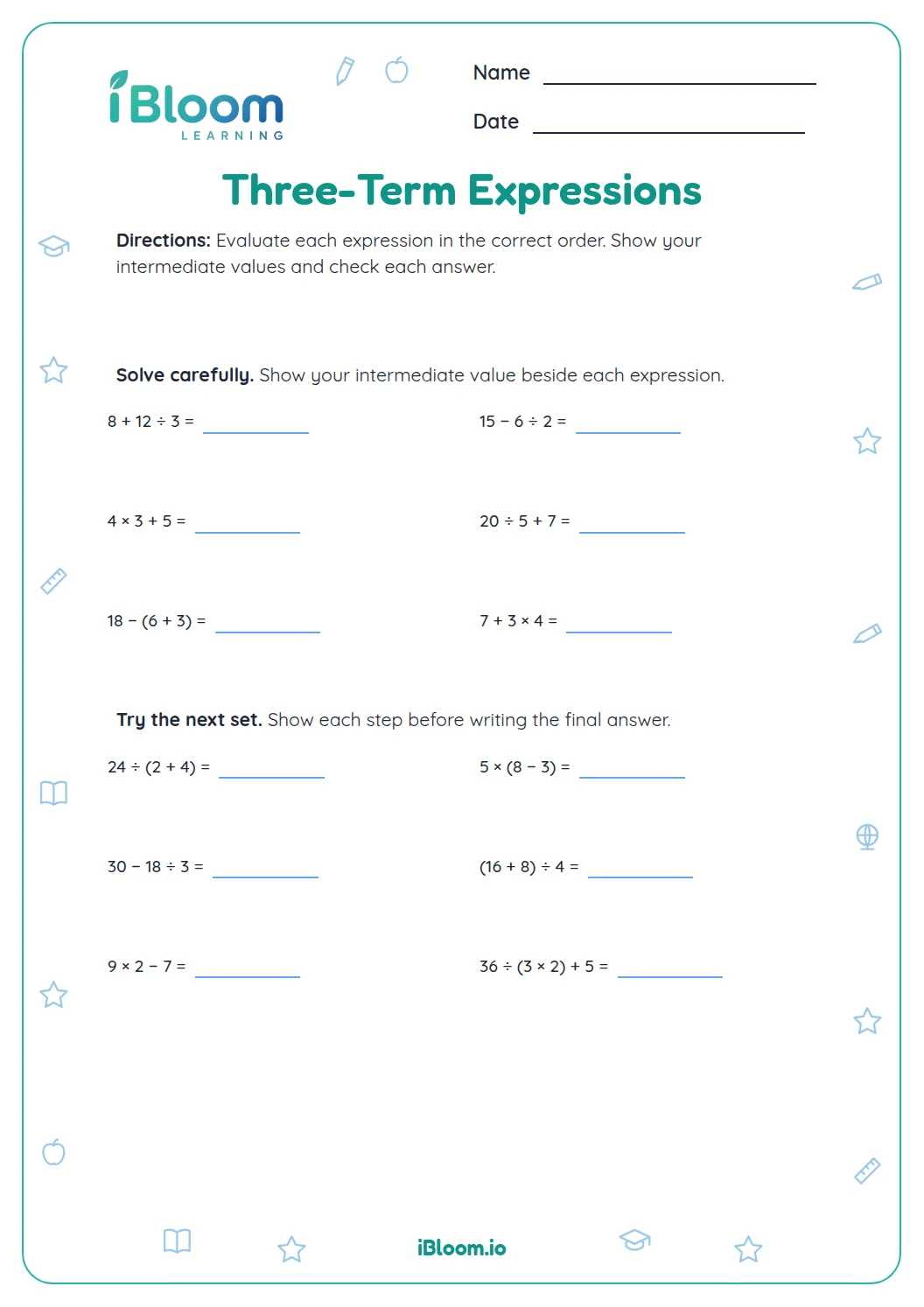

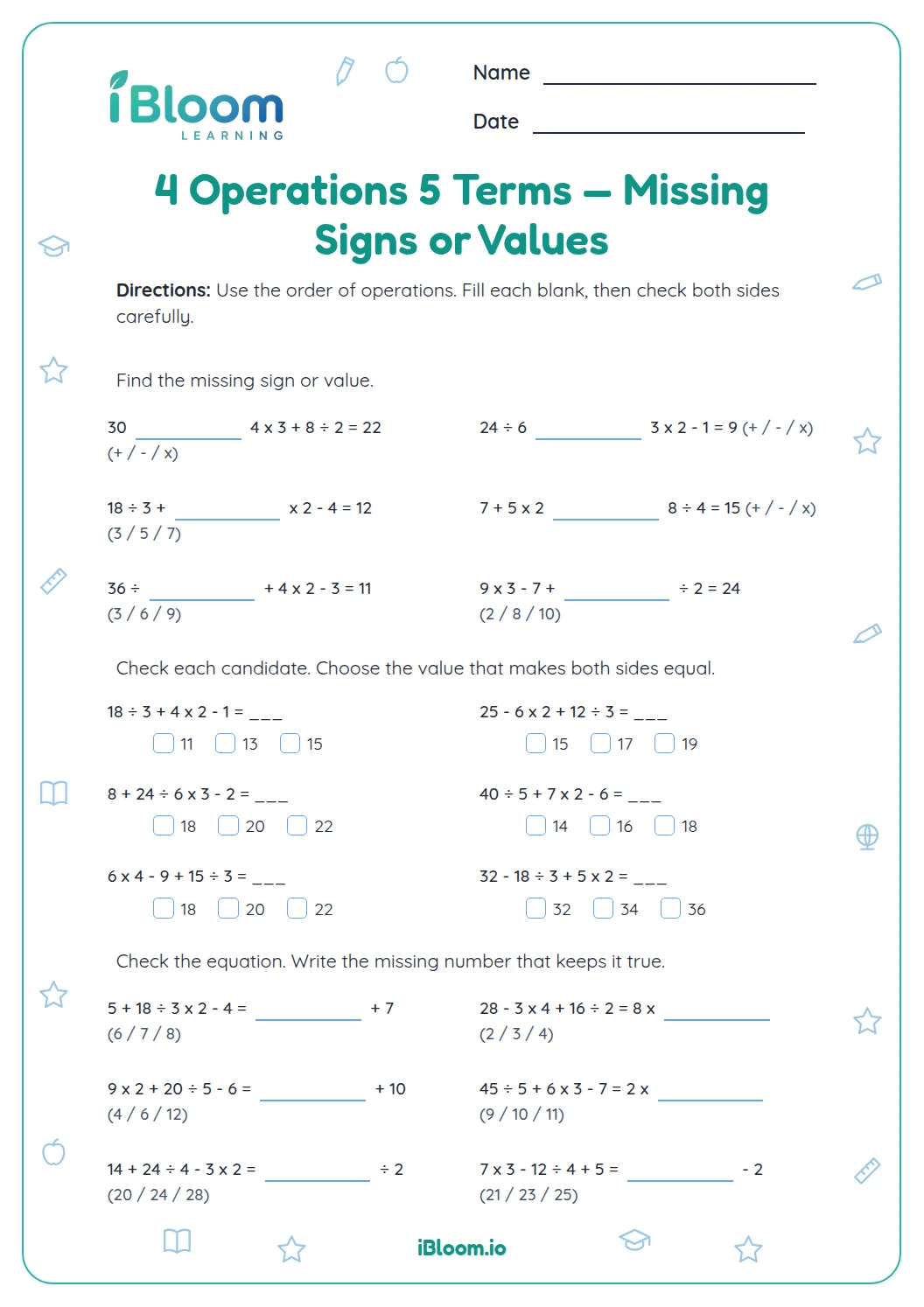
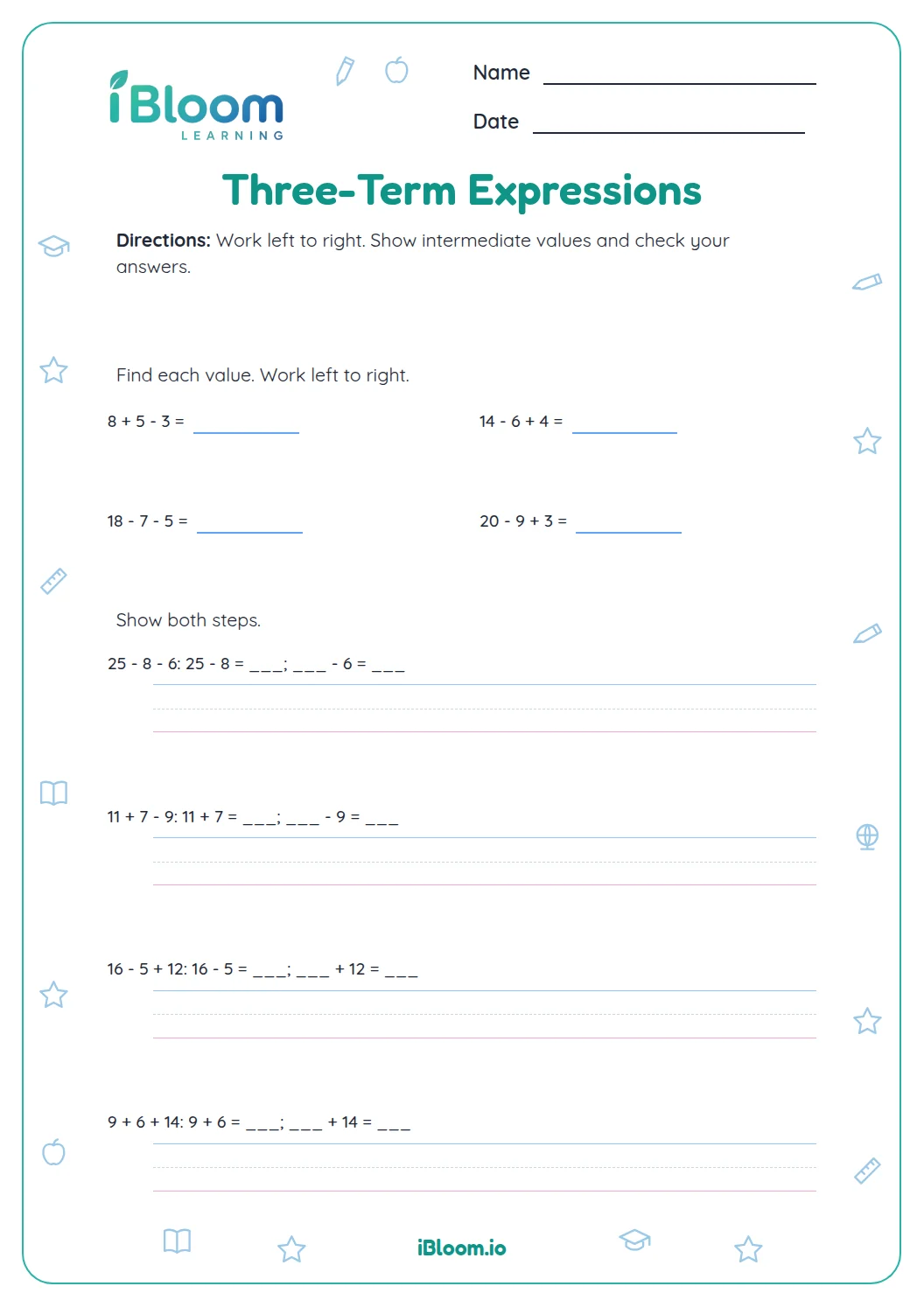
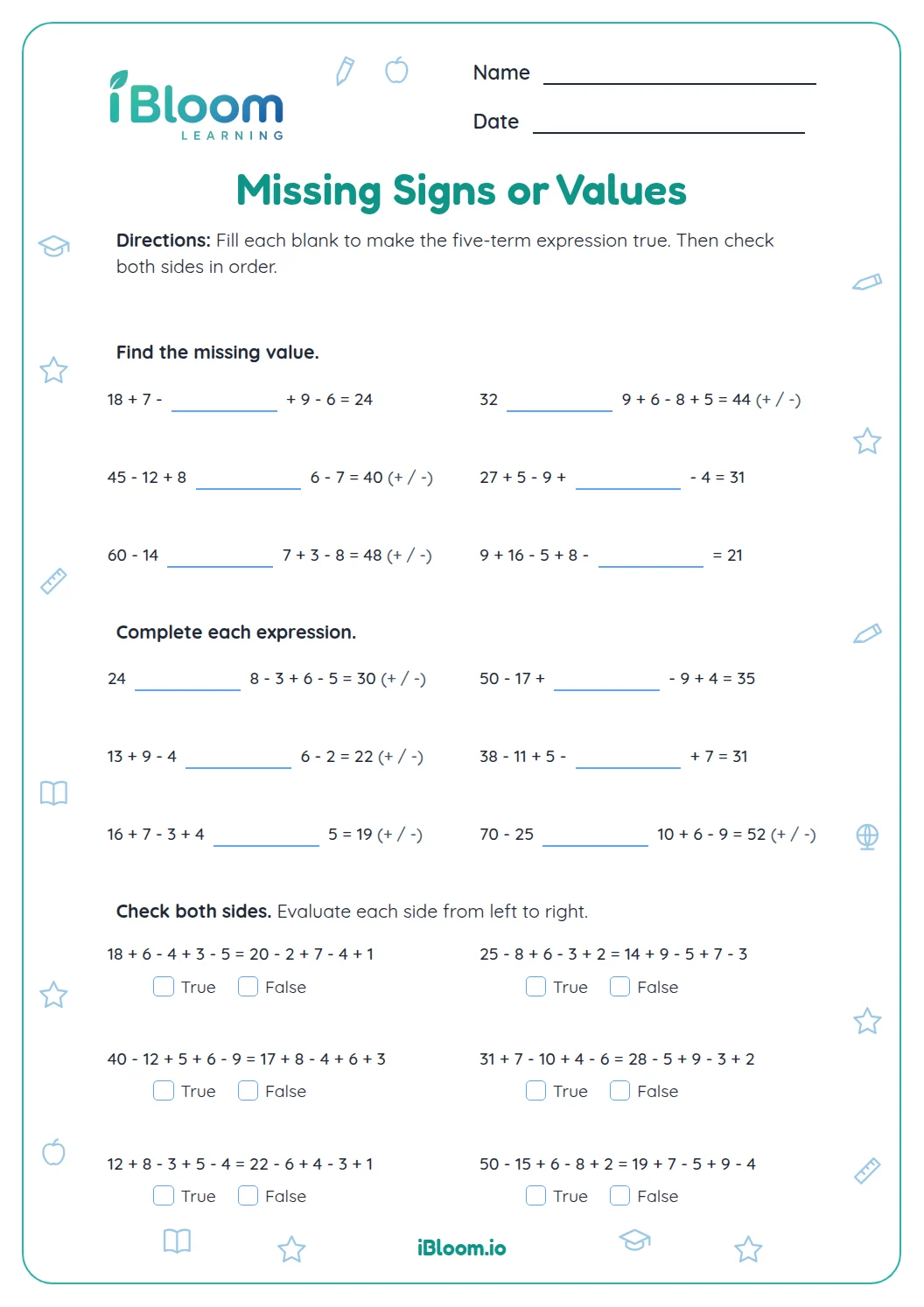
About this worksheet
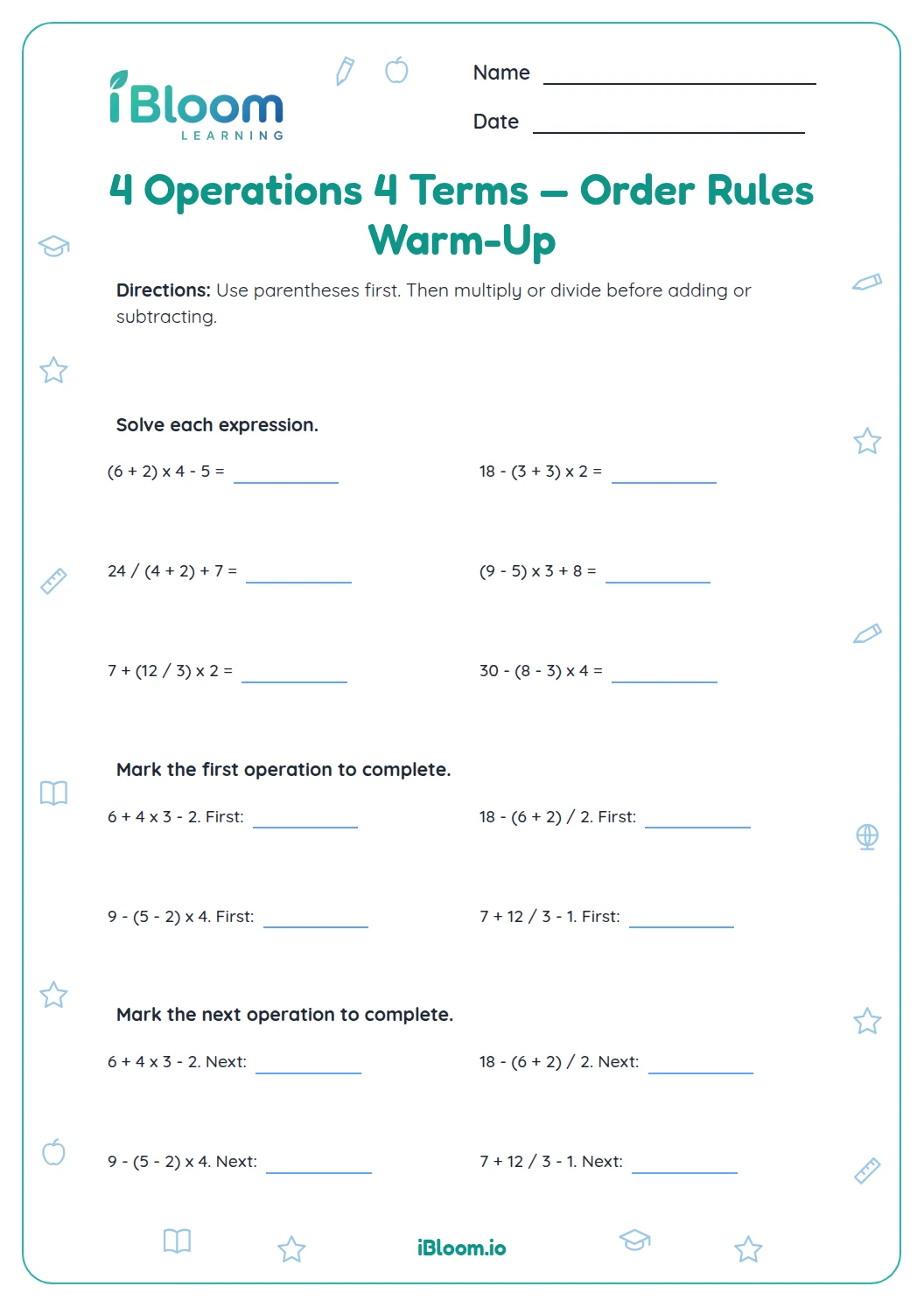
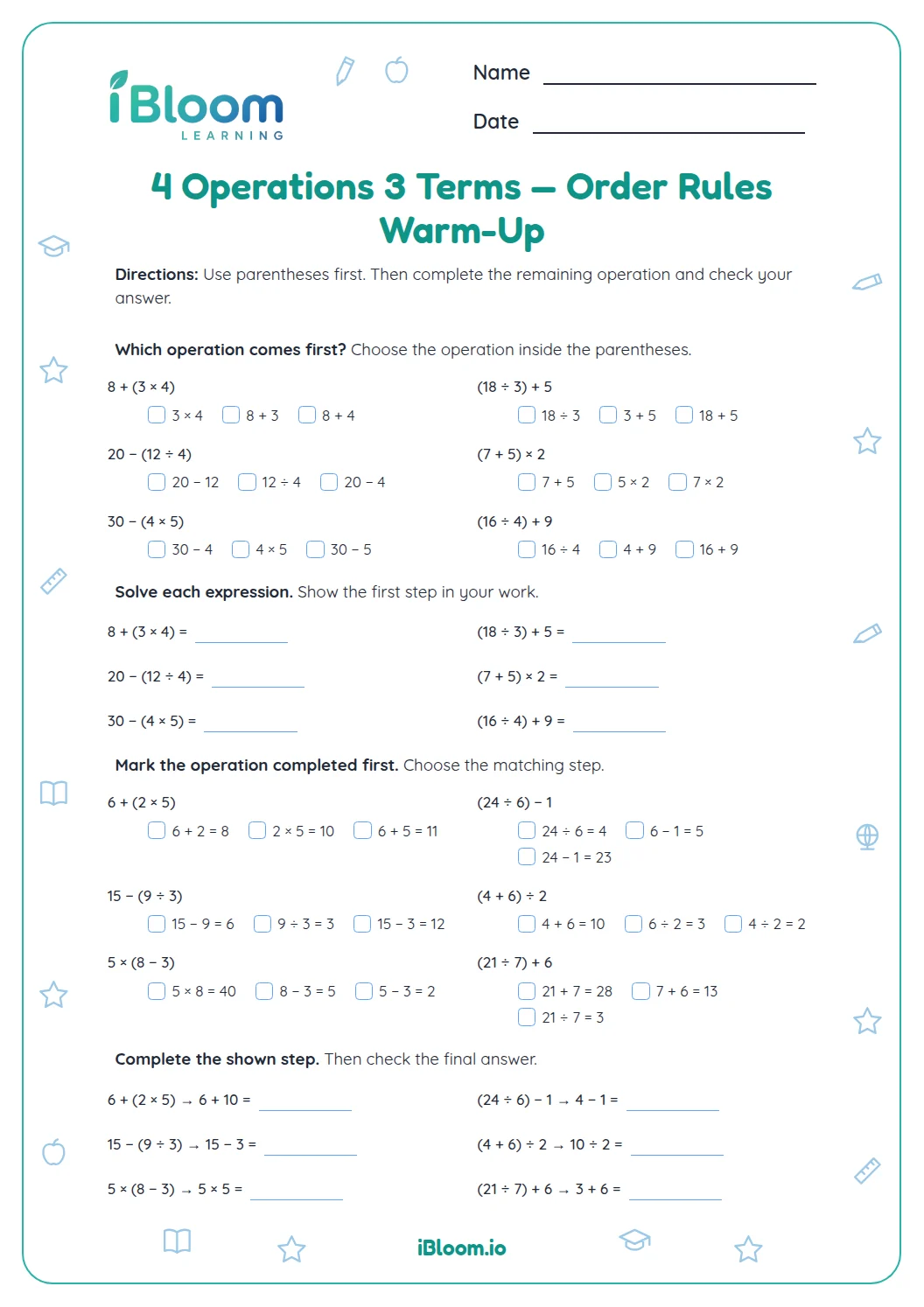
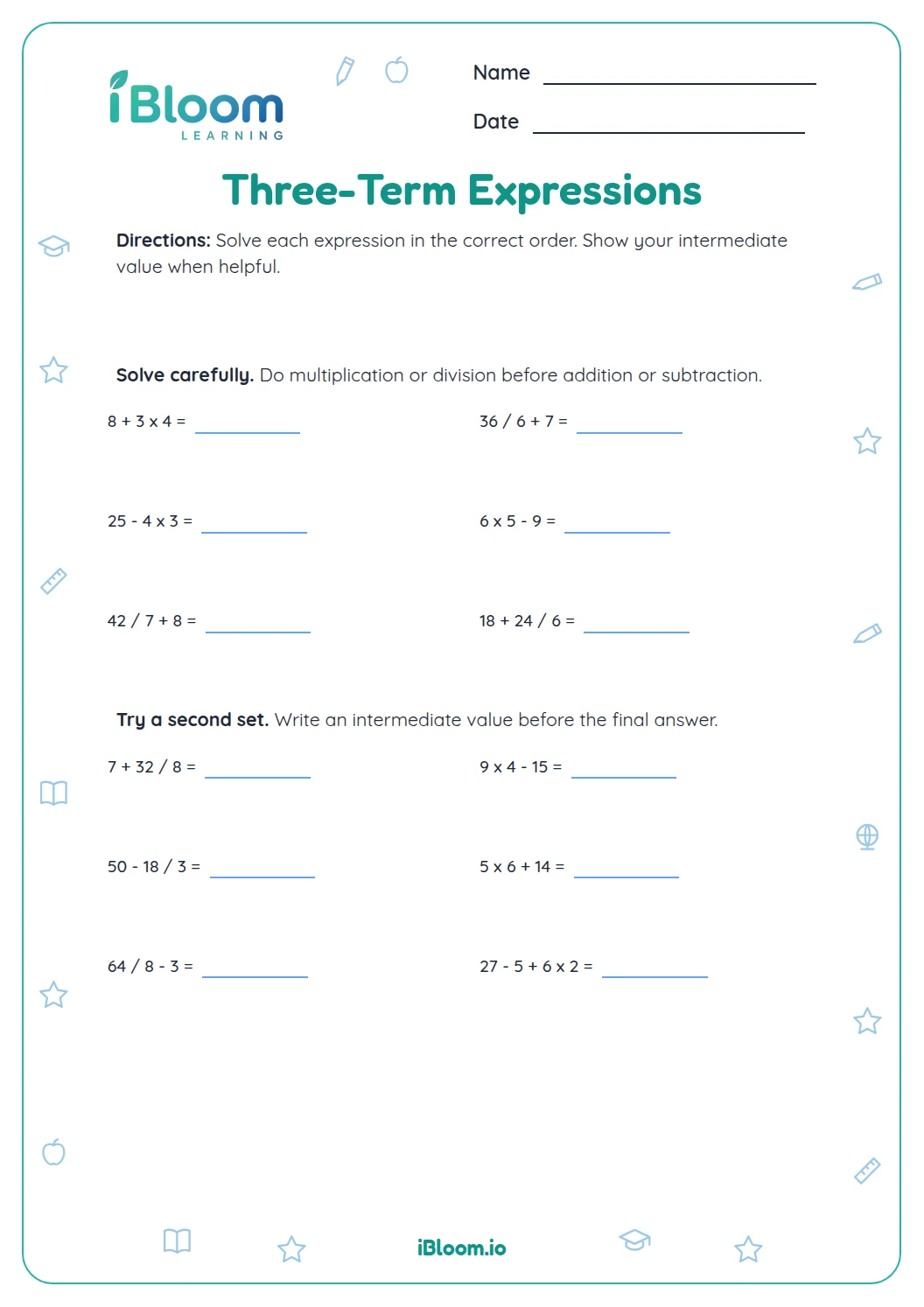
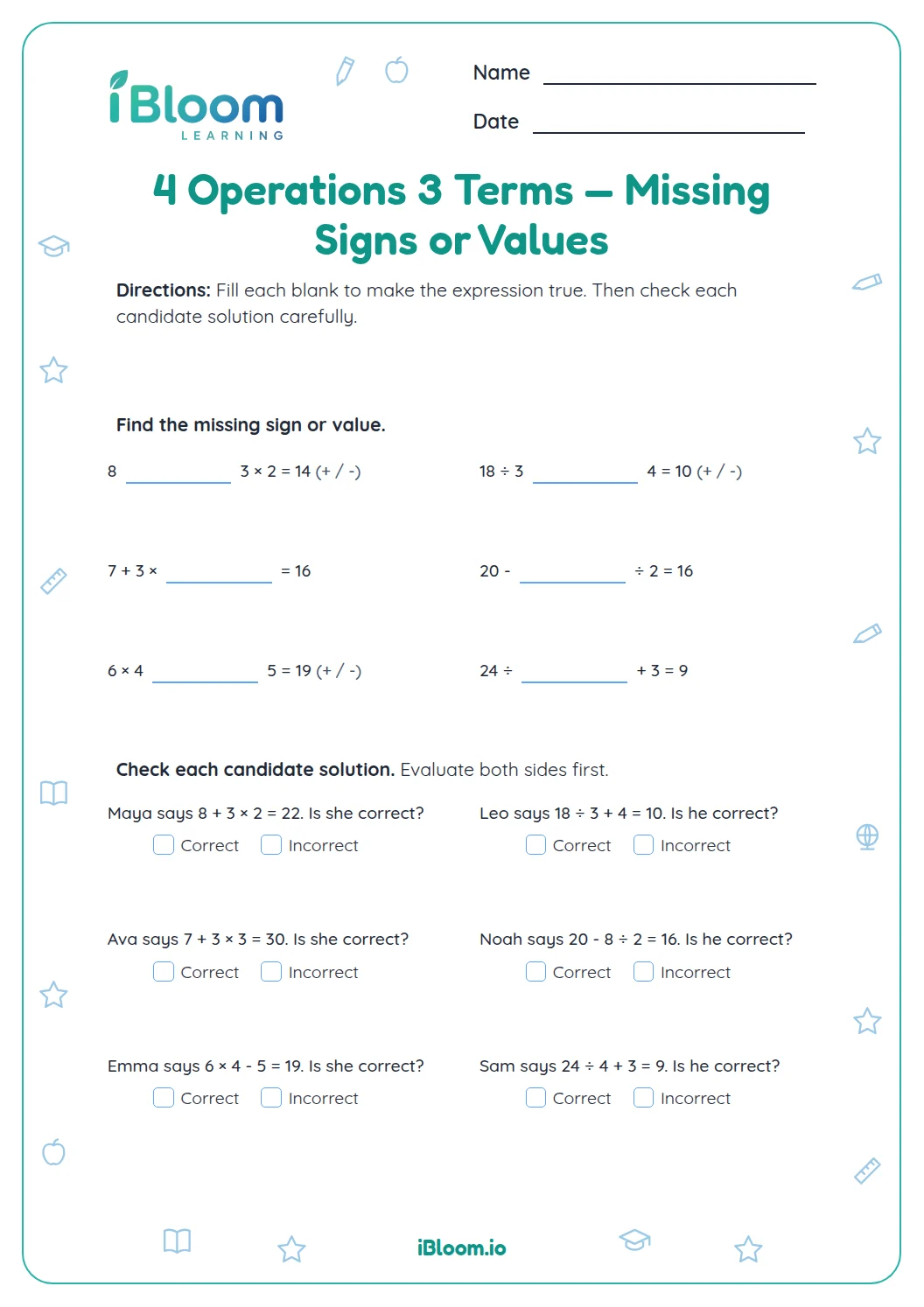
This printable worksheet gives students practice completing four-term expressions that use addition, subtraction, multiplication and division. Part A asks for the missing operation sign in a true equation; Part B asks for a missing value. It is designed for Grades 5–6. Each of the 16 questions has one correct answer, with a separate key for checking.
How can operation order complete an equation?
For a missing-sign question, test the operation in the blank and evaluate the full expression. For a missing-value question, substitute a number and check that both sides match.
- 124 ÷ 6 + 3 × 2 = 10
- 2Evaluate division and multiplication first: 4 + 6 = 10.
- 3The equation is true with + between 6 and 3.
What kinds of questions are included?
Part A has eight missing-sign equations with one sign that makes the equality true. Part B has eight missing-value equations; each answer makes both sides equal.
- Part A: Choose the missing sign
- A separate answer key follows the worksheet pages.
How can students work through the page?
- 1In Part A, test each operation sign using operation order.
- 2Evaluate multiplication and division before addition and subtraction.
- 3For operations at the same level, work from left to right.
- 4In Part B, substitute a possible value and check the whole equation.
- 5Record one sign or number in each blank and check with the key.
Common order-of-operations mistakes
The mistake
Evaluating every operation strictly from left to right.
The fix
Do multiplication and division first, then addition and subtraction; move left to right within a priority level.
The mistake
Choosing a sign by looking only at the first two numbers.
The fix
Evaluate the complete expression on both sides before deciding whether the equation is true.
The mistake
Filling a missing value without substituting it back.
The fix
Replace the blank with your number and verify that both sides have the same value.
What to practice next
Make more practice
Questions parents and teachers ask
How should students choose a missing sign?
They should try the listed operation, follow the usual operation order, and see whether the completed equation is true. The answer choices are operation signs, and only one produces equal values on the two sides. Substitution is a useful final check because it confirms the complete equality, not just one side.
How do students find a missing value?
Use the expression's operation order to reason about the unknown, then substitute the candidate into the blank. Evaluate both sides to confirm they match. Checking the completed equation helps catch a misplaced operation or arithmetic slip. Substitution is a useful final check because it confirms the complete equality, not just one side.
Do multiplication and division always go before addition and subtraction?
Yes. Multiplication and division have priority over addition and subtraction. When multiplication and division appear together, work from left to right; the same left-to-right rule applies to addition and subtraction. Substitution is a useful final check because it confirms the complete equality, not just one side.
How many questions are on this worksheet?
There are 16 questions in two parts: eight missing-sign questions and eight missing-value equations. Each question has one answer, and a separate answer key lists the signs and numbers. Substitution is a useful final check because it confirms the complete equality, not just one side.
Why are the choices operation signs instead of equations?
Each prompt already prints one expression with a blank where the sign belongs. Choosing the sign completes that expression directly, so students can focus on which operation makes the statement true. Substitution is a useful final check because it confirms the complete equality, not just one side.