




About this worksheet
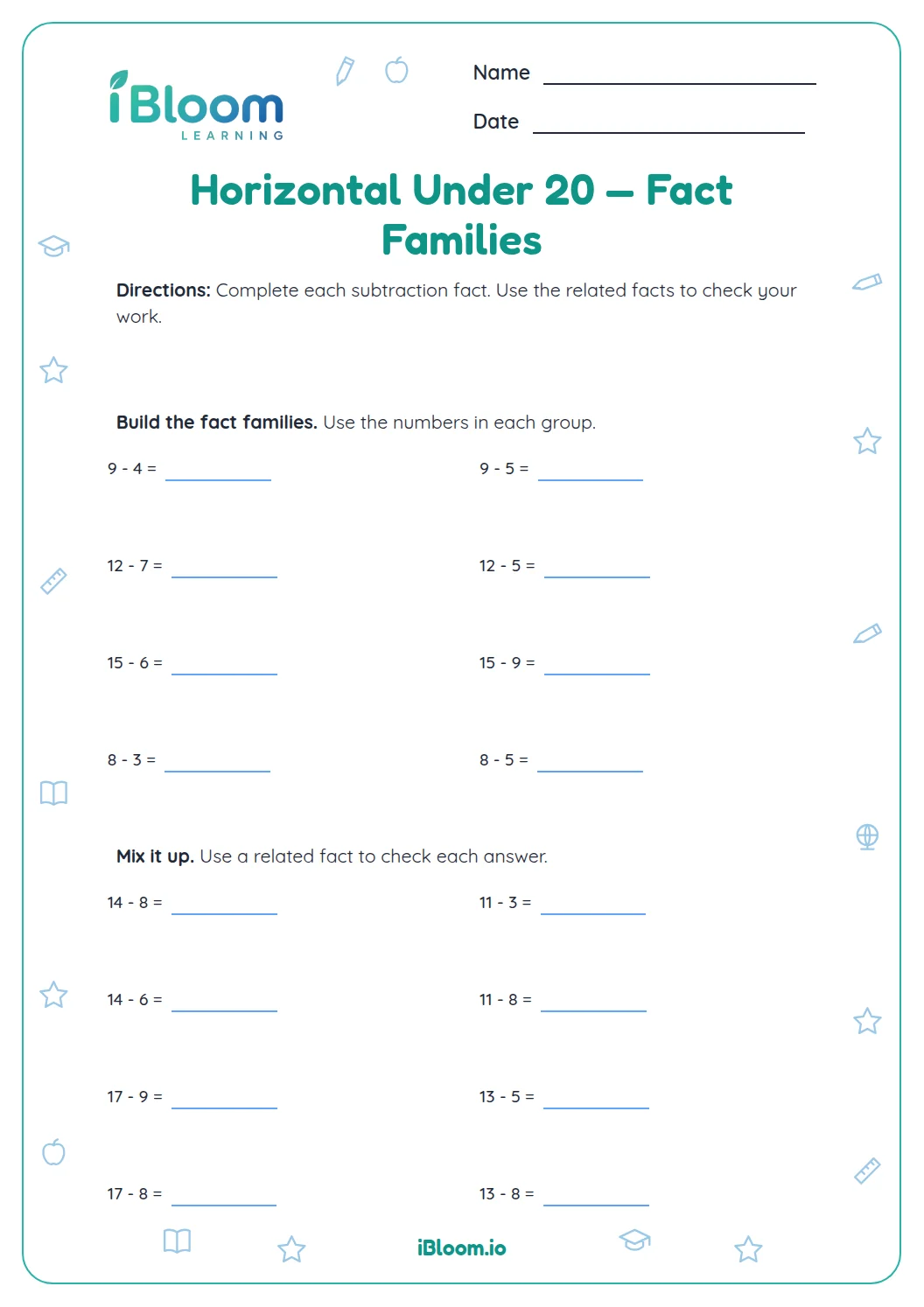
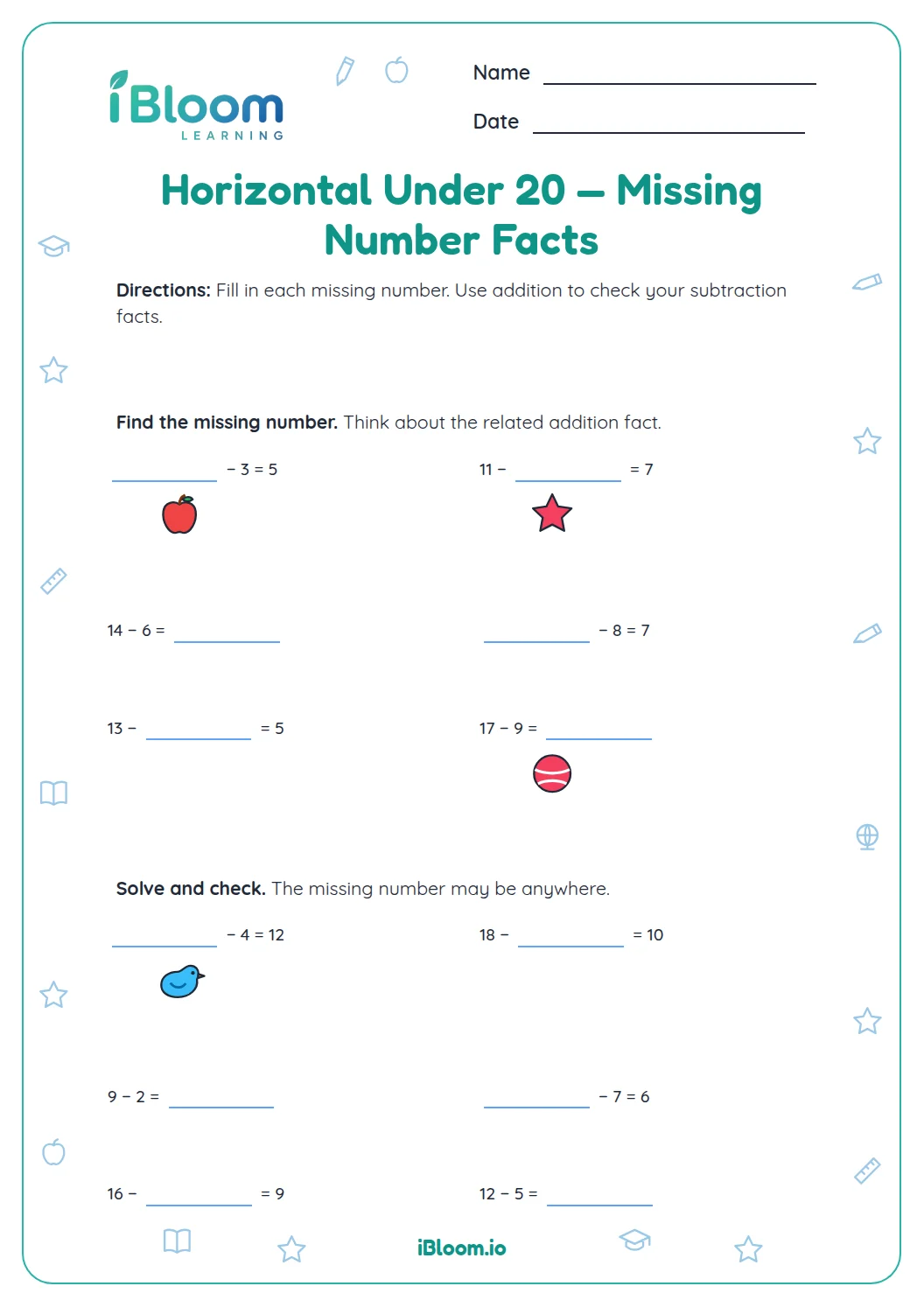
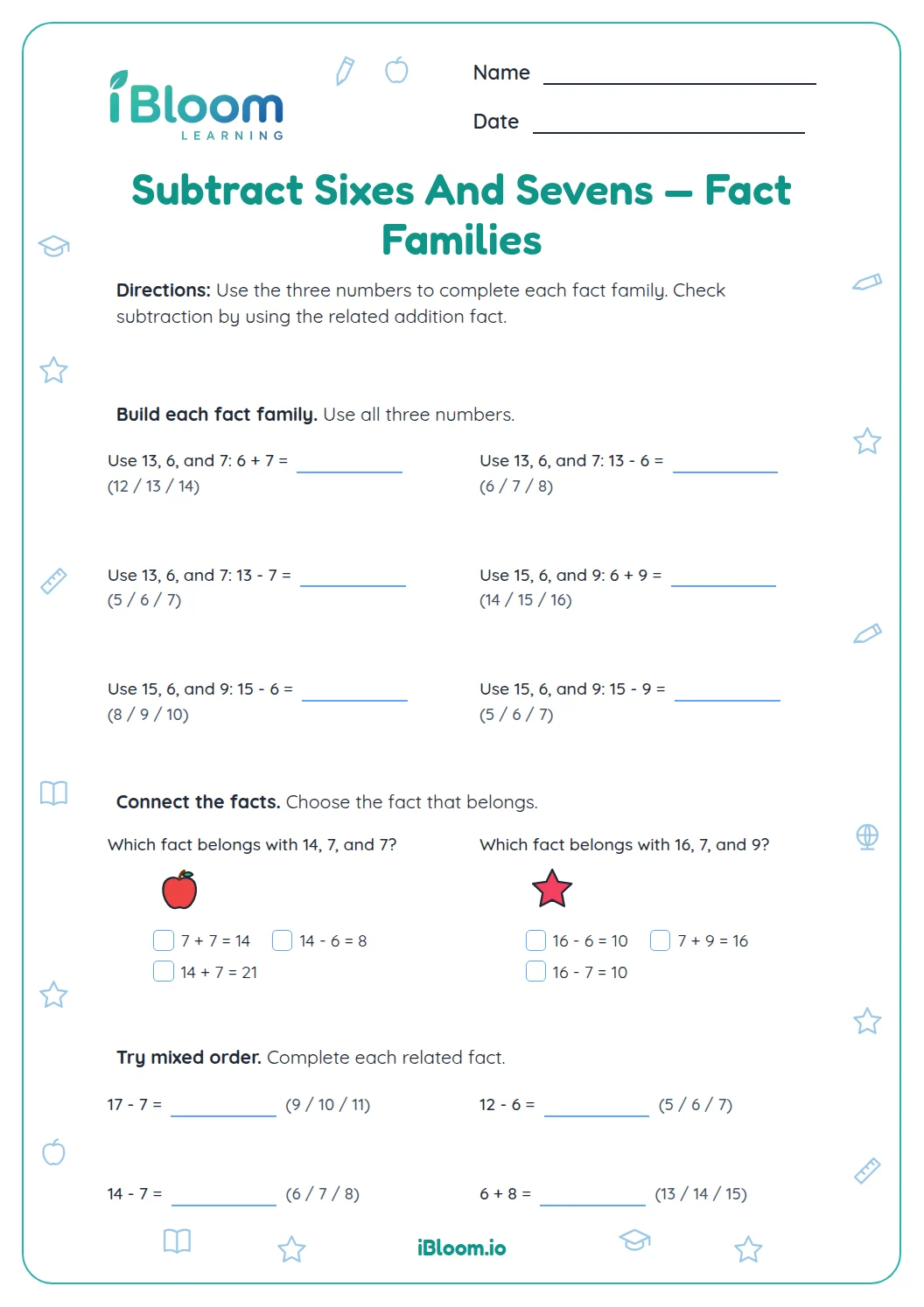
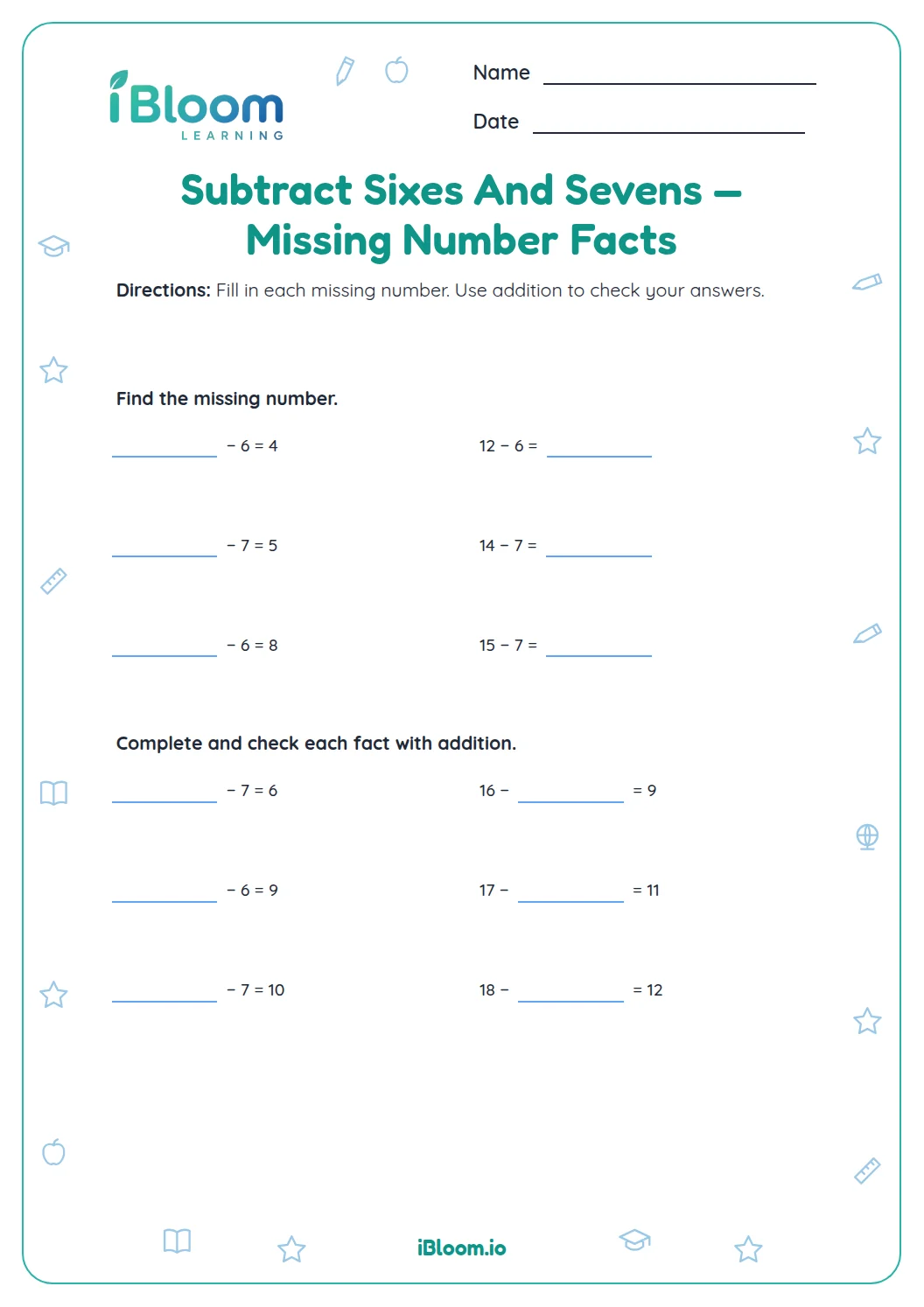
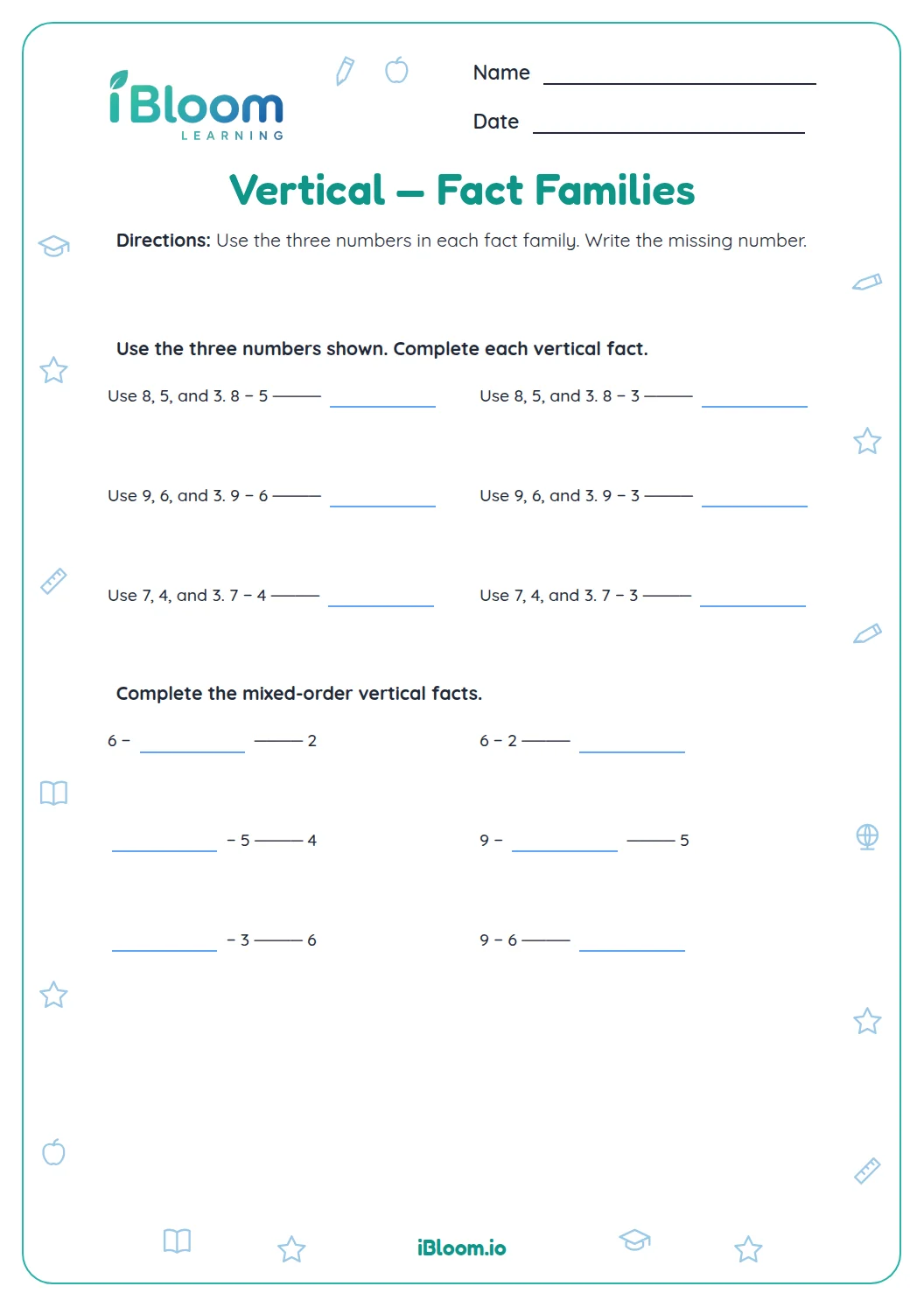
This free printable gives Grade 1 learners 18 problems practicing subtraction facts using numbers below 10. Every student prompt includes its known numbers, with blanks only where the student supplies an answer or missing number. The two parts move from solving complete facts to completing missing-number equations. The sheet practices Common Core 1.OA.C.6 through subtraction within 20 and fluency with facts within 10; a separate two-page key supports checking the work.
Aligned to 1.OA.C.6
How can a child solve each subtraction fact?
In the first part, solve each complete fact by counting back or recalling a related fact. For example, 8 − 3 = 5 shows the difference after taking away the second number. Check by adding the difference to the number subtracted; the total should return to the starting number.
- 18 − 3 = ___
- 28 − 3 = 5
- 3Check: add the difference and subtrahend to get the minuend.
How do missing-number facts work?
Each subtraction equation has a starting number (minuend), a number taken away (subtrahend), and a difference. If the subtrahend is blank, subtract the difference from the minuend. If the minuend is blank, add the subtrahend and difference.
How is the practice organized?
There are 18 questions in two parts. Part A has six complete subtraction facts and six equations with a missing subtrahend. Part B has six equations with a missing minuend. Each problem is printed as a one-line equation with its given numbers visible.
- Part A: solve complete facts and find missing subtrahends
- Part B: find missing minuends
- Check all 18 answers with the separate key
How can we use the worksheet?
- 1Read the minuend and subtrahend in each complete fact.
- 2Solve the first six equations by counting back or recalling a fact.
- 3For a missing subtrahend, compare the starting number with the difference.
- 4For a missing minuend, add the subtrahend and the difference.
- 5Use addition to check each answer, then compare with the key.
Common subtraction slips and quick fixes
The mistake
Adding the two numbers instead of subtracting them.
The fix
Point to the minus sign and say “take away” before solving.
The mistake
Reversing the starting number and the amount taken away.
The fix
Read the fact left to right; the starting number comes before the minus sign.
The mistake
Writing a difference larger than the starting number.
The fix
Check the size: taking away a positive amount leaves fewer than you started with.
Common Core alignment
This worksheet practices a Grade 1 subtraction fluency standard.
Solve subtraction facts within 20 and build fluency with facts within 10.
On this sheet: The worksheet asks students to solve and complete subtraction equations within 20.
Show the official wordingHide the official wording
Add and subtract within 20, demonstrating fluency for addition and subtraction within 10. Use strategies such as counting on; making ten (e.g., 8 + 6 = 8 + 2 + 4 = 10 + 4 = 14); decomposing a number leading to a ten (e.g., 13 − 4 = 13 − 3 − 1 = 10 − 1 = 9); using the relationship between addition and subtraction (e.g., knowing that 8 + 4 = 12, one knows 12 − 8 = 4); and creating equivalent but easier or known sums (e.g., adding 6 + 7 by creating the known equivalent 6 + 6 + 1 = 12 + 1 = 13).
What to practice next
Make more practice
Further reading
Questions parents and teachers ask
Are the numbers printed on the student pages?
Yes. Each equation shows all of its given numbers on the student sheet, with a blank for the answer or the one missing value. Students do not need the key to discover which numbers to subtract. The separate key gives completed answers for checking after the work is done.
How many questions and pages are included?
The worksheet has 18 questions across two student pages, followed by two answer-key pages. Six questions ask for a difference, six have a missing subtrahend, and six have a missing minuend. The parts progress from complete facts to missing-number equations.
What is a missing minuend?
The minuend is the number you start with in a subtraction equation. In ___ − 4 = 5, the student adds 4 and 5 to find the starting number, 9. The last six questions on this worksheet use that missing-starting-number structure.
How can a student check an answer?
Add the difference to the subtrahend. The sum should match the minuend. For example, after solving 14 − 6 = 8, check that 8 + 6 returns to 14. This related addition fact works for complete equations and for either kind of missing-number problem.
What does the answer key show?
The key gives the correct missing value for each numbered question on two separate pages. Students can complete one part first, then use the key to find any equation to review. For a useful check, cover the key until the student has tried all 18 questions.