Free printable practice
Geometry Practice Activities
Printable Class 1 geometry worksheets for recognising, drawing, moving, comparing and describing 2D and 3D shapes.
Explore Geometry
Free printable worksheet PDFs
Preview every available page, then download the free worksheet PDF for home, homeschool, tutoring, or classroom practice.
Preview the exact activity before downloading it.
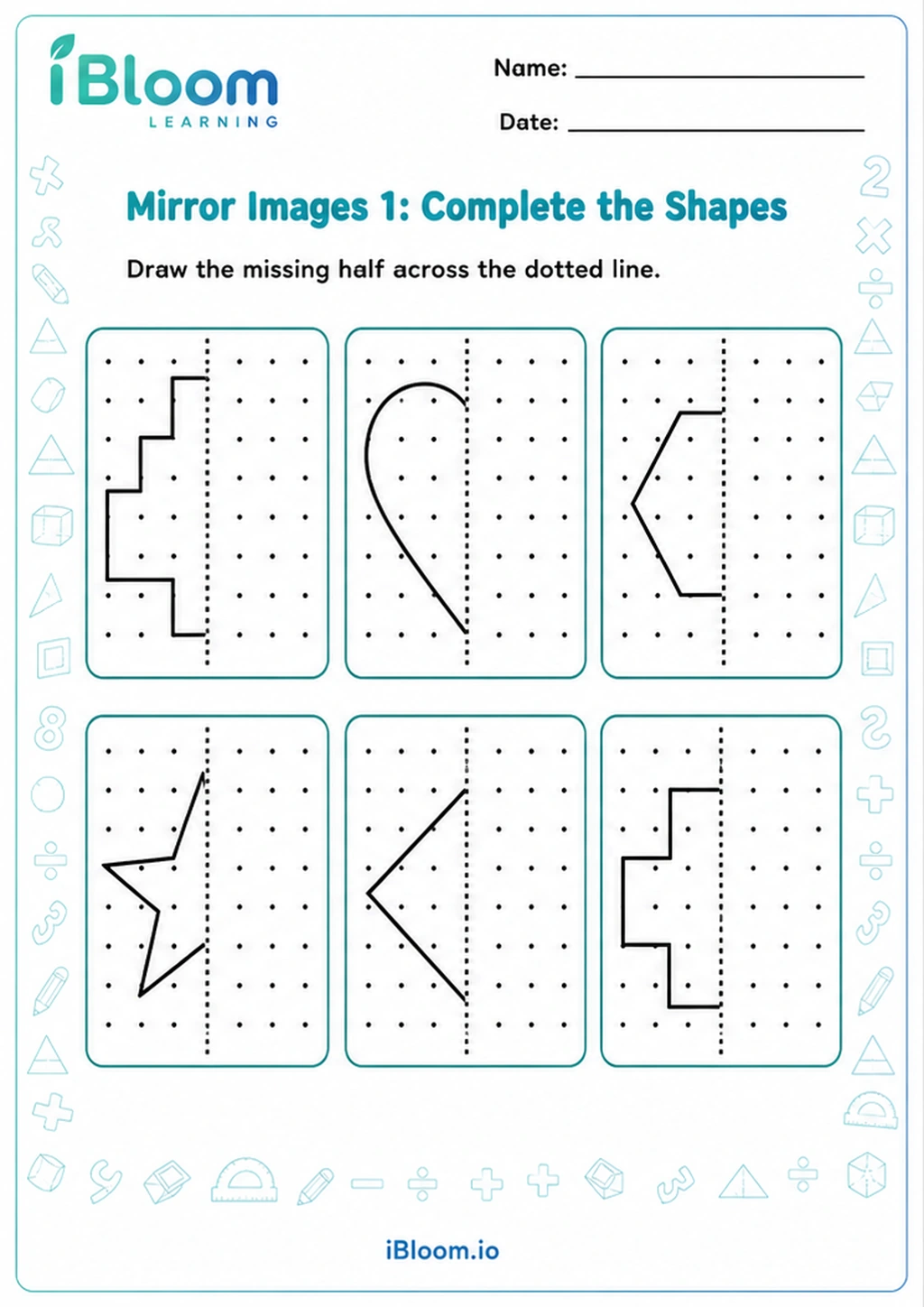 Mirror Images 1: Complete the ShapesClass 1 printable practice for Mirror Images and Symmetry.Class 1Free PDF preview
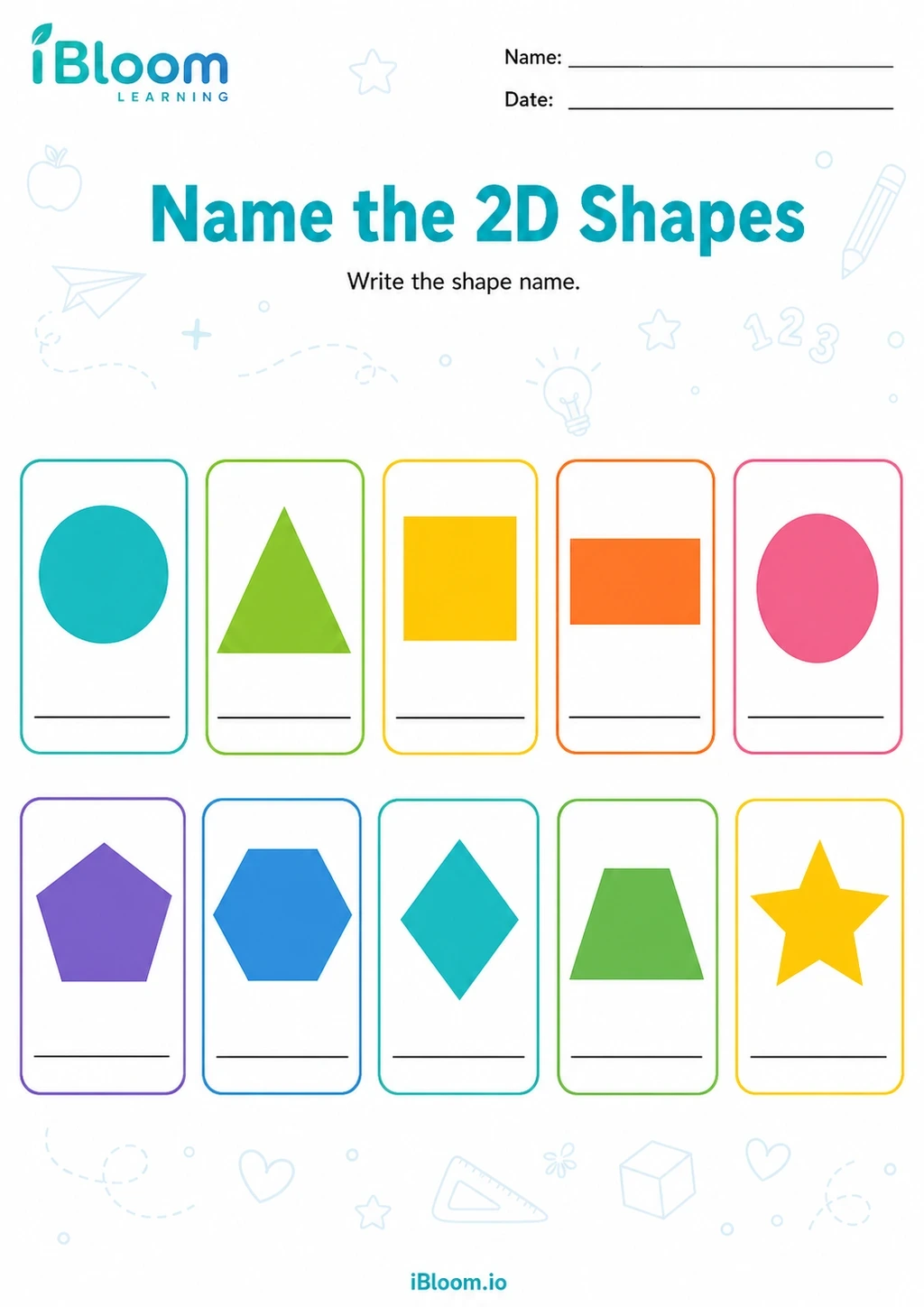 Name the 2D ShapesA Class 1 geometry worksheet where children name common 2D shapes from pictures.Class 1Free PDF preview
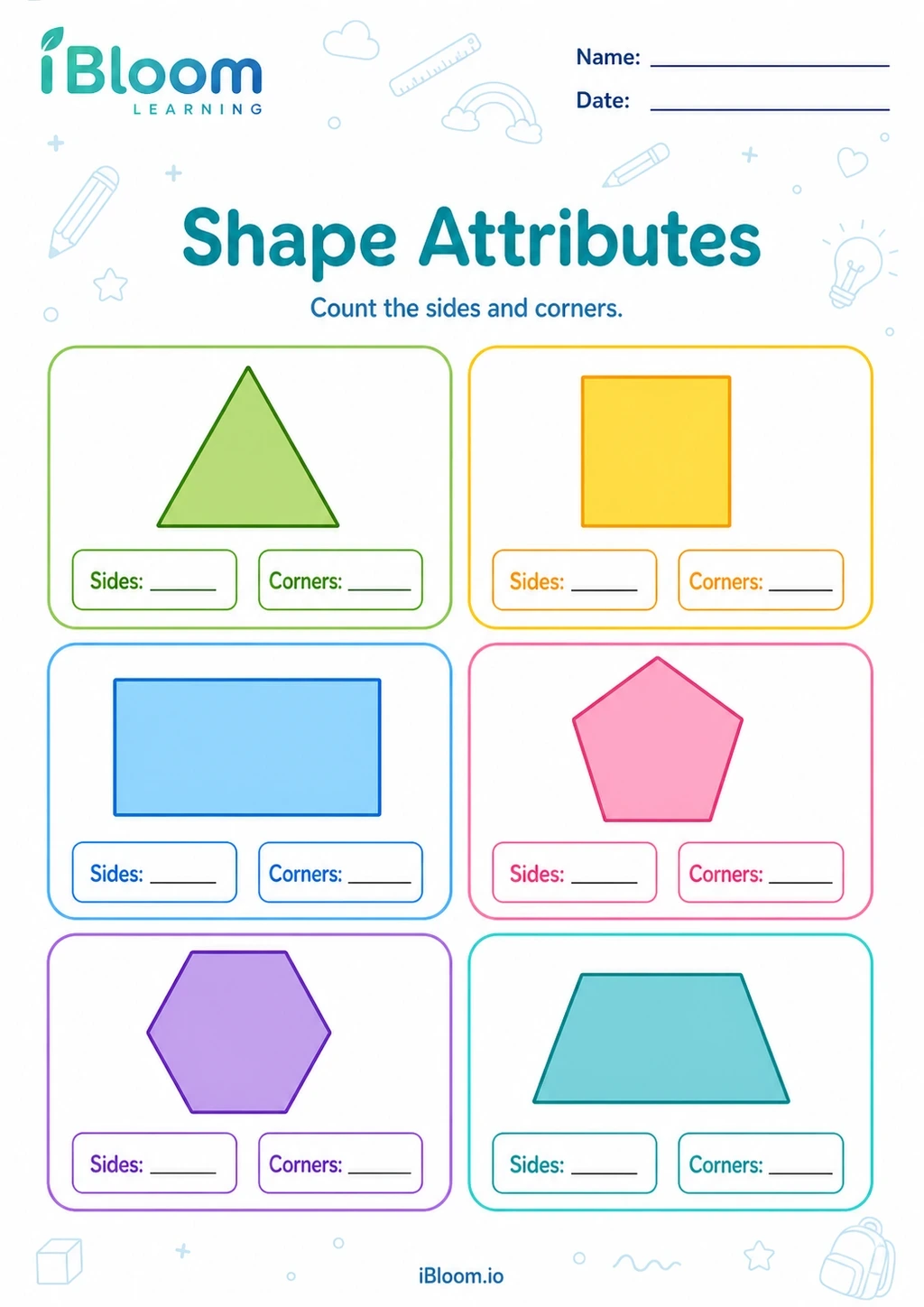 Shape AttributesA Class 1 geometry worksheet where children count sides and corners of common two-dimensional shapes.Class 1Free PDF preview
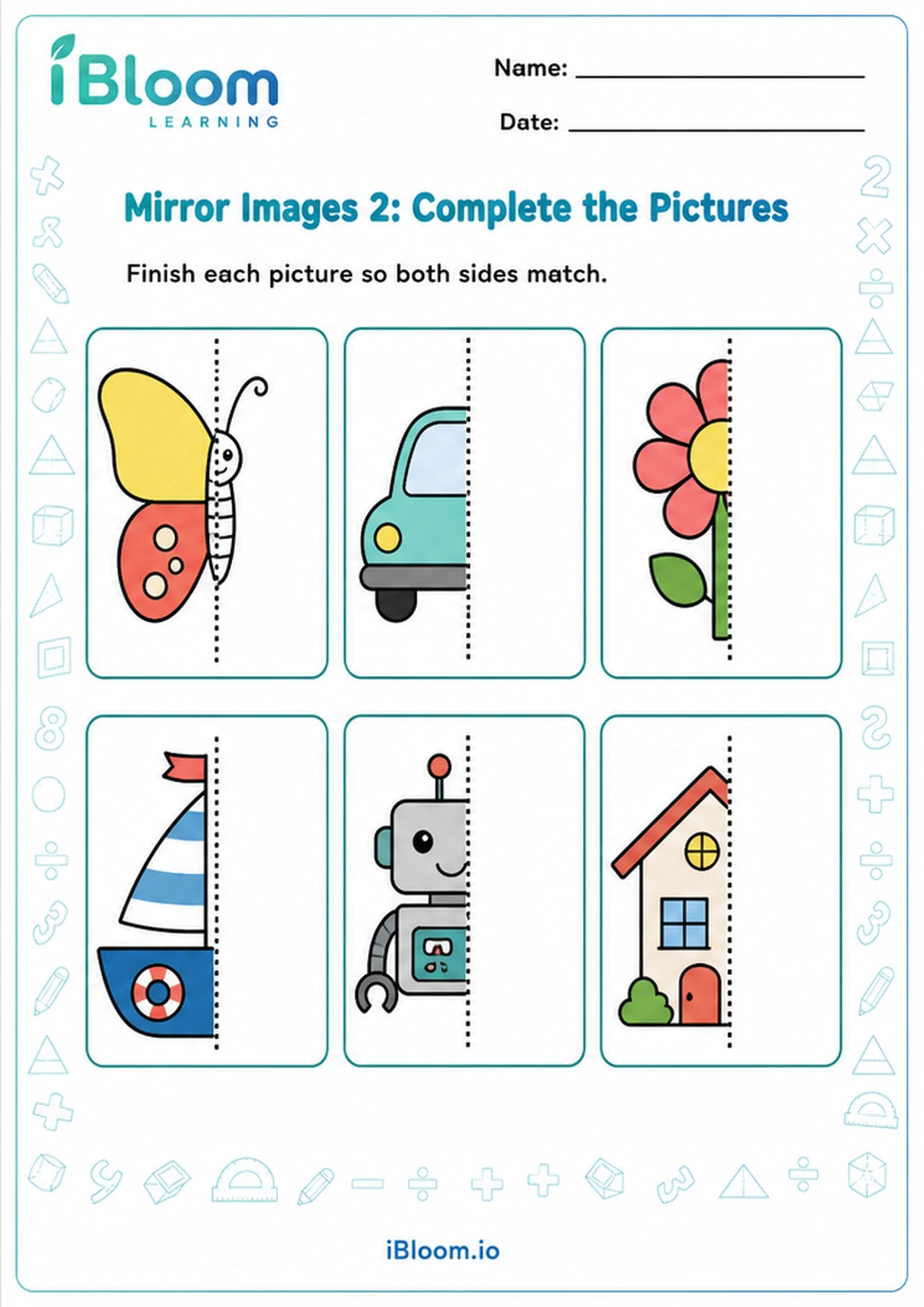 Mirror Images 2: Complete the PicturesClass 1 printable practice for Mirror Images and Symmetry.Class 1Free PDF preview
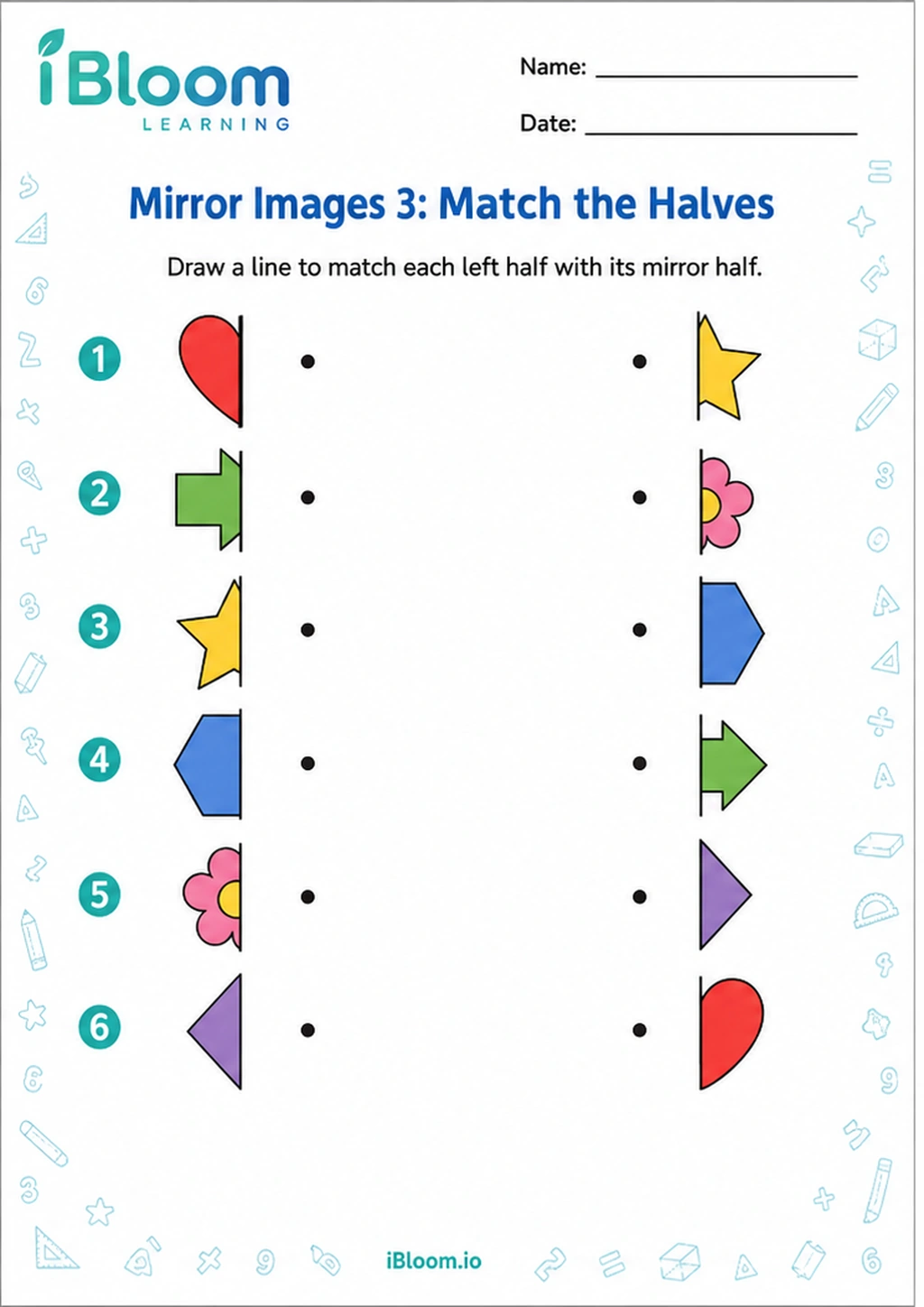 Mirror Images 3: Match the HalvesClass 1 printable practice for Mirror Images and Symmetry.Class 1Free PDF preview
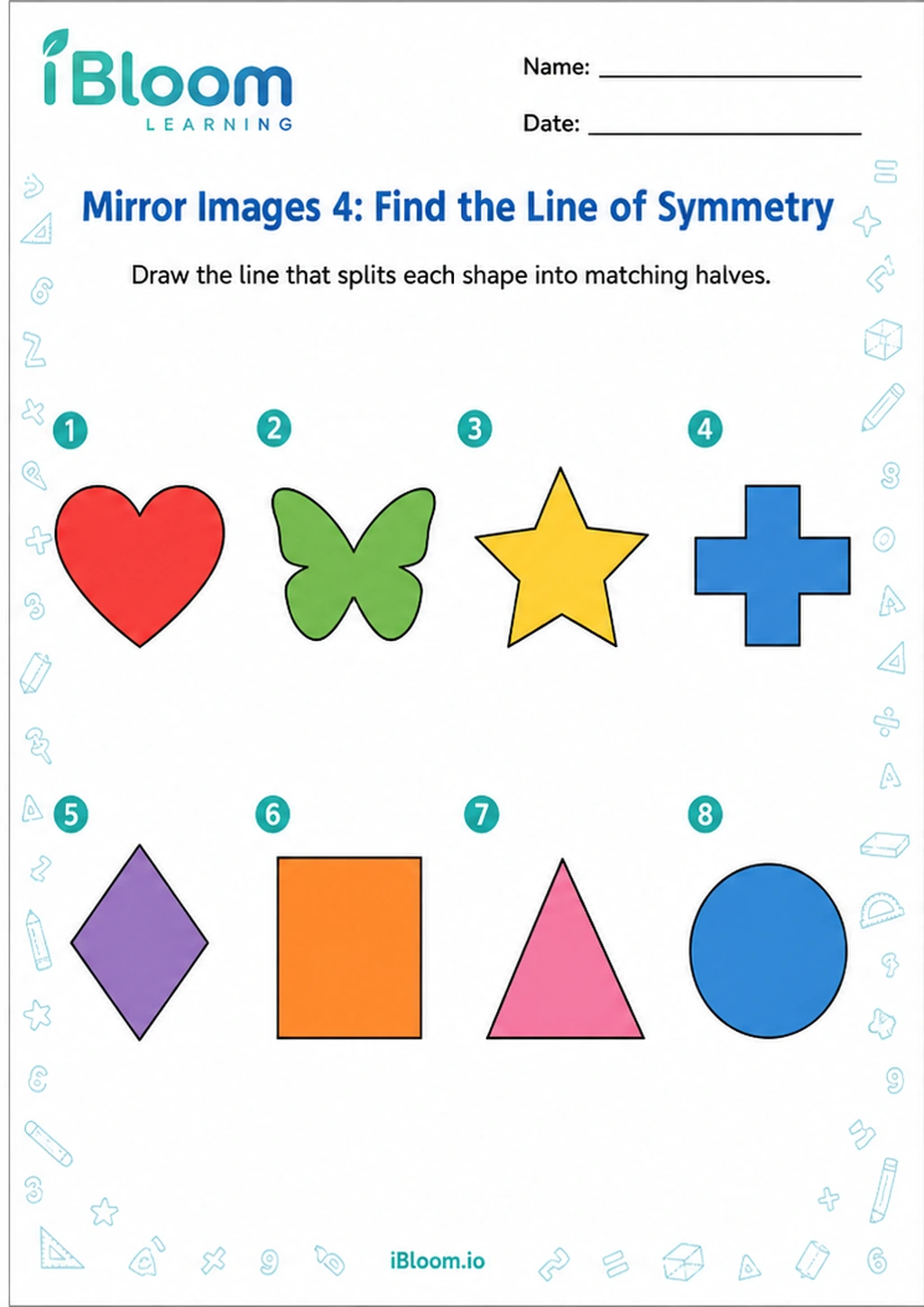 Mirror Images 4: Find the Line of SymmetryClass 1 printable practice for Mirror Images and Symmetry.Class 1Free PDF preview
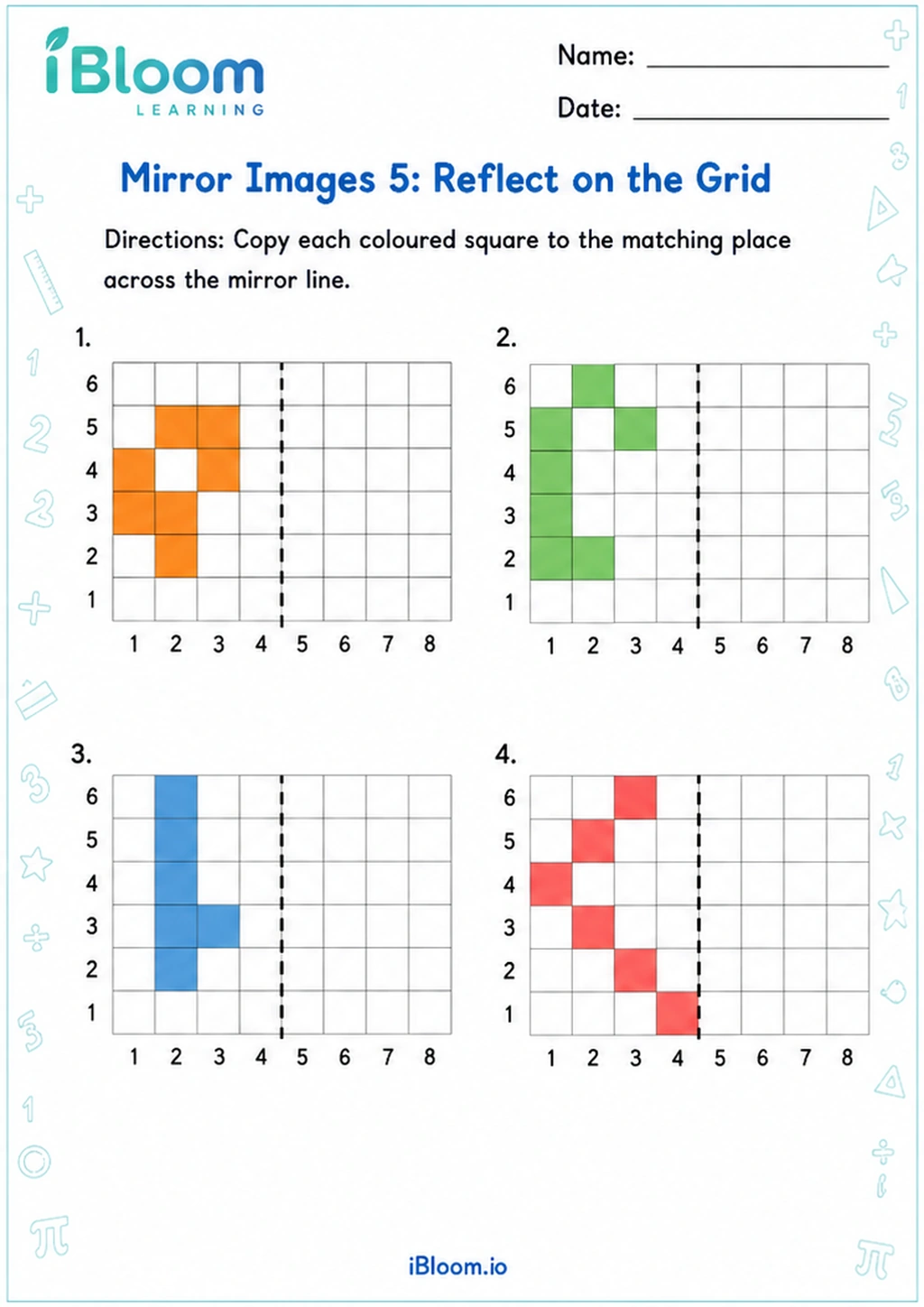 Mirror Images 5: Reflect on the GridClass 1 printable practice for Mirror Images and Symmetry.Class 1Free PDF preview
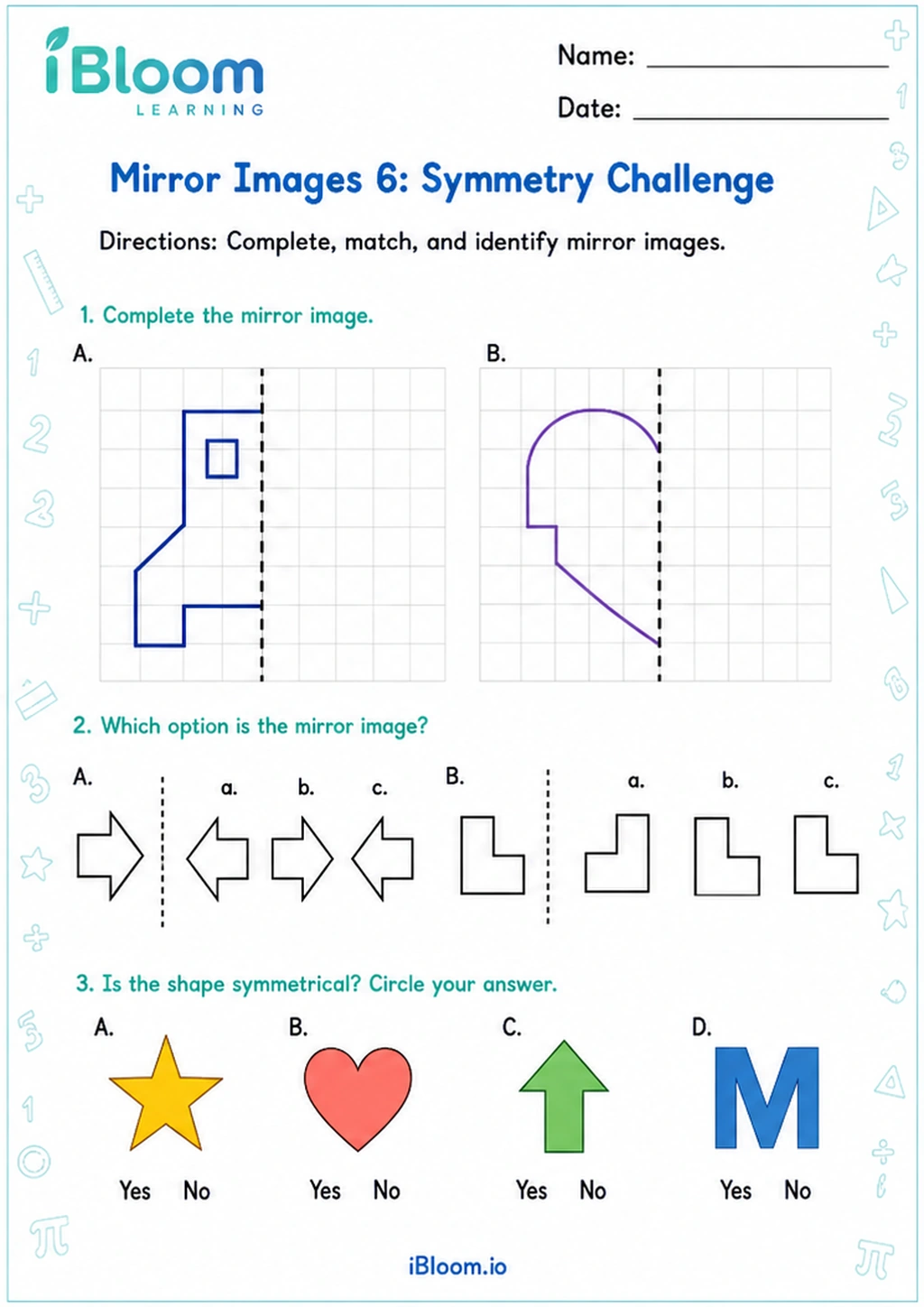 Mirror Images 6: Symmetry ChallengeClass 1 printable practice for Mirror Images and Symmetry.Class 1Free PDF preview
Practice that builds confidence
Building shape understanding
These Class 1 geometry worksheets help children explore shapes through naming, identifying, drawing, rotating, scaling, mirror images, symmetry, 3D objects and position words. The activities build visual thinking along with the maths vocabulary children need to describe what they see.
Each printable worksheet uses clear pictures, tracing, matching, colouring, sorting and simple drawing tasks. Children practise with familiar shapes and objects so they can connect classroom geometry to tiles, boxes, balls, doors, books and everyday patterns.
Class 1 geometry begins with recognising common 2D shapes, saying their names and noticing features such as sides, corners, curved edges and flat faces. The worksheets move from simple shape identification to drawing 2D shapes, matching shapes to names, and comparing how shapes look when they are turned, resized or shown in a different position.

From flat shapes to solid objects
Children also meet 3D shapes through real-world examples: a cube may look like a dice or box, a sphere like a ball, a cylinder like a can, and a cone like an ice-cream cone. These pages help learners separate flat shapes from solid shapes and use words such as face, edge, corner, side, straight, curved, above, below, inside, outside, left and right.
Parent routine for home practice
Choose one worksheet and first ask your child to point to shapes they already know. Then let them complete a small section independently. After checking, use the room around you: “Find something shaped like a rectangle,” “Which object is under the table?” or “What shape do you see if this page is turned?” For mirror-image practice, fold a paper or use a spoon and let your child notice what stays the same and what changes.

Classroom uses for teachers
Teachers can use these printables for maths centres, early finisher tasks, revision after a geometry lesson, or small-group support. Rotate 2D shapes and mirror image sheets work well for visual reasoning; positions worksheets support language development; scaling tasks help children notice that a shape can become bigger or smaller while keeping the same form.

Common errors to watch for
Many children call every four-sided shape a square, confuse rectangles with squares, or think a rotated triangle is a new shape. Some may focus only on colour or size instead of shape properties. In 3D shape work, children may mix up a circle with a sphere or a square with a cube. Encourage them to explain using sides, corners, faces and whether the shape is flat or solid.
Free printable PDF download
Use this Class 1 geometry worksheet page to preview the activity, print it, or download it as a PDF for quick practice. It works well for homework, homeschool lessons, tutoring, morning work, revision, and classroom centers.
Answers and answer key support
After the child completes the worksheet independently, parents and teachers can use the answer support or answer key information to check the work, review mistakes, and choose the next practice step.
Why iBloom worksheets help
The iBloom sequence gives children repeated practice without making the page feel crowded. Tasks combine seeing, saying, drawing and comparing, so learners do not only memorise names. A helpful child-friendly strategy is: “Look, turn, trace, tell.” Look at the shape, turn the page if needed, trace its outline with a finger, and tell one thing about it before choosing an answer.
Helpful answers
Frequently asked questions
What geometry skills do these Class 1 worksheets cover?
They cover shape names, identifying and drawing 2D shapes, 3D shapes, rotating and scaling 2D shapes, mirror images, simple symmetry and position words such as above, below, inside and outside.
How can I explain the difference between 2D and 3D shapes to my child?
Use simple language: 2D shapes are flat, like a circle drawn on paper; 3D shapes are solid, like a ball, box or can. Ask your child to touch real objects and decide whether they are flat pictures or solid things.
Why does my child not recognise a shape after it is rotated?
Young learners often depend on the usual position of a shape. Let them turn the worksheet or trace the outline with a finger so they notice that the number of sides and corners stays the same.
Are these worksheets useful for learning position words?
Yes. The positions activities ask children to describe where objects are placed, helping them practise words such as left, right, top, bottom, near, far, inside and outside in a visual way.
How should teachers use these geometry printables in class?
Teachers can use them after teaching a shape concept, in maths centres, for quick revision, or with small groups that need extra support in shape recognition, symmetry or spatial language.
Is this Class 1 geometry worksheet free?
Yes. You can preview it for free and use the printable worksheet for home or classroom practice.
Can I download this Class 1 geometry worksheet as a PDF?
Yes. Use the worksheet download option to save a printable PDF, or print the worksheet directly from the page.
Does this Class 1 geometry worksheet include answers or an answer key?
When the activity has fixed answers, iBloom includes answer support so parents and teachers can check the completed worksheet.