Free printable practice
Shapes Names Practice Activities
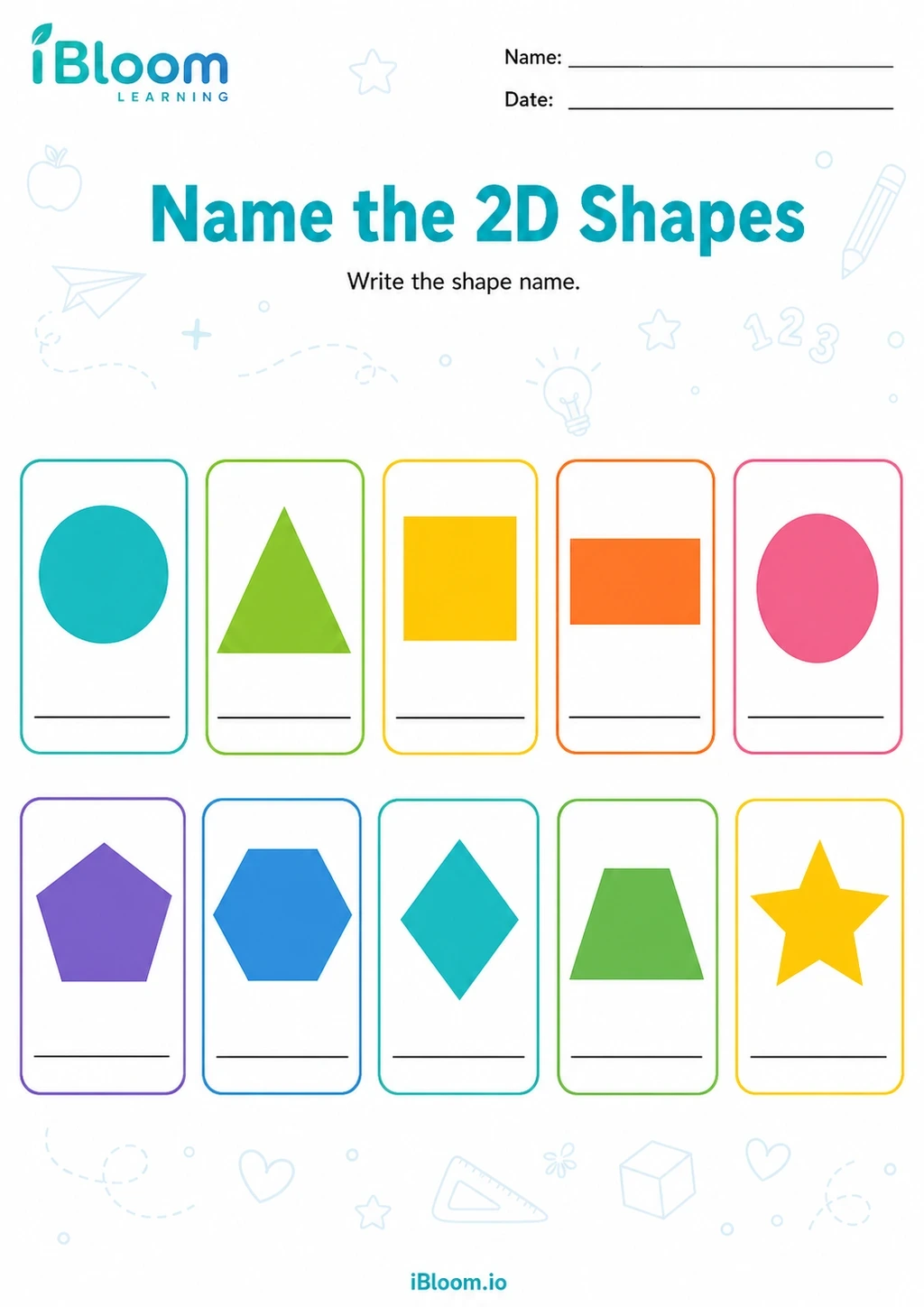
Printable Class 1 maths worksheets that help children recognise, name, trace, match and sort common shapes in early geometry.
Free printable worksheet PDFs
Preview every available page, then download the free worksheet PDF for home, homeschool, tutoring, or classroom practice.
Preview the exact activity before downloading it.
Practice that builds confidence
Building shape vocabulary
These Class 1 maths worksheets help children practise recognising and naming common shapes such as circle, square, triangle, rectangle, oval, diamond, star and heart. Children connect each shape name with its outline, sides, corners and familiar real-life objects.
The printable activities include tracing, matching, colouring, identifying, sorting and simple shape-word practice. They build early geometry vocabulary while giving children repeated chances to see shapes in different sizes, positions and orientations.
Shape names are often a child's first step into geometry. These worksheets move from simple recognition to confident naming, so children learn that a circle is still a circle whether it is big, small, red or blue. Activities may ask learners to match a shape to its name, colour all triangles, circle the rectangles or trace words linked to shape pictures.

Understanding sides and corners
Class 1 children benefit from noticing features, not just memorising pictures. A square has 4 equal sides and 4 corners, while a rectangle has 4 sides but looks longer on one pair of sides. A triangle has 3 sides and 3 corners. A circle has no corners. Using words such as side, corner, straight, curved, same and different helps children explain their thinking clearly.
A simple parent routine
At home, choose one worksheet and first ask your child to name every shape they already know. Then point to one shape and ask, “How do you know?” After the page, do a quick room hunt: plate for circle, window for rectangle, tile for square or a rangoli pattern for triangle. Keep the focus on observation and correct naming rather than speed.

Classroom uses for teachers
Teachers can use these printables for maths practice, revision, morning work, small-group support or geometry centers. They also work well after a hands-on activity with cut-outs, blocks or shape cards. For mixed-ability groups, ask some children to simply identify shapes, while others describe sides and corners or sort shapes by shared features.

Common errors to watch for
Some children call every four-sided shape a square, mix up oval and circle, or identify a triangle only when its point is at the top. Others rely on colour instead of shape. Show the same shape in different sizes and rotations, and compare close examples: “This is a square because all sides look the same; this is a rectangle because it is longer.”
Free printable PDF download
Use this Class 1 shapes names worksheet page to preview the activity, print it, or download it as a PDF for quick practice. It works well for homework, homeschool lessons, tutoring, morning work, revision, and classroom centers.
Answers and answer key support
After the child completes the worksheet independently, parents and teachers can use the answer support or answer key information to check the work, review mistakes, and choose the next practice step.
Why iBloom worksheets help
The pages give focused practice without crowding the child with too many ideas at once. Clear pictures, repeated shape-name exposure and varied tasks help children move from seeing a shape to naming it accurately. A child-friendly strategy is: look at the outline, count corners, check sides, then say the shape name.
Helpful answers
Frequently asked questions
Which shape names should a Class 1 child practise first?
Start with circle, square, triangle and rectangle, then add oval, diamond, star and heart. Children should learn to recognise the shape and say its name clearly.
How can I help my child tell a square from a rectangle?
Ask your child to look at the sides. A square has 4 sides that look equal, while a rectangle has 2 longer sides and 2 shorter sides. Comparing a tile and a door can help.
Why does my child know a triangle only when it points upward?
Many children first learn shapes in one position. Show triangles turned sideways or upside down and count the 3 sides and 3 corners to prove they are still triangles.
Are these worksheets only for writing shape names?
No. They include visual recognition tasks such as matching, tracing, colouring, sorting and identifying shapes, along with practice using the correct shape names.
How can teachers use these shapes names worksheets in class?
Teachers can use them for geometry revision, independent practice, small-group support, maths centers or follow-up after using shape cards, cut-outs or classroom object hunts.
Is this Class 1 shapes names worksheet free?
Yes. You can preview it for free and use the printable worksheet for home or classroom practice.
Can I download this Class 1 shapes names worksheet as a PDF?
Yes. Use the worksheet download option to save a printable PDF, or print the worksheet directly from the page.
Does this Class 1 shapes names worksheet include answers or an answer key?
When the activity has fixed answers, iBloom includes answer support so parents and teachers can check the completed worksheet.