Free printable practice
Number Charts Practice Activities
Class 1 number chart worksheets for counting, number writing, skip counting, before-after numbers, even-odd numbers, and number words up to 100.
Explore Number Charts
Free printable worksheet PDFs
Preview every available page, then download the free worksheet PDF for home, homeschool, tutoring, or classroom practice.
Preview the exact activity before downloading it.
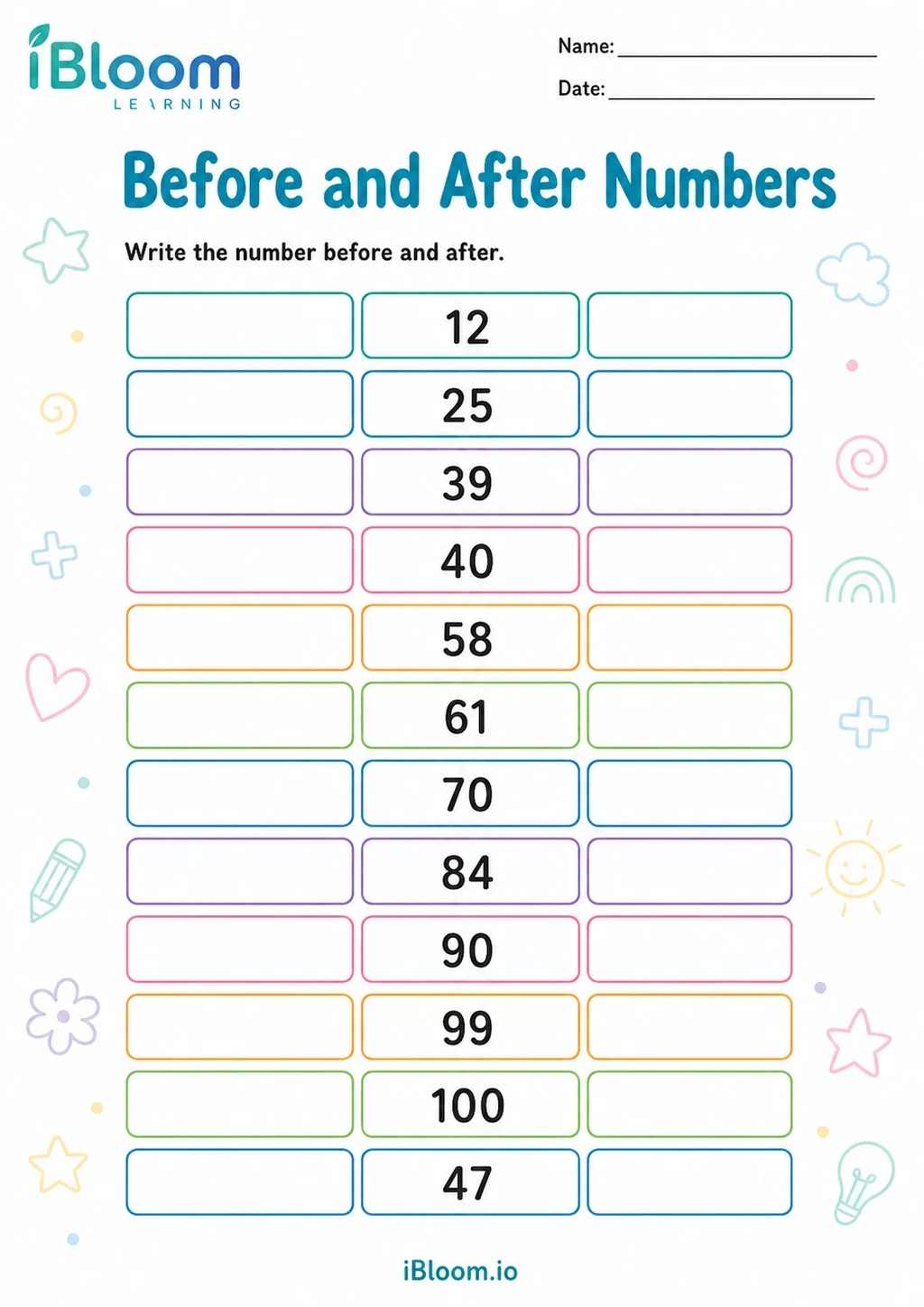 Before and After NumbersA Class 1 number-sequence worksheet where children write the number before and after each given number.Class 1Free PDF preview
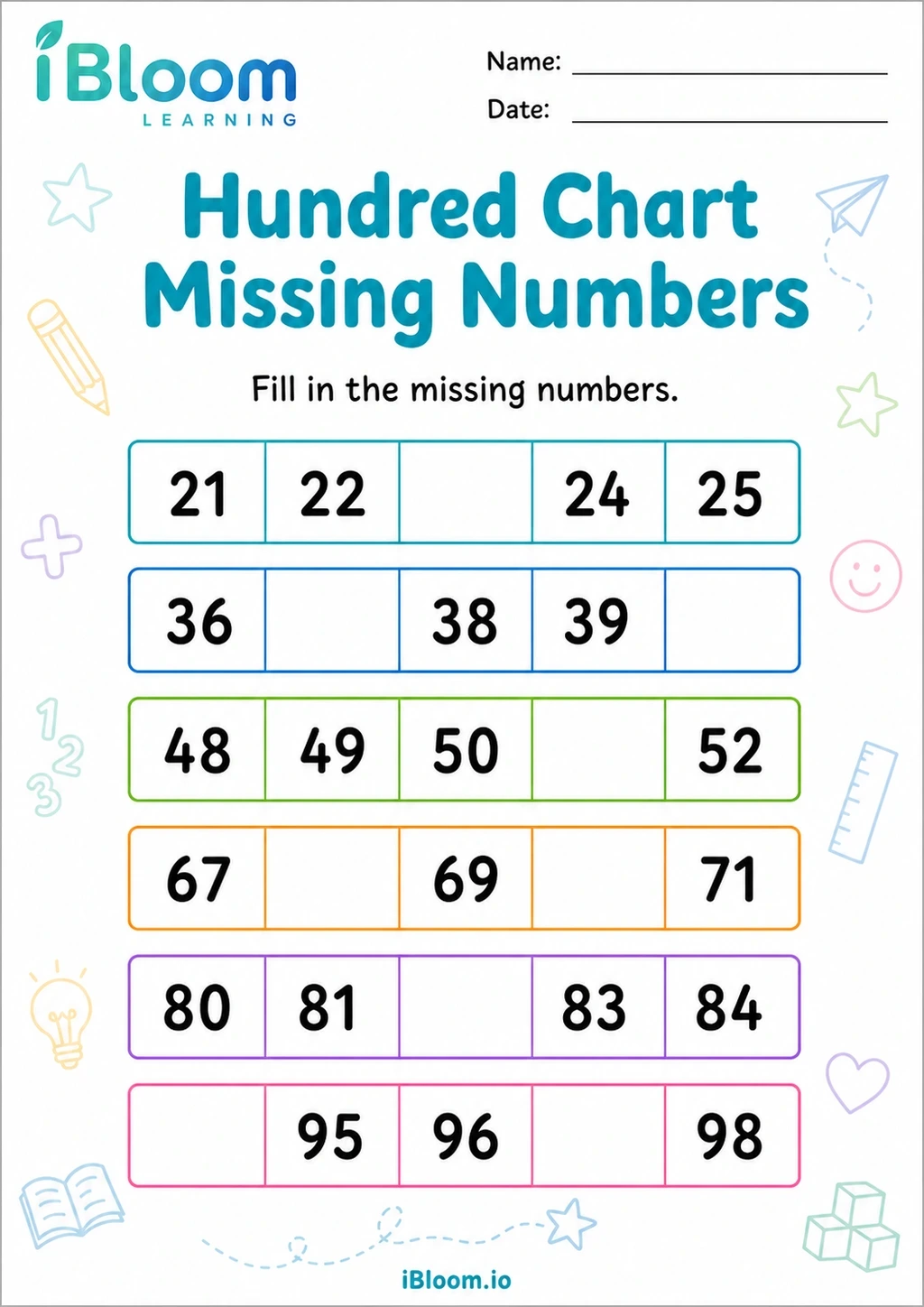 Hundred Chart Missing NumbersA Class 1 number chart worksheet where children fill missing numbers in short hundred-chart strips.Class 1Free PDF preview
Practice that builds confidence
What children learn with number charts
These Class 1 Mathematics worksheets help children build confidence with number charts, counting patterns, and writing numbers from 1 to 100. Learners practise counting objects and pictures, filling missing numbers, reading a full 1–100 chart, and understanding before and after numbers.
The printable activities include count-and-write tasks, number sequences, printing numbers in ranges such as 1–25, 26–50, and 76–100, skip counting by 2s, 3s, 4s, 5s, and 10s, counting backwards, number words from 51–100, and early even and odd number practice.
Number charts give Class 1 children a visual way to see how numbers grow, repeat, and connect. On these pages, children move from counting objects and pictures to reading rows of numbers, filling gaps, and noticing patterns such as 10, 20, 30 or 2, 4, 6, 8. The focus is not only on saying numbers aloud, but also on matching quantity, numeral, number word, and place in a sequence.

A clear progression from 1 to 100
The collection begins with familiar counting to 20 and 50, then extends to the full chart from 1 to 100. Printing practice is grouped into smaller ranges like 1–25, 26–50, and 76–100 so children are not overwhelmed. Activities on counting before and after, counting questions, count-combine, and count-write help them use numbers in different ways instead of simply copying a chart.
Skip counting and backward counting
Children practise counting by 2s, 3s, 4s, 5s, and 10s, including chart-based tasks for counting backwards by 2s and 5s. These patterns prepare them for addition, subtraction, grouping, and later multiplication. Even and odd number worksheets link naturally with counting by twos, helping children see why numbers such as 12 and 18 belong together while 13 and 19 do not.
Parent routine at home
Choose one worksheet and a small set of counters such as buttons, rajma, crayons, or coins. First, ask your child to count real objects. Next, point to the same number on a chart. Then ask, “What comes before?” and “What comes after?” End with one short pattern, such as counting by 5s to 50 or by 10s to 100. If a child makes an error, go back to the nearest known number and count forward slowly.

Classroom uses for teachers
Teachers can use these printables for maths warm-ups, number chart centres, remedial practice, quick checks, or homework. Pair a full 1–100 chart with missing-number sheets so children can first explore and then work independently. Small groups can sort even and odd numbers, complete skip-counting paths, or read number words from 51 to 100 aloud before writing the matching numeral.

Free printable PDF download
Use this class 1 number charts worksheet page to preview the activity, print it, or download it as a PDF for quick practice. It works well for homework, homeschool lessons, tutoring, morning work, revision, and classroom centers.
Answers and answer key support
After the child completes the worksheet independently, parents and teachers can use the answer support or answer key information to check the work, review mistakes, and choose the next practice step.
Why iBloom worksheets help
The worksheets build one idea at a time: count, write, sequence, compare, and recognise patterns. Common mistakes to watch for include reversing digits, skipping 29 to 40, confusing teen numbers with tens, and losing place while counting backwards. A child-friendly strategy is: “Touch, say, write, check.” Touch the object or chart space, say the number, write it neatly, and check whether the next number makes sense.
Helpful answers
Frequently asked questions
What number range do these Class 1 number chart worksheets cover?
They cover counting and number writing from 1 to 100, with focused practice in smaller ranges such as 1–25, 26–50, and 76–100.
Do the worksheets include skip counting?
Yes. Children practise counting by 2s, 3s, 4s, 5s, and 10s, along with chart activities for counting backwards by 2s and 5s.
How do number charts help with even and odd numbers?
A number chart helps children see that even numbers follow the counting-by-2 pattern, while odd numbers sit between them. This makes the idea more visual and easier to remember.
Can these worksheets be used before a child can write neatly?
Yes. Start with counting objects, pointing to numbers, and saying before-after numbers aloud. Then move to tracing or printing numbers when the child is ready.
What common mistakes should I watch for?
Look for reversed digits, skipped numbers, confusion between teen numbers and tens, and errors when moving from one row of the 1–100 chart to the next.
Is this class 1 number charts worksheet free?
Yes. You can preview it for free and use the printable worksheet for home or classroom practice.
Can I download this class 1 number charts worksheet as a PDF?
Yes. Use the worksheet download option to save a printable PDF, or print the worksheet directly from the page.
Does this class 1 number charts worksheet include answers or an answer key?
When the activity has fixed answers, iBloom includes answer support so parents and teachers can check the completed worksheet.