Free printable practice
Full Chart 1 100 Practice Activities
Printable Class 1 maths worksheets that help children read, complete, and use the full 1–100 number chart with confidence.
Free printable worksheet PDFs
Preview every available page, then download the free worksheet PDF for home, homeschool, tutoring, or classroom practice.
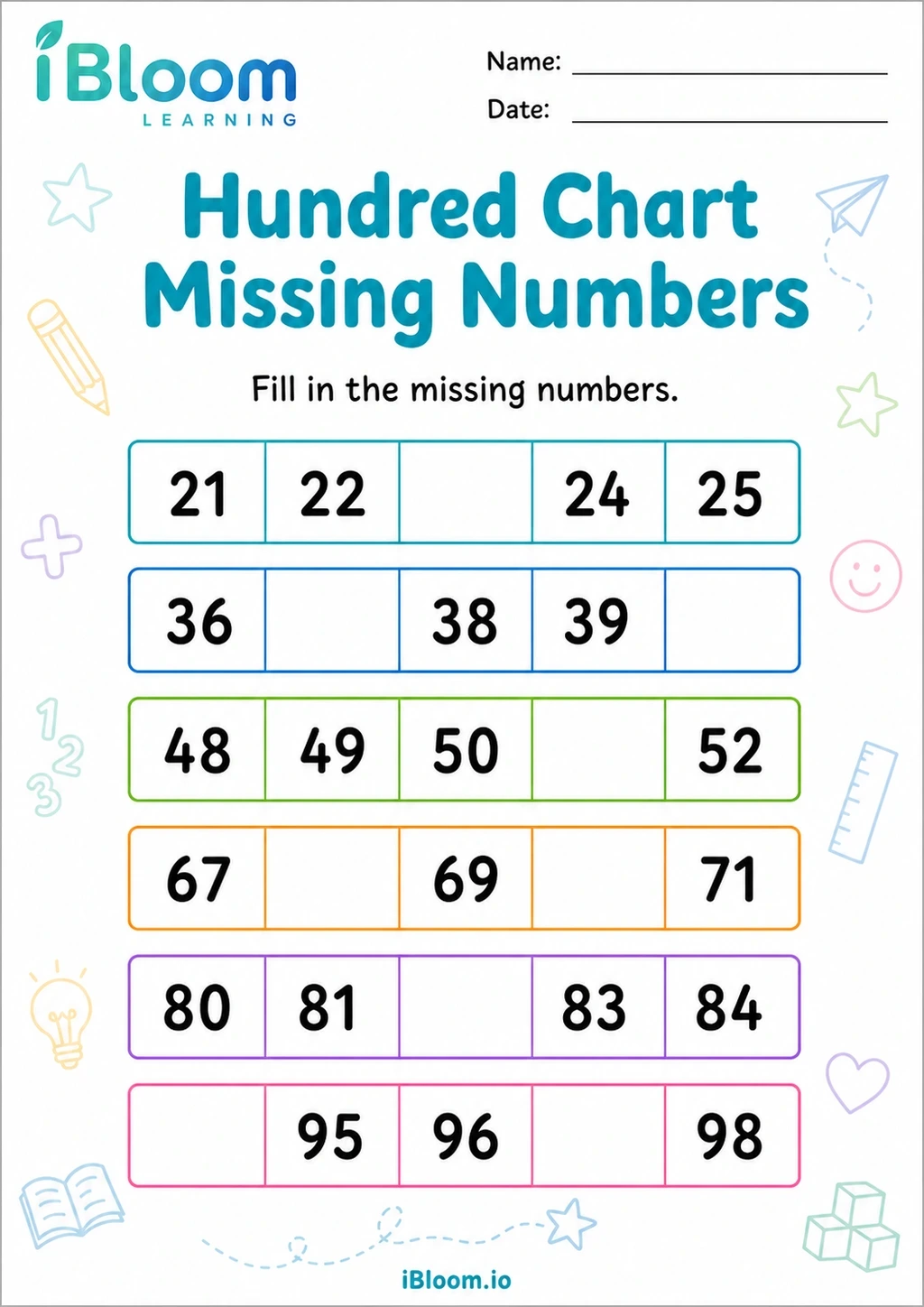
Preview the exact activity before downloading it.
Practice that builds confidence
Understanding the 1–100 chart
These Class 1 maths worksheets help children practise the full number chart from 1 to 100. Learners build number order, counting fluency, before-and-after understanding, and early place value awareness by seeing how numbers are arranged in rows and columns.
The printable activities include complete 1–100 charts, missing-number tasks, number search practice, sequencing work, and simple chart-based questions. Children learn to move forward, backward, down a column, and across a row while noticing patterns in tens and ones.
A full 1–100 chart gives children a clear visual map of numbers. In Class 1, it supports counting beyond 20, recognising number names in order, and seeing that each row usually moves by ones while each column moves by tens. Children begin to connect 34, 35, 36 as neighbours and also notice that 24, 34, 44, and 54 share the same ones digit.

Skills children build step by step
The worksheets move from reading a complete chart to filling blanks, identifying numbers before and after, and using the chart to answer simple questions. This progression helps children understand that 1 more means moving to the next box and 10 more often means moving down one row. They also practise comparing positions, spotting patterns, and locating numbers quickly without guessing.
A simple parent routine
At home, start by asking your child to point and count aloud from 1 to 30, then from any given number such as 47 to 60. Next, cover a few numbers with small paper pieces and ask, “What number is hiding? How do you know?” Encourage your child to explain using row and column clues, such as “It comes after 72” or “It is below 63.” Finish by asking them to colour all numbers ending in 5 or circle every ten.

Classroom uses for teachers
Teachers can use these printables for warm-ups, maths centres, small-group revision, or quick checks during the Number Charts unit. A chart can become a discussion tool: ask children to find the number just before 80, jump down from 16 to 26, or mark all numbers from 41 to 50. Pair work is useful because one child can give clues while the other locates the number.

Common errors to watch for
Some children reverse digits, writing 41 for 14, or lose track when crossing a ten, such as moving from 29 to 30. Others may count each box slowly instead of using chart patterns. Gently point out the row change after 9, 19, 29, and so on. Use vocabulary such as before, after, between, row, column, more, less, tens, and ones.
Free printable PDF download
Use this full 1 100 chart worksheets class 1 page to preview the activity, print it, or download it as a PDF for quick practice. It works well for homework, homeschool lessons, tutoring, morning work, revision, and classroom centers.
Answers and answer key support
After the child completes the worksheet independently, parents and teachers can use the answer support or answer key information to check the work, review mistakes, and choose the next practice step.
Why iBloom worksheets help
iBloom worksheets keep the chart clear, uncluttered, and purposeful so children focus on number relationships rather than decoration. A child-friendly strategy is “look across for ones, look down for tens.” This simple rule helps learners use the full 1–100 chart as a thinking tool, not just a counting poster.
Helpful answers
Frequently asked questions
What does a full 1–100 chart help Class 1 children learn?
It helps children see number order from 1 to 100, practise counting, find missing numbers, and understand simple patterns such as moving by ones across a row and by tens down a column.
Are these worksheets suitable before learning place value formally?
Yes. The chart gently prepares children for place value by showing tens and ones patterns visually, without requiring formal regrouping or advanced place value language.
How can I use the 1–100 chart at home?
Ask your child to point and count, hide a few numbers for them to identify, colour numbers ending in the same digit, or find what comes before, after, and between given numbers.
What mistakes are common when children fill a 1–100 chart?
Common mistakes include reversing digits such as 14 and 41, skipping numbers at the end of a row, and getting confused when moving from 9 to 10, 19 to 20, or 29 to 30.
Can teachers use these worksheets for maths centres?
Yes. They work well for maths centres, warm-ups, revision groups, and partner activities where one child gives number clues and another finds the answer on the chart.
Is this full 1 100 chart worksheets class 1 free?
Yes. You can preview it for free and use the printable worksheet for home or classroom practice.
Can I download this full 1 100 chart worksheets class 1 as a PDF?
Yes. Use the worksheet download option to save a printable PDF, or print the worksheet directly from the page.
Does this full 1 100 chart worksheets class 1 include answers or an answer key?
When the activity has fixed answers, iBloom includes answer support so parents and teachers can check the completed worksheet.