Free printable practice
Calendar Elapsed Time Practice Activities
Printable Class 3 maths worksheets for finding days, weeks, dates, and elapsed time on calendars.
Free printable worksheet PDFs
Preview every available page, then download the free worksheet PDF for home, homeschool, tutoring, or classroom practice.
Preview the exact activity before downloading it.
 Telling Time: Calendar Elapsed Time — Concept FoundationsConcept Foundations for telling time: calendar elapsed time in Class 3. Use day and date sequences to find days, weeks, and simple calendar elapsed time.Class 3Free PDF preview
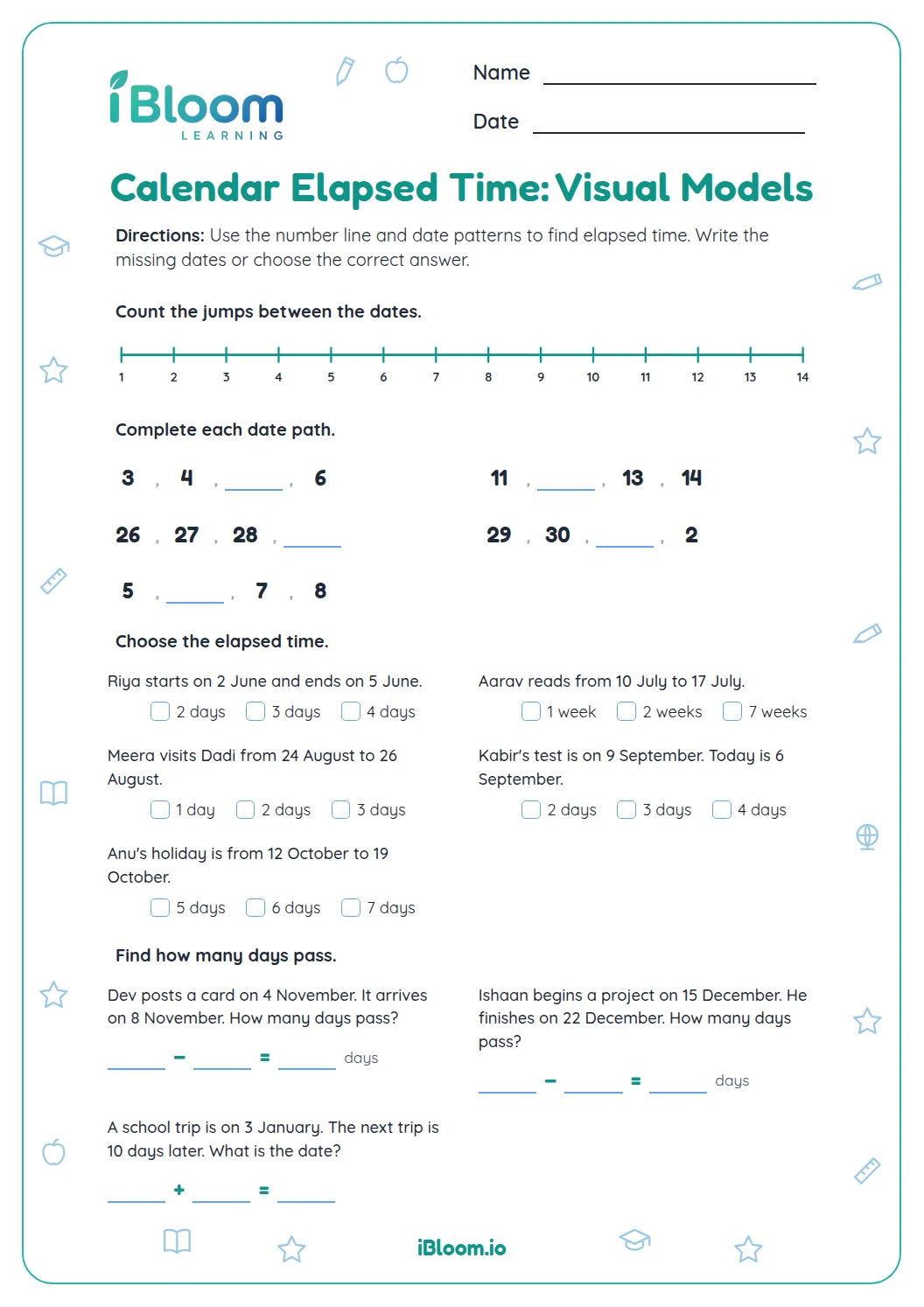 Telling Time: Calendar Elapsed Time — Visual ModelsVisual Models for telling time: calendar elapsed time in Class 3. Use number lines, date sequences, and simple calendar stories to count days and weeks between dates.Class 3Free PDF preview
 Telling Time: Calendar Elapsed Time — Guided PracticeGuided Practice for telling time: calendar elapsed time in Class 3. Find elapsed days and weeks by counting forward between given calendar dates, using guided choices first and then completing number sentences.Class 3Free PDF preview
 Telling Time: Calendar Elapsed Time — Independent PracticeIndependent Practice for telling time: calendar elapsed time in Class 3. Find elapsed days, weeks, and dates by counting forward and backward between calendar dates.Class 3Free PDF preview
 Telling Time: Calendar Elapsed Time — Real-World ProblemsReal-World Problems for telling time: calendar elapsed time in Class 3. Solve real-world calendar stories by finding dates, days, weeks, and elapsed time.Class 3Free PDF preview
 Telling Time: Calendar Elapsed Time — Reasoning ChallengeReasoning Challenge for telling time: calendar elapsed time in Class 3. Solve calendar elapsed-time problems by counting days, weeks, and dates carefully, then explain two answers in words.Class 3Free PDF preview
Practice that builds confidence
Understanding calendar elapsed time
These Class 3 calendar elapsed time worksheets help children work out how much time passes between dates, days of the week, weeks, and months. They practise reading a calendar, counting forward and backward, and connecting everyday events to time intervals.
The printable activities include date questions, calendar grids, word problems, and simple planning tasks. Children learn to answer questions such as “What date is 10 days after 5 March?” or “How many weeks are there between two Mondays?”
Calendar elapsed time is the amount of time between two calendar points, such as from Monday to Friday, from 7 June to 15 June, or from one festival date to another. In Class 3 maths, children move beyond naming days and months to using a calendar as a tool for reasoning.

How the practice progresses
The worksheets usually begin with familiar calendar reading: identifying dates, weekdays, weekends, and the order of months. Children then count days forward or backward, find “one week later”, compare two dates in the same month, and solve simple word problems. This gradual build-up helps them see that 7 days make a week and that dates do not always match the same weekday every month.
A simple parent routine
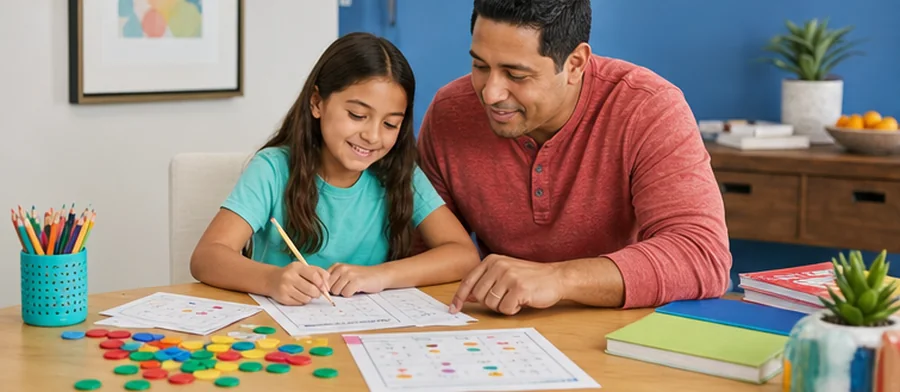
At home, keep one printed calendar page nearby. Ask your child one real question each day: “How many days until Sunday?”, “What date is two weeks from today?”, or “If your class test is on the 18th, how many days are left?” Encourage them to circle the start date, mark the end date, and count carefully. Use birthdays, holidays, library due dates, and travel plans to make the skill meaningful.
Classroom uses for teachers
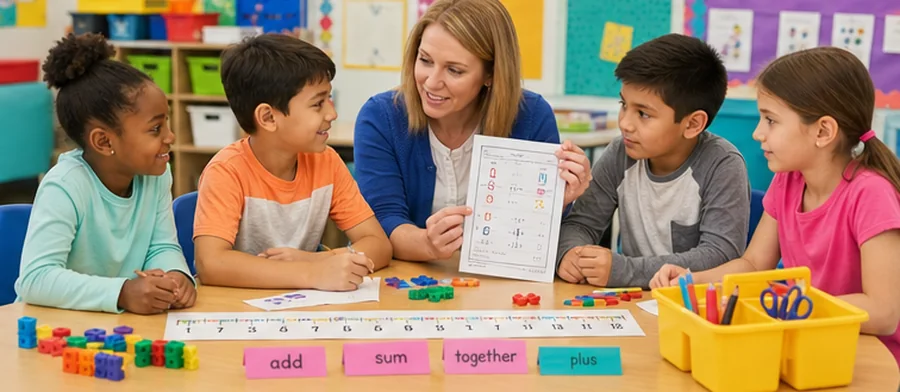
Teachers can use these sheets during the Telling Time unit, for morning warm-ups, maths centres, homework, or quick revision before calendar word problems. Pair work is useful: one child can read the question while the other traces the dates. Calendar tasks also connect well with class timetables, attendance charts, project deadlines, and monthly event boards.
Common errors and a child-friendly strategy
Watch for children counting the starting date as a full day when the question asks “after”, skipping from the end of one week to the wrong date, or assuming every month has the same number of days. A helpful strategy is: Start, hop, stop. Put your finger on the start date, make one hop for each day or week, and stop only when the required number of hops is complete.
Free printable PDF download
Use this class 3 calendar elapsed time worksheet page to preview the activity, print it, or download it as a PDF for quick practice. It works well for homework, homeschool lessons, tutoring, morning work, revision, and classroom centers.
Answers and answer key support
After the child completes the worksheet independently, parents and teachers can use the answer support or answer key information to check the work, review mistakes, and choose the next practice step.
Why iBloom worksheets help
iBloom worksheets give Class 3 learners repeated practice with clear calendar layouts and everyday contexts. The questions are designed to strengthen date reading, careful counting, and simple elapsed-time reasoning without rushing into clock-based time. This makes children more confident when they meet timetables, schedules, and multi-step time problems later.
Helpful answers
Frequently asked questions
What does calendar elapsed time mean for Class 3 children?
It means finding how many days, weeks, or sometimes months pass between two calendar dates or events, such as from 3 August to 10 August.
Should children count the starting date when solving these worksheets?
It depends on the wording. For “How many days after 5 March is 8 March?”, children usually start counting the next day. Marking the start date and making one hop per day helps avoid mistakes.
Do these worksheets include clock time?
No. This page focuses on calendar time: dates, weekdays, weeks, months, and simple elapsed-time questions using calendar grids.
How can I support my child if they lose track while counting dates?
Ask them to use a finger, pencil marks, or small ticks on the calendar. They can circle the start date, tick each hop, and box the final date.
Are calendar word problems useful in daily life?
Yes. Children use this skill to understand school events, holidays, birthdays, due dates, travel plans, and how long they have to prepare for an activity.
Is this class 3 calendar elapsed time worksheet free?
Yes. You can preview it for free and use the printable worksheet for home or classroom practice.
Can I download this class 3 calendar elapsed time worksheet as a PDF?
Yes. Use the worksheet download option to save a printable PDF, or print the worksheet directly from the page.
Does this class 3 calendar elapsed time worksheet include answers or an answer key?
When the activity has fixed answers, iBloom includes answer support so parents and teachers can check the completed worksheet.