Free printable practice
Geometry Practice Activities
Class 6 geometry worksheets for angles, triangles, quadrilaterals, circles, area, perimeter, volume and surface area with decimals and fractions.
Explore Geometry
Free printable worksheet PDFs
Preview every available page, then download the free worksheet PDF for home, homeschool, tutoring, or classroom practice.
Preview the exact activity before downloading it.
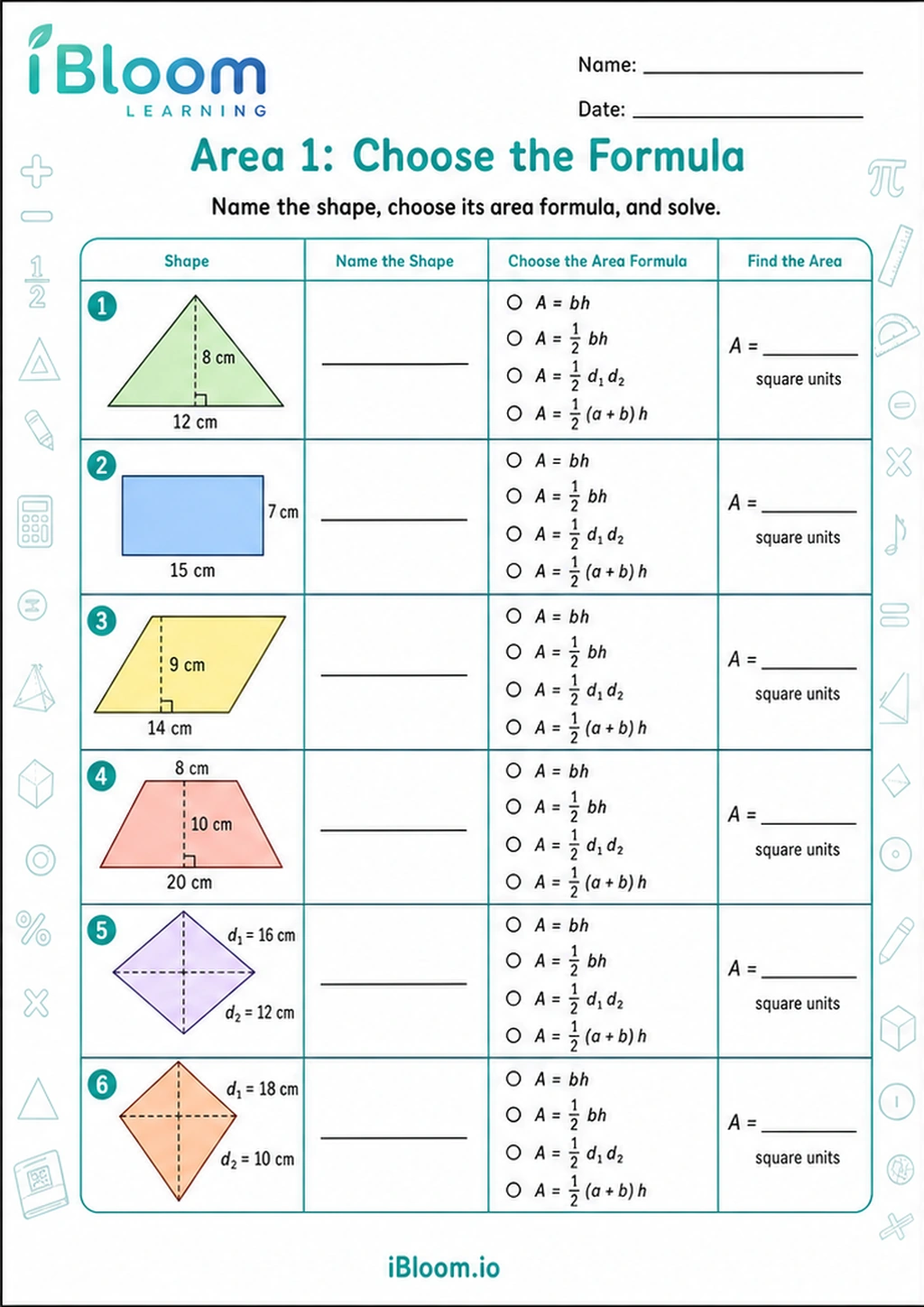 Area 1: Choose the FormulaClass 6 printable practice for Area of Triangles and Quadrilaterals.Class 6Free PDF preview
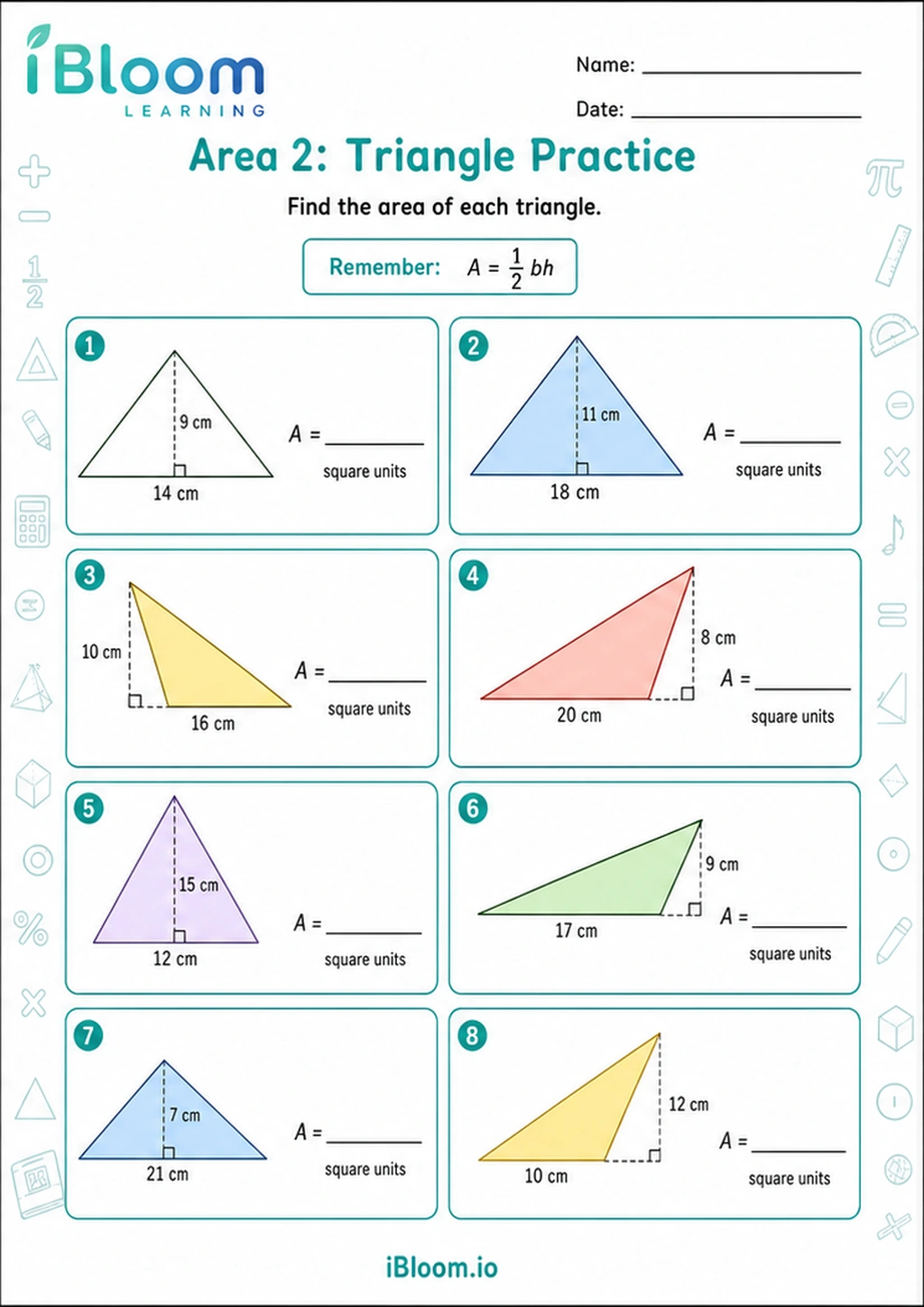 Area 2: Triangle PracticeClass 6 printable practice for Area of Triangles and Quadrilaterals.Class 6Free PDF preview
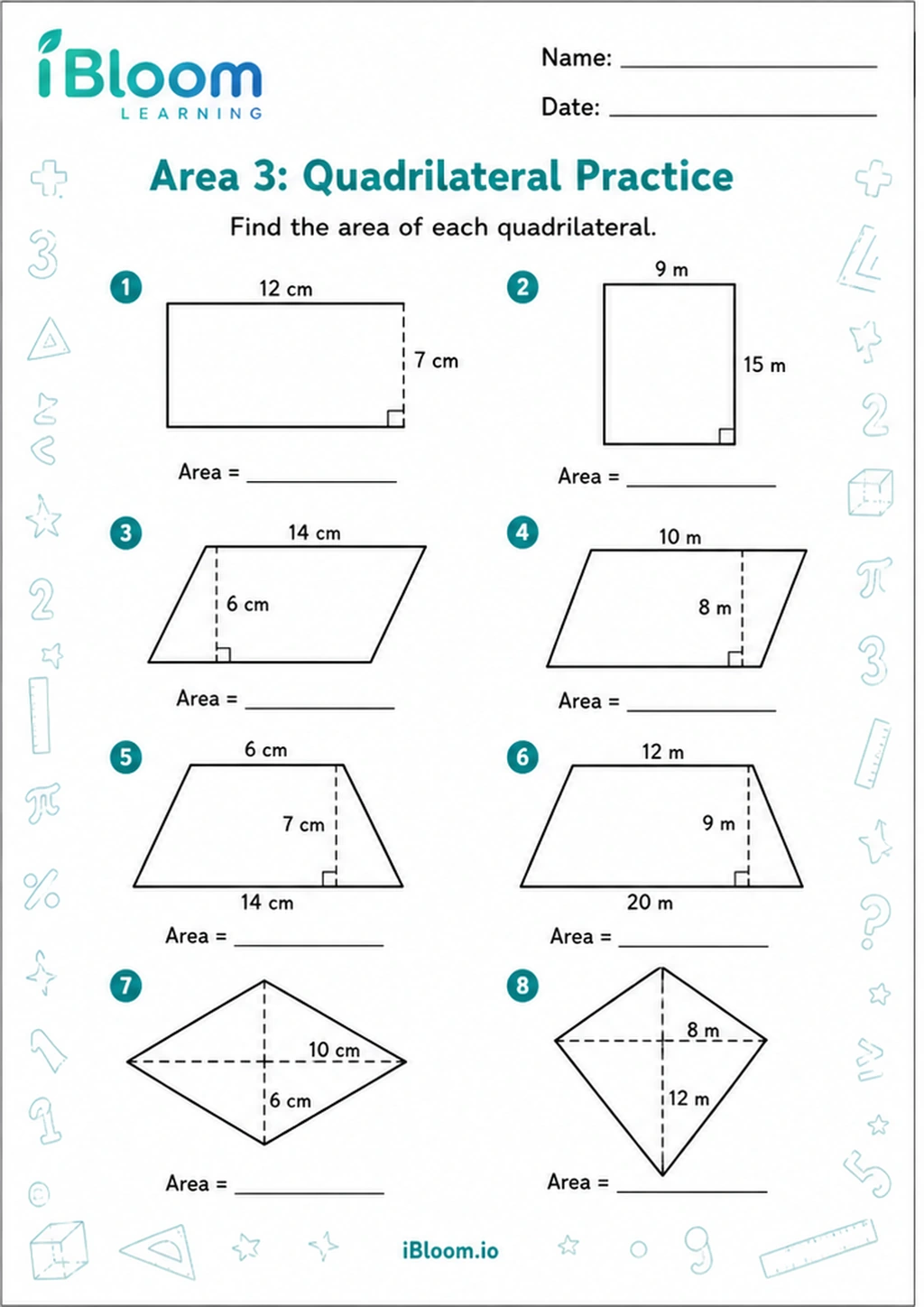 Area 3: Quadrilateral PracticeClass 6 printable practice for Area of Triangles and Quadrilaterals.Class 6Free PDF preview
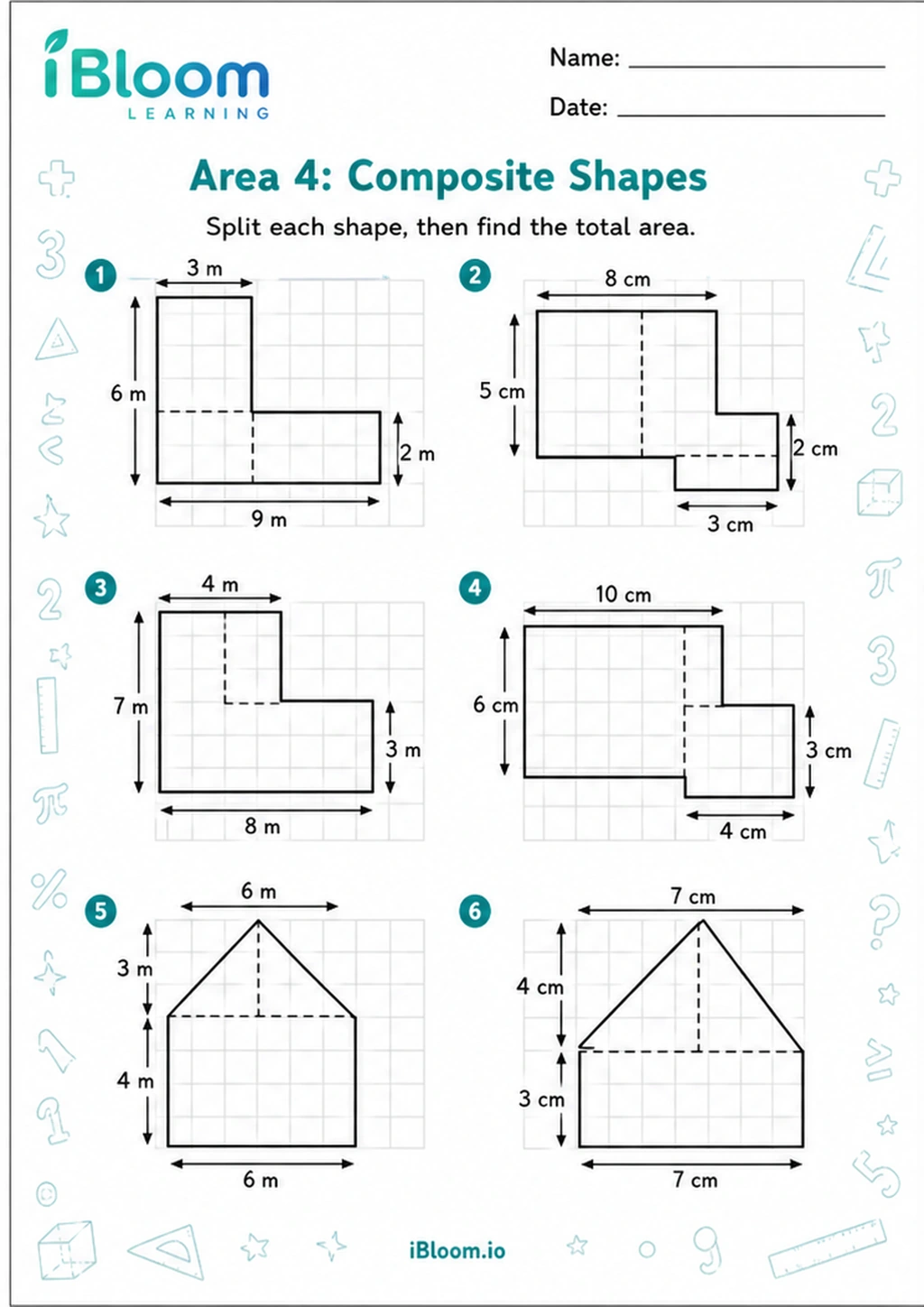 Area 4: Composite ShapesClass 6 printable practice for Area of Triangles and Quadrilaterals.Class 6Free PDF preview
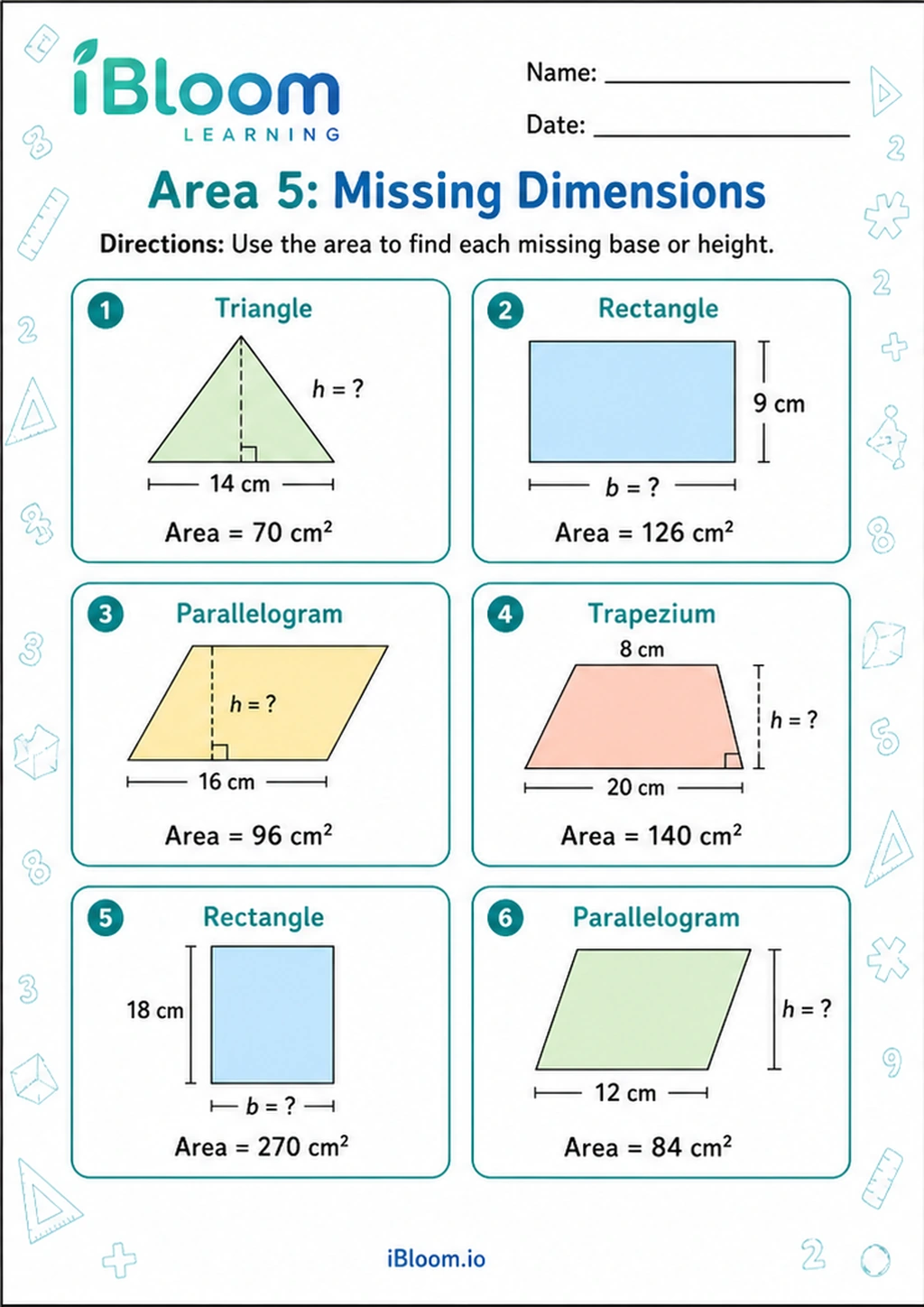 Area 5: Missing DimensionsClass 6 printable practice for Area of Triangles and Quadrilaterals.Class 6Free PDF preview
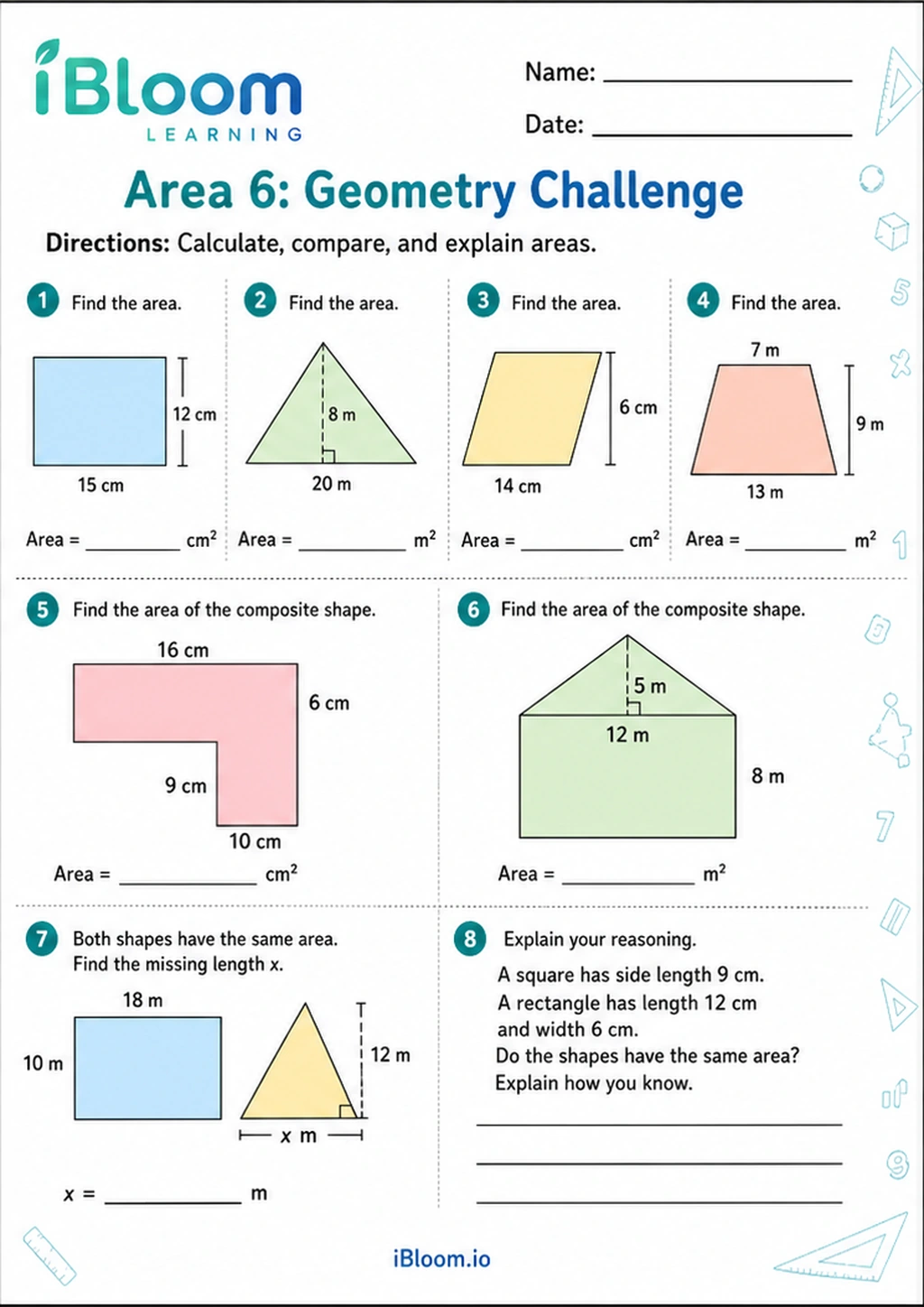 Area 6: Geometry ChallengeClass 6 printable practice for Area of Triangles and Quadrilaterals.Class 6Free PDF preview
Practice that builds confidence
From shape properties to measurement
These Class 6 Mathematics geometry worksheets help children practise measuring and classifying shapes, finding area and perimeter, and connecting 2D figures to 3D solids. The activities cover angles, triangles, quadrilaterals, circles, irregular rectangular shapes, and rectangular prisms.
Printable tasks include direct practice, labelled diagrams, mixed review questions, and word-style problems. Children work with area of triangles, parallelograms, trapezoids and circles, circumference, right triangles, volume and surface area, including decimal and fraction dimensions.
This Geometry collection sits under Mathematics > Class 6 > Geometry and moves beyond naming shapes. Children classify triangles by sides, identify quadrilaterals by their properties, and measure or classify angles before using those ideas in area, perimeter, circumference, volume and surface area problems.

What children practise
Worksheets include area of triangles and quadrilaterals, area of right triangles, parallelograms and trapezoids, area and perimeter of irregular rectangular shapes, circumference and area of circles, and volume and surface area of rectangular prisms. Some rectangular prism questions use decimal or fraction side lengths, helping learners apply operations accurately in geometry contexts.
A simple parent routine
At home, begin with one diagram and ask your child to say what is known: length, breadth, height, base, radius, diameter, or angle measure. Then ask, “Which formula fits this shape?” Have them write the formula before substituting numbers. For irregular rectangular shapes, encourage them to split the figure into smaller rectangles, label each part, and add or subtract carefully.

Classroom uses for teachers
Teachers can use these printables for maths centres, revision after a geometry lesson, quick checks before moving from area to volume, or differentiated practice. One group can classify angles and triangles, another can work on circles, while confident learners solve surface area and volume questions with fractions or decimals.

Common errors to watch for
Children may confuse area with perimeter, use diameter instead of radius, forget square or cubic units, or apply the triangle formula without dividing by 2. In surface area, they may count only three faces of a rectangular prism instead of pairs of opposite faces. In quadrilateral work, they may rely on appearance instead of properties such as parallel sides or equal side lengths.
Free printable PDF download
Use this Class 6 geometry worksheet page to preview the activity, print it, or download it as a PDF for quick practice. It works well for homework, homeschool lessons, tutoring, morning work, revision, and classroom centers.
Answers and answer key support
After the child completes the worksheet independently, parents and teachers can use the answer support or answer key information to check the work, review mistakes, and choose the next practice step.
Why iBloom worksheets help
iBloom worksheets build geometry step by step: identify, measure, choose a method, calculate, and check units. A child-friendly strategy is “name it, mark it, formula it, solve it.” Naming the shape, marking given measurements, choosing the formula, and then calculating helps Class 6 learners slow down and avoid guesswork.
Helpful answers
Frequently asked questions
What geometry topics are included in these Class 6 worksheets?
They include classifying and measuring angles, classifying triangles and quadrilaterals, area of triangles and quadrilaterals, area and circumference of circles, irregular rectangular shapes, and volume and surface area of rectangular prisms.
Do the worksheets include both 2D and 3D geometry?
Yes. Children practise 2D topics such as area, perimeter, circles, triangles and quadrilaterals, as well as 3D work on rectangular prism volume and surface area.
How can my child avoid mixing up area and perimeter?
Ask them to say what the answer measures before calculating. Perimeter is the distance around a shape and uses linear units, while area covers the inside and uses square units.
Are decimal and fraction measurements included?
Yes. Some rectangular prism volume and surface area worksheets use decimal or fraction side lengths, so children practise geometry along with careful number operations.
How should students approach irregular rectangular shapes?
They should split the figure into smaller rectangles, label missing lengths where possible, find each part’s area or perimeter, and then combine the results carefully.
Is this Class 6 geometry worksheet free?
Yes. You can preview it for free and use the printable worksheet for home or classroom practice.
Can I download this Class 6 geometry worksheet as a PDF?
Yes. Use the worksheet download option to save a printable PDF, or print the worksheet directly from the page.
Does this Class 6 geometry worksheet include answers or an answer key?
When the activity has fixed answers, iBloom includes answer support so parents and teachers can check the completed worksheet.