Free printable practice
Area Of Triangles And Quadrilaterals Practice Activities
Printable Class 6 geometry worksheets for practising area of triangles and quadrilaterals using base, height, formulas, diagrams, and word problems.
Free printable worksheet PDFs
Preview every available page, then download the free worksheet PDF for home, homeschool, tutoring, or classroom practice.
Preview the exact activity before downloading it.
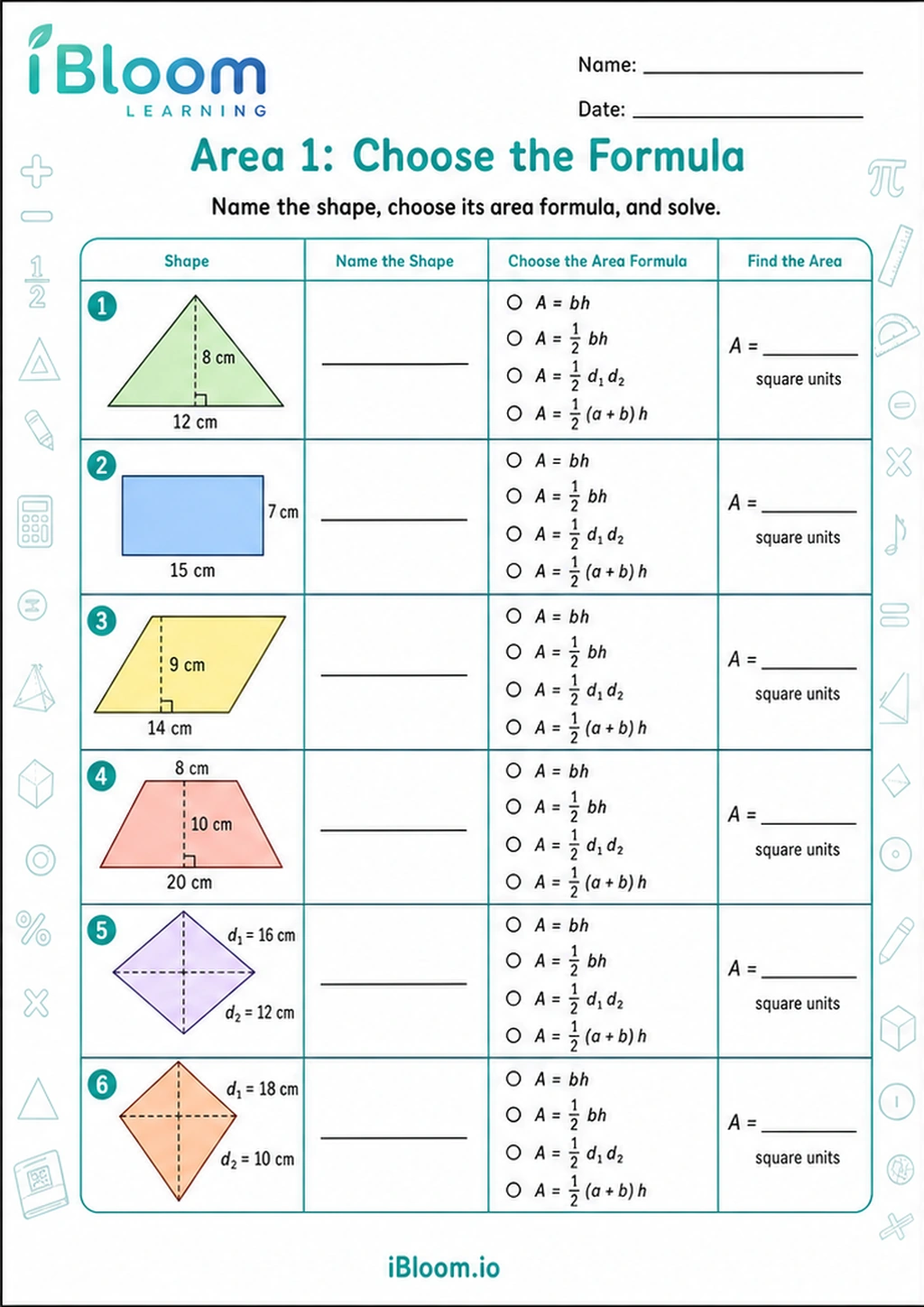 Area 1: Choose the FormulaClass 6 printable practice for Area of Triangles and Quadrilaterals.Class 6Free PDF preview
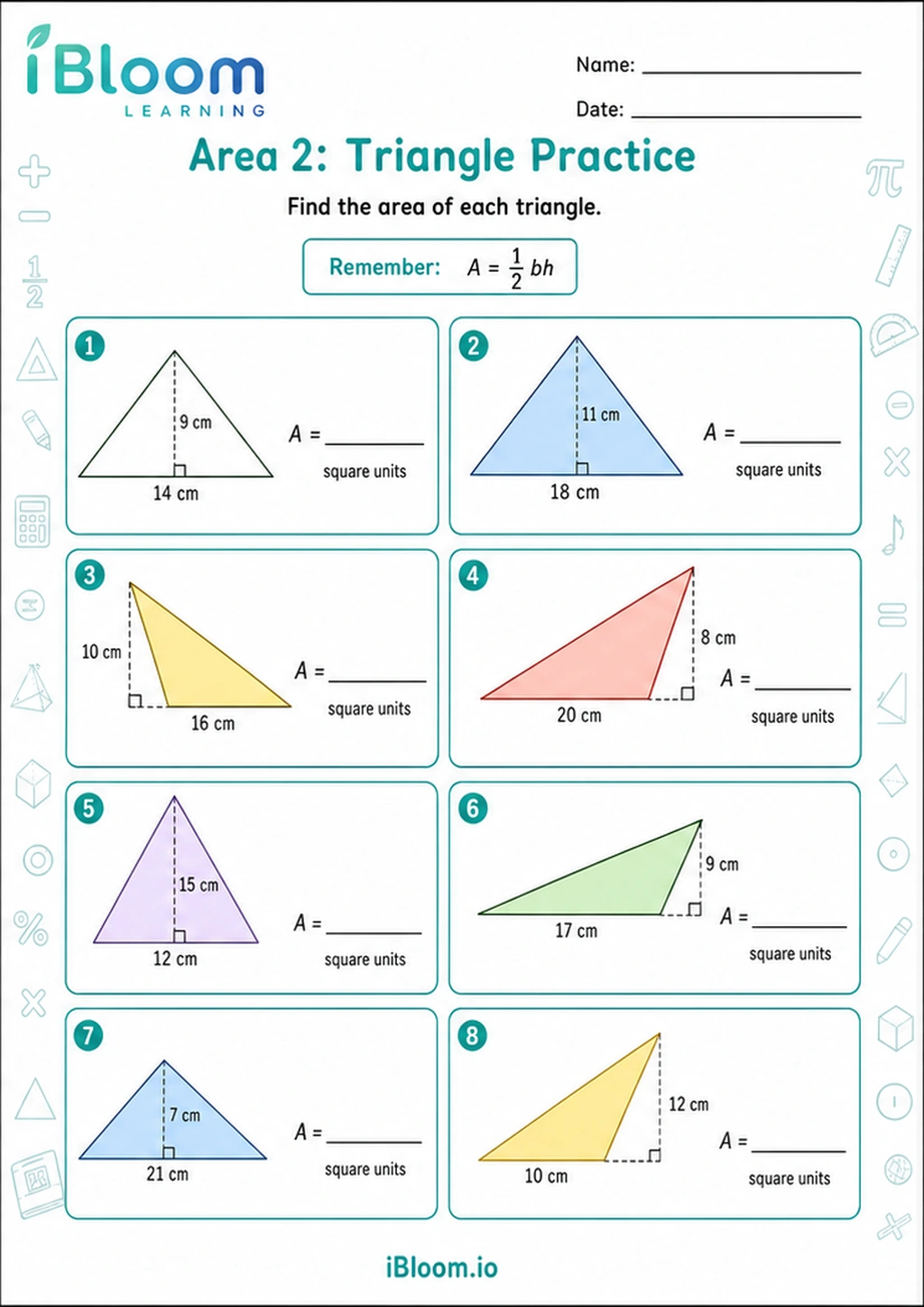 Area 2: Triangle PracticeClass 6 printable practice for Area of Triangles and Quadrilaterals.Class 6Free PDF preview
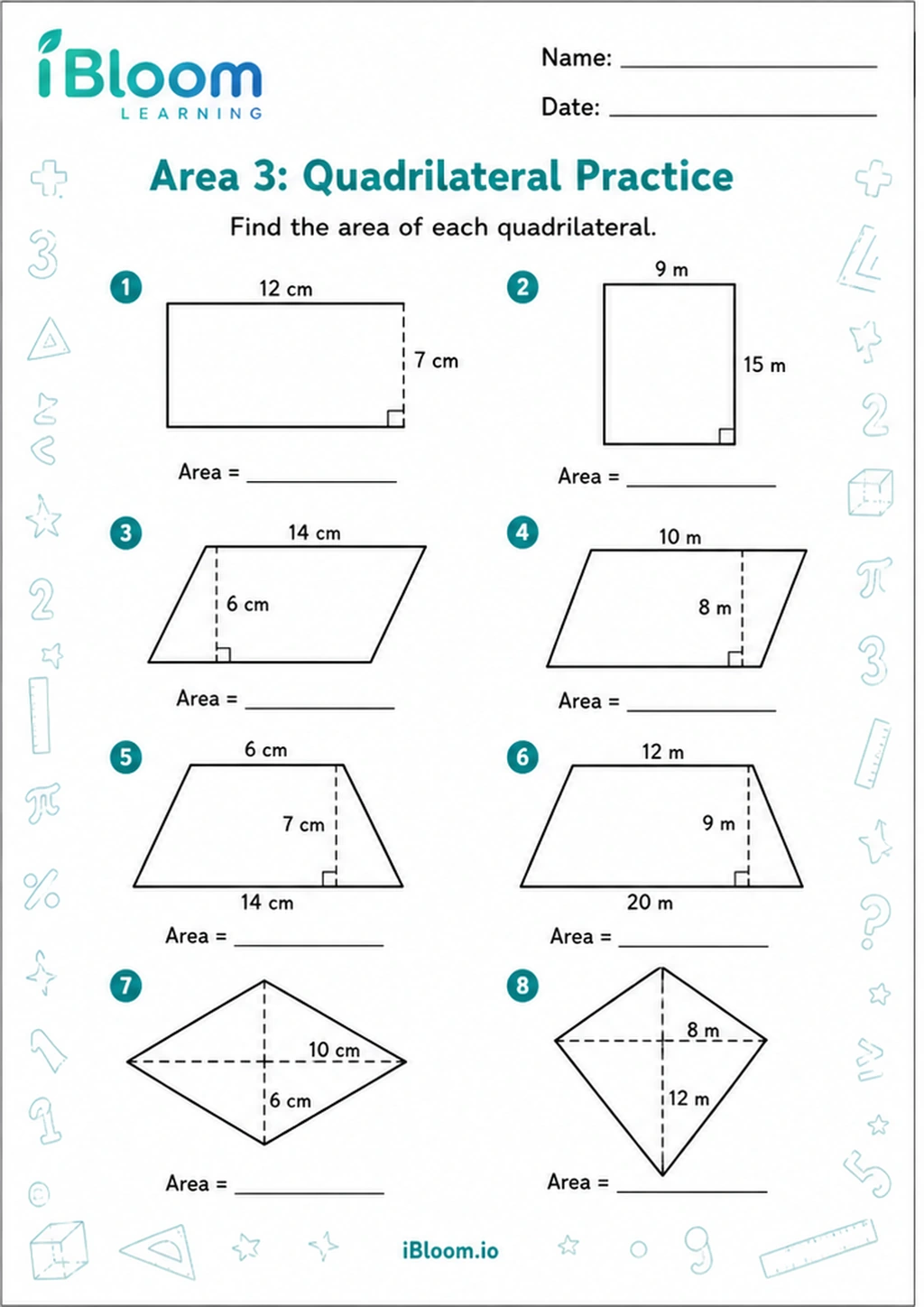 Area 3: Quadrilateral PracticeClass 6 printable practice for Area of Triangles and Quadrilaterals.Class 6Free PDF preview
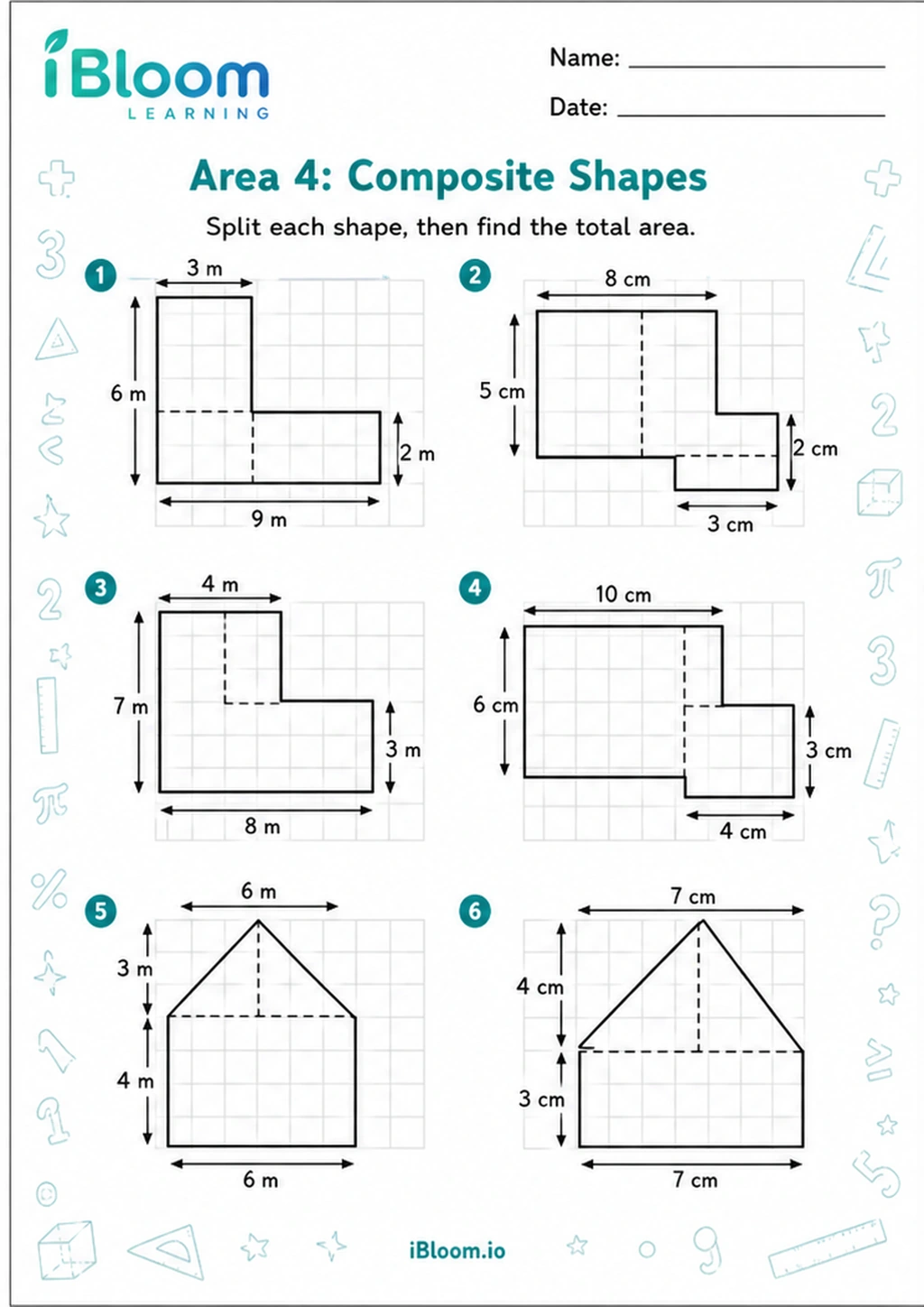 Area 4: Composite ShapesClass 6 printable practice for Area of Triangles and Quadrilaterals.Class 6Free PDF preview
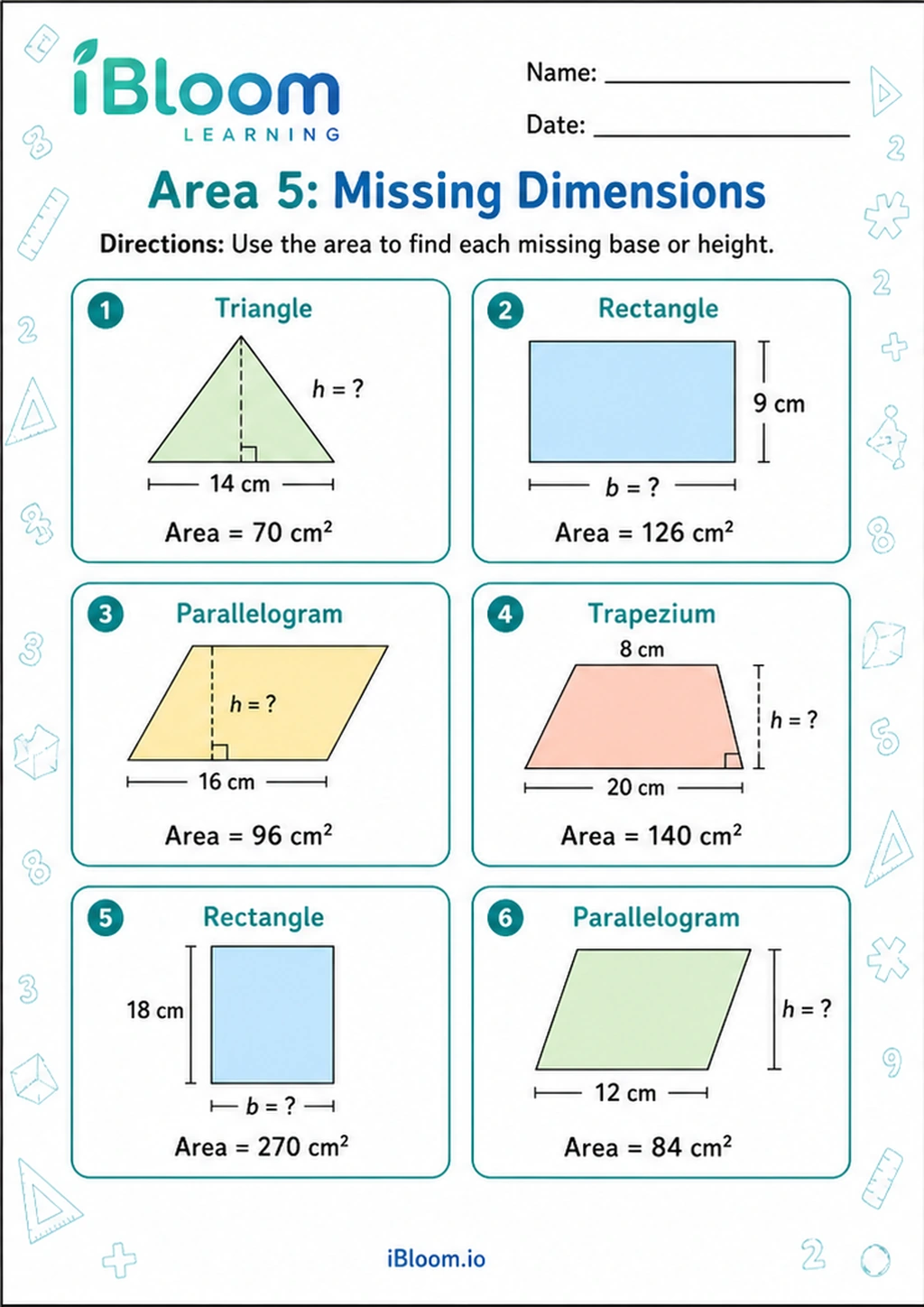 Area 5: Missing DimensionsClass 6 printable practice for Area of Triangles and Quadrilaterals.Class 6Free PDF preview
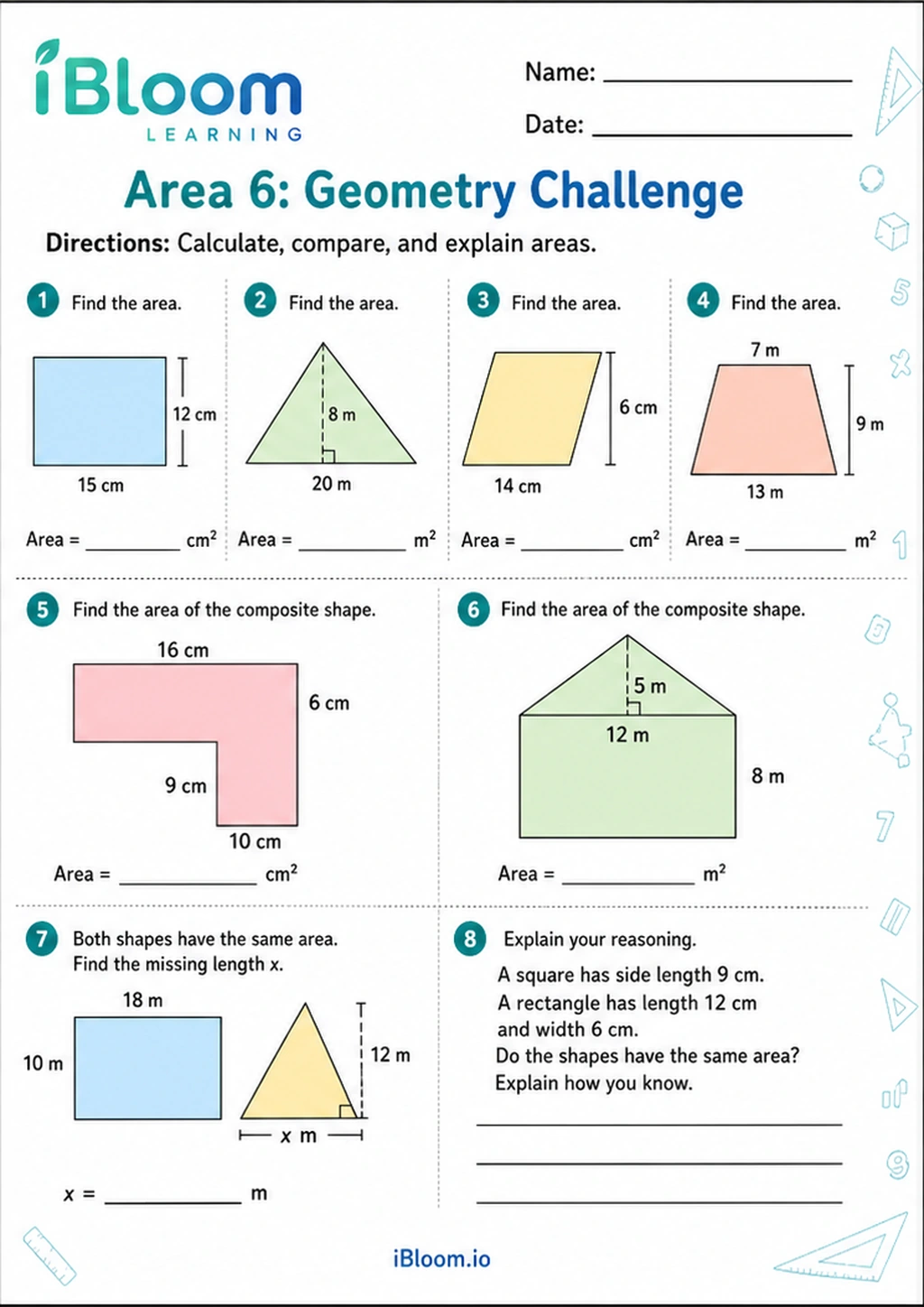 Area 6: Geometry ChallengeClass 6 printable practice for Area of Triangles and Quadrilaterals.Class 6Free PDF preview
Practice that builds confidence
What this skill covers
These Class 6 maths worksheets help children practise finding the area of triangles and quadrilaterals in geometry. Learners work with base, height, length, breadth, side, perpendicular height, and square units while building confidence with common area formulas.
The printable activities include labelled figures, missing-measure questions, mixed-shape practice, and short word problems. Children learn to choose the correct formula, substitute values carefully, and write answers with the correct unit.
Area is the amount of surface covered by a flat shape. In this collection, Class 6 learners practise area of triangles and quadrilaterals such as squares, rectangles, parallelograms and other four-sided figures shown with clear dimensions. The focus is not only on remembering formulas, but also on understanding which measurements matter: a triangle needs a base and its perpendicular height, while a rectangle needs length and breadth.

Building from familiar shapes
Children usually begin with rectangles and squares because these connect strongly to counting square units. From there, they move towards triangles as “half” of a related rectangle or parallelogram. This helps them see why the area of a triangle is half × base × height. Quadrilateral questions may ask learners to use a direct formula, split a figure into simpler parts, or compare areas when dimensions change.
Parent practice routine
At home, ask your child to read the shape name first, circle the given measurements, and say the formula aloud before calculating. Keep a small “formula corner” in the notebook for square, rectangle, triangle and parallelogram. After each answer, ask: “What unit should this be in?” This simple check prevents many mistakes with cm², m² and other square units.

Classroom use for teachers
Teachers can use these printables for geometry practice, revision sheets, small-group support, or maths centres. One group can work on formula fluency, another on drawing the correct height, and another on word problems. The worksheets also work well for quick exit checks: give one triangle, one quadrilateral, and one question where students must explain which measurements they used.

Common errors and a child-friendly strategy
Watch for children using a slant side as the height of a triangle, forgetting to halve the triangle area, mixing perimeter with area, or writing plain cm instead of cm². A helpful strategy is: “Name it, choose it, check it.” Name the shape, choose the correct formula and measurements, then check whether the answer makes sense and has square units.
Free printable PDF download
Use this class 6 area of triangles and quadrilaterals worksheet page to preview the activity, print it, or download it as a PDF for quick practice. It works well for homework, homeschool lessons, tutoring, morning work, revision, and classroom centers.
Answers and answer key support
After the child completes the worksheet independently, parents and teachers can use the answer support or answer key information to check the work, review mistakes, and choose the next practice step.
Why iBloom worksheets help
The worksheets are arranged to move from direct substitution to reasoning with diagrams. A child may first calculate area from a labelled triangle, then identify the base-height pair, and later solve a short situation such as finding the area of a plot or a tiled region. This progression supports accuracy, visual understanding, and independent problem solving without overwhelming the learner.
Helpful answers
Frequently asked questions
What will my child practise in these Class 6 area worksheets?
Your child will practise finding the area of triangles and quadrilaterals using given measurements, formulas, diagrams, and short word problems.
Which formulas are most important for this topic?
Children should know area of a rectangle = length × breadth, area of a square = side × side, and area of a triangle = 1/2 × base × height. They may also meet quadrilaterals that can be solved by using a direct formula or splitting the shape.
Why is perpendicular height important in triangle area?
The height used in a triangle’s area formula must meet the base at a right angle. A slant side is not the height unless it is actually perpendicular to the chosen base.
How can I help my child avoid confusing area and perimeter?
Remind your child that perimeter goes around the boundary, while area covers the inside surface. Area answers use square units such as cm² or m².
Are these worksheets useful for classroom revision?
Yes. Teachers can use them for geometry revision, independent practice, small-group support, maths centres, or quick checks after teaching area formulas.
Is this class 6 area of triangles and quadrilaterals worksheet free?
Yes. You can preview it for free and use the printable worksheet for home or classroom practice.
Can I download this class 6 area of triangles and quadrilaterals worksheet as a PDF?
Yes. Use the worksheet download option to save a printable PDF, or print the worksheet directly from the page.
Does this class 6 area of triangles and quadrilaterals worksheet include answers or an answer key?
When the activity has fixed answers, iBloom includes answer support so parents and teachers can check the completed worksheet.