Free printable practice
Convert Units Mass Practice Activities
Class 6 maths worksheets for converting mass between metric units such as milligrams, grams, kilograms, quintals and tonnes.
Free printable worksheet PDFs
Preview every available page, then download the free worksheet PDF for home, homeschool, tutoring, or classroom practice.
Preview the exact activity before downloading it.
 Measurement: Convert Units Mass — Concept FoundationsConcept Foundations for measurement: convert units mass in Class 6. Choose the correct mass-unit relationships, then complete simple metric conversions from larger to smaller and smaller to larger units.Class 6Free PDF preview
 Measurement: Convert Units Mass — Visual ModelsVisual Models for measurement: convert units mass in Class 6. Use unit-bridge models and simple conversion blanks to practise changing mass between milligrams, grams, kilograms, quintals and tonnes.Class 6Free PDF preview
 Measurement: Convert Units Mass — Guided PracticeGuided Practice for measurement: convert units mass in Class 6. Complete guided mass conversions by using metric relationships, then solve mixed unit conversions.Class 6Free PDF preview
 Measurement: Convert Units Mass — Independent PracticeIndependent Practice for measurement: convert units mass in Class 6. Convert mass measurements between milligrams, grams, kilograms, quintals and tonnes by completing and choosing equivalent values.Class 6Free PDF preview
 Measurement: Convert Units Mass — Real-World ProblemsReal-World Problems for measurement: convert units mass in Class 6. Solve real-world mass problems by converting between milligrams, grams, kilograms, quintals and tonnes.Class 6Free PDF preview
 Measurement: Convert Units Mass — Reasoning ChallengeReasoning Challenge for measurement: convert units mass in Class 6. Solve conversion puzzles, compare equivalent masses, and explain which mass statements are correct.Class 6Free PDF preview
Practice that builds confidence
Building the idea of mass
These Class 6 maths worksheets help children practise converting units of mass accurately within the metric system. Learners work with relationships such as 1 kg = 1000 g, 1 g = 1000 mg, 1 quintal = 100 kg and 1 tonne = 1000 kg.
The printable activities include direct conversions, mixed-unit questions, comparison tasks and word problems based on everyday situations like groceries, parcels, sacks of grain and medicine weights. The focus is on choosing the correct operation and writing the correct unit.
Mass tells us how heavy an object is, and Class 6 learners need to move confidently between smaller and larger metric units. These worksheets start from familiar units such as grams and kilograms, then extend to milligrams for very small quantities and quintals or tonnes for heavier loads.

Understanding the conversion pattern
Children practise the key idea that moving to a smaller unit means multiplying, while moving to a larger unit means dividing. For example, 5 kg becomes 5000 g, while 7500 g becomes 7.5 kg. The activities encourage learners to notice the scale factor before calculating, instead of guessing from the size of the number.
A simple parent routine
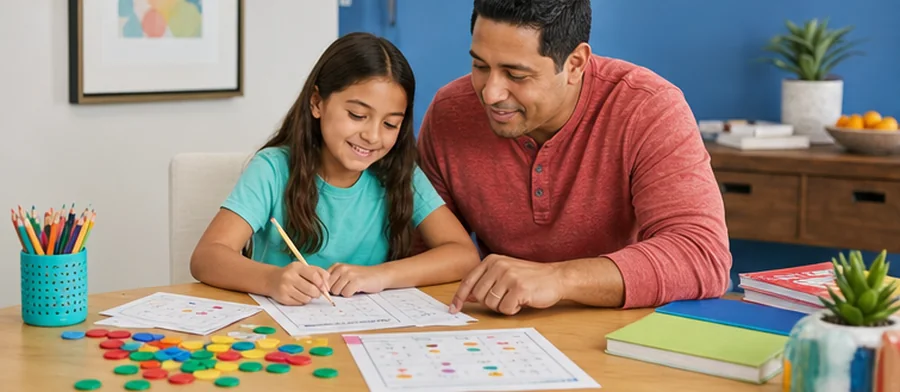
At home, ask your child to read one question aloud, circle the starting unit and underline the target unit. Then have them say, “I am going from larger to smaller” or “smaller to larger” before multiplying or dividing. Use kitchen packets, rice bags or medicine labels to connect worksheet numbers with real objects.
Classroom use and quick checks
Teachers can use these printables for maths practice, revision, homework or small-group support. They also work well as class warm-ups: display one conversion, ask pupils to show the operation, then compare answers. Pair work is useful for word problems because one child can identify the units while the other sets up the calculation.

Common errors and a child-friendly strategy
Watch for missing units, adding zeroes in the wrong direction, and confusing grams with milligrams. A helpful strategy is: Read the units, choose multiply or divide, calculate, then label. Children can remember it as “Unit first, number next, label last.”
Free printable PDF download
Use this Class 6 convert units mass worksheet page to preview the activity, print it, or download it as a PDF for quick practice. It works well for homework, homeschool lessons, tutoring, morning work, revision, and classroom centers.
Answers and answer key support
After the child completes the worksheet independently, parents and teachers can use the answer support or answer key information to check the work, review mistakes, and choose the next practice step.
Why iBloom worksheets help
The questions are arranged so learners meet one conversion relationship at a time before handling mixed practice. This progression helps children connect number facts, place value and measurement vocabulary. Clear spaces for working also make it easier for parents and teachers to spot whether an error comes from the operation, the zeroes or the unit label.
Helpful answers
Frequently asked questions
What mass units are practised in these Class 6 worksheets?
The worksheets focus on common metric mass units used in Class 6 maths, including milligrams, grams, kilograms, quintals and tonnes.
How can my child decide whether to multiply or divide?
Ask them to compare the units first. When converting from a larger unit to a smaller unit, they multiply. When converting from a smaller unit to a larger unit, they divide.
Do these worksheets include word problems?
Yes. Along with direct conversions, children practise mass conversions in everyday contexts such as food packets, parcels, sacks and other measured objects.
What mistakes should I watch for in mass conversion practice?
Common mistakes include writing the wrong unit, placing zeroes incorrectly, confusing grams and milligrams, or multiplying when the conversion requires division.
Are these worksheets suitable for revision before a maths test?
Yes. They are useful for revising metric mass relationships, practising calculation steps and checking whether children can apply conversions in both numerical and word problems.
Is this Class 6 convert units mass worksheet free?
Yes. You can preview it for free and use the printable worksheet for home or classroom practice.
Can I download this Class 6 convert units mass worksheet as a PDF?
Yes. Use the worksheet download option to save a printable PDF, or print the worksheet directly from the page.
Does this Class 6 convert units mass worksheet include answers or an answer key?
When the activity has fixed answers, iBloom includes answer support so parents and teachers can check the completed worksheet.