Free printable practice
Adding Two Single Digit Numbers Sum 20 Or Less Practice Activities
Printable Class 1 maths practice for adding two single-digit numbers with answers within 20 using pictures, counting, number bonds, and written sums.
Free printable worksheet PDFs
Preview every available page, then download the free worksheet PDF for home, homeschool, tutoring, or classroom practice.
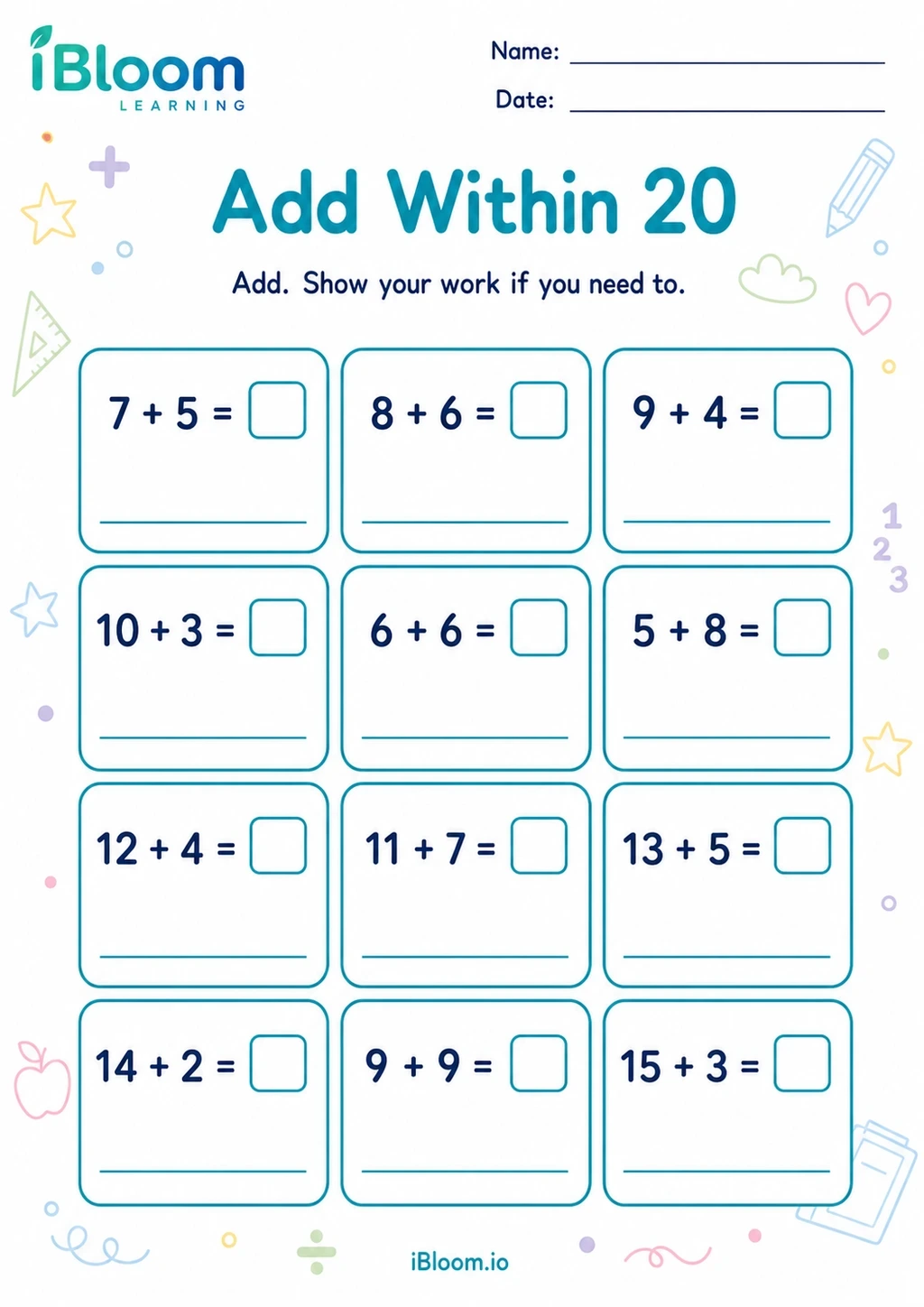
Preview the exact activity before downloading it.
Practice that builds confidence
Building addition within 20
These Class 1 addition worksheets help children practise adding two single-digit numbers with totals within 20. Learners build confidence with facts such as 4 + 3, 8 + 6, and 9 + 9 while connecting counting, symbols, and answers.
The printable activities include clear addition sums, picture-supported problems, number representations, and mixed practice. They are designed for early maths revision at home, classroom practice, or extra support after children have been introduced to basic addition.
Adding two single-digit numbers is a key Class 1 maths skill because children move from counting objects one by one to understanding that two parts can make a whole. These worksheets keep the numbers manageable, with addends from 0 to 9 and answers within 20, so children can focus on meaning as well as accuracy.

From pictures to number sentences
Early tasks may use dots, objects, or simple visual groups so children can see what 5 + 2 means before writing 7. As practice develops, children read number sentences, fill in missing answers, and solve mixed sums. This progression helps them connect vocabulary such as add, plus, total, altogether, and sum with the symbols + and =.
A simple parent routine
At home, begin with a few real objects such as buttons, crayons, or rajma beans. Ask your child to make two groups, say 6 and 3, then push them together and count the total. Next, show the matching written sum: 6 + 3 = 9. After two or three hands-on examples, complete a short set on the worksheet. Encourage your child to say the full sentence aloud: “Six plus three equals nine.”

Classroom uses for teachers
Teachers can use these printables for daily warm-ups, maths centres, early finisher tasks, small-group reteaching, or revision before moving to addition strategies within larger numbers. A sheet can also be cut into strips for quick practice, paired work, or oral questioning. Mixed examples help teachers notice which facts are secure and which children still rely on slow counting.

Common errors to watch for
Some children count both numbers from 1 instead of counting on from the larger number. Others reverse digits, skip a counted object, write the answer beside the wrong sum, or misunderstand the equals sign as “write something next” instead of “is the same as.” If a child answers 7 + 5 as 11, ask them to show 7 fingers or marks, then count on 5 more slowly.
Free printable PDF download
Use this adding two single digit numbers sum 20 or less worksheet page to preview the activity, print it, or download it as a PDF for quick practice. It works well for homework, homeschool lessons, tutoring, morning work, revision, and classroom centers.
Answers and answer key support
After the child completes the worksheet independently, parents and teachers can use the answer support or answer key information to check the work, review mistakes, and choose the next practice step.
Why iBloom worksheets help
The iBloom worksheets give repeated, focused practice without overwhelming young learners. The layout is child-friendly, the number range stays appropriate for Class 1, and the activities support both visual understanding and written fluency. A useful child-friendly strategy is “start with the bigger number and count on”: for 8 + 4, say 8, then count 9, 10, 11, 12.
Helpful answers
Frequently asked questions
What numbers are used in these Class 1 addition worksheets?
The worksheets focus on adding two single-digit numbers, from 0 to 9, with answers within 20. Examples include sums such as 3 + 5, 7 + 8, and 9 + 9.
Should my child use fingers or objects while solving these sums?
Yes. For Class 1 learners, fingers, counters, beads, crayons, or drawn dots are helpful. They make addition concrete before children begin to remember facts mentally.
How can I help my child move beyond counting every object?
Teach the counting-on strategy. For 6 + 4, your child starts at 6 and counts four more: 7, 8, 9, 10. This is faster than counting all ten objects from the beginning.
Are these worksheets suitable for revision before double-digit addition?
Yes. Quick recall of single-digit addition facts helps children feel more prepared when they later add two-digit numbers, use place value, or work with carrying.
What mistakes should I check for when my child completes the sheet?
Look for skipped counts, misread symbols, reversed digits, and answers copied into the wrong space. Ask your child to explain one or two sums aloud to check understanding.
Is this adding two single digit numbers sum 20 or less worksheet free?
Yes. You can preview it for free and use the printable worksheet for home or classroom practice.
Can I download this adding two single digit numbers sum 20 or less worksheet as a PDF?
Yes. Use the worksheet download option to save a printable PDF, or print the worksheet directly from the page.
Does this adding two single digit numbers sum 20 or less worksheet include answers or an answer key?
When the activity has fixed answers, iBloom includes answer support so parents and teachers can check the completed worksheet.