Add Three Digit Numbers Without Carrying worksheet for Class 2

Lesson-Wise Builder
A premium AI tool that creates syllabus-aligned questions and worksheets for any lesson in seconds.
A 3-digit addition without carrying worksheet helps a Class 2 learner add two three-digit numbers while keeping hundreds, tens and ones in their correct places. In every column, the two digits make a total below ten, so no new ten or hundred has to move into the next column. This page practises the same idea in horizontal and vertical questions. The verified activity shows response boxes, a multiple-choice item and speaker controls, while the calculation itself remains a careful place-value task.
What without carrying and without regrouping mean
An addend is a number being added. The sum is the result. In three-digit addition, each addend has a hundreds place, a tens place and a ones place. Carrying, regrouping and exchange describe the same place-value event: a column reaches ten or more, so ten units are renamed as one unit of the next place. Without carrying means that this event never occurs in the question. Each column total is a single digit and can stay where it belongs.
This distinction matters because the learner should not carry merely because the numbers have three digits. First inspect the ones, tens and hundreds columns. If every pair stays below ten, the problem is a no-regrouping sum. If even one pair reaches ten, that other problem needs a different method.
Align hundreds, tens and ones before adding
Correct alignment is the foundation of column addition. The ones digit of the top addend must sit over the ones digit below it. Tens belong under tens, and hundreds belong under hundreds. Right-aligning the numbers keeps these relationships visible. A simple place-value mat with three labelled columns can help a learner who writes digits too close together.
Zero still holds a place even though it adds no quantity in that column. The visible horizontal question containing 406 is useful for this idea: the zero tells the reader that there are no tens in that addend. It must remain between the hundreds and ones digits. Skipping it would slide another digit into the wrong column and change the number. Expanded form can reinforce the structure by naming each addend as hundreds plus tens plus ones without changing the calculation.
Read the horizontal questions by place value
The verified image shows three horizontal prompts: 321 + 154, 406 + 213, and 837 + 162. They appear in a left-to-right equation followed by an equals sign and an empty response box. This draft deliberately does not state their results. The useful learning move is to read each addend, identify its three place values and calculate independently.
A learner who finds the horizontal layout crowded can rewrite one addend above the other. Keep both ones digits on the far right, then check the tens and hundreds columns before calculating. Another option is to point to matching places without rewriting: ones with ones, tens with tens and hundreds with hundreds. After finding a sum, read the entire equation again so the response is connected to the original question rather than to a copied pattern.
Use the vertical column and choice format carefully
The preview also shows 414 + 121 arranged vertically above a line, followed by four selectable choices. The vertical layout makes place values easier to see because matching digits are already stacked. The learner should still trace the right-hand column first, continue to the middle column and finish with the left-hand column. The line below the addends marks where the resulting digits belong.
Multiple choice changes how the response is submitted, not how the sum is found. Calculate before inspecting the choices too closely. Then compare the independently found hundreds, tens and ones with each option. This prevents a familiar-looking choice from replacing the actual method. No choice is identified as correct in this content.
How to know that no carrying is needed
Look at one place at a time. If the two ones digits total nine or less, the ones result stays in the ones place. Apply the same test to the tens and hundreds. A carried digit appears only when a column total reaches ten. For example, ten ones would be exchanged for one ten, but that situation is not part of a no-carrying item.
A helpful verbal check is: "Does this column make a new group of ten?" If the answer is no in all three places, write one digit in each result position. This explains why there is no small carried mark above the next column. It also helps children compare no-carrying questions with later regrouping questions without mixing the two procedures.
A repeatable ones-tens-hundreds method
- Read both addends. Point to each number and say it as a complete three-digit number.
- Check the layout. Match ones with ones, tens with tens and hundreds with hundreds. Rewrite a horizontal item vertically if that makes the places clearer.
- Start with ones. Add only the two digits in the right-hand place. Ask whether their total reaches ten. For this activity, it does not.
- Continue with tens. Move one column left. Keep the ones result separate and add only the tens digits.
- Finish with hundreds. Add the two digits in the left-hand place. Do not combine a hundreds digit with a tens or ones digit.
- Read the completed number. Name its hundreds, tens and ones so every written digit has a clear value.
- Review once. Point back through the three columns and confirm that no column required an exchange.
A learner who loses track can cover two columns with a strip of paper and reveal only the place being solved. Another useful prompt is, "Which place are you adding now?" The child should be able to say ones, tens or hundreds before recording a digit.
Check the sum without repeating the same mistake
Begin with magnitude. Adding two positive three-digit numbers should produce a result larger than either addend. Next, inspect the ones digit: it should come only from the two ones digits. Repeat that place-by-place check for tens and hundreds. If an unexpected digit appears, locate the exact column instead of erasing the entire result.
Expanded form provides a second view. Separate each addend into its hundreds, tens and ones parts, combine matching parts and compare those place totals with the column method. A quick estimate based on the hundreds also helps spot an implausible result, although an estimate is not a replacement for the exact calculation. For a multiple-choice item, calculate first and use the options only as the final comparison.
Inverse thinking can strengthen the review: imagine removing one addend from the proposed total and consider whether the other addend's place values remain. The child does not need a new written procedure for every item; the aim is to notice whether the number structure makes sense.
What the visible activity formats ask the learner to do
The horizontal items place an empty response box after the equals sign. The visible vertical item asks the learner to select from four options. Speaker icons appear beside prompts in the preview, so a learner can recognise that an audio-supported direction is present. This observation does not assume the exact spoken wording. Whether the direction is read or heard, the task is still to find the sum and check all three place values before responding.
Using both formats can reveal different habits. A typed response checks whether the learner can produce a complete number, while a choice question checks whether they can distinguish their calculated result from nearby alternatives. Adults should keep the reasoning consistent across both formats rather than teaching a shortcut for one screen layout.
A short home routine for Class 2
Start with three cards labelled hundreds, tens and ones. Ask the child to place the digits of each addend under the correct label. Read the two numbers aloud, then uncover one column at a time. After each calculation, ask, "Did this place make ten?" A clear no should be followed by writing the single digit in that same place.
To prompt without giving the sum, use questions such as "Where is the ones place?" "What does the zero hold?" and "Which two digits belong together?" If a mistake occurs, return to the column that caused it and let the child repair only that step. One or two carefully explained questions can be more useful than a long session completed by guessing. End by asking the learner to describe the method in their own words.
For a child who skips zero, build 406 with place-value cards and leave the tens card visibly marked as zero. This makes the placeholder role concrete without changing the number. The adult can then return to the horizontal question and ask the child to point to the same three places.
Teacher and tutor prompts for accurate practice
Use a three-column board for a brief warm-up. Build two addends with digit cards and invite learners to name the value of each digit before adding. Show one horizontal equation beside the same numbers in vertical form. Ask what changed in the layout and what stayed mathematically identical.
During individual work, observe four separate behaviours: whether the child reads each addend correctly, aligns the places, tests for a new group of ten and records one digit per column. A wrong final response may come from only one of those steps. In a small group, partners can point to a column and explain why it does or does not require carrying. This keeps the discussion about place value rather than speed.
A useful exit question is not another large set of sums. Ask the learner to create two three-digit addends that would not need regrouping and explain how they checked each place. Review the created pair before anyone calculates it. This shows whether the learner understands the condition behind the method.
Common mistakes and precise corrections
- Misaligned digits: draw three light columns and move every digit into its named place before adding.
- Ignoring a zero: say the whole number aloud and mark the empty tens or ones value explicitly.
- Starting at hundreds and losing track: point to the right-hand ones column and follow a consistent direction across the page.
- Carrying automatically: ask whether the current column actually reaches ten. Do not add a carried digit unless an exchange occurred.
- Writing two result digits in one place: revisit whether the question was truly a no-carrying item. On this activity, every column should produce one result digit.
- Combining digits from different addends incorrectly: trace a vertical line through each place and add only within that line.
- Choosing an option before calculating: cover the choices, find the sum independently and reveal them only for comparison.
- Reading a horizontal equation as one long number: identify the plus and equals signs, then name the two addends separately.
Grid paper can help a child who repeatedly drifts across columns. Put one digit in each square and use a different row for each addend. The squares are a temporary support; the mathematical reason remains that a digit's position determines its value.
Clear answers to the main method questions
How do you add three-digit numbers without carrying? Align equal place values, add ones, then tens, then hundreds, and keep each one-digit column total in its original place. Which column comes first? Ones are the conventional starting point because any exchange would affect the next place, even though no exchange occurs here. Can a horizontal sum be written vertically? Yes, provided the ones digits remain aligned on the right.
What does find the sum mean? It asks for the result after the addends are combined. Why is zero important in 406? It records that the number has no tens and prevents the ones digit from sliding into the tens place. When should a learner carry? Only when the total in a place reaches ten or more. These direct answers give useful language for a child, parent or teacher discussing the worksheet.
What to practise before and after this skill
If three-digit alignment is difficult, return briefly to two-digit addition without carrying for Class 2. The same ones-and-tens logic is easier to see with one fewer place. Learners can also practise combining three two-digit addends on the add three two-digit numbers activity, while remembering that it changes the number of addends.
After the learner can align places, calculate accurately and explain why no exchange occurred, compare selected examples that do and do not reach ten in a column. The closely related three-digit addition with carrying worksheet is a later progression. It should be introduced as a new decision about column totals, not as a reason to change answers on this page.
Another useful extension is to create a new pair of three-digit addends and check the ones, tens and hundreds before solving. Then explain the method to a partner or place the equation into a short word problem. Accuracy and place-value reasoning should come before speed.
Continue on the exact iBloom routes
- 3-digit addition without carrying worksheet for Class 2
- two-digit addition without carrying practice
- add three two-digit numbers practice
- three-digit addition with carrying practice
Frequently Asked Questions
Is no carrying the same as no regrouping?
Yes. Both phrases mean that each column total remains below ten, so no group is exchanged into the next place. Some adults may also call this addition without exchange.
Is this activity specifically for Class 2?
The verified route, row and preview identify Class 2 maths. The content therefore uses three-digit place-value language suited to that exact page rather than mixing in another grade.
Does the activity include horizontal and vertical questions?
Yes. The verified preview shows three horizontal equations with response boxes and one vertically arranged equation with selectable choices. The same no-carrying method applies to both layouts.
Do the speaker icons change the maths method?
No. The icons indicate an audio-supported prompt format in the visible activity. Listening may help a learner revisit the direction, but the child still aligns and adds the same place values.
Should children always begin with the ones column?
Starting with ones creates a dependable habit for later questions where an exchange may affect tens. In this worksheet no column needs carrying, but the ones-tens-hundreds order remains clear and consistent.
What if one addend contains zero?
Keep zero in its place. In a number such as 406, it records zero tens and preserves the hundreds and ones positions. Removing it would change the value of the number.
How can an adult help without giving the result?
Ask the learner to name the current place, point to the two digits being combined and decide whether that column reaches ten. These prompts support the method while leaving the calculation to the child.
What should a learner check before submitting?
Check the original addends, the alignment of all three places, each separate column total and the overall size of the proposed sum. For a choice item, compare only after calculating independently.
More practice for this grade
More Math worksheets
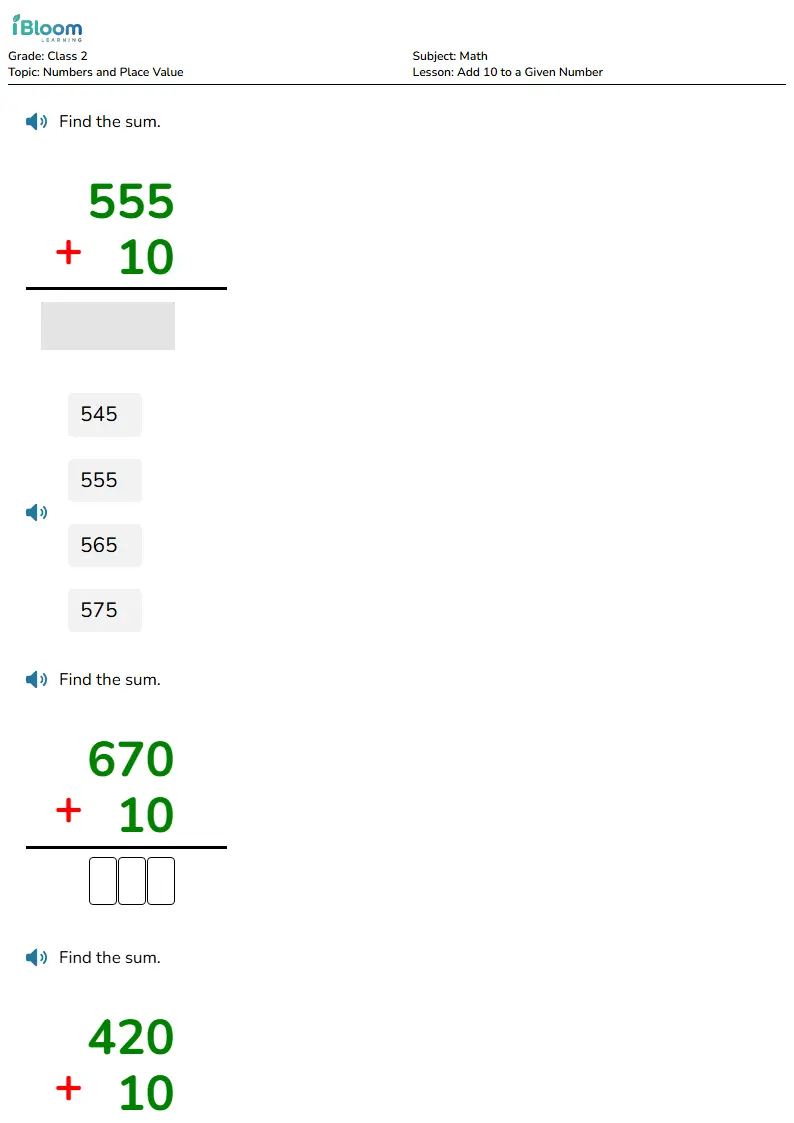
Free Add 10 to a Given Number Worksheets for Class 2
Looking for class 2 math help? Download free, interactive add 10 to a given number worksheets. AI-personalized and Common Core-aligned. Practice math with iBloom.
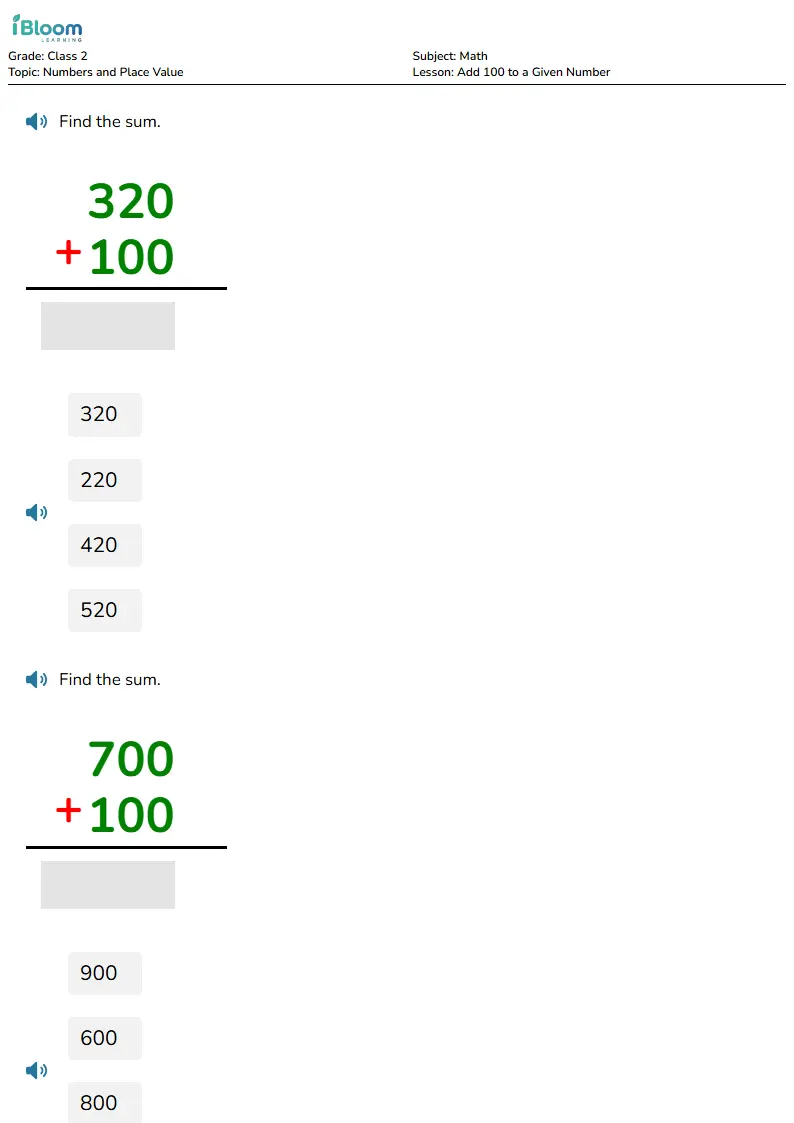
Free Add 100 to a Given Number Worksheets for Class 2
Looking for class 2 math help? Download free, interactive add 100 to a given number worksheets. AI-personalized and Common Core-aligned. Practice math with iBloom.
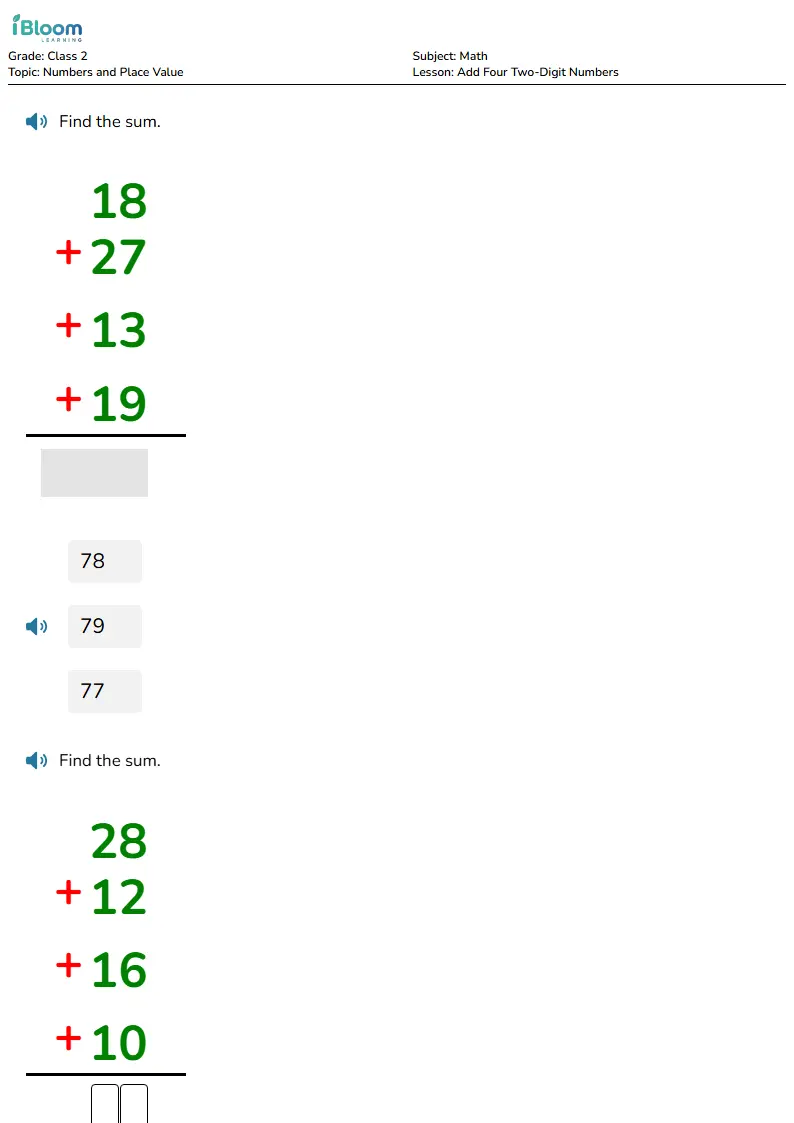
Free Add Four Two-Digit Numbers Worksheets for Class 2
Looking for class 2 math help? Download free, interactive add four two-digit numbers worksheets. AI-personalized and Common Core-aligned. Practice math with iBloom.
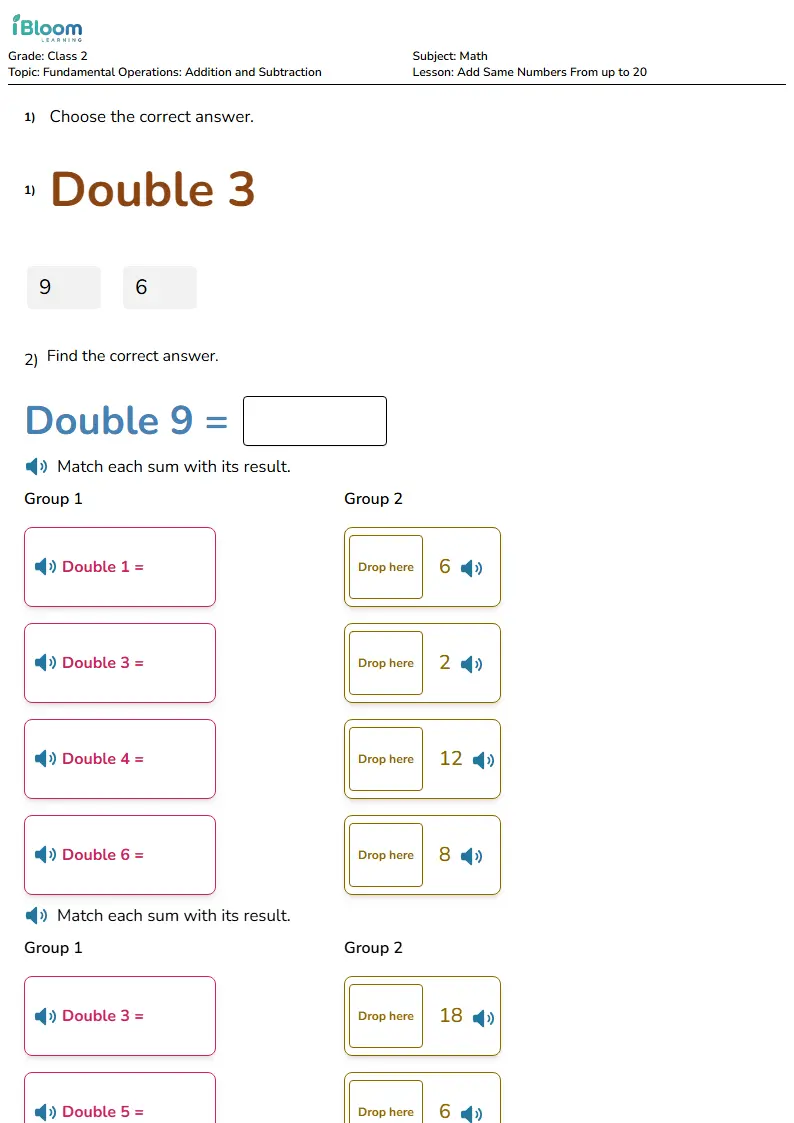
Doubles to 20 Worksheet for Class 2
Practise doubles facts from 1 + 1 to 9 + 9 with Class 2 children through multiple-choice, fill-in and matching tasks for accurate sums within 20.
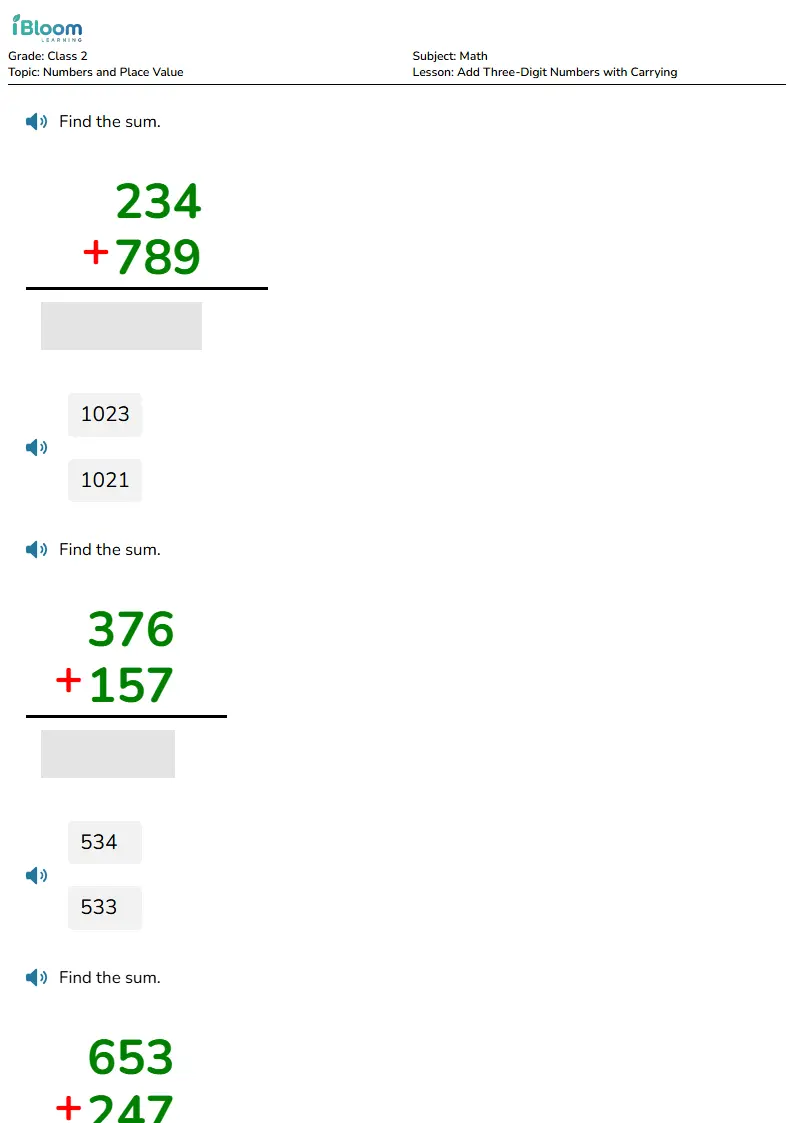
Free Add Three-Digit Numbers with Carrying Worksheets for Class 2
Looking for class 2 math help? Download free, interactive add three-digit numbers with carrying worksheets. AI-personalized and Common Core-aligned. Practice math with iBloom.
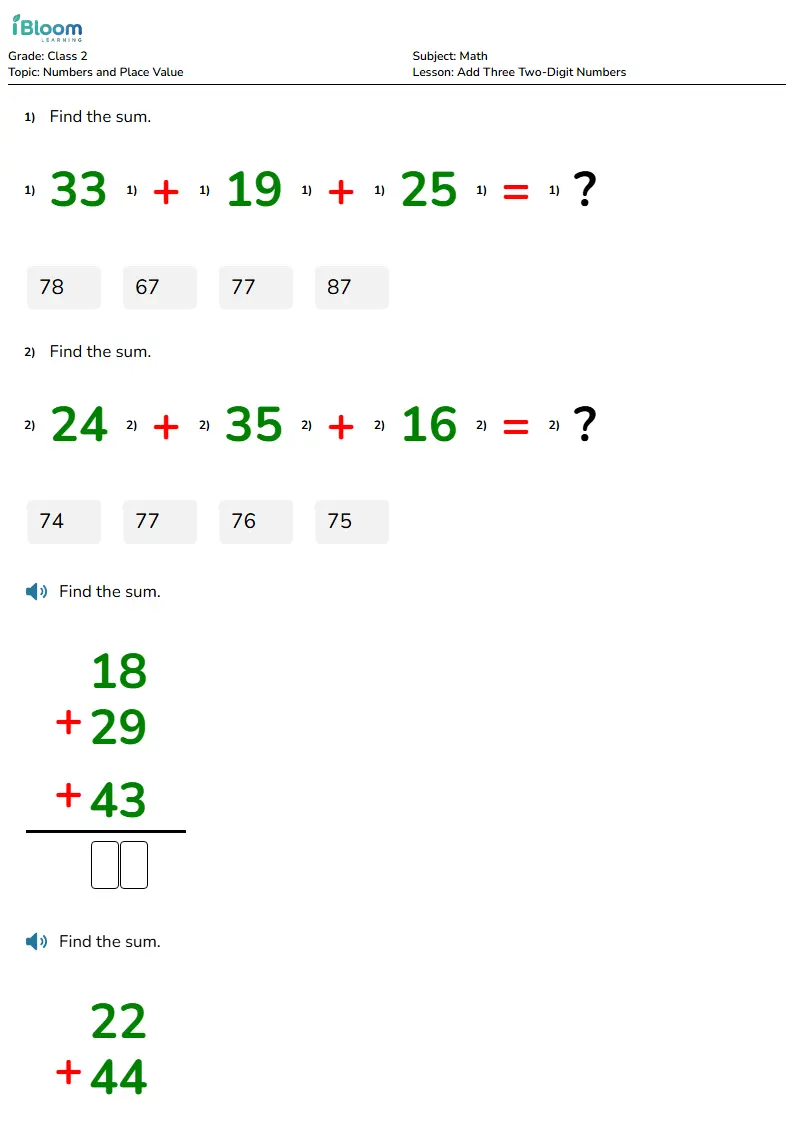
Free Add Three Two-Digit Numbers Worksheets for Class 2
Looking for class 2 math help? Download free, interactive add three two-digit numbers worksheets. AI-personalized and Common Core-aligned. Practice math with iBloom.
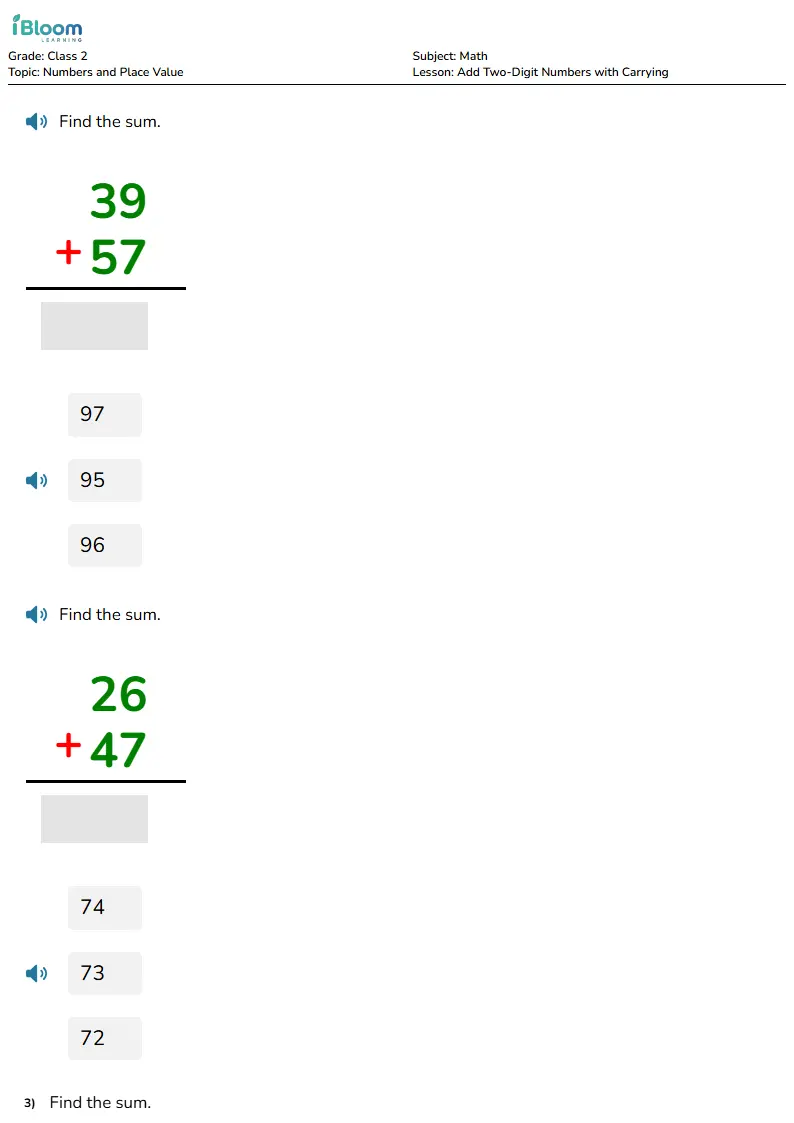
Free Add Two-Digit Numbers with Carrying Worksheets for Class 2
Looking for class 2 math help? Download free, interactive add two-digit numbers with carrying worksheets. AI-personalized and Common Core-aligned. Practice math with iBloom.
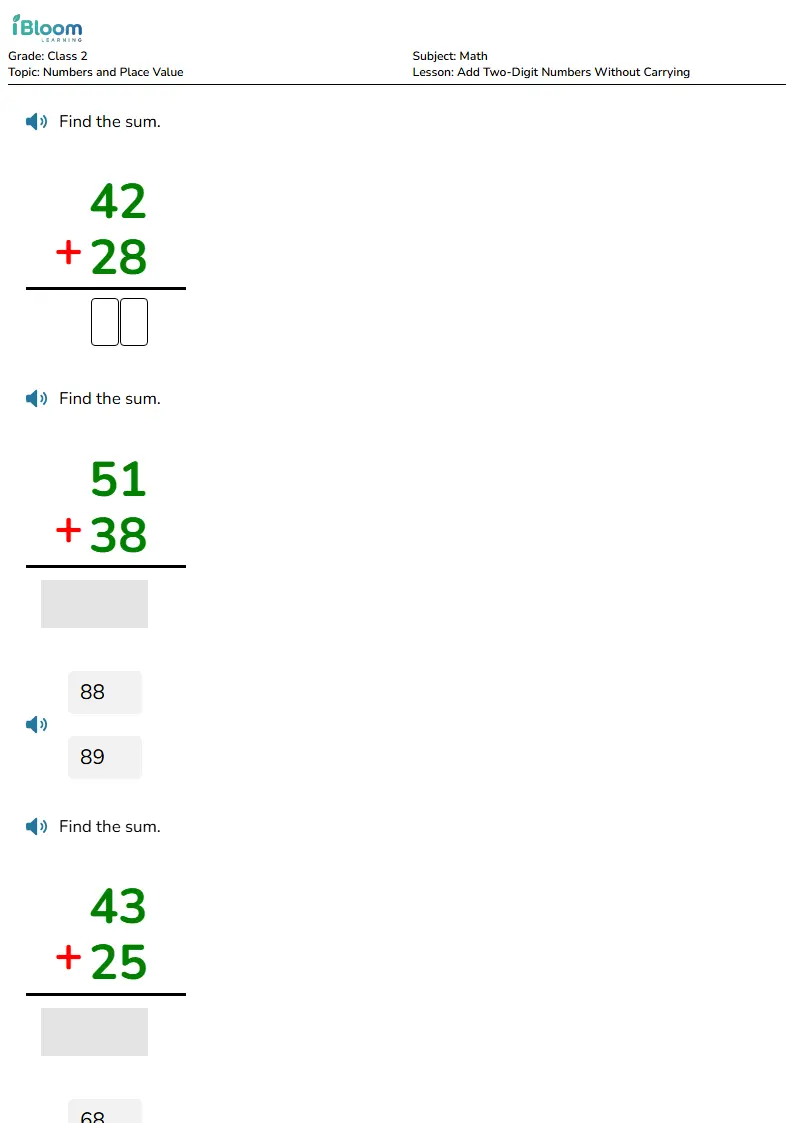
Free Add Two-Digit Numbers Without Carrying Worksheets for Class 2
Looking for class 2 math help? Download free, interactive add two-digit numbers without carrying worksheets. AI-personalized and Common Core-aligned. Practice math with iBloom.
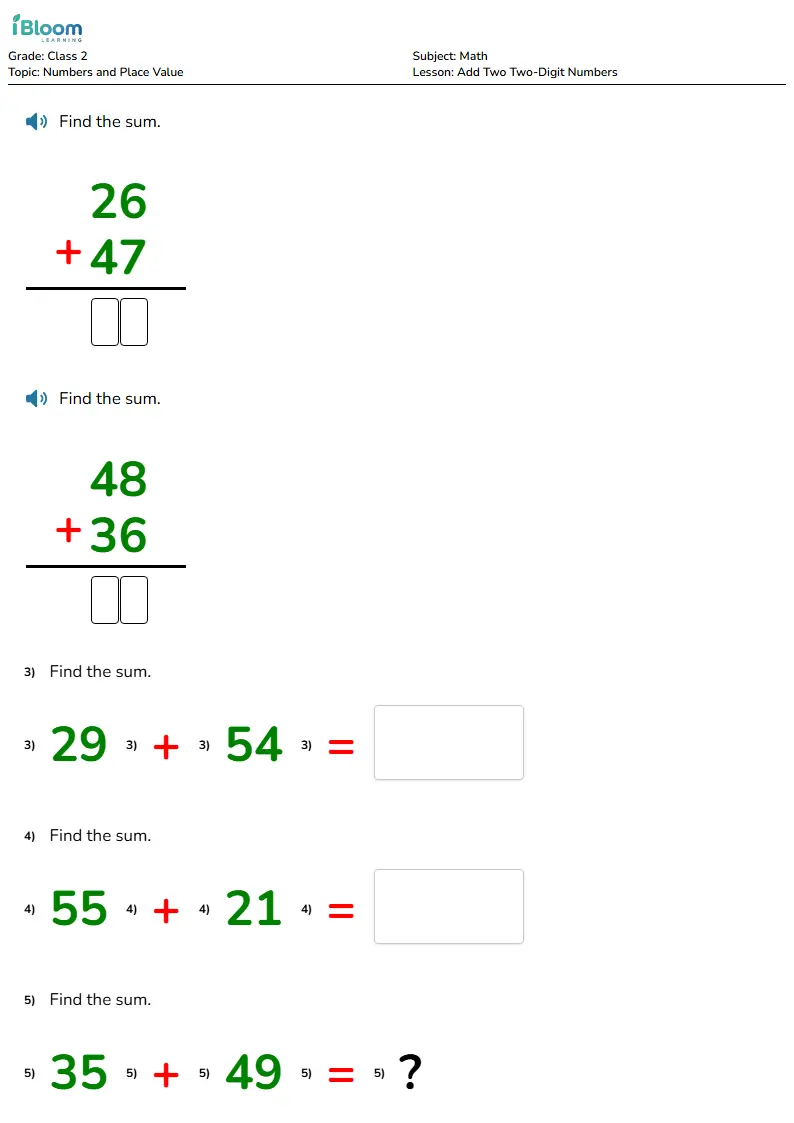
Free Add Two Two-Digit Numbers Worksheets for Class 2
Looking for class 2 math help? Download free, interactive add two two-digit numbers worksheets. AI-personalized and Common Core-aligned. Practice math with iBloom.
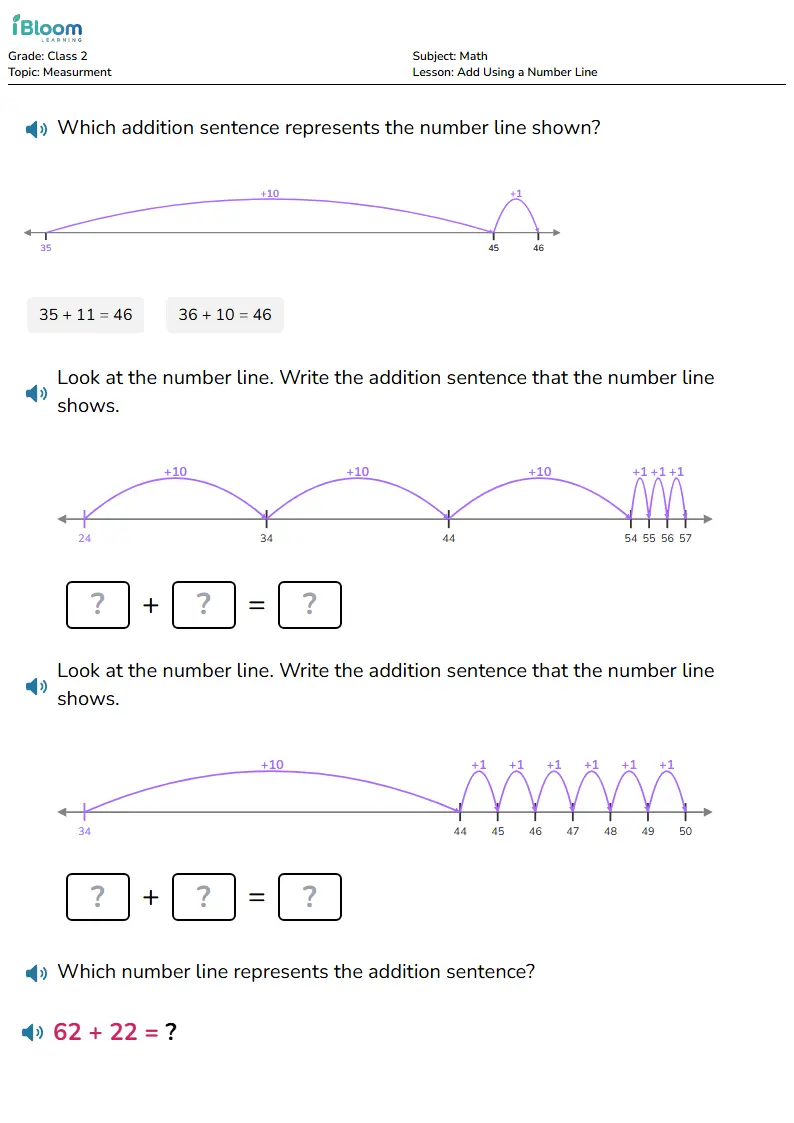
Free Add Using a Number Line Worksheets for Class 2
Looking for class 2 math help? Download free, interactive add using a number line worksheets. AI-personalized and Common Core-aligned. Practice math with iBloom.
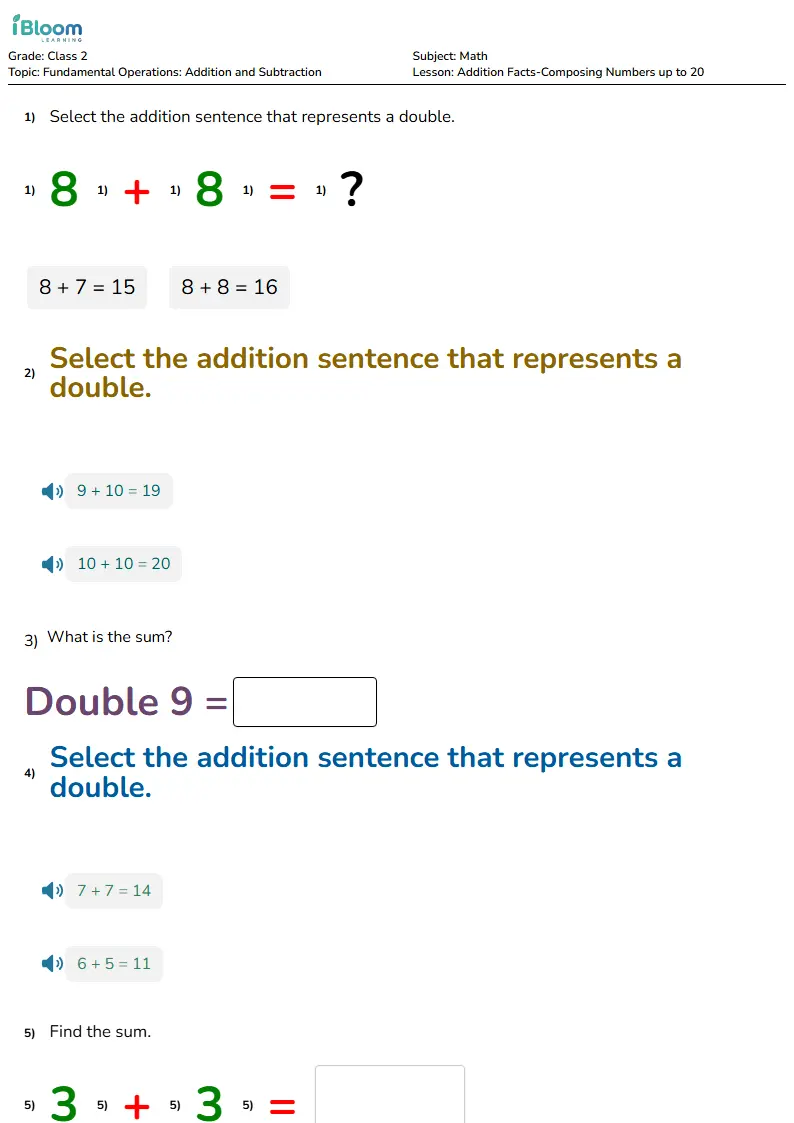
Free Addition Facts-Composing Numbers up to 20 Worksheets for Class 2
Looking for class 2 math help? Download free, interactive addition facts-composing numbers up to 20 worksheets. AI-personalized and Common Core-aligned. Practice math with iBloom.
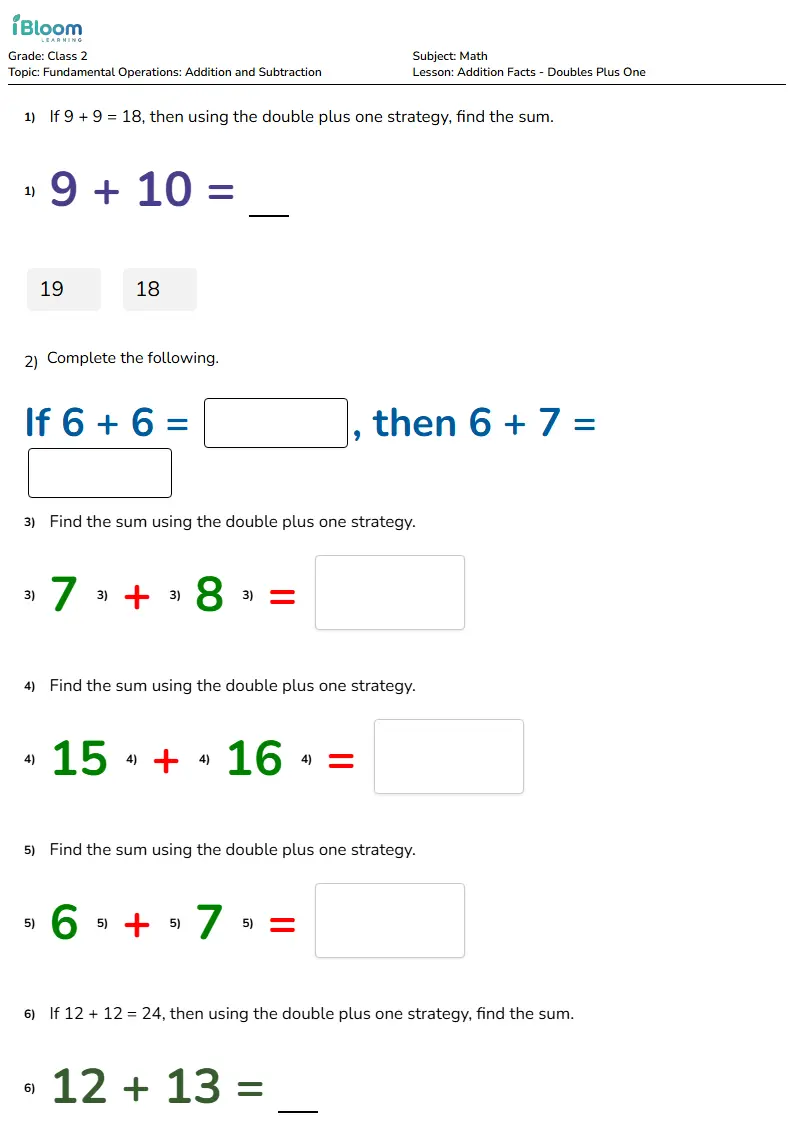
Free Addition Facts - Doubles Plus One Worksheets for Class 2
Looking for class 2 math help? Download free, interactive addition facts - doubles plus one worksheets. AI-personalized and Common Core-aligned. Practice math with iBloom.
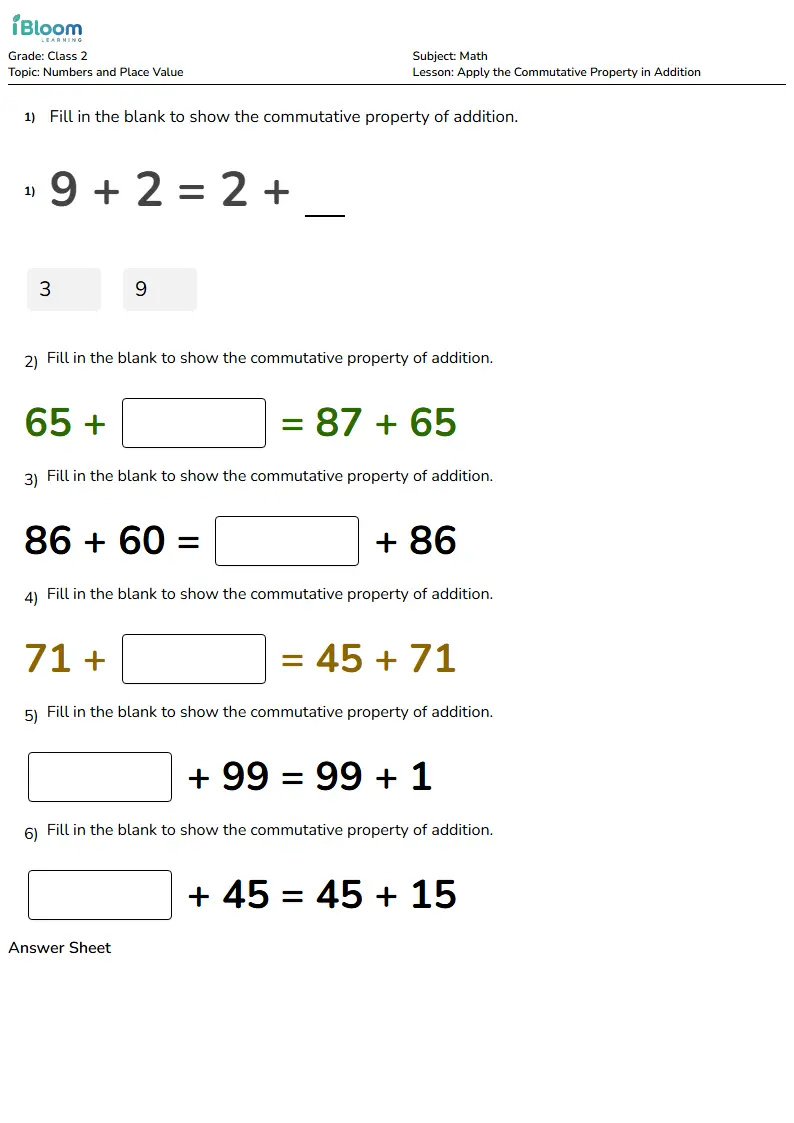
Free Apply the Commutative Property in Addition Worksheets for Class 2
Looking for class 2 math help? Download free, interactive apply the commutative property in addition worksheets. AI-personalized and Common Core-aligned. Practice math with iBloom.
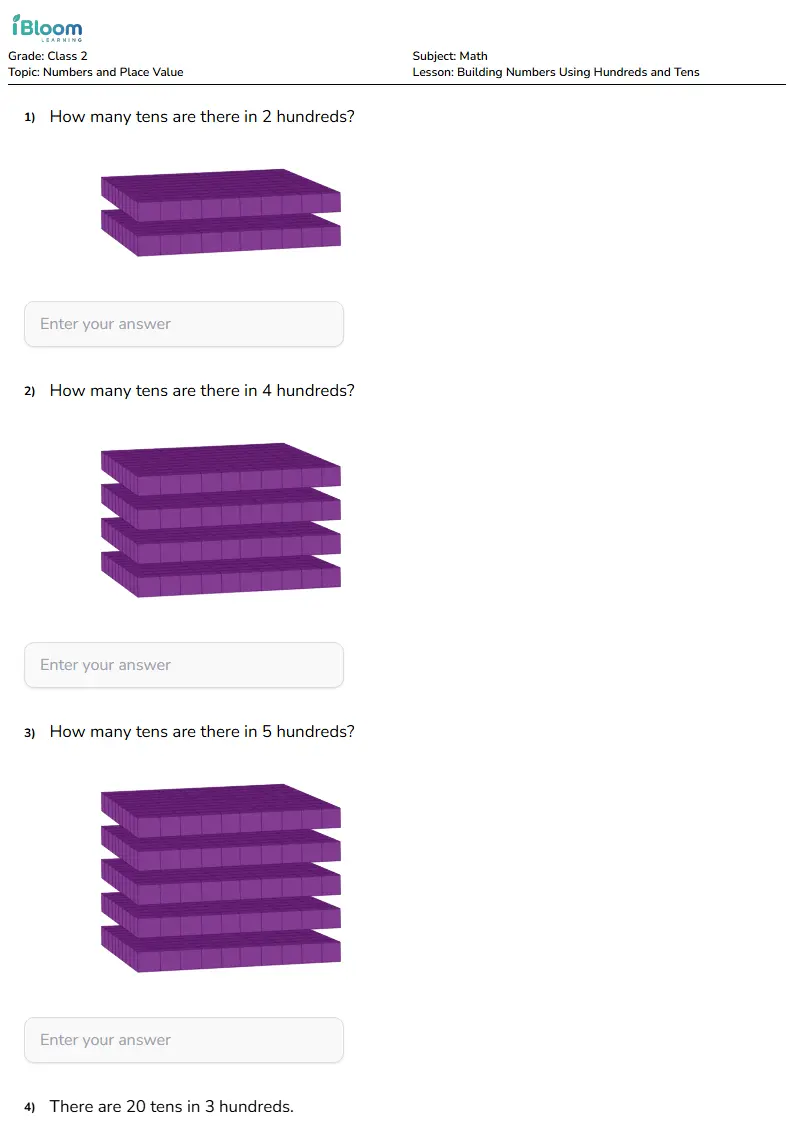
Free Building Numbers Using Hundreds and Tens Worksheets for Class 2
Looking for class 2 math help? Download free, interactive building numbers using hundreds and tens worksheets. AI-personalized and Common Core-aligned. Practice math with iBloom.
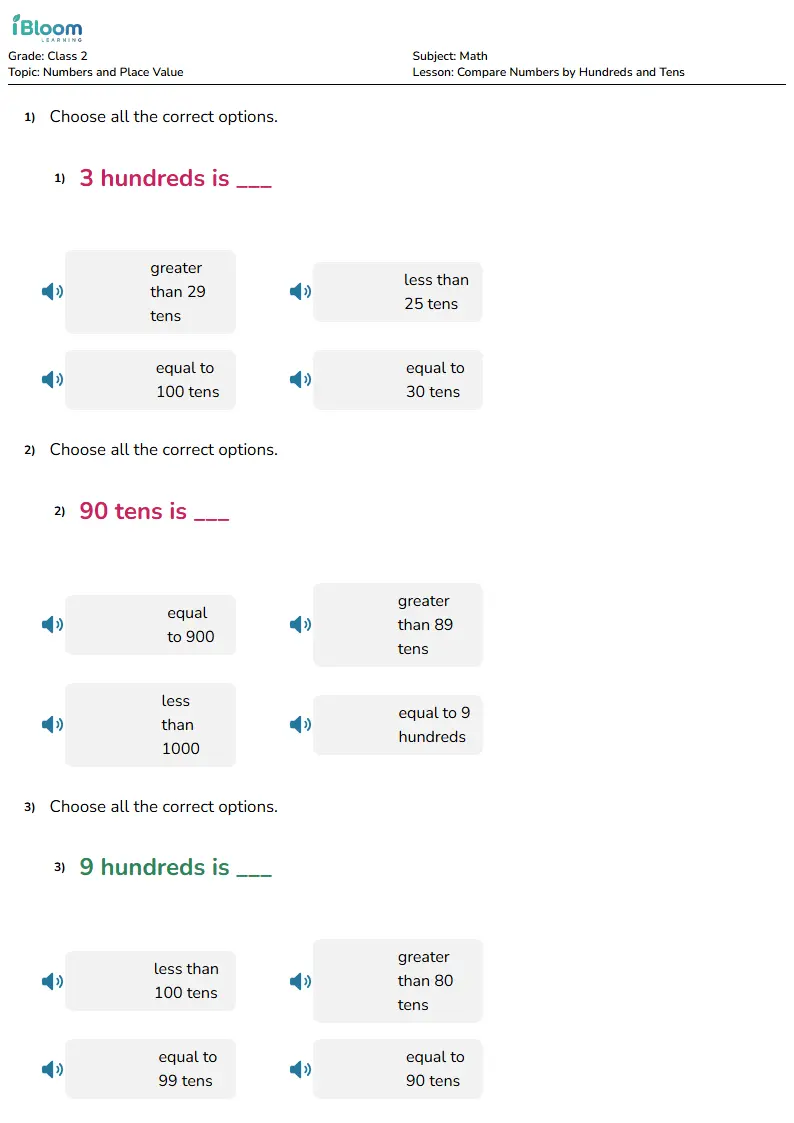
Free Compare Numbers by Hundreds and Tens Worksheets for Class 2
Looking for class 2 math help? Download free, interactive compare numbers by hundreds and tens worksheets. AI-personalized and Common Core-aligned. Practice math with iBloom.
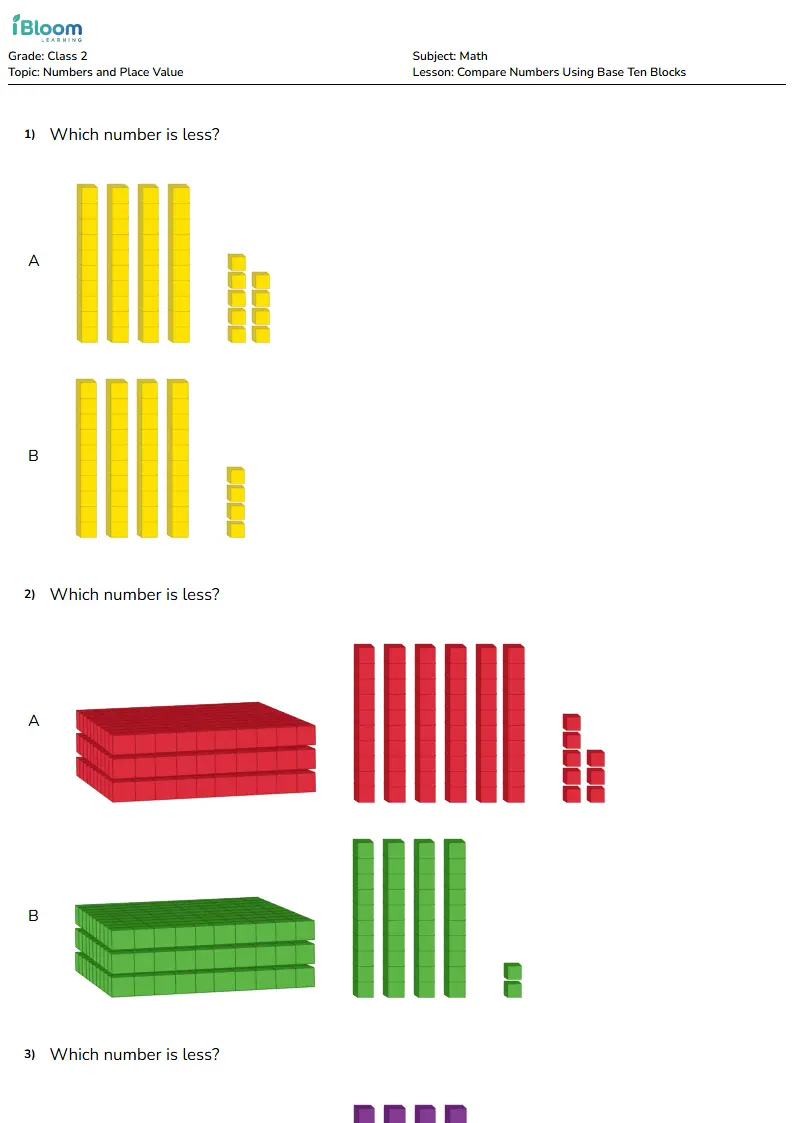
Free Compare Numbers Using Base Ten Blocks Worksheets for Class 2
Looking for class 2 math help? Download free, interactive compare numbers using base ten blocks worksheets. AI-personalized and Common Core-aligned. Practice math with iBloom.
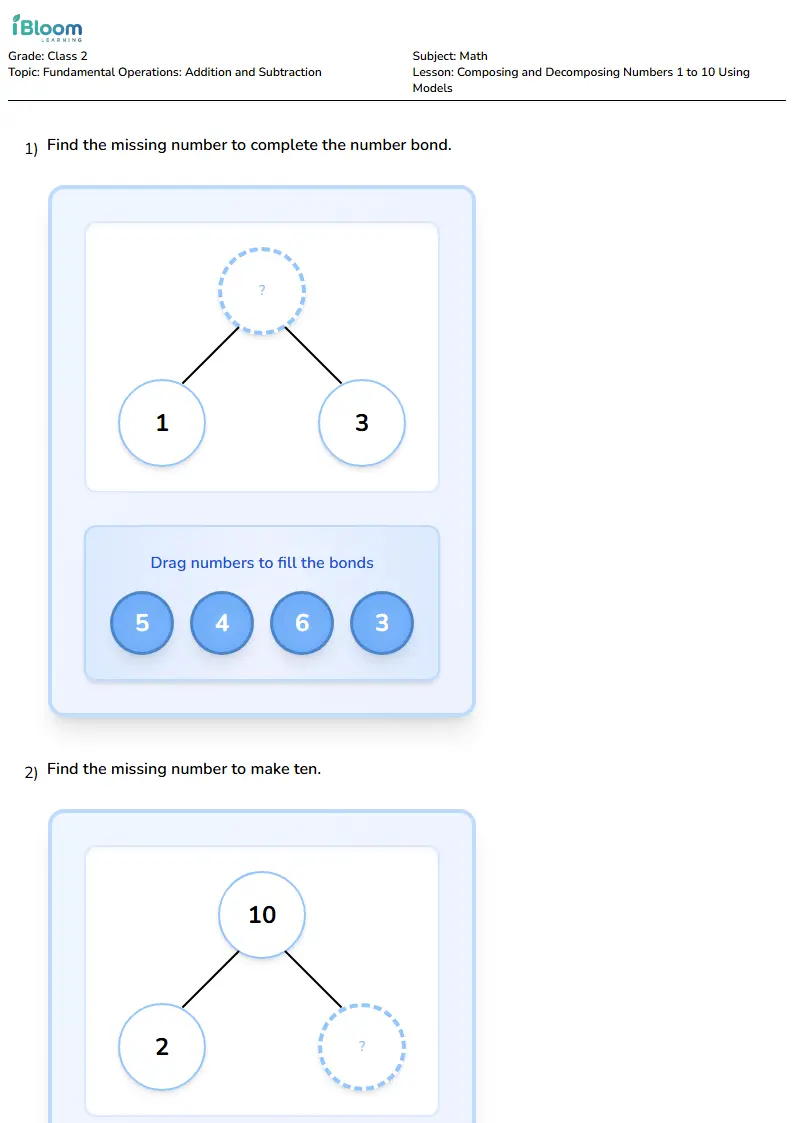
Free Composing and Decomposing Numbers 1 to 10 Using Models Worksheets for Class 2
Looking for class 2 math help? Download free, interactive composing and decomposing numbers 1 to 10 using models worksheets. AI-personalized and Common Core-aligned. Practice math with iBloom.
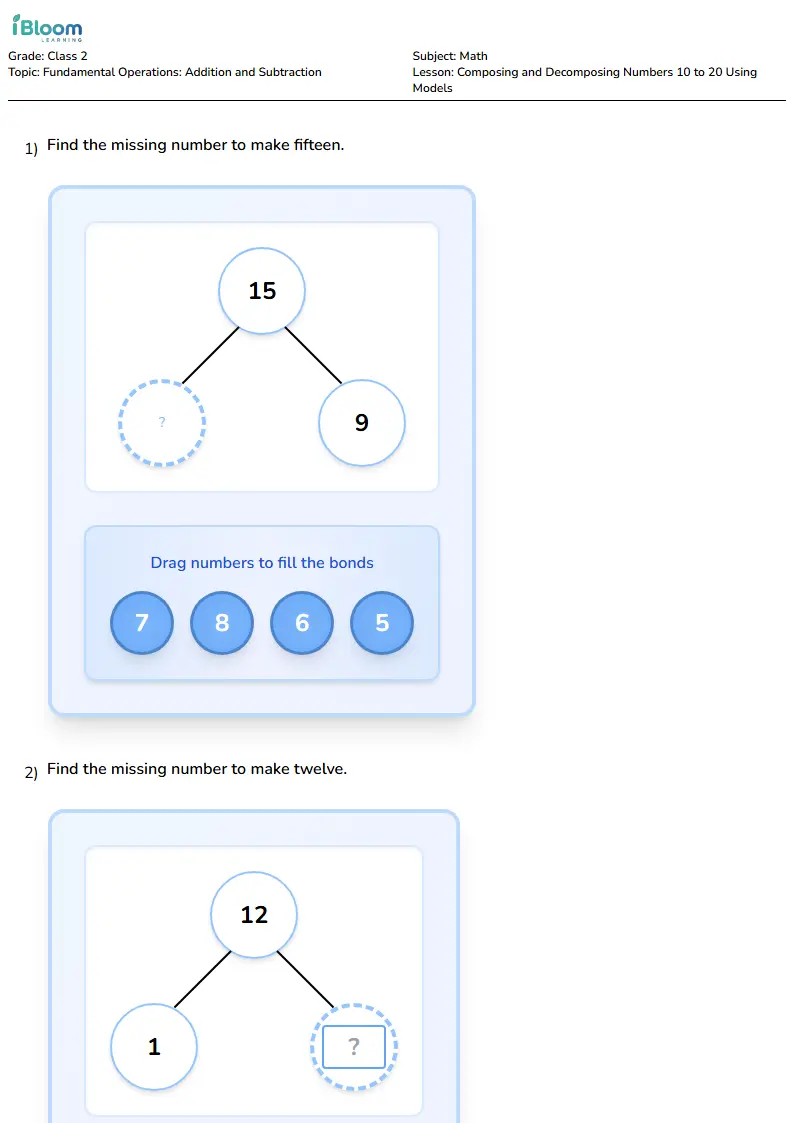
Free Composing and Decomposing Numbers 10 to 20 Using Models Worksheets for Class 2
Looking for class 2 math help? Download free, interactive composing and decomposing numbers 10 to 20 using models worksheets. AI-personalized and Common Core-aligned. Practice math with iBloom.
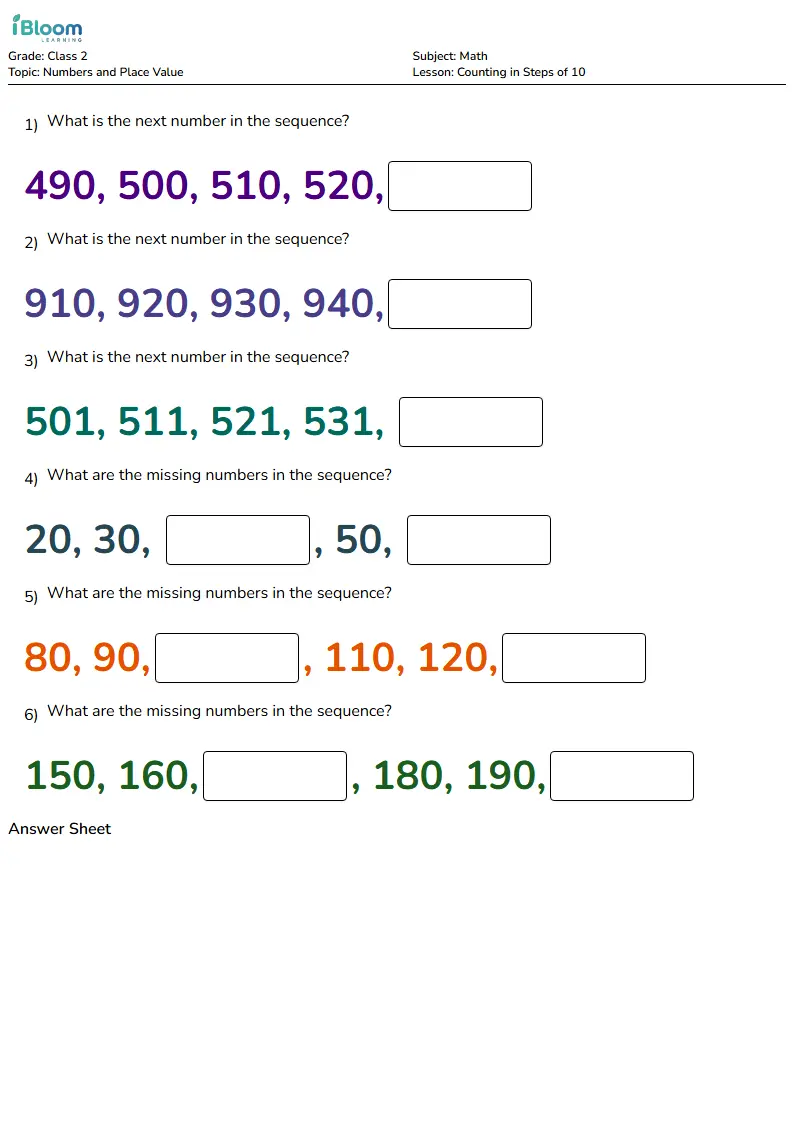
Free Counting in Steps of 10 Worksheets for Class 2
Looking for class 2 math help? Download free, interactive counting in steps of 10 worksheets. AI-personalized and Common Core-aligned. Practice math with iBloom.
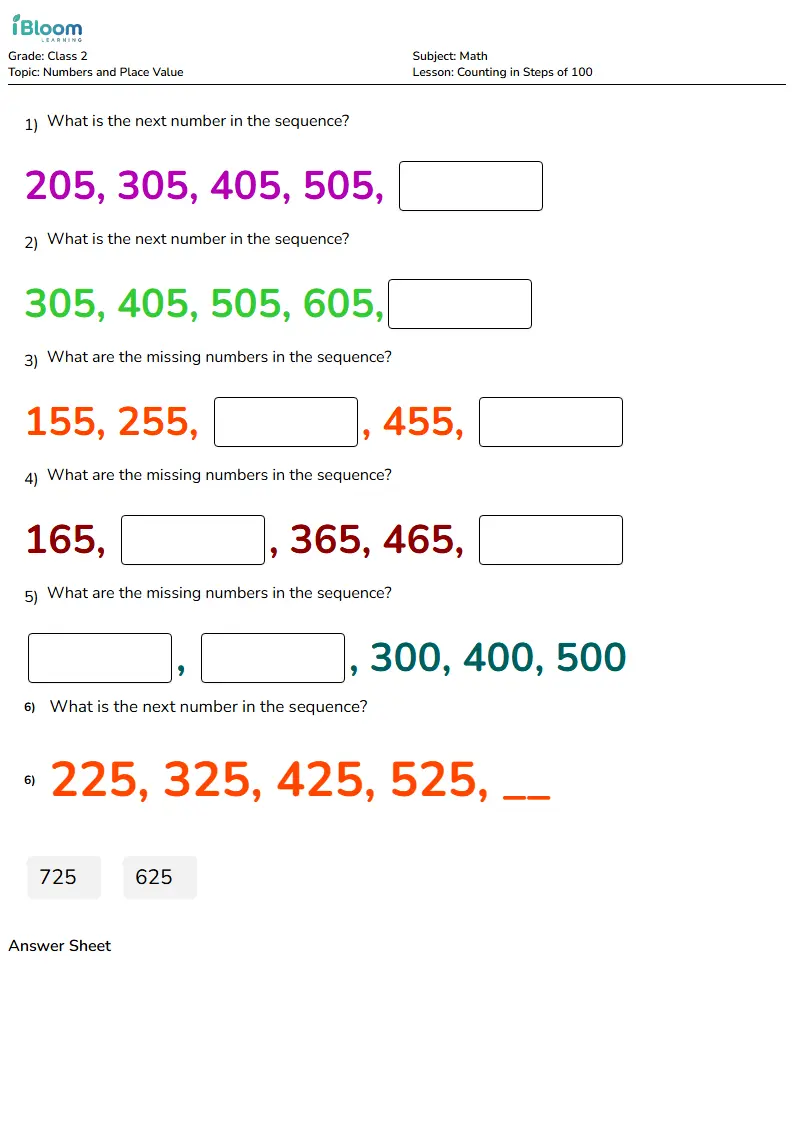
Free Counting in Steps of 100 Worksheets for Class 2
Looking for class 2 math help? Download free, interactive counting in steps of 100 worksheets. AI-personalized and Common Core-aligned. Practice math with iBloom.
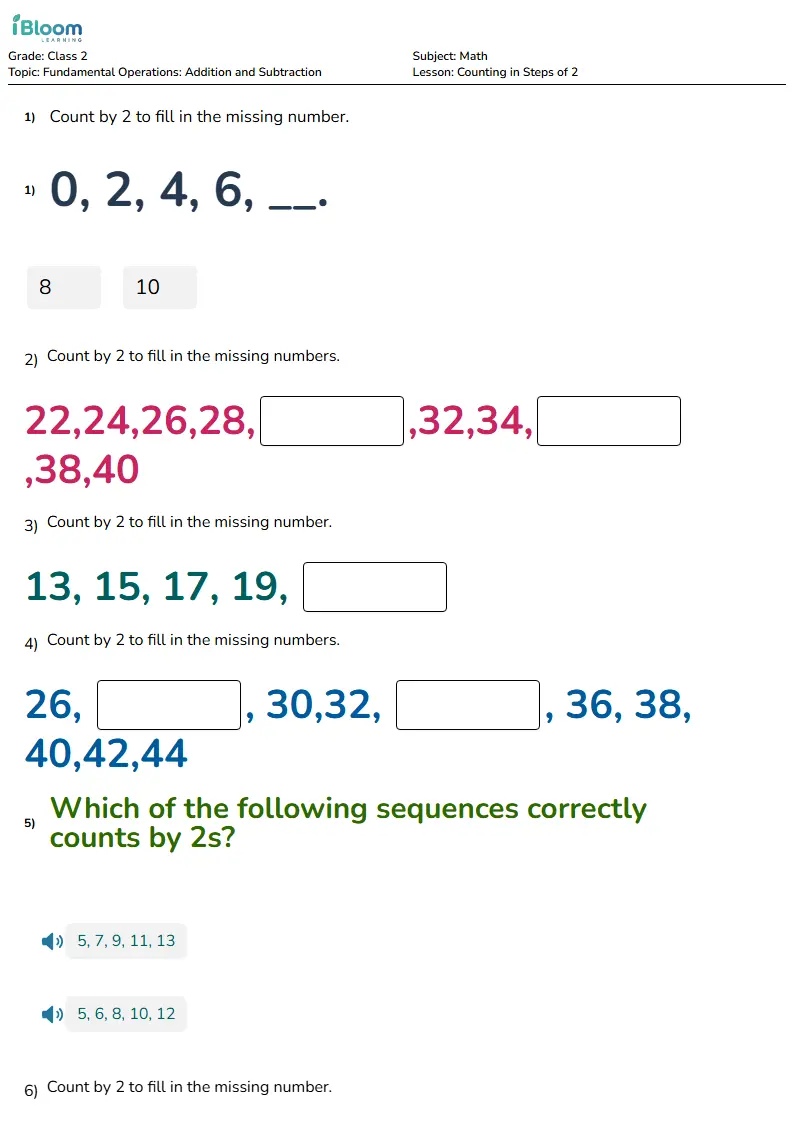
Free Counting in Steps of 2 Worksheets for Class 2
Looking for class 2 math help? Download free, interactive counting in steps of 2 worksheets. AI-personalized and Common Core-aligned. Practice math with iBloom.
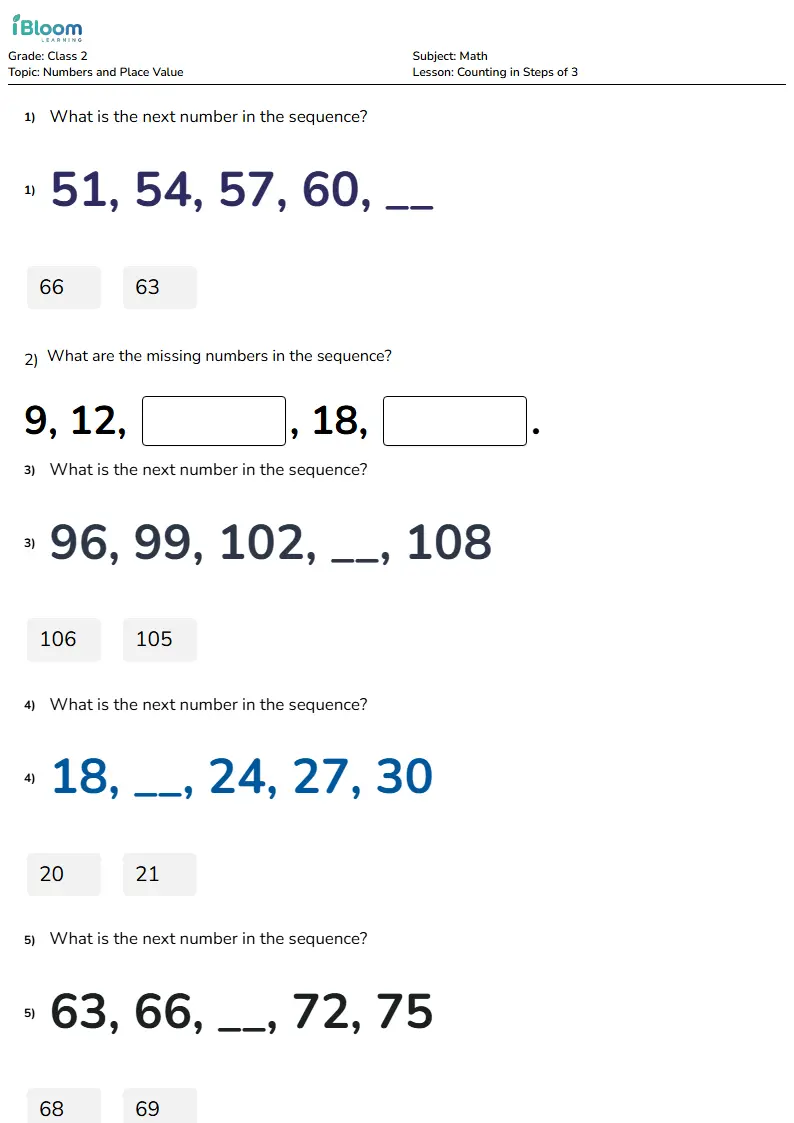
Free Counting in Steps of 3 Worksheets for Class 2
Looking for class 2 math help? Download free, interactive counting in steps of 3 worksheets. AI-personalized and Common Core-aligned. Practice math with iBloom.
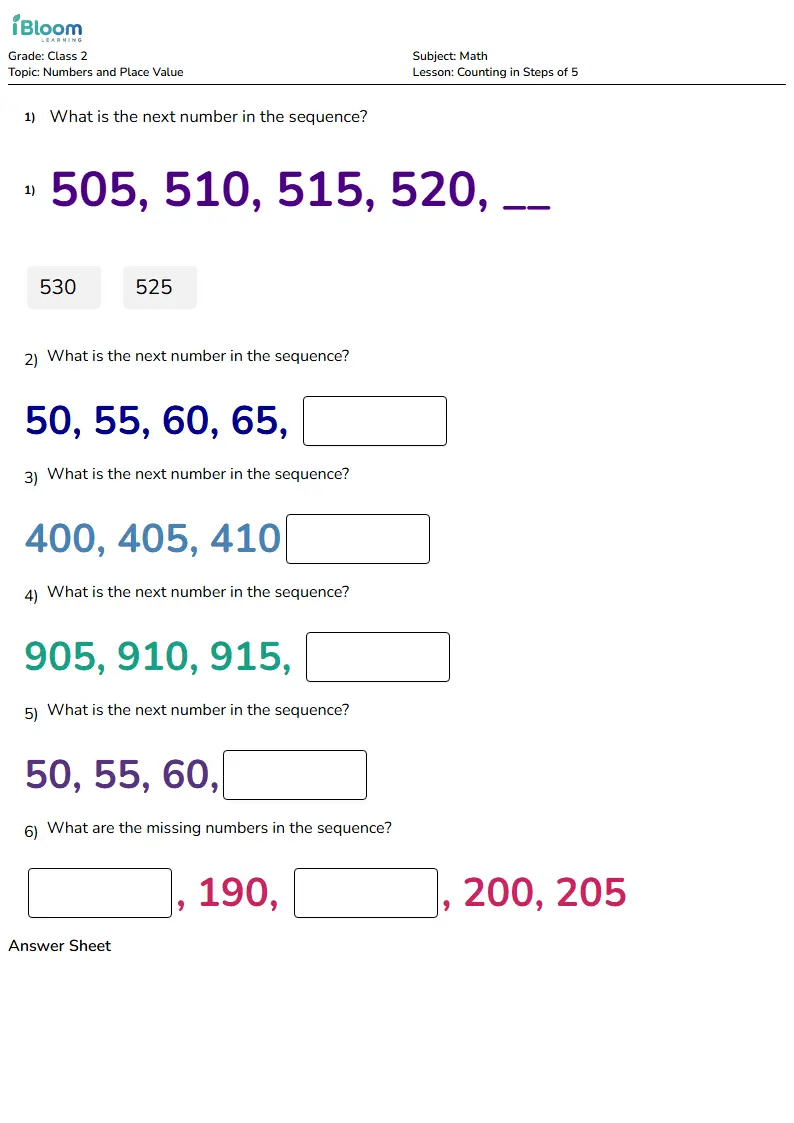
Free Counting in Steps of 5 Worksheets for Class 2
Looking for class 2 math help? Download free, interactive counting in steps of 5 worksheets. AI-personalized and Common Core-aligned. Practice math with iBloom.
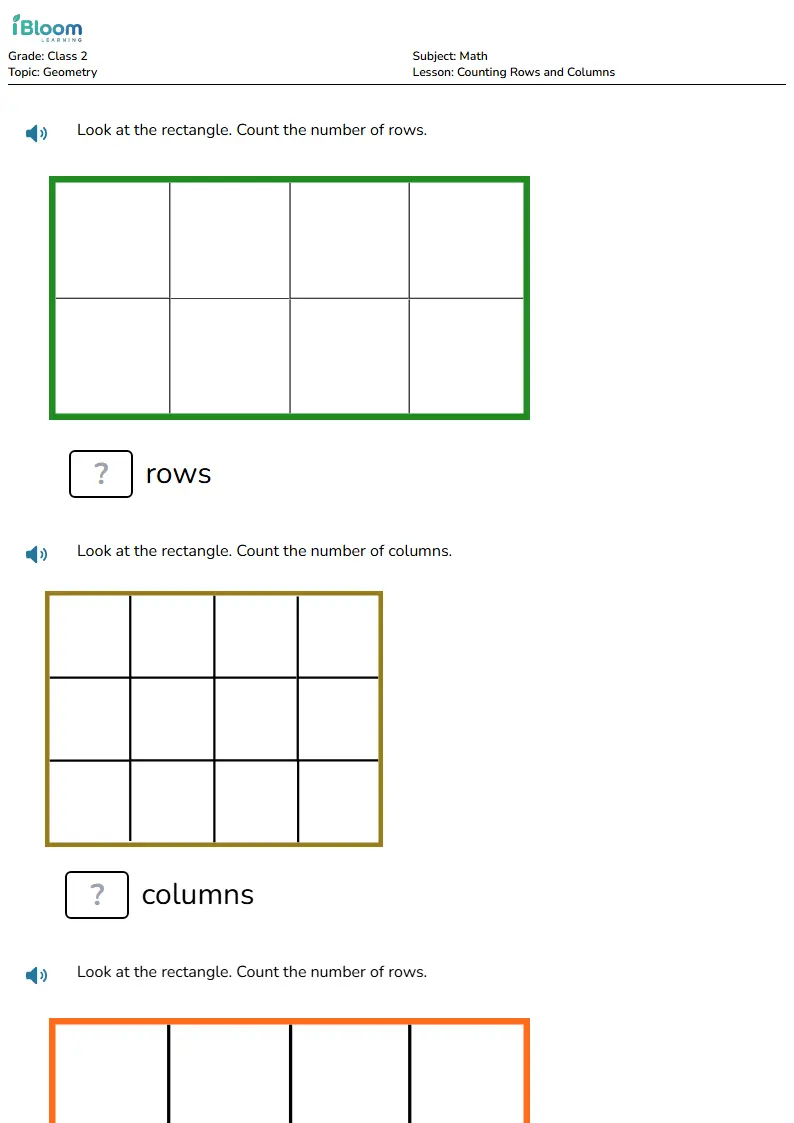
Free Counting Rows and Columns Worksheets for Class 2
Looking for class 2 math help? Download free, interactive counting rows and columns worksheets. AI-personalized and Common Core-aligned. Practice math with iBloom.