Understand Thirds Of A Shape worksheet for Class 2

Lesson-Wise Builder
A premium AI tool that creates syllabus-aligned questions and worksheets for any lesson in seconds.
A shape shows thirds only when one whole is divided into three equal parts. The word “three” is important, but equality is just as important. Three pieces of different sizes are not thirds of the same whole. One of three equal parts is one third; two selected parts are two thirds; and all three parts together are three thirds, which rebuild the complete whole. This activity asks Class 2 children to use those ideas when comparing pictures rather than recognising a single memorised diagram.
A simple test for thirds
First identify the whole shape being discussed. Next count the regions created by the partition lines. There must be exactly three parts. Then compare their areas: each part must contain an equal share of the whole. The outlines can face different directions, but no part can be larger or smaller in amount. Finally, name the selected amount in relation to that whole.
- Point to the complete whole.
- Count three separate regions, not just the lines.
- Decide whether the three regions have equal area.
- Name one region as one third or all three as three thirds.
- Explain the choice using “whole,” “three,” and “equal.”
Equal area does not require identical orientation
Thirds may appear as vertical strips, horizontal strips, sectors of a circle, or other equal regions. The parts must represent equal amounts of the same whole. A child should compare the space covered, not rely only on whether the pieces have a familiar outline.
Worked visual examples
A rectangle in equal strips
Draw a rectangle and divide it into three equal vertical strips. Each strip is one third. Shade one strip to show one third, two strips to show two thirds, and all three strips to show three thirds or one whole.
A circle in three sectors
A circle can show thirds when three sectors cover equal areas. A circle split across one diameter has two equal parts, so it shows halves rather than thirds. Counting the regions distinguishes the two models immediately.
Three pieces that are unequal
If two partition lines create a narrow middle strip and two larger outer regions, the picture has three parts but not thirds. The equality test fails. Moving the lines so each region has the same area can repair the model.
All three thirds shaded
When every one of the three equal regions is shaded, the selected amount is three thirds. Since no part of the original whole is left unshaded, three thirds equal one whole.
Reasoning through the worksheet choices
The verified activity image first compares bread-shaped pictures partitioned into three regions. The learner must judge whether the regions are equal, not merely count visible dividing bands. Another visible question contrasts a circle divided into three sectors with a circle divided into two parts. The three-part circle represents thirds; the two-part circle represents halves.
A later visible item asks which shape shows three thirds shaded and uses a grid-style model. The child should identify the whole grid region, confirm that it is divided into three equal sections, and check whether all three are shaded. Ask for a sentence such as, “This shows three thirds because all three equal parts of the whole are selected.”
Common mistakes and useful responses
- Counting pieces without checking equality: Compare the area of each region and ask whether the shares are fair.
- Counting partition lines: Two lines can produce three regions. Trace each region and count the spaces.
- Confusing one third with three thirds: Name how many of the equal parts are selected.
- Using three separate objects: Thirds must be equal parts of one identified whole, not simply a group of three unrelated objects.
- Choosing halves because they are equal: Equality alone is insufficient; thirds require three equal parts.
Ways to verify a thirds model
Use three checks. Count: there are exactly three regions. Compare: the regions have equal area. Recombine: the three regions cover the original whole without gaps or overlap. For a shaded model, count how many equal regions are selected. These checks work for circles, rectangles, grids, and familiar-object pictures.
A paper strip offers a physical check. Folding it into three equal sections creates congruent lengths along the strip. Unfolding shows the whole divided into three equal shares, and refolding demonstrates how the shares rebuild the whole.
Guidance for parents
Use one paper strip or a rectangular piece of card and mark three equal sections. Ask the child to point to one third, then two thirds, then three thirds. Change the orientation of the strip so the child learns that turning the whole does not change the fractions. Compare with a strip folded into halves and ask what differs.
When a child accepts unequal pieces, avoid saying only that the picture is wrong. Ask, “Would each person receive the same amount?” or “Which part covers more space?” Fair-sharing language can make equality meaningful. Then invite the child to adjust the boundaries.
Guidance and practice ideas for teachers
Present examples and non-examples together: a rectangle in equal thirds, one in three unequal strips, a circle in halves, and a rotated thirds model. Ask pupils to sort them and justify each placement. This reveals whether they attend to the number of regions, equality, or only a familiar visual pattern.
- Have pupils draw two different rectangles that both show thirds.
- Ask partners to improve an unequal three-part model.
- Shade one, two, and three thirds in matching wholes.
- Use the sentence stem “It is/is not thirds because…” for explanations.
Related fraction concepts
The idea of equal parts is the foundation for halves, thirds, quarters, and later fractions. The denominator in 1/3 tells that the whole has been divided into three equal parts; the numerator tells how many of those parts are being considered. At this stage, visual and spoken reasoning matter more than symbolic manipulation. Comparing halves and thirds also shows that the size of a fraction part depends on how many equal shares make the same whole.
Continue with related iBloom practice
- compare thirds with halves: Highlights that equal shares change when a whole has two rather than three parts.
- compare thirds with quarters: Extends equal-part reasoning from three shares to four shares.
Useful questions and answers
Are any three pieces called thirds?
No. They must be three equal parts of one whole. Three unequal pieces do not represent thirds.
Why can two lines make thirds?
Partition lines are boundaries. Two suitable boundaries can separate one shape into three regions, just as two cuts can make three pieces.
Can thirds have different shapes?
Different models can show thirds, and regions may be oriented differently. What must stay equal is each region's share of the same whole.
How is one third different from three thirds?
One third selects one of the three equal parts. Three thirds select all three equal parts and therefore equal the whole.
How can understanding be checked?
Ask the child to find the whole, count the parts, compare their areas, name the selected fraction, and explain why a nearby non-example fails.
More practice for this grade
More Math worksheets
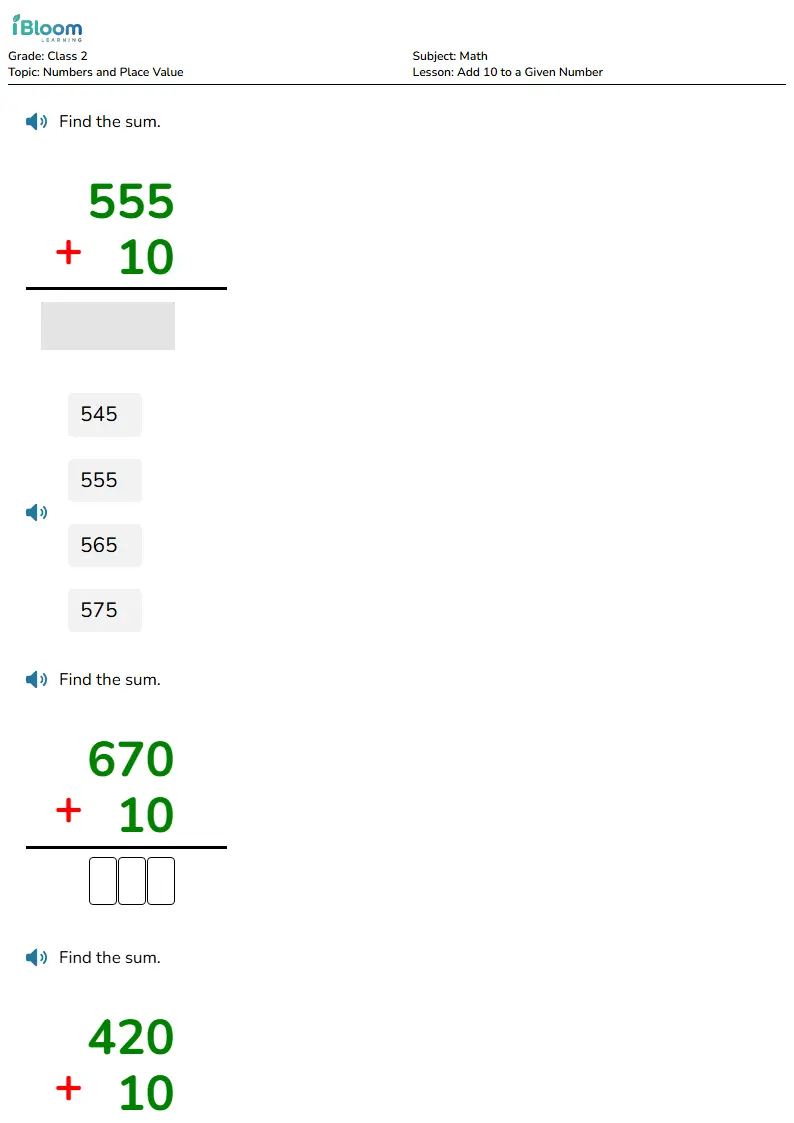
Free Add 10 to a Given Number Worksheets for Class 2
Looking for class 2 math help? Download free, interactive add 10 to a given number worksheets. AI-personalized and Common Core-aligned. Practice math with iBloom.
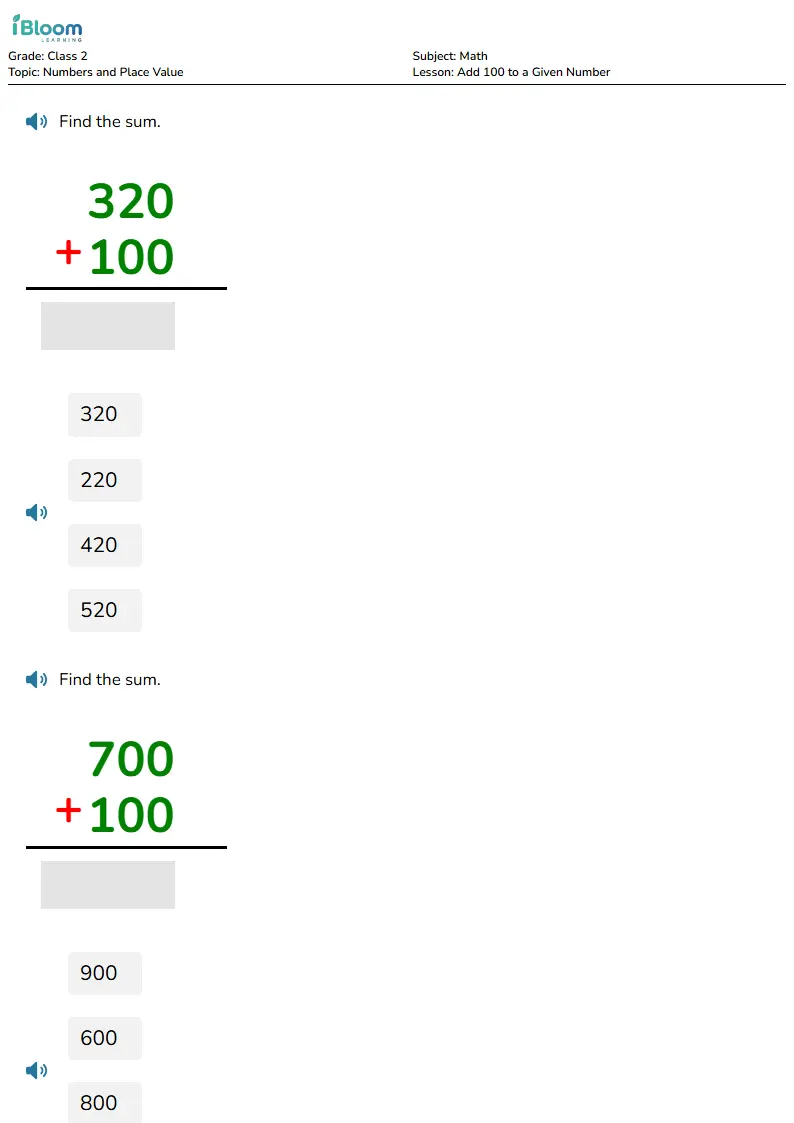
Free Add 100 to a Given Number Worksheets for Class 2
Looking for class 2 math help? Download free, interactive add 100 to a given number worksheets. AI-personalized and Common Core-aligned. Practice math with iBloom.
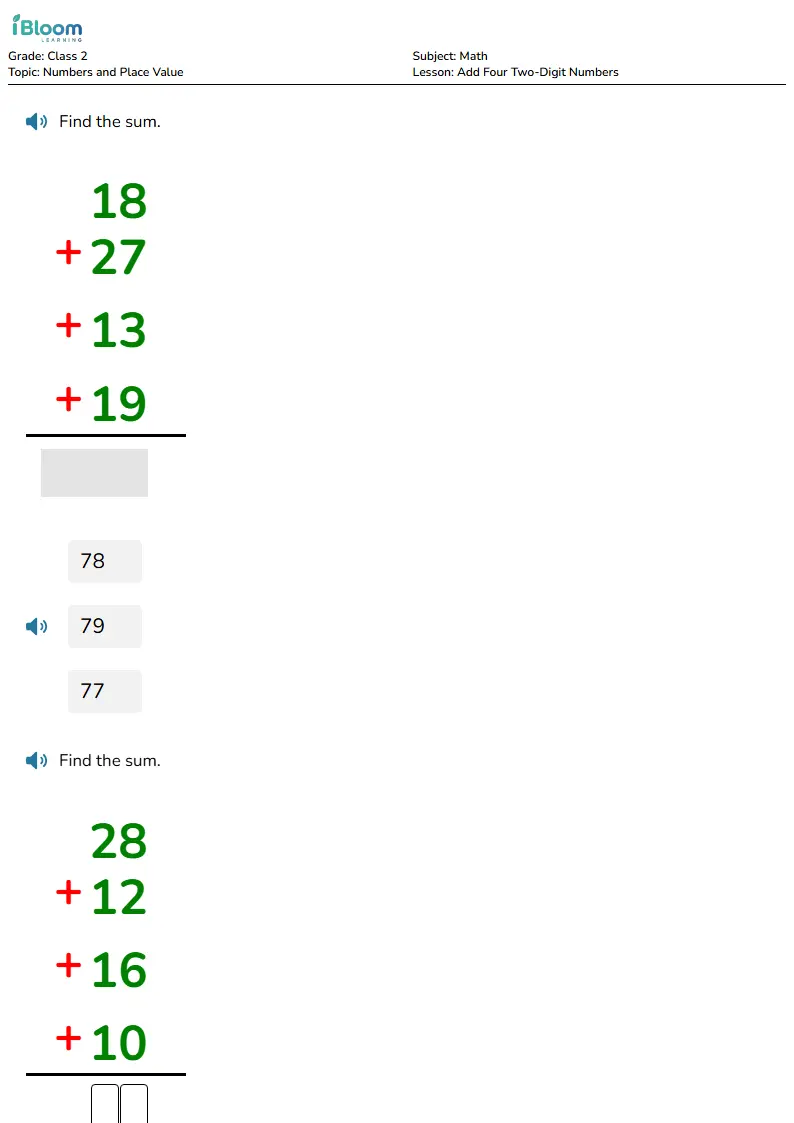
Free Add Four Two-Digit Numbers Worksheets for Class 2
Looking for class 2 math help? Download free, interactive add four two-digit numbers worksheets. AI-personalized and Common Core-aligned. Practice math with iBloom.
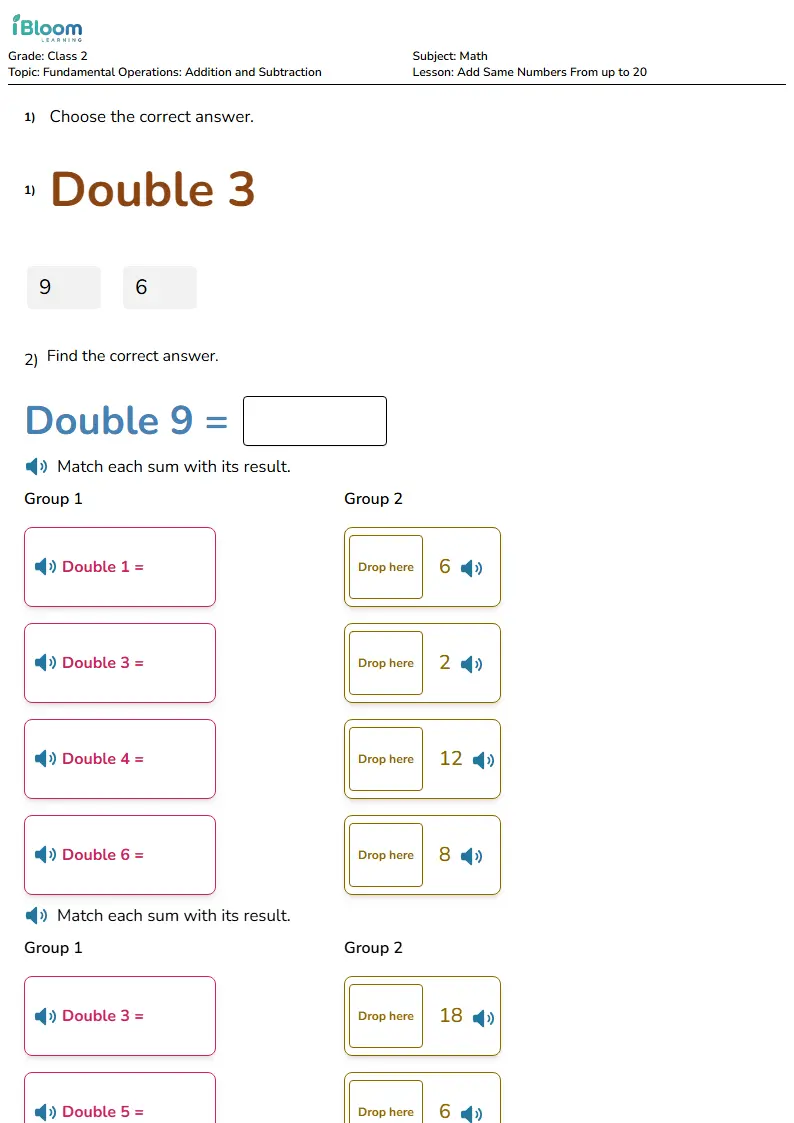
Doubles to 20 Worksheet for Class 2
Practise doubles facts from 1 + 1 to 9 + 9 with Class 2 children through multiple-choice, fill-in and matching tasks for accurate sums within 20.
Free Add Three-Digit Numbers with Carrying Worksheets for Class 2
Looking for class 2 math help? Download free, interactive add three-digit numbers with carrying worksheets. AI-personalized and Common Core-aligned. Practice math with iBloom.
3-Digit Addition Without Carrying Worksheet | Class 2
Class 2 practice for three-digit addition without carrying: line up hundreds, tens and ones in horizontal and vertical sums, then check the answer.
Free Add Three Two-Digit Numbers Worksheets for Class 2
Looking for class 2 math help? Download free, interactive add three two-digit numbers worksheets. AI-personalized and Common Core-aligned. Practice math with iBloom.
Free Add Two-Digit Numbers with Carrying Worksheets for Class 2
Looking for class 2 math help? Download free, interactive add two-digit numbers with carrying worksheets. AI-personalized and Common Core-aligned. Practice math with iBloom.
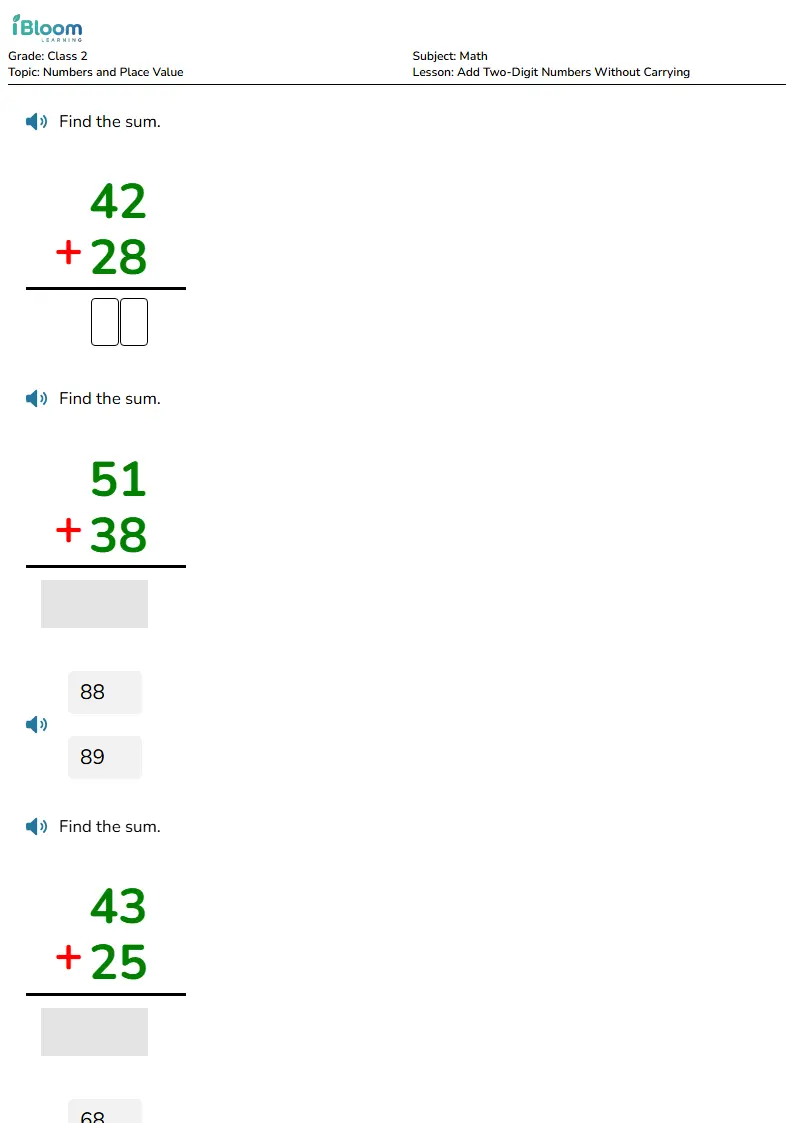
Free Add Two-Digit Numbers Without Carrying Worksheets for Class 2
Looking for class 2 math help? Download free, interactive add two-digit numbers without carrying worksheets. AI-personalized and Common Core-aligned. Practice math with iBloom.
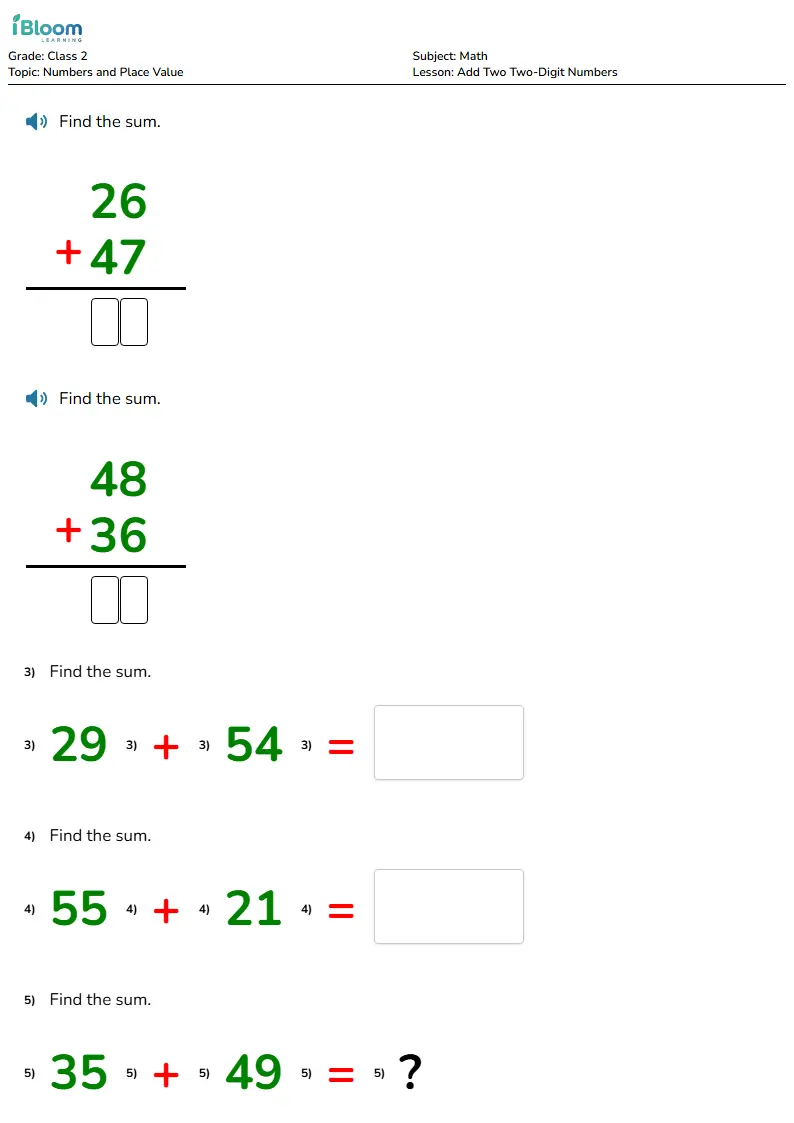
Free Add Two Two-Digit Numbers Worksheets for Class 2
Looking for class 2 math help? Download free, interactive add two two-digit numbers worksheets. AI-personalized and Common Core-aligned. Practice math with iBloom.
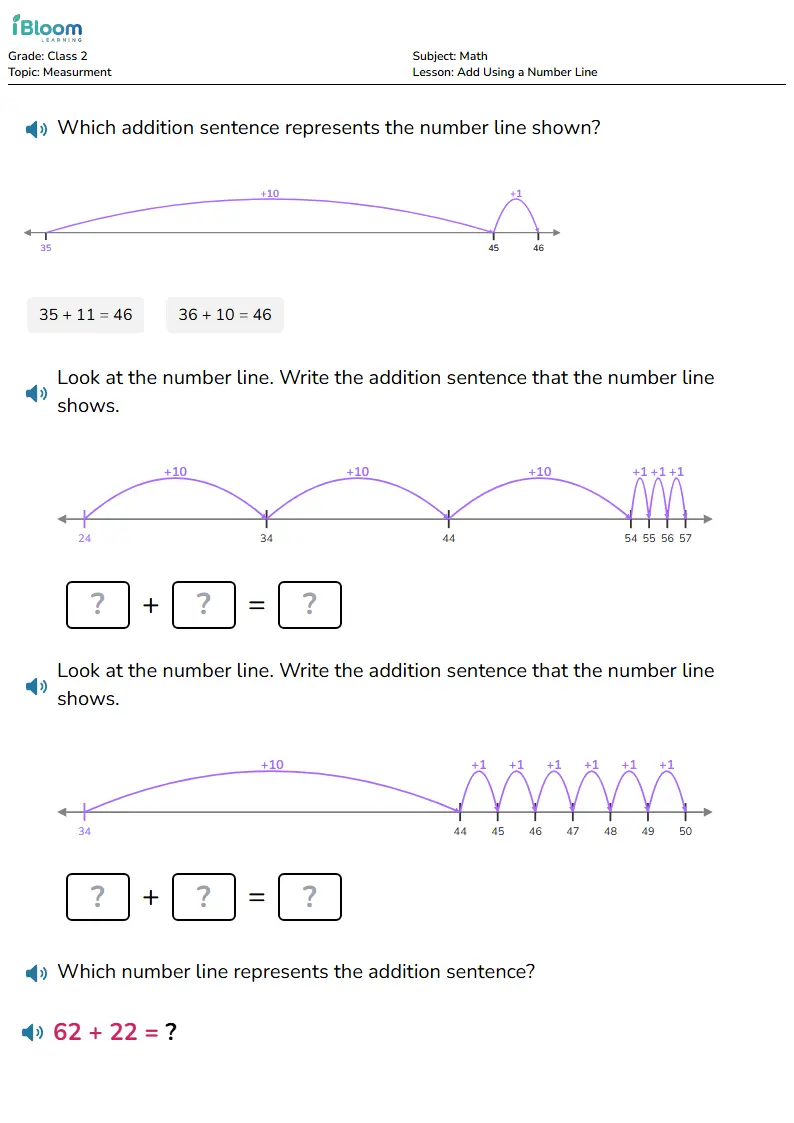
Free Add Using a Number Line Worksheets for Class 2
Looking for class 2 math help? Download free, interactive add using a number line worksheets. AI-personalized and Common Core-aligned. Practice math with iBloom.
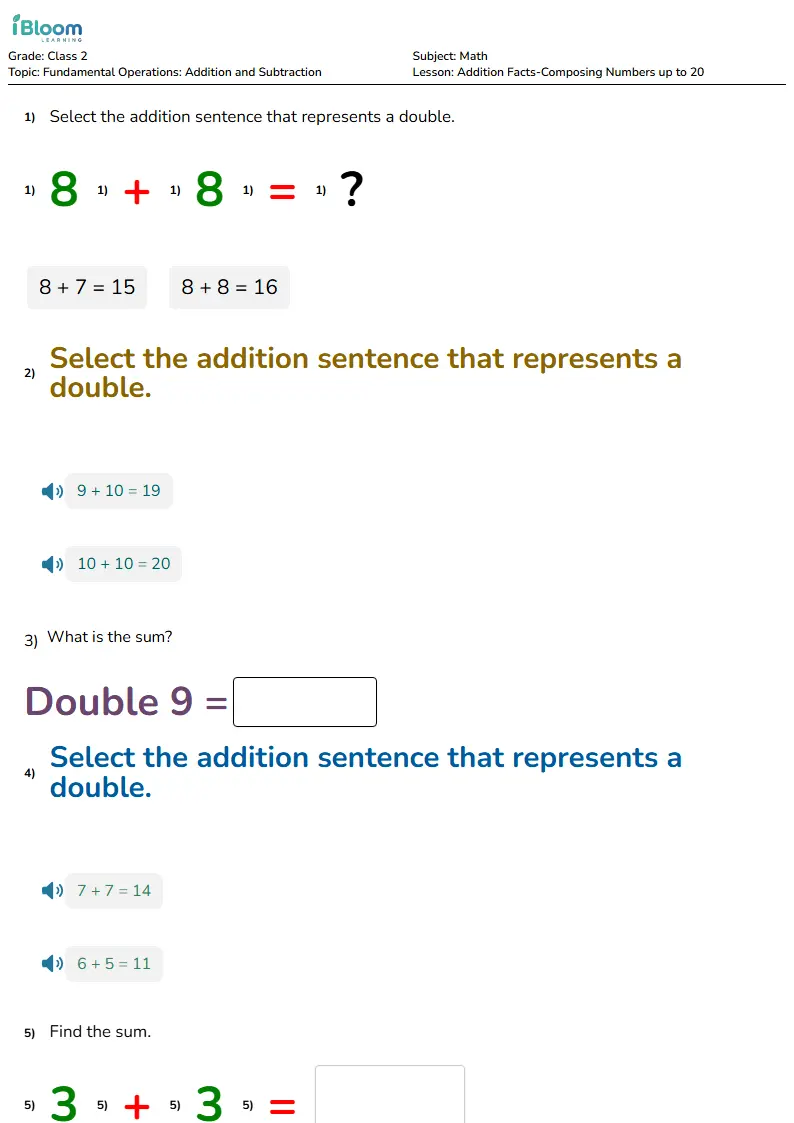
Free Addition Facts-Composing Numbers up to 20 Worksheets for Class 2
Looking for class 2 math help? Download free, interactive addition facts-composing numbers up to 20 worksheets. AI-personalized and Common Core-aligned. Practice math with iBloom.
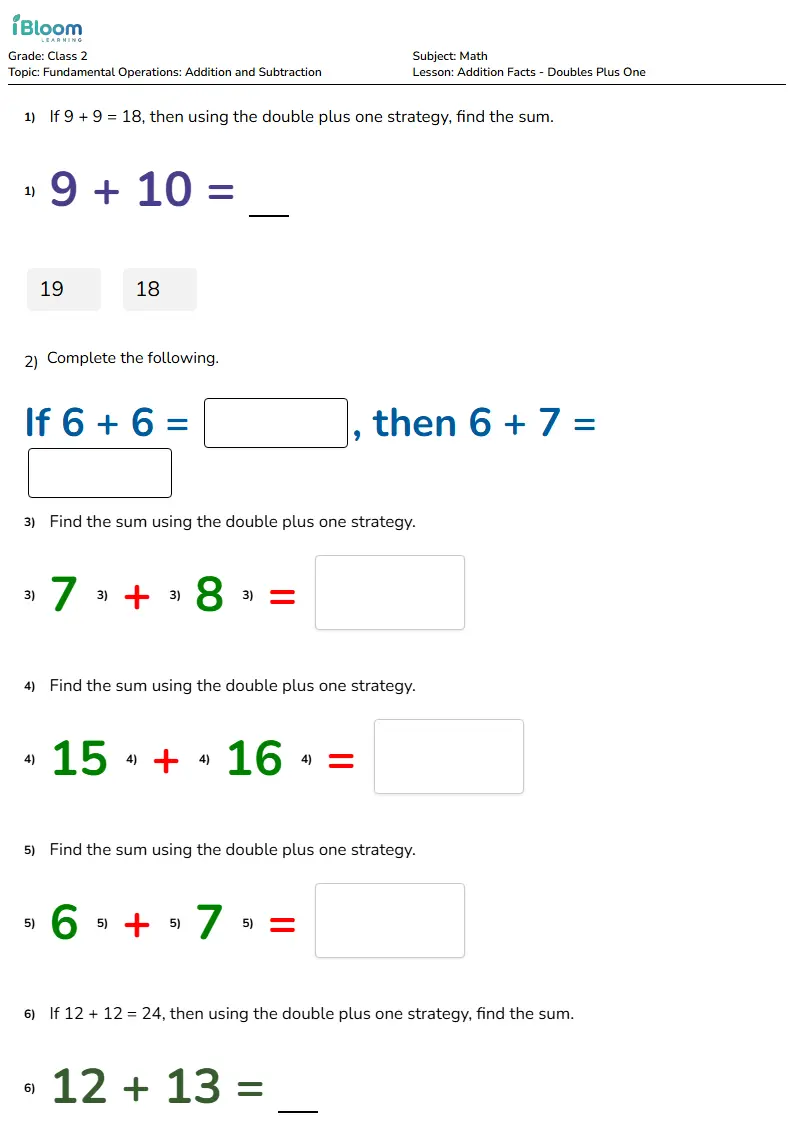
Free Addition Facts - Doubles Plus One Worksheets for Class 2
Looking for class 2 math help? Download free, interactive addition facts - doubles plus one worksheets. AI-personalized and Common Core-aligned. Practice math with iBloom.
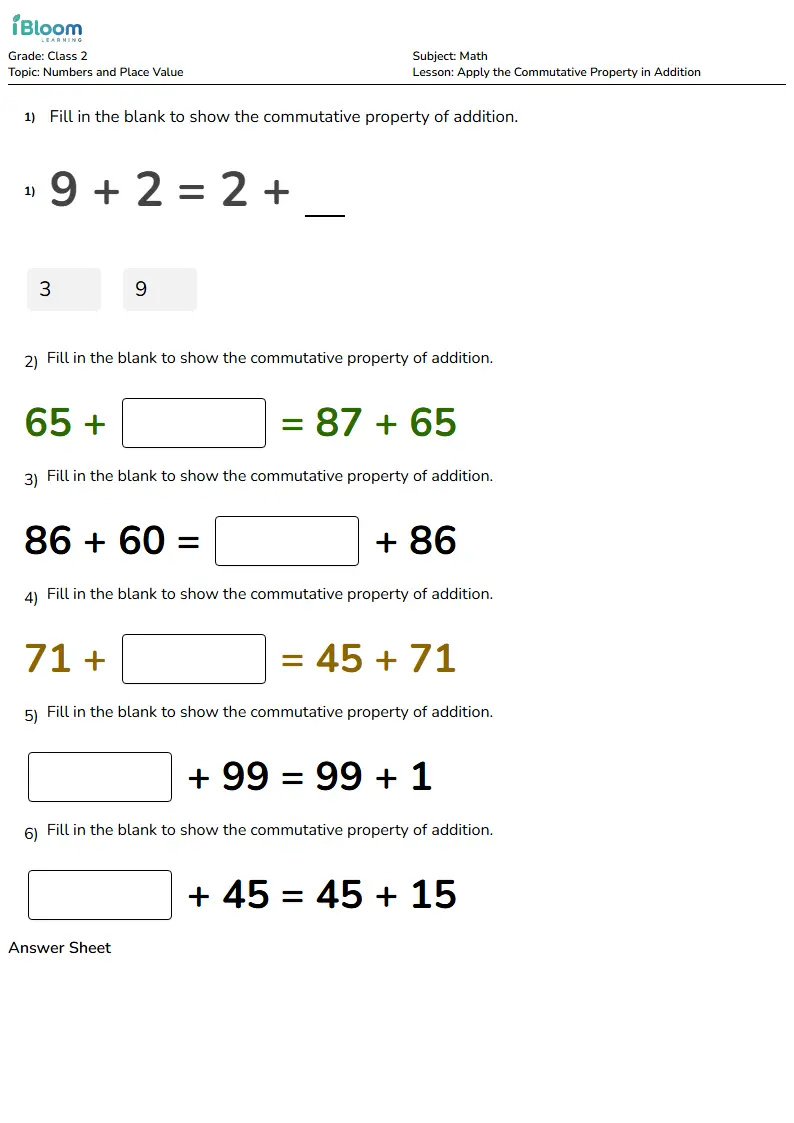
Free Apply the Commutative Property in Addition Worksheets for Class 2
Looking for class 2 math help? Download free, interactive apply the commutative property in addition worksheets. AI-personalized and Common Core-aligned. Practice math with iBloom.
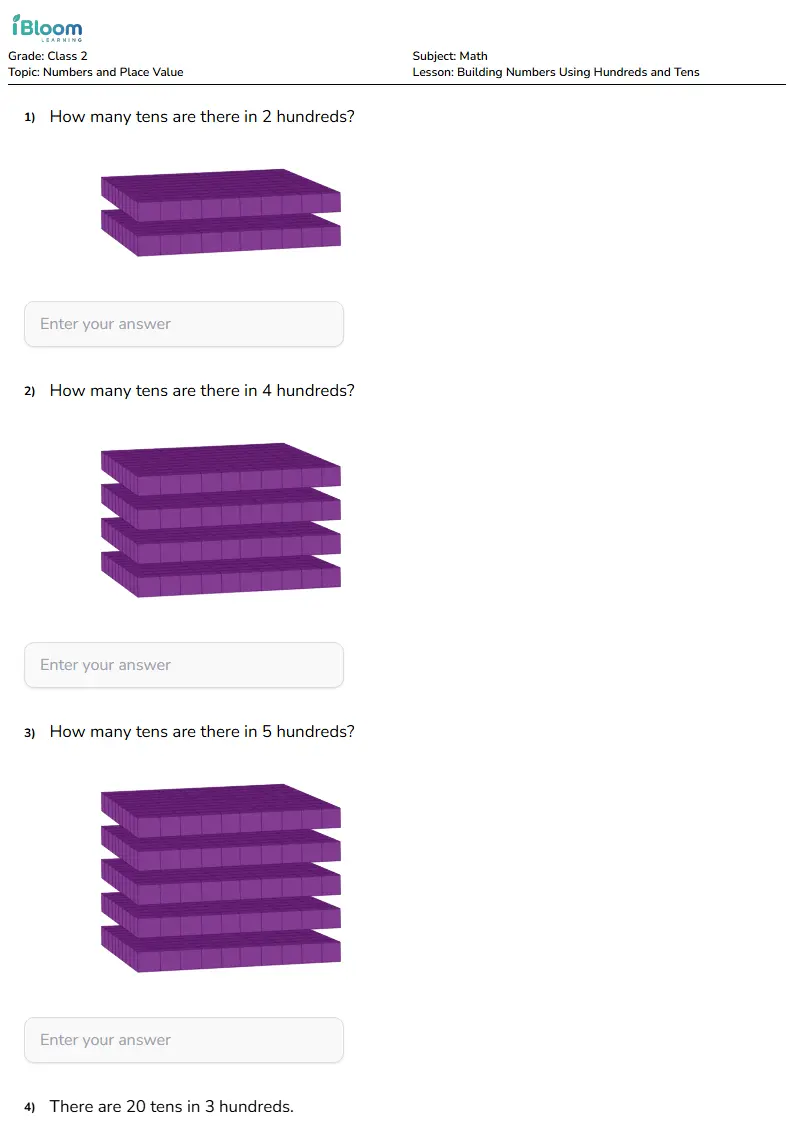
Free Building Numbers Using Hundreds and Tens Worksheets for Class 2
Looking for class 2 math help? Download free, interactive building numbers using hundreds and tens worksheets. AI-personalized and Common Core-aligned. Practice math with iBloom.
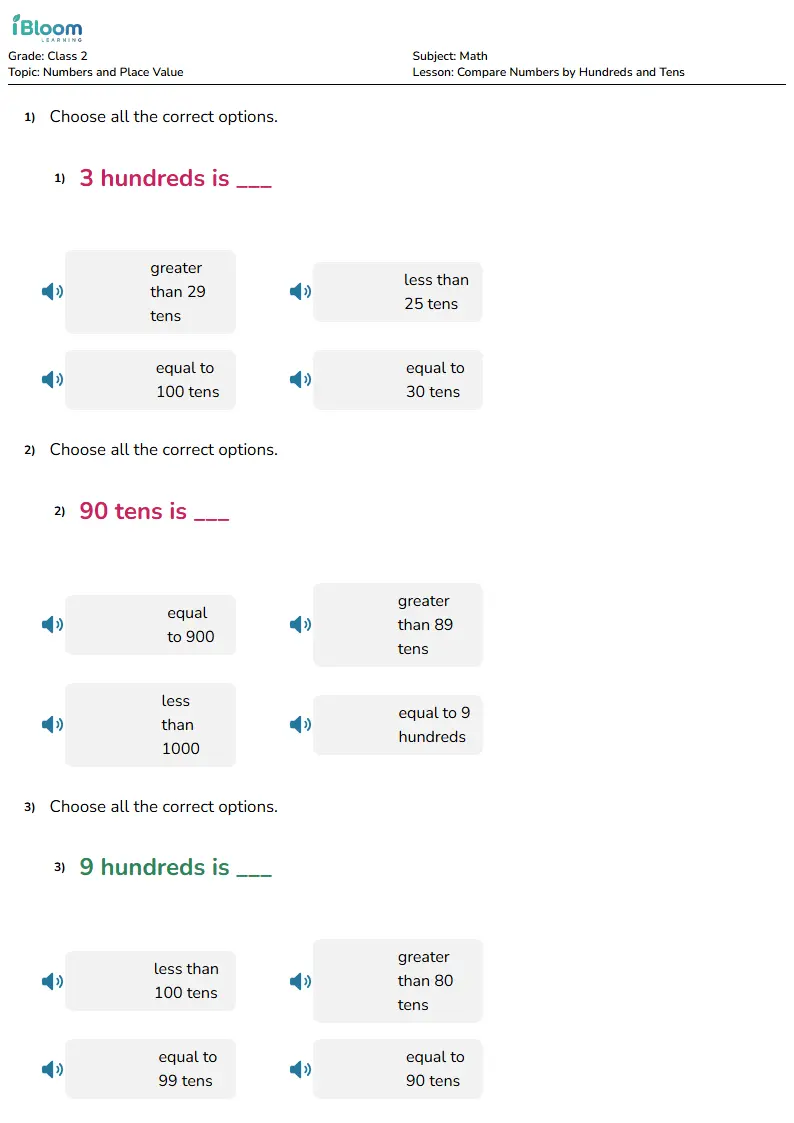
Free Compare Numbers by Hundreds and Tens Worksheets for Class 2
Looking for class 2 math help? Download free, interactive compare numbers by hundreds and tens worksheets. AI-personalized and Common Core-aligned. Practice math with iBloom.
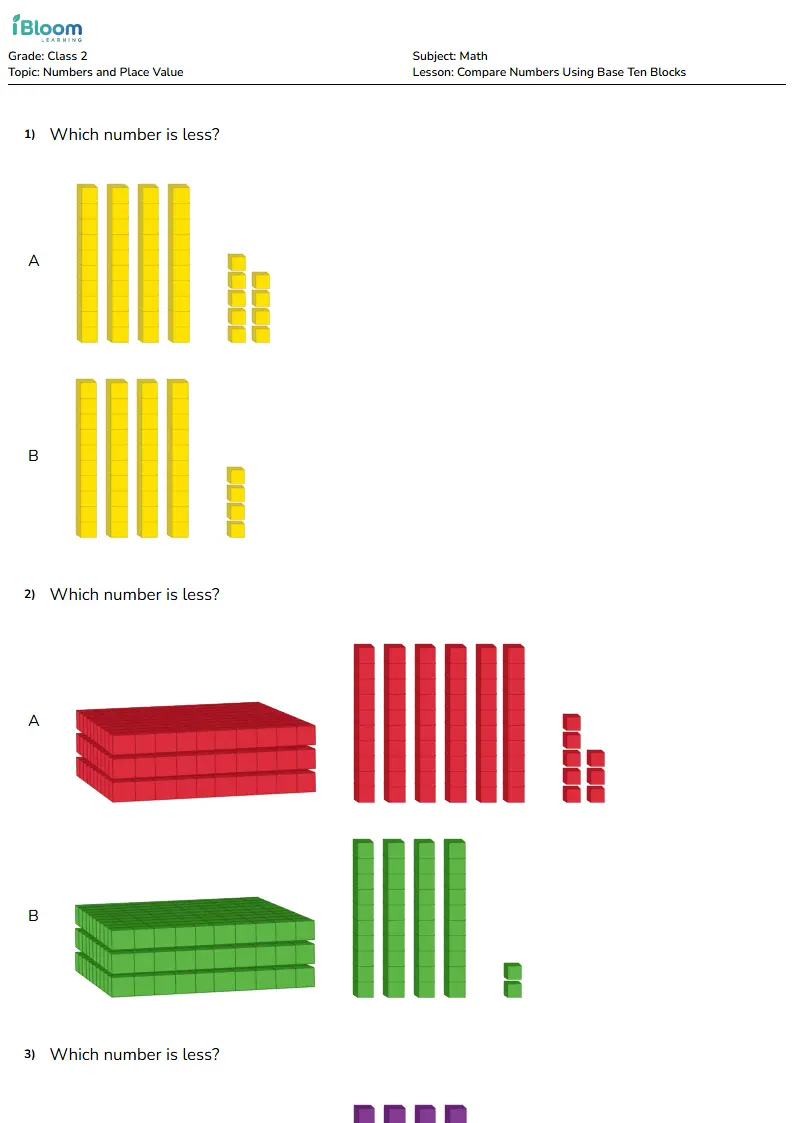
Free Compare Numbers Using Base Ten Blocks Worksheets for Class 2
Looking for class 2 math help? Download free, interactive compare numbers using base ten blocks worksheets. AI-personalized and Common Core-aligned. Practice math with iBloom.
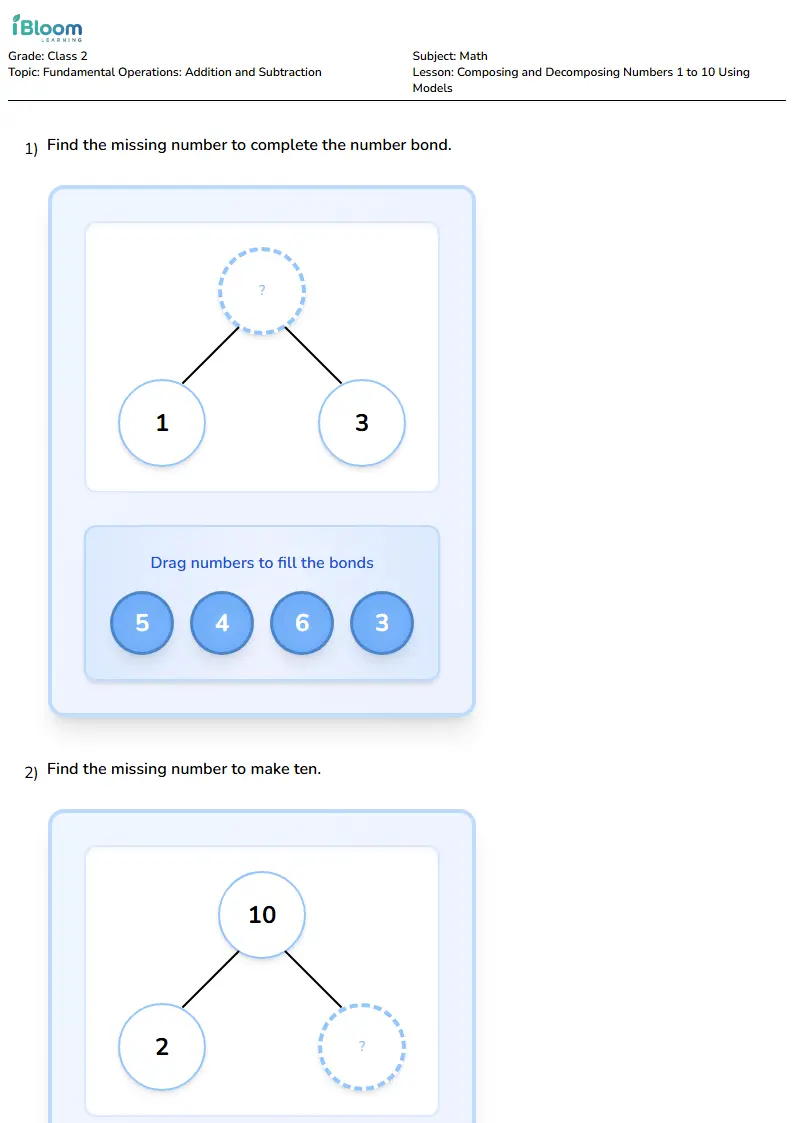
Free Composing and Decomposing Numbers 1 to 10 Using Models Worksheets for Class 2
Looking for class 2 math help? Download free, interactive composing and decomposing numbers 1 to 10 using models worksheets. AI-personalized and Common Core-aligned. Practice math with iBloom.
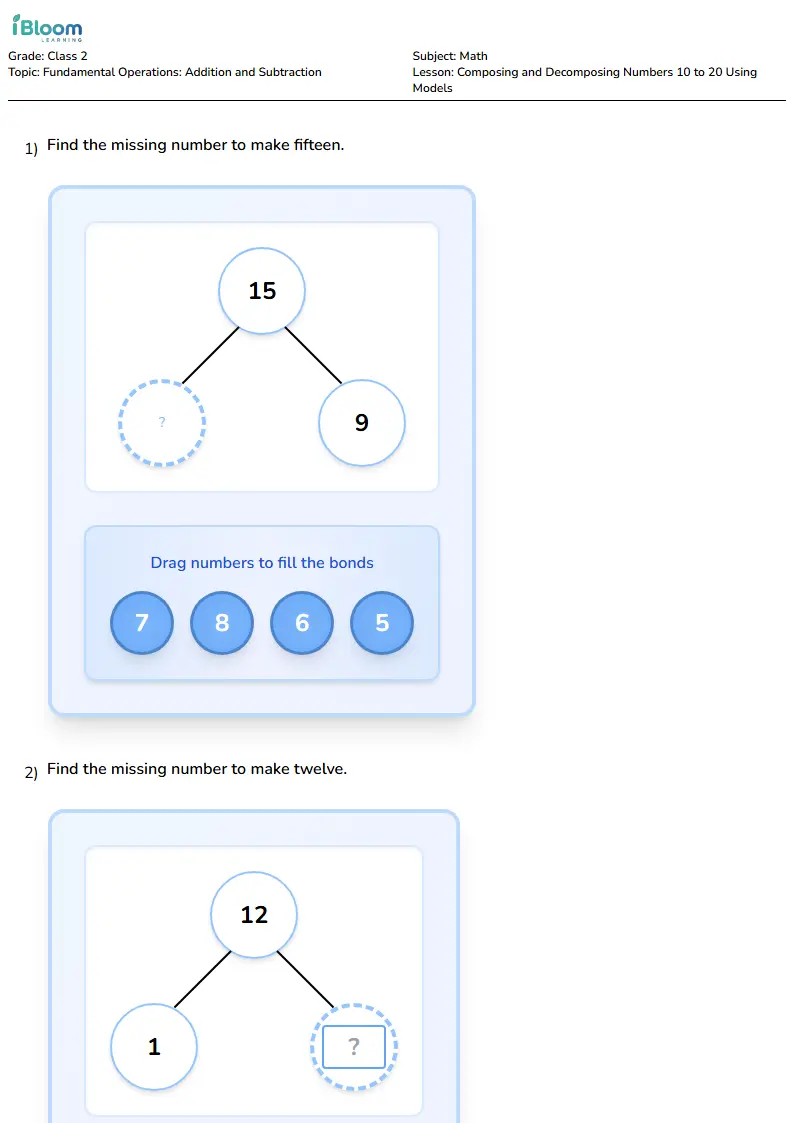
Free Composing and Decomposing Numbers 10 to 20 Using Models Worksheets for Class 2
Looking for class 2 math help? Download free, interactive composing and decomposing numbers 10 to 20 using models worksheets. AI-personalized and Common Core-aligned. Practice math with iBloom.
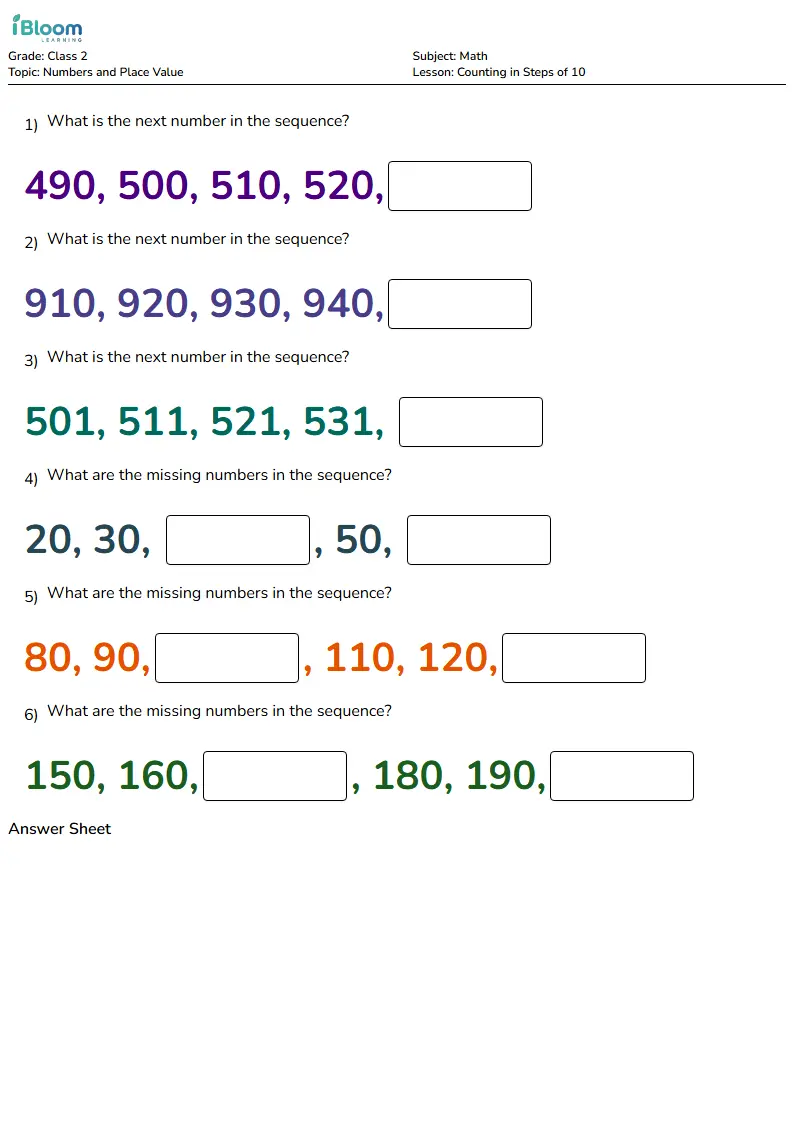
Free Counting in Steps of 10 Worksheets for Class 2
Looking for class 2 math help? Download free, interactive counting in steps of 10 worksheets. AI-personalized and Common Core-aligned. Practice math with iBloom.
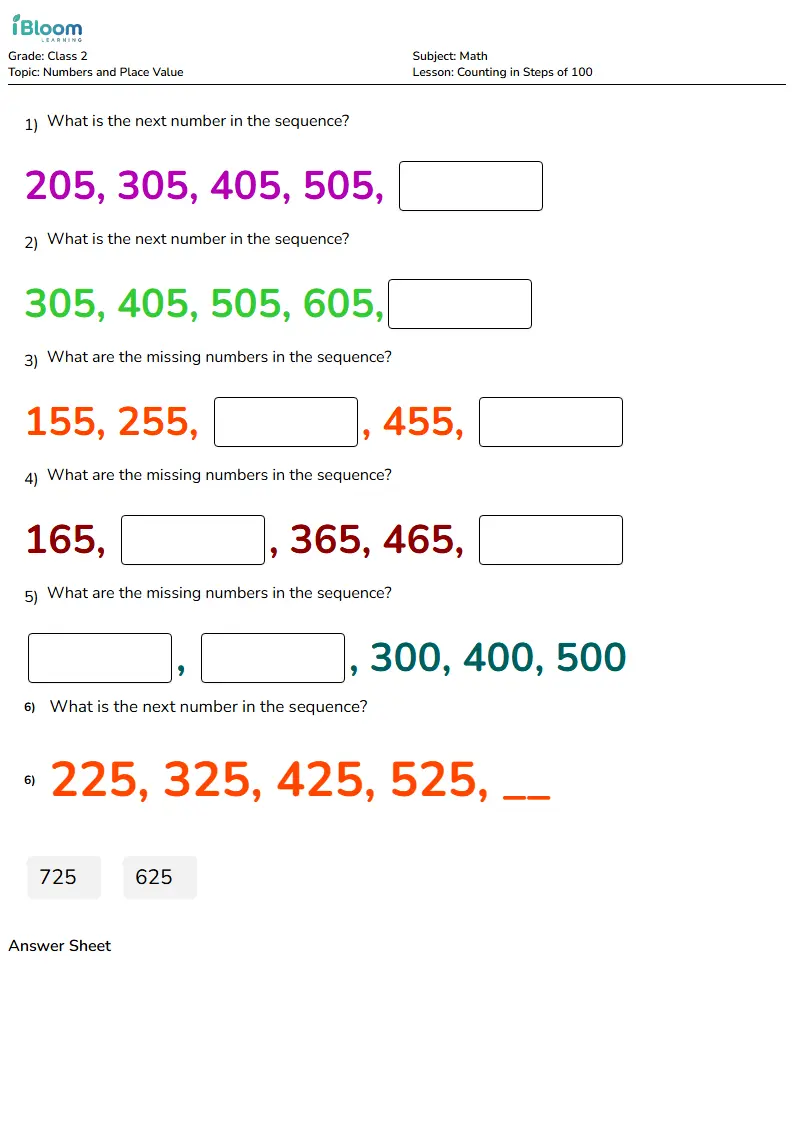
Free Counting in Steps of 100 Worksheets for Class 2
Looking for class 2 math help? Download free, interactive counting in steps of 100 worksheets. AI-personalized and Common Core-aligned. Practice math with iBloom.
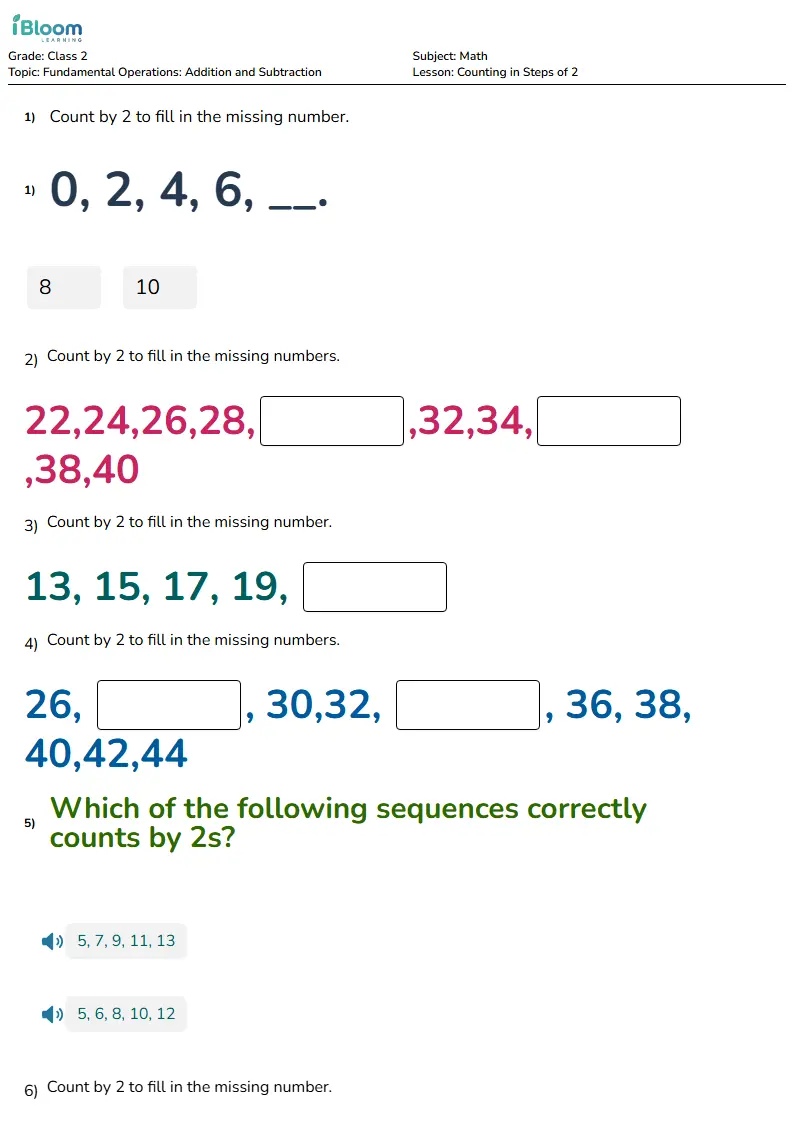
Free Counting in Steps of 2 Worksheets for Class 2
Looking for class 2 math help? Download free, interactive counting in steps of 2 worksheets. AI-personalized and Common Core-aligned. Practice math with iBloom.
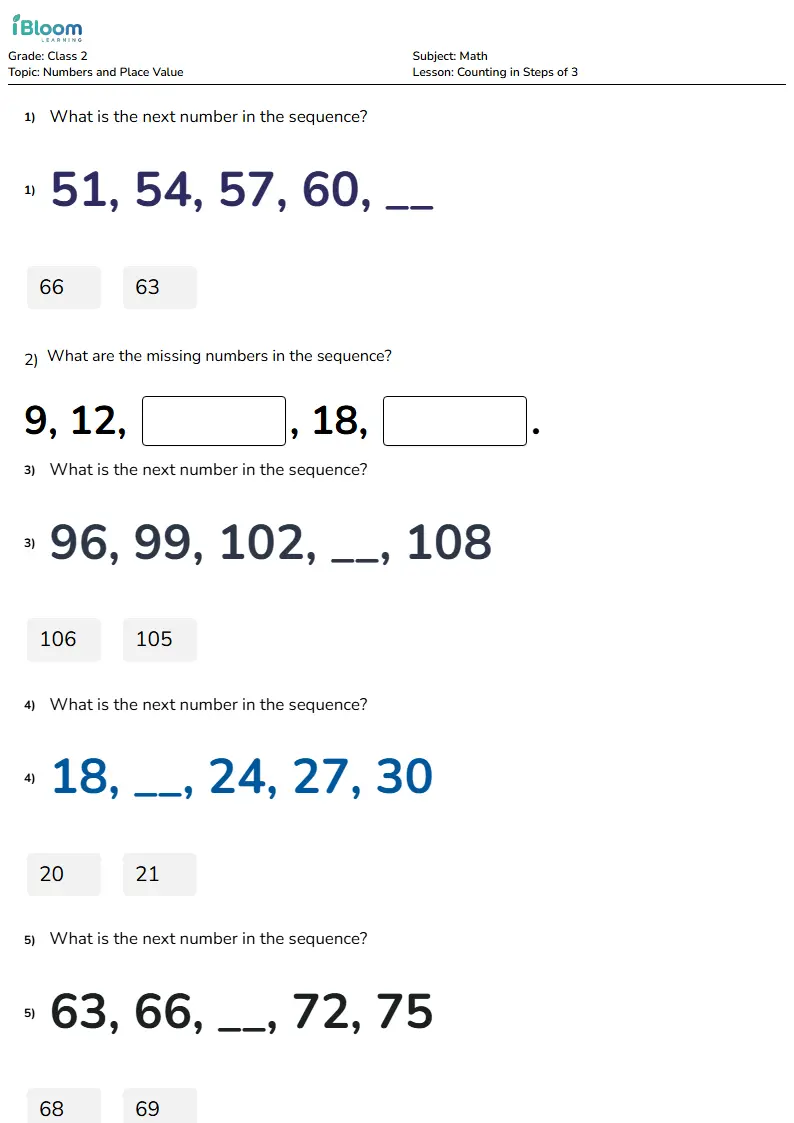
Free Counting in Steps of 3 Worksheets for Class 2
Looking for class 2 math help? Download free, interactive counting in steps of 3 worksheets. AI-personalized and Common Core-aligned. Practice math with iBloom.
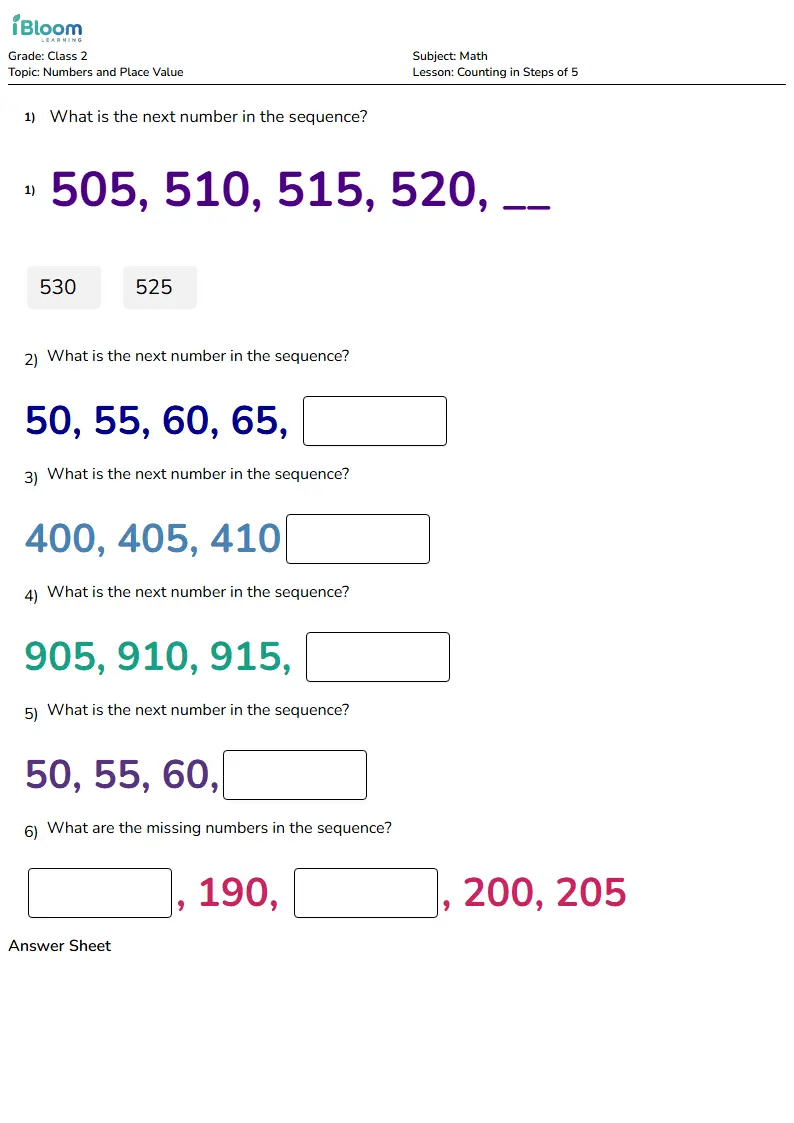
Free Counting in Steps of 5 Worksheets for Class 2
Looking for class 2 math help? Download free, interactive counting in steps of 5 worksheets. AI-personalized and Common Core-aligned. Practice math with iBloom.