Small Letters A To E worksheet for LKG

Lesson-Wise Builder
A premium AI tool that creates syllabus-aligned questions and worksheets for any lesson in seconds.
A small letters a to e worksheet for LKG helps a child recognise that each lowercase letter has an uppercase partner. The verified activity shows lowercase a, b, c, d and e in one group and asks the learner to match each one with A, B, C, D or E in a shuffled group. The focus is letter identity across two cases, not tracing, handwriting or a full-alphabet test.
What the child practises
The child looks at one small letter, says its name, scans the capital-letter choices, and selects the same letter in uppercase form. Because the choices are not placed in matching alphabet order, the learner must recognise the letter rather than copy a row position.
- Lowercase a matches uppercase A.
- Lowercase b matches uppercase B.
- Lowercase c matches uppercase C.
- Lowercase d matches uppercase D.
- Lowercase e matches uppercase E.
The preview contains repeated matching groups, which gives the child another chance to recognise the same five pairs when the order changes. Repetition is useful only when the child still looks at the letter shape and names the pair.
Capital and small letter pairs from A to E
| Uppercase letter | Lowercase letter | What to notice |
|---|---|---|
| A | a | The two forms look quite different but share the name A. |
| B | b | Lowercase b has one tall stem and one rounded part. |
| C | c | Both forms are open on the right and have a curved shape. |
| D | d | Lowercase d has a rounded part followed by a tall stem. |
| E | e | The lowercase form is curved and looks different from capital E. |
Use letter names during the match: This is small b. I am looking for capital B. The colour and size of the symbols may help a child see each item, but they do not decide the answer. The white letter shape inside the blue circle is the important clue.
How to match uppercase and lowercase letters
- Name the small letter. Point to it and say small a or lowercase a.
- Scan all capital choices. Do not choose the box in the same row automatically.
- Find the same letter name. Match a to A even though their shapes differ.
- Say the pair together. Use a short response such as A and a are partners.
- Check each letter once. Confirm that all five lowercase letters have one uppercase match.
The digital response method may ask the learner to connect or place a match in the available box. Whatever control appears on the live activity, the thinking step remains the same: identify the lowercase letter and choose its uppercase equivalent.
Why shuffled order matters
If A always appears beside a and B always appears beside b, a child can rely on position. Shuffling the uppercase choices encourages real recognition. After one round, change the order of homemade cards and ask again.
Look closely at letter shapes
Some uppercase and lowercase partners look similar, while others change shape. Capital C and small c both have an open curve. A and a, B and b, D and d, and E and e look less alike. These changed forms deserve calm comparison rather than extra speed.
Lowercase b and d
The verified set contains both b and d, so a child may confuse them. Lowercase b has the tall stem first and the round part after it. Lowercase d has the round part first and the tall stem after it. Place b beside B and d beside D while saying each name. Avoid turning either letter upside down or asking the child to guess from row position.
Lowercase a and e
Both letters are rounded, but lowercase a has a closed round part with a short stroke, while lowercase e has an opening and a cross-like middle stroke in this font. Ask the child to trace the shape in the air with a finger only after naming it; air movement is an optional extension, not the worksheet's embedded task.
Lowercase c and e
Lowercase c stays open on the right. Lowercase e begins with a small horizontal movement before curving around. If the child is unsure, show only c and e, name one, and ask them to point. Return to all five letters after that pair is clear.
A short parent routine for home
Five minutes is enough for focused letter matching. Begin with one known pair, then mix all five. Let the child touch or point to each letter while saying its name. If the answer is wrong, show the correct pair together and ask again later rather than repeating the same correction many times.
- Place A, B, C, D and E in a row.
- Give the child one lowercase card at a time.
- Ask, Which capital letter has the same name?
- Let the child place the pair together and say both forms.
- Shuffle the capital cards before a second round.
Homemade cards, fridge magnets or letters written on small pieces of paper can support the same skill. Keep the symbols clear and use the same printed letter style first. Later, show the letters in a picture book or on a sign so the child learns to recognise them in a new setting.
Useful parent prompts
- What is the name of this small letter?
- Can you find its capital partner?
- How do you know this is b and not d?
- Which pair was easy? Which pair needs another look?
Teacher and tutor guidance
Model one pair before independent work: point to lowercase a, name it, scan the uppercase choices and select A. For the next item, prompt only the step the child needs. A learner who names b but chooses D needs case-pair support; a learner who cannot name b needs letter-recognition support first.
- Use the page as a brief alphabet-centre or small-group activity.
- Ask children to say each letter name while matching.
- Shuffle five uppercase cards so position cannot supply the answer.
- Observe lowercase recognition and uppercase recognition separately.
- Repeat only a confused pair instead of restarting all five every time.
- Finish with one quick check in a new order.
For partner work, one child can hold a lowercase card while the other finds the uppercase partner. Both children say the pair, then switch roles. Keep the round short so the practice remains attentive.
What to observe
Note whether the child can name the lowercase letter, find the uppercase form and keep the match when choices are shuffled. Matching by colour, row or first available box does not show letter-case recognition. A brief explanation such as small d goes with capital D makes the child's thinking visible.
Common mistakes and helpful responses
- Matching by position: ask the child to scan every uppercase choice before selecting.
- Matching by colour: point out that all lowercase letters use the same blue background, so the letter shape matters.
- Confusing b and d: isolate those two lowercase forms and place each beside its capital partner.
- Calling every letter by its sound: return to the letter name for this case-matching task.
- Working too fast: ask the child to say the pair aloud before completing the match.
- Adding all 26 letters immediately: keep the first set to a through e until the child can recognise the five pairs in mixed order.
Practice ideas after the matching activity
Letter hunt
Look for A, a, B, b, C, c, D, d, E and e in a familiar picture book. Point to one symbol at a time and ask for its partner on a prepared card.
Memory pairs
Place five uppercase and five lowercase cards face down. Turn over two cards and keep them only when they share the same letter name. Begin with three pairs if ten cards are too many.
Sort by case
Mix the ten cards and sort them into uppercase and lowercase groups. Then rebuild the five pairs. This helps the child notice the idea of letter case before matching individual partners.
Say the sound after the match
Once a pair is correct, add one familiar example: A and a can begin apple, B and b can begin ball, C and c can begin cat, D and d can begin dog, and E and e can begin egg. Sound practice is an extension; the verified worksheet itself asks for case matching.
Form the pair after recognition
If the child is ready for writing, copy one uppercase and lowercase pair after matching it. Use the child's usual handwriting guidance. Do not require letter formation to prove success on the recognition task.
Related concepts to build next
After the five pairs are secure, continue with lowercase f to j or revisit a broader big-and-small-letter matching activity. Letter names can then connect with beginning sounds and careful letter formation. Keep these as separate next steps so the child knows whether the immediate goal is recognising, matching, sounding or writing a letter.
Related iBloom practice
- Small Letters a to e lesson for LKG revisits the same letter set in lesson form.
- Big Letters A to E worksheet for LKG focuses on the uppercase forms.
- Big and Small Letters Match worksheet for LKG extends case-pair practice.
- Small Letters f to j worksheet for LKG continues with the next five lowercase letters.
Frequently Asked Questions
What are small letters a to e?
They are the lowercase forms a, b, c, d and e. Each has an uppercase partner: A, B, C, D and E.
What is the difference between capital and small letters?
They are two written forms of the same alphabet letters. Some partners look similar, such as C and c, while others look different, such as A and a.
Why do uppercase and lowercase letters match?
Both forms have the same letter name and belong to the same alphabet position. The form changes according to how the letter is used in text.
Which capital letter matches lowercase b?
Lowercase b matches uppercase B. Say both names together and compare the tall stem and rounded parts.
What if a child confuses b and d?
Show only b and d at first. Point out that b has the tall stem before the round part and d has the round part before the tall stem. Pair each with B or D.
Should children say letter names while matching?
Yes. Saying capital A and small a helps connect two different shapes with one letter identity.
How many pairs should an LKG child practise at once?
This activity uses five pairs. If that is too much, begin with two or three and add another pair after the child responds accurately in mixed order.
Is this worksheet about matching letters?
Yes. The verified preview asks children to match each lowercase letter a through e with its uppercase partner. Tracing and handwriting are separate extensions.
Does this activity teach letter sounds?
The main task is visual letter-case matching. An adult may say a familiar sound or example word after a correct match, but sounds are not the visible question.
What should a child practise after a to e?
Continue with f to j or use a mixed big-and-small-letter activity. Revisit any confused pair before increasing the set.
More practice for this grade
More English Language Arts worksheets
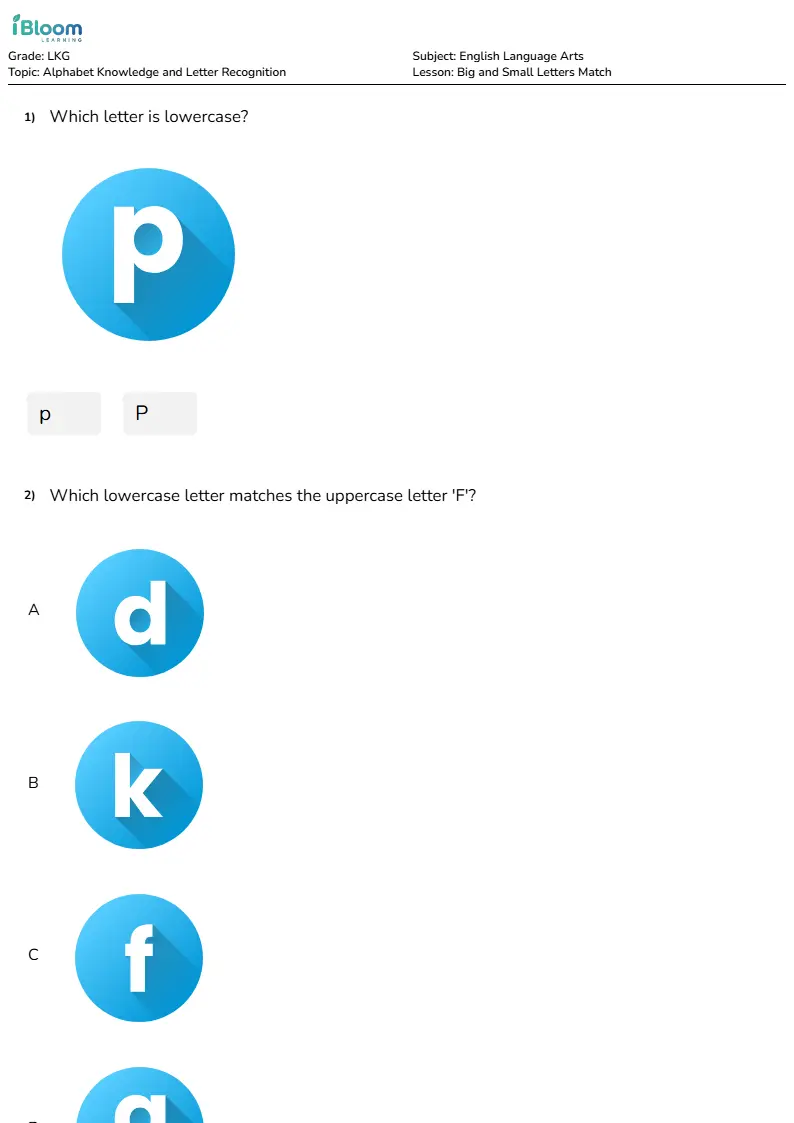
Free Big and Small Letters Match Worksheets for Lkg
Looking for lkg english language arts help? Download free, interactive big and small letters match worksheets. AI-personalized and Common Core-aligned. Practice early literacy with iBloom.
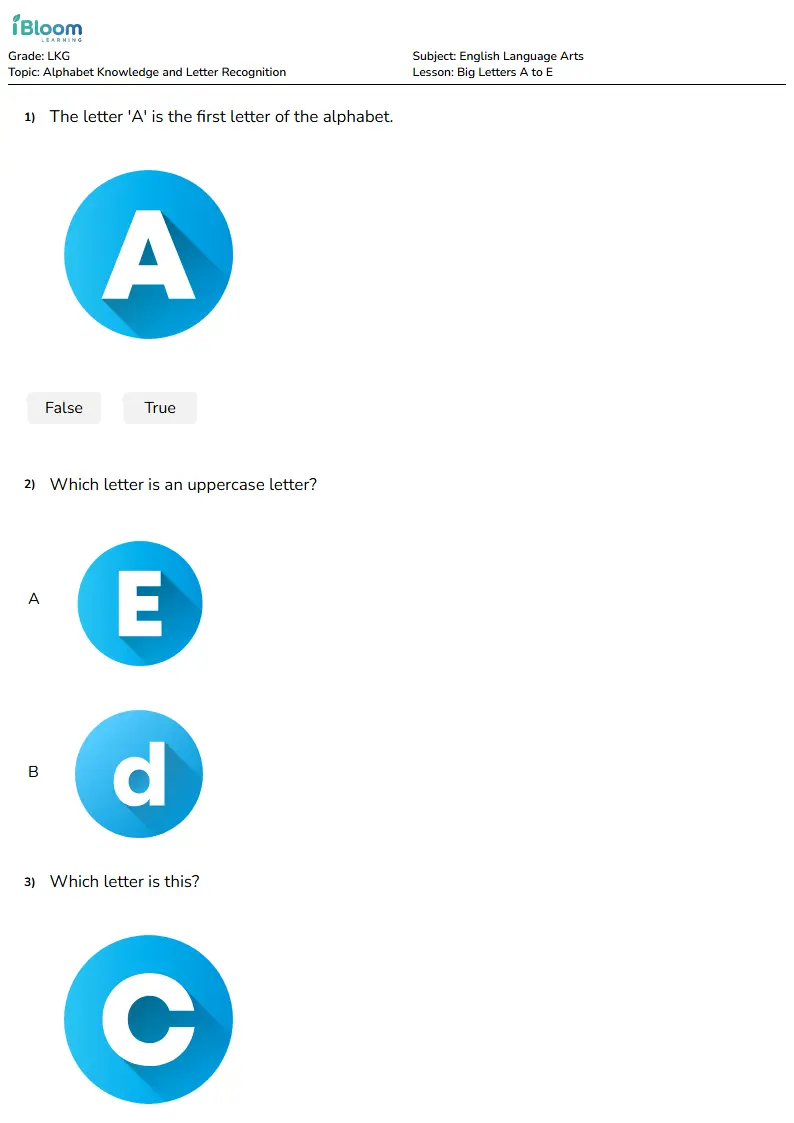
Free Big Letters A to E Worksheets for Lkg
Looking for lkg english language arts help? Download free, interactive big letters a to e worksheets. AI-personalized and Common Core-aligned. Practice early literacy with iBloom.
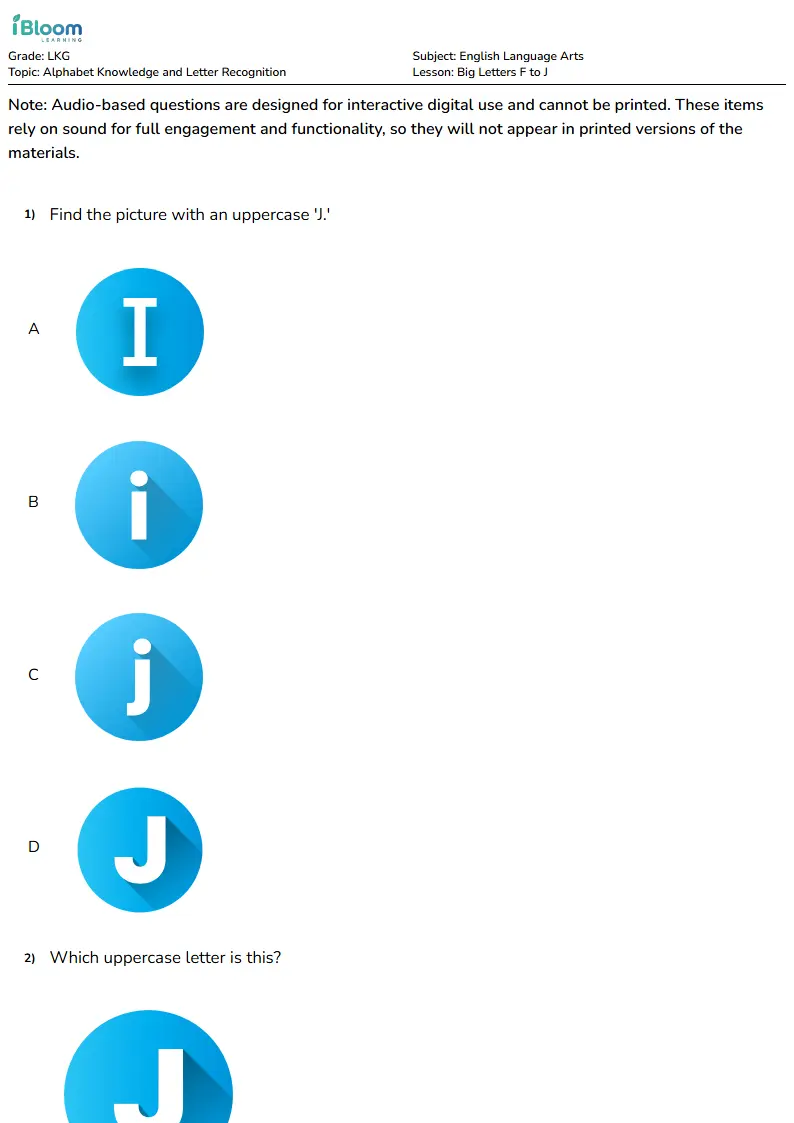
Free Big Letters F to J Worksheets for Lkg
Looking for lkg english language arts help? Download free, interactive big letters f to j worksheets. AI-personalized and Common Core-aligned. Practice early literacy with iBloom.
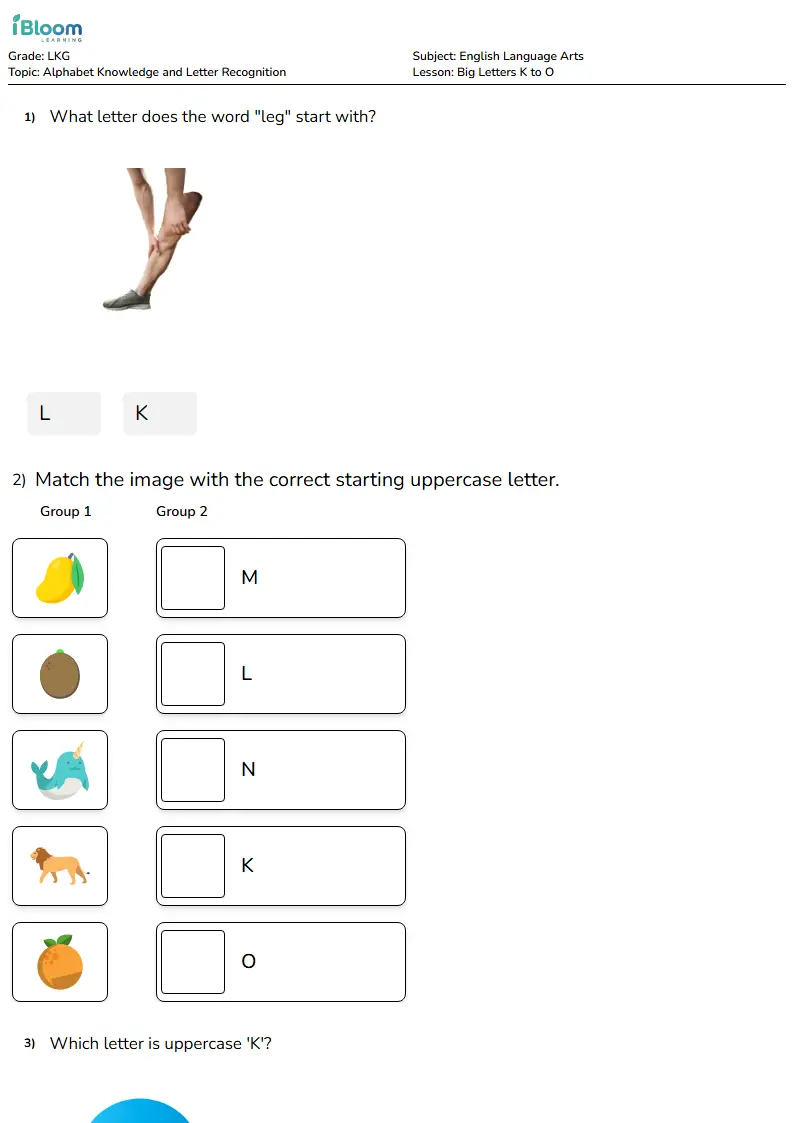
Free Big Letters K to O Worksheets for Lkg
Looking for lkg english language arts help? Download free, interactive big letters k to o worksheets. AI-personalized and Common Core-aligned. Practice early literacy with iBloom.
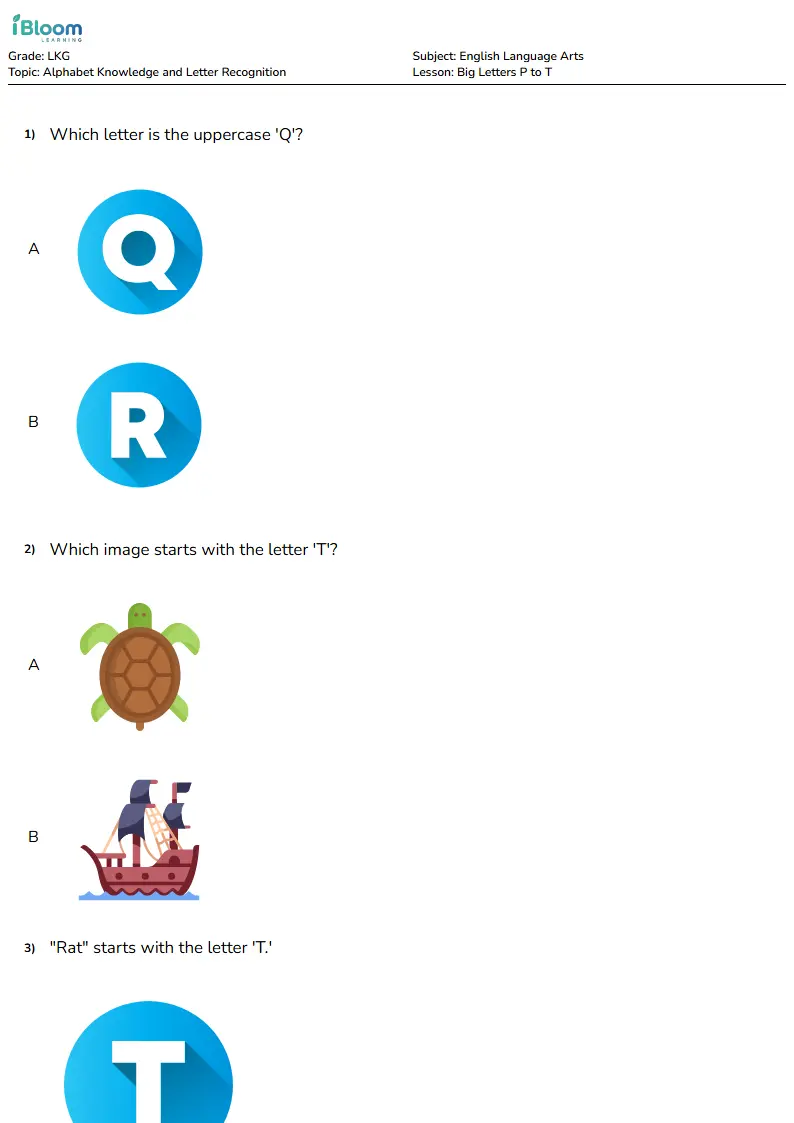
Free Big Letters P to T Worksheets for Lkg
Looking for lkg english language arts help? Download free, interactive big letters p to t worksheets. AI-personalized and Common Core-aligned. Practice early literacy with iBloom.
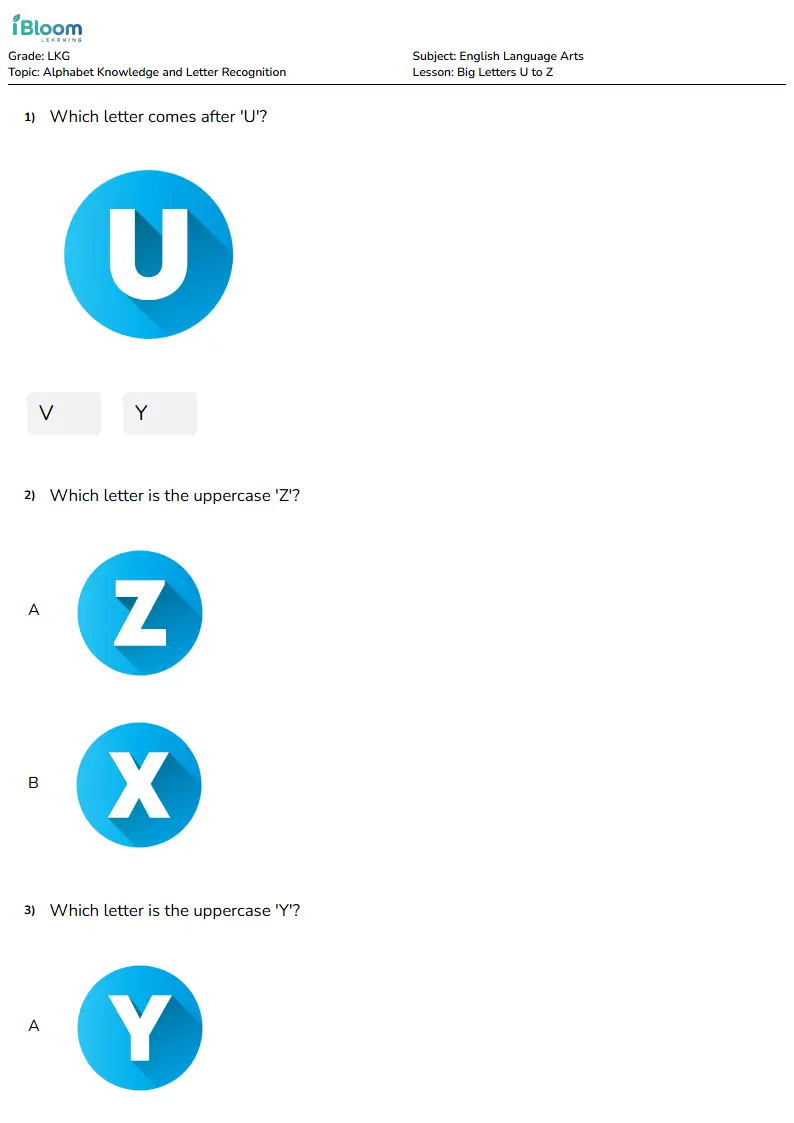
Free Big Letters U to Z Worksheets for Lkg
Looking for lkg english language arts help? Download free, interactive big letters u to z worksheets. AI-personalized and Common Core-aligned. Practice early literacy with iBloom.
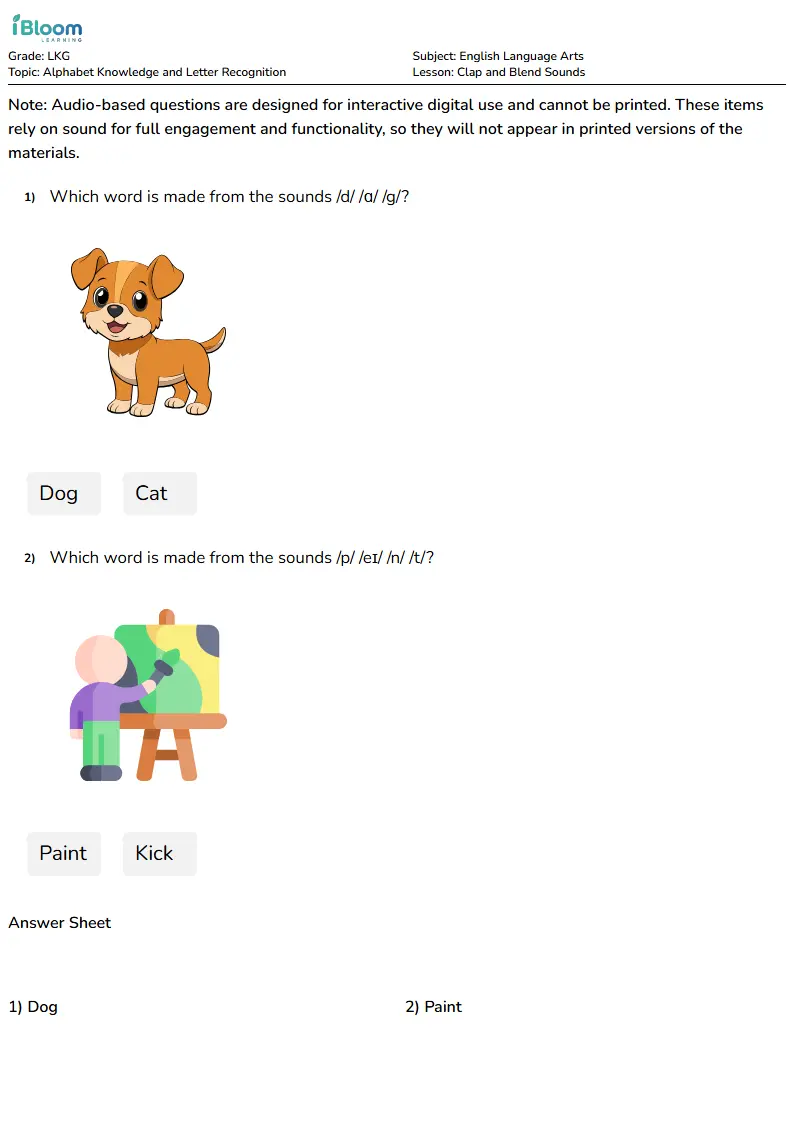
Free Clap and Blend Sounds Worksheets for Lkg
Looking for lkg english language arts help? Download free, interactive clap and blend sounds worksheets. AI-personalized and Common Core-aligned. Practice early literacy with iBloom.
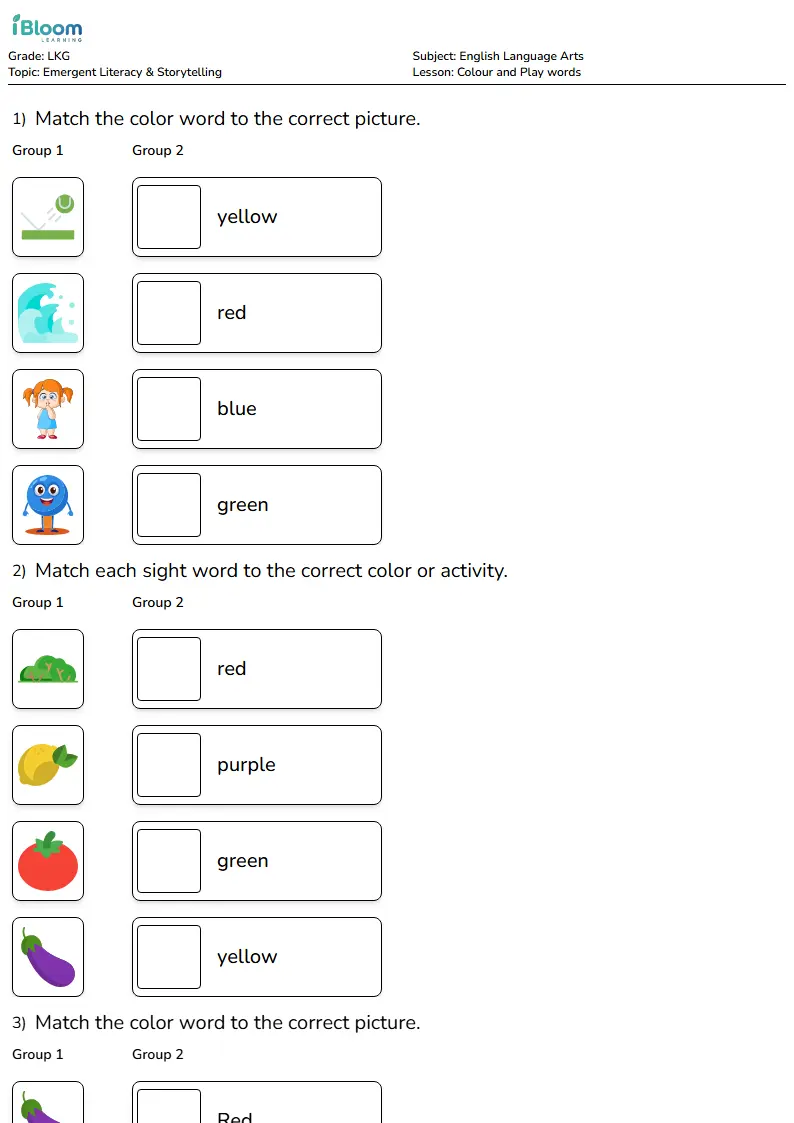
Free Colour and Play words Worksheets for Lkg
Looking for lkg english language arts help? Download free, interactive colour and play words worksheets. AI-personalized and Common Core-aligned. Practice early literacy with iBloom.
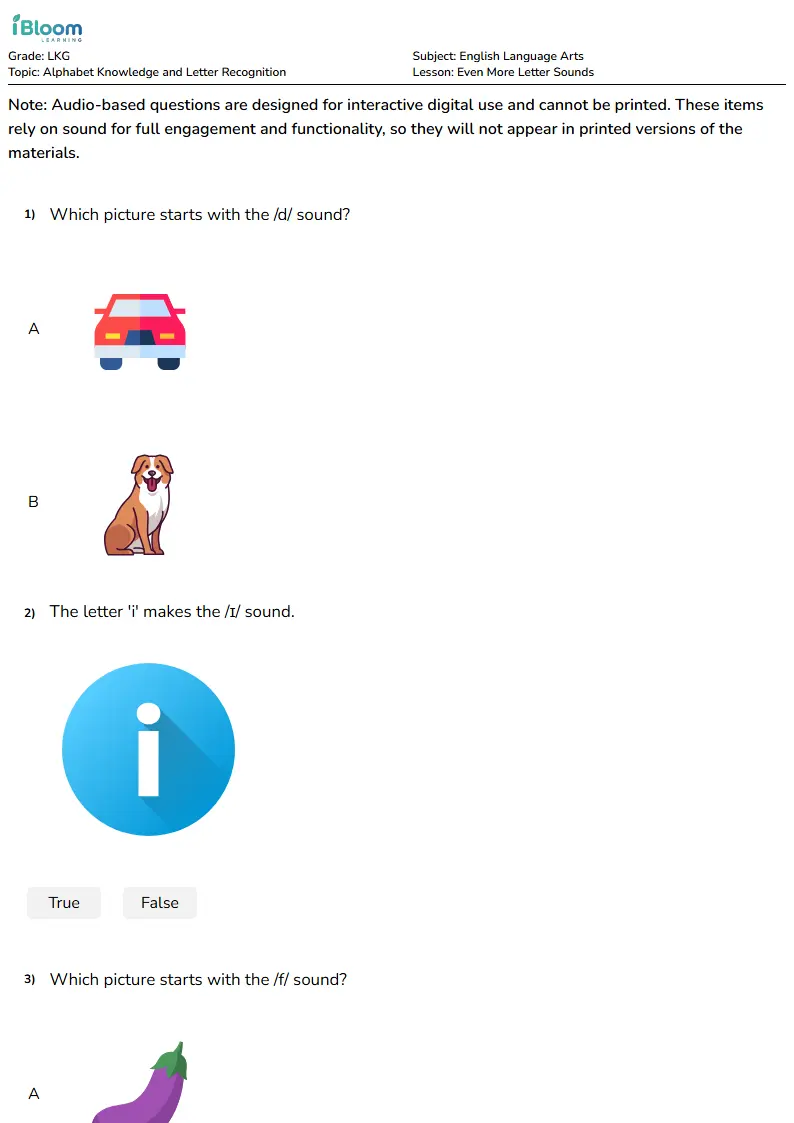
Free Even More Letter Sounds Worksheets for Lkg
Looking for lkg english language arts help? Download free, interactive even more letter sounds worksheets. AI-personalized and Common Core-aligned. Practice early literacy with iBloom.

Free Even More Sight Words Worksheets for Lkg
Looking for lkg english language arts help? Download free, interactive even more sight words worksheets. AI-personalized and Common Core-aligned. Practice early literacy with iBloom.
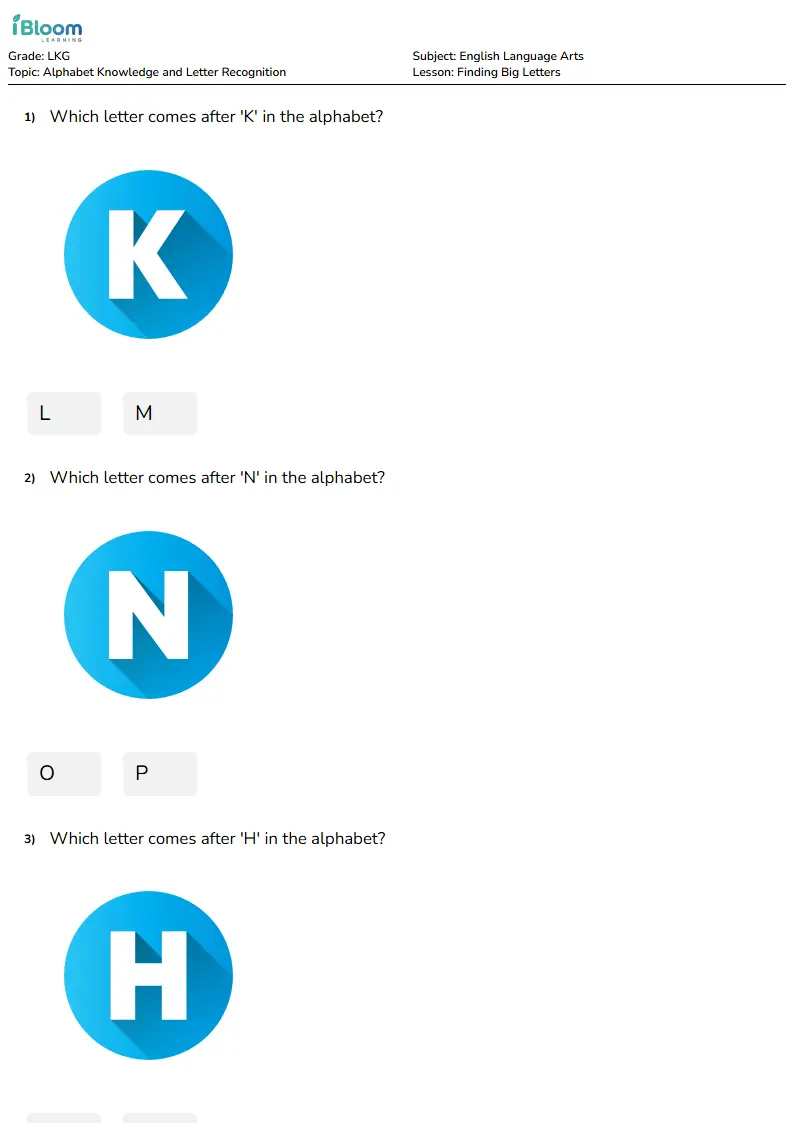
Free Finding Big Letters Worksheets for Lkg
Looking for lkg english language arts help? Download free, interactive finding big letters worksheets. AI-personalized and Common Core-aligned. Practice early literacy with iBloom.
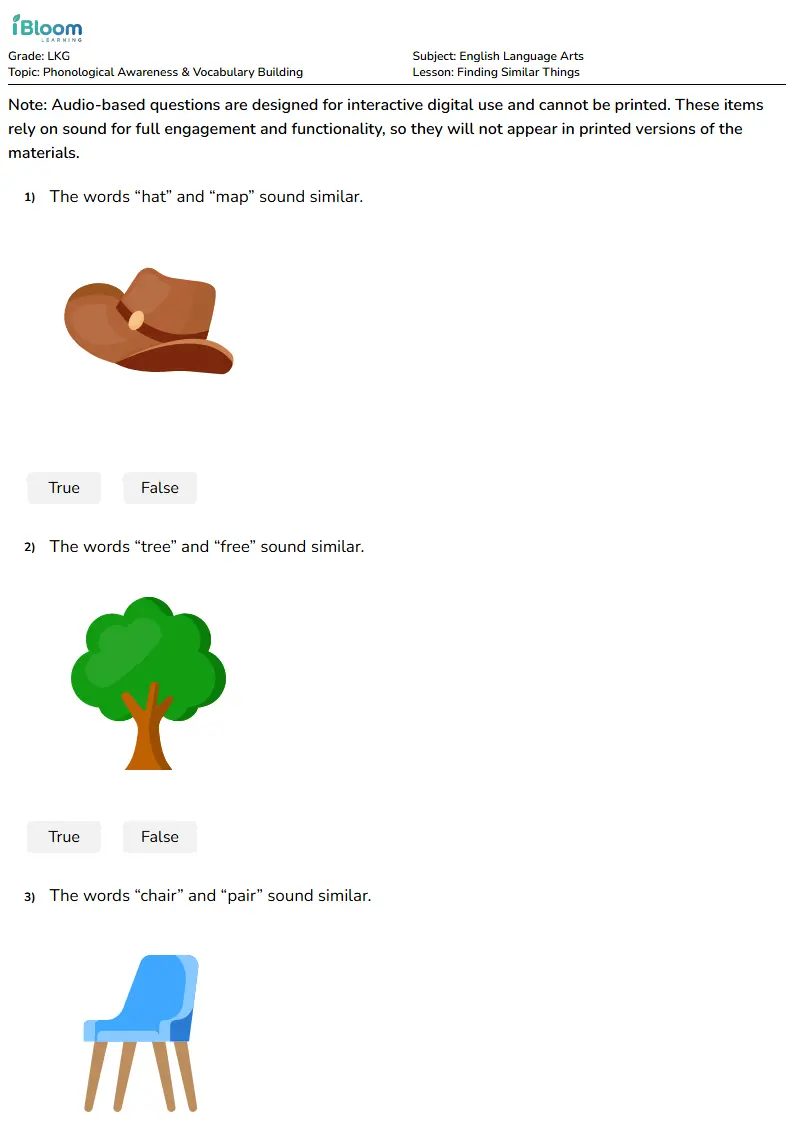
Free Finding Similar Things Worksheets for Lkg
Looking for lkg english language arts help? Download free, interactive finding similar things worksheets. AI-personalized and Common Core-aligned. Practice early literacy with iBloom.
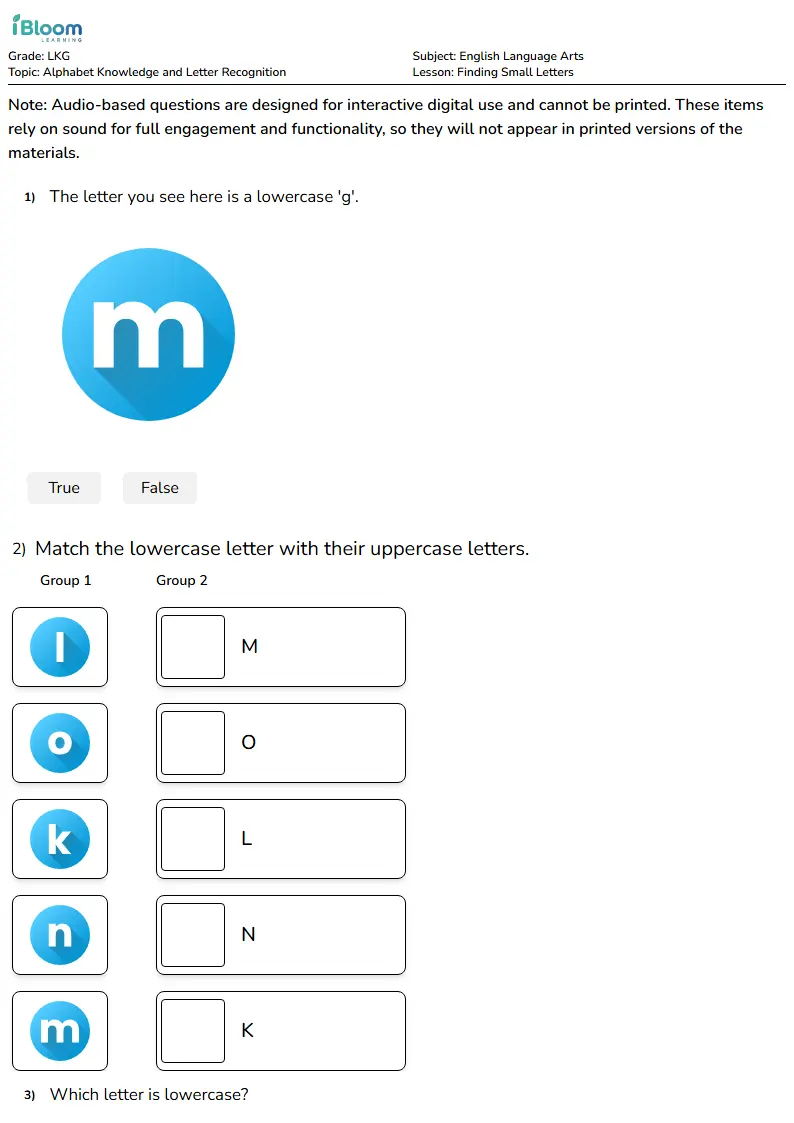
Free Finding Small Letters Worksheets for Lkg
Looking for lkg english language arts help? Download free, interactive finding small letters worksheets. AI-personalized and Common Core-aligned. Practice early literacy with iBloom.
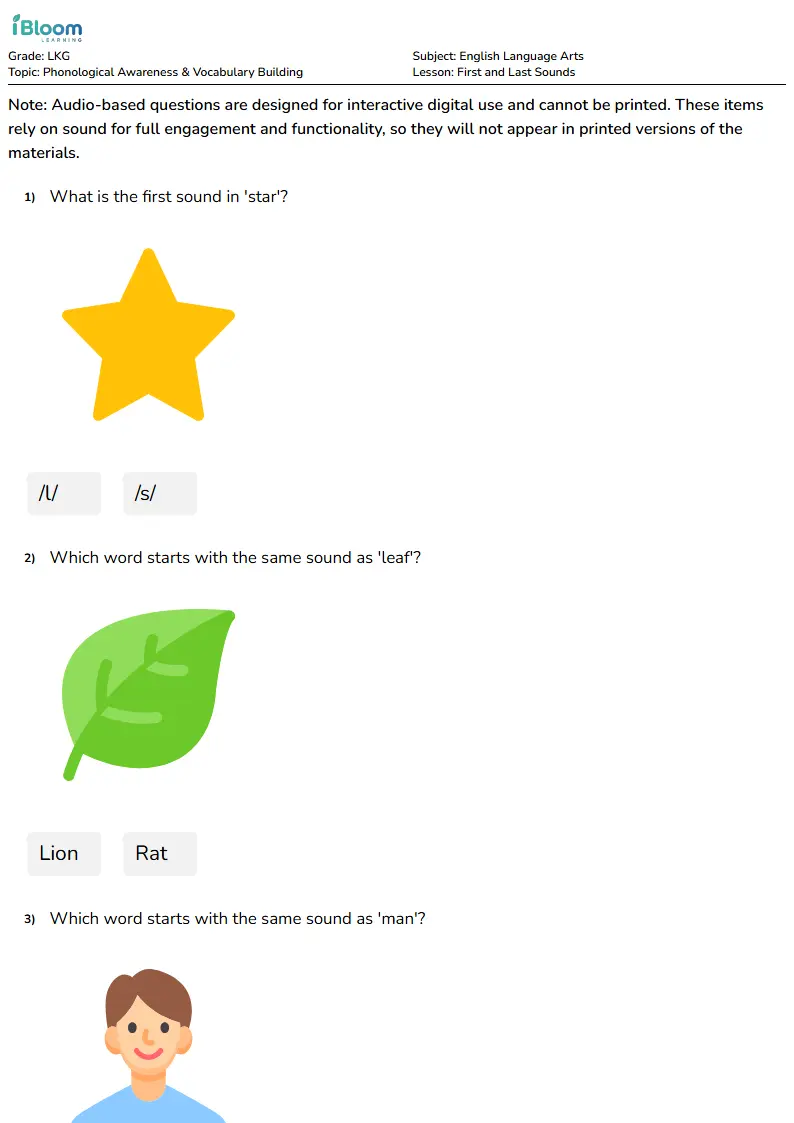
Free First and Last Sounds Worksheets for Lkg
Looking for lkg english language arts help? Download free, interactive first and last sounds worksheets. AI-personalized and Common Core-aligned. Practice early literacy with iBloom.
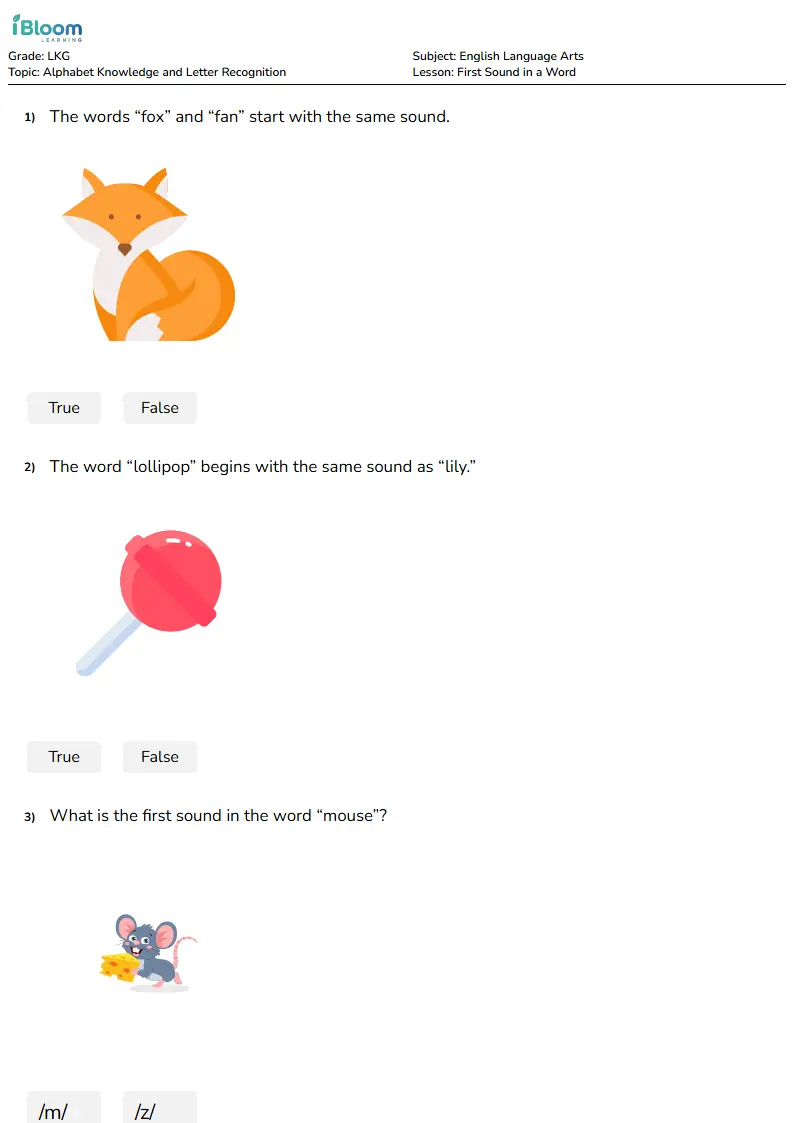
Free First Sound in a Word Worksheets for Lkg
Looking for lkg english language arts help? Download free, interactive first sound in a word worksheets. AI-personalized and Common Core-aligned. Practice early literacy with iBloom.

Free Harder Words I Can Read Worksheets for Lkg
Looking for lkg english language arts help? Download free, interactive harder words i can read worksheets. AI-personalized and Common Core-aligned. Practice early literacy with iBloom.

Free I Know All My Sight Words! Worksheets for Lkg
Looking for lkg english language arts help? Download free, interactive i know all my sight words! worksheets. AI-personalized and Common Core-aligned. Practice early literacy with iBloom.
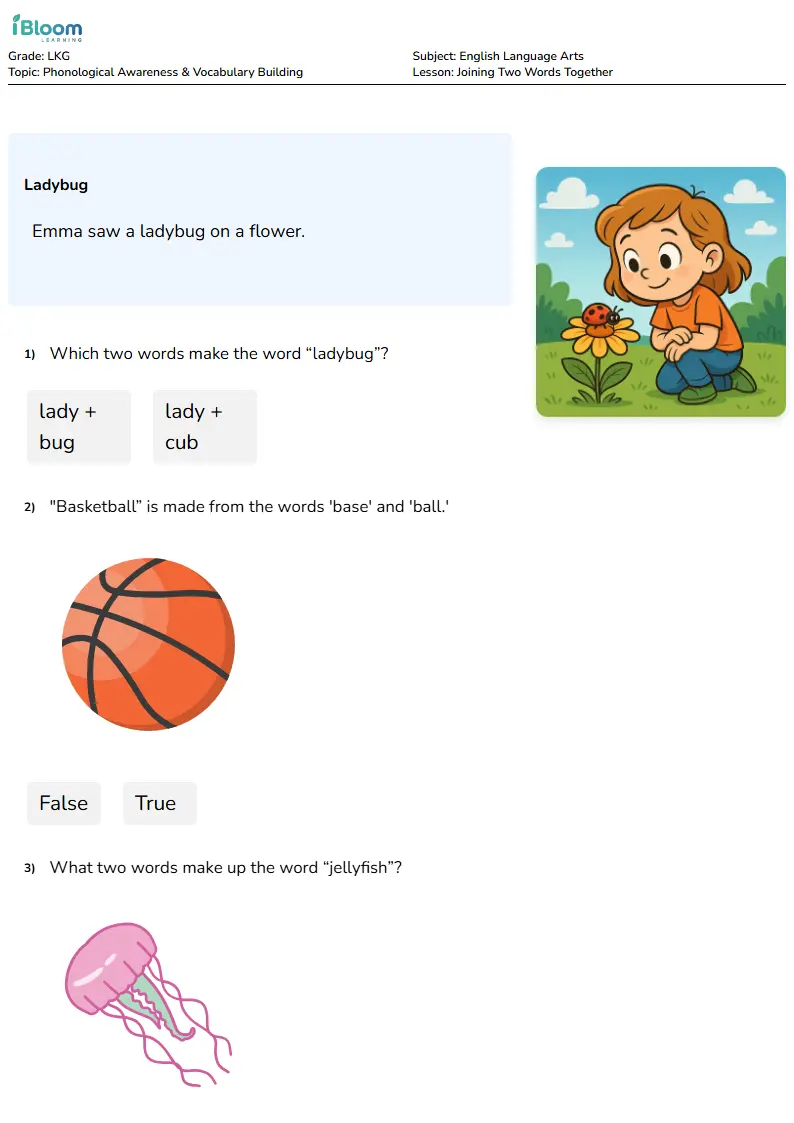
Free Joining Two Words Together Worksheets for Lkg
Looking for lkg english language arts help? Download free, interactive joining two words together worksheets. AI-personalized and Common Core-aligned. Practice early literacy with iBloom.
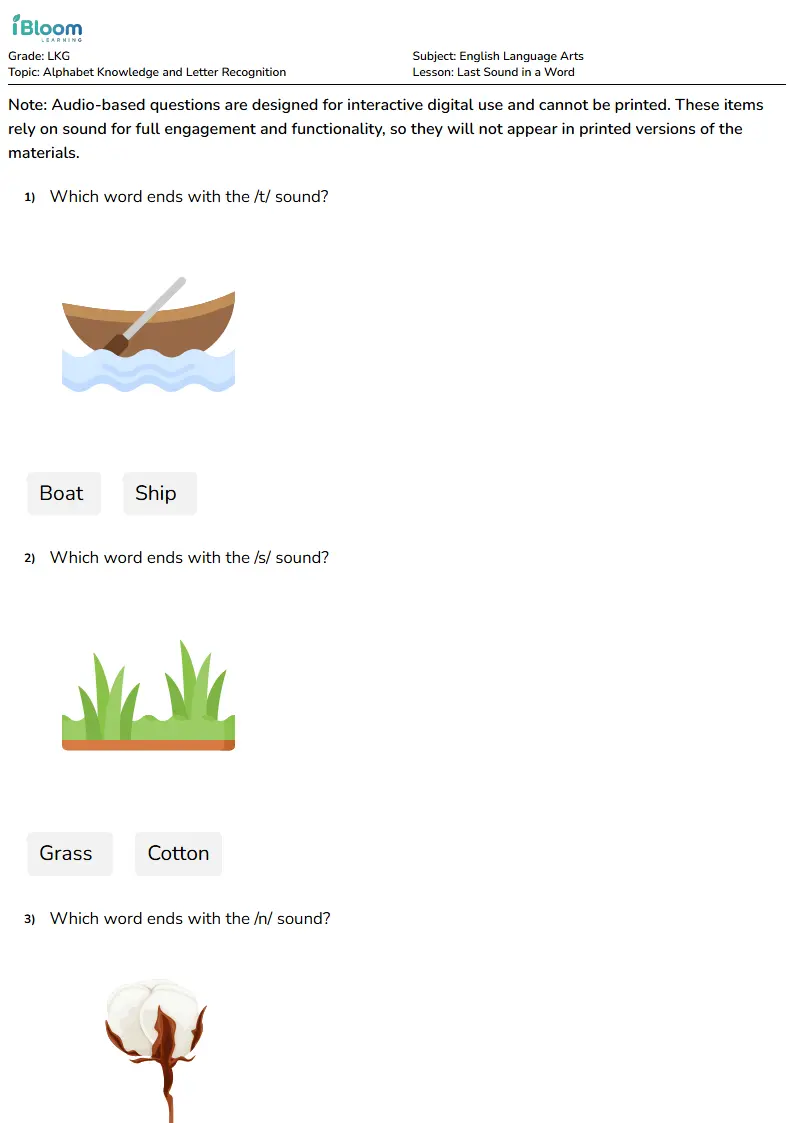
Free Last Sound in a Word Worksheets for Lkg
Looking for lkg english language arts help? Download free, interactive last sound in a word worksheets. AI-personalized and Common Core-aligned. Practice early literacy with iBloom.
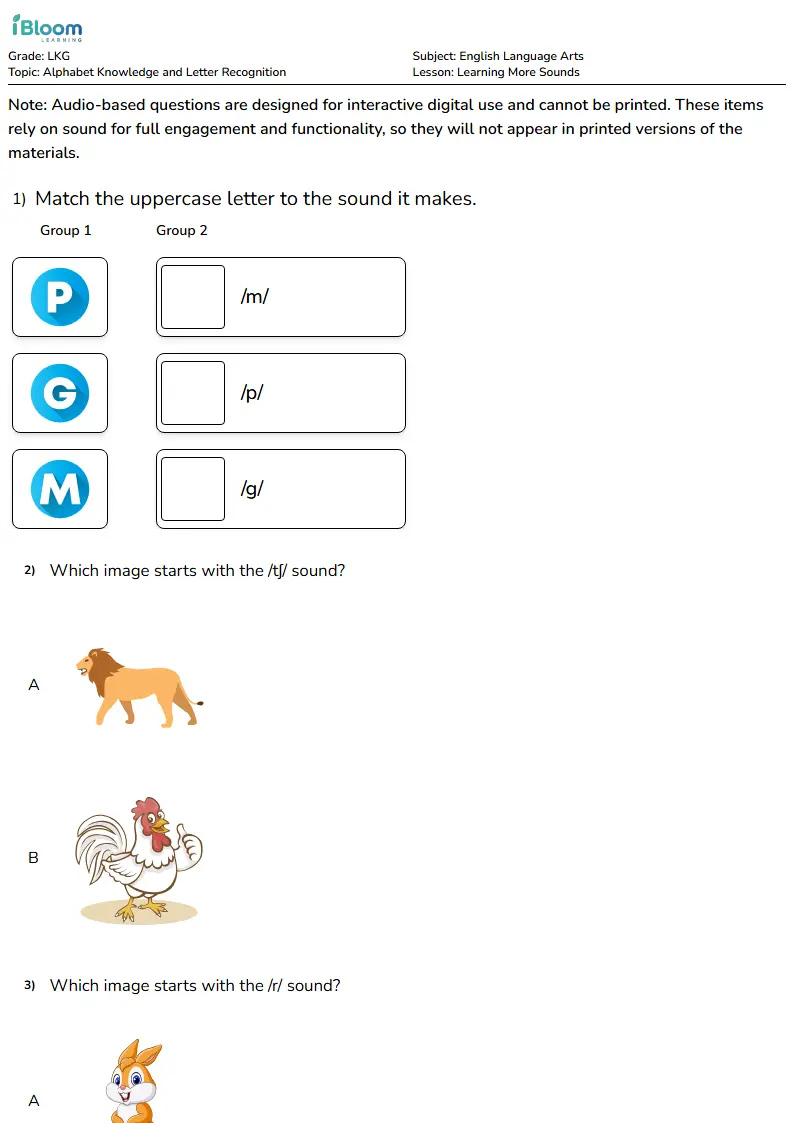
Free Learning More Sounds Worksheets for Lkg
Looking for lkg english language arts help? Download free, interactive learning more sounds worksheets. AI-personalized and Common Core-aligned. Practice early literacy with iBloom.
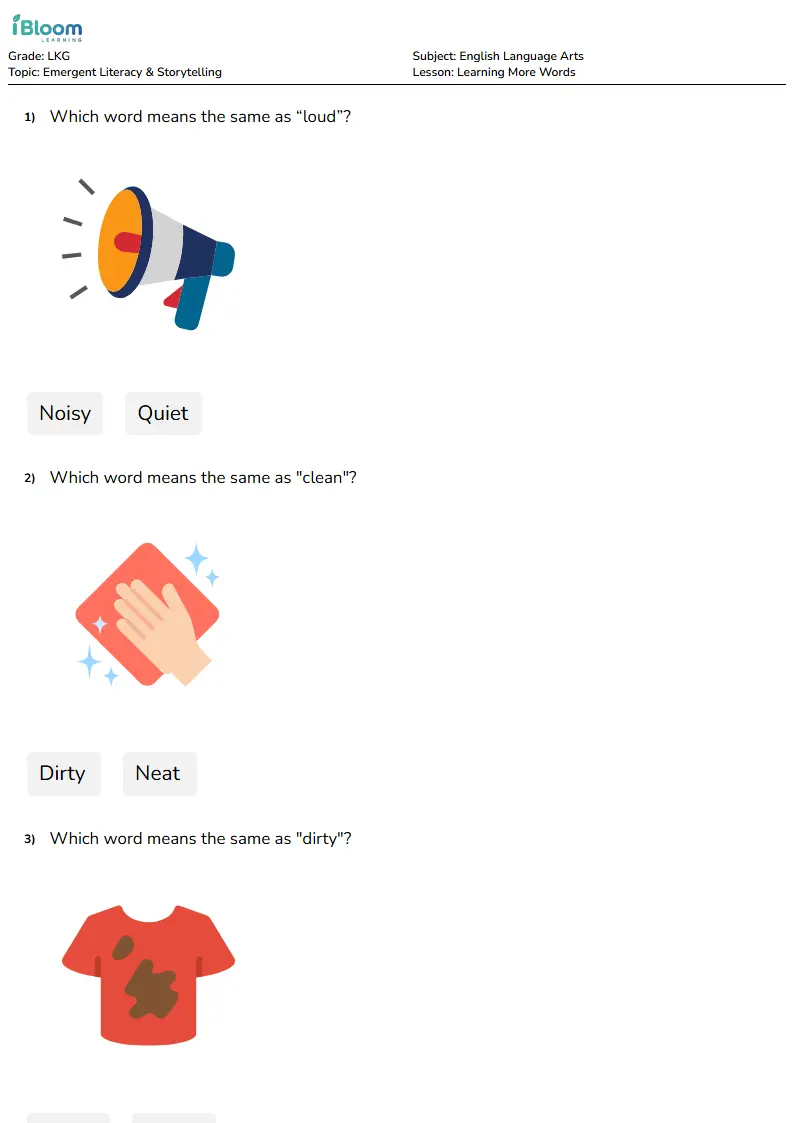
Free Learning More Words Worksheets for Lkg
Looking for lkg english language arts help? Download free, interactive learning more words worksheets. AI-personalized and Common Core-aligned. Practice early literacy with iBloom.
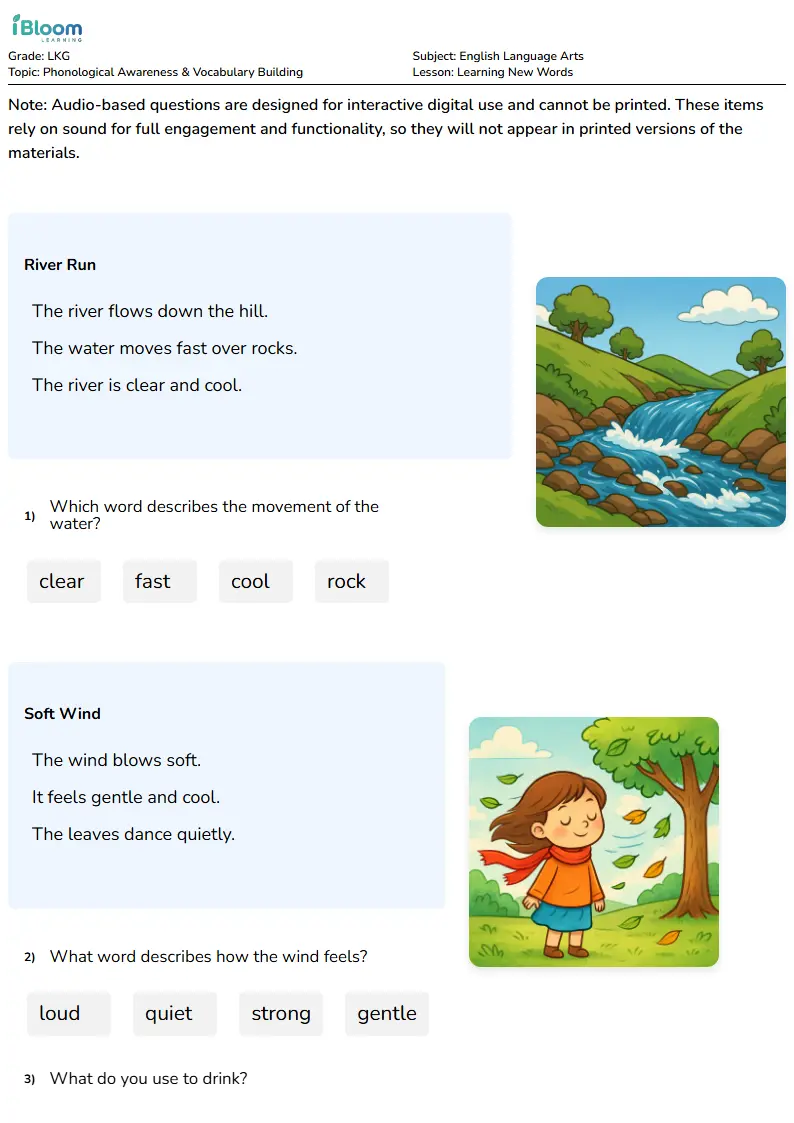
Learning New Words Worksheet for LKG
Help LKG children read River Run and Soft Wind, choose words such as fast and gentle, and answer one everyday vocabulary prompt that uses audio.
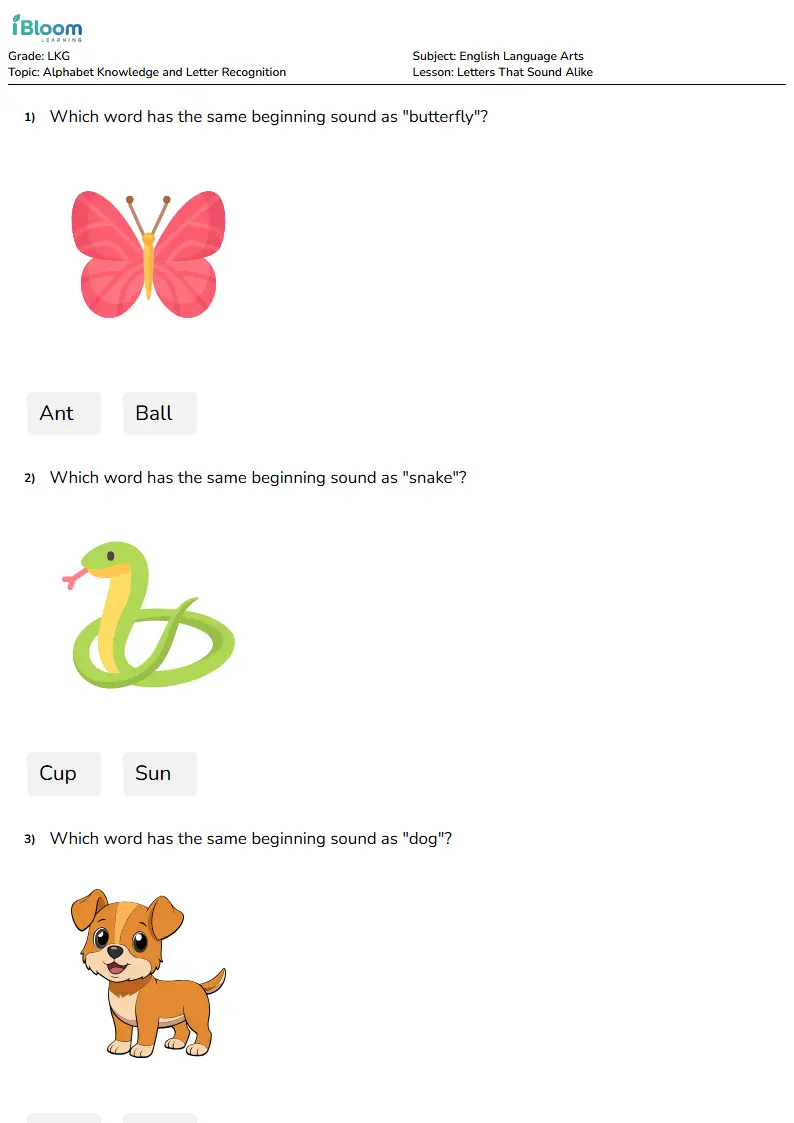
Free Letters That Sound Alike Worksheets for Lkg
Looking for lkg english language arts help? Download free, interactive letters that sound alike worksheets. AI-personalized and Common Core-aligned. Practice early literacy with iBloom.
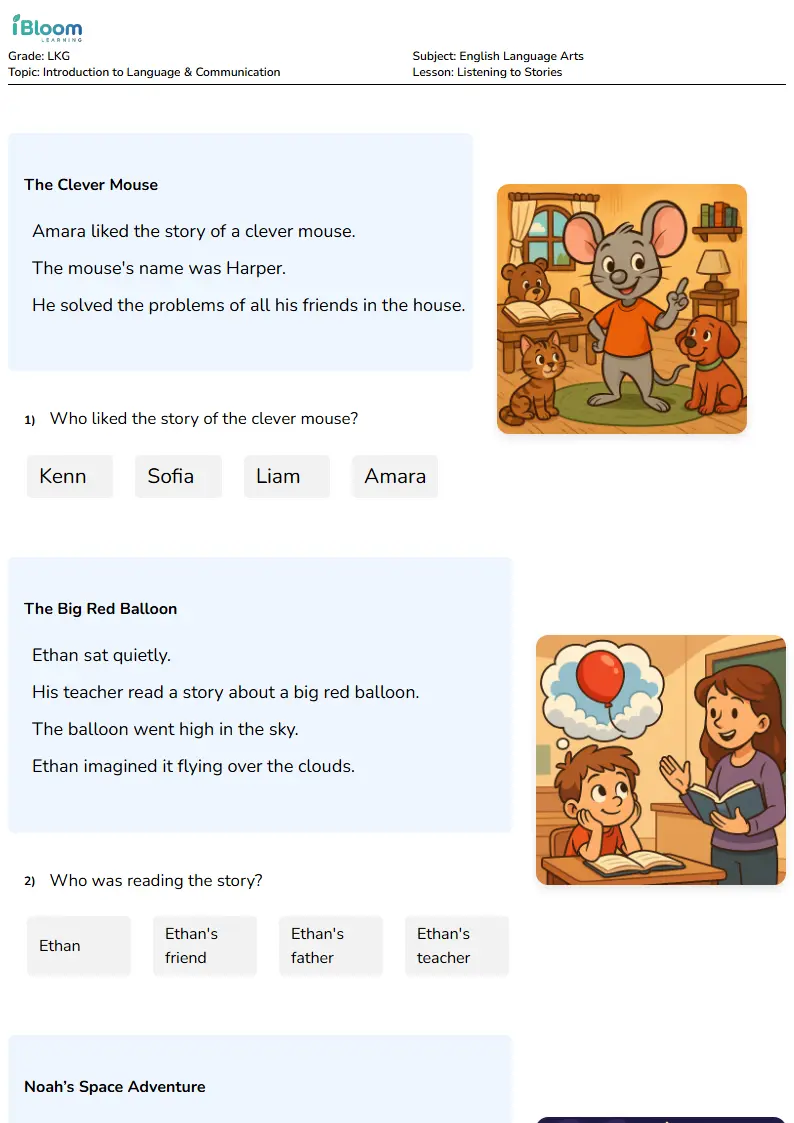
Listening to Stories Worksheet for LKG
Read The Clever Mouse and The Big Red Balloon with an LKG child, then answer who questions and use clear story details to check understanding.