Subtraction Story Sums for Class 1
Free subtraction story sums for Class 1 with printable-style and interactive worksheet practice, examples, CBSE-friendly wording, and answer checks.
Free printable worksheet
Free subtraction story sums worksheet for Class 1
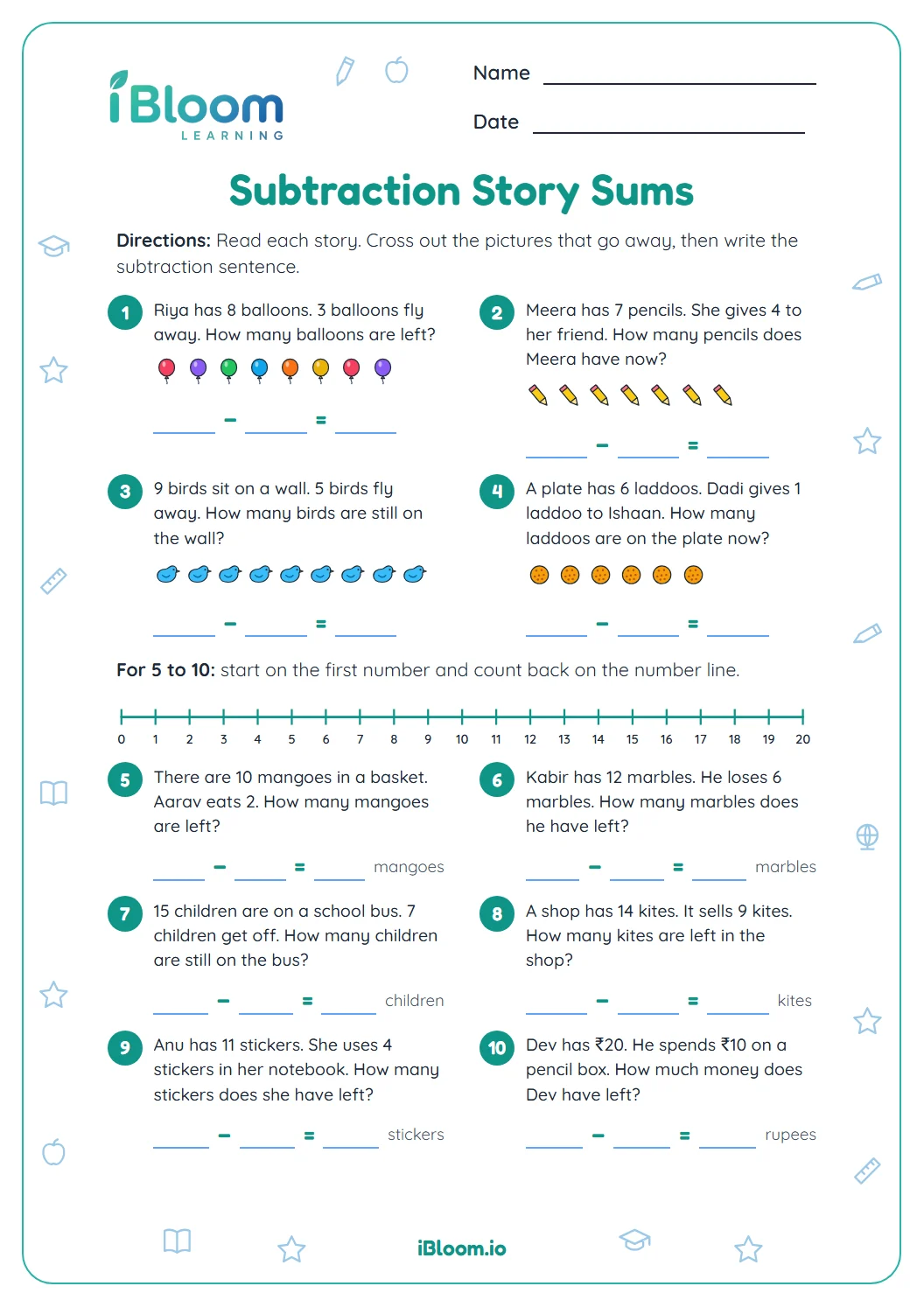
This two-page printable has 10 subtraction story sums and an answer key on page 2. In questions 1 to 4, children cross out the pictures that go away. In questions 5 to 10, they count back on a 0 to 20 number line.
- Free PDF download
- Answer key included
- Ready to print
Free to print and use at home or in class. How to use this worksheet
Subtraction story sums for Class 1 help children read a small situation, decide what is taken away, and explain what is left.
Free subtraction story sums worksheet for Class 1
This two-page printable has 10 subtraction story sums and an answer key on page 2. In questions 1 to 4, children cross out the pictures that go away. In questions 5 to 10, they count back on a 0 to 20 number line.
Download the free subtraction story sums worksheet PDF
Answer key preview
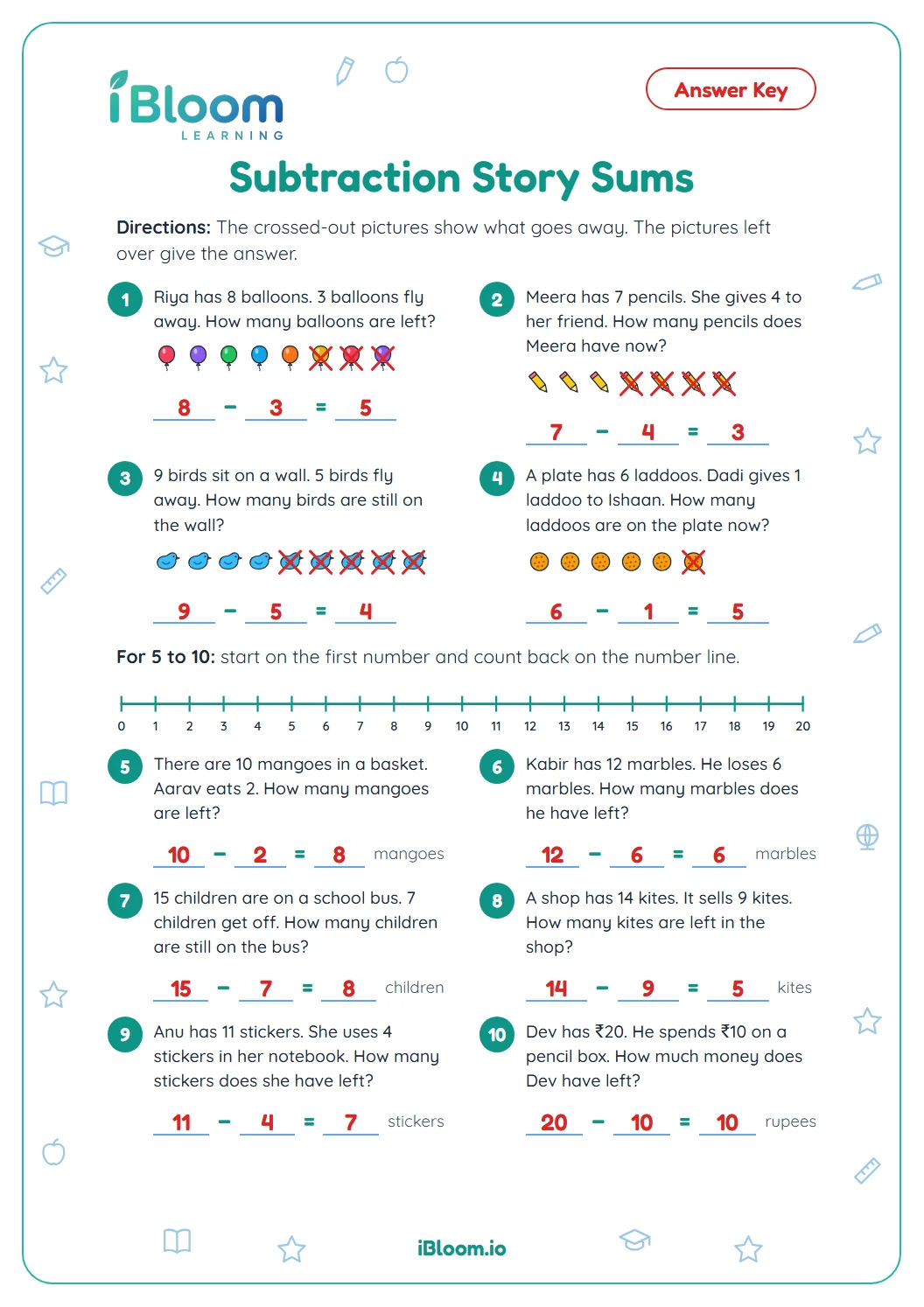
Read each story aloud first. Ask your child to point to the starting number before crossing out or counting back.
Start With the Matching Practice
Use this article with a direct Class 1 subtraction word-problem worksheet so the story-sum routine becomes real practice.
India Worksheet Search Match
Parents and teachers searching for subtraction story sums for class 1 usually want a free worksheet-style page that is quick to understand, printable or usable online, and clear enough for India curriculum practice. This page now names that intent early for CBSE, NCERT-aligned, ICSE, and state-board families so they can see that it covers Class 1 subtraction story sums with object stories, frames, and simple answer checks.
It is written for India-based school and home practice across Delhi, Mumbai, Bengaluru, Chennai, Hyderabad, Pune, Kolkata, Ahmedabad, Jaipur, Lucknow, Kerala, Tamil Nadu, Karnataka, Maharashtra, Telangana, Gujarat, Rajasthan, West Bengal, and Uttar Pradesh.
Use it this way:
- Start with the worked example or short explanation before the child begins.
- Use the linked iBloom practice page for interactive worksheet practice.
- Ask the child to explain one answer aloud so the activity is more than copying.
- Use India curriculum language naturally: Class, UKG, LKG, CBSE, NCERT, state-board, sums, story sums, worksheet, printable practice, interactive practice, and answer checks.
This update is aimed at better snippet match for the query subtraction story sums for class 1 while keeping the visible copy useful for children, parents, and teachers.
Table of Contents
Worksheet And Lesson Previews
Solving Subtraction Word Problems Using Models Worksheets for Kindergarten Preview
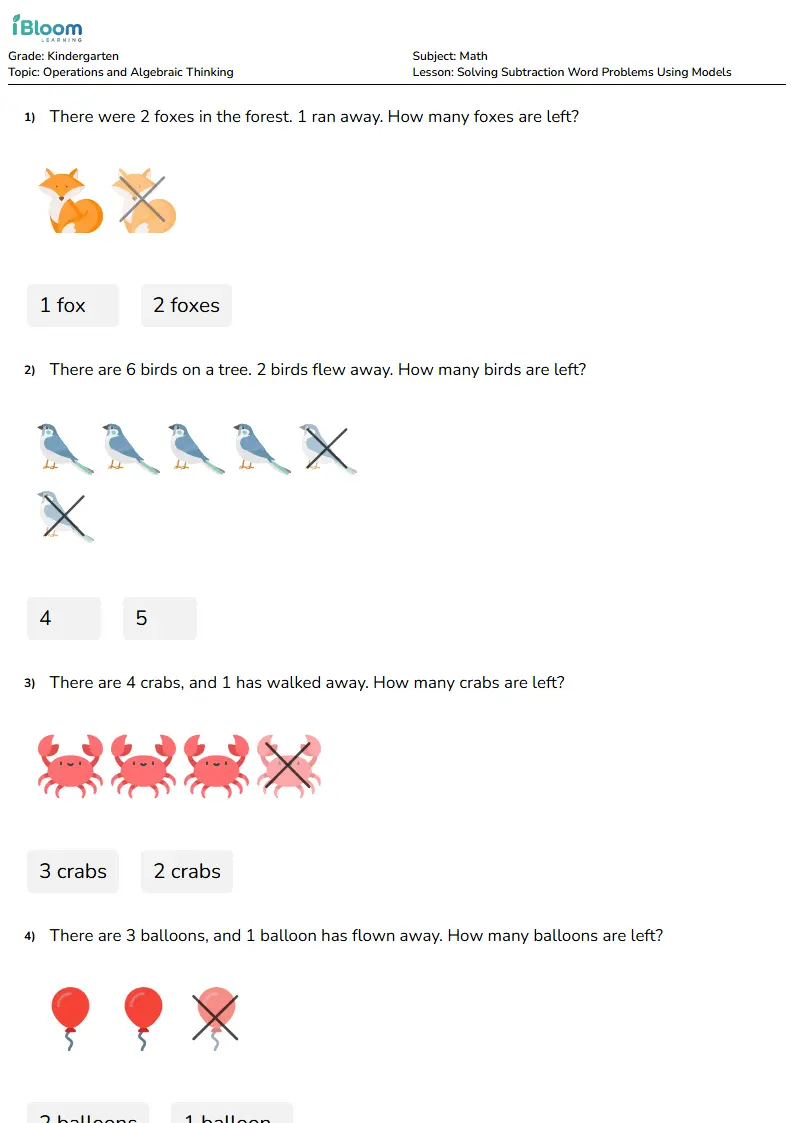
Use this preview to see the kind of practice children will open before you start the routine.
Key Takeaways
- subtraction story sums for class 1 should connect the story, model, subtraction sentence, and spoken explanation.
- Children need concrete objects, drawings, frames, or number lines before they are asked to solve many written problems.
- Parents can use short routines at home; teachers can reuse the same page for warm-up, center work, small groups, and exit tickets.
- The best next step is always a matching iBloom worksheet or lesson, not another disconnected page.
- India, US, and UAE families may use different curriculum labels, but young learners still need the same careful model-and-explain routine.
Why This Type of Subtraction Practice Matters
Story sums are different from plain subtraction facts because the child must understand the action in the sentence. A learner may know 9 - 3 = 6 but still struggle when a story says that 9 mangoes were on a plate and 3 were eaten. The goal is to connect language, objects, pictures, and a subtraction sentence.
The IES early math practice guide recommends intentional early math teaching that builds from concrete examples toward clear mathematical language. The NCTM classroom resources also support visual models, reasoning, and discussion in early number work. For children, that means subtraction practice should include a situation, a model, an equation, and a simple sentence explaining what changed.
Use this article with Class 1 Subtraction Word Problems Using Objects Worksheet) and Class 1 Subtraction Word Problems Using Objects Lesson so children move from explanation into real practice. Families who want the broader hub can also use Subtraction Word Problems for Class 1 or Subtraction Word Problems Grade 1 before returning to the worksheet.
A Step-by-Step Routine
Use story sums as a reading-and-math routine. The child should not hunt for numbers and subtract automatically. They should understand who or what the story is about, what changed, and what question is being asked.
- Read the story slowly and ask what is happening.
- Circle or say the starting amount.
- Show what is taken away, crossed out, moved back, or removed.
- Write or say the subtraction sentence.
- Ask the child to explain the answer in one complete sentence.
This routine works for home and school because it protects the thinking step. A child who says, "I started with 10 and took away 3, so 7 are left," is doing more than memorizing a fact. They are connecting the story to the operation.
Examples Children Can Try
- 8 pencils are in a box. 3 pencils are used. How many pencils are left?
- 10 children are playing. 4 go inside. How many children are still playing?
- 12 stickers are on a sheet. 5 are removed. How many stickers remain?
- 15 shells are on the sand. 6 are picked up. How many shells are left?
After each example, ask one follow-up question: "What did you start with?", "What changed?", "What is left?", or "How did your model show the story?" These short prompts help children avoid guessing from numbers alone.
Parent Practice Plan
Parents can keep practice to ten calm minutes. Start with a real situation at home: crayons on a table, snacks in a bowl, toy cars in a line, books on a shelf, or steps on the floor. Then move to Class 1 Subtraction Word Problems Using Objects Worksheet). Let the child point, move, draw, or count before writing the answer.
In India, families may connect this to CBSE, ICSE, NCERT-aligned, state-board, Class 1, Class 2, tuition revision, Delhi, Mumbai, Bengaluru, Chennai, Hyderabad, Pune, Kolkata, Ahmedabad, Jaipur, Kerala, Tamil Nadu, Karnataka, Maharashtra, Telangana, Gujarat, Rajasthan, West Bengal, and Uttar Pradesh.
Teacher Practice Plan
Teachers can use the same subtraction page several ways:
- Morning warm-up: solve one story together and ask for one explanation.
- Small group: use counters, ten-frames, drawings, or number lines before the worksheet.
- Math center: pair the worksheet with a model mat and sentence frame.
- Exit ticket: ask children to write one sentence explaining what was taken away.
For a broader planning path, teachers can pair this article with How to Teach Subtraction to First Graders, Subtraction Worksheets for Grade 1, and First Grade Modeling Subtraction Word Problems with Objects Worksheet). When children need a gentler entry point, UKG Subtraction Worksheets and Picture Subtraction Worksheets for UKG give earlier visual practice.
Common Mistakes
- The child subtracts because two numbers appear, but does not understand the story.
- The child adds instead of subtracting because the action word is unclear.
- The child writes an equation but cannot explain what was removed.
- The child counts too fast and skips an object, frame, or number-line jump.
- The adult gives the answer before the child has a chance to model the situation.
When a mistake appears, return to Class 1 Subtraction Word Problems Using Objects Lesson or Class 1 Subtraction Word Problems Using Objects to 20 Worksheet) and solve one problem slowly. One corrected example is more useful than a full page completed with the same error.
Keep Practicing on iBloom
Use this article with a direct Class 1 subtraction word-problem worksheet so the story-sum routine becomes real practice.
Frequently Asked Questions
What age is this subtraction practice best for?
It is best for children who are beginning to connect real situations, pictures, number lines, frames, and subtraction sentences. That often includes UKG, Class 1, kindergarten, and Grade 1 learners, depending on the curriculum.
Should children memorize subtraction facts first?
No. Memorizing facts can help later, but young learners should first understand what subtraction means in a story or model. Use objects, pictures, frames, or number lines before expecting fast recall.
How many problems should a child do in one sitting?
Three to six well-explained problems are often enough. Stop after the child can explain one answer clearly.
What should I do if my child adds instead of subtracting?
Ask what changed in the story. Then model the action by removing objects, crossing out pictures, or jumping backward on a number line.
Which iBloom page should we use next?
Start with Class 1 Subtraction Word Problems Using Objects Worksheet) if the child needs direct practice. Use Class 1 Subtraction Word Problems Using Objects Lesson when the child needs the same idea taught step by step.
Related practice
Practice this topic
Continue with a lesson, generator, or printable worksheet.