

About this worksheet
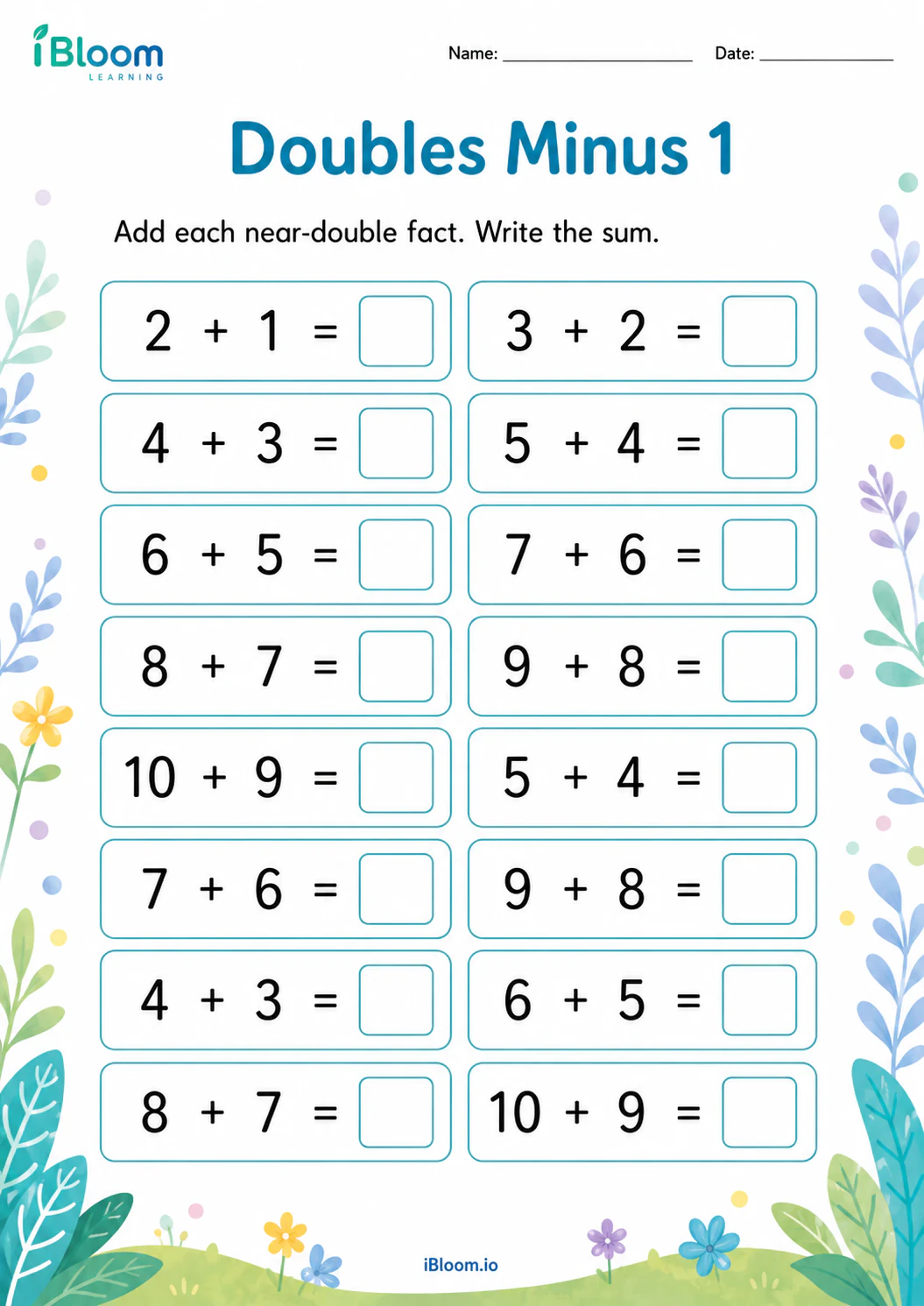
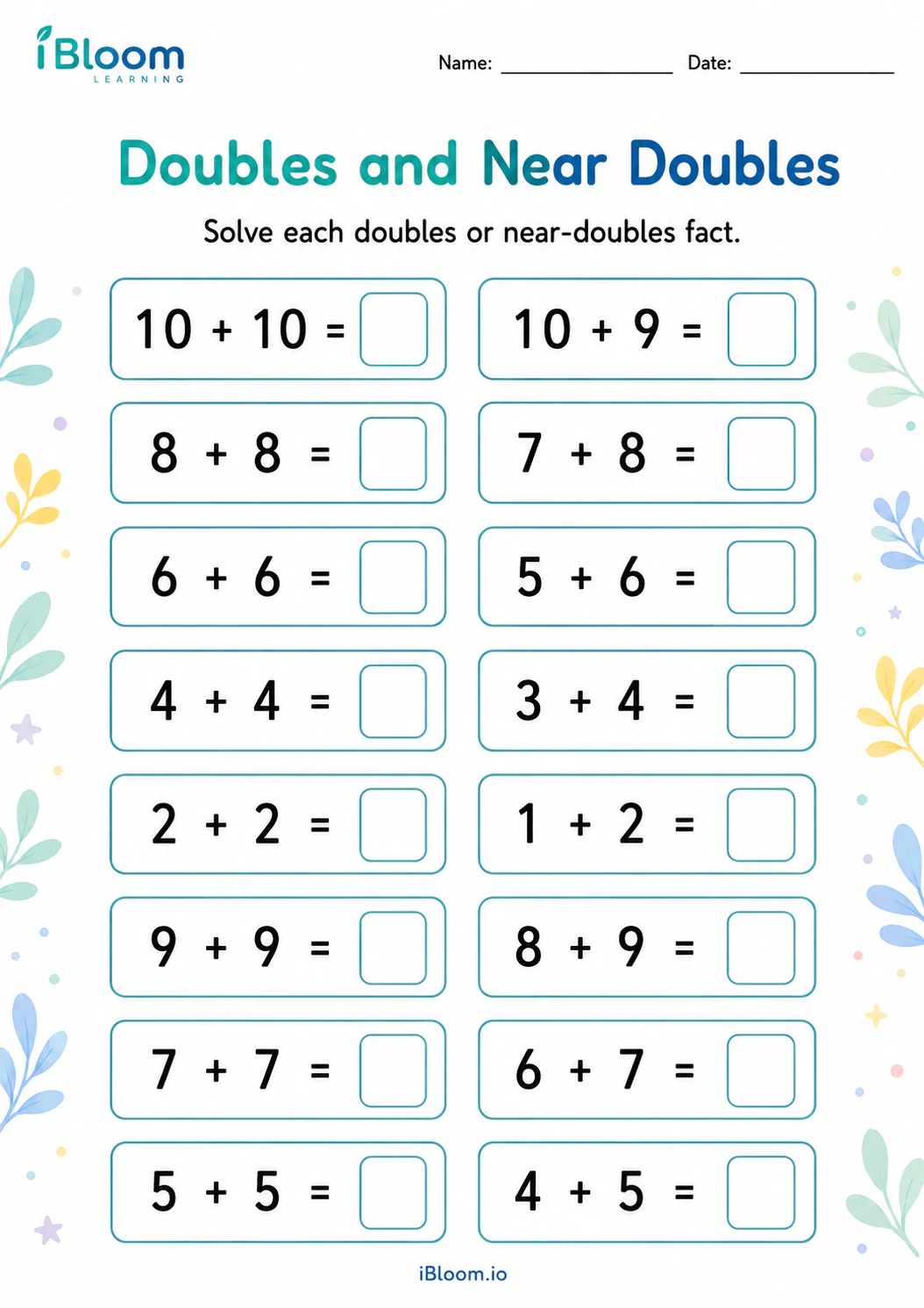
This free printable Grade 1 worksheet practices doubles-minus-one addition. In Part A, learners solve facts such as 6 + 5 by doubling 6 and taking away 1; Part B switches the order of each pair, as in 5 + 6. The two-page sheet has 16 sums and a separate answer key. It supports CCSS 1.OA.C.6, which includes using known sums to make an easier equivalent sum.
Aligned to 1.OA.C.6
How does “doubles minus one” help?
When addends differ by one, double the larger addend and subtract one. For example, 6 + 5 is one less than 6 + 6, so the sum is 11.
How do you solve 6 + 5?
Use the known double 6 + 6 = 12, then subtract one because the second addend is one less. The result is 11.
- 16 + 5 = ___
- 26 + 6 = 12; 12 − 1 = 11
- 3Answer: 11
What is on the two worksheet pages?
Part A has the eight facts from 3 + 2 through 10 + 9. Part B repeats those pairs in reverse order, so learners can use the same idea whichever addend comes first. The answer key has the sums for all 16 equations.
How to use this worksheet
- 1Read the two addends and find the larger one.
- 2Double the larger addend.
- 3Subtract one from that double.
- 4Write the sum and check it with the answer key.
Common mistakes and quick fixes
The mistake
Doubling the smaller addend
The fix
Double the larger number, then subtract one. For 6 + 5, start with 6 + 6.
The mistake
Adding one to the double
The fix
The smaller addend is one less, so take one away from the double.
The mistake
Changing the sum when the addends switch
The fix
Addition keeps the same sum when the addends trade places; 6 + 5 and 5 + 6 both equal 11.
Common Core alignment
This page uses known sums to build fluency within 20.
Use a known double to find a nearby addition fact.
On this sheet: The near-double sums use a known double with one taken away.
Show the official wordingHide the official wording
Add and subtract within 20, demonstrating fluency for addition and subtraction within 10. Use strategies such as counting on; making ten (e.g., 8 + 6 = 8 + 2 + 4 = 10 + 4 = 14); decomposing a number leading to a ten (e.g., 13 − 4 = 13 − 3 − 1 = 10 − 1 = 9); using the relationship between addition and subtraction (e.g., knowing that 8 + 4 = 12, one knows 12 − 8 = 4); and creating equivalent but easier or known sums (e.g., adding 6 + 7 by creating the known equivalent 6 + 6 + 1 = 12 + 1 = 13).
What to practice next
Make more practice
Further reading
Questions parents and teachers ask
What is a doubles-minus-one fact?
It is an addition fact with addends that differ by one. Double the larger addend, then subtract one: 6 + 5 is one less than 6 + 6, so 6 + 5 = 11. Part A practices eight facts, and Part B switches the addends.
How many questions and pages are included?
There are 16 equations across two worksheet pages, followed by two answer-key pages. The first eight facts put the larger addend first. The next eight show the same pairs in reverse order, so learners can practice the fact whichever way it appears.
Why are some addition facts repeated in reverse order?
The second part changes the order of the addends, such as 6 + 5 and 5 + 6. The sum stays the same. That gives learners practice recognizing the same near-double relationship without changing the strategy: double the larger number and subtract one.
What should a learner do if the sum is one too high?
Check the double first. If the learner doubled 6 to get 12 for 6 + 5, the final step is to subtract one, giving 11. Adding one instead would solve a doubles-plus-one fact, so reread which addend is smaller before checking the result.
Can a learner use a different strategy?
Yes. Counting on or using a number line can also find these sums. The worksheet highlights doubles minus one because a known double can make the nearby fact quicker to see; learners can use the method that helps them check their reasoning.