Free printable practice
Adding Doubles Near Doubles Practice Activities
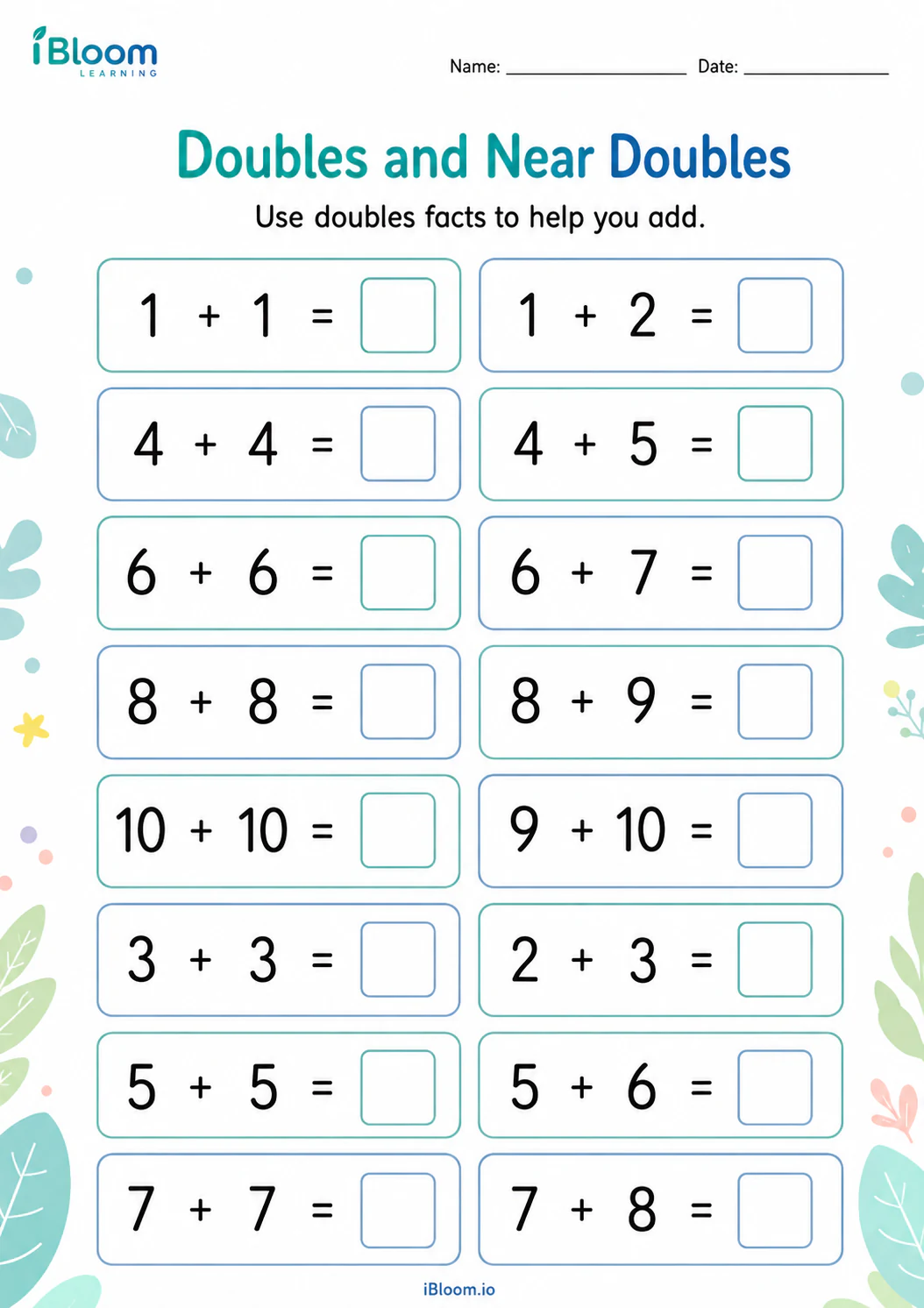
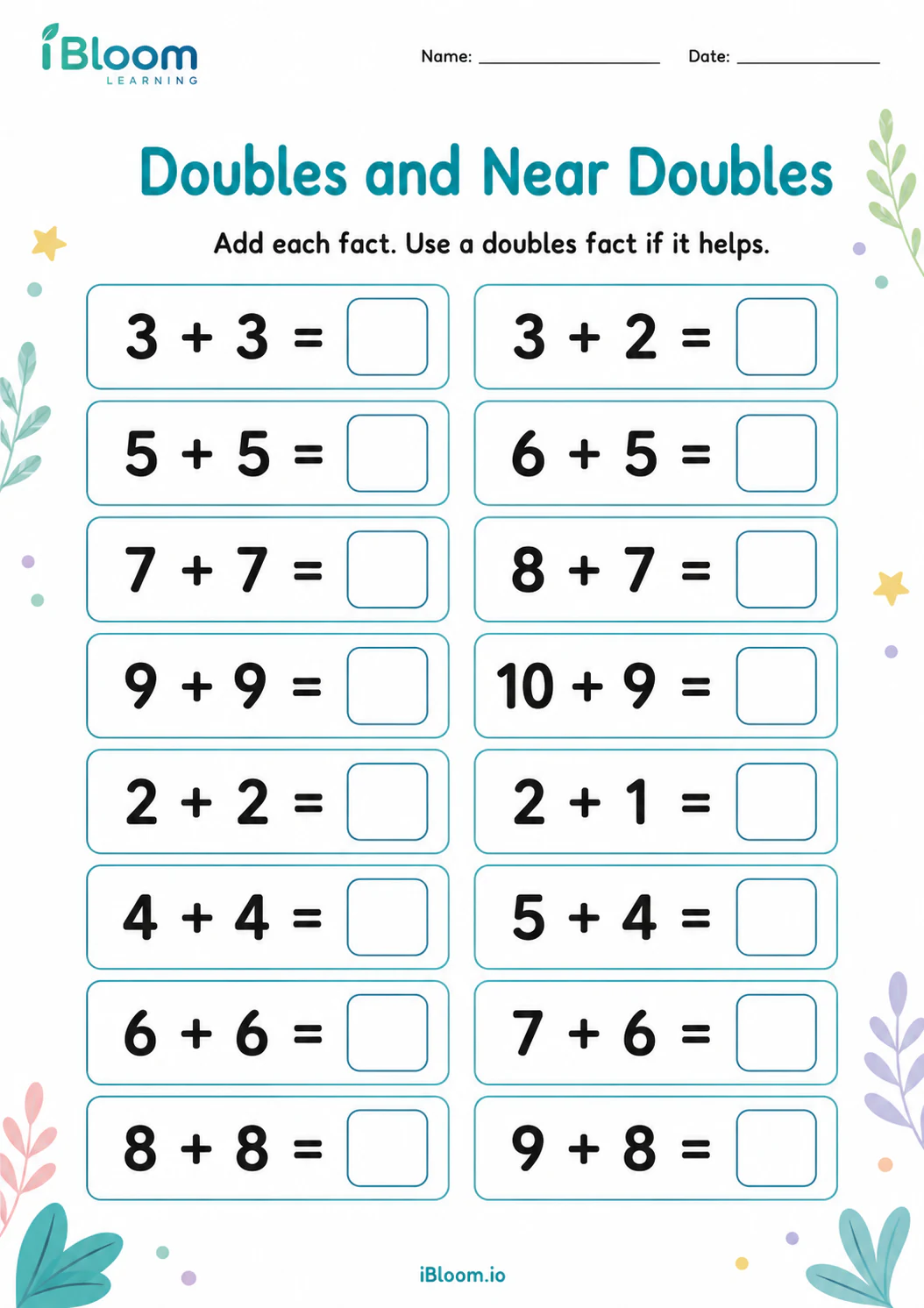
Grade 1 worksheets help children use doubles facts like 5+5 to solve near doubles such as 5+6 with greater confidence.
Free printable worksheet PDFs
Preview every available page, then download the free worksheet PDF for home, homeschool, tutoring, or classroom practice.
Preview the exact activity before downloading it.
Practice that builds confidence
Understanding doubles and near doubles
These Grade 1 addition worksheets help children build fluency with doubles facts and use them to solve near doubles. Students practise seeing that facts like 4+5 are close to 4+4 or 5+5, then adjust by one instead of counting every object.
The printable activities include visual models, number sentences, matching tasks, and mixed practice that connect equal addends to “one more” addition facts. Children strengthen mental math, fact families, and flexible thinking while working within familiar first-grade addition.
Doubles are addition facts with two equal addends, such as 3+3 or 8+8. Near doubles are almost the same, such as 3+4 or 8+9. These worksheets guide Grade 1 students to notice the relationship: if you know 6+6, then 6+7 is one more. That shift helps children move from counting one by one to using a known fact.

How the practice progresses
Activities begin with clear doubles facts supported by pictures, ten-frames, or grouped objects. Students then compare a double with a near double and complete related number sentences. Later pages mix facts so children must decide whether a doubles strategy is useful. This progression builds accuracy first, then flexible recall.
A simple parent routine
At home, choose one doubles fact each day. Say, “We know 5+5 is 10. What is 5+6?” Ask your child to explain, “It is one more, so it is 11.” Use small objects, fingers, or a quick drawing if needed, then repeat with a new nearby fact. Keep the focus on the relationship, not speed.

Classroom uses for teachers
Teachers can use these printables for addition centers, small-group reteaching, morning work, or quick checks after a doubles lesson. They also work well for math talks: display a problem like 7+8 and ask students which double helped them. Partner activities encourage children to listen for math vocabulary such as double, addend, sum, one more, and near double.

Common errors to watch for
Some students double the larger number and forget to adjust, turning 6+7 into 14 instead of 13. Others count all from 1 even when a known double is visible. Watch for reversed reasoning too: 4+5 can be 4+4 plus one, or 5+5 minus one. Both are valid when explained correctly.
Free printable PDF download
Use this adding doubles near doubles worksheets grade 1 page to preview the activity, print it, or download it as a PDF for quick practice. It works well for homework, homeschool lessons, tutoring, morning work, revision, and classroom centers.
Answers and answer key support
After the child completes the worksheet independently, parents and teachers can use the answer support or answer key information to check the work, review mistakes, and choose the next practice step.
Why iBloom worksheets help
iBloom worksheets give children repeated, varied practice without making every page feel the same. The mix of models, equations, and explanation prompts helps students connect what they see to what they say and write. A child-friendly strategy to remember is: “Find the double, then add or take away one.”
Helpful answers
Frequently asked questions
What are doubles facts in Grade 1 addition?
Doubles facts are addition facts where both addends are the same, such as 2+2, 5+5, or 9+9. They help children remember sums and build mental math fluency.
How do near doubles help children add?
Near doubles help children use a fact they already know. For example, if a child knows 7+7 is 14, they can solve 7+8 by adding one more to get 15.
Should my child memorize doubles before practising near doubles?
A strong recall of common doubles makes near doubles easier, but children can build both together with pictures, objects, and repeated comparison of related facts.
What is a good way to explain 6+7 to a first grader?
Ask the child to find the nearby double: 6+6 is 12. Since 7 is one more than 6, 6+7 is one more than 12, so the answer is 13.
Can these worksheets be used for math centers?
Yes. The pages are suitable for independent addition centers, partner practice, small-group review, or follow-up work after teaching doubles and near doubles.
Is this adding doubles near doubles worksheets grade 1 free?
Yes. You can preview it for free and use the printable worksheet for home or classroom practice.
Can I download this adding doubles near doubles worksheets grade 1 as a PDF?
Yes. Use the worksheet download option to save a printable PDF, or print the worksheet directly from the page.
Does this adding doubles near doubles worksheets grade 1 include answers or an answer key?
When the activity has fixed answers, iBloom includes answer support so parents and teachers can check the completed worksheet.