
About this worksheet
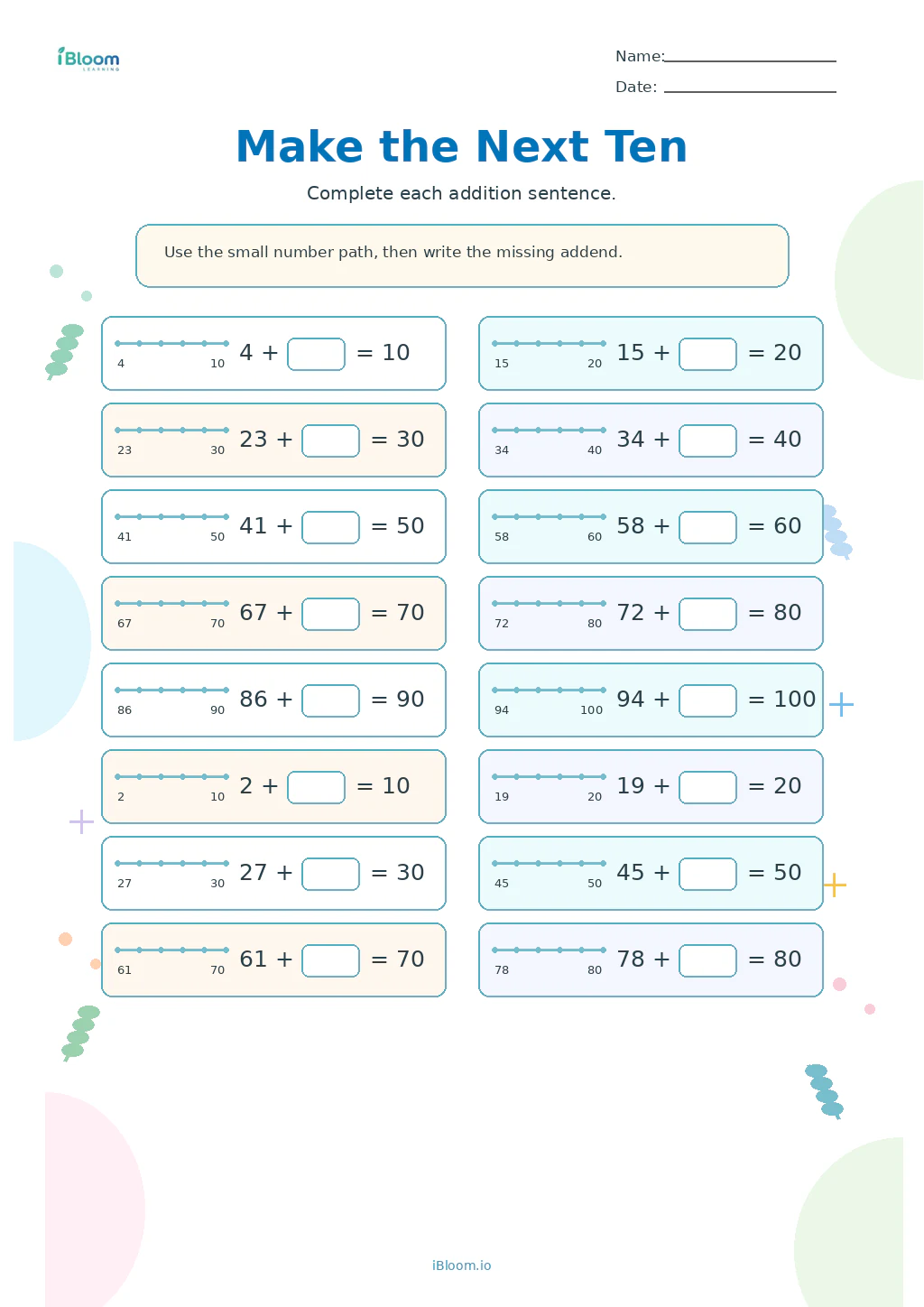
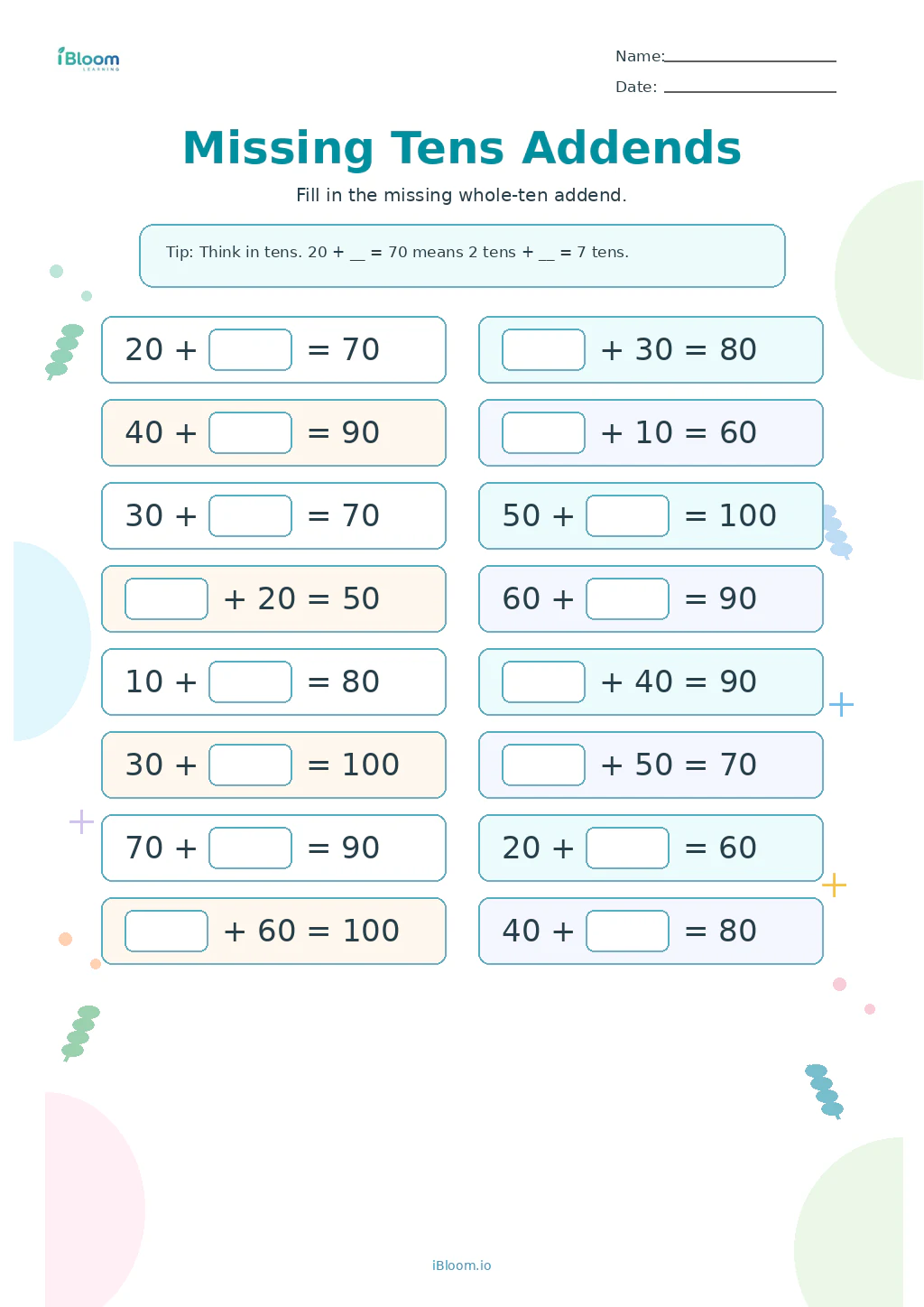
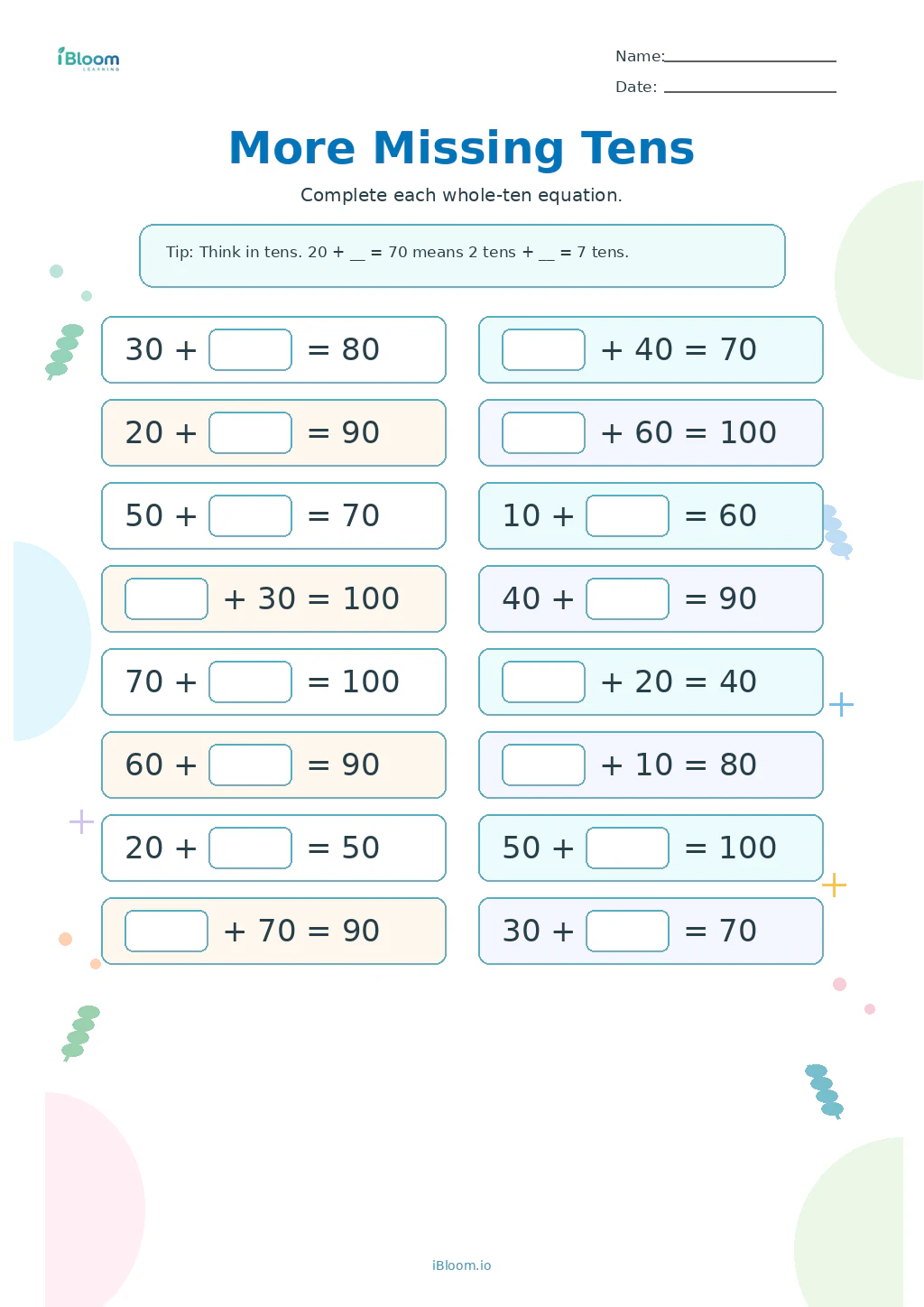
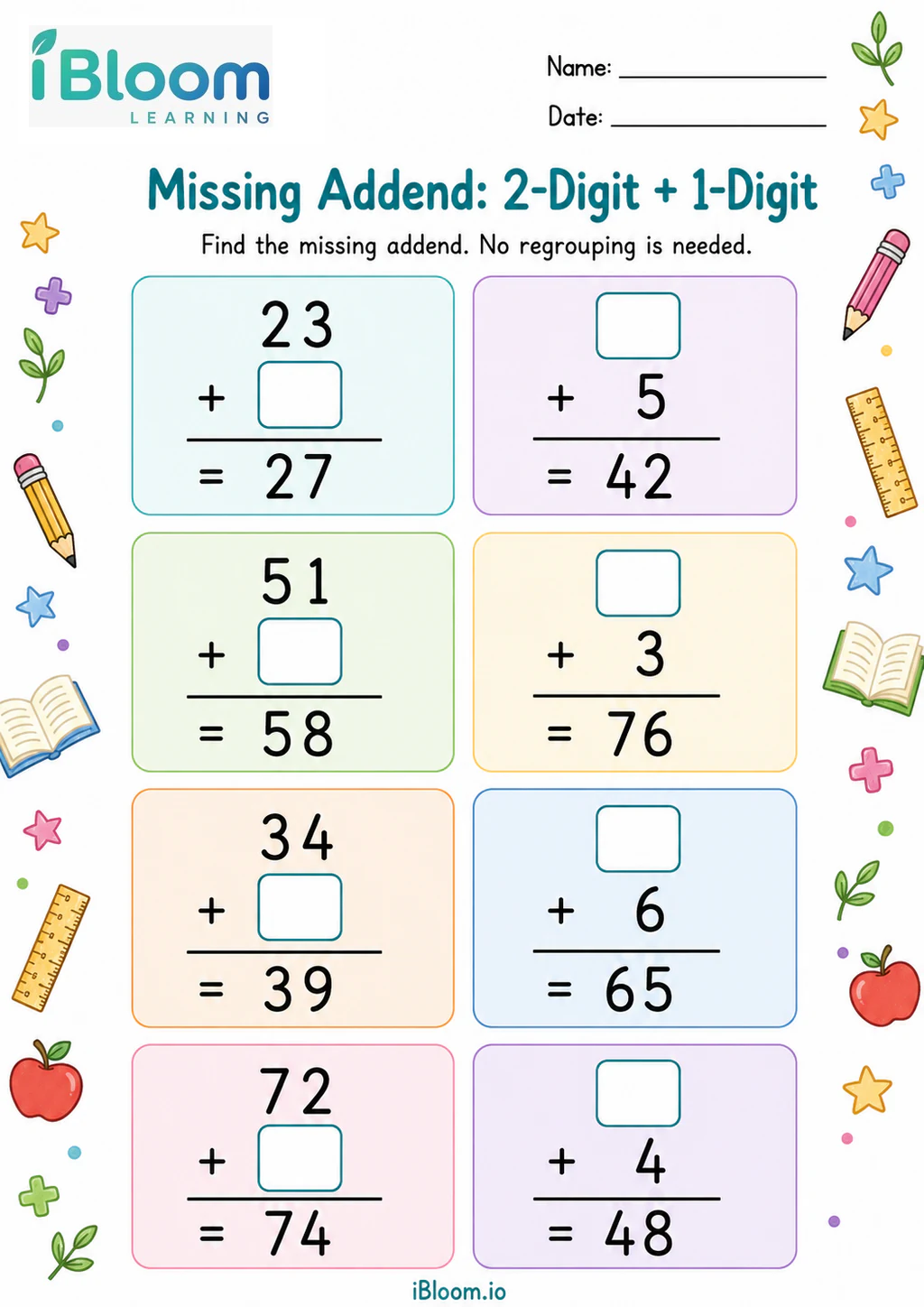
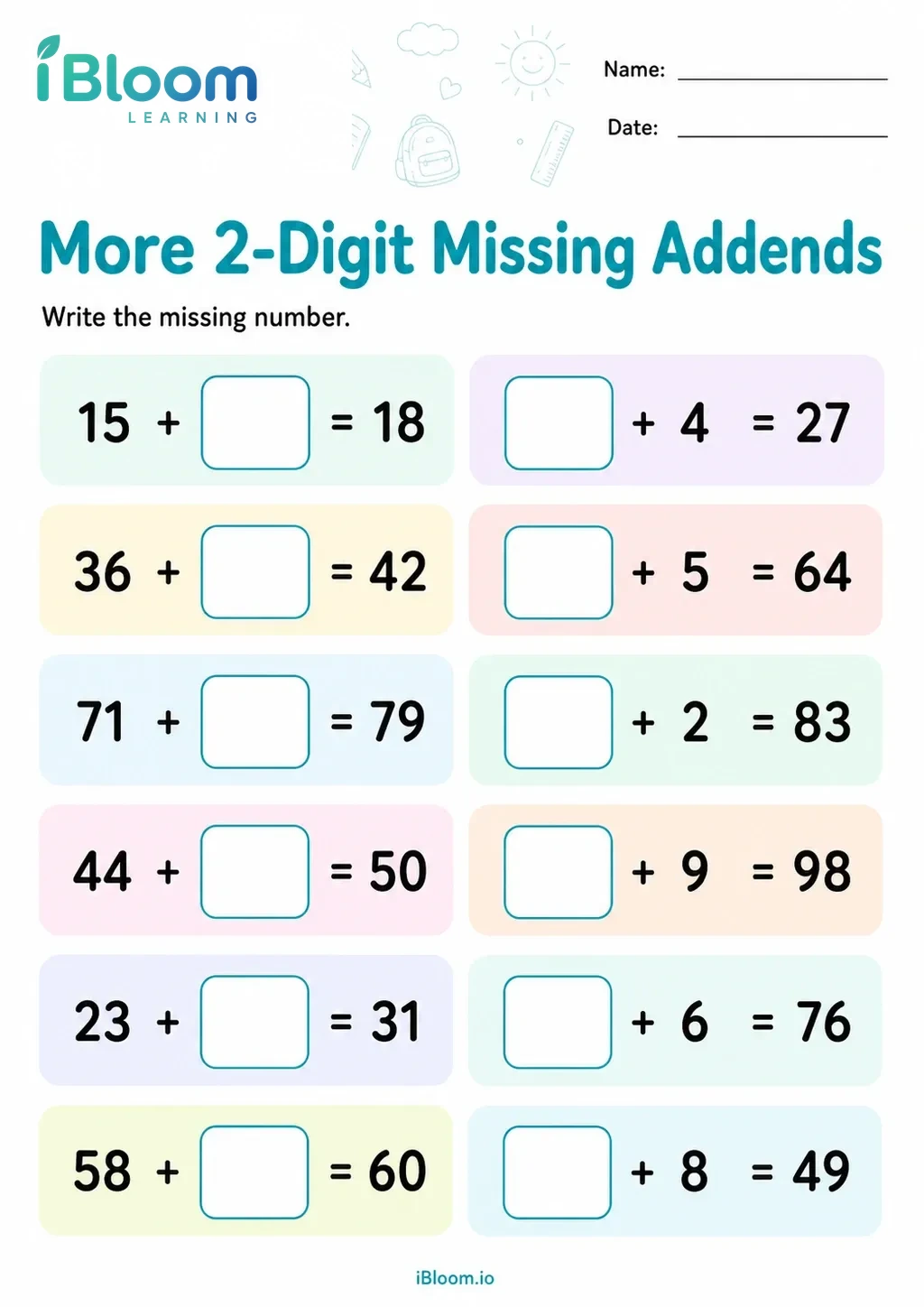
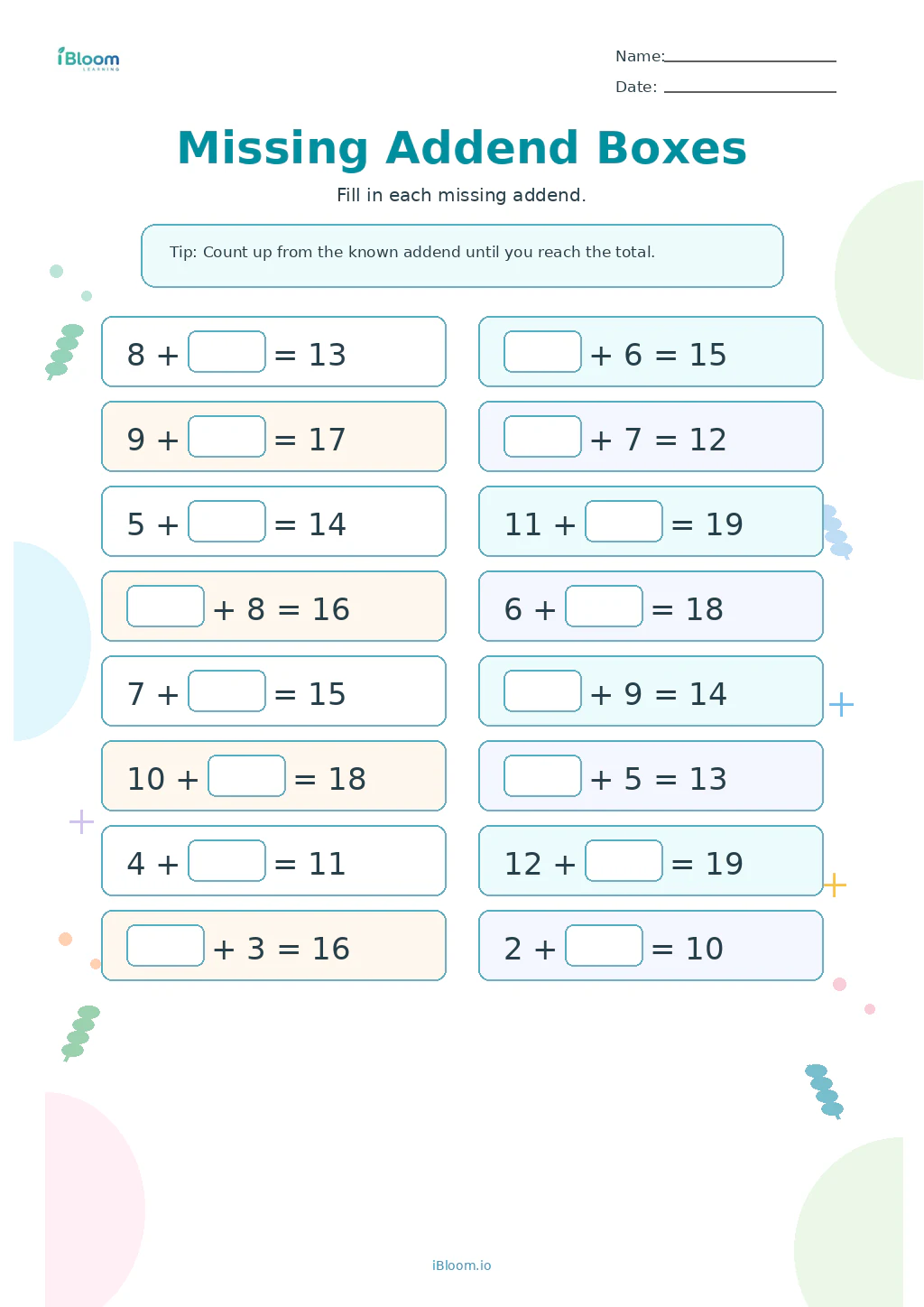
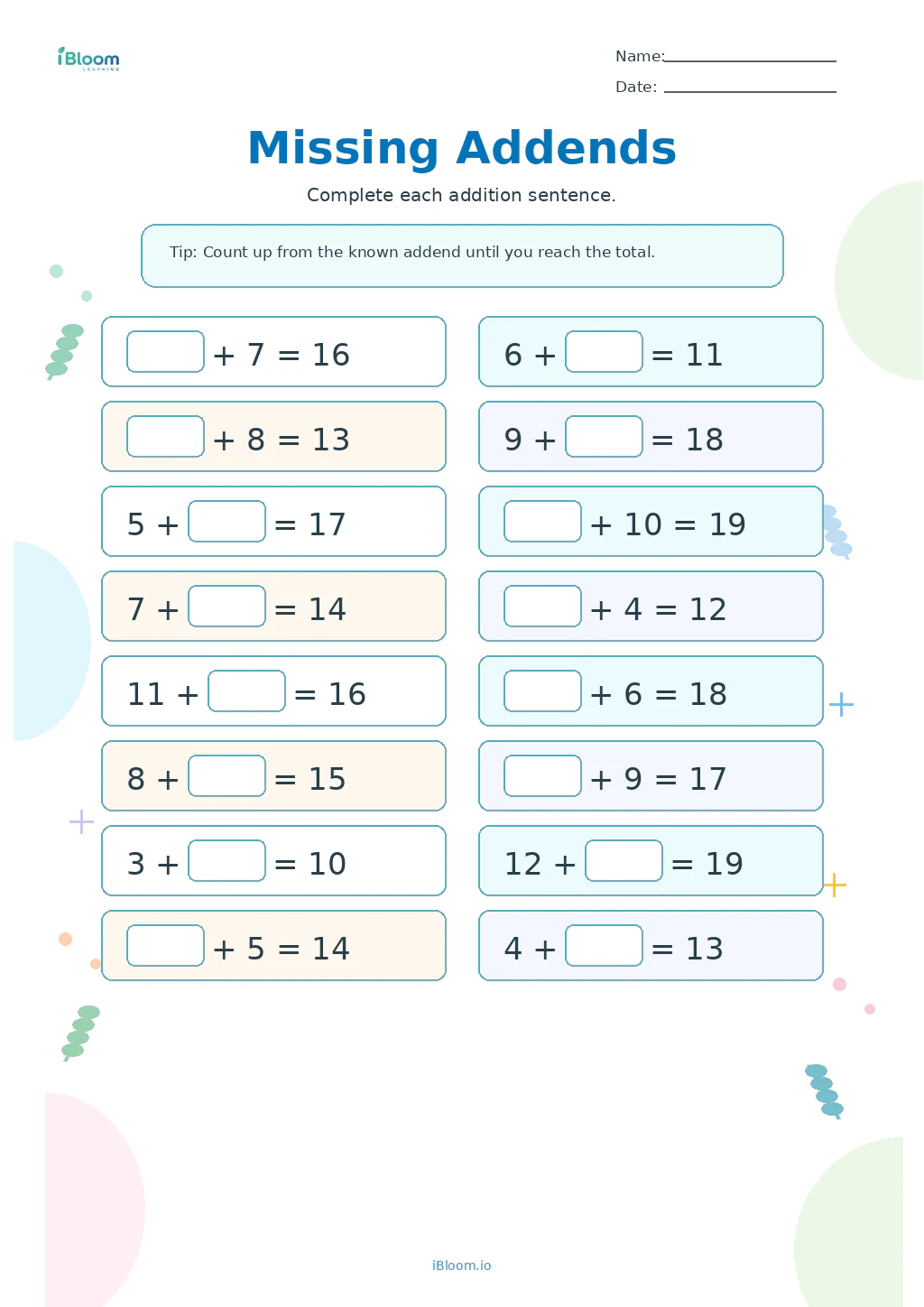
This free Grade 1 addition worksheet gives children 16 missing-addend questions that reach the next ten, from 10 through 100. In Part A, students complete equations; in Part B, they count equal jumps on number lines. The drawings make the distance to the target ten visible. This practice aligns with CCSS 1.NBT.C.4, which includes addition within 100 using drawings and strategies. A separate answer key is included.
Aligned to 1.NBT.C.4
How do you find the missing addend?
Start at the number in the equation and count forward to the next multiple of ten. In 26 + ___ = 30, four counts—27, 28, 29, 30—show that the missing addend is 4. Part A gives the start and target so students can focus on the amount needed.
- 126 + ___ = 30
- 2Count on four numbers: 27, 28, 29, 30.
- 3The missing addend is 4.
How do number lines show the distance?
Each line begins at a two-digit number and ends at the next ten. Count the equal jumps between the labeled endpoints. For example, from 48 to 50 takes two jumps, so 48 + 2 = 50. The later questions include a line that ends at 100.
How can you check the answer?
Add the number of jumps to the starting number. The sum should match the endpoint. If 91 + 9 reaches 100, then nine is the missing addend.
How to use this worksheet
- 1Read the starting number and the next-ten target.
- 2For an equation, count on from the starting number.
- 3For a number line, count each jump from its first tick.
- 4Write the number of jumps as the missing addend.
- 5Add to check that the total reaches the target.
Mistakes to watch for
The mistake
Counting the starting tick as one jump.
The fix
A jump moves from one tick to the next; begin counting after the start.
The mistake
Stopping at the number before the target ten.
The fix
Include the final jump onto the labeled target.
The mistake
Writing the target ten in the blank.
The fix
Write only how many more are needed to reach it.
Common Core alignment
The Grade 1 place-value standard includes addition within 100 using drawings and strategies.
Add within 100 with place-value strategies and drawings.
On this sheet: The equations and number lines model adding on from two-digit numbers to the next ten.
Show the official wordingHide the official wording
Add within 100, including adding a two-digit number and a one-digit number, and adding a two-digit number and a multiple of 10, using concrete models or drawings and strategies based on place value, properties of operations, and/or the relationship between addition and subtraction; relate the strategy to a written method and explain the reasoning used. Understand that in adding two-digit numbers, one adds tens and tens, ones and ones; and sometimes it is necessary to compose a ten.
What to practice next
Make more practice
Further reading
Questions parents and teachers ask
How many problems are included?
There are 16 questions: 12 missing-addend equations and four number-line counts. The targets range from 10 through 100, and each answer is the number of ones needed to reach the next multiple of ten. Students can point to the equation or ticks to show how the answer was found.
What does “complete the next ten” mean?
It means finding how many more ones are needed to reach the next multiple of ten. This worksheet begins with targets such as 10 and 30, then includes later targets through 100. Students can point to the equation or ticks to show how the answer was found.
What strategy can my child use?
Count on from the given number until reaching the target, or count equal jumps on the number line. In 26 + ___ = 30, four more makes the next ten. Students can point to the equation or ticks to show how the answer was found.
Can students use fingers or counters?
Yes. The number lines make each jump visible, and students can also count aloud or use counters. After finding the missing addend, add it to the starting number and check the target. Students can point to the equation or ticks to show how the answer was found.
What is on the answer key?
The key lists the missing addend for every equation and number-line item, in question order. It makes it easy to check each answer and see whether the sum reaches the next ten. Students can point to the equation or ticks to show how the answer was found.