Free printable practice
Adding Whole Tens 2 Digits Missing Addend Practice Activities
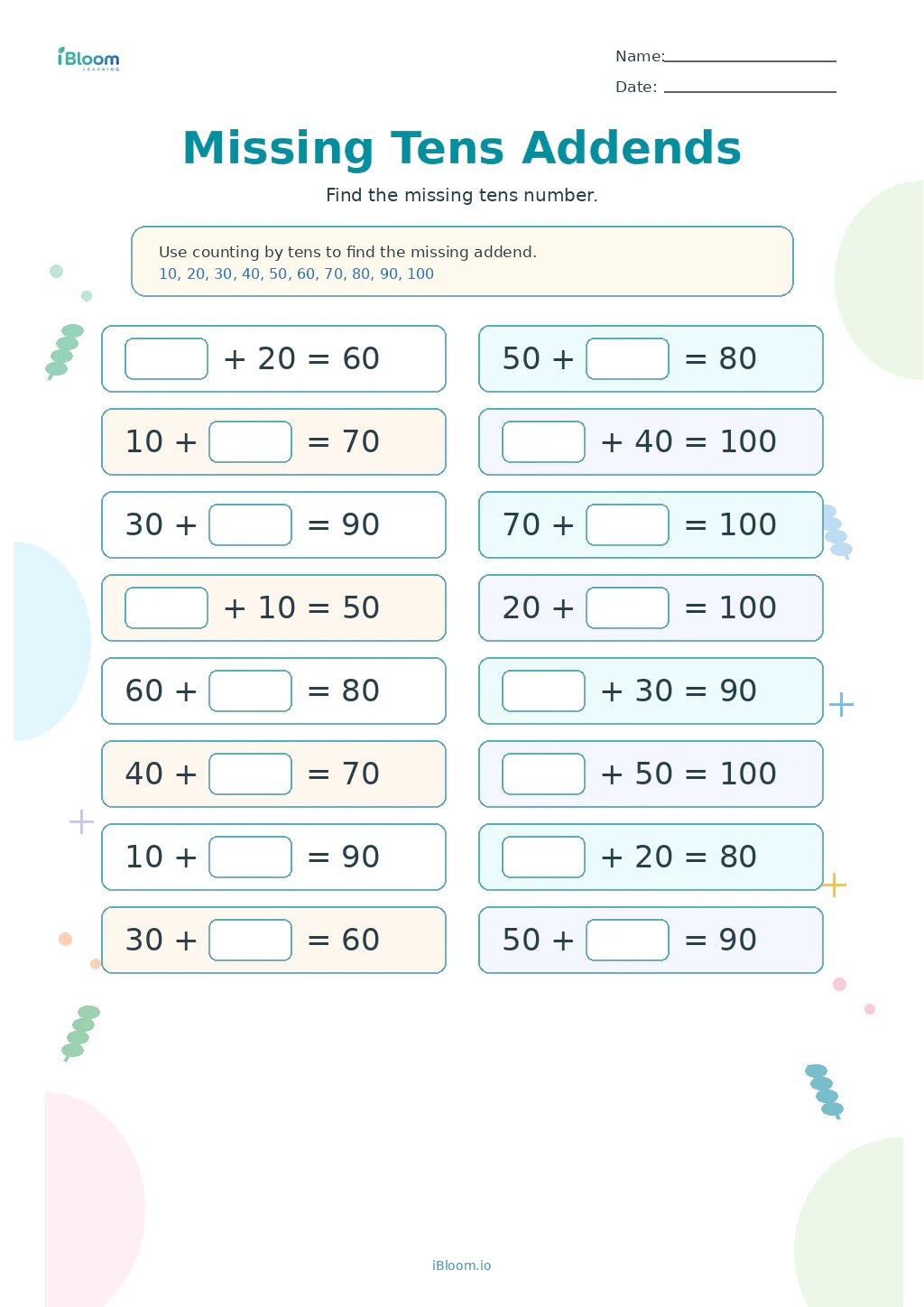
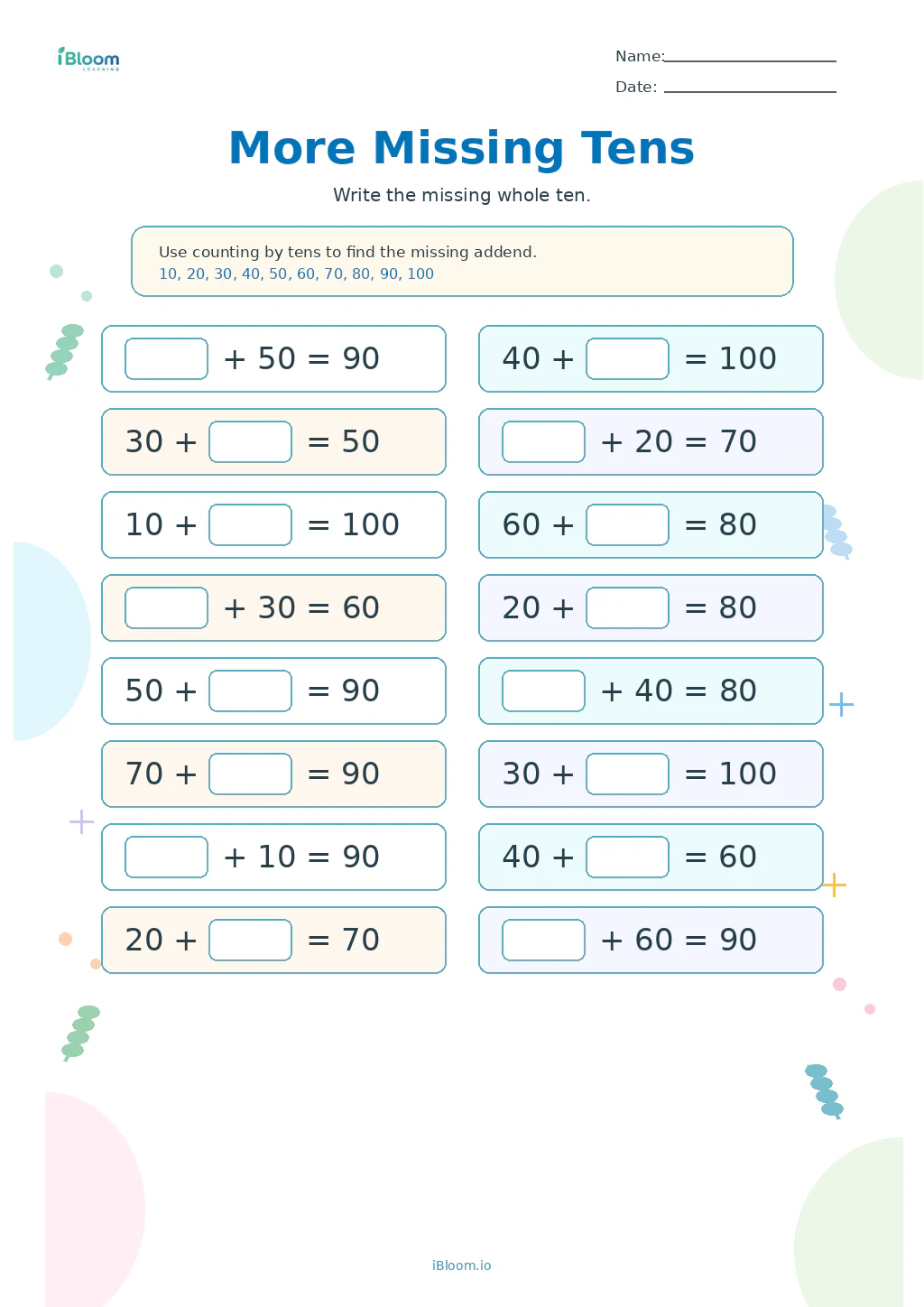
Grade 1 worksheets for finding the missing whole-ten addend in two-digit addition equations using place value and number patterns.
Free printable worksheet PDFs
Preview every available page, then download the free worksheet PDF for home, homeschool, tutoring, or classroom practice.
Preview the exact activity before downloading it.
Practice that builds confidence
What children learn
These Grade 1 addition worksheets help children find the missing addend when a two-digit number is increased by a whole ten. Children practise seeing that the tens digit changes while the ones digit stays the same, as in 24 + 30 = 54 or 68 + ? = 98.
The printable activities include equation practice, place-value thinking, and missing-number problems that encourage children to count by tens, compare two-digit numbers, and choose the correct whole-ten addend with confidence.
In this worksheet collection, children work with two-digit numbers and whole tens such as 10, 20, 30, and 40. The key idea is that a missing addend can be found by looking at how many tens were added. In 36 + ? = 66, the ones digit is still 6, so the missing addend is 30.

Place-value progression
Problems move children away from simply counting every number. They learn to compare the starting number and the sum, then notice the difference in the tens place. Base-ten blocks, ten rods, hundred charts, and open number lines all support the same idea: add tens, keep the ones, and land on a larger two-digit number.
A simple parent routine
At home, choose one problem and ask your child to read it aloud: 42 plus what equals 72? Have them circle the ones digits first to check that they match. Then ask, How many tens did we jump? Your child can count 52, 62, 72 or say 4 tens to 7 tens is 3 tens, so the answer is 30. Finish by having them put the missing addend back into the equation and reread the complete number sentence.

Classroom uses
Teachers can use these pages for small-group place-value review, morning work, math centers, or quick checks after a lesson on adding tens. The same worksheet can support discussion: students can explain whether they counted on by tens, used a hundred chart, or compared tens digits. Partner work also works well because one child can solve and the other can verify that the ones digit did not change.

Common errors to watch for
Some children write the change in the tens digit as a single digit, such as 3 instead of 30. Others add ones by accident or choose an addend that changes the ones digit. Encourage them to name the answer as a whole ten: 3 tens means 30. If the ones digits are not the same, they should pause and recheck the equation.
Free printable PDF download
Use this grade 1 adding whole tens missing addend worksheet page to preview the activity, print it, or download it as a PDF for quick practice. It works well for homework, homeschool lessons, tutoring, morning work, revision, and classroom centers.
Answers and answer key support
After the child completes the worksheet independently, parents and teachers can use the answer support or answer key information to check the work, review mistakes, and choose the next practice step.
Why iBloom worksheets help
The practice is focused on one clear Grade 1 skill, so children can build accuracy before mixed addition pages. A child-friendly strategy is: check the ones, count the tens, write the whole ten. This keeps missing-addend problems manageable and helps children connect equations to place value.
Helpful answers
Frequently asked questions
What skill do these worksheets focus on?
They focus on finding the missing whole-ten addend in a two-digit addition equation, such as 45 + ? = 75 or ? + 20 = 63.
How should my child solve a problem like 28 + ? = 58?
Have your child compare the two numbers. The ones digit stays 8, and the tens move from 2 tens to 5 tens. That is 3 tens, so the missing addend is 30.
Why does the ones digit usually stay the same in these problems?
Because the added number is a whole ten, such as 10, 20, or 30. Whole tens add to the tens place and do not add extra ones.
What tools can help if my child is stuck?
A hundred chart, open number line, or base-ten rods can help. Children can jump by tens from the starting number until they reach the total, then count how many tens they jumped.
What mistake is most common with missing whole-ten addends?
A common mistake is writing 3 instead of 30. Remind children that if they added 3 tens, the missing addend is the whole number 30.
Is this grade 1 adding whole tens missing addend worksheet free?
Yes. You can preview it for free and use the printable worksheet for home or classroom practice.
Can I download this grade 1 adding whole tens missing addend worksheet as a PDF?
Yes. Use the worksheet download option to save a printable PDF, or print the worksheet directly from the page.
Does this grade 1 adding whole tens missing addend worksheet include answers or an answer key?
When the activity has fixed answers, iBloom includes answer support so parents and teachers can check the completed worksheet.