
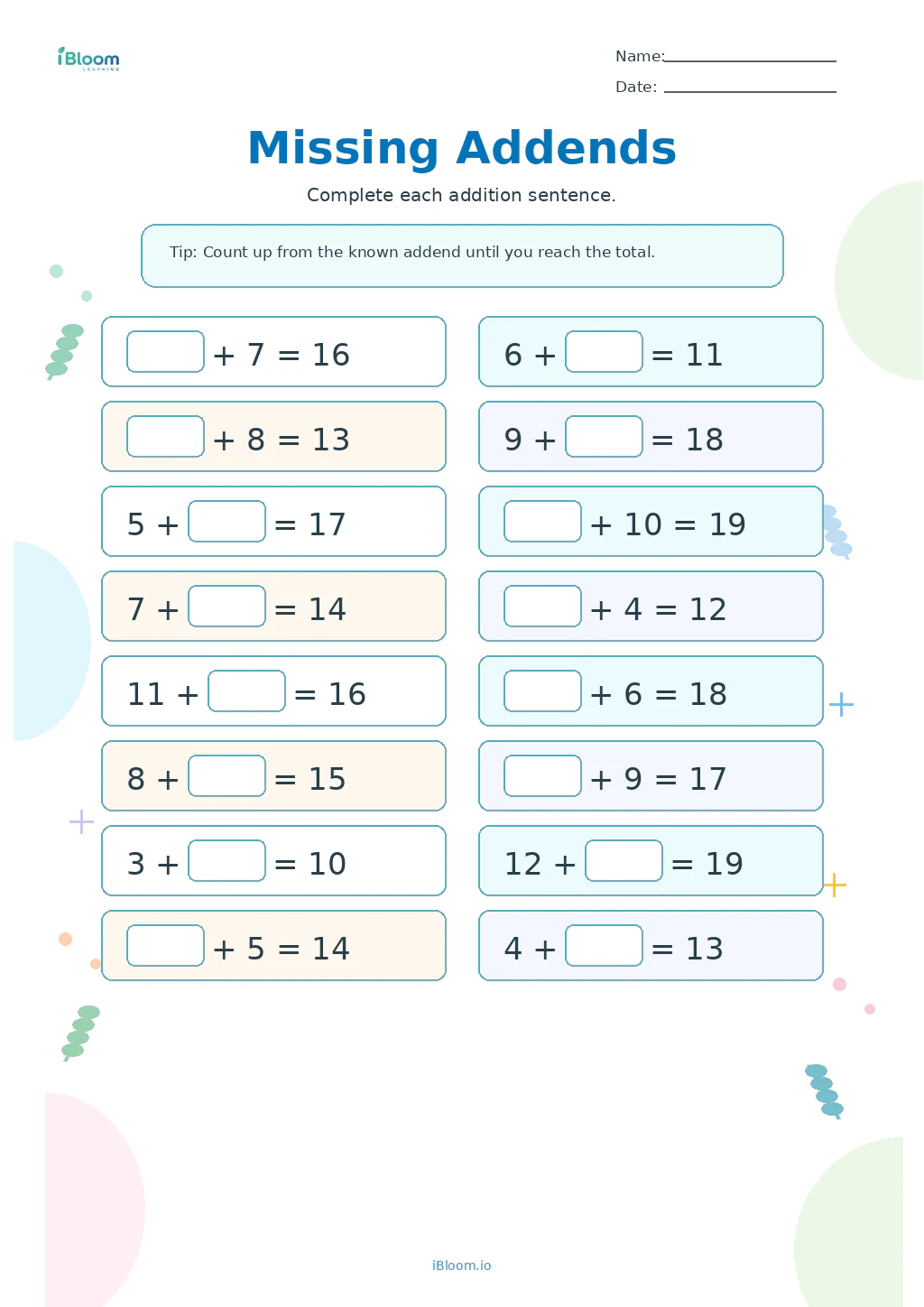
About this worksheet
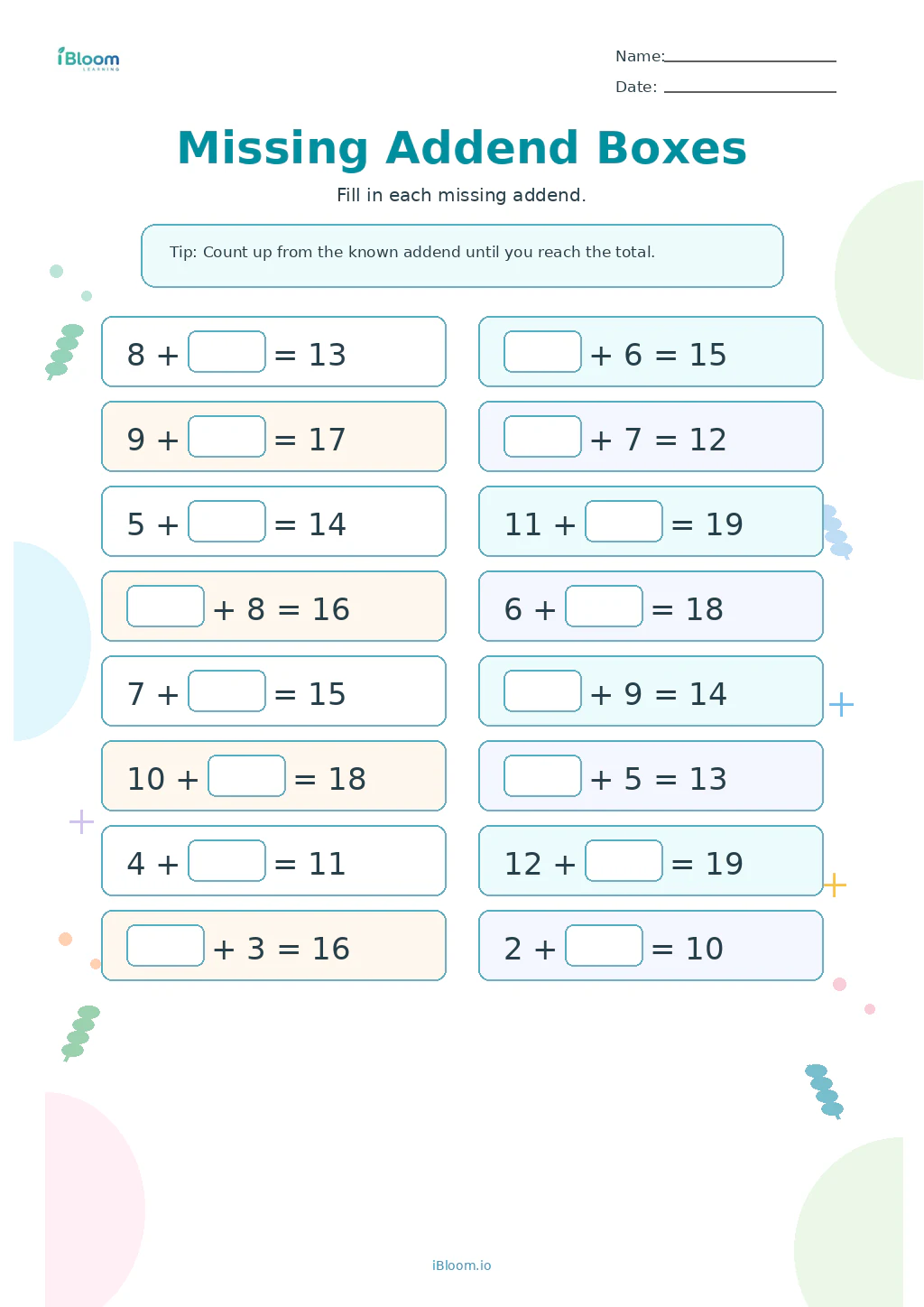
This free Grade 1 math worksheet practices missing addends in sums of 10 or less. Students use number relationships to solve addition equations with a blank in either addend and answer related subtraction facts. A few number-line models support counting on, as on the earlier sheet. The 18 questions are grouped into two parts, and a separate answer key is included.
Aligned to 1.OA.A.1
How do you find an unknown addend?
Think of the total as the whole and the known addend as one part. Count on from the known part or subtract it from the total to find the missing part. Use the number line models to track the jumps.
For question 1, 1 + ___ = 7. Since 7 − 1 = 6, the missing addend is 6.
- 11 + ___ = 7
- 27 − 1 = 6, so the blank is 6.
How can subtraction check an addition equation?
A sum and its related subtraction fact use the same three numbers. If 4 + 6 = 10, then 10 − 4 = 6 and 10 − 6 = 4.
Part B changes the position of the blank or uses subtraction, so identify the whole and known part before calculating.
How to use this worksheet
- 1Point to the total in each equation.
- 2Find the part that is missing by counting on or subtracting.
- 3Write one number in each blank.
- 4Check addition with a related subtraction fact.
- 5Use the key to review each equation.
Common mistakes and quick fixes
The mistake
Adding the known part to the total.
The fix
Subtract the known addend from the total to find the other part.
The mistake
Treating the blank as the total.
The fix
Look at the equals sign and identify the number that represents the whole.
The mistake
Writing a number that makes a nearby equation true but not this one.
The fix
Put the answer back in the original equation and check both sides.
Common Core alignment
This page practices addition and subtraction equations with an unknown number.
Represent unknown addends with equations and solve within 10.
On this sheet: The equations place the unknown in an addend and keep each sum at 10 or less.
Show the official wordingHide the official wording
Use addition and subtraction within 20 to solve word problems involving situations of adding to, taking from, putting together, taking apart, and comparing, with unknowns in all positions, e.g., by using objects, drawings, and equations with a symbol for the unknown number to represent the problem.
What to practice next
Make more practice
Further reading
Questions parents and teachers ask
What does this missing-addend worksheet practice?
The worksheet has 18 equations with totals of 10 or less. Students find missing addends, use several number-line models to count on, and solve related subtraction facts. The separate key gives the number that makes each equation true for checking.
How should we use the answer key?
Solve one equation, then substitute the answer to check it. For example, in 1 + ___ = 7, the missing addend is 6 because 1 + 6 equals 7. A related fact, 7 − 1 = 6, confirms the same missing part.
Can I print the worksheet for a classroom?
Yes. The printable includes one student worksheet page and a separate answer-key page. The key lists all 18 answers, so a parent or teacher can check completed work or review one equation at a time with the student. Keep the student copy separate while checking completed work.
What comes after missing-addend practice?
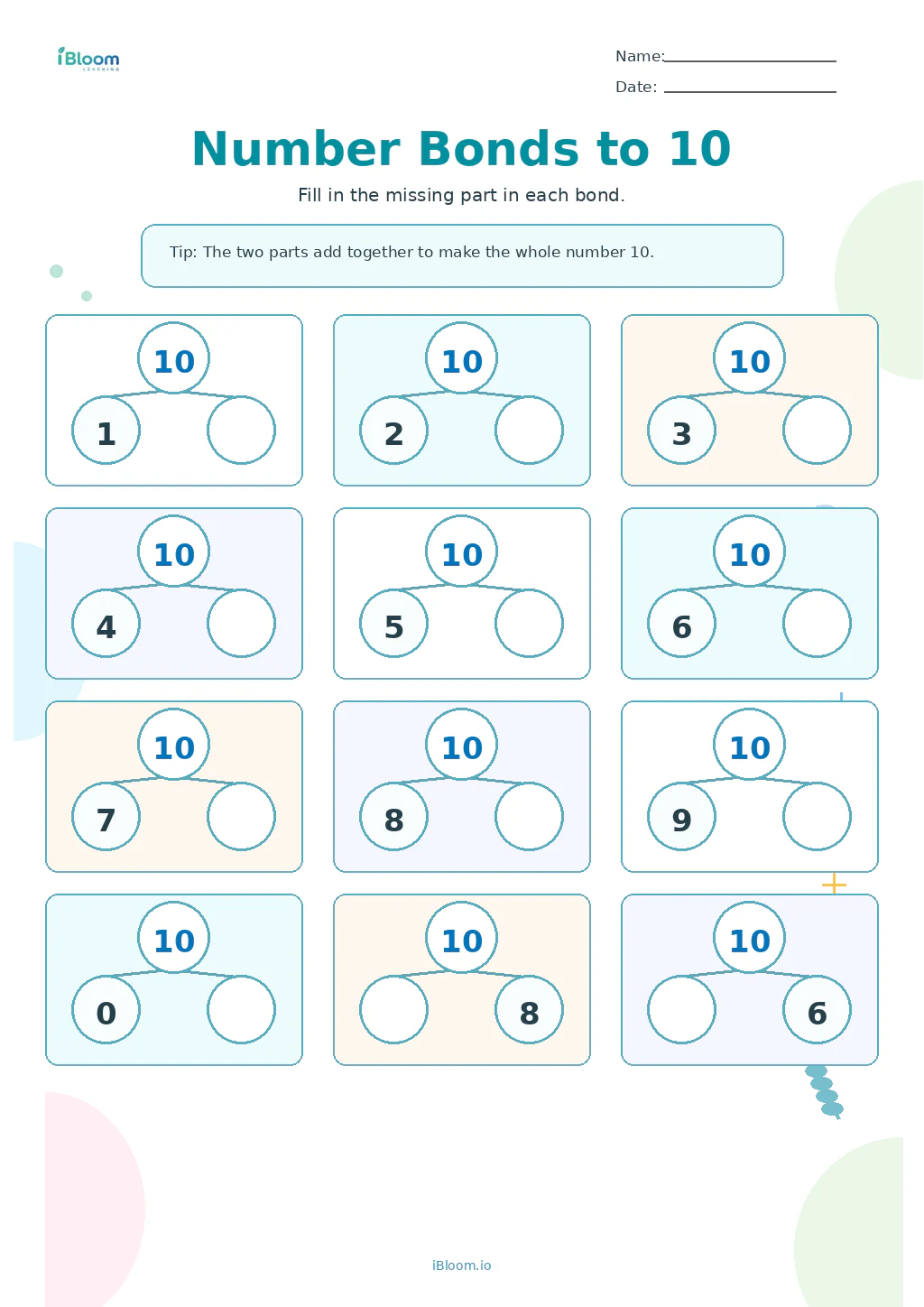
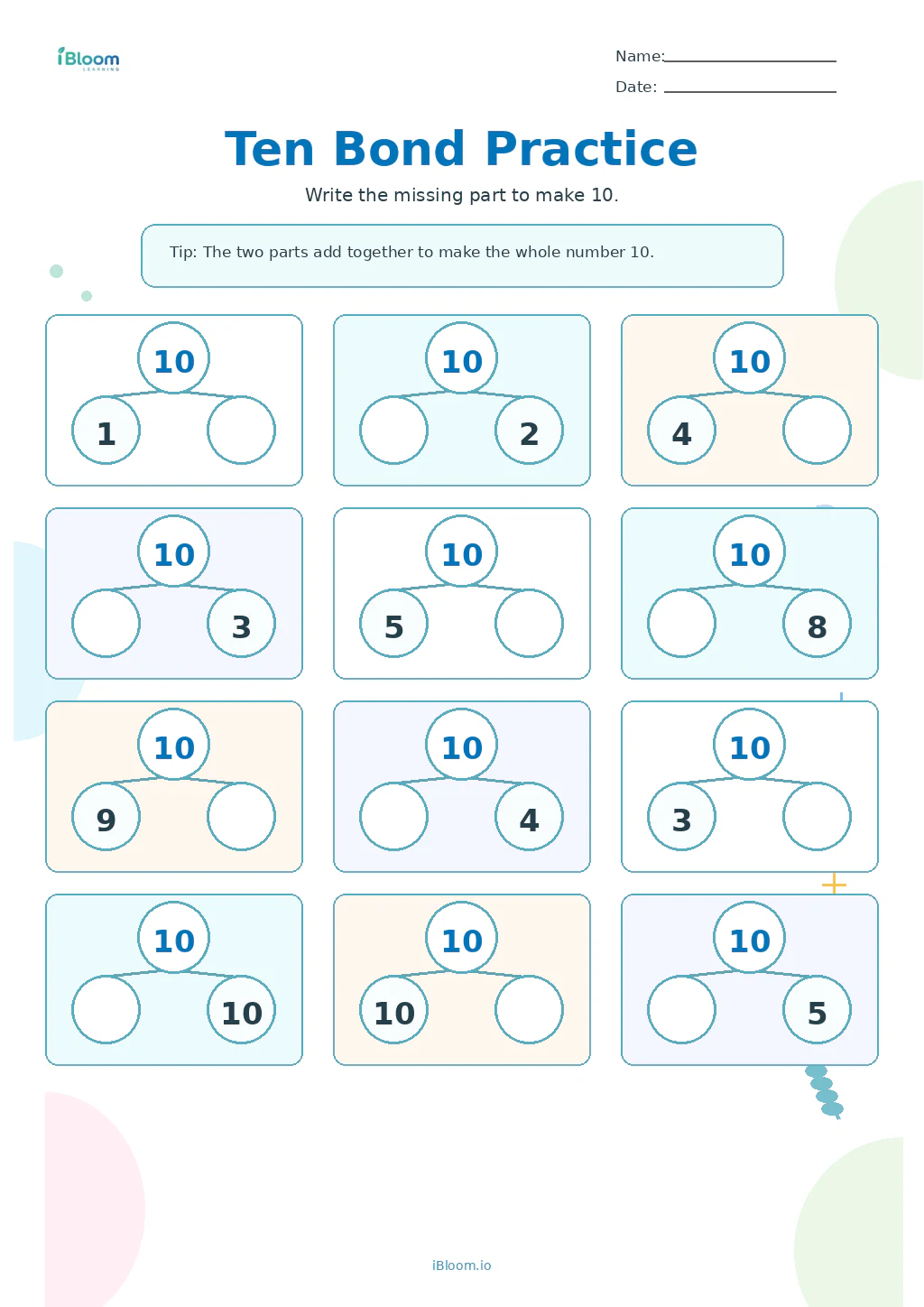
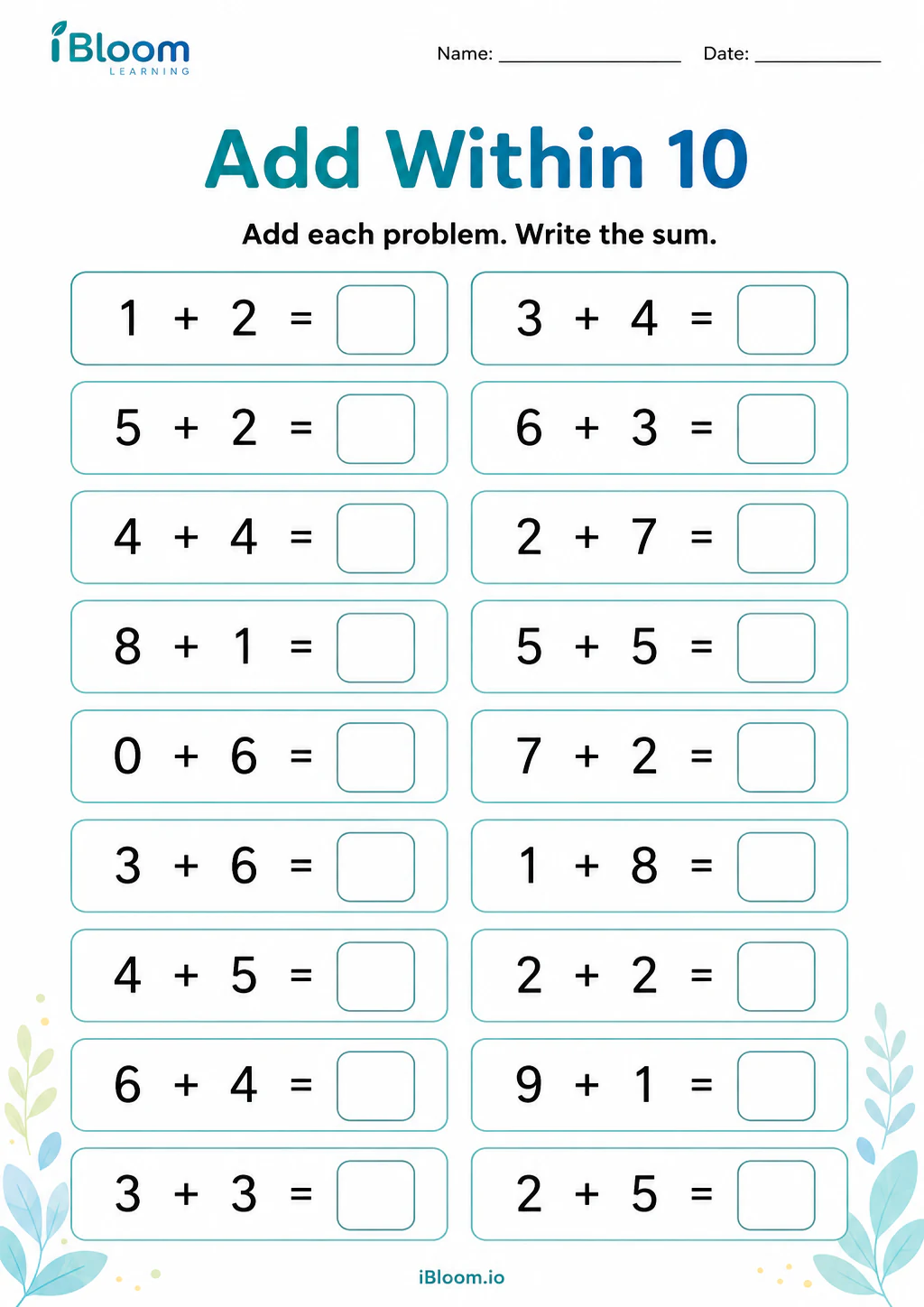
After finding missing parts in sums to 10, students can practice number bonds or addition facts to 10. The links below lead to Grade 1 activities that reinforce how two parts make a whole and extend addition practice. Each link names a next step that stays within early addition practice.
How long will this worksheet take?
Plan for about 15 minutes. A student who uses the number-line models to count on may need a little more time. Work through Part A first, then use the mixed addition and subtraction equations in Part B for a final check.