Free printable practice
Missing Addend Sum Under 10 Practice Activities
Grade 1 worksheets help children find the missing addend in addition equations with totals under 10 using pictures, counting, and number facts.
Free printable worksheet PDFs
Preview every available page, then download the free worksheet PDF for home, homeschool, tutoring, or classroom practice.
Preview the exact activity before downloading it.
Practice that builds confidence
Understanding the missing part
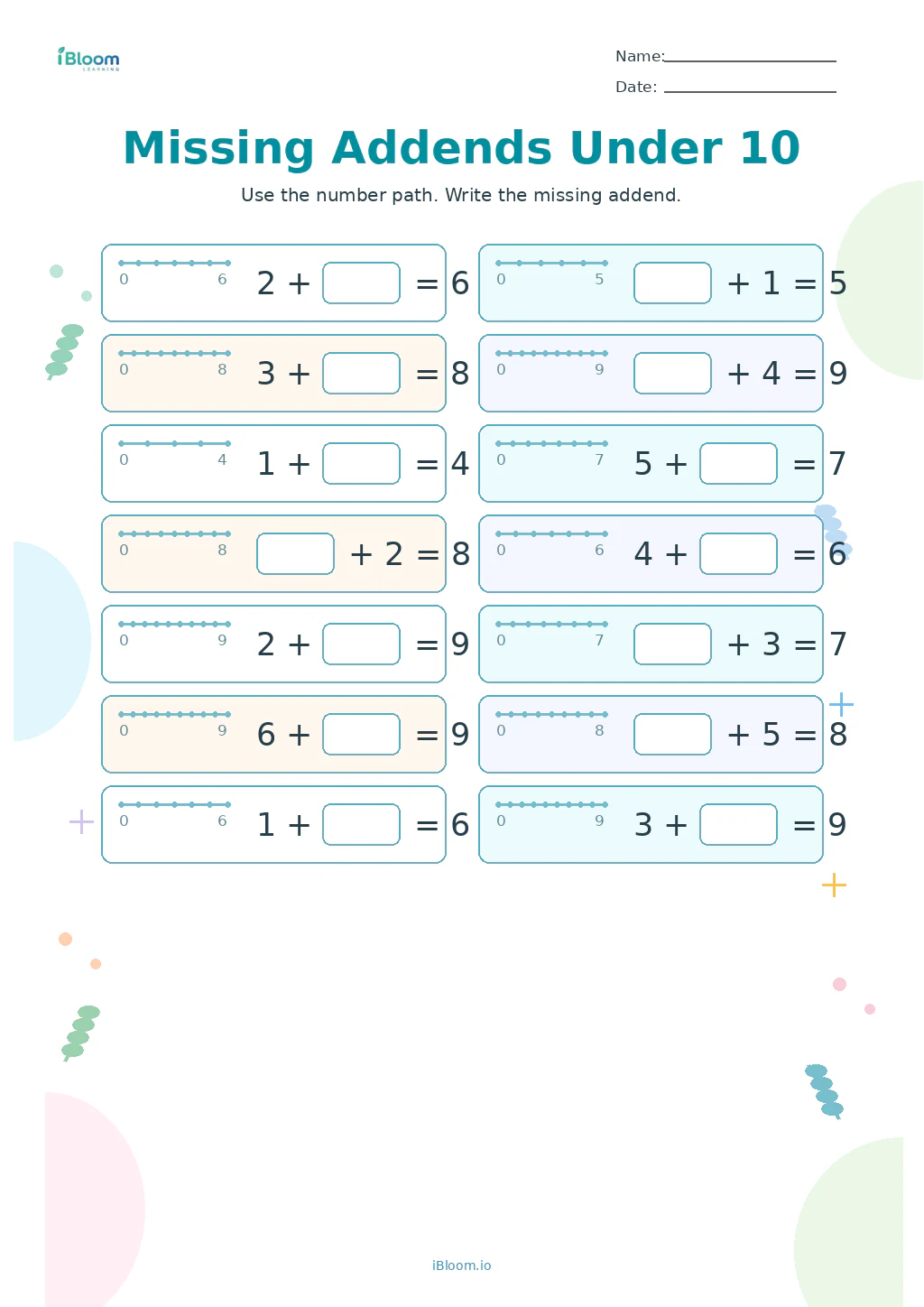
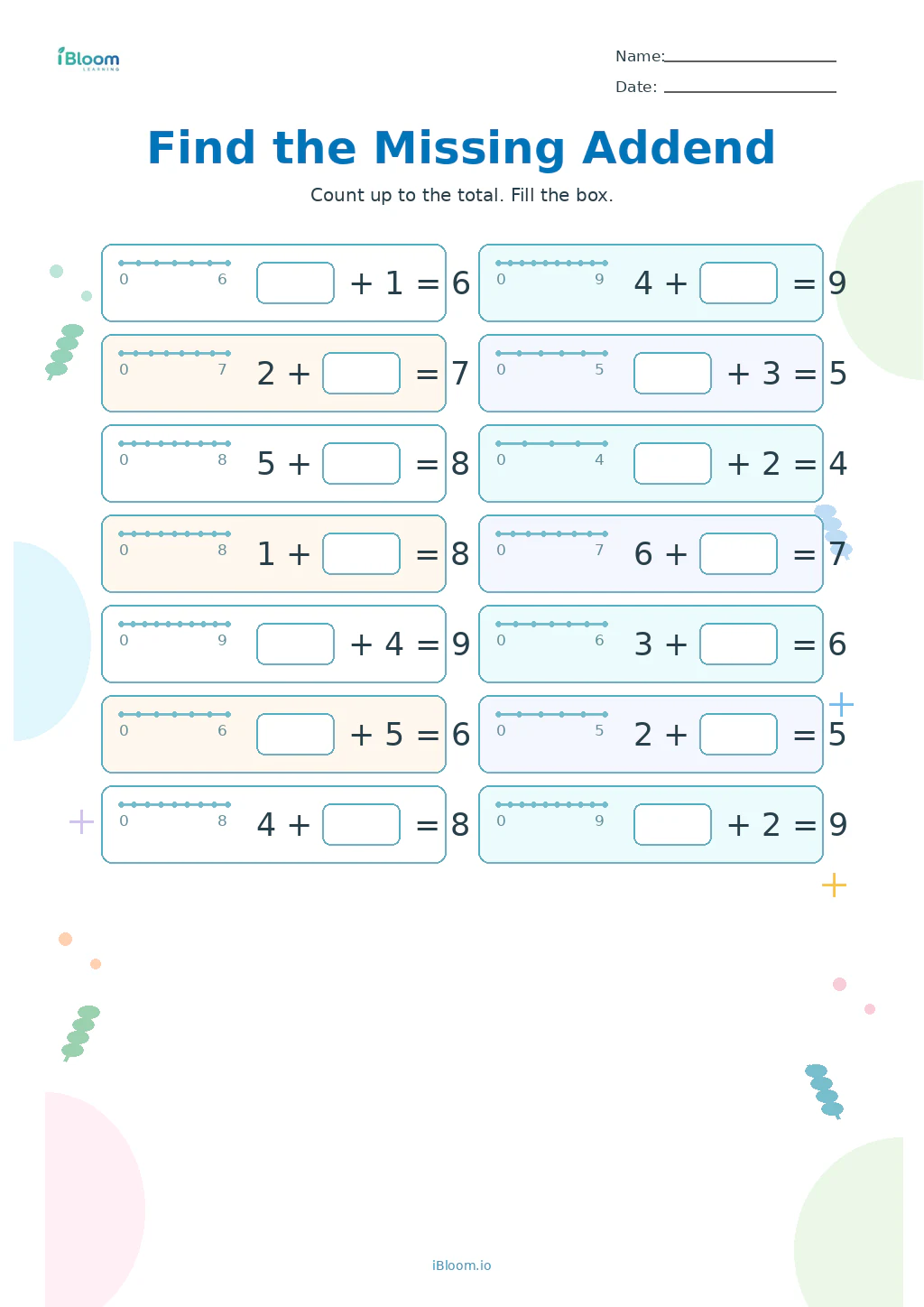
These Grade 1 addition worksheets focus on missing addends with sums under 10, such as 3 + __ = 8 or __ + 2 = 7. Children practise seeing an addition equation as two parts that make one total, not just as a signal to count forward.
The printable activities include simple equations, visual models, and number fact practice that help children connect objects, pictures, and symbols. Each page builds confidence with small numbers so learners can explain what number is missing and why it works.
Missing addend work asks children to find one unknown part when the total is already known. In Grade 1, this is an important bridge between basic addition and early subtraction thinking. For example, in 4 + __ = 9, children know one part is 4 and the whole is 9, so they need the other part. The worksheets keep totals under 10 so children can reason with familiar facts, fingers, counters, drawings, and mental images.

From pictures to equations
The practice can be approached with concrete and visual representations first: draw 6 circles, color 2, and ask how many are not colored; show 5 counters and add more until there are 8; or use a number line to count on from 3 to 7. As children move through the pages, they begin to connect these actions to equations such as 2 + __ = 6, __ + 5 = 8, and 1 + __ = 9. Useful vocabulary includes addend, sum, total, part, whole, missing number, and equation.
A simple parent routine
At home, choose one row of problems and give your child small objects such as buttons, blocks, or cereal pieces. Say, “The total is 8. We already have 3. How many more do we need?” Let your child build the 3, add objects one at a time, and then write the missing number. After a few examples, ask, “Could you solve it without building every counter?” This encourages a gradual move from counting all to counting on.

Classroom uses for teachers
Teachers can use these worksheets for guided math groups, addition centers, morning review, or quick checks after a mini-lesson on part-part-whole relationships. They also work well with ten-frame mats, cubes, and number lines. Students can partner up: one child reads the equation, and the other explains the missing addend strategy before writing the answer.

Common errors to watch for
Some children copy the total into the blank, especially in problems like __ + 2 = 6. Others count the known addend again and answer one too many or one too few. Watch for students who ignore the position of the blank or treat every problem as ordinary addition. Encourage them to circle the total, underline the known part, and ask, “What part is missing?”
Free printable PDF download
Use this missing addend worksheets sums under 10 page to preview the activity, print it, or download it as a PDF for quick practice. It works well for homework, homeschool lessons, tutoring, morning work, revision, and classroom centers.
Answers and answer key support
After the child completes the worksheet independently, parents and teachers can use the answer support or answer key information to check the work, review mistakes, and choose the next practice step.
Why iBloom worksheets help
The pages are designed around small, manageable sums so children can focus on the meaning of the unknown addend. A child-friendly strategy is: “Start with the number you know, count up to the total, and count how many steps you took.” For 5 + __ = 9, say 6, 7, 8, 9 while raising four fingers; the missing addend is 4.
Helpful answers
Frequently asked questions
What is a missing addend in Grade 1 addition?
A missing addend is the unknown part in an addition equation. In 3 + __ = 8, the total is 8, one addend is 3, and the missing addend is 5.
Why do these worksheets keep the sums under 10?
Totals under 10 let first graders use familiar number facts, fingers, counters, and simple drawings while they learn the idea of finding an unknown part.
How can my child solve 4 + __ = 9 without guessing?
Have your child start at 4 and count up to 9: 5, 6, 7, 8, 9. Since that took five counts, the missing addend is 5.
Should children use counters for every problem?
Counters are helpful at first. As children gain confidence, encourage them to count on, use a number line, or recall related addition facts.
What mistake is common with missing addend equations?
A common mistake is writing the total in the blank or adding the known number and total together. Ask children to identify the total first, then find the part that is missing.
Is this missing addend worksheets sums under 10 free?
Yes. You can preview it for free and use the printable worksheet for home or classroom practice.
Can I download this missing addend worksheets sums under 10 as a PDF?
Yes. Use the worksheet download option to save a printable PDF, or print the worksheet directly from the page.
Does this missing addend worksheets sums under 10 include answers or an answer key?
When the activity has fixed answers, iBloom includes answer support so parents and teachers can check the completed worksheet.