
About this worksheet
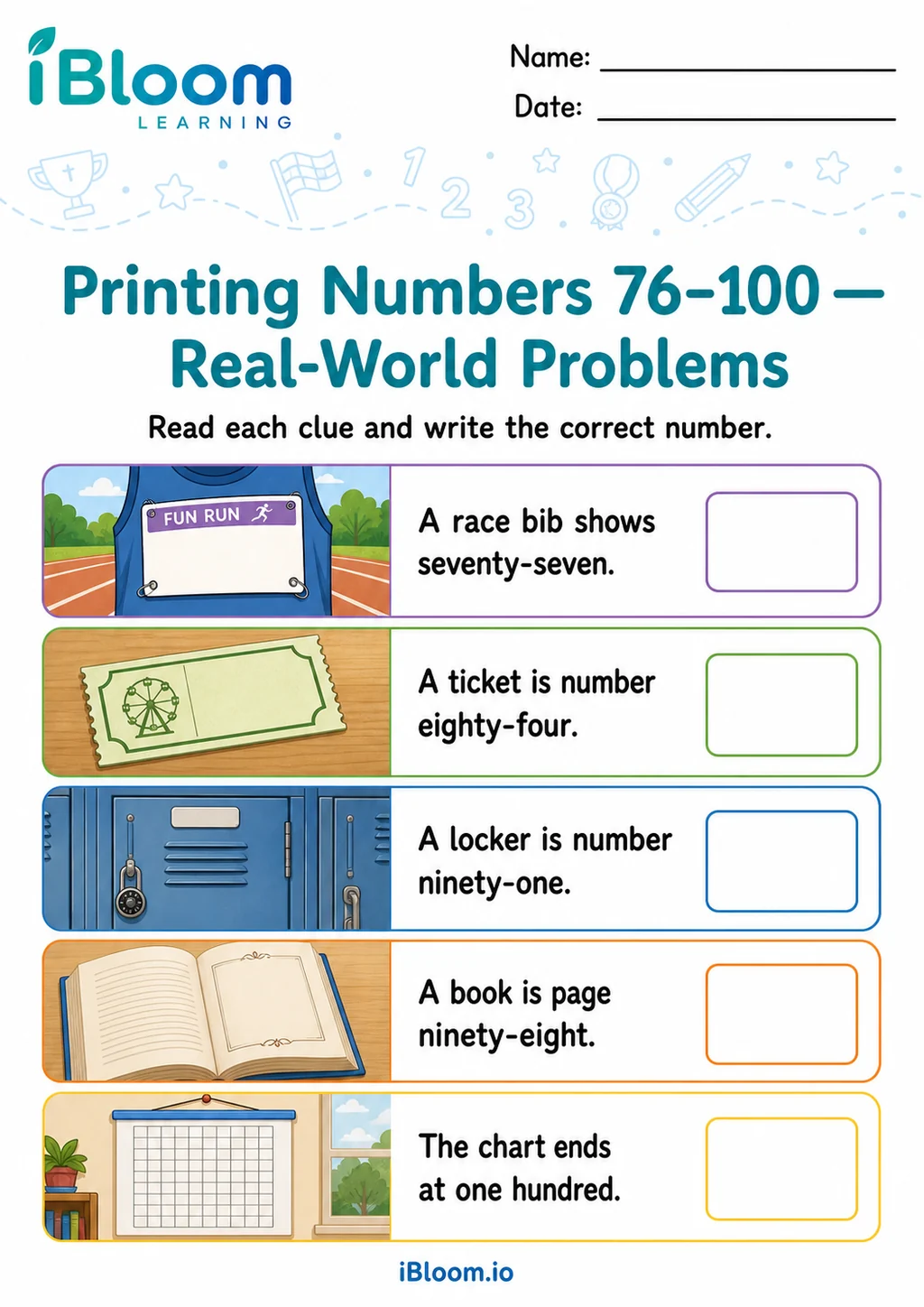
This Grade 1 printable uses base-ten blocks to represent every number from 76 through 100. Children count the tens rods and ones cubes, then write the matching numeral. The last model shows one hundred as a hundred flat, connecting ten tens with the next place value. The practice supports CCSS 1.NBT.B.2, and a separate answer key lists all 25 numbers.
Aligned to 1.NBT.B.2
How do base-ten blocks show a number?
A tens rod is worth ten ones cubes. Count the tens rods first, then count any separate ones cubes. For example, 7 tens rods and 6 ones cubes show 76.
What happens when the ones reach ten?
As children move through the models, the ones count returns to zero when a new ten begins. At the end of the range, ten tens make one hundred.
- 19 tens and 9 ones show 99.
- 2Ten tens and no extra ones show 100.
How to count the blocks
- 1Count the hundreds flats, if there are any.
- 2Count the tens rods.
- 3Count the separate ones cubes.
- 4Say the value of each place and combine them.
- 5Write the numeral and check that it fits the model.
Common mistakes and quick fixes
The mistake
Counting each small mark on a tens rod as a separate block.
The fix
Count each full rod as one group of ten.
The mistake
Writing the ones digit before the tens digit.
The fix
Write the tens count first, then the extra ones.
The mistake
Treating ten tens as the number 10.
The fix
Ten groups of ten make one hundred.
Common Core alignment
Children connect two-digit numbers with groups of tens and ones.
Read each two-digit number as a count of tens and ones.
On this sheet: The models represent every number from 76 through 100, including ten tens.
Show the official wordingHide the official wording
Understand that the two digits of a two-digit number represent amounts of tens and ones.
What to practice next
Make more practice
Further reading
Questions parents and teachers ask
Which numbers does the sheet cover?
The worksheet covers every whole number from 76 through 100. Each number appears as a base-ten block model, and the child writes the numeral that matches the hundreds, tens, and ones shown. The sequence begins with 76 and ends with 100.
How many questions are included?
There are 25 questions, one for each number from 76 to 100. Children count the blocks in every model and write the numeral, so no number in the promised range is skipped. That is one prompt for each number in the range.
How should children count base-ten blocks?
Count any hundreds flats first, then count tens rods and extra ones cubes. Each rod stands for ten ones. Seven rods and six cubes show 76 because 70 plus 6 equals 76. Count each rod as one group of ten.
Why is 100 shown as a hundred flat?
A hundred flat represents ten tens or one hundred ones. It shows how the number changes place value after 99 and makes the final model different from the earlier two-digit numbers. The hundred flat groups those ten tens together.
Is an answer key included?
Yes. The separate answer key lists the numeral represented by every model, from 76 to 100. An adult can ask the child to name the tens and ones before checking the written answer. It follows the models in their printed order.