






About this worksheet
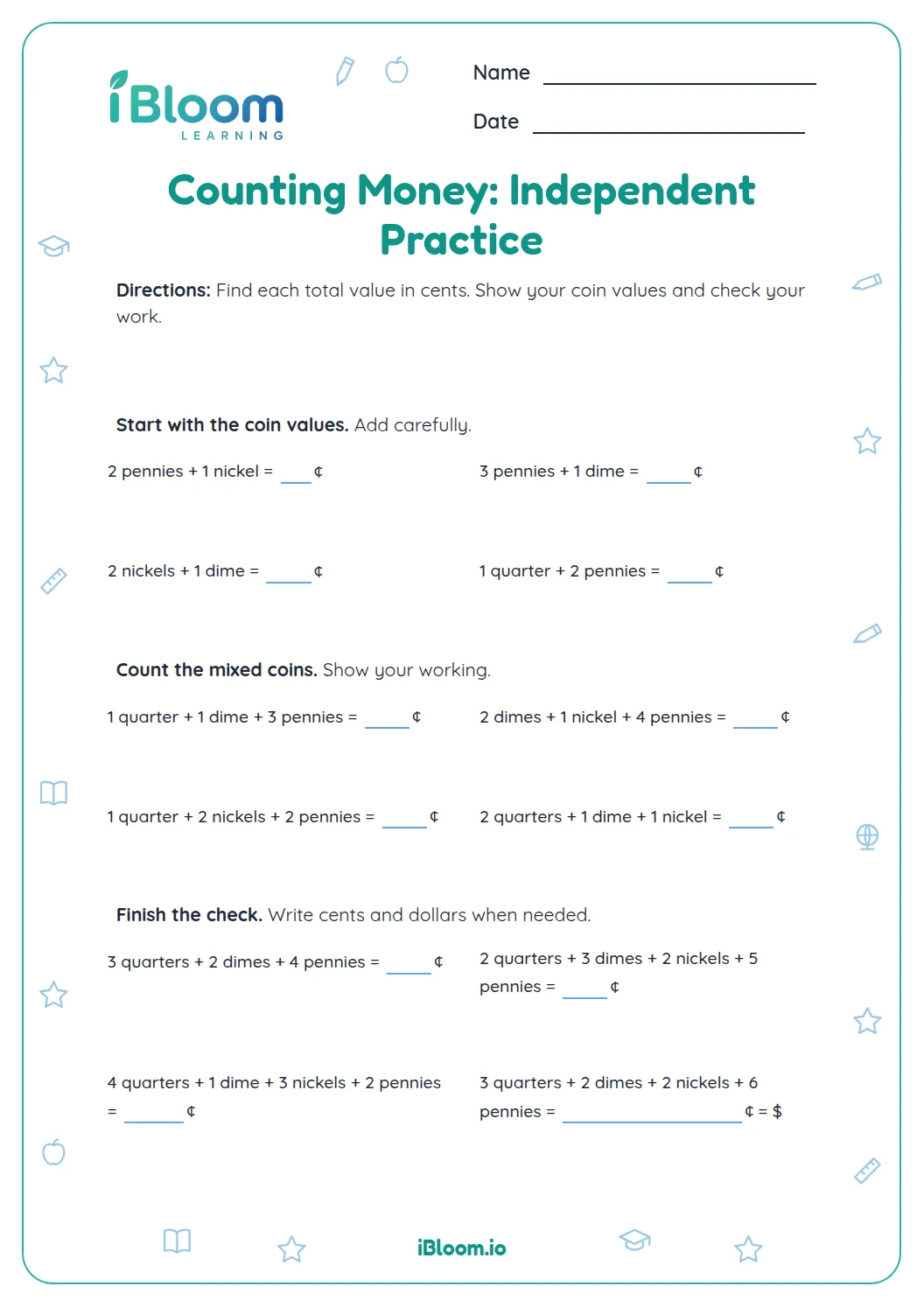
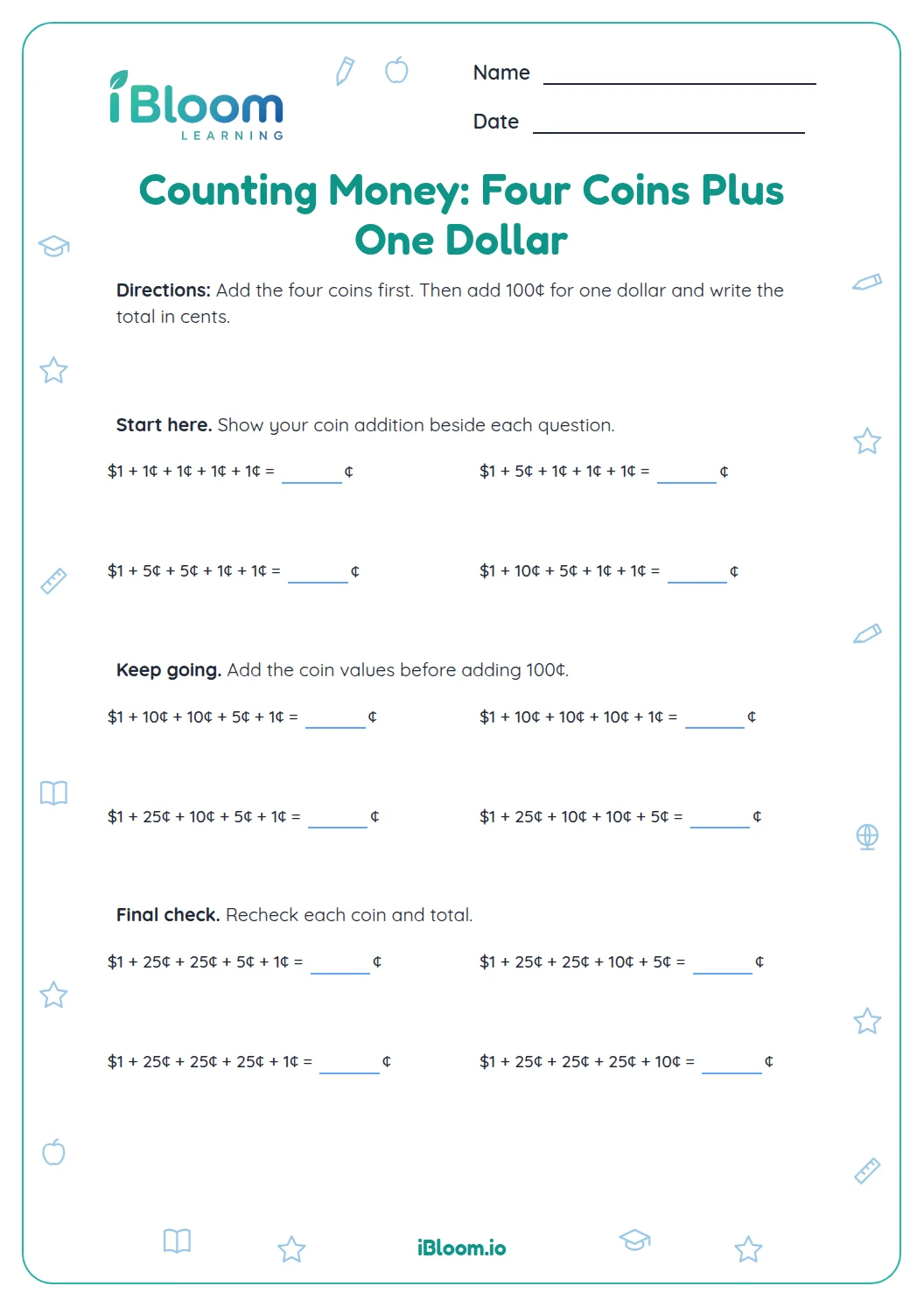
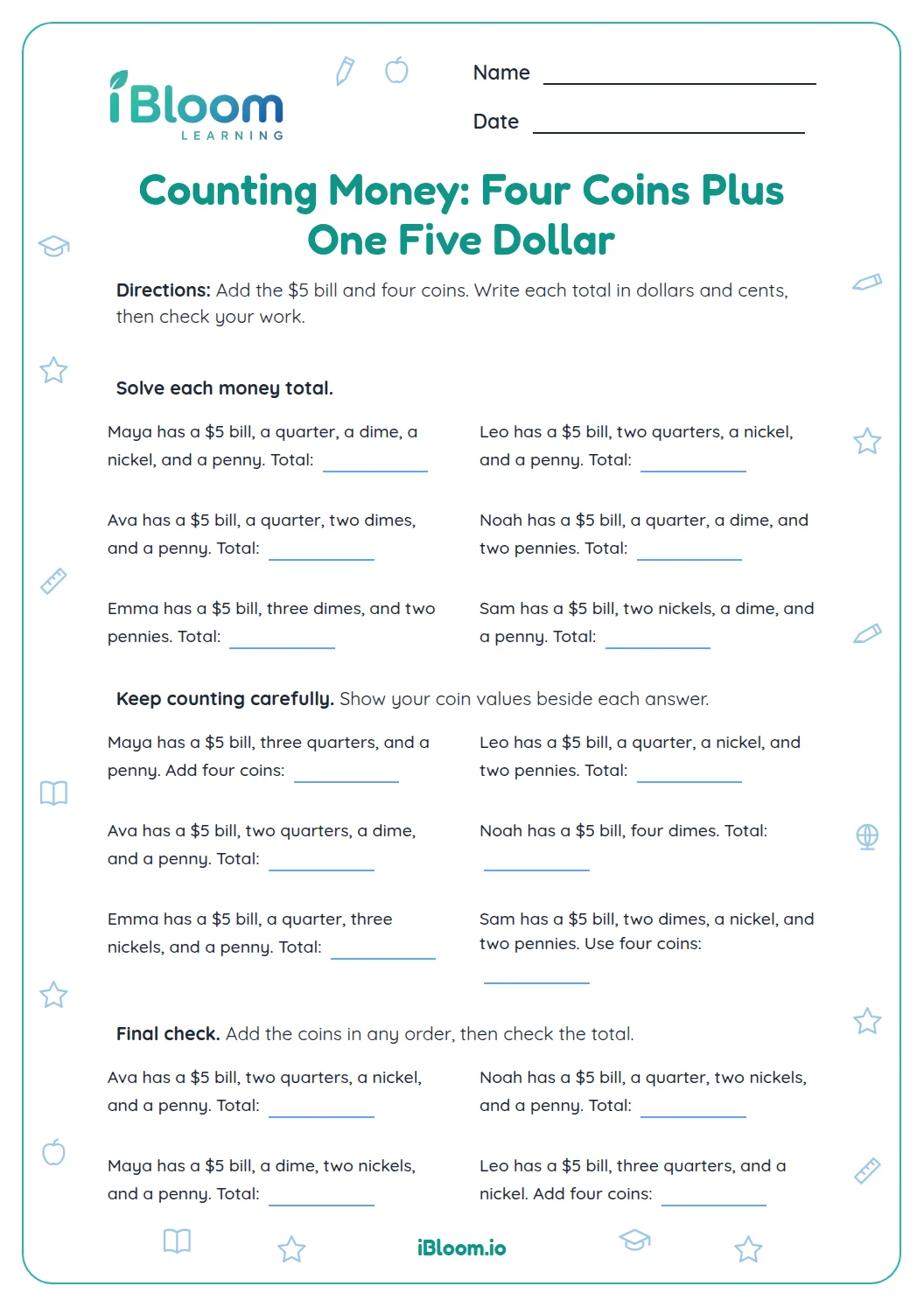
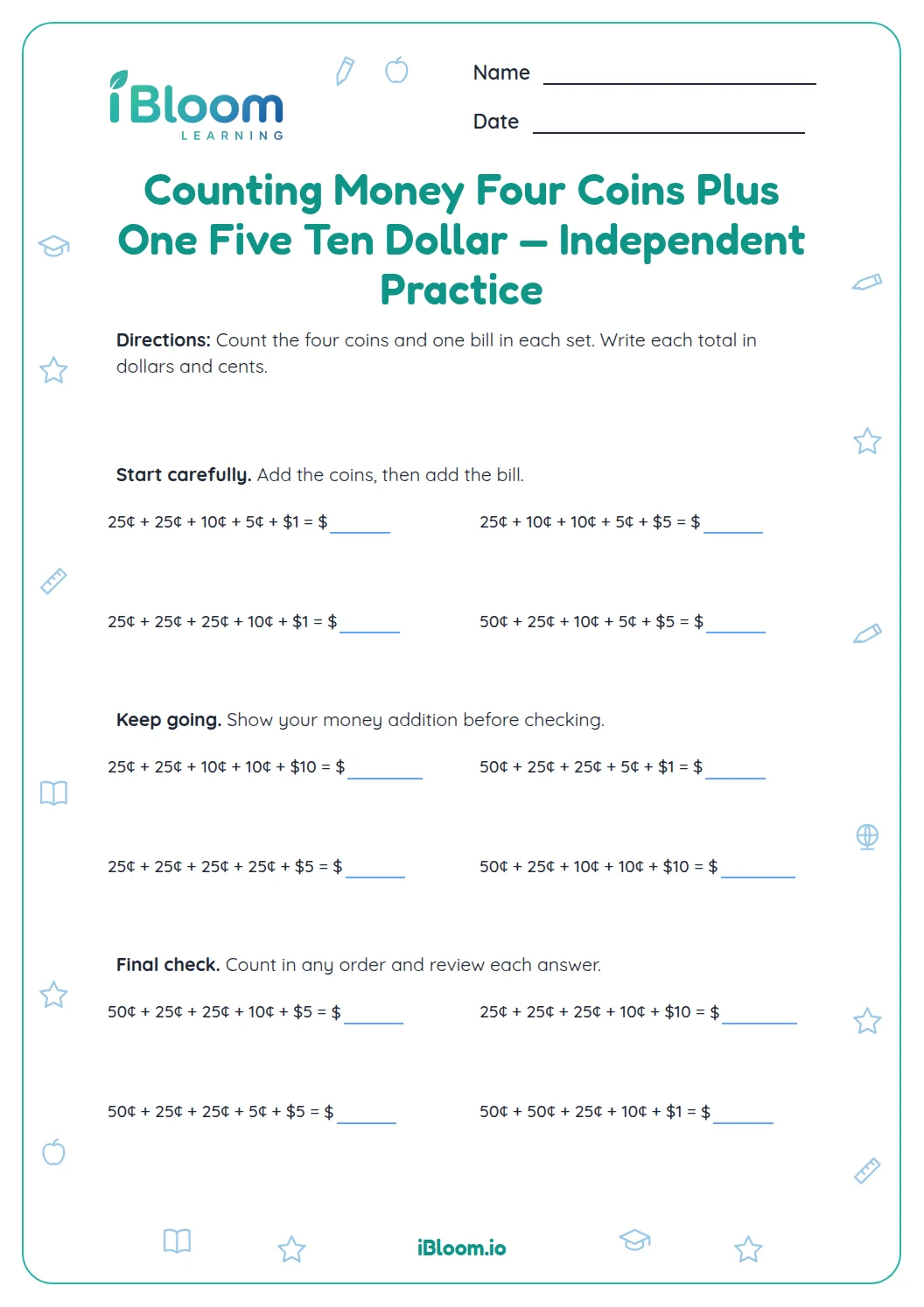
This Grade 3 worksheet asks students to reason about coin values instead of only adding a list. Across 15 questions in three parts, they check totals, identify a mistake, compare efficient ways to count, and find coins that complete a target amount. The two repaired examples are explicit: Maya’s coins total 63¢, and Ava’s coins total 67¢. A separate answer key is included.
Aligned to 2.MD.C.8
How can students verify a claimed total?
Write the value of every coin before combining the cents. In question 1, Maya has two quarters, one dime, and three pennies: 25 + 25 + 10 + 3 = 63 cents. Her claim is correct because every coin is included.
- 125¢ + 25¢ + 10¢ + 3¢ = 63¢
- 2The stated total matches the coin values.
What is Ava’s correct total?
Ava’s quarter is 25 cents, four dimes are 40 cents, and two pennies are 2 cents. The total is 67 cents. Since the coin values add to 67 cents, students choose that total instead of 66 cents.
What kinds of reasoning questions are included?
Students check whether a claim is true, find a set of coins that completes a target total, and choose an efficient counting method. There are 15 multiple-choice questions in three parts, with each set of choices listed once.
How to use this worksheet
- 1Name each coin value in the prompt.
- 2Add every coin before judging a stated total.
- 3For a claim, compare the computed value with the claim.
- 4For a target total, subtract the known coin value and find the remainder.
- 5Use the answer key to review each choice.
Common mistakes and quick fixes
The mistake
Adding unlike place values or pieces without naming their unit.
The fix
Say the unit or denominator aloud as you combine the values.
The mistake
Stopping when the fractional parts make one or more wholes.
The fix
Trade each complete set of parts for a whole and include it in the total.
The mistake
Copying an answer before checking every addend.
The fix
Read each addend again and check the total with the model or a second calculation.
Common Core alignment
This worksheet builds reasoning with coin values and money totals.
Solve money problems using the values of dollars and coins.
On this sheet: Students reason about coin values and determine whether money totals are correct.
Show the official wordingHide the official wording
Solve word problems involving dollar bills, quarters, dimes, nickels, and pennies, using $ and ¢ symbols appropriately.
What to practice next
Make more practice
Further reading
Questions parents and teachers ask
Is Maya’s 63-cent claim correct?
Yes. Two quarters are 50 cents, one dime is 10 cents, and three pennies are 3 cents. Together they make 63 cents. Question 1 asks students to check this total by including every coin value, so the keyed response confirms Maya’s claim.
What is Ava’s total?
Ava has one quarter, four dimes, and two pennies. Add 25 + 40 + 2 to get 67 cents. Her 66-cent claim is incorrect; the worksheet asks students to choose the actual total rather than guess at a mistake that does not explain 66.
What does the worksheet mean by an efficient strategy?
An efficient strategy counts larger coin values first, then adds the smaller values. For example, students can count quarters by 25s, add dimes by 10s, and finish with nickels or pennies. The comparison questions ask which stated method organizes those values clearly.
Does the worksheet include an answer key?
Yes. The separate answer key lists the correct choice for each of the 15 questions. Students can use it after completing a part and explain which coin values support a corrected total. Review the choices together and ask the student to point to the values that prove the total.
How can I help if a student misses a coin?
Ask the student to point to each coin named in the problem and say its value aloud. Then add the values in order and compare the result with the claim. This makes it easier to notice whether a dime, nickel, or penny was skipped or assigned the wrong value.